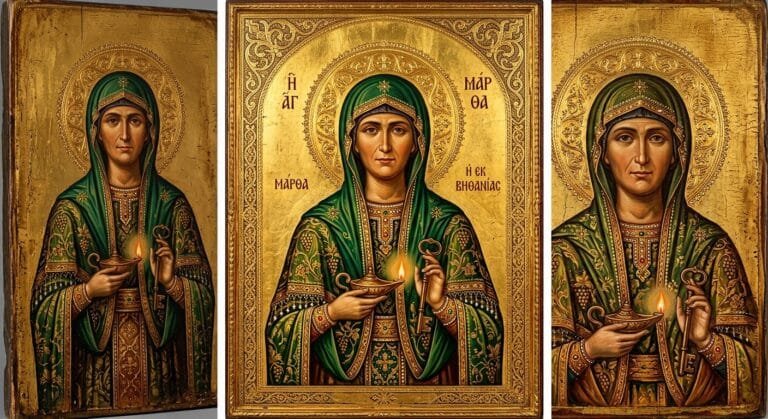
The Novena to Saint Martha for Nine Tuesdays is one of the most celebrated, profound, and universally embraced devotional practices in Christian spirituality. For centuries, millions of the faithful around the globe have turned to this continuous nine-week prayer in times of severe spiritual affliction, insurmountable life crises, family discord, grave illnesses, and urgent necessities requiring the restoration of peace and divine justice. Saint Martha of Bethany—sister of Saint Lazarus of the Four Days and Saint Mary—holds an extraordinary place in sacred New Testament history as one of the closest companions of our Lord Jesus Christ, under whose roof in Bethany the Savior found rest, hospitality, and profound friendship.
However, in contemporary popular culture, this grace-filled devotion is frequently surrounded by folk distortions, superstitious misconceptions, and magical syncretism. The objective of this comprehensive academic and pastoral guide is to provide an exhaustive biblical, exegetical, and patristic analysis of Saint Martha, illuminate the authentic Christian foundation of the nine-Tuesday rule, purify the devotion from superstition, and present the complete canonical texts of the prayers, litanies, and liturgical hymns, uniting Eastern and Western spiritual heritage into a vibrant wellspring of living faith.
1. Biblical and Theological Portrait of Saint Martha of Bethany
Sacred Scripture does not present Saint Martha as an abstract figure of medieval legend, but as an active, spiritually courageous, and intellectually profound confessor of faith. The family of Bethany—Martha, Mary, and Lazarus—enjoyed an exceptional intimacy with Jesus Christ. The Evangelist John explicitly records: «Now Jesus loved Martha and her sister and Lazarus» (John 11:5). This direct scriptural testimony of the incarnate Son of God’s personal friendship provides the theological key to understanding the profound boldness (parrhesia) with which Saint Martha intercedes before the throne of the Almighty.
1.1. Exegesis of Luke 10:38–42: The True Meaning of the Rebuke
The most famous encounter with Martha is documented in the Gospel of Luke (10:38–42), when Jesus entered their village. Martha opened her home and took upon herself the demanding labor of welcoming the divine Master and His disciples—preparing the meal, attending to their physical comfort, and managing the household. Meanwhile, her sister Mary sat at the Lord’s feet, listening to His teaching. Exhausted, Martha approached the Lord and said: «Lord, do You not care that my sister has left me to serve alone? Tell her to help me» (Luke 10:40). To this, the Savior responded with tender gentleness:
«Martha, Martha, you are anxious and troubled about many things, but one thing is necessary. Mary has chosen the good portion, which will not be taken away from her» (Luke 10:41–42).
In the original Greek New Testament, the text employs two profound verbs: μεριμνᾷς (merimnas—from merimna, literally signifying an inner tearing of the mind apart, anxiety, fragmentation of focus) and θορυβάζῃ (thorybaze—to be troubled, tossed in tumult, creating inward clamor). Christ did not condemn Martha’s service! Without her generous labor, the disciples would have lacked shelter and food. The double vocative («Martha, Martha!») is a classic biblical marker of intimate affection and divine solicitude (reminiscent of «Abraham, Abraham!» or «Saul, Saul!»). Christ was correcting not her hospitality, but her internal agitation and distracted resentment. When holy labor becomes a source of inner turmoil and bitterness toward one’s neighbor, one loses the «one necessary thing»—the peaceful contemplation of Christ’s presence.
1.2. Exegesis of John 11:1–44: The Zenith of Christological Confession
While Luke portrays Martha as the bustling hostess, the Gospel of John (chapter 11) reveals her as one of the most towering theological minds and confessors of faith in all of Sacred Scripture. When her brother Lazarus died and had already been four days in the tomb, it was Martha who, upon hearing that Jesus was approaching, went out immediately to meet Him on the road, while Mary remained weeping in the house.
Martha’s dialogue with Jesus at the threshold of Bethany represents a theological summit of the New Testament. She declared: «Lord, if You had been here, my brother would not have died. But even now I know that whatever You ask from God, God will give You» (John 11:21–22). When Jesus announced: «I am the resurrection and the life. Whoever believes in Me, though he die, yet shall he live… Do you believe this?», Martha uttered a confession of faith that rivals Saint Peter’s in Matthew 16:
«Yes, Lord; I have believed that You are the Christ, the Son of God, who is coming into the world» (John 11:27; Greek: Ναί, Κύριε, ἐγὼ πεπίστευκα ὅτι σὺ εἶ ὁ Χριστὸς ὁ Υἱὸς τοῦ Θεοῦ).
The Greek verb πεπίстеυκα (perfect tense) indicates a permanent, steadfast conviction formed long before this crisis. While Peter proclaimed Christ’s divinity in a moment of triumph at Caesarea Philippi, Martha made her monumental confession in the face of tragedy, death, bodily corruption, and the grave. Her unwavering faith became the theological doorway through which Christ called Lazarus forth from the tomb.
1.3. Eucharistic Diakonia at Bethany (John 12:1–3)
In John 12, six days before the Passover, a banquet was held in Bethany in honor of the risen Lazarus. The Gospel simply states: «And Martha served» (Greek: ἡ Μάρθα διηκόνει—she exercised diakonia). Here, there is no longer any complaint, anxiety, or comparison with her sister. Martha had achieved perfect spiritual maturation: her domestic labor had been transformed into a serene, eucharistic service of love directed toward God Himself.
2. Patristic Heritage: Harmony of Action and Contemplation (Vita Activa et Vita Contemplativa)
The Church Fathers consistently interpreted Martha and Mary not as competing archetypes, but as complementary dimensions of the Christian soul: active charity and mystical contemplation.
2.1. Saint Augustine of Hippo (Sermons 103 & 104)
In his celebrated discourses Sermo 103 and Sermo 104, Saint Augustine presents a profound defense of Saint Martha:
«Martha and Mary were two sisters, closely knit not only by blood but by religious devotion. Both ministered harmoniously to the Lord while He walked in the flesh. Martha received Him into her house as a pilgrim, yet she was receiving her Creator in the flesh of His creation… Martha was concerned how she might feed the Lord; Mary was intent upon being fed by the Lord. Was Martha’s service blameworthy? If she had not prepared food, would there have been anyone to listen to the discourse? Both portions are holy, yet Martha’s labor belongs to the present life where hunger and misery dwell, whereas Mary’s contemplation is a foretaste of the world to come, where God shall be all in all.»
2.2. Saint Gregory the Great and Saint Teresa of Avila
Saint Gregory the Great (Moralia in Job) taught that the active life of Martha must precede the contemplative life of Mary: by training the soul in patience, domestic charity, and humble service, one is purified of self-love and prepared for higher divine contemplation.
Saint Teresa of Avila, Doctor of the Church, writes in The Interior Castle (Seventh Mansions, Chapter 4):
«Believe me, Martha and Mary must combine to receive the Lord and to entertain Him always, and not fret if one of them is in the kitchen. For how could Mary have sat at His feet if Martha had not provided the meal? Let our contemplation be tested by the reality of our charity toward our neighbor.»
3. Historical Genesis of the Nine Tuesdays Devotion and the Provençal Tradition
Why is this devotion structured specifically around nine Tuesdays?
3.1. The Theological Meaning of the Novena
The word novena originates from the Latin novem (nine). The scriptural foundation of any Christian novena is the apostolic vigil recorded in Acts 1:14: between Christ’s Ascension into heaven and the descent of the Holy Spirit at Pentecost, the Apostles and the Blessed Virgin Mary persevered in united, uninterrupted prayer for exactly nine days. In Christian theology, the number nine symbolizes patient expectation, spiritual perseverance, and the humble ripening of faith.
3.2. Why Tuesday?
In the liturgical calendar, Tuesday has historically been dedicated to the Holy Angels and Saint John the Baptist, as well as holy helpers in tribulation. Saint Martha became closely associated with Tuesday as a special day of intercession for urgent domestic, financial, and emotional crises.
3.3. The Legend of Tarascon: Taming the Dragon
The traditional prayer to Saint Martha contains the famous phrase: «help me overcome all my difficulties as you overcame the ancient dragon». This alludes to the ancient Provençal tradition recorded in the 13th-century Golden Legend (Legenda Aurea) by Jacobus de Voragine.
Following the early persecutions in Judea, Martha, Mary, Lazarus, and their companions were cast adrift upon the Mediterranean Sea without oars, sails, or rudder. Divine Providence brought their vessel safely to the shores of Southern Gaul (modern-day Provence, France). While Lazarus evangelized Marseille, Martha journeyed along the Rhône River to the region of Nerluc.
The inhabitants were terrorized by a monstrous river dragon named the Tarasque, which devoured livestock, destroyed boats, and caused widespread panic. Armored knights had failed to destroy the beast. Saint Martha entered the beast’s lair armed only with a wooden cross and holy water. Sprinkling the monster and signing it with the Cross in the name of Jesus Christ, the dragon was instantly stripped of its ferocity and became gentle as a lamb. Martha bound it with her own girdle and led it before the amazed townsfolk. The city was saved and renamed Tarascon.
Spiritual Allegory of the Dragon: For the Christian, the dragon is not mere folklore, but a profound symbol of demonic oppression, despair, addictive bondages, financial ruin, and chronic anxiety. Martha conquers the beast not through worldly weapons, but through holy water, the Cross, humility, and faith. When we pray to her, we ask for Christ’s power to subdue the «dragons» of our personal crises.
4. Deconstructing Superstition: Authentic Faith vs. Magical Thinking
Due to the extraordinary popularity of this devotion, superstitious distortions often emerge. The Church categorically distinguishes between authentic Christian prayer and esoteric practices:
| Attribute | Superstitious / Esoteric Distortion | Authentic Christian Novena |
|---|---|---|
| Nature of Prayer | Treated as a magical formula («recite exactly to force a result»). | Humble, filial petition submitted to the sovereign Will of God. |
| Mechanics | Obsession with candle colors (green/white), chain letters («make 9 copies»). | Inner repentance, Sacraments (Confession and Holy Communion), charity. |
| Scope of Request | Any selfish whim, revenge, romantic coercion, or ill-gotten wealth. | Strictly righteous intentions conducive to salvation and family peace. |
| Conclusion | Demanding a timeline («must be granted before the 9th Tuesday»). | Surrender to divine timing: «Thy will be done on earth as it is in heaven.» |
5. Complete Canonical Order of Prayer for the 9 Tuesdays
To undertake this devotion fruitfully, follow this weekly prayer order every Tuesday for nine consecutive weeks:
5.1. Opening Prayers
In the name of the Father, and of the Son, and of the Holy Spirit. Amen.
Prayer to the Holy Spirit:
O Heavenly King, the Comforter, the Spirit of Truth, who art everywhere present and fillest all things; Treasury of good gifts and Giver of life: come and abide in us, and cleanse us from every impurity, and save our souls, O Good One.
The Lord’s Prayer (Our Father — 1 or 3 times):
Our Father, who art in heaven, hallowed be Thy name; Thy kingdom come; Thy will be done on earth as it is in heaven. Give us this day our daily bread; and forgive us our trespasses, as we forgive those who trespass against us; and lead us not into temptation, but deliver us from evil. Amen.
The Angelic Salutation (Hail Mary — 1 or 3 times):
Hail Mary, full of grace, the Lord is with thee; blessed art thou among women, and blessed is the fruit of thy womb, Jesus. Holy Mary, Mother of God, pray for us sinners, now and at the hour of our death. Amen.
Glory Be:
Glory be to the Father, and to the Son, and to the Holy Spirit, as it was in the beginning, is now, and ever shall be, world without end. Amen.
5.2. The Canonical Novena Prayer to Saint Martha
«O admirable Saint Martha, wonderful miracle-worker! With deep faith, filial trust, and sincere devotion, I fly to your compassionate patronage before the throne of God. In token of my thanksgiving for your powerful intercession, I promise to honor your holy memory, imitate your selfless charity, and proclaim God’s abundant mercies to others.
Humbly and suppliantly, I implore you: comfort me in my afflictions, anxieties, and distress. By that singular joy which flooded your pure heart when you welcomed into your home at Bethany the Savior of the world, our Lord Jesus Christ, intercede for me and for my loved ones. Pray to the Father of Mercies that we may preserve unwavering faith, domestic concord, and divine charity in our hearts, and obtain heavenly assistance in our pressing necessities, particularly in this urgent trial which currently weighs upon my soul:
(Here devoutly and reverently state your righteous intention)
I beseech you, powerful helper in every need: assist me in overcoming all temptations, obstacles, and perils, even as by the power of the holy Cross and holy water you vanquished the ancient dragon. May your blessed intercession guide my soul into the serene haven of God’s holy Will, where with you I may glorify the Father, the Son, and the Holy Spirit for ever and ever. Amen.»
5.3. Litany of Saint Martha
- Lord, have mercy. (Christ, have mercy. Lord, have mercy.)
- Christ, hear us. (Christ, graciously hear us.)
- God the Father of Heaven, — have mercy on us.
- God the Son, Redeemer of the world, — have mercy on us.
- God the Holy Spirit, — have mercy on us.
- Holy Trinity, One God, — have mercy on us.
- Holy Mary, Queen of Virgins, — pray for us.
- Saint Martha, beloved friend of Jesus, — pray for us.
- Saint Martha, model of Christian hospitality, — pray for us.
- Saint Martha, who welcomed the Savior into your home, — pray for us.
- Saint Martha, steadfast confessor of the Resurrection, — pray for us.
- Saint Martha, whose faith called Lazarus from the tomb, — pray for us.
- Saint Martha, conqueror of the ancient serpent, — pray for us.
- Saint Martha, consoler of the afflicted and destitute, — pray for us.
- Saint Martha, patroness of family peace and harmony, — pray for us.
- Lamb of God, who takest away the sins of the world, — spare us, O Lord.
- Lamb of God, who takest away the sins of the world, — graciously hear us, O Lord.
- Lamb of God, who takest away the sins of the world, — have mercy on us.
- Leader: Pray for us, blessed Saint Martha.
- Response: That we may be made worthy of the promises of Christ.
6. Eastern Christian & Hesychast Dimension
In the Eastern Orthodox and Byzantine Catholic traditions, Saint Martha is venerated as one of the Holy Myrrh-bearing Women. She is commemorated on the Third Sunday of Pascha (Sunday of the Myrrh-bearers) and on June 4 (New Calendar). Eastern theology emphasizes Martha’s total self-offering as an icon of liturgical service.
In the Hesychast tradition, when one is overwhelmed by secular anxieties, one may employ the prayer rope (chotki/komboskini), repeating in silence:
«Lord Jesus Christ, Son of God, through the prayers of Saint Martha, have mercy on me, a sinner.»
This practice calms the troubled mind and restores the soul to internal stillness (hesychia). Discover more on our spiritual platform at Hesychasm & Spiritual Practice Forum on Pray.ee.
7. Fruits of Faith: Works of Mercy During the 9 Tuesdays
True devotion must bear tangible fruit. Accompany your prayer rule with practical acts of Christian charity:
- Almsgiving: Feed the hungry, support refugees, or assist an elderly neighbor in Martha’s spirit of hospitable service.
- The Sacraments: Receive the Sacrament of Penance (Confession) and partake of the Holy Eucharist during these nine weeks.
- Reconciliation: Forgive any lingering resentments; God’s grace enters the heart that forgives its debtors.
8. Frequently Asked Questions (FAQ)
What should I do if I miss a Tuesday?
Do not despair. Simply resume the prayers on the following Tuesday, extending the nine-week sequence by one week. God looks upon the sincere disposition of the heart, not upon mechanical rigidities.
May I pray this novena on behalf of another person?
Yes, interceding for others—for a sick family member, a struggling child, or a soldier—is one of the highest expressions of Christian charity.
9. Academic Bibliography
- The Holy Bible (Luke 10:38–42; John 11:1–44, 12:1–3).
- Saint Augustine of Hippo. Sermones 103 et 104: De verbis Evangelii Lucae 10. Patrologia Latina, Vol. 38.
- Saint John Chrysostom. Homilies on the Gospel of Saint John (Homily 62).
- Saint Gregory the Great. Moralia in Job (Book VI: On the Active and Contemplative Lives).
- Jacobus de Voragine. Legenda Aurea (The Golden Legend), Cap. CV: De Sancta Martha.
- Saint Teresa of Avila. The Interior Castle, Seventh Mansions, Chapter IV.
I want to bear witness to the miraculous intercession of Saint Martha. During a prolonged legal and financial dispute that threatened our family home, I prayed the 9 Tuesdays novena faithfully, lighting a blessed candle each Tuesday. By the 7th Tuesday, against all expectations, an amicable settlement was reached. Praise God and thank you, dear Saint Martha!
Source / Devotion: Catholic Prayers & Intercessions Community (catholicnovenas.org)
We were on the brink of losing our small family bakery during an economic crisis. A parish priest recommended turning to Saint Martha, patroness of hospitality and household provision, with the 9 Tuesdays devotion. We coupled our prayer with fasting and active repentance. On the eighth Tuesday, unexpected financing was approved by an ethical community fund. Glory to God for this providential help!
Source: St. Jude & St. Martha Shrine Devotions Forum (praymorenovenas.com)
My son was trapped in severe addiction and refused any rehabilitation or spiritual counsel for two years. With a grieving mother’s heart, I dedicated 9 consecutive Tuesdays to Saint Martha, uniting my petition with the Holy Mass. Before the novena ended, he voluntarily asked to enter a Christian rehabilitation facility. Today he is clean, working, and returning to church. Santa Marta never abandons those who pray with sincere contrition.
Source: Catholic Devotional Testimonies Directory
After eight months of unemployment and depleting our savings, anxiety had taken over our home. Learning about Saint Martha’s deep faith when she declared to Jesus: “Even now I know that whatever you ask of God, God will give you” (John 11:22), I prayed the 9 Tuesdays novena without treating it as a superstition, but as an exercise in surrendering my pride. On the 5th Tuesday, I received two interview offers and secured a position providing for my four children.
Source: New England Catholic Testimonies Archive