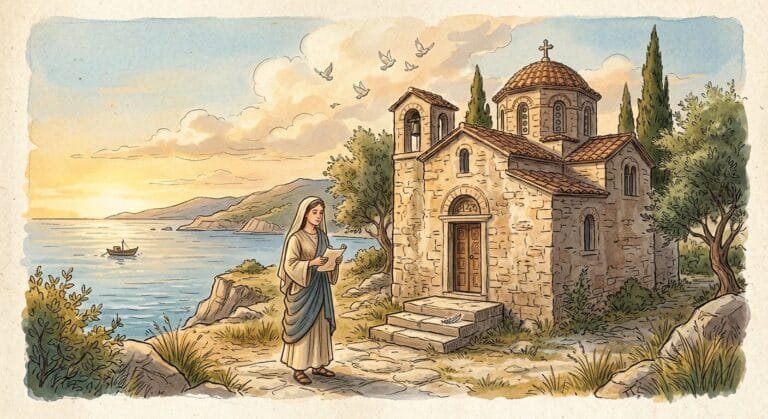
Every day, millions of believers ask the same important question: what holiday is today according to the Church’s liturgical calendar, what folk signs and customs belong to the day, what is forbidden, whose name day is being celebrated, and which prayer will help us ask God for protection and peace of heart. September 16 is a day of great faith in the Orthodox calendar (new style / revised Julian calendar): the Church commemorates Saint Euphemia the All-Praised, the Great Martyr — the maiden of Chalcedon who did not betray Christ even under the cruelest tortures, and whose relics later witnessed to the truth of the Orthodox faith at the Fourth Ecumenical Council. On this day the Church also recalls Saint Ludmila of Bohemia, patroness of the Czech lands, and Saint Cyprian, Metropolitan of Kyiv. In folk tradition the day was called Euphemia of the Bird Bone. This complete guide recounts the life of the Great Martyr Euphemia in detail, gathers the folk customs of the day, and provides the canonical prayer texts.
Understanding the liturgical year helps us realize that every day is dedicated to a particular saint or a key Gospel event. Our ancestors always began the day with prayer, because prayer is the key to peace of soul. When we say the Lord’s Prayer or turn to Great Martyr Euphemia in the morning before work, or in the evening to quiet our hearts, we place our minds under God’s care and calm our souls before life’s worries and anxieties. The life of Saint Euphemia reminds us: the truth always wins — even when the highest price must be paid for it.
To strengthen your faith and your spiritual watchfulness (nepsis) amid daily temptations, we invite you to the spiritual treasury of the Christian East: the Philokalia (Dobrotolyubiye), where the Holy Fathers teach how to guard the truth of faith and peace of soul.
The Orthodox Feast of September 16: Saint Euphemia the All-Praised, the Great Martyr
The Life of the Saint: A Maiden Who Did Not Betray Christ
Saint Euphemia was born in the city of Chalcedon (present-day Kadıköy in Turkey, opposite Constantinople), in the pious Christian family of the senator Philophron and his wife Theodorisiana. She lived at the end of the third and the beginning of the fourth century, in the time of one of the cruelest persecutions of the Christians [3][5].
Once the ruler of the city decided to hold a pagan festival in honor of the god Mars. The Christians refused to take part in it and gathered for a secret service. For this they were all arrested — and the young Euphemia was among those arrested. She was ordered to offer sacrifice to the idols, but the maiden refused. For this she was subjected to cruel tortures — the wheel, the heated furnace, the beasts — but through God’s help and her steadfastness in faith, Euphemia endured all the torments and remained unharmed even in the most terrible trials [1][3].
At last the saint was thrown into the arena to be torn apart by wild beasts. But the beasts did not touch her — only one she-bear inflicted a small wound upon her, after which Euphemia gave up her soul to God. This happened in the year 304. Over the martyr’s tomb a majestic church was later built, which became one of the most venerated places of the Christian world [1][5].
The Miracle at the Fourth Ecumenical Council (451)
The glory of Saint Euphemia did not fade after her death but, on the contrary, increased. It was precisely in the church above her relics that the Fourth Ecumenical Council of Chalcedon took place in the year 451, called to judge the dispute between the Orthodox and the Monophysite heretics about the nature of Christ. When both sides had set out their confessions of faith in written scrolls, the Fathers of the Council, moved by inspiration, placed both scrolls on the breast of Saint Euphemia in her tomb, closed it, and set a guard. Three days later the tomb was opened — and to everyone’s astonishment they saw: the scroll with the Orthodox confession was in the saint’s right hand, and the heretical one lay at her feet. This miracle definitively confirmed the Orthodox teaching, and the Church gave Euphemia the title “All-Praised” [4][5].
What Believers Ask of Saint Euphemia
Believers pray to Saint Euphemia the Great Martyr for healing from illnesses, for protection from drought and natural disasters, for confirmation in the true faith, and for strength not to betray one’s convictions under pressure. She is the intercessor of all who stand for the truth, even when the majority is against them.
What Else the Church Commemorates on September 16
On this day the Church also recalls [2][6]:
- Saint Ludmila of Bohemia — the duchess of the tenth century, grandmother of Saint Wenceslaus, who converted the Czech people to Christ and was killed for the faith; she is venerated by both Orthodox and Catholics as the patroness of Bohemia.
- Saint Cyprian, Metropolitan of Kyiv and All Rus’ — a great church leader and man of letters.
- The martyrs Sebastian, Melitina, Victor, and Sosthenes, and the brothers Joseph and Isaac.
- The venerable hermit Dorotheus of Egypt.
- According to the old calendar, this day also commemorated the martyr Domna of Nicomedia, the martyr Basilissa, and the hieromartyr Anthimus of Nicomedia [6].
The Catholic Feast of September 16: Saints Cornelius and Cyprian
On September 16 the Roman Catholic Church keeps the memorial of Saints Cornelius, Pope of Rome, and Cyprian, Bishop of Carthage — two great pastors of the third century who died for the faith in the time of persecution and whom the Church has honored together on one day since ancient times. Both defended the unity of the Church and mercy toward those who had renounced the faith under pressure but later repented. Their common memorial reminds us: truth and mercy are not enemies, but the two wings of one faith.
The Folk Feast of Euphemia of the Bird Bone: Traditions, Signs, and Prohibitions
In the folk calendar, September 16 is known as Euphemia of the Bird Bone. The ancient custom of this day was connected with fowl: people caught a duck or a goose, prepared a dish from it, and told fortunes about the coming winter by its bones — a thick bone with fat promised a cold winter. Women also gathered together to ferment cabbage for the winter and to share recipes [1][3]. On the Bird Bone day, dreams were considered prophetic and could come true.
What Is Forbidden on September 16
- Do not quarrel, gossip, envy, or swear — according to belief, quarrels on this day come back threefold [3][6].
- Avoid beginning important new undertakings — so as not to invite misfortune.
- Do not lend money or things from the house.
- Avoid chopping trees and cutting branches.
- Do not set out on a journey or move house.
- Avoid spending large sums of money.
- Do not do deep cleaning or repairs.
- Avoid staying alone — the day is better spent with family and friends [2].
Weather Signs for September 16
- Morning fog and chill — early frosts are coming.
- Bright sun all day long — the autumn will be warm and long.
- Low clouds — bad weather is coming.
- A lot of spider webs — a dry autumn.
- The leaves have turned yellow but do not yet fall — the autumn will be dry and long.
- Thunder on September 16 — the winter will have little snow.
- A warm, dry day — winter will come late and will be mild [2][3].
Name days on September 16 are celebrated by Victor, Euphemia, Basilissa, Domna, Chariton, Euphemius, Peter, Constantine, Joseph, Isaac, Ludmila, and Sebastian [2]. If your loved ones bear these names, greet them on their name day with a warm prayer and a kind word. It is especially good to greet the Ludmilas on this day — the day is truly “Ludmila’s day” [2].
The Spiritual Laws of This Day: Truth and Steadfastness
The law of truth. The miracle with the scrolls in Euphemia’s tomb teaches: the truth cannot be buried. The world may arrest the truth, throw it into prison, even kill its witness — but after three days the tomb will be opened, and the truth will be found in the right hand. For us this means: do not be afraid to be honest before God and people, even when it is not to your advantage.
The law of steadfastness. Euphemia endured the wheel, the furnace, and the beasts not by her own strength, but by God’s. Steadfastness in faith is not the tension of muscles, but trust: “I can do all things through Him who strengthens me, Jesus Christ” (cf. Philippians 4:13). When it is hard for you to hold on to what is good and true, simply ask God for strength for this one day.
The commandment of love. On the Bird Bone day our ancestors gathered together: women fermented cabbage, families sat down to a common table. Work done together with love is also a kind of prayer. Prepare something today for your family, share with your neighbors, call those you have not heard from for a long time.
Hesychast Watchfulness: Standing in Truth with the Heart
The hesychast Fathers taught: as Euphemia stood in the midst of the arena, surrounded by beasts, and did not turn her heart away from Christ, so the Christian, amid the noise of thoughts, must stand with attention in the heart, holding on to the name of Jesus. The beasts did not touch the saint — and thoughts do not cling to the heart when it is filled with prayer. The venerable Fathers counseled: do not argue with thoughts, do not feed them with attention — simply return to prayer, again and again [7].
The practice of prayer with the chotki on this day is simple:
- Take your prayer rope and say 33 knots of the Jesus Prayer: “Lord Jesus Christ, Son of God, have mercy on me, a sinner.”
- Add a petition for all who suffer for the truth: “O Lord, strengthen all who stand for the truth.”
- One round of the prayer rope may be devoted to prayer through the intercession of Saint Euphemia and Saint Ludmila.
- Finish with thanksgiving: “Glory to You, O our God, glory to You.”
The short prayer of the day. “Holy Great Martyr Euphemia the All-Praised, you did not betray Christ either in tortures or before the beasts, and your relics witnessed to the truth of the faith. Pray for us, that we too may stand in the truth to the end. Holy righteous Ludmila, patroness of the Slavic lands, keep our families in faith. Amen.”
Common Prayer on September 16 on Pray.ee
Prayer offered together has a special power: “For where two or three are gathered together in My name, there am I in the midst of them” (Matthew 18:20). On this day, when the Church recalls the steadfastness of Saint Euphemia, invite your family to common evening prayer — even for a few minutes, even with one Lord’s Prayer.
On our prayer portal Pray.ee you can leave your prayer intention in the comments under this article — and the community of believers will pray for you and your loved ones. Write down whom or what you ask prayer for: for healing from illnesses, for protection from natural disasters, for confirmation in faith, for peace in the family. Do not remain alone with your cares — in common prayer we bear one another’s burdens.
A Living Testimony: A Story from Our Community
“Three years ago the doctors told my mother: prepare for the worst. My sister and I then sincerely prayed for the first time — we asked Saint Euphemia, because it was her very day. Mom recovered in a way that seemed like a miracle, and the doctors could only shrug. Since then, every year on September 16 we bake a goose, gather the whole family, and give thanks. And Mom always says: ‘The most important thing is not the goose, but that we are together again.'”
If you have your own testimony of God’s help, share it in the comments on Pray.ee. Your word may be the very spark of faith that someone is missing right now.
The Canonical Prayers of September 16
Troparion to Great Martyr Euphemia, Tone 4
Your lamb Euphemia, O Jesus, cries out to You with a loud voice: You, my Bridegroom, I love, and seeking You I suffer, and I am crucified and buried with You in Your baptism, and I suffer for You, that I may reign with You, and I die for You, that I may live with You. Accept me as an unblemished sacrifice, offered to You with love. By her prayers, as the Merciful One, save our souls.
Prayer to Great Martyr Euphemia (for home use)
O holy Great Martyr Euphemia the All-Praised, you witnessed to the truth of the faith with your blood, and your relics confirmed the Orthodox confession. Entreat Christ God for us: grant us steadfastness in faith, purity of heart, and courage to stand for the truth. Obtain for us healing from illnesses, protection from all evil, and forgiveness of sins. Amen.
Prayer to Saint Ludmila of Bohemia
Holy righteous Ludmila, grandmother of Saint Wenceslaus and patroness of the Slavic lands, you enlightened your people with the light of the Gospel and ended your journey with a martyr’s crown. Pray for our families, that in them too faith may be handed down from grandparents to grandchildren, as a candle from a candle. Amen.
FAQ: Frequently Asked Questions About September 16
What church feast falls on September 16, 2026?
According to the new style, the Orthodox Church on September 16 venerates Saint Euphemia the All-Praised of Chalcedon (†304), and also recalls Saint Ludmila of Bohemia, Saint Cyprian of Kyiv, and other saints. The Roman Catholic Church keeps the memorial of Saints Cornelius, Pope of Rome, and Cyprian, Bishop of Carthage.
Who was Saint Euphemia the All-Praised?
A maiden of Chalcedon who, during the persecution under Diocletian, refused to offer sacrifice to idols and, after cruel tortures, was given to the beasts in 304. At the Fourth Ecumenical Council (451), held above her tomb, her relics miraculously witnessed to the Orthodox confession of faith, holding the Orthodox scroll in her right hand.
Why is September 16 called Euphemia of the Bird Bone?
In folk tradition, on this day people caught a duck or a goose, prepared a dish from it, and told fortunes about the winter by its bones: a thick bone with fat promised a cold winter. Women gathered to ferment cabbage, and the dreams of that night were considered prophetic.
What is forbidden on September 16?
One must not quarrel or gossip, begin important new undertakings, lend money or things from the house, chop trees, set out on a journey or move house, spend large sums, or do deep cleaning or repairs. It is also not advised to spend the day alone.
Who celebrates name days on September 16?
Name days are celebrated by Victor, Euphemia, Basilissa, Domna, Chariton, Euphemius, Peter, Constantine, Joseph, Isaac, Ludmila, and Sebastian. The Ludmilas are especially warmly greeted on this day.
Sources
- [1] Bukvy — September 16: the feast of Great Martyr Euphemia, name days, traditions, signs (in Ukrainian)
- [2] RBC-Ukraine — The feast of September 16: signs, prohibitions and name days (in Ukrainian)
- [3] RBC-Ukraine — What is forbidden on the day of Euphemia of the Bird Bone (in Ukrainian)
- [4] MolBuk — The church feast of September 16: the miracle of the scrolls at the Council of Chalcedon (in Ukrainian)
- [5] Chas.cv.ua — The church feast of September 16: Saint Euphemia and the Fourth Ecumenical Council (in Ukrainian)
- [6] Rivne 1 — September 16: feasts, traditions and folk signs (Domna of Nicomedia) (in Ukrainian)
- [7] The Philokalia (Dobrotolyubiye) — Pray.ee