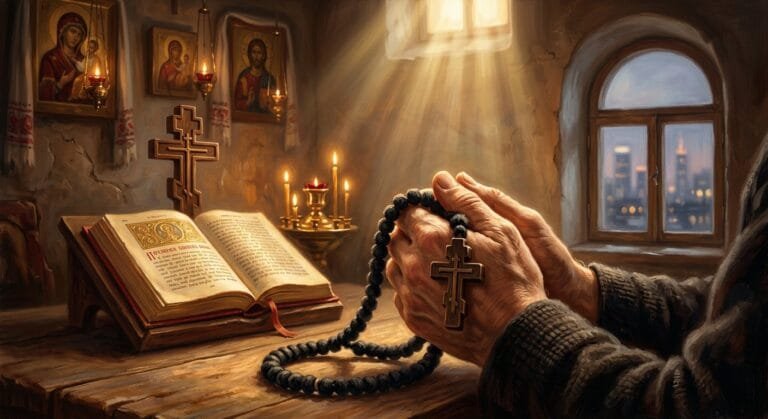
In a world of endless notifications, anxious news, chronic stress and inner confusion, millions of people are searching for a point of spiritual support that is both simple and profound. One of the oldest and most powerful practices of the Christian East — now experiencing a true revival in the 21st century — is the Jesus Prayer, a short invocation of the Saviour: “Lord Jesus Christ, Son of God, have mercy on me, a sinner!” This prayer, born in the deserts of Egypt and Palestine and perfected by the ascetics of the Holy Mountain of Athos, requires neither churches nor long books nor special circumstances: it can be prayed on public transport, at work, in a queue, in a hospital ward or in the middle of the night. In this in-depth article we examine the biblical roots and the history of the Jesus Prayer, explain why its power is so relevant precisely in the modern world, unfold the spiritual laws of invoking the Name of God, and offer a practical rule for laypeople together with the canonical texts.
Understanding the liturgical year helps us realize that every day is dedicated to a particular saint or an important Gospel event. Our ancestors always began the day with prayer, for prayer is the key to peace of soul. When we say the “Our Father” or turn to God with the words of the Jesus Prayer in the morning before work, or in the evening to calm the heart, we place our minds under God’s care and quiet our hearts before the cares and debts of daily life. On this day we also recall the great value of patristic wisdom for the daily sobriety of the mind.
To strengthen faith and spiritual watchfulness (nepsis) amid daily temptations, we recommend the spiritual treasury of the Christian East: the Philokalia (Dobrotolyubiye) — Table of Contents on our site, where you will find the priceless teachings of the Holy Fathers on the prayer of the heart.
1. What Is the Jesus Prayer: Text, Variations and Biblical Roots
The Jesus Prayer is a short, rhythmic invocation of our Lord Jesus Christ that unites a confession of faith in His divinity with a plea for mercy. Its full canonical text is:
Lord Jesus Christ, Son of God, have mercy on me, a sinner!
In monastic and Athonite practice shorter forms are also widespread: “Lord Jesus Christ, have mercy on me”, “Son of God, have mercy on me”, or even simply “Jesus, have mercy”. The Holy Fathers emphasize that the power of the prayer lies not in the number of words, but in the faith, humility and attention of the one who prays. The biblical roots of the prayer reach directly into the Gospel. It consists of two parts — a confessional and a penitential one — both of which are grounded in Scripture:
- The cry of blind Bartimaeus: “Jesus, Son of David, have mercy on me!” (Mk. 10:47) — healing came precisely through the persistent invocation of the Name.
- The prayer of the publican: “God, be merciful to me, a sinner!” (Lk. 18:13) — the model of repentance that justifies a person before God.
- The confession of the Apostle Peter: “You are the Christ, the Son of the living God” (Mt. 16:16) — the foundation of the dogmatic part of the prayer.
- The promise of the Apostle Paul: “Everyone who calls on the name of the Lord shall be saved” (Rom. 10:13) — the promise of salvation to all who invoke the Lord’s Name.
- The Name above every name: “That at the name of Jesus every knee should bow, of those in heaven and of those on earth and of those under the earth” (Phil. 2:10).
In the Old Testament, invoking the Name of God was considered a special way of worship and of God’s presence among His people (Ex. 3:14-15; Ps. 115:4). The Jesus Prayer is the New Testament continuation of this cult of the Name: the Christian invokes not an abstract force, but the living Christ, Who is “the same yesterday, today and forever” (Heb. 13:8).
2. The History of the Prayer: From the Desert Fathers to Athos and the Philokalia
The practice of a short, repeated prayer was born in the first centuries of Christianity among the Desert Fathers, the ascetics of Egypt and Palestine. Saint John Climacus (†649), author of the famous “Ladder of Divine Ascent”, already teaches “to strike the adversaries with the name of Jesus”, and his disciple Hesychios of Jerusalem devoted whole chapters to the “prayer of attention of the heart”, uniting sobriety of mind (nepsis) with the unceasing invocation of the Name. The classic formula “Lord Jesus Christ, Son of God, have mercy on me, a sinner”, according to tradition, was shaped in the milieu of the Athonite monks, and Saint Gregory of Sinai (†1346), coming from Sinai to Athos, became a true missionary of the Jesus Prayer among hermits and cenobites — from his time Athos became the main hearth of this practice.
In the 14th century Saint Gregory Palamas, Archbishop of Thessalonica, defended the hesychast practice against the attacks of Barlaam of Calabria and formulated the teaching on the uncreated divine energies and the Light of Tabor: the prayer of the heart opens to man the way of real, not symbolic, union with God — deification. In the 18th century Elder Paisius Velichkovsky translated the collection “Philokalia” (Dobrotolyubiye) into Slavonic, opening the ascetic wisdom of Athos to the whole Orthodox world, and in the 19th century the book “The Way of a Pilgrim” (Candid Tales of a Wanderer to His Spiritual Father) made the prayer of the heart known among ordinary people. Saint Ignatius Brianchaninov, in his work “On the Jesus Prayer”, gave laypeople safe and tested guidance for its practice.
If you wish to read the very book that changed the lives of millions, the full English text is available on our site: “The Way of a Pilgrim — Candid Tales of a Wanderer to His Spiritual Father”, with explanations of how a simple peasant, through prayer on the rope, attained the state of unceasing prayer.
3. Why the Power of the Jesus Prayer Is Needed Precisely in the Modern World
Modern man lives under unprecedented informational pressure: smartphones, social networks, news feeds and constant notifications keep the mind in a state of chronic agitation, while anxiety about the future, financial debts, war and illness exhaust the heart. Psychologists increasingly speak of an “epidemic of anxiety”, and the world at large searches for practices of inner calming. It is here that the Jesus Prayer reveals its power — not as a relaxation technique, but as a living encounter with God:
- Against distraction: the short formula gathers the mind, which wanders among hundreds of thoughts a day, and returns it to a single centre — Christ.
- Against anxiety: the words “have mercy on me” transfer the burden of the future from human shoulders into the hands of the God Who “cares for you” (1 Pet. 5:7).
- Against pride and constant comparison with others: the penitential character of the prayer heals the heart of envy and of the chase for likes and success.
- Against spiritual emptiness: the prayer fills the “dead” minutes of the day — commuting, queues, insomnia — with living communion with God.
- Against temptations: Saint Paisios of Athos called the Jesus Prayer “heavy artillery” against the enemy — where long reasoning is powerless, one invocation of the Name cuts off the thought.
It is important to understand the essential difference from modern secular “mindfulness” techniques: the goal of the Jesus Prayer is not simply calming the nervous system, but the salvation of the soul and deification. Silence of heart is not an end in itself, but a space in which a person stands before the living Christ. Peace of soul, reduced anxiety, better sleep — these are accompanying fruits of the prayer, but its chief fruit is love, humility and the grace of the Holy Spirit in the heart.
4. The Spiritual Laws of Prayer: the Law of the Name and the Law of Humility
The working of the Jesus Prayer obeys two unshakable spiritual laws. The first is the law of invoking the Name of God. Scripture testifies: “There is no other name under heaven given among men by which we must be saved” (Acts 4:12). The Name of God in biblical tradition is not an empty sound but a bearer of God’s presence and power. When a Christian with faith pronounces “Lord Jesus Christ”, he really unites with Christ, as iron laid in fire takes on the properties of fire. The second is the law of humility, embodied in the Gospel publican: God “resists the proud, but gives grace to the humble” (Jas. 4:6). The words “have mercy on me, a sinner” are not a humiliation of human dignity, but an honest recognition of one’s need for God, which opens the heart to grace.
To these two laws the Holy Fathers add the law of thanksgiving: “In everything give thanks” (1 Thess. 5:18). Prayer combined with gratitude for the years lived and even for trials transforms the heart into a clean vessel for God’s power. And finally, the Commandment of Love (Mt. 22:37-39): no prayer practice replaces active mercy — helping the poor, supporting the sick, forgiving offenders. The Jesus Prayer without love of neighbour remains merely an exercise; with love it becomes fire that transforms the world around.
5. How to Pray the Jesus Prayer in Modern Life: a Rule for Laypeople
The Holy Fathers always warned: the prayer of the heart should be begun with humility and, where possible, under the guidance of an experienced spiritual father. For laypeople living in a modern rhythm, the practice tested by centuries looks like this:
- 1. Start with a small rule. Set aside 5–10 minutes in the morning and in the evening; stand before an icon, light a candle, and slowly, with attention, say the Jesus Prayer 33 times (in honour of the years of Christ’s earthly life) or on the prayer rope. Quantity without attention has no value — better fewer words, but from the heart.
- 2. Gather attention in the words. The mind must “sit” inside the words of the prayer. When thoughts fly away, do not become irritated, but gently return attention to the words; that very return is the spiritual labour.
- 3. Pray in the movement of the day. The commute, queues, household chores, waking at night — all are ideal times for quiet prayer. Many modern ascetics advise praying while walking, step by step: “Lord Jesus Christ” on the breath in, “have mercy on me” on the breath out.
- 4. Use the prayer rope. The rope (komboskini) helps keep rhythm and attention: one prayer and a light bow on each knot. Traditional ropes have 33, 50, 100 or 300 knots.
- 5. Do not seek visions or sensations. Saint Ignatius Brianchaninov warns strictly: do not imagine images, do not seek warmth, light or “spiritual experiences”. The only right disposition is repentance and faith. Any visions during prayer, the Fathers advise, must be rejected.
- 6. Combine the prayer with the sacraments. The prayer of the heart bears the greatest fruit when united with Confession and Communion, with reading the Gospel and with works of mercy.
Those who wish to go deeper into the ascetic science of prayer will find guidance in the Philokalia — Selections for the Laity on our site.
6. The Power of Communal Prayer: Mt. 18:20 and the Prayer Circle of Pray.ee
The Jesus Prayer, although it is the prayer of the personal heart, lives in the bosom of the Church and is nourished by the communal prayer of the faithful. The Lord Himself gave the promise of extraordinary power to common prayer: “For where two or three are gathered together in My name, there am I in the midst of them” (Mt. 18:20). When believers unite their hearts — in church, in the family rule of prayer, or in an online prayer circle — the Spirit of God descends to comfort the sorrowful and strengthen broken hearts. Dear brothers and sisters! We invite you to join the prayer circle on Pray.ee: if you are going through hard times, suffering from anxiety, debts, illness or danger, write your names and your needs in the comments below. Our great Christian family will remember you daily in prayers before the Throne of God.
7. A Living Testimony: the Jesus Prayer in the Life of a Modern Person
Parish chronicles and home testimonies contain many tales of the power of the prayer of the heart in modern circumstances. One of them belongs to Andriy, a programmer from Lviv. For years he lived in a state of chronic anxiety: insomnia, panic attacks before deadlines, fear of losing his job during the war. Tablets brought temporary relief, but no peace. Once, in a metro carriage, he read “The Way of a Pilgrim” on his phone and for the first time tried quietly repeating: “Lord Jesus Christ, have mercy on me.” At first his thoughts scattered, but he persevered, praying on the way to work and home; later he bought a prayer rope and began to read a rule morning and evening, adding Sunday Liturgy and Confession. After a few months the panic attacks stopped, his sleep returned, and, above all, a sense appeared that he was not alone: “I understood that prayer is not a calming technique but the living Christ beside me. Now I pray in the queue, in the shelter during air raids, in the lift — and it holds my heart.” Andriy advises everyone suffering from anxiety: begin with ten prayers a day, but do not abandon them.
8. Canonical Texts: the Jesus Prayer and a Short Rule of Prayer
Full text of the Jesus Prayer:
Lord Jesus Christ, Son of God, have mercy on me, a sinner!
Short forms (according to the tradition of the Holy Fathers):
Lord Jesus Christ, have mercy on me.
Son of God, have mercy on me, a sinner.
Jesus, have mercy.
A short rule for laypeople (on the prayer rope): “Glory to the Father, and to the Son, and to the Holy Spirit, now and ever and unto ages of ages. Amen” (three times) → the Jesus Prayer 33 times with a light bow on each knot of the rope → “Most Holy Theotokos, save us!” (three times) → “By the prayers of our holy fathers, Lord Jesus Christ our God, have mercy on us. Amen.” This rule may be increased to 50, 100 or more prayers with the blessing of a spiritual father.
9. Frequently Asked Questions (FAQ)
May laypeople pray the Jesus Prayer without a special blessing?
Yes, the short Jesus Prayer is available to every Christian: it may be prayed on the road, at work, in moments of anxiety. But for increasing the rule, and especially for prayer with breathing techniques or hours-long standing, the Holy Fathers strongly advise taking the blessing of a spiritual father, to avoid spiritual self-deception (prelest).
What should one do when thoughts scatter during prayer?
Distraction is the natural state of our mind, and the struggle with it is the very content of spiritual labour. Return attention to the words of the prayer gently, without irritation, and do not enter into conversation with the thoughts. The Fathers say: blessed is the mind that cuts off thoughts with prayer at the very moment of their appearance.
How many times a day should one say the Jesus Prayer?
There is no obligatory minimum. To begin with, 10–33 prayers morning and evening are enough, gradually increasing according to the desire of the heart. The ideal to which the saints strove is unceasing prayer (1 Thess. 5:17), when the heart prays even in sleep; but it is attained gradually and only by the grace of God.
How does the Jesus Prayer differ from meditation and mindfulness?
Secular mindfulness techniques focus attention on breathing or bodily sensations and aim at relaxation. The Jesus Prayer is a personal address to the living Christ with faith, repentance and love; its goal is not relaxation but the salvation of the soul, healing from sin and union with God (deification).
10. Sources
1. Jesus Prayer: history, theology and practice — Wikipedia article: en.wikipedia.org (Jesus Prayer).
2. Hesychasm: the Athonite tradition of the prayer of the heart — Wikipedia article: en.wikipedia.org (Hesychasm).
3. Saint Gregory Palamas and the defence of hesychasm — Wikipedia article: en.wikipedia.org (Gregory Palamas).
4. The Way of a Pilgrim: full English text on Pray.ee — pray.ee (The Way of a Pilgrim).
5. Philokalia (Dobrotolyubiye): Table of Contents on Pray.ee — pray.ee (Philokalia).
6. On the Jesus Prayer: origins of the formula and the Athonite tradition — Study of Studite monasticism (in Ukrainian): studyty.in.ua (On the Jesus Prayer).