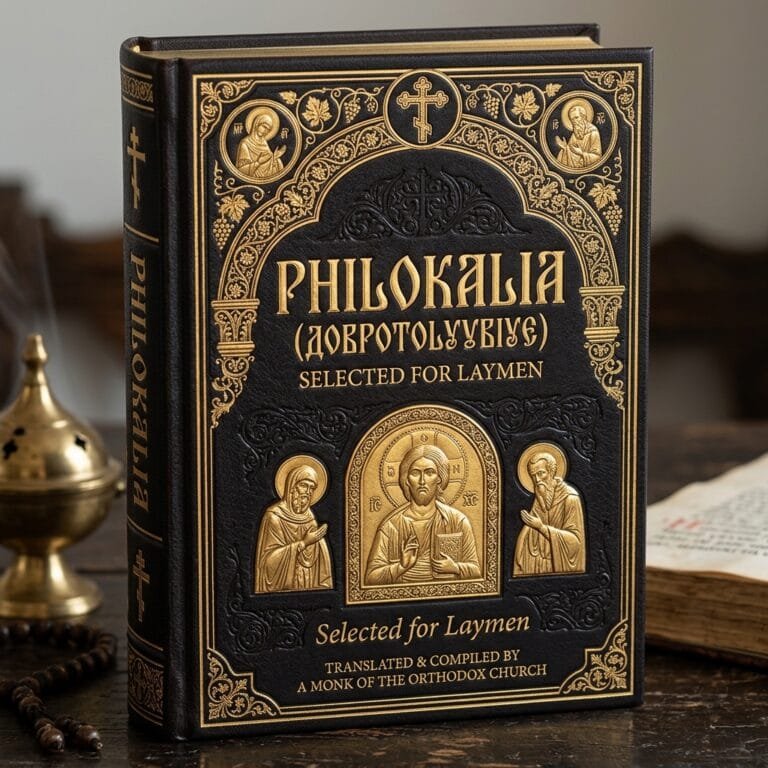
Foreword
And they that are Christ’s have crucified the flesh with the affections and lusts.
Gal. 5:24
The Philokalia is not a book for entertaining a bored mind, nor a series of “psychological studies,” nor a collection of curious aphorisms. Into the truths of the Philokalia are engraved the works of the holy Fathers, whose minds were enlightened by God and whose hearts were so pure that many of them, while still in this life, beheld God. Wondrous intellects and burning hearts have been imprinted in the Philokalia. An earthly, vainglorious man will obtain this pearl of the spirit and enter the royal banqueting hall only when, in humility, aware of the weakness of his own mind and of the stains and wounds of his heart, he opens the pages of the Philokalia with prayer to the Holy Spirit. And then, only by the help of the fiery and purifying Spirit of God, will earthly man find here on earth peace of mind and the right ordering of the senses; he will enter upon the path of joyful and boundless goodness; in a word, he will be joined to the life of the great fathers and teachers of human souls, to a joy and a light of life which man’s feeble word is powerless to express.
There are two ways of accepting life. The one — and it belongs to the majority — is to take from the present moment everything that can be taken for the pleasure and comfort of the body. This cult of the body and of luxury is expressed in the distorted philosophy of Epicurus: “Let us eat and drink, for tomorrow we die.” Such has been the acceptance of life since the day of Adam’s fall. With Adam’s fall mankind lost the divinely enlightened mind, the “intelligent” intellect, and ever more often takes falsehood for truth; it lost the perception of true beauty, for it has distorted its senses and takes ugliness for beauty; and its will is often directed toward evil, accepting evil as good, or evil under the guise of good. Yet there has not perished in all mankind the longing for other worlds, the memory of Eden, of communion with God; and vainglorious, earthly man still strives for the knowledge of the whole truth, seeks true beauty, and longs to serve the genuine good. In a moment of enlightenment, earthly life plainly appears as a succession of deceptive dreams. “Every man’s life is but a shadow” — such a life becomes a burden; and there grows the longing for the lost “image of ineffable glory” (Orthodox memorial service).
Entering the world of the Philokalia, the vainglorious man is bewildered. Like one who has run out of a stifling, foul-smelling room into clean air, his head spins and his heart stands still. But the experienced physicians of souls — the authors of the Philokalia — will uphold him by their example; they will lead him to spiritual heights along the true path appointed by God, the path they themselves have walked. That marvellous physician of souls, John Climacus, in his work called The Ladder, leads step by step the soul that seeks God and salvation in God. And beside this guardian, how many wondrous protectors and instructors there will be, true friends: Anthony and Pachomius the Great, Nilus of Sinai, Symeon the New Theologian, Ephraim and Isaac the Syrians — a host of light-bearers, the fairest of the sons of men, a reflection of paradise upon earth. The great dogmas of the faith, incomprehensible to the limited and flat human reason — concerning the Holy Trinity, the redemption of the world by Jesus Christ, the resurrection — will be opened by the God-enlightened minds of the Fathers of the Philokalia to the feeble mind of the seeker of truth; and he will marvel at how simply the Fathers of the Church and the hermits of Sinai have expressed the depths of the Christian faith. The reader of the Philokalia will feel how simply his teachers — minds and hearts that stood before the mysteries of God — put their words. Dogma will be received as life, and not as abstraction. And to the worldly and vainglorious man the great Fathers will condescend, they who had “a heart burning for all creation” (Isaac the Syrian). They will point out that “to condemn is the death of the soul” (Abba Or); that “prejudice is short-sighted, and hatred sees nothing at all” (Isidore of Pelusium); that “to say much, even if it be good, is to be like a bathhouse door, which is often opened and lets out the steam”; and that “he who indulges his own habit is like a man who feeds the fire” (Isaac the Syrian).
The present work, consisting of selected passages from all five volumes of the Philokalia, came into being by the mercy of God through the labour of the abbot of the Monastery of the Kazan Icon of the Mother of God in the city of Harbin, Father Archimandrite Juvenaly.
Father Juvenaly did a beautiful and saving work in gathering these pearls, so that the Philokalia might be accessible to all. The Orthodox Christian community carries on the apostolic continuation of Father Juvenaly’s labour: to make this volume of the Philokalia a constant companion in the life of every Christian soul.
FAITH IN GOD
Blessed Diadochos
– He who loves God believes sincerely and performs the works of faith with reverence. But he who only believes, and is not established in love, does not have even that faith which he seems to have. He believes with a certain lightness of mind, not bearing within himself the effective working of glorious love. Only faith which works through love is the great chief of the virtues (Gal. 5:6).
– He who searches out the depth of faith is tossed by waves of thoughts; but he who contemplates it with simplicity of heart enjoys a sweet inward stillness. The depth of faith is like the water of forgetfulness: it does not endure to be examined or grasped by inquisitive thoughts.
St. Maximus the Confessor
– Without faith, hope and love, nothing evil is utterly destroyed in the end, and nothing good is finally established in us. Faith persuades the embattled intellect to turn to God and stirs it to boldness, assuring it that all spiritual weapons are ready at hand; hope proves to be for it an unfailing guarantor of divine help, promising the destruction of the hostile powers; and love makes it inseparable from union with the Divine, so that even in the very midst of battle it keeps the whole force of its inclination greedily fixed upon God.
– Faith comforts the embattled intellect and inspires it with confidence in God’s help; hope, setting that help before its eyes, beats back the assaults of the hostile forces; and love makes them dead, or ineffectual, for the God-loving intellect, wholly slackening their hold by its longing for God. Blind is the faith of him who does not fulfil God’s commandments by faith. If God’s commandments are light, then it is plain that he who does not fulfil God’s commandments remains outside the divine light, bearing a calling which is groundless and not truly divine.
St. Symeon the New Theologian
– Faith is this: to be ready to die for Christ for the sake of His commandment, in the conviction that such a death brings life; to reckon poverty as riches, insignificance and lowliness as true glory and renown; and, while possessing nothing, to be certain that you possess all things — or rather, that you have acquired that unsearchable wealth which is the knowledge of Christ, and to look upon all visible things as dust or smoke.
– Faith in Christ consists not only in despising the pleasures of this life, but also in bearing patiently and with good will every trial — in sorrow, in affliction, in unpleasant misfortunes — until God is pleased to look upon us; in imitation of the prophet David, who says: I waited patiently for the Lord, and He inclined unto me (Ps. 39:1); that is, having endured suffering, I hoped that the Lord would help me; and therefore the Lord, seeing that I did not waver in turning to Him for help, looked upon me and showed me His mercy.
– Faith in Christ, the true God, begets desire for eternal blessings and fear of torment; and the desire of these blessings and the fear of torment lead to the strict keeping of the commandments; and the strict keeping of the commandments teaches men to know deeply their own infirmities; and this awareness of our true weakness begets the remembrance of death. He who has this remembrance as a constant companion painfully seeks to learn what his departure and passage from this life will be like.
Sts. Callistus and Ignatius
– Of all good things, or of moral goodness, the beginning, the middle and the end — the leader and guide, if you will — are faith, hope and love. This is the threefold cord, and the greatest strand woven into it by God is love, for God is love (1 John 4:8); and it would be unjust not to supply what is still lacking in the present work; the more so since, according to St. Isaac, “the fulfilment of the fruits of the Holy Spirit is when one is counted worthy of perfect love.” St. John Climacus writes: “Now abide these three, bound in the closest union and held together in it: faith, hope and love; but the greatest of these is love, for by it God is named (1 Cor. 13:13; 1 John 4:8). In my judgement, the first of them is a ray, the second is light, and the third is the orb; yet they are all one radiance and one splendour. The first can guarantee and set all things in order; the second the mercy of God enfolds and makes them unashamed; the third never falls, never ceases from its course, and gives no rest from blessed rapture even to him whom it has wounded.”
THE FEAR OF GOD
St. Clement of Alexandria
– Fear is the beginning of love, and afterwards it passes over into love. The fear of God, in truth, is not a dread of God, but a fear of departing from God and of falling into sins and passions.
St. John Climacus
– A ray of sunlight that has entered a house through a crevice lights up everything within it, so that even the finest dust is seen rising in the air; in the same way, when the fear of the Lord comes into the heart, it shows the heart all its sins.
St. Ephraim the Syrian
– Let the cross be always upon your brow, and in your heart the fear of God.
Blessed Diadochos
– No one can love God with his whole heart without first kindling the fear of God in the feeling of his heart; for the soul comes to active love only after it has first been purified and softened by the working of the fear of God. And into the fear of God, with the fruit just spoken of, no one can come unless he steps outside all earthly cares; for only when the intellect is at rest in complete stillness and freedom from care does the saving operation of the fear of God begin in it, purifying it of every earthly grossness, so as to raise it to the fullness of love for the all-good God. Thus this fear belongs to those who are being made righteous, who are only in process of purification, in whom there is a middle measure of love; whereas perfect love is the mark of the purified, in whom there is no more fear, since perfect love casts out fear (1 John 4:18).
St. Maximus the Confessor
– The fear of God is twofold: one is born of the threat of punishment, and from it there arise in us, in this order, self-control, patience, hope in God and impassibility, from which comes love. The other is joined to love itself, engendering reverence in the soul, so that out of the boldness of love the soul may not come to make light of God. Fear, then, is twofold: the one pure, the other impure. The fear that is born of sins under the expectation of punishment is impure, since its cause is the awareness of sin; and it will not remain for ever, for it vanishes together with the sin through repentance. But that fear which, without any such anxiety over sins, is always present in the soul is pure, and it will never disappear, for it is in some way co-inherent with God, being a tribute paid by creatures, in which is shown the natural reverence of all before His majesty, which is above every kingdom and power.
St. Symeon the New Theologian
– He who is filled with the fear of God is not afraid to deal with wicked men. Having within himself the fear of God, and possessing the invincible weapon of faith, he is strong in all things and can do even what seems difficult and impossible to many. He walks among them like a giant among apes, or like a lion among dogs and foxes, trusting in the Lord; by the firmness of his wisdom he astonishes them, he strikes fear into their minds, and his words of wisdom fall upon them like a rod of iron.
The Elder Symeon the Pious
– One must always fear God and daily examine and weigh what is good and what is bad; and one must consign the good to forgetfulness, so as not to fall into the passion of vainglory; and the contrary must be repented of with tears of confession and intense prayer.
St. Nicetas Stethatos
– Fear, once it has been joined to the soul through repentance, fills it with thoughts of the judgement. Then it is encompassed by the pangs of hell (Ps. 114:3); sighing and grievous pain with a tightening of the heart torment it as it thinks of the future, of the recompense for evil deeds. Then, conceived by many tears and much labour in the womb of the thoughts, the resolve to find salvation grows, and there is brought forth upon the earth the spirit of salvation, that is, resolution; and being delivered from the torment of the thought of hell and from weeping under the sentence of God’s judgement, the soul takes to itself the longing and the joy of the blessings to come, and it meets with chastity, which joins it to God in sincere love. And having been united with God, the soul tastes an ineffable sweetness, and from this it now sheds with delight the tears of compunction that come of gladness; it becomes a stranger to all sympathy with the things of this world and, as though possessed, runs after Christ the Bridegroom, turning to Him without voice yet with a voice: “I will run after Thee in the fragrance of Thy repose. Tell me, Thou whom my soul loves, where Thou dwellest, where Thou feedest, where Thou restest at noonday in pure contemplation (cf. Song 1:3, 6), lest I be left to wander among the flocks of Thy friends the righteous, for with Thee is the radiance of all mysteries.” And the Bridegroom, bringing the soul into the treasury of His hidden mysteries, makes it a contemplator of creation in wisdom.
St. Ephraim the Syrian
– If you have truly come to love the Lord, and have added to this an effort to secure the Kingdom to come, and have promised to labour on account of your falls, then remember the judgement and the eternal torment, and await your departure from this world with fear.
ON DEATH, THE LAST JUDGEMENT,
ETERNAL TORMENT AND THE DWELLING IN PARADISE
St. Hesychios
– Let us, if possible, remember death without ceasing; for out of this remembrance there is born in us the laying aside of all cares and vanities, the guarding of the intellect and unceasing prayer, detachment from the body and hatred of sin — and, to speak the truth, well-nigh every virtue that is living and active springs from it. Therefore let us make this work as unceasing as our own breathing.
St. Isaac the Syrian
– When the Saviour spoke of many mansions with the Father, He meant the different measures of understanding of those who are established in that country — that is, the distinctions and differences in the spiritual gifts which they enjoy in proportion to their understanding. For it was not by a difference of places, but by the degree of the gifts, that He called the mansions many.
– Just as all enjoy the one sensible sun according to the purity and receptive power of their sight, and just as from one and the same lamp in one house the illumination differs, though the light is not divided into many lights, so it will be also in the age to come: all the righteous will dwell inseparably in one country, yet each, in his own measure, will be enlightened by the one intelligible Sun, and according to his worthiness will draw to himself joy and gladness — out of one air, one place, one throne, one vision, one form. And no one sees his neighbour’s measure as higher or lower, so that, seeing the greater grace of his neighbour and his own deprivation, this should be for him a cause of grief and sorrow. There each rejoices inwardly, in his own measure, in the grace given to him. Outwardly there is one vision and one country; and apart from these two degrees — I mean the one country above and the other below — the variety among them lies in the difference of the recompense.
St. Anthony the Great
– Death, for those who understand it, is immortality; but for the simple, who do not understand it, it is death. And this death is not to be feared; what is to be feared is the perdition of the soul, which is ignorance of God. This is what is terrible for the soul! Life is the union and joining together of the intellect (spirit), the soul and the body; and death is not the destruction of these joined parts, but the dissolution of their union — and all this God preserves even after the dissolution. As a man comes forth from his mother’s womb, so the soul comes forth from the body naked; and one soul is pure and radiant, another is stained with faults, another is black with many sins. Therefore the intelligent and God-loving soul, remembering and reflecting upon the calamities and excesses that follow death, lives in piety, so as not to be condemned; whereas those who do not believe, and have no feeling, sin and despise what is to come, being foolish in soul. Just as, having come forth from the womb, you do not remember what was in the womb, so, having come forth from the body, you will not remember what was in the body. As, on coming forth from the womb, you became better and greater in body, so, on coming forth from the body pure and unstained, you will be better and incorruptible, dwelling in the heavens. Mortals must take care for themselves, knowing beforehand that death awaits them. For blessed immortality is the lot of the honourable soul when it is good, and eternal death meets it when it is evil. Remember that your youth has passed, your strength is spent, your feeble powers have grown weak, and the time of your departure is already near, when you must give an answer for everything; and know that there neither will brother redeem brother, nor father deliver son. Always remember your departure from the body, and do not let go of the thought of eternal condemnation; if you act thus, you will never sin.
St. John of Karpathos
– With threats and abuse the enemy boldly falls upon the soul as soon as it has left the body, appearing as a bitter and terrible accuser of its falls. But you may also see how a God-loving and faithful soul, though it has many times before been wounded by sins, is not afraid of his assaults and threats; rather it grows the stronger in the Lord, it is filled with joy, it is inspired with courage, seeing the heavenly powers that escort it and the light of faith like a wall about it; and with great boldness it cries out against the wicked devil: “What have you to do with us, you stranger to God? What have you to do with us, you who were cast down from heaven and are a slave of evil? You have no authority over us; authority over us belongs to Christ the Son of God, who has authority over all. Against Him have we sinned, and to Him shall we give answer, having as the pledge of His mercy toward us and of our salvation in Him His precious Cross. Flee far from us, accursed one! You have nothing to do with the servants of Christ.” At last, when the soul speaks such bold words, the devil breaks into a howl, powerless to withstand the name of Christ; and the soul, rising above him and soaring over the enemy as a swift-winged bird over a raven, is borne by the divine angels to the place appointed for it.
Abba Dorotheos
– Who can remember without horror those terrible places of torment, the fire, the darkness, the pitiless tormentors and the other sufferings of which the Scripture speaks: Depart from Me, you cursed, into the eternal fire prepared for the devil and his angels (Matt. 25:41). And the shame of that condemnation alone — how crushing and deadly it is! St. Chrysostom says: “If no river of fire flowed, and no dread angels stood by, but all men were merely called to the Judgement, and some were praised and glorified, while others were sent away in shame, so as not to behold the glory of God — would not the punishment of that shame and dishonour, and the grief of that deprivation, be worse than any hell?”
St. Maximus the Confessor
– Death, in truth, is estrangement from God; and the sting of death is sin, which Adam, having received it into himself, was for that cause banished from the tree of life, from paradise and from God; and after this bodily death inevitably followed. Life, in truth, is He who said: I am… the life (John 14:6). He, by His death, brought the dead to life. The fear of hell moves those who are being led into the said path — the beginners — to avoid sin; the desire for the reward of good things gives readiness to those who are advancing in the practice of the virtues; and the mystery of love raises the intellect above all created things, making it blind to everything that comes after God. The Lord makes wise the one who has this love, showing him things most divine. Some of those who love learning have sought to understand wherein lies the difference among the eternal mansions and the promised inheritances: whether it is determined by the place itself, or by the quantity and quality of each one’s spiritual perfection. And to some the first seems true, to others the second. But he who knows that the Kingdom of God is within you, and that in My Father’s house are many mansions (Luke 17:21; John 14:2), will side with the second: the Kingdom of God and of the Father is present, by His almighty power, in all believers; but by grace it is in those who have wholly laid aside all inclination to the natural life, both of soul and of body, and have acquired the life of the Spirit, so that they can say with the Apostle: It is no longer I who live, but Christ lives in me (Gal. 2:20).
– It is not right, I think, to call the end of this life death, but rather deliverance from death — a removal from the realm of corruption, a release from slavery, a ceasing of anxiety, a putting down of warfare, a going forth out of darkness, a rest from labours, a refuge from shame, a flight from the passions and, in a word, a limit set to all evils. The saints, having attained these things through voluntary self-abasement, made themselves strangers and pilgrims in this life. For they fought manfully against the world and the flesh, and against the risings that come from them, and by putting down the deceit begotten of sympathy with what is sensible, they preserved the dignity of the soul.
St. Theognostos
– What ineffable and unutterable consolation it is when the soul, in the assurance of salvation, is separated from the body, laying it aside as a garment! For, as one already in possession of what she hoped for, she leaves it without sorrow and goes in peace to the angel who descends to her from above with joy and gladness; and passing with him through the airy spaces without hindrance, in no way assaulted by the evil spirits, she rises with joy, with boldness and with cries of thanksgiving, until she comes to worship her Creator; and there she receives the sentence that places her among the assembly of those akin to her in virtue, until the general resurrection.
St. Philotheos of Sinai
– He who gives the time of his life to goodness and is constantly occupied with the thought and remembrance of death, and thereby most wisely draws the intellect away from the passions, sees more keenly the daily workings of the demons than one who lives without the remembrance of death, hoping to purify the heart by the activity of the intellect alone and not always holding to that mournful and sobering thought. He who has the unceasing thought of death is sharper-sighted than he who has it not: noticing the intrusion of the demons, he easily drives them off and tramples upon them. Many virtues, in truth, are gathered together in the deeper remembrance of death. It is the mother of mourning, the guide to universal self-control, a reminder of hell, the mother of prayer and tears, the guardian of the heart, the source of detachment and discernment, whose children are the fear of God and the cleansing of the heart from passionate thoughts; and it embraces many of the Lord’s commandments. In such a heart one may see the warfare and the ascetic struggle that are endured with extreme difficulty. And this is the one care of many of Christ’s warriors.
Elias the Ekdikos
– Nothing is more awesome than the remembrance of death, and nothing more wondrous than the remembrance of God; the one inspires a saving sorrow, the other fills us with spiritual joy. For the prophet David sings: I remembered God, and was gladdened (Ps. 76:4); and the wisest of men teaches: Remember your last end, and you will never sin (Sir. 7:36). The good things of the Kingdom that is within us the peace-loving eye has not seen, nor has the ambitious ear heard them, nor have they risen up in a heart that is bereft of the Holy Spirit. They are the pledge of the blessings that will be given to the righteous in the Kingdom of God to come. He who does not enjoy these fruits of the Spirit here cannot be assured that he will enjoy them there.
St. Symeon the New Theologian
– He who has planted in the depth of his heart the fear of the Judgement appears on the stage of this world as a kind of condemned man, bound in chains. Therefore he is seized with fear, as though he had been laid hold of by a pitiless executioner and led away to the place of execution, thinking of nothing else but the sufferings and torments he must endure in the eternal fire. This feeling of pain is kept for ever in his heart by the fear that begot it, and together with that fear it does not allow him to have a care for any man; for he is always in such a state as though he had been hung upon a cross and felt in all his being the sickness and the suffering of death upon the cross — which does not permit him to look to any man’s face, nor to think of human honour or dishonour. Counting himself in his whole heart worthy of every contempt and dishonour, he pays no heed at all to the reproaches and humiliations inflicted upon him.
St. Nicetas Stethatos
– The last day will be revealed by fire, and the fire will test the works of each one, as St. Paul says (1 Cor. 3:13); adding that those whose works are incorruptible in their essence, which they have laid up within themselves for their own building, will remain incorruptible in the midst of the fire, and not only will they not be burnt, but they will become yet brighter, being wholly cleansed of the least stains. And those whose works are corruptible in their essence, works with which they have burdened themselves, will be set alight and burnt up, and will leave them in the fire with nothing. Works that are incorruptible and enduring in essence are these: tears of repentance, almsgiving, compassion, prayers, humility, faith, hope and every work of true godliness — works which, while a man lives, are built up in him as a holy temple of God, and which, when he dies, depart with him and dwell with him incorruptibly for ever. And the works that are consumed in the fire, as is plain to all, are these: love of pleasure, love of glory, love of money, hatred, envy, theft, drunkenness, irritability, condemnation and all the other deeds committed by the body out of passion or anger. All such works, even while a man lives, smoulder together with him as he is inflamed by passion, and they do not remain with him, but, destroyed by fire, they leave the one who wrought them in the fire for endless ages of torment.
St. Gregory of Sinai
– The torments are of many kinds, as are also the rewards of the good. All the torments are in hell, which, according to the Scripture, is a dark and gloomy land, a land of eternal darkness (Job 10:21-22), where sinners dwell before the judgement, and to which they return after the last sentence of God is pronounced, as the Scripture says: The sinners shall return to hell (Ps. 9:18; cf. 48:15) — what else could these words mean but the last judgement and eternal condemnation?
– Fire, darkness, the worm and Tartarus correspond to the passions: to sensuality of every kind, to the all-embracing darkness of ignorance, to the unquenchable thirst for sensual pleasure, to the foul stench of sin, which are, as it were, the seed and the germ of the torments of hell — already from here they begin to work painfully upon the souls of sinners, once they have taken root through long habit. The rewards and punishments to come are equally eternal, though to some it seems otherwise. For divine Truth grants eternal life to some, and eternal torment to others. Both, having lived for good or for evil in the present age, will receive the recompense of their deeds; and the number and quality of that recompense is determined by the virtues or the passions that have become rooted habit. For the hidden foundations of the blessings to come are inherent in the hearts of the righteous and work spiritually within them and inspire them, since the Kingdom of Heaven is the virtuous life, just as the torments of hell are passionate habits. The Kingdom of Heaven is like the God-given tabernacle, for in the age to come, as with Moses, it will have two veils, of which all who are sanctified by grace will enter the first, but only the most perfect the second. The Saviour called the mansions many because there are there different states. The Kingdom is one, yet it has many distinctions within itself, according to the difference of those who enter it in virtue, in knowledge and in the measure of deification. For there is one glory of the sun, another glory of the moon, and another glory of the stars: for one star differs from another star in glory — though all of them shine in the divine firmament (1 Cor. 15:41). In the age to come, it is said, the angels and the saints will never cease from advancing in the multiplication of the gifts, striving toward ever greater blessings. And no lowering, nor any passage from virtue to sin, is permitted in that age.
THE NARROW WAY AND THE BROAD WAY
St. Ephraim the Syrian
– Throughout the whole compass of Scripture, blessedness is promised only to those who walk the narrow path, while everywhere woe is foretold for those who have entered upon the broad and spacious way. Let us leave the broad way that leads to destruction and enter upon the narrow one, so that, labouring a little here, we may reign for endless ages. Let us labour, keeping always before our eyes Him who is to come to judge the living and the dead, and remembering always eternal life, the endless Kingdom, rejoicing with the angels and dwelling with God. Let us walk the narrow and sober path, loving repentance, so that the remembrance of death may live in us, and that we may be delivered from condemnation; for it is said: Woe to you who laugh now, for you shall mourn and weep (Luke 6:25). Blessed are those who mourn now, for they shall be comforted (Matt. 5:4). Let us look into the grave and see the mysteries of our nature — a heap of bones lying one upon another, skulls stripped of flesh, and other bones. Looking at them, we shall see ourselves in them. Where is the beauty of our present colour? Where is the sight that once was bold? Reflecting on this, let us renounce the passions of the flesh, so that we may not be put to shame at the general resurrection of the dead.
St. John of Karpathos
– How is a sin that has long taken root to be overcome? Self-compulsion is needed. For it is said: A man who labours, labours for himself and drives away — by force — his own destruction (cf. Prov. 16:26), always eagerly lifting his thoughts to what is holy. To destroy violence by violence is not forbidden by the laws — that is, the violence of sin by the violence of good endeavours.
Blessed Abba Zosimas
– In the striving of the will lies all power. A fervent will can in a single hour offer God more that is pleasing to Him than long efforts made without it. A sluggish and lazy will is ineffectual.
– If a man should live the years of Methuselah and yet not walk the straight path by which all the saints have walked — I mean the way of dishonour and of unjust reproaches and of manful endurance — he will prosper neither much nor little, and he will not find the treasure hidden in the commandment, but all the years of his life will have been in vain.
St. Theodore of Edessa
– Why is the way of Christ our God in the Gospel called narrow and afflicted, and then His yoke good and His burden light (Matt. 11:30)? How can both be true, and how can what seems contrary be seen in one and the same thing? Thus: by its own nature this way is hard and difficult, but by the will of those who walk it, and by reason of their good hopes, it is desirable, beloved, and sweeter than any sweetness to souls that love the good. Therefore you see that those who have chosen this narrow and afflicted way follow it more easily than the spacious and broad one. Hear what blessed Luke says of the apostles: when they had been beaten with rods, they returned from the presence of the council rejoicing (Acts 5:41). Yet the nature of scourging is not such: it produces not sweetness and joy, but grief and pain. But if the scourges were sweet for Christ’s sake, what wonder is it that for His sake other forms of suffering and bitterness of the flesh should be no bitterness at all?
Elias the Ekdikos
– It is not the same thing to have the world crucified to oneself and to be oneself crucified to the world. For some the nails are fasting and vigil, for others detachment and self-abasement. And without the second, the labour of the first is in vain. Many ascend the cross of suffering — voluntary bodily deprivation — but few receive its nails, that is, nail their self to it for ever. Many are slaves of a submission that is forced upon them; but they willingly give themselves over to dishonour only when they have renounced ambition.
St. Anthony the Great
– Let us awake from sleep while we are still in the body; let us sigh for ourselves and weep for ourselves with all our heart, day and night, that we may be saved from those terrible torments, from the mourning, the weeping and the suffering that will have no end. Let us beware of entering by the wide gate and the broad way that leads to destruction, though many follow it; rather let us pass through the narrow gate and along the strait path that leads to life, which very few follow; and those who walk by the latter are true workmen, who receive the reward of their labour with joy and inherit the Kingdom.
– He who is not yet fully ready to appear there — I entreat him not to be negligent while there is still time, so that at the proper moment he may not be left without oil, and moreover at a time when no one will be willing to sell him any. For this is precisely what happened to those five foolish virgins, who found no one from whom to buy. Then they cried out with tears, saying: Lord, Lord, open to us. But He answered and said to them: Truly, truly, I say to you, I do not know you (Matt. 25:11-12). And this befell them for no other reason than their sloth. Then they awoke and began to make disturbance, but it was in vain, for the master of the house had risen and shut the door, as it is written. I will give you yet another example of this kind. When Noah had entered the ark with his sons and their wives, and with all the others who were with him, and the door of the ark was shut because of the waters sent upon the evildoers, he no longer opened the door of the ark; neither could he and his sons bear to look upon that dreadful spectacle of the punishment of the ungodly; and still less could those ungodly ones, once the door was shut, enter in and be together with the righteous, but all perished in the waters because of their sloth and disobedience. For Noah, throughout the hundred years during which he was building the ark, called them constantly to a better life, but they did not listen to him and did not obey, and therefore they perished.
LOVE FOR GOD AND FOR ONE’S NEIGHBOUR
St. Seraphim of Sarov
– God is a fire that warms and kindles hearts and inward parts. If we feel coldness in the heart, let us call upon the Lord, and He, coming, will warm our hearts with perfect love, not only for Him but for our neighbour also.
St. John Climacus
– Love is the source of the divine fire in the heart.
Philo of Alexandria
– He who has attained the stage of divine contemplation becomes steadfast in virtue; for, cleaving to the love of God, he forgets all else, and he will not prefer earthly goods to the blessedness he has received.
Abba Dorotheos
– Imagine a circle with its centre in the middle and radii going out from the centre. These radii — the further they move from the centre, the more they diverge and grow distant from one another; and conversely, the nearer they come to the centre, the closer they draw to each other. Now suppose that this circle is the world; in the very centre of the circle is God, and the straight lines — the radii — going from the centre to the circumference, or from the circumference to the centre, are the ways of men’s lives. And here is the same truth: in the measure that the saints move inward along the circle toward its centre, desiring to draw near to God, in that measure, as they go inward, they draw nearer both to God and to one another… And understand it likewise concerning withdrawal. When they withdraw from God, in the same measure they grow distant from one another; and in the measure that they grow distant from one another, in that measure they withdraw from God. Such is the nature of love: in the measure that we are outside and do not love God, in that measure each of us is also separated from his neighbour. But if we love God, then the nearer we come to God through love for Him, the more we are united in love with our neighbours; and in the measure that we are united with our neighbours, in that measure we are united with God. That is: (1) the more a man shows mercy and loves people, the nearer he is to God; and (2) the more a man feels the Divinity in his heart, the more he loves people.
St. Ephraim the Syrian
– When we treat one another without envy, with simplicity, with love, with peace and with joy, counting our neighbour’s success as our own gain, and acknowledging his infirmities, faults and sorrows as our own hurt, then we shall be able to fulfil the law of Christ. This is truly the life of angels!
St. Isaac the Syrian
– Without love for one’s neighbour the intellect cannot be enlightened by converse with God and by love.
– Love that is called forth by something is like a small lamp fed with oil, by which its light is sustained; or like a stream filled by rain, whose flow ceases when the rainwater that composed it is spent. But love whose author is God is like a spring welling up from the earth: its streams are never interrupted, for He Himself is the source of that love, and its nourishment is inexhaustible.
– The fruits of the Spirit are brought to fulfilment when a man is confirmed in perfect love. And it is known thus: when the remembrance of God is awakened in the intellect, at once the heart is stirred with love for God, and the eyes shed tears abundantly. For love naturally calls forth tears at the remembrance of the beloved; and whoever is in this state never fails in tears, since that which draws him to the remembrance of God never ceases in him. Therefore even in sleep he converses with God, for love has the power to bring this about; and this is the perfection of men in the present life.
– Love for God is by nature fervent; and when it comes upon someone without measure, it makes that soul as one beside itself. Therefore the heart of him who feels it cannot contain it or bear it, but according to its own quality and to the love found in it, an extraordinary change is perceived in him. And these are its sensible signs: the face becomes fiery and full of gladness, and the body grows warm. Shame and fear depart from him, and he becomes as one caught up in ecstasy; the power that gathers the intellect flees from him, and he is, as it were, out of his senses. He counts dread death as joy, and the contemplation of his intellect never suffers any interruption in its meditation on heavenly things. Though absent, he converses as though present, though seen by no one. His knowledge and his sight naturally vanish, and he does not sensibly perceive his own movement among things. For though he does something, he is almost unaware of it, since his intellect is lifted up in contemplation, and his thought always seems to be speaking with another. With this spiritual ecstasy were the apostles and martyrs once made drunk; and the one group went about the whole world, labouring and enduring reproaches, while the others poured out their blood like water and endured the most terrible sufferings, not falling into weakness, but bearing all things manfully, and, being wise, were counted as fools. May God help us to attain such a disposition!
– First divine love must be acquired, and after that spiritual contemplation — the ascent of the revelations of knowledge and mysterious contemplation — will be natural to us.
– The soul that loves God finds its rest in God and in Him alone.
– Fear God out of love for Him, and not because of the dread name given to Him.
– Bless always with your lips, and you will not be a slanderer; for from slander is born reviling, and from blessing, blessing.
– A friend who reproves in secret is a wise physician, and he who heals before the eyes of many is a mocker.
– Be friendly with all men, and in your thoughts remain alone.
– Do not hate the sinner, for we are all accountable. If you rise up against him, it is for God’s sake — and why then should you hate him? Hate his sin and pray for him, so that you may become like Christ, who was not angry with sinners but prayed for them.
St. Anthony the Great
– Do all that you can, so that through you your Father who is in heaven may be glorified (Matt. 5:16).
– Love for God is the strongest incentive to zeal in pleasing God. The holy Apostle himself knew that love is stronger than fear, and said: I no longer fear God, but I love Him — that is, I am held not by fear, as to how I should conduct myself, but by love — for love casts out fear (1 John 4:18).
– And he urged others above all to cultivate in themselves love for God, as something indestructible that does not pass away. Thus when the brethren once asked him how best to please God, he answered: “The thing most pleasing to God is love. It is accomplished by one who continually praises God in his pure thoughts, being stirred by the remembrance of God, by the remembrance of the promised blessings and of all that He was pleased to attain for us. From the remembrance of all this is born perfect love, as it is commanded: You shall love the Lord your God with all your heart and with all your soul and with all your strength (Deut. 6:5), and as it is written: As the deer longs for the springs of water, so my soul longs for You, O God (Ps. 41:2). This is how we ought to please God, so that the words of the Apostle may be fulfilled in us also: Who shall separate us from the love of God? Shall tribulation, or distress, or persecution, or famine, or nakedness, or peril, or sword? Nothing shall (Rom. 8:35).”
– The brethren asked St. Anthony: “If someone says, I will take nothing from the brethren and I myself will give nothing to them — what is mine is enough for me — is this pleasing to God?” St. Anthony answered: “My children! Such a man has a cruel heart, and his soul is the soul of a lion. He must be reckoned a stranger to the fellowship of all good men.”
– The greatest outrage is to command another to do what you do not do yourself; for we shall gain nothing from the deeds of others.
– To him who does not receive instruction, do not speak it.
– Strive to attain this: that all men should bless you.
St. Maximus the Confessor
– A brother said: What must be done, father, in order to be with God unceasingly? The elder answered: It is impossible for the intellect always to be with God alone unless it acquires these three virtues: love, self-control and prayer. Love tames anger; self-control dries up desire; and prayer, separating the intellect from all thoughts, presents it naked to God Himself. These three virtues embrace all things truly, and without them the intellect cannot dwell with God alone.
– Love is a good disposition of the soul, according to which it prefers nothing that exists to the knowledge of God. But it is impossible for anyone to come to such a loving disposition if he has an attachment to anything earthly.
– Love is born of impassibility; impassibility of hope in God; hope of patience and long-suffering; and these last of self-control in all things; self-control of the fear of God; and fear of faith in God.
– He whose intellect is bound to God by love counts everything visible as nothing, even his own body, as though it were another’s.
– Blessed is the intellect which, passing beyond all creatures, is unceasingly delighted by the divine beauty.
– He who loves God lives an angelic life on earth, fasting and keeping vigil, and always thinking well of every man.
– He who loves something desires by every means to obtain it, and he casts aside everything that hinders him, lest he lose it. So too he who loves God takes care for pure prayer, and every passion that puts an obstacle in his way he spits out from himself.
– A brother said: “See, father, I have left everything — kindred, property, pleasures and the glory of the world — so that I have nothing but this body; and yet I cannot love the brother who hates me and turns away from me, though I compel myself not to repay him evil for evil. Tell me what I must do in order to love from the heart such a man, and everyone who offends me and slanders me.” The elder answered: “It is impossible to love one who gives offence, even for a man who has renounced the world and all that is in the world, unless he truly knows the purpose of the Lord. When the Lord grants him to know it, and he is zealous to walk according to His commandment, then he will be able to love from his whole heart the one who hates and offends him, as the apostles also loved.”
– Why did the Lord command us to love our enemies (Matt. 5:44)? To free you from hatred, grief, anger and rancour, and to make you worthy of the greatest possession — perfect love, which cannot be had by one who does not love all men equally, after the example of God, who loves all men equally and desires all… to be saved and to come to the knowledge of the truth (1 Tim. 2:4).
– Perfect love does not divide the single nature of men according to their different characters, but always looking to that nature, it loves all men equally: the good as friends, and the not-good as enemies, doing good to them, being long-suffering, bearing what they inflict, in no way repaying them for their fault, but even suffering for them when the occasion requires, so that, if possible, it may make them its friends; and if that is not possible, it still does not depart from its disposition toward them, always showing the fruits of love equally to all men. So too our Lord and God Jesus Christ, showing His love toward us, suffered for the whole human race and gave to all equally the hope of resurrection, though each one makes himself worthy either of glory or of the torments of hell.
– Watch over yourself, lest there be in you the evil that separates you from your brother; and hasten to be reconciled with him, so that you may not fall away from the commandment of love.
Blessed Diadochos
– I have seen a man who was grieved and wept because he does not love God as he would wish, though he loves Him so greatly that he constantly bears in his soul a burning desire that God alone should be glorified in him, and that he himself should be as nothing. Such a man does not know what he is, and he takes no pleasure even in praise spoken of him. For in his great longing for humility he does not reckon his own dignity, but serves God as the law commands of the priests; and being strongly disposed to the love of God, he steals away the remembrance of his own worth, hiding it somewhere in the depth of his love for God, concealing his natural self-esteem in the spirit of humility, so that in his own thoughts he always appears to himself an unprofitable servant, a complete stranger to any dignity required of him, out of his strong longing for humility. Acting in this way, we too must flee from every honour and glory, for the sake of the abundant riches of the love of the Lord, who has so greatly loved us.
– He who loves God in the feeling of his heart is known by Him. For everyone who receives the love of God in the feeling of his heart abides in the love of God. For as an inexhaustible fire of love burns unceasingly in his heart, he cleaves to God with all sincerity, having wholly renounced love of self through the power of that love for God. If we are beside ourselves, says the Apostle Paul, it is for God; if we are of sober mind, it is for you (2 Cor. 5:13). A soul that has not been freed from the world will not love God sincerely, nor will it hold the devil in due abhorrence. The cares of this life lie upon it like a heavy curtain, and the intellect cannot set up within itself its own judgement seat, so as to hear for itself the unquestionable verdicts of the court of conscience. Therefore separation from the world is necessary in every respect.
– Let faith be guided by spiritual contemplation, hope and love, and above all by love; for faith and hope teach only to despise visible goods, whereas love joins the soul itself, through the virtues, to God, perceiving the Invisible with the intelligent sense.
– He who loves himself does not love God; and he who does not love himself, for the sake of the abundant riches of the love of God, truly loves God alone.
– When a man begins to feel a deep love for God, then in spiritual perception he begins to love his neighbour also; and having begun, he does not cease: of such love all the holy Scriptures speak. Carnal love, not being bound by spiritual perception, evaporates very easily as soon as an occasion arises, even some slight cause. Spiritual love is not like this: even though it sometimes suffers grief in a God-loving soul under the influence of some trial, the bond of love is not broken; for, warmed by the warmth of love for God, it at once returns to its good disposition, and with great joy receives back love for its neighbour, even though it has suffered no small offence or great harm from him; for then the bitterness of the quarrel is wholly absorbed by the sweetness of God.
St. Theodore of Edessa
– Love is rightly called the mother of the virtues, the head of the law and the prophets. Let us take up every labour until we have gained that honourable love; and through it let us be torn away from the tyranny of the passions and raised to heaven, ascending on the wings of the virtues; and let us behold God, so far as it is possible for human nature.
St. Nicetas Stethatos
– He who is deeply wounded by love for God does not find the strength of his body sufficient to satisfy that love; for in the labours and sweat of asceticism there is for him no place of satiety. Being in a state like that of one tormented by a burning thirst, he can do nothing to slake his inward burning thirst; day and night he is ready to labour, but the strength of the body fails him. I believe that it was by this same supernatural heat of love that the martyrs of Christ were taken captive, so that they did not feel their torments and gave themselves over to them; rather, the zeal for God that burned in them overcame them, and they always found their sufferings far short of the measure of their ardent longing to suffer for the Lord. The beginning of love for God is contempt for visible and human things; the middle is the purification of the heart and of the intellect, from which is opened the understanding of the eyes of the intellect and the knowledge of the Kingdom of Heaven hidden within us; and the end is an unquenchable thirst for the supernatural gifts of God and a natural desire to converse with God and to rest in Him.
Abba Thalassios
– The intellect that has acquired spiritual love does not think about its neighbour anything unbefitting love.
– True love is acquired by him who neither suspects nor allows any word against his neighbour.
– Under the guise of love hypocrisy is hidden by him who blesses with his lips but despises in his heart.
– Do not touch your brother with an enigmatic, suspicious word; for if this happens, you yourself will not endure it.
Sts. Callistus and Ignatius
– Of all good things, or of moral goodness, the beginning, the middle and the end — the leader and guide, if you will — are faith, hope and love; and of this threefold and divinely woven cord the greatest is love, for God is love (1 John 4:8); and it would be unjust not to supply what is still lacking in the present work; the more so since, according to St. Isaac the Syrian, “the fulfilment of the fruits of the Holy Spirit appears when one is counted worthy of perfect love.” St. Climacus writes: “Now abide these three, bound and held together in it: faith, hope and love; but the greatest of these is love, for by it God is named (1 Cor. 13; 1 John 4). In my judgement, the first of them is a ray, the second is light, and the third is the orb; yet they are one radiance and one splendour. The first can create and set all things in order; the second the mercy of God enfolds and makes them unashamed; the third never falls, never ceases from its course, and gives no rest from blessed ecstasy to him whom it has wounded.”
– The word about love is known to the angels, yet even they know it by the working of God’s love; and he who wishes to speak of its limit is like a blind man trying to count the sand in the abyss of the sea. Love, in its quality, is likeness to God, so far as this is accessible to mortals; in its working, it is the inebriation of the soul; in its property, it is the fountain of faith, an abyss of long-suffering, a sea of humility. True love is the laying aside of every contrary thought, for love… thinks no evil (1 Cor. 13:5). Love, impassibility and sonship differ only in name. Just as light, fire and flame merge into one action, so understand it also concerning these.
St. Nilus of Sinai
– Love God, and do not cleave to your own kin more than to Him; otherwise, by His word, you will be found unworthy of Him, though you do not wish it.
Natural love for God and grace-filled love
– There is in the soul a natural love, and there is a love from the Holy Spirit poured out into it. The first, if we so wish, comes into its proper movement by our own will, and therefore it is easily plundered by the evil spirits as soon as we cease to keep our will in strenuous tension. But the second so inflames the soul with love for God that all the parts of the soul cleave with unspeakable sweetness to the divine love, in a boundless simplicity of disposition; for then the intellect, as it were filled to overflowing by the spiritual and grace-filled working of energy, pours forth an abundant stream of love and joy.
Love for one’s neighbour
Blessed Diadochos
– When a man begins to feel a deep love for God, then in spiritual perception he begins to love his neighbour also; and having begun, he does not cease: such is the love of which all the holy Scriptures speak. Carnal love, not being bound by spiritual perception, evaporates very easily as soon as an occasion arises, even some slight cause. Spiritual love is not like this: even though it suffers some grief in a God-loving soul under the influence of some trial, the bond of love is not broken; for, warmed by the warmth of love for God, it at once returns to its good disposition, and with great joy receives back love for its neighbour, even though it has suffered much offence or great harm from him; for then the sweetness of God wholly absorbs the bitterness of the quarrel.
St. Maximus the Confessor
– Let us love one another, and we shall be loved by God. Let us be long-suffering toward one another, and He will be long-suffering toward our sins. Let us not repay evil for evil, and He will not repay us according to our sins. We shall find the forgiveness of our sins in the forgiveness of our brethren; for God’s mercy toward us is hidden in our mercy toward our neighbours. For this reason the Lord said: Forgive, and you will be forgiven (Luke 6:37). And if you forgive men their trespasses, your heavenly Father will also forgive you (Matt. 6:14). Thus our salvation lies already in our own will.
– If love does no evil to its neighbour (Rom. 13:10), then he who envies his brother and is grieved at his good name, darkening that name with slander or maligning him out of an evil disposition — does he not make himself a stranger to love and guilty of eternal condemnation?
– If love is the fulfilment of the law (Rom. 13:10), then he who bears rancour against his brother, and lays snares for him, and curses him, and rejoices at his fall — is he not a transgressor, and is he not worthy of eternal torment?
– If he who speaks against his brother and judges his brother speaks against the law and judges the law (Jas. 4:11), and the law of Christ is love (John 13:34), then does not the slanderer fall away from the love of Christ, and does he not make himself the cause of his own eternal torment?
– But I say to you, says the Lord, love your enemies… do good to those who hate you, and pray for those who mistreat you (Matt. 5:44). Why did He command this? To free you from hatred, grief, anger and rancour, and to make you worthy of the greatest possession — perfect love, which cannot be had by one who does not love all men equally, after the example of God, who loves all men equally and desires all to be saved and to come to the knowledge of the truth (1 Tim. 2:4).
– Men love one another, whether with praise or with abasement, for these five reasons: either for God’s sake, as the virtuous man loves all, and as the virtuous is loved even by the non-virtuous; or by nature, as parents love their children, and children their parents; or out of vainglory, as one who is praised loves the one who praises him; or out of self-interest, as a poor man loves a rich one for the sake of gain; or out of love of pleasure, as one who serves the belly and what is below the belly loves those who provide him with feasts. The first of these is praiseworthy, the second is neutral, and the rest are passionate.
– A temptation has come upon you from your brother, and grief has pushed you toward hatred — do not be overcome by hatred, but overcome hatred with love. And you can overcome it thus: by praying to God sincerely for him, by accepting the excuse your brother offers, or by healing yourself with his excuse, by counting yourself the author of the temptation, and by bearing patiently until the cloud passes.
– Do not be quick to cast away spiritual love, for there remains for men no other way of salvation.
– The causes by which love is dissolved are these: dishonour, injury, slander — whether against one’s faith or one’s way of life — beatings, blows, wounds and the like; and still more when these things happen either to a man himself or to one of his kinsmen and friends. And he who breaks love for any of these causes has not yet learned the purpose of Christ’s commandments.
– We ought to honour and love one another in the way that Christ Himself first showed by His example, deigning to suffer for us.
– If you wish to be rid of passionate thoughts, acquire self-control and love for your neighbour.
The merciful heart
St. Isaac the Syrian
– I was asked what a merciful heart is, and he said: “It is the burning of a man’s heart for all creation — for men, for birds, for animals, for demons and for every creature. At the remembrance of them and at the sight of them the eyes of such a man overflow with tears. Out of the great and strong pity that grips his heart, and out of his great endurance, his heart is moved, and he cannot bear to hear or see any harm or the least suffering endured by any creature. Therefore even for the dumb beasts, and for the enemies of truth, and for those who do him harm, he prays every hour with tears, that they may be preserved and shown mercy; and he prays likewise for the reptiles, out of the great pity that is stirred without measure in his heart, so as to become like God in all things.”
REPENTANCE
St. John Cassian
– Perfect repentance consists in no longer committing those sins of which we repent and for which our conscience condemns us; and the proof that satisfaction has been made on our part and that they have been forgiven us is the casting out of our hearts of any sympathy toward them.
St. Isaac the Syrian
– Someone was asked: What is repentance? And he answered: The renunciation of one’s former deeds and grief over them, together with contrition of heart and humility.
– When a man, remembering his past sins, punishes himself, then God looks upon him with good will. God rejoices that a man who has strayed from His path lays a punishment upon himself, which is a sign of repentance. And the more a man constrains his soul, the more God’s good will toward him is multiplied.
– Repentance is a second grace, and it is born of faith and fear; and fear is a father’s rod that guides us until we reach the spiritual paradise of blessings; and thereafter it departs from us.
– The foul sea that lies between us and the intelligible paradise we can cross only in the boat of repentance, whose oarsmen are fear. But if the oarsmen of fear do not steer the ship of repentance, in which we cross to God over the sea of this world, we shall drown in that foul sea.
– Repentance is the ship, and fear is its pilot; and love is the divine harbour. Fear leads us into the ship of repentance, carries us across the foul sea of this life, and brings us to the divine harbour, which is love. To this harbour come all who labour and are heavy laden — through repentance. And when we have reached love, then we have reached God, and our journey is complete.
St. Maximus the Confessor
– A brother said: Why, father, do I have no compunction? The elder answered: Because we do not have the fear of God before our eyes; because we have become a lodging place for every evil, and we despise the fearful judgement of God as though it were an empty tale.
– The fruit of repentance is the impassibility of the soul; and impassibility is the blotting out of sin. We do not yet have perfect impassibility if we are at one time troubled by the passions and at another not.
St. Ephraim the Syrian
– Repentance is a feast for God, for the Gospel declares that God rejoices more over one sinner who repents than over ninety-nine righteous (Luke 15:7).
– Repentance, making a feast for God, is also called a banquet in heaven. The angels rejoice when repentance calls them to the supper. All the heavenly ranks triumph, lifted up to joy by repentance.
– Do not say: Today I will sin, and tomorrow I will repent; it is better to repent today, for we do not know whether we shall live until tomorrow.
– We were freed from ancestral sin by holy Baptism; but from the sins we ourselves have dared to commit after Baptism we are freed only through repentance.
St. Nilus of Sinai
– Let us condemn ourselves, and the Judge will be merciful; for He, being good, rejoices when He sees the sinner cast off his burden.
– If we have done anything impure, let us wash it away with repentance, for we must present the image of God in ourselves as something pure.
– Wise is he who, standing before perfect repentance, does not cease to remember his sins with sorrow, and the just punishment appointed for them in the eternal fire.
St. Anthony the Great
– Grieve day and night for your sins.
– Do not turn over in your mind the sins you have committed, lest they be renewed in you again. Be certain that they were forgiven you at the moment when you gave yourself over to God in repentance, and do not doubt this in the least. As for the pleasures and delights you enjoyed in your time of negligence, do not remember them and do not begin to speak of them, saying: I did this, or I transgressed in that; for this may serve as a stumbling block to you. And as for the passions with which you struggled in the world, do not recall them at all, lest you awaken those passions again and they become an obstacle to you.
St. John of Karpathos
– A sin committed almost at once drives the penitent to God, as soon as he comes to himself and perceives the stench, the burden and the fury of sin. But he who does not wish to bow down in repentance is not driven by his sin to God; rather it keeps him close beside itself and binds him with bonds that cannot be untied, making the ruinous desires strong and most fierce.
– When one of those who strive earnestly is overcome, let him not lose heart or slacken his disposition, but, moved by the words of Isaiah, let him straighten himself up and sing this song with confidence: Be strong, O mighty ones, and be overcome — O evil demons! — for if you are strong again, again you will be overcome; and whatever counsel you take, the Lord will scatter it… for God is with us (cf. Isa. 8:9-10). It is God who casts down the curse and makes our enemies be torn with grief and vexation, if only we repent quickly.
– How is a sin that has long taken root to be overcome? Self-compulsion is needed. For it is said: A man who labours, labours for himself and drives away — by force — his own destruction (cf. Prov. 16:26), always eagerly lifting the thoughts of grief to what is holy. To destroy violence by violence is not forbidden by the laws — that is, the violence of sin by the violence of good endeavours.
Abba Zosimas
– In the striving of the will lies all power. A fervent will can in a single hour offer God more that is pleasing to Him than long efforts made without it. A sluggish and lazy will is ineffectual.
– If a man should live the years of Methuselah and yet not walk the straight path by which all the saints have walked — I mean the way of dishonour and of unjust reproaches, and the manful endurance of them — he will succeed in nothing, and he will not find the treasure hidden in the commandments, but will merely spend in vain all the years of his life.
Elias the Ekdikos
– Those who have no desire to offer repentance sin the more often; and those who are not in the state of sin find repentance easy, and moreover they need it but rarely.
Sts. Callistus and Ignatius
– Concerning a lapse, St. Isaac the Syrian says: “Let us not grieve when we slip in something, but when we grow hardened in it; for a slip often befalls even the perfect, but to be hardened in the same is a perfect death. The grief we feel over our faults is reckoned to us by grace in place of pure works. He who slips in the hope of a second repentance deals deceitfully with God. Death comes upon such a man unforeseen and leaves him no time to repent, as he hoped, and to accomplish the virtues.”
– He (St. Isaac the Syrian) says: “We must know at every hour that in these twenty-four hours of the day and night we have need of repentance. And the meaning of the word repentance, as we have understood from the unchanging nature of things, is this: it is an approach to God with a prayer full of contrition, an unceasing petition for the forgiveness of the past and a grieving over the keeping of what is to come. Grace upon grace, repentance is given to men after baptism, for repentance is a second birth from God.”
St. Theognostos
– We shall not be punished in the age to come because we have sinned — we are not to be condemned on that account, having received a nature that is changeable and unstable — but because, having sinned, we did not repent and did not turn from the evil way to the Lord, though we had the strength and the time for repentance. God is good and merciful to those who repent, though He is portrayed as threatening and wrathful; but that is toward evil and sin, not toward us, whom He is always ready to receive as soon as He sees a tear of repentance on our face. When you happen to fall, do not tremble, but quickly straighten yourself and hasten to return to your former well-being with grief, contrition, self-reproach and tears poured out abundantly in the repentance of the soul; and by this, rising from the fall that has taken place, you will enter into the bosom of that saving joy which sets it in the heart to stand henceforth unshaken, lest, angering God the Judge again, you should have need of tears and contrition for your cleansing; for if this does not take place here, then assuredly the torments to come will be your due.
St. John Climacus
– Before we fall into sin, the demons represent God to us as loving mankind; but after the fall, as exceedingly severe.
St. Gregory of Sinai
– To feel the torments of conscience here or in the age to come is not for everyone, but only for those who sin against faith and love. Conscience, holding an unsheathed sword of zeal and reproach, torments without pity. He who resists sin and the flesh receives consolation from it, but he who submits to them is tormented by it until he repents. And if men do not repent, the torment passes over with them into the other life and continues there for ever.
Blessed Diadochos
– Those of us who have become partakers of holy knowledge must certainly give account even for the involuntary distractions of the intellect, as Job says: You have sealed up my transgressions in a bag (Job 14:17), and rightly. For if a man always remembers God, he will neither neglect His holy commandments nor fall into sin, whether involuntary or voluntary. We must therefore immediately set about offering to the Lord a contrite confession for our involuntary faults, applying it to the fulfilment of the usual beginning of our prayer rule. But if we do not judge these involuntary sins worthy of confession, then at the hour of our departure we shall find something indefinite within us. And we who love the Lord rightly desire and pray that at that hour we may be free from all fear; for he who is then in fear will not pass by the princes of hell, since they take that timidity of the soul as a sign of its participation in their evil, as in their own. But the soul that rejoices in the love of God, at the hour of its departure, is borne with the angels of light above all the dark hosts; for such a soul is in some way winged with spiritual love, having in that love the full keeping of the law with no deficiency. Therefore those who depart this life with such boldness will be caught up together with all the saints at the second coming of the Lord. But those who at the hour of death are somewhat stricken with fear will then remain in the crowd of all the rest of men, as those under judgement, so that after being tested by the fire of judgement they may receive from the good God the inheritance due to them for their deeds.
HUMILITY
St. Anthony the Great
– If a man does not have extreme humility — humility with all his heart, with all his mind, with all his spirit, with all his soul and body — then he will not inherit the Kingdom of God.
– Love humility, and it will cover all your sins. Do not envy the one who rises, but rather count all men higher than yourself, so that God Himself may be with you.
– Be humble in everything: in your bearing, in your clothing, in your sitting, in your standing, in your walking about the cell and in everything that belongs to it. If men praise you for your works, do not rejoice at it and take no pleasure in it; hide your works as much as you can, do not allow yourself to speak of them with anyone, and strive by every means that men should not praise you. Fear to be known for any of your deeds.
– If someone reproaches you for a sin of which you are innocent, humble yourself, and you will receive a crown.
– Teach your tongue in all circumstances and at all times to say to every brother: “Forgive me.”
– Love your work, submit to everyone, keep silence as a prisoner does — and you will attain humility. Humility will draw down the remission of all your sins.
– First of all, do not count yourself as anything, and this will beget humility in you; humility begets knowledge — that is, experience and sound judgement; knowledge begets faith; faith, hope; hope, love; love, obedience; and obedience will bring forth unchanging steadfastness — firmness in goodness.
– If we would fight the good fight, we must humble ourselves exceedingly before God, so that He, who knows our weakness, may cover us with His right hand and preserve us; but if we are lifted up in pride, He will take His covering from us, and we shall perish.
– If someone takes up the labour of silence, let him not think that he is practising some virtue, but let him hold in his heart that he is silent because he is not worthy to speak.
– St. Anthony heard a voice during prayer: “Anthony, you have not yet reached the measure of a certain cobbler in Alexandria.” Anthony found the cobbler and pressed him to say what was special in his life. He said: “I do not know that I have ever done anything good. But rising from my bed in the morning, before sitting down to work, I say: All in this city, young and old, will enter the Kingdom of God for their good deeds; I alone shall be condemned for my sins to eternal torment. And the same, with all sincerity of heart, I repeat in the evening before I sleep.” Hearing this, St. Anthony understood that he had not yet reached such a measure.
St. Ephraim the Syrian
– When you render to God what is God’s, do not be exalted; but, praying to the Lord, say: “Of Thine own do I offer unto Thee; and of Thee, O Lord, I ask only the salvation of my soul.”
– Know how beautiful humility is, and choose it for yourself, for it raises a man to heaven. A good reward is offered you for humility — the Kingdom of Heaven: do not despise it!
– God is present not only in works, but in their being done in simplicity and humility; for though the power of God is made perfect in weakness (2 Cor. 12:9), the Lord will not reject the humble labourer.
Sts. Barsanuphius and John
– In every circumstance let us turn to humility, for the humble man lies upon the ground, and he who lies upon the ground — where can he fall? But for the one who is on a height, falling is easy. If we are converted and set right, this is not from ourselves but a gift of God, for the Lord makes the blind wise; the Lord raises up the fallen (Ps. 145:8).
– One must count oneself a sinner beyond all other sinners, as one who has done nothing good before God, always reproaching oneself in every place and in every matter, blaspheming no one, and finding no man on earth who is more sinful and more slothful than oneself.
St. Isaac the Syrian
– The truly righteous always think within themselves that they are unworthy of God; and the very fact that they are truly righteous is evident from this, that they acknowledge themselves accursed and unworthy of God’s care, and confess this both secretly and openly, and are made wise in this by the Holy Spirit. And it has been so ordained that they remain in labour and suffering while they are in this life. Their time of rest God has kept for the age to come. And having the Lord living within them, they themselves do not desire rest or release from sorrow, though at times a mysterious consolation in the Spirit is given to them. And whether a man has attained humility he will know by this: if he counts it repugnant to please the world by association with it or by a word, and if in his eyes the glory of this world is hateful. A life of pilgrimage, poverty and solitude — these are what beget humility and purify the heart.
– Humility, through constant self-restraint — abstinence, poverty of clothing and the like — comes to contemplation and adorns the soul with chastity.
– He who humbly bears the accusations laid upon him has attained perfection, and the holy angels marvel at him. For no other virtue is so lofty and so hard to grasp. He who is truly humble, when he is groundlessly accused, is not offended and does not defend himself in the matter in which he has no guilt, but accepts the slander as truth; and he does not try to persuade men that he is slandered, but asks forgiveness.
– The man who has come to know the measure of his own weakness has attained the perfection of humility.
– Grace goes before humility, and chastisement before self-confidence.
– There is a humility that comes from the fear of God, and there is a humility that comes from love for God; and this last comes about through joy.
– The assembly of the humble is beloved of God, like an assembly of Seraphim.
– Humility and chastity prepare the soul for the promise of the marriage of the Holy Trinity.
Abba Dorotheos
– One of the elders said: “Before all things we have need of humility.” Why did he not speak of some other virtue? The elder shows us that neither the fear of God, nor almsgiving, nor faith, nor self-control, nor any other virtue can be brought to completion without humility. By humility all the arrows of the enemy are crushed, and the enemy himself. All the saints walked this path and laboured in it. Behold my humility and my labour, and forgive all my sins, cries David; and again: I was brought low, and He saved me — the Lord (Ps. 24:18; 114:5).
– The same elder said: “Humility angers no one and irritates no one. Humility draws down the grace of God. And when the grace of God has come, it frees the soul from those two heavy passions. For what can be more grievous than to be angry with one’s neighbour and to rage against him? Humility frees the soul from every passion and from every temptation.”
– When St. Anthony saw all the snares of the enemy spread out over the earth, he sighed and asked God: “Who then escapes them?” And God answered him: “Humility escapes them”; and, what is still more wondrous, He added: “They may not even touch it.” Truly there is nothing stronger than humility — nothing overcomes it. If anything sorrowful befalls the humble man, he at once condemns himself as deserving it, and will not reproach anyone, will not lay the blame upon another. And so he bears what has happened without confusion, without grief, with perfect calm; and therefore he is not angry with anyone and provokes no one to anger. There are two kinds of humility. The first is to honour your brother as wiser and in all things better than yourself, or to count yourself lower than all men. The second is to ascribe your own labours to God. And this is the perfect humility of the saints. Perfect humility is born of the fulfilment of the commandments. The saints, the nearer they come to God, the more they count themselves sinners. So Abraham, when he saw the Lord, called himself earth and ashes (Gen. 18:27); and Isaiah, beholding the majestic God, cried out: Woe is me, for I am accursed and unclean (Isa. 6:5).
– When Abba Agathon was drawing near his end, the brethren said to him: “Are even you afraid, father?” He answered: “So far as I was able, I have constrained myself to keep the commandments; but I am a man, and how can I know whether my labour is pleasing to God? For the judgement of God is one thing, and the judgement of man another.” An elder, when he was asked: “What is the greatest thing you have found upon this way, father?” answered: “To reproach oneself in everything.” And so Abba Poimen said with sorrow: “All the virtues have entered into this house, but without one virtue a man can hardly stand.” “And what virtue is that?” he was asked. He answered: “That a man should reproach himself.” And St. Anthony said: “It is a great thing to set one’s sins before the face of God and to await temptation until one’s last breath.” And everywhere we find that our fathers found peace because, entrusting everything to God, even the very least thing, they always kept one rule — to reproach themselves in all things.
Abba Zosimas
– The abba was once asked: “How may it be attained that a man is not angered when others humiliate and slander him?” He answered: “He who in his heart counts himself the most insignificant of all is not troubled by any humiliation; as Abba Poimen said: If you humble yourself, you shall find rest.”
Blessed Diadochos
– Humility is not easily acquired; for the higher it is, the greater the labour needed to obtain it. It comes to those who partake of holy knowledge in two ways. 1) When the ascetic of piety stands in the middle of his spiritual progress, then a humbler mind concerning himself is held in him either by reason of bodily infirmity, or by reason of troubles from those who war against such as live righteously, or by reason of evil thoughts. 2) When the intellect is illumined by the Holy Spirit in full understanding and with certainty, then the soul begins to have humility as, so to speak, a natural disposition. For being made drunk and filled with the divine grace and goodness of God, it can no longer be puffed up with the love of glory; even though it fulfils God’s commandments unceasingly, it honours itself as the most insignificant of all — in the sense of that divine communion which is granted by the mercy of God. The first humility is for the most part accompanied by sorrow and discouragement, and the second by joy joined with a wise modesty of mind; the first comes to those who are in the middle of their striving, and the second is sent to those who are already drawing near to perfection. For this reason the first is often depressed by the affairs of everyday life; whereas the second, even were all the kingdoms of the world offered to it, would not waver, and not only does it not fear the terrible arrows of sin, but does not even feel them at all; for being wholly spiritual, it no longer has that feeling for outward glory. Yet to this second state the ascetic comes only after he has passed first through the former in all things: for grace does not bestow upon us the riches of the second unless it first softens our will through trial, by an instructive permission of the assault of the passions during the earlier period.
St. Nilus of Sinai
– The prayer of the humble bows God down, but the petition of the proud provokes Him. The word of the humble is a soothing ointment for the soul, but the word of the proud is filled with arrogance.
– One of the most experienced fathers, speaking of humility, related also this: “A very experienced father was struck upon the cheek by a man possessed with a fury of madness; and the father, turning at once, offered him the other cheek also, ready to receive the blow. Then the demon, as though struck by lightning at this humility, cried out and immediately left the creature of God.”
St. Philotheos of Sinai
– We have need of great humility if we sincerely care to keep the intellect in the Lord: first in relation to God, and second in relation to men. By every possible means we must break our hearts, seeking out and bringing in everything that can humble them. And the heart is broken and humbled, as you know, by the remembrance of our former life in the world, if we remember it rightly; likewise by the remembrance of all our sins from youth — when a man goes over them in his intellect part by part, he is usually humbled, and they beget tears and a sincere thanksgiving to God; as does also the ever-present and active remembrance of death, brought to living feeling, which moreover begets joyful tears together with sweetness and sobriety of the intellect. But above all, our wisdom is humbled and our eyes are cast down to the earth by the remembrance of the sufferings of our Lord Jesus Christ, when a man passes them through his memory and recalls them all in detail. This too brings him to weeping. Moreover, the great blessings of God truly humble the soul, especially when a man enumerates them in detail and goes over them: for we wage our battle with proud and ungrateful demons.
St. John Cassian the Roman
– Without deep and sincere humility no victory over any passion can ever be won. No one can attain the last limit of perfection and purity otherwise than by true humility, which, being made manifest before his brethren, he confesses also before God in the innermost places of his heart, believing that without His protection and the help that visits him at every moment he cannot attain the perfection which he desires and toward which he strives with labour.
St. Theodore of Edessa
– In the soul of the humble man the Lord rests, but in the heart of the proud are the passions of dishonour; for nothing so strengthens them against us as thoughts of self-conceit, and, on the contrary, nothing so effectively uproots these evils from the soul as blessed humility, which for this reason is rightly called the slayer of the passions.
St. Theognostos
– I shall tell you a strange word, but do not be amazed. If you do not attain impassibility, perhaps by reason of the tyranny of your inclinations, yet if at the hour of your departure you are found in the depth of the feeling of humility, you shall be borne up to the clouds no less than the impassible. For though the treasure of the impassible consists of all the virtues, yet the precious stone of humility is more honourable and higher than them all; and for him who has acquired it, it is not only a propitiation before God, but also an entry together with the chosen into the bridal chamber of His Kingdom.
St. Symeon the New Theologian
– Where there is deep humility, there are abundant tears; and where these are, there also is the presence of the Holy Spirit. When the grace of the worshipful Spirit comes, then in him who begins to abide under its action there is all purity and holiness; then he beholds God, and God looks upon him. For the Lord says: Upon whom shall I look, but upon him that is humble and silent, and trembleth at My words (Isa. 66:2).
St. Nicetas Stethatos
– Humility consists neither in the bowing of the neck, nor in loosened hair, nor in unkempt, coarse and poor clothing, in which many place the whole essence of this virtue, but in contrition of heart and lowliness of spirit, as David said: A sacrifice to God is a broken spirit: a contrite and humble heart God will not despise (Ps. 50:19).
– Modesty is one thing, lowliness of mind another, and humility another. Modesty and lowliness of mind show themselves in the struggle with every kind of hardship (voluntary privations) and in the outward labours of virtue, since all these are turned into bodily deeds and occupations; wherefore the soul that has these alone does not always stand in firm well-being, but when it meets with temptation it is thrown into confusion. But humility is a kind of divine and great thing, and it comes to pass only in those who, by the inbreathing of the Comforter, have already passed the middle, that is, have gone far ahead upon the short way of virtue, through humility in all things.
– Humility, penetrating into the depths of the soul and resting upon it as a heavy stone, presses it down and squeezes it so hard that all its powers are poured out in an unconquerable stream of tears; by which the intellect is cleansed of every defiling thought, and coming to be in the vision of God, and under its action, is constrained to cry out like Isaiah: Woe is me, for I am pricked to the heart, because being a man, and unclean, and dwelling in the midst of a people of unclean lips, mine eyes have seen the King, the Lord of Sabaoth (Isa. 6:5). When you come to the deep feeling of humility, then arrogance will be destroyed in you. When humility descends into the depths of your heart, then all mere modesty will vanish from you. When you are enriched from above with humility, then the outward show of lowliness and the lowliness of the tongue will be done away in you, according to the word of the holy Apostle Paul: When that which is perfect is come, then that which is in part shall be done away (1 Cor. 13:10). As far as the East is from the West, so far is true humility from mere modesty. As much greater as heaven is than the earth, and the soul than the body, so much more perfect and greater than mere modesty is that perfect humility which is given by the Holy Spirit.
– And do not, because a man in humble bearing and dress speaks humbly, at once think that he is humble in heart; nor, because another speaks with grandeur and pomp, suppose him all at once to be full of arrogance and pride, without having tested them beforehand; but know them by their deeds.
– Know yourself; and this is indeed true humility, which teaches lowliness of mind and breaks the heart; and this is what must be done and kept with all diligence. If, however, you do not yet know yourself, then you do not know what humility is either; you have not yet touched its labour and its care; for knowledge is the end of the fulfilling of the commandments. When a man learns this — and it demands great watchfulness, the setting aside of worldly affairs and a strict testing of the conscience — then at once, all of a sudden, there appears in the soul something divine, greater than words: humility, which brings contrition and tears of warm tenderness into the heart, so that then he who is under its action counts himself earth and ashes, a worm and no man, unworthy even of this life, by reason of the surpassing greatness of that gift of God in which he is granted to abide; he is in an unutterable drunkenness of tenderness; he enters into the depth of humility, and going out of himself he counts as nothing all outward things — food, drink, the clothing of the body — as though he were changed by a good change of the right hand of the Most High (Ps. 76:11).
St. Maximus the Confessor
– Humility and hardship (bodily privation) free a man from every sin; for humility cuts off the passions of the soul, and hardship those of the body. This is what David does, as is seen in the following prayer of his to God: Behold my humility and my labour, and forgive all my sins (Ps. 24:18). Learn of Me, says the Lord, for I am meek and lowly in heart (Matt. 11:29). Meekness guards the incensive power from being stirred to indignation, and humility frees the intellect from arrogance and vainglory.
– Do not measure yourself against the weaker among men, but rather stretch yourself out to the measure of the commandment of love. For by measuring yourself against men you will fall into the abyss of arrogance; but by stretching yourself out toward love you will attain the height of humility. Humility is born of pure prayer, with tears and pain. For prayer, always calling upon God for help, does not permit a man to trust madly in his own strength and wisdom, nor to exalt himself above others — those two cruel diseases of the passion of pride.
The Elder Symeon the Reverent
– All who are in the cenobium (the common life) must be seen as saints, and you alone must count yourself a sinner and the last of all, adding to this that of all who are being saved you alone will be condemned to eternal torment in that day.
St. Gregory of Sinai
– There are seven different works and dispositions that lead and bring to this God-given humility; they enter one into another and come one from another: 1) silence, 2) a humble mind concerning oneself, 3) humble speech, 4) humble clothing, 5) self-abasement, 6) contrition, 7) and the last — to count oneself last in all things. Silence with understanding begets a humble mind concerning oneself; and from a humble mind concerning oneself three kinds of humility are born: humble speech, the wearing of humble and poor clothing, and self-abasement. These three kinds beget contrition, which arises from the permitted assault of temptations and is called providential instruction, and from the demons. And contrition of heart makes the soul feel that it is lower than all men and the last, surpassed by everyone. These two forms bring forth the perfect and God-given humility, which is called the strength and the perfection of all the virtues, and which ascribes our good deeds to God. And so: the first of all the guides to humility is silence; from it is born a humble mind concerning oneself; and this begets the three kinds of humility. These three beget the one — contrition; and contrition begets the seventh kind — the counting of oneself as the lowest of all, which is called providential humility. And this humility God grants: it is perfect, sincere, true humility. Providential humility comes about thus: when a man, left to himself, is defeated, enslaved and subdued by every passion and thought, then, being overcome by the spirit of the enemy and finding no help either from his works, or from God, or from anything at all, and being ready even to fall into despair, he is humbled in all things, is broken, and counts himself the lowest of all, the last and the slave of all, worse even than the demons themselves, as one subject to their tyranny and vanquished by them. All this is providential humility, in virtue of which God grants the second, higher humility, that is, the divine power, all-active and all-creative. And by it a man, counting himself an instrument of the divine power, accomplishes through it the wondrous works of God.
Sts. Callistus and Ignatius
– Humility obtains forgiveness for many sins even without works, whereas works without humility are, on the contrary, of no profit. What salt is to every food, humility is to every virtue; and by it the strength of many sins can be broken. Therefore we must unceasingly grieve over it (care for it) in the soul, with the labour of our understanding; and if we acquire it, it makes us sons of God and sets us up again even without good works; but without it, all our deeds, all our virtues and all this labour of ours are in vain. It alone suffices to stand before us as a helper, to present us before the face of God and to speak in our defence… And another said: “When the thought of pride comes to you and says: Remember your virtues — say to it: Look, old man, at your fornication.”
– Rejoice when you practise the virtues, but do not be exalted, lest you suffer shipwreck within the very harbour.
– The faithful man must humble himself before all men; for to humble oneself before one man only is not humility but a lie.
PRIDE AND VAINGLORY
St. John Climacus
– Pride is a denial of God, a demonic invention, the despising of men, the mother of condemnation, the offspring of praise, a sign of barrenness, a fleeing from the help of God, the forerunner of madness of the intellect, the artificer of falls, the source of irritability, the door of hypocrisy, the support of the demons, the guardian of sins, the begetter of pitilessness, an ignorance of compassion, a cruel exactor, an inhuman judge, an adversary of God, a root of blasphemy…
– The beginning of pride is the end of vainglory; its middle is the humiliation of one’s neighbour, the shameless proclaiming of one’s own labours and struggles, self-praise in the heart, hatred of reproof; and its end is the denial of God’s help, the exalting of one’s own diligence, a demonic disposition.
– He who is captivated by pride has need of God Himself for his help; for the salvation that comes from men is of no avail to him.
Abba Dorotheos
– As there are two kinds of humility, so there are two kinds of pride. The first pride is when a man reproaches his brother, when he condemns and despises him as of no account, and counts himself higher than he. If such a man does not quickly come to himself and strive to amend, then little by little he comes to the second pride, so that he grows proud even against God Himself, and ascribes his ascetic labours and his virtues to himself and not to God, as though he had achieved them by himself, by his own understanding and diligence, and not by the help of God. Truly, my brethren, I once knew a man who came to this pitiable state. At first, if one of the brethren said anything to him, he humiliated them all and objected: “What is such a one? There is no one worthy but Zosimas and those like him.” Then he began to condemn even these and to say: “There is no one worthy but Macarius.” A little later he began to say: “What is Macarius? There is no one worthy but Basil the Great and Gregory the Theologian.” But soon he began to condemn these also, saying: “What is Basil? And what is Gregory? There is no one worthy but the Apostles Peter and Paul.” I said to him: “Truly, brother, you will soon begin to despise even them.” And believe me, after a time he began to say: “Who is Peter? And who is Paul? No one is of any account but the Holy Trinity.” And at last he grew proud even against God Himself, and thus lost his mind. For this reason we must strive with all our strength against the first pride, lest little by little we fall into the second also, that is, into complete pride.
St. Isaac the Syrian
– Poverty is abhorrent to men, but far more abhorrent to God is a soul with a haughty heart and a mind that is exalted. Among men riches are held worthy of honour, but with God a humble soul is held in esteem.
– The proud man is permitted to fall into blasphemy; he who is exalted by his active virtue is permitted to fall into fornication; and he who exalts himself by his wisdom, into the dark snares of ignorance.
St. Anthony the Great
– Concerning the good deed you intend to do, tell no one beforehand, but do it.
St. John of Karpathos
– The haters of our souls — the demons — inspire certain men to give us a little praise, and then they urge us to rejoice in it. If after this, weakened by self-confidence, we give place to vainglory, then it will not be hard for our enemies to take us wholly captive.
St. Gregory Palamas
– Those who labour for the sake of human glory suffer, and yet they do good works. For such men, having received the lot of having their life in the heavens, alas, turn their glory into dust, bringing upon themselves that oath of David (Ps. 7:6). And their prayer does not rise to the heavens; and all their efforts go down into the valley, not being fitted with the wings of divine love, which alone lifts our earthly works on high: so that their labours lift them up, but they receive no reward. Yet why do I speak of the fruitlessness of their efforts? They do bear fruit. But of what kind? — shame, inconstancy of thoughts, captivity and confusion of the mind. For God hath scattered the bones of them that please men: they were put to shame, because God despised them (Ps. 52:6).
St. Nilus of Sinai
– Vainglory is an irrational passion, and it readily interweaves itself with every virtuous deed.
– The vainglorious monk is a labourer without pay — he bears the toil, but will receive no reward.
– As you hide your sins from men, so hide from them your labours also. You are ashamed to disclose your shameful deeds, lest you be subjected to reproach and humiliation, though this would be of profit to your soul. Fear to display your efforts, lest through the sin of the love of human praise you bring ruin upon your soul. If you disclose your shameful falls to God alone, do not disclose to men the struggles you wage against them, lest they think to crown you with victory.
– Pride is a swelling of the soul, filled with infected blood; if it ripens, it will burst and cause great trouble.
– God has helped you — do not deny your Benefactor: you have ascended to the height of life, but it was God who led you; you have attained excellence in virtue, but it was God who acted in you; acknowledge Him who has exalted you, lest you totter from your height.
– When you have ascended to the heights of virtue, then you have great need of a hedge; for if he who stands upon the floor falls, he will soon rise again, but he who falls from a height is in danger of death.
– Pride is a bubble of water, puffed up by a vainglorious thought about oneself, which, at the least breath, turns into nothing.
St. Maximus the Confessor
– The demon of pride has a twofold deceit: either he persuades the monk to ascribe his good deeds to himself and not to God, the Giver of good things and the Helper in their accomplishment; or, when the monk does not consent to this, he urges him to despise the brethren who are less perfect. But the monk does not know that by acting so the demon is making him renounce the help of God. For by humiliating those who could not be as capable as he, he presents himself as one who has displayed a special capability of his own strength. Which is impossible, as the Lord said: Without Me ye can do nothing (John 15:5). For such is our weakness that, even desiring the good, it cannot bring it to completion without the Giver of good things.
– Vainglory sometimes begets pride when it is driven out, and sometimes when it remains. But when it is driven out, it leads to self-confidence; and when it remains, to arrogance. Vainglory is destroyed by hidden works, and pride by ascribing to God the deeds that are rightly accomplished. It is no small struggle to be freed from vainglory! Men are freed from it by the hidden practice of the virtues and by frequent prayer; and the sign of deliverance is to bear no grudge against the one who has slandered or reviled you.
– The hypocrite, so long as he thinks himself undetected, is at peace; sometimes he keeps silence, content with the glory he has, for he seems to be a just man. But when he is exposed, then he pours out sarcastic words, thinking by the reproach of others to hide his own shame. To such men the Scripture, likening them to a brood of vipers as evil, commands that they bring forth fruits worthy of repentance — that is, that in accordance with what he appears to be, a man should also change the inmost disposition of his heart.
– He who is exalted in heart by reason of the gifts he has received, and whose mind is lifted up as though he had not received them (1 Cor. 4:7), justly finds himself in God’s wrath, when God permits the devil to entangle him in the intellect, and to remove him from the active order of the virtues, and to darken the bright reason of his understanding; so that he, feeling his own weakness, may understand where that strength is which alone conquers the passions in us; and, understanding this, may be humbled, casting away the arrogance of self-confidence, and may thus turn away from himself the wrath of God, which usually falls upon the unrepentant — that wrath which takes away the grace that guards the soul and leaves the ungrateful intellect empty.
– The passion of pride is composed of two kinds of ignorance, or unawareness, which, coming together, beget one confused conceit (pride). For he alone is proud who acknowledges neither the help of God nor human weakness. And so pride is a deprivation of both divine and human knowledge.
– Vainglory is a turning aside from the goal, which is God, and a stepping toward another goal that is not according to God. For he is vainglorious who cares for the virtues for the sake of his own glory and not for the glory of God, and who means by his efforts to purchase only the inconstant praise of men.
– The man who pleases men cares only for one thing — that his outward conduct should be for display and should deserve the good word of the flatterer: sight being the first, and hearing the second, that he bribes in his own favour; for those who are delighted or astonished are so only by what is seen and heard, and virtue is judged by them only by what the senses display. And so, to please men is to display good manners and words before men and for men.
– Hypocrisy is a feigning of friendship; or hatred under the guise of friendship; or enmity under the guise of acting as a cover for goodwill or for envy; or the imitation of the character of love, or the living of a specious life for the feigning of a kind of virtue that is not true virtue; or the feigning of righteousness for the sake of witnesses, only as though it were something observed; or a deceit that has the appearance of truth — all these being ways of contriving moral corruption in imitation of the serpent.
– Truly accursed is the passion of arrogance, consisting of a joining of two evils: pride and vainglory; of which pride denies the Author of virtue and of nature, while vainglory counterfeits both nature and virtue itself; for with the proud nothing is done according to God, and with the vainglorious nothing happens according to nature.
PATIENCE. AFFLICTIONS, TEMPTATIONS AND SICKNESSES
Patience
St. Ephraim the Syrian
– There is no patience unless it be dissolved in love.
St. Isaac the Syrian
– Every hard circumstance and every affliction, if there is no patience toward them, brings a still greater torment; for patience in a man turns misfortunes away, while faintheartedness (the absence of patience) is the mother of torment. Patience is the mother of consolation and a certain strength, which is usually begotten of largeness of heart. It is hard for a man to find such strength in his sufferings without the divine gift of grace, which is obtained by persistent prayer and by a flood of tears.
St. Theodore the Studite
– It always happens thus: today there is faintheartedness, and tomorrow courage; now a sorrowful mood — and then, as it were, inspiration; at one moment the passions rise in revolt, and at the next the help of God stops them. You will not appear tomorrow, beloved, as you were yesterday. But the grace of God will come to you, and the Lord will fight for you. Then you will say: “Where wert Thou until now, O Lord?” — and He will say to you: “I was watching you as you fought, and I knew.” Let us be patient, let us be a little more magnanimous, let us press hard upon ourselves and crush the body, that we may enslave it and cast the passions far from us.
Sts. Barsanuphius and John
– Each man must bear with thanksgiving, according to his understanding of it, the burden of sympathizing with all who dwell in the common life; for by this he fulfils the commandment of the Apostle: if one is sorrowful, sorrow together with him, exhort him, uphold him (Rom. 12:15; 1 Thess. 5:11, 14).
Afflictions and Temptations
Abba Dorotheos
– Whether someone does us good or we suffer evil from someone, we must look upon it as upon our own affliction and give thanks to God for everything that always happens to us, reproaching ourselves and saying, as the Fathers said, that if something good happens to us, it is the work of God’s providence; and if something evil, it is because of our sins, for everything we endure, we endure for our sins. The saints, if they suffer, suffer either for the name of God, or that the virtues may be made manifest for the profit of many, or that their crowns and their rewards from God may be multiplied.
– Some men rejoice when they are insulted, but because they mean thereby to have a reward from God. This belongs to the destroying of passion, but it is done unwisely. Another rejoices at receiving insults, and thinks that he ought to endure insults because he himself gave cause for them: this destroys the passion wisely. To accept an insult, to lay the blame upon oneself and to count everything that comes upon us as our own — this is the work of understanding; for everyone who prays to God: “Lord, grant me humility” must know that he is asking God to send him someone to insult him. And another man is not only glad when he is insulted and counts himself to blame, but also grieves over the confusion of the one who insulted him. May God bring us to such a disposition.
– There have been foolish men in the past who were so worn out by their afflictions that they renounced even life itself and counted death sweet, if only to be rid of sufferings, sicknesses and misfortunes upon earth. But this comes of weakness and of great folly, for such men do not know the fearful necessity that meets us at the departure of the soul from the body. This very thing is described in the “Patericon”. A very zealous brother once asked an elder: “Why does my soul long for death?” The elder answered him: “Because you flee from trials, and do not know that the affliction to come is far heavier than the affliction here.” And another likewise asked an elder: “Why do I fall into listlessness and despair while I sit in my cell?” The elder said to him: “Because you have not yet come to know either the rest that is hoped for or the torment to come; for if you knew this for certain, then even if your cell were full of worms, so that you stood in them up to your very neck, you would endure it without growing slack.” But we, while we sleep, wish to be saved, and therefore we are worn out in our afflictions; whereas we ought to give thanks to God and count ourselves blessed that we have been granted to weep a little here, so as to find a little rest there.
– The soul of a man, when it ceases from committing sins in deed, must first labour in ascetic struggles and in many afflictions, and thus, through affliction, enter into holy rest; for through many afflictions we must enter into the Kingdom of God (Acts 14:22). Affliction draws down upon the soul the mercy of God; it is like the winds that bring rain filled with grace. Carelessness, negligence and earthly ease slacken and scatter the soul, whereas temptations, on the contrary, bind it together and unite it to God, as the prophet says: Lord, in affliction we remembered Thee (Isa. 33:2). Therefore we must not be troubled nor lose heart in temptations, but we must endure and give thanks to God in affliction and always pray to Him with humility, that He may show mercy to our weakness and shelter us from every temptation, to His glory.
Blessed Diadochos
– As wax that is not warmed and softened cannot receive the seal set upon it, so neither can a man, unless he be tried by labours and infirmities, receive the seal of the virtue of God. If we endure with thanksgiving every kind of trial that comes upon us by the will and providence of God, then both our sicknesses and our struggles with demonic thoughts will be reckoned to us as a second martyrdom. For he who then spoke through the lawless rulers of the Scriptures to the martyrs: renounce Christ and love the glory of this world — he himself says the same now to the servants of God. Then he tormented the bodies of the righteous and utterly despised the honourable teachers through those who served the wisdom of the devil; and now he (the devil) brings various sufferings upon the confessors of piety, with great reproaches and humiliations, especially when for the glory of the Lord they help the oppressed and the poor with great strength. For this reason we must be watchful and patient, to bring about in ourselves such a witness of conscience before the Lord: I waited patiently for the Lord, and He heard me (Ps. 39:2).
St. John of Karpathos
– It is both consoling and at the same time spiritually profitable to endure every pain, whether from men or from demons, knowing that we are deservedly subjected to every burden and reproaching no one but ourselves for it. It is impossible for one who is being taught by temptations to escape afflictions; but after them great joy comes, and tears, and sweet and divine thoughts, for the infirmity has cultivated contrition in the heart. — First the keys were handed to Peter, and then he was permitted to deny Christ the Lord, that through such a fall he might be made chaste in his wisdom. In like manner you also, if, having received the key of understanding, you are subjected to various temptations, do not be astonished at this, but glorify the one all-wise Lord, who restrains the arrogance that follows upon divine knowledge: for temptations are a bridle, by God’s providence, which can restrain human arrogance.
Abba Zosimas
– The demons are afraid if they see someone who, being subjected to insult, disgrace, loss and everything else, grieves not because he has suffered this, but because, having suffered it, he did not endure it courageously; for they understand from this that he is setting out upon the true way and has a strong desire to keep the commandments of God perfectly.
– Do away with temptations and thoughts — and there will not be a single saint. He who flees from a saving temptation flees from eternal life. One of the saints says: “Who granted those crowns to the holy martyrs, if not their tormentors? Who granted to holy Stephen that glory which surrounded him, if not those who stoned him?” And there is the saying of another saint, who said: “I do not accuse those who despise me; on the contrary, I call them and count them my benefactors; and I do not turn away the Physician of souls, who gives to my vainglorious soul the medicine of dishonour, fearing lest He should one day say of my poor soul also: We would have healed Babylon, but she was not healed (Jer. 51:9).”
St. Maximus the Confessor
– “Tell me, father, I pray you: what is it to be long-suffering?” The elder answered: “To be strong in spirit amid misfortunes, to endure all evils and to await the end of the temptation, not letting oneself be moved to anger, nor uttering an unwise word, nor suspecting or thinking anything unseemly for a devout man; as the Scripture says: He that is long-suffering shall endure for a season, and afterward joy shall spring up unto him (Sir. 1:23).” For many of the things that befall us happen in order to teach us, or to cleanse past sins, or to correct present negligence, or to prevent falls in the future. He who considers that a temptation has come upon him for one of the reasons here shown will not be angry when he is struck, especially when he is aware of it as being for his sins; nor will he blame the one through whom the temptation comes; for whether through him or through another, he had in any case to drink the cup of God’s judgements — but he will turn to God with his intellect and will give thanks to Him who permitted the temptation, blaming himself and willingly accepting the correction, as David did. But the unwise often ask mercy of God, and when mercy comes they do not accept it, because it did not happen as they wished, but as the Physician of souls judged to be profitable. Wherefore such a man grows weak in heart, is troubled, and now grows angry with men, now pours out blasphemy against God; and by his ingratitude he shows that he receives no healing from the wise rod.
– He who has acquired divine love within himself, like the prophet Jeremiah, does not grow weary in following after the Lord his God (Jer. 17:16), but courageously endures all labours, insults and reproaches, thinking no evil against anyone.
– When it goes hard with you because of reproach or disgrace, then know that you have gained great profit from it; for by that humiliation vainglory is providentially driven out of you.
– The demons either tempt us themselves, or they arm against us men who do not fear the Lord: they tempt us themselves when we withdraw from men, as the Lord was tempted in the wilderness; they tempt us through men when we have dealings with men, as they again tempted the Lord through the Pharisees. But we, looking to our model — that is, to the Lord — repel them in both cases.
– If an unexpected temptation comes upon you, do not blame the one through whom it came, but seek out for what purpose it came, and you will find amendment.
– The more evil you are, the less should you refuse hardships, that by them you may be humbled and may vomit out your pride.
– Temptations are sent upon some to wipe away sins committed in the past; upon others to stop a sin being committed now; and upon others to prevent sins they were about to commit — apart from those temptations which are for the testing of a man, as it was with Job. For five reasons God permits us to be fought by the demons. The first reason is this: that by fighting and resisting we may attain the skill of discerning virtue from sin. The second: that, having acquired virtue through struggle and labour, we may hold it firm and unchanging. The third: that, advancing in virtue, we may not think highly of ourselves, but may learn humility. The fourth: that, being persuaded how evil sin is, we may hate it with a perfect hatred. And the fifth and most important: that, having become impassible, we may not forget our own weakness nor the strength of Him who has helped us.
– He who does not resist sincerely desires to be saved by the physician’s medicine; and this medicine is, in essence, the afflictions and sorrows caused by various misfortunes. But he who resists his troubles does not know what trade we are engaged in here upon earth, nor with what gain he will depart from here. If love is long-suffering and kind (1 Cor. 13:4), then he who grows weak in the midst of sorrowful happenings, and is angry with those who have grieved him, and cuts himself off from them — is he not departing from the purpose of God’s providence?
– He is long-suffering who awaits the end of the temptation and receives praise for what he has endured.
– If God suffers in the flesh when He becomes man, who will not rejoice when he suffers, having God as a partner in his suffering? For suffering together with Him is the price of the Kingdom. True is he who said: If we suffer with Him, we shall also be glorified with Him (Rom. 8:17).
– Let us renounce in equal measure the pleasures of the present life and the fear of its sorrows, and we shall be freed from every passionate thought and from every demonic malice. For it is for the sake of pleasure that we love the passions, and it is because of sorrows that we flee from the virtues.
– The wrath of God is a painful sensation in those who are being taught; and this painful sensation comes about through the bringing on of involuntary troubles in life, by which God often brings to lowliness and modesty an intellect that is filled with virtue and knowledge, allowing it through them to know itself and to become aware of its own weakness; and, feeling this, it lays aside the vain arrogance of the heart.
Abba Thalassios
– The willing endurance of the dreadful humiliation of vainglory begets tenderness; but patience utterly banishes from the soul all that is evil.
St. Theodore of Edessa
– To those who slander and reproach us, or in any other way attack us, we are commanded not to repay in kind — that is, not to speak evil in return and not to reproach, but rather to speak good words of them and to bless them. For at the time when we are not at peace with men, we are in battle and warfare with the demons; but when we are at enmity and in quarrels with our brethren, then we are at peace with the demons, whom the perfect man has been taught to hate with hatred and to war against unceasingly.
Elias the Ekdikos
– Do not take offence at one who has operated upon you against your will (that is, who by his exposure has brought to light what was hidden in evil), but, looking at the impurities that have been cast out, curse the evil and bless God, who has been the cause of such a dispensation for you.
St. Nicetas Stethatos
– God does not wish that the works of zealous ascetics should remain untested, but rather that they should be splendidly tried. Wherefore He fills them with the fire of temptation, and for a time conceals the grace bestowed upon them from above; and He sometimes permits the spirits of malice to stir up the stillness of their thoughts, in order to see the inclination of the soul — which it wishes rather to please, its Creator and Benefactor, or worldly feelings and the sweetness of sensible pleasure. And then He either increases their grace, if they grow in His love; or He pursues them with temptations and afflictions, if they are attached to earthly things, until they come to hate the visible goods, through their changeable inconstancy, and until the bitterness of their pleasures drowns them in tears.
– Glory to the Lord God, who leads us with bitter medicines (through misfortunes and temptations) into the sweetness of health!
St. Nilus of Sinai
– Endure sorrows, for in them, as roses among thorns, the virtues are born and ripen.
St. Isaac the Syrian
– If you cannot labour with your body, then grieve at least in your thoughts.
– The Lord bears with all human infirmities, but He does not bear with the man who is always murmuring, and He does not leave him without correction.
Sicknesses
Blessed Diadochos
– In time of sickness there is nothing to hinder the calling in of a physician. God foresaw that there would be need of the art of healing, and He was well pleased that it should at last be put together on the basis of men’s experiments; and in the order of creation He gave physicians their existence. Yet the hope of healing must be placed not in them but in our true Physician and Saviour, Jesus Christ. This, however, I say to those who lead the ascetic life in cenobia or in the cities, since they, by reason of the circumstances that have befallen them, cannot always have the unceasing action of faith at work, being surrounded by love; and also lest they fall into that vainglory and temptation of the devil by which some of them declare before many that they have no need of a physician’s help. But if a man leads the life of a hermit in desert places with two or three brethren of one mind with him, then however he may suffer from infirmities, let him give himself over to the one Lord, the Healer of all our sicknesses and infirmities. For after the Lord he has in the wilderness itself consolation enough in his sicknesses. Besides, the action of faith can never fail in him, and therefore he has no need to make a display of his virtue: he is covered by the fair veil of the wilderness. For it is of this that the Lord maketh those of one mind to dwell in a house (Ps. 67:7).
St. Maximus the Confessor
– The wasting of the body is the strengthening of the soul. As physicians who heal the body do not prescribe the same medicine for all, so God, in healing the diseases of the soul, does not know one single method of healing suited to all, but works the cure for each soul by giving what is profitable for it. Let us give thanks to Him when we are healed, even if it happens with torment for us, for the end of it is blessed.
St. Nicetas Stethatos
– Sicknesses are profitable for those who are only beginning to be led into the virtuous life, helping them to waste away and to tame the flesh with its heat. They make the strength of the flesh very weak, they make the coarse earthly wisdom of the soul finer, and they make the soul’s own strength stronger and mightier, according to the divine Paul: For when I am weak, then am I strong (2 Cor. 12:10).
St. Nilus of Sinai
– In sickness, before physicians and medicines, make use of prayer.
St. John Climacus
– Sickness is sometimes sent for the cleansing of transgressions, and sometimes in order to humble one who is exalted.
PRAYER
St. Basil the Great
St. Theophan the Recluse
– The action of prayer was for the holy Fathers the sign of spiritual life, and they called it the breath of the spirit. There is breath in the body — the body lives; the breathing stops — life stops too. It is the same in the spirit. There is prayer — the spirit lives; there is no prayer — there is no life in the spirit.
St. Isaac the Syrian
– When a man comes to the point where his heart is truly filled with faith (with perfect faith, known by experience), then it is revealed to him that the whole multitude of spiritual good things becomes accessible to him through prayer.
– Let him who desires to see the Lord within himself make every effort to cleanse his heart by the unceasing remembrance of God; and thus, in the brightness of his intellect, he shall behold the Lord at every hour.
St. John Climacus
– It happens that while we are standing at prayer some work of charity comes to us which admits of no delay. In such a case the work of love must be preferred. For love is greater than prayer, since prayer is one particular virtue, whereas love embraces all the virtues.
– Let not pride deceive us and push us to seek before its time that which comes in its own time.
– The beginning of prayer is to drive away the thoughts that come as soon as they appear; the middle is that the intellect should be contained within the words we speak or think; and the perfection of prayer is a rapture unto the Lord.
Elias the Ekdikos
– He cannot pray purely who is possessed by the passion of greed and ambition. For attachment to these things entangles him even in vain thoughts, as with ropes; and at the time of prayer they drag him down, as happens with a bird that is tied when it tries to rise into the air.
– He cannot be a friend of prayer who has not renounced all material things save food and clothing (1 Tim. 6:8). Stand apart from everything else, if you would be at prayer with an undivided mind. – If the words of prayer do not penetrate into the bosom of the soul, then tears will not wash the cheeks of the soul. For what food without salt is to the throat, prayer without compunction is to the intellect.
– The ascetic must limit his body to one kind of food, and his intellect to a prayer of one word. And then, becoming unhindered by the passions, he will be able to delight in the Lord at the time of prayer.
– God sees all men; but God is seen only by those who at the time of prayer see God alone. And those who see God in this way are also heard by Him; but those who are not heard do not see Him. Blessed is he who believes that he sees God, for such a man will not turn aside from the way of pleasing Him (Ps. 15:8).
Blessed Callistus
– The attempt of those who demand before its time that which comes in its own time, and who persistently try to force their way into the harbour of impassibility without the proper labour, is called by the holy Fathers a fever of the intellect; for it is impossible for a man who does not know his letters to read books.
St. Symeon the New Theologian
– Let the intellect guard the heart at the time when it prays, and let it turn unceasingly within it; and from there, from the depths, let it pray to God. This is the whole of the work, until you taste the Lord.
St. Nilus of Sinai
– He is wholly to be blamed who, while loving true prayer, is angry or bears a grudge; for he is like a man who wishes to see clearly, but at the same time throws dust in his own eyes.
– There is a highest prayer of the perfect, a certain rapture of the intellect, its complete withdrawal from all that is perceived by the senses, when with unutterable sighs of the spirit a man draws near to God, who sees the opening of the heart as a written book, and expresses His will in imageless ways.
– If you desire to obtain prayer, renounce everything, so that you may inherit everything. – Blessed is he who at the time of prayer preserves complete freedom from images. – Prayer is a branch of the tree of meekness and freedom from anger, a showing forth of joy and thanksgiving, a healing of sorrow and despondency. If you are patient, you will always pray with joy. – He who has not obtained pure prayer has no weapon for the battle. – Speak much with God and little with men… – The bath that profits the soul is tears at the time of prayer; but after prayer, remember what it was you wept over.
St. Nikodimos of the Holy Mountain
– One must pray not with words only, but with the intellect; and not with the intellect only, but with the heart as well; so that the intellect may clearly see and understand what is uttered in words, and the heart may feel what the intellect is thinking at the same time. All this together is true prayer; and if any of this is lacking in your prayer, then it is either imperfect prayer, or no prayer at all.
St. Anthony the Great
– There was once a brother who lacked zeal for salvation; coming to St. Anthony, he asked him to pray for him. The great elder answered: “Neither I nor God will have mercy on you, if you do not care for yourself and do not pray to God.”
Blessed Diadochos
– We must exercise ourselves most of all in prayer, and not in theology. For the most part our intellect comes to prayer without a willing disposition, because of the constraint and the narrowness of the virtue of prayer; whereas it enters willingly upon theology, because of the spaciousness and boundlessness of divine contemplation. And so, that we may not give it free passage to pour itself out in words, nor let it soar too high in the chase after such contemplation, let us exercise ourselves most of all in prayer.
– When the soul abounds in its own natural fruits, then it performs its psalmody and is sometimes inclined to pray aloud. But when it is acted upon by the Holy Spirit, then with all gladness and sweetness it sings and prays in the heart alone. The first disposition is accompanied by a dreamy joy (which comes of self-satisfaction), and the second by spiritual tears, and then by a kind of quiet gladness; for the remembrance of God, when it is kept warm, disposes the heart to bring forth tearful thoughts that go deep into themselves. In this, indeed, one may see the sowing of prayer with tears, though joyfully — the seed sown in the earth of the heart, in the faithful hope of an abundant harvest (Ps. 125:5). Yet when we are weighed down by great sorrow, then we must perform our psalmody aloud, so that it may overwhelm the sorrowful cries of the soul with the gladness of hope, until that heavy cloud of grief is scattered by the wind of the melody of the psalms.
St. John of Karpathos
– Those who lean more upon prayer are subjected to still more fearful and cruel temptations.
– A long ascetic struggle in prayer and a considerable time are needed, in order that in the untroubled state of the intellect a man may find another kind of paradise for the heart, in which Christ dwells.
On the prayer of the saints
St. Maximus the Confessor
– For the fervent prayer of a righteous man availeth much (James 5:16). It becomes fervent in two ways. 1) When he who prays is himself righteous and rises up to prayer before God in deeds according to the commandments; so that his prayer does not consist of a word only, nor is an empty sound of the voice uttered and offered in a state of inactivity, having nothing firm beneath it, but is active and living, being inspired by the working of the commandments. For the strength and the stability of prayer depend upon the fulfilment of the commandments through good deeds; and by reason of this the righteous have a strong and mighty prayer, made fervent by the commandments. 2) When he who asks the prayer of the righteous himself performs the works of prayer, promising to amend and indeed amending his former life, and thus making the prayer of the righteous, thus rightly appealed to, strong and mighty.
– There is only one thing to be sought urgently and persistently (in prayer) — that we may not be separated from God.
St. John Cassian the Roman
– According to their subjects, the Apostle distinguishes four kinds of prayer: supplications, prayers (petitions), intercessions, thanksgivings (1 Tim. 2:1). Supplication is an entreaty or a plea concerning one’s sins, when a man, having come to repentance for present or past sins that he has committed, asks forgiveness for them. Prayer is when a man, while praying, offers or promises something to God, saying: I will do such and such, only be merciful to me, O Lord! Intercession is when, with fervour of spirit, we pray for others, for those whom we love, or for the peace of the whole world. Thanksgiving is when the intellect brings gratitude and praise to God, remembering the blessings of God that it has received, or seeing those that are present, or beholding what good things God has prepared in the age to come for those who love Him.
– Although the prayer “Our Father”, uttered by the Master Himself, contains within itself the fullness of the perfection of prayer, yet the Lord leads His own still further, to that exalted, fiery state which very few have investigated or experienced — I shall even say, to that unutterable prayer which, surpassing every human conception, is not marked by any sound of the voice, nor by the movement of the tongue, nor by the uttering of any words; but which the intellect, illumined by the outpouring of the heavenly light, does not express in human speech at all, but, gathering all its feelings as from a most abundant fountain, pours forth from itself uncontrollably and belches out unutterably straight to the Lord, uttering in that briefest moment of time so much that, when it comes back to itself, it can neither speak of it nor follow it in thought.
The action of prayer upon the souls of those in hell
(From the life of St. Macarius the Great)
– Once the monk Macarius was walking in the desert and found a dried human skull lying on the ground. Turning it over with his staff, the monk heard it give forth, as it were, a sound. Then Macarius asked the skull:
– “Who are you?”
– “I,” it answered, “was the chief of the pagan priests who dwelt in this place. When you, Abba Macarius, filled with the Spirit of God and moved with compassion for those tormented in hell, pray for us, then we receive some relief.”
– “What relief do you receive?” asked Macarius, “and what are your torments? Tell me.”
– “As far as the heaven is from the earth,” answered the skull with a groan, “so great is the fire in the midst of which we are burned on every side, from head to foot. And in this state we cannot see one another’s faces. But when you pray for us, we in hell see one another a little, and this serves us as a kind of consolation.”
Hearing such an answer, the monk shed tears and said:
– “Accursed be the day on which man transgressed the divine commandments.”
Again he asked the skull:
– “Are there yet other torments, more cruel than yours?”
– “Below, far deeper than we, there are many others,” it answered.
– “And who are in those most cruel torments?” asked Macarius.
– “We who did not know God,” answered the skull, “still feel some little mercy of God. But those who came to know the name of God and yet rejected Him and did not keep His commandments — they are tormented far below us, with a far more severe and cruel torment.”
After this the monk Macarius took up that skull and buried it in the earth, and departed from that place.
The prohibition of prayer for suicides
(From the life of St. Pachomius the Great)
There is one weighty incident from the life of a women’s monastery. One of the nuns once went outside the monastery fence. She met a layman, a tailor, and, wondering, asked him why he had come to those parts. He answered that he would like to have work. The sister objected that they had tailors of their own. The tailor went away. A witness of this conversation was another nun. Having quarrelled with the first nun, she began to reproach her and mentioned reproachfully her conversation with the tailor. The young nun, provoked by the false accusation, wept bitterly. She had an exaggerated notion of the disgrace which, as she thought, now awaited her in the monastery. Weighed down by grief, she secretly went to the river, threw herself into its waves and was drowned. Learning of this, the other sister, who had allowed herself to reproach the unhappy young nun undeservedly, fell into great despair and made an end of herself, strangling herself with a rope.
Soon the monk Pachomius learned of this. Deeply grieved by this occurrence, the elder forbade that they should be commemorated in the prayers of the house, that the Liturgy should be celebrated for them, or that alms should be given for them. Pachomius was severe also with all the sisters of the community. Because they had not made the necessary effort to find out who was innocent and who was the offender, to reconcile and to calm them, and because they had neglected their condition and their peace, and perhaps had even believed the slander of one of the sisters, the elder excommunicated them from Holy Communion for seven years.
The Jesus Prayer
St. Maximus the Confessor
– A brother said: “But how can the intellect pray unceasingly? When we sing or read, when we speak with someone or serve someone, we naturally occupy it with many thoughts and ideas.” The elder answered: “The divine Scriptures command nothing that is impossible. The Apostle himself, through whom this was said, both sang and read, and prayed without ceasing. To pray without ceasing means to keep the intellect turned toward God with great reverence and with warm desire, to hold fast to hope in Him and to be bold in Him in all things, in deeds and in the happenings of life” (Rom. 8:35; 2 Cor. 4:8–10).
– The highest state of prayer is when the intellect at the time of prayer is wholly outside the flesh and the world, immaterial and free from form. He who keeps this state inviolate truly prays without ceasing.
– There are two highest states of pure prayer. The one comes to men of the active life, the other to men of the contemplative life. The first arises in the soul from the fear of God and good hope; the second from divine love and utmost purity. The sign of the first measure is when the intellect, gathered from all earthly thoughts, prays without distraction and confusion, as though God Himself stood before it, as indeed He does. The sign of the second is when, in the very reaching out of prayer, the intellect is caught up by the divine and boundless light, and feels neither itself nor anything at all of the things that exist, save only Him who by love works such illumination in it. In this state, he who strives to understand the words concerning God receives a pure and bright knowledge of Him.
– He who loves something strives in every way to obtain it, and everything that hinders him in this he puts away, that he may not lose it. In like manner he who loves God cares for pure prayer, and every passion that sets an obstacle in his way he spits out from himself.
St. Nicetas Stethatos
– Know for certain that there is an unceasing prayer which departs from the soul neither by day nor by night, and which consists neither in the lifting up of the hands, nor in the posture of the body at prayer, nor in the crying out of prayers with the tongue, so as to be seen with bodily eyes; but it consists in the activity of the intellect and in the remembrance of God with constant tenderness; and this is understood only by those who know how to understand it.
– If you truly wish to cover your thoughts with shame, to keep silence and to be watchful without difficulty of heart, let the Jesus Prayer cleave to your breathing — and in a few days you will see this in practice.
– With your breathing unite watchfulness and the name of Jesus, or the thought of death and humility; for both the one and the other are of great profit.
St. Isaac the Syrian
– The long keeping of the remembrance of God sometimes brings the soul to astonishment and sometimes to amazement.
St. Hesychios
– You will find no better help than the help of Jesus in all your life; for He alone, as Lord and God, knows the demonic fetters, the wiles and the deceits of the demons.
Blessed Diadochos
– When the intellect begins to feel the grace-filled consolation of the Holy Spirit, then Satan too instils his own consolation into the soul, in a seemingly sweet sensation during the rest of the night, in the moment of the lightest sleep (or of the falling asleep). If then the intellect keeps the warmest remembrance of the holy name of Jesus, and uses this most holy and glorious name as a sure weapon against illusions, then the evil tempter departs at once; but because of this he is inflamed at last to war against the soul face to face. And so the intellect, discerning exactly the deceitful enchantments of the evil one, comes more and more to discern spiritual things. Let him therefore who desires to cleanse his heart warm it unceasingly with the remembrance of the Lord Jesus, having this alone as the object of his divine contemplation and his unceasing spiritual activity. For he who wishes to cast off his own rottenness must not behave in such a way as to pray sometimes and sometimes not, but must always exercise himself in prayer with the intellect, even though he live far from houses of prayer.
St. Maximus the Confessor
– To pray without ceasing means to keep the intellect cleaving to God with great reverence and warm desire, to hold fast to hope in Him and to be bold in Him in all things, in one’s affairs and in the happenings of life (Rom. 8:35).
St. Philemon
– Take up the hidden teaching in your heart, and it will cleanse your intellect of every soaring thought. And the hidden teaching is this: to be watchful in heart and in thought, and to say with fear: “Lord Jesus Christ, have mercy on me.” If prayer and the teaching of the Scriptures abide in you without ceasing, then the eyes of your soul will be opened, and there will be great joy in this, and a certain unutterable and burning feeling, when the Spirit warms both flesh and spirit, so that the whole man becomes spiritual. And so, whether by night or by day, God will help you to pray without distraction with a pure intellect: keep the rule of prayer and, so far as your strength allows, stretch out your heart to hold fast to God, and He will enlighten your heart in this spiritual labour.
St. Gregory of Sinai
– The beginning of the prayer of the intellect is the cleansing action or power of the Holy Spirit and the mysterious rite of the intellect; just as the beginning of stillness is the setting aside of all cares; the middle is the illumining power of the Spirit and contemplation; and the end is ecstasy, or the rapture of the intellect unto God.
– In the morning make your intellect descend from the head into the heart, and hold it there, and cry out unceasingly with the intellect and in the spirit: “Lord Jesus Christ, have mercy on me!”
– As plants do not take root if they are often transplanted, so neither do the prayerful movements of the heart, if the words of the prayer are often changed.
– When you see the appearance and the beginning of thoughts, do not look at them, even though they be not evil; but hold the intellect in the heart from the very first, call upon the Lord Jesus, and soon you will drive away the thoughts, and their leaders, the demons, you will chase off, scorching and invisibly scourging them by this divine name.
Sts. Callistus and Ignatius
– The saints, who have entered upon the field of beneficent silence, giving themselves to God and cutting themselves off from the world, are taught before every other work and care to pray to the Lord and to ask His mercy with unwavering hope, having unceasingly, in their deeds and occupations, the invocation of His all-holy and most sweet name, always bearing Him in their thoughts and in their hearts, and by every means constraining themselves to breathe in Him and with Him, and to live, to sleep, to be awake, to walk, to eat and to drink — and in general, whatever we do, to do it in this way. For as in His absence everything harmful comes upon us, leaving no room for anything profitable to the soul, so in His presence everything contrary is driven away, nothing good is lacking, and everything becomes possible to fulfil, as the Lord Himself proclaims: He that abideth in Me, and I in him, the same bringeth forth much fruit: for without Me ye can do nothing (John 15:5). For it is a name fearful to every creature and honourable above every other name, which, being invoked with faith, lifts even us who are unworthy boldly up, with the help of the breath of this word, and makes us begin to stretch forward.
– You know how we breathe: we draw the air into ourselves and let it out. Upon this the life of the body rests, and upon this depends the warmth of the body. And so, sitting in your silent cell, gather your intellect, lead it along the path of the breath by which the air enters within, and make it descend together with the inhaled air into the heart, and keep it there; keep it, but do not leave it silent and idle, but give it these words to say: “Lord Jesus Christ, Son of God, have mercy on me.”
St. John Climacus
– Let the remembrance of Jesus be joined with your breathing, and then you will know the profit of stillness.
St. Barsanuphius
– If the inward work with God does not help a man, then he labours in vain in outward things. For the inward struggle, with pain of heart, brings purity; purity brings the true stillness of the heart; this stillness brings humility; humility makes a man a dwelling place of God; and by the power of such an indwelling the demons are driven out together with the passions; and such a man is a temple of God, filled with holiness, filled with light, purity and grace.
St. Nilus of Sinai
– The highest prayer of the perfect is a kind of rapture of the intellect and its complete ecstasy from all that is perceived by the senses, at the moment of the intercession of the Spirit with groanings that cannot be uttered (Rom. 8:26) before God, who sees the open state of the heart, like a written book, silently expressing His will. Thus Paul found himself in the third heaven, without knowing whether he was in the body or out of it (2 Cor. 12:2). Thus Peter, having gone up to the upper room to pray, saw the sheet (Acts 10:9). And second after this first and highest prayer is that in which the words of prayer are uttered together with a contrite intellect, by one who knows to whom he is praying. But prayer that is cut off by bodily cares and mingled with them is far from that freedom which is worthy of one who prays.
Everyone must pray unceasingly, both monks and laymen
St. Gregory Palamas
– We must remember the name of God in prayer more often than we draw breath. In obedience to the commandment of the saints, we must not only pray always ourselves, but also teach others to do the same — all men in general: monks and laymen, the wise and the simple, men, women and children — and encourage them to pray unceasingly. But what do laymen say? “We are burdened with affairs and worldly cares; how can we pray unceasingly?” I answer them that God has commanded us nothing impossible, but only what we are able to do. There have been many who, living in the world, gave themselves wholly to the prayer of the intellect (the Jesus Prayer), as the historical records concerning them affirm. Wherefore I too beseech you, together with St. John Chrysostom: for the salvation of your souls, do not neglect the work of such prayer. At first it may seem very difficult; but be assured, as though from the person of Almighty God, that the very name of our Lord Jesus Christ, which you call upon constantly, will help you to overcome the difficulty; and with the passing of time you will learn to accomplish this work and will feel how sweet is this name of the Lord. Then you will be persuaded by experience that this matter is not only not impossible and not difficult, but is possible and easy. Wherefore the holy Apostle Paul, who knew better than we what great good this prayer would bring, commanded us to pray without ceasing (1 Thess. 5:17).
FASTING
Abba Dorotheos
– It is written in the law that God commanded the sons of Israel to give every year a tithe of all they had; and doing this they received a blessing in all their works. Knowing this, the holy Apostles established and handed down to us, as a help and as a blessing for our souls, something else greater and higher — that we should set apart a tithe of the very days of our life and consecrate them to God: so that we too might receive a blessing upon all our works, and might yearly cleanse the sins we have committed throughout the whole year. Reasoning thus, the Apostles sanctified for us, out of the three hundred and sixty-five days of the year, these seven weeks of the Holy Forty Days. God gave these holy days so that, if a man strives to care for himself and to repent with attention and humility of his sins, he may be cleansed of the sins he has committed throughout the year. Thus his soul will be freed from its burden, and thus he will come to the holy day of the Resurrection cleansed, and will partake of the Holy Mysteries without condemnation, having become a new man through repentance in this holy fast. Such a man will keep the whole holy Pentecost in spiritual gladness and joy, with the help of God; for Pentecost, as the Fathers say, is the rest and the resurrection of the soul; and this is confirmed by the fact that throughout the whole holy Pentecost (from holy Pascha to Trinity Day) we do not bend the knee.
– But we must not only keep moderation in food, but also abstain from every other sin: so that as we fast with the belly, we should fast with the tongue also. We must likewise fast with the eyes — that is, not look at vain things, not give the eyes freedom, not look at anyone shamelessly and without fear. In like manner the hands and the feet must be restrained from every evil deed. Fasting in this way, as St. Basil the Great says, with an acceptable fast, shunning every sin by all our senses, we shall come to the holy day of the Resurrection, becoming, as we have said, new, pure and worthy of communion in the Holy Mysteries.
Blessed Diadochos
– When our body is weighed down by a multitude of foods, it makes the intellect somehow slack and slow to move; and when it is exhausted by excessive abstinence, it makes the contemplative part of the soul dull and unwilling to reason. Therefore the measure of bodily nourishment must be adjusted to the state of the strength and soundness of the body: when the body is in good condition, it must be chastened as much as is needed; and when it is weak, it must be allowed a little relaxation. For the ascetic must not be weakened in body, but must be in such strength as is needful for his striving, so that through bodily labour the soul too may be duly cleansed.
– When certain brethren, or any traveller, arrive, the demon of vainglory will take the occasion and be set in motion, and, striking us with his poison, will urge us not to break our own rule concerning food, whereas it is chiefly profitable to relax a little from our accustomed fare. For in this way we shall at once send the demon away from us, lamenting the failure of his attempt; and we shall wisely fulfil the law of love, and shall leave the mystery of our abstinence unknown through this relaxation.
– Fasting, as an instrument for the amendment of those who desire chastity, has its value, but not before God. Wherefore ascetics of piety must not be arrogant on account of it, but must hope from faith in God alone for the attainment of their goal.
Abba Thalassios
– Break the bonds of your fellowship with the body, and do not give the slave more than what is most necessary.
– While shunning gluttony, guard yourself against pleasing men by making a show of the sallowness of your face as something contrived.
Elias the Ekdikos
– Some watch carefully over what goes in at the mouth, but pay no heed to what comes out of it in words. Thus, according to Ecclesiastes, they do not know how to drive anger from the heart and passion from the flesh (Eccles. 11:10) — the heart being built up solely by the Holy Spirit, who renews us.
– Let your belly burn from lack of food, and let your heart be humbled by the restraining of the tongue; and then your powers — the desiring and the incensive — will always serve the good.
The Elder Symeon the Reverent
– Moderate abstinence is needful also for those who have passed through the middle of the ascetic struggles and have stretched out toward the kingdom of the highest contemplation. It is the mother of health, the friend of chastity, the companion of humility (for an uneven and irregular diet often begets many sicknesses).
St. Nilus of Sinai
– A body poorly fed is a well-trained horse that will never throw its rider into confusion. Satiety with food feeds thoughts, and the drunkard fills his sleep with dreams. – The flower of fruitfulness, and the beginning of the active life, is abstinence.
Sts. Barsanuphius and John
– Give the body as much food as it needs, and you will suffer no harm, even if you eat three times a day. But if a man eats once a day and does so unwisely, what profit is there in that? Overeating is followed by the abuse of fornication — and after it the enemy weighs the body down with sleep in order to defile it.
St. Isaac the Syrian
– As a flame in dry wood, so is the body with a full belly.
St. Anthony the Great
– Always set one and the same hour for taking food, and take it for the nourishing of the body and not for pleasure.
ON HOLY COMMUNION
St. Theophan the Recluse (from the book “Unseen Warfare”)
– This most holy Mystery, this all-conquering weapon — and still more, Christ who is in this Mystery — may in fact be received in two ways: first, sacramentally, in the Mystery of the Body and Blood of Christ, with worthy preparation, that is, contrition, confession, cleansing through repentance and the needful fast; and second, spiritually and in the intellect, in the mind and the heart. The first may be as often as outward circumstances, one’s inward state and the discernment of the spiritual father allow; the second at every moment, so that you may always hold this weapon in your hands and defend yourself with it against the enemies unceasingly. Listen therefore to the Holy Spirit in this also: partake of the Mysteries of Christ as often as possible, as soon as you receive the permission of your spiritual father; and be zealous to partake of Christ the Lord in intellect and in spirit at all times.
– After communion in the Holy Mysteries, having given reverent thanks to the Lord for His great mercy, shown at that moment as a kind of great and unutterable gift, enter at once into the innermost places of your heart; and worshipping the Lord there with a humble feeling, unfold before Him in your consciousness such a converse as this: “Thou seest, O my good Lord, how easily I fall into sin to my own ruin, and what strength the passion has that wars against me, and how powerless I am of myself to be freed from it. Help me and strengthen my powerless efforts; or rather, do Thou Thyself take up my weapons, and with them, in my stead, slay this fierce enemy.”
St. Hesychios
– When we, the unworthy, with fear and trembling partake of the divine and most pure Mysteries of Christ our God and King, then let us show forth the utmost self-restraint, guarding the intellect and keeping strict attention; and this divine fire, that is, the Body of our Lord Jesus Christ, will consume our sins and our impurities, both great and small. For when it enters into us, it at once drives the evil spirits of malice from the heart and remits the sins we have committed before; and then our intellect is left free from the troublesome irritation of evil thoughts. And if after this we stand at the door of the heart and guard our intellect carefully, then when we are again granted to partake of the Holy Mysteries, the divine Body will enlighten our intellect more and more and will make it shine like a star.
HOLY SCRIPTURE
St. Nicetas Stethatos
– The reading of Scripture is one thing for those who are only beginning in the life of piety; another for those who have come to the middle of their progress; and another for those who are pressing on toward perfection. For the first it is the bread of God’s table, strengthening their hearts for the sacred struggles of virtue, giving them strong power for the battle with the spirits that work in the passions, and making them brave warriors against the demons, so that they may say: Thou hast prepared a table before me against them that afflict me (Ps. 22:5). For the second it is the wine of the divine Cup, which gladdens their hearts and leads their intellects into ecstasy by the power of its meanings, carrying them from the letter that kills into the depths of the Spirit, which brings them in and makes them wholly seekers after understanding; so that it is proper for them too to say: And Thy cup, which inebriateth me, how excellent it is (Ps. 22:5). And for the third it is the oil of the divine Spirit, anointing their souls, taming and humbling them by the abundance of divine illuminations, and giving their whole joy over the body; so that such a soul too cries out in exultation: Thou hast anointed my head with oil… and Thy mercy shall follow me all the days of my life (Ps. 22:5–6).
– The divine Scripture is understood spiritually, and the treasures hidden in it are revealed only to the spiritual through the Holy Spirit. But the natural man cannot receive such a revelation (1 Cor. 2:13–14), since apart from the succession of his own thoughts he is capable neither of thinking nor of listening to the words of another. Moreover, he does not have in himself the Spirit of God, who searches the depths of God and alone leads to God (1 Cor. 2:10), but he has the spirit of sensible ease, full of zeal and envy, overflowing with disputes and quarrels; and for this reason it is folly for him to plunge into the meaning of Scripture and to think that he can search it out. Not having the strength to understand it, since everything contained in the divine Scriptures is spiritually discerned (1 Cor. 2:14) — whether it be divine or human matters — he mocks those who reason spiritually about these things (1 Cor. 1:13); and he calls them not spiritual, and not led by the Spirit of God, but presumptuous (for opening up at will the spiritual meaning of Scripture), and their words and spiritual understandings he distorts and reinterprets according to his own way of thinking, to the ruin of his own soul and of the souls of others. But the spiritual man is not so; he discerns all things, being under the action of the divine Spirit, while he himself is discerned by no one, for he has the mind of Christ (1 Cor. 2:15–16).
St. John Climacus
– If you are a man of action (advancing actively through life), read the active writings of the Fathers; for if you turn what you read into deeds, the reading of other things will be superfluous for you.
St. Gregory of Sinai
– Let your reading not be insatiable, for in all things moderation is best; and let it be neither too hasty nor too lazy and careless, but done with reverence, attention and understanding. The intellect, strengthened by spiritually profitable reading, receives the power to pray fervently. Disorderly reading darkens and weakens the intellect and makes it unfit for prayer.
St. Ephraim the Syrian
– Others boast of their conversations with nobles, princes and kings; but do you boast of the Holy Scriptures, in which you converse with the Holy Spirit, for through them the Holy Spirit speaks.
– When you read, read with attention and diligence, dwelling upon each word; and do not merely try to turn the page, but if need be do not be too lazy to read a verse twice, three times and many times, in order to understand its power.
– When you sit down to read, or to listen to a reader, first pray to God, saying: “Lord Jesus Christ, open the ears and the eyes of my heart, that I may hear Thy words and do Thy will. Open Thou mine eyes, and I shall understand the wondrous things of Thy law (Ps. 118:18). I believe, O God, that Thou wilt enlighten my heart.” Always pray to God that He may enlighten your intellect and reveal to you the power of His words. Many, leaning upon their own understanding, have fallen into error, and professing themselves to be wise, they became fools (Rom. 1:22).
Sts. Barsanuphius and John
– When you learn the Psalms by heart, do not be arrogant, lest you be found to be one who fills the air with useless words, and lest this condemn you. The word of God is the seed of good; if it is fruitless in you, then you will be condemned together with the one who hid in the earth the silver given him to be multiplied.
St. Isaac the Syrian
– If a man reads verses of great significance without plunging into them, his heart remains poor (it eats nothing), and the holy power in him is quenched — that power which in the hour of the soul’s wondrous understanding brings the sweetest tastes into the heart.
– Occupy yourself with reading in stillness, that your intellect may always be drawn to the wonders of God.
– Read the Gospel, which God appointed to be made known to the whole universe, that your intellect may be plunged into the wonders of God.
– Without attentive reading you will not learn the subtlety of thoughts.
– Wine warms the body, and the word of God warms the intellect.
– Until a man receives the Comforter, he has need of the divine Scriptures, so that the remembrance of the good may be imprinted upon his thoughts, and so that by unceasing reading the striving after the good may be renewed in him and may guard his soul from the subtlety of the ways of sin; for he has not yet acquired the power of the Spirit, which removes error and takes captive the awareness that is profitable to the soul. But when the power of the Spirit descends into the spiritual power that works in a man, then instead of the law the commandments of the Spirit take root in the heart; and then he is secretly taught by the Spirit and has no need of the help of sensible matter. For while the heart learns from matter, error and forgetfulness follow immediately upon the learning; but when the learning is taught by the Spirit, then the memory remains unharmed.
– Do not approach the words of the mysteries contained in the divine Scriptures without prayer and without asking for help; but say: “Grant me, O Lord, to receive the sense of the power contained in them.” Count prayer the key to the true meaning of what is said in the divine Scriptures.
Abba Dorotheos
– In the case of insensibility of soul, it is profitable to read often the divine Scriptures and the moving words of the God-bearing Fathers, and to remember the fearful judgement of God, the departure of the soul from the body and the dreadful dark powers that will meet it, with whom it wrought evil in this short and wretched life.
Sts. Barsanuphius and John
– The Scriptures are uttered spiritually, and the man of flesh cannot understand spiritual things. It is better for us to turn our conversation to the words of the Fathers, and let us find the profit contained in them. But let us use even these with caution, remembering Him who said: In the multitude of words thou shalt not escape sin (Prov. 10:19). And that we may not fall into arrogance and self-praise in our thoughts, let us remember that, not having accomplished in deed what we say, we speak to our own condemnation.
– Water by nature is soft, and stone is hard; but if a channel hangs above the stone, so that the water falls drop by drop upon the stone, it gradually wears the stone through. So too the word of God is soft, and our heart is hard; but if a man hears the word of God often, then his heart is opened to receive the fear of God into itself.
St. Maximus the Confessor
– When something is written, it is written either for one’s own remembrance, or for the profit of others, or for both; or else to the harm of some — whether for display or out of necessity. He who writes for the sake of glory and display loses his reward and will gain no profit either here or in the age to come, but will be condemned as a man-pleaser and a wicked thief of the word of God.
GRACE
St. John Cassian the Roman
– In the work of our salvation both the grace of God and our free will take part; and a man, though he may at times desire virtue (that is, strive toward perfection), yet in order to fulfil these desires he always stands in need of God’s help. We must not think that the nature of man is capable of evil alone; the Creator has implanted in our souls the seeds of all the virtues, but for their growth the influence of God is necessary. Therefore man always has the free will to receive or not to receive these grace-filled influences.
St. Isaac the Syrian
– In the measure that a man draws near to God by his intention, in that measure does God draw near to him by His gifts.
Blessed Diadochos
– Grace usually illumines the soul at the beginning with a strong perception of its light; but when progress in the spiritual and Christian life goes forward, then for the most part it works its mysteries in the soul unknown to the God-loving soul. It does the first so as to lead us with joy on to the way of divine contemplation, as though we had only just been called forth from ignorance into knowledge; and the second in the midst of the ascetic struggles (concerning the pacifying of the soul from the passions), so that our thoughts may not be vainglorious. We must be plunged in moderate sorrow, as though grace had abandoned us, that we may be humbled and may learn to obey the Lord’s commands concerning us; and then we must enter into joy at the fitting moment, taking wing with the good grounds of hope. For as measureless sorrow leads the soul into despair and hopelessness, so excessive joy leads it into self-confidence and arrogance — I speak of those who are still infants in life and in understanding. Between the illumination of grace and its withdrawal, in the middle, is temptation; and between sorrow and joy, in the middle, is hope. For it is said: I waited patiently for the Lord, and He heard me; and again: In the multitude of my sorrows… Thy consolations have gladdened my soul (Ps. 39:2; 93:19).
– Grace acts through the intellect, and Satan through the bodily senses and desires. Satan is driven out of the soul through holy baptism, but he is permitted to act upon it through the body. The grace of God dwells in the very depths of the soul, that is, in the intellect. For, as it is said, all the glory of the king’s daughter is within, invisible to the demons (Ps. 44:14). Wherefore, when we warmly remember God, we feel that love as it were pouring out from the very depths of our heart; but the evil spirits also assail the bodily senses in which they nest, working conveniently through the flesh upon those who are still infants in soul. And so our intellect, according to the divine Apostle, always accords with the law of the Spirit; but the bodily senses are willingly carried away by luxurious inclinations (Rom. 7:18). For this reason, in those who zealously advance in knowledge, grace works through the perception of the intellect and gladdens the body also with an unutterable joy; but when a man sails the way of godliness with negligence and carelessness, then the demons, finding us in such a state, take our soul captive through the bodily senses, dragging it by force toward what it does not wish — those murderers! Those who say that two persons, that is, the Spirit of grace and the spirit of sin, dwell together in the heart of the faithful confirm this thought from the words of Scripture [The light shineth in darkness, and the darkness comprehended it not (John 1:5)], and conclude that the brightness of the divine is in no way defiled by coexistence with the evil one, although the divine light in some way draws near to the darkness of the demons. But that same word of the Gospel — He was in the world, and the world was made by Him, and the world knew Him not: He came unto His own, and His own received Him not. But as many as received Him, to them gave He power to become the sons of God, even to them that believe on His name (John 1:10–12) — reproves them, that they may not think contrary to the Holy Scriptures. For it is not of Satan that the Evangelist says that he did not know the true light, since he was a stranger to it from the beginning; but by this word he worthily reproves those men who, having heard of the powers and wonders of God, yet do not wish to draw near to the light of His knowledge, because of the darkening of their hearts. The Lord teaches us in His holy Gospel that when Satan returns and finds his house swept and empty — if the heart is barren — he takes with him seven other spirits worse than himself, and enters in and nests there, making the last state of that man worse than the first (Luke 11:25–26). From this it must be understood that while the Holy Spirit dwells in us, Satan cannot penetrate into the depths of the soul and dwell there. According to the Apostle (Rom. 7:22–23), the devil attacks with fiery arrows the souls that bear Christ the Lord within them; and if he cannot gain a foothold in the intellect of those who struggle, by reason of the presence of grace in it, then, as in a prison, he leans upon the body’s lustful humours, so that by their attraction he may deceive the soul. Wherefore the body must be dried out, lest the intellect, dragged down by the lustful humour, slip upon the bait of splendour and fall in love with it.
St. John Cassian the Roman
– The grace of God always directs our will toward the good side; but yet it requires of us and awaits the proper effort. That it may not bestow its gifts carelessly, it seeks occasions by which it may stir us out of cold negligence; that the generous imparting of its gifts may not seem without cause, it imparts them after our desire and labour. Yet with all this, grace is always given freely, for it repays our small efforts with boundless generosity. Therefore, however great human labours may be, they cannot make grace something owed. The Apostle to the Gentiles, although he says that he laboured more abundantly than all the Apostles, adds that these labours are not his own, but belong to the grace of God that was with him (1 Cor. 15:10). And so by the word “laboured” he expresses the effort of his own will; by the words “yet not I, but the grace of God” — the divine help; and by the words “which was with me” he shows that grace worked together with him not in indifference and negligence, but when he was labouring.
St. Isaac the Syrian
– Grace is preceded by humility, and chastisement is preceded by self-confidence.
St. Nicetas Stethatos
– All who struggle are abandoned by grace, and this usually happens for the following faults: 1) for vainglory, 2) for the condemnation of one’s neighbour, and 3) for arrogance about one’s virtues. Wherefore, as soon as any of these is found to have entered the soul of those who strive, it brings about their being cast off by God; nor can they escape a just condemnation for this when they fall, until, casting away what was formerly the cause of their being cast off, they flee to the height of humility.
St. Gregory of Sinai
– Those who lose grace suffer this through unbelief and negligence; and those who find it again are granted this for their faith and diligence. These latter press ever forward and forward; but the former, being their opposites, turn wholly back. Those who receive grace are like women who have conceived and are with child by the Spirit; but it happens that they cast out the divine seed, either through a fall, or because they are widowed of God by reason of communion with the enemy who hides himself within them. The abandonment by grace comes about for the sake of the working of the passions (for the sake of delighting in passionate movements), and its complete loss for the sake of the doing of sins. For the soul that loves the passions and loves sin is deprived of grace, and thereby becomes a dwelling place of the passions.
– We affirm that there are eight chief objects of contemplation: 1) God, invisible and formless, without beginning and uncreated, the cause of all that exists, the threefold Unity and the superessential Godhead; 2) the order and station of the intelligent powers; 3) the composition of visible things; 4) the dispensation of the condescension of the Word; 5) the universal resurrection; 6) the fearful second coming of Christ; 7) eternal torment; and 8) the Kingdom of Heaven. The first four are past and accomplished, and the last four are to come and not yet manifest; yet they are clearly contemplated and recognized by those who by grace have acquired complete purity of the intellect. But let him who approaches these things without the light of grace know that he is building fantasies and does not possess contemplation, being dreamy in spirit, entangled in fantasies and given over to daydreams.
THE WILL AND THE COMMANDMENTS OF GOD
St. Theophan the Recluse (from the book “Unseen Warfare”)
– He who has repented gives himself over to God for service and at once begins to serve Him, walking in His commandments and according to His will. The commandments are not burdensome, but they meet with many hindrances to their fulfilment in the outward circumstances of the labourer and especially in his own inward inclinations and habits. The labourer acts by himself, though with God’s help, giving himself over to devotion to the will of God and to submission to the almighty power of God.
St. Maximus the Confessor
– The whole purpose of the Saviour’s commandments is to free the intellect from incontinence and hatred and to raise it up to the love of Him and of one’s neighbour, from which is born the light of holy active knowledge.
– Some of the things we do for God are done according to the commandment; others not according to a commandment but as a freewill offering. According to the commandment it is when we love God and our neighbour, when we love our enemies, when we do not commit adultery, do not kill and so forth; for if we transgress in these, we are punished. Not according to the commandment it is when we keep virginity and lead a celibate life, when we are estranged from all our property, when we become hermits and so forth. These latter deeds have the meaning of gifts, so that if through infirmity we fail to fulfil some commandment, we may propitiate our good Master by these gifts.
– The commandments of the Lord teach us to use ordinary things in a blameless way. The blameless use of them makes the state of the soul pure with regard to the things of the middle sort. A pure state of the soul begets discernment; discernment begets impassibility, from which is born perfect love.
Abba Thalassios
– Keep the commandments, and you will find peace; love God, and you will receive knowledge.
St. Theodore of Edessa
– As a good deed done without right faith is wholly dead and inactive, so faith standing alone, without the works of righteousness, does not save us from the eternal fire. If a man love Me, says the Lord, he will keep My commandments (John 14:23). And so, if we love the Lord and believe in Him, let us bear witness to it by fulfilling His commandments, that we may receive eternal life. But if we despise the keeping of His commandments — His, whom all creation obeys — while we call ourselves faithful and are honoured above every creature, then we are more disobedient than all creatures, being disobedient to the command of Him who created them, and ungrateful to our Benefactor.
– In keeping the commandments of Christ, we are not making a gift to Him who lacks nothing and is the Giver of every good thing, but we are doing good to ourselves, earning for ourselves eternal life and the enjoyment of unutterable blessings.
St. Symeon the New Theologian
– God requires nothing else of us men, save only that we should not sin. But this is not the fulfilling of the law, but only the inviolate keeping of the image and of the heavenly dignity in which, standing according to our nature and clothed in the shining garment of the Spirit, we abide in God and He in us; and we are by grace gods and sons of God, and are sealed with the light of the knowledge of God, according to the word: The light of Thy countenance is signed upon us, O Lord (Ps. 4:7).
St. Nicetas Stethatos
– When a man who is actively labouring at the fulfilment of the commandments is suddenly filled with an unutterable and unspeakable joy, so that he himself is changed by a wondrous and unutterable change, as though freed from the burden of the body, and forgets food, sleep and the other needs of nature — then let him know that this is God’s visitation upon him, which begets in those who struggle a life-giving death, and which thus brings them into the state of bodiless ecstasy. Of such a blessed life humility is the author; its nurse and mother is holy tenderness; its friend and sister is the contemplation of the divine light; its throne is impassibility; and its end is the Most Holy Trinity, God.
– God wishes that we, like harts, should climb up to the high mountains of His commandments and should thirst most eagerly for the life-giving waters of the Holy Spirit.
Sts. Callistus and Ignatius
– We must know that for the sake of the life-giving commandments and for the faith of our Lord Jesus Christ we must, when the time demands it, willingly lay down the soul itself, that is, not spare our own life; as the Lord Himself says: Whosoever shall lose his life for My sake and the Gospel’s, the same shall save it (Mark 8:35). Abiding in such a state and forgetting those things which are behind, and reaching forth unto those things which are before (Phil. 3:13), a man runs together with Christ Jesus upon the way without looking back.
THE PROVIDENCE OF GOD
Abba Dorotheos
– Abba Poimen said well that the progress of a monk (and of every man) is disclosed in temptations; for everyone who comes to labour for the Lord must, as the All-Wise One says, prepare his soul for temptation (Sir. 2:1), and must never be astonished or troubled by anything that happens to him, believing that nothing comes to pass without the providence of God. And where there is the providence of God, there everything serves well enough for the good of the soul; for everything that God does with us, He does for our profit, loving us and having mercy upon us.
St. Maximus the Confessor
– God, who is all-sufficient, brought creatures out of non-being into being — not because He had need of anything, but that they, according to their receptivity, might receive His blessedness and delight in it. And He Himself rejoiced in His works, seeing them rejoicing and always insatiably satisfied with Him who is insatiable.
St. Isaac the Syrian
– Be assured that your Guardian is always beside you, and that together with the other creatures you too stand under one Lord, who by a single sign sets everything in motion and orders all things. Stand courageously and be of good cheer. None of the demons, nor destroying beasts, nor cruel men can work their will to your harm and ruin, unless He permits it by the will of Him who governs, and unless He grants them place to some measure. And so say to your soul: “I have a Guardian who keeps me, and none of the creatures can appear before me unless there be a command from above. But if it be the will of my Lord that evil creatures should prevail, then I accept it without grief, as one who does not wish that the will of my Lord should remain unperformed.” Thus in your temptations you will be filled with joy, as one who has seen and fully understood that the command of the Lord governs and disposes of you. Therefore strengthen your heart with hope in the Lord.
– As a handful of sand thrown into the sea, so is the fall of all flesh in comparison with the providence of God and with the mercy of God. And as a spring with abundant water is not blocked by a handful of dust, so the mercy of the Creator is not overcome by the vices of His creatures.
THE VIRTUES
St. Nikodimos of the Holy Mountain
– As regards the acquiring of the virtues, we must act so as always to be reaching forth unto those things which are before (Phil. 3:13), if we would attain quickly and successfully the goal we have set before us. But as soon as we come to a stop, even for a short time, we at once turn back; and therefore we must listen to what is good and let nothing slip from our hands that may become an occasion for the purchase of virtue. And so, those who do not manage well their strength shun every opposition upon the way of virtue, which, however, might have been profitable for a successful course. For example, if you wish to gain the habit of patience, then you must not shun those men, deeds and circumstances which most of all make you lose your patience.
– To acquire the virtues there is need of a soul that is courageous and great, and of a will that is not weak and slack, but resolute and strong, with a true foresight of many hindrances and much hard labour, and with a readiness to take up and bear them all.
Abba Dorotheos
– Neither the fear of God Himself, nor almsgiving, nor faith, nor abstinence, nor any other virtue can be brought to completion without humility.
– He who does not pay attention to himself and does not strive easily turns aside from the virtues; for virtue is the middle way, that royal road of which a certain holy elder said: “Go by the royal road and count the miles (of the way of salvation).”
– And so, when a man receives the assurance of having gained this virtue, then he is pleasing to God; and although everyone sees that he eats, drinks and sleeps like other men, yet such a man is pleasing to God by reason of the virtue that he has. But he who does not pay attention to himself and does not guard himself easily turns aside from this way, either to the right or to the left, that is, either to excess or to deficiency, and of himself begets the infirmity which is evil. This is the royal road along which all the saints have marched.
Abba Zosimas
– A small inclination of our will toward the good draws down the help of God, as I have often said and as the divine Anthony says: for virtue we need our own desire; and by experience we need not go far to gain the Kingdom of Heaven, nor cross the sea for the sake of virtue. What rest is granted to the humble and the modest! Truly, the meek shall inherit the earth, and shall delight themselves in the abundance of peace (Ps. 36:11).
– For every virtue there is need both of labour and of time; and to desire it sincerely, there is above all need of the help of God. For if God does not work together with our will, it will be the labour of the poor, like the labour of a farmer who has tilled and sown his fields, if God does not send rain upon his seed. And the working together of God requires our prayers, for it is only through them that we draw down the help and protection of God upon us. If we neglect prayer, how will God look upon our labours?
St. Maximus the Confessor
– Three principles move us toward the good: 1) the seed of good that is in us by nature; 2) the holy powers; and 3) a good will. The seed of nature is when, for example, we do to men the same as we wish men to do to us; or when we see a man in straits and in need, and have compassion on him. The holy powers are when, feeling the desire to do a good deed, we find good help, and have the time for it. A good will is when, discerning good from evil, we choose the good. Among human deeds many are good in themselves, but may become bad for some reason. For example, fasting, prayer, almsgiving and hospitality are in themselves good deeds; but when they are done out of vainglory, then they are no longer good.
– Some virtues are bodily (fasting, vigil), and others are spiritual (love, generosity, meekness). And so, if by reason of some necessity or bodily condition — for example, through sickness or other such causes — we are unable to fulfil the bodily virtues mentioned above, we have a merciful pardon from the Lord, who knows the cause of it; but if we do not fulfil the virtues of the soul, we have no excuse, for they are not subject to such hindrances.
– As the body sins by deeds and has for its instruction the bodily virtues, that it may be chaste, so the intellect sins by passionate thoughts and has for its instruction the spiritual virtues, that, looking at things purely and dispassionately, it may become chaste.
– If you wish to be righteous, give what is due to each part in you, that is, to soul and body: to the reasoning part of the soul, reading, spiritual contemplation and prayer; to the incensive part, spiritual love, the opposite of hatred; to the desiring part, chastity and abstinence; and to the flesh, food and clothing, and only such as are necessary.
– It is profitable to practise virtue in the midst of painful labours, for in such a case it brings to those who endure it, without self-satisfaction, the impassibility of the soul; according to which the soul, being united with God through love, is separated by its inclination from the flesh and from the world. The wasting of the body is the strengthening of the soul.
– No one can truly bless God unless he has sanctified his body by the virtues and enlightened his soul with true knowledge. Fair conduct in virtue is the countenance of the contemplative intellect, lifted as toward heaven by the summit of true knowledge.
– The demons who fight us because of the absence of virtue are those that teach fornication and drunkenness, the love of money and envy; while those who fight us in the virtues themselves are those that teach self-confidence, vainglory and pride, and so through the right hand secretly sow in us what belongs to the left.
Elias the Ekdikos
– The beginning of active virtue is abstinence and humility, truthfulness and chastity; and its end is peace of thought and the holy purity of the body.
St. Gregory of Sinai
– Three virtues must be strictly kept in stillness, and every hour we must examine whether we are always abiding in them, lest we be robbed by forgetfulness and step outside them. These are: abstinence, silence and self-abasement, that is, humility. They uphold and guard one another; and from them prayer is born and grows unceasingly.
St. Nicetas Stethatos
– The last day shall be revealed by fire, and the fire shall try the works of each man, says the holy Apostle Paul (1 Cor. 3:13); adding at the same time that the works of him whose deeds are incorruptible in their essence, which he has laid up within himself in his own building, shall remain incorruptible in the midst of the fire, and shall not only not be burned up, but shall become still more radiant, being wholly cleansed of their small stains. But the works of him whose deeds are corruptible in their essence, which he has laid upon himself as a burden, shall be set on fire and shall burn up and leave him in the fire with nothing. Incorruptible works, and of an abiding essence, are: tears of repentance, almsgiving, compassion, prayer, humility, faith, hope, and every deed done in the form of true piety, which, while a man lives, is built up in him as a holy temple of God, and when he dies, remains in him incorrupt for ever. And all that burns, being corruptible, is, as is plain to all, the essence of sensuality, love of glory, love of money, hatred, envy, theft, drunkenness, irritability, condemnation, and all the other deeds done with the body out of passion or anger. All such things, while a man lives, being kindled by passion, decay along with him; and when he is torn away from the body, they go together with him, but they do not live with him; and being destroyed by the fire, they leave those who wrought them in the fire for endless torment for ever.
St. Ephraim the Syrian
– Let us care for the salvation of the soul, for this is the one thing needful (Luke 10:42). The body too has its demands, but not many, for the soul is above all.
– You are made of soul and body: give therefore to the soul spiritual food, and to the body bodily food. Do not let the soul die, but nourish it with the word of God, with psalms, hymns and spiritual songs, with the reading of the saving Scriptures, with fasting, vigil, prayers, tears, hope and the thought of the blessings to come. All this and the like is food and life for the soul.
GOOD AND EVIL
Abba Dorotheos
– God created man in His own image, that is, immortal, self-governing and adorned with all the virtues. But when he transgressed the commandment, eating of the fruit of the tree of which God had commanded him not to eat, he was cast out of paradise (Gen. 3), departed from the natural state and fell into the unnatural, and was now in sin: in the love of glory, in the love of the pleasures of this world and in the other passions; and they took possession of us, for we ourselves became their slaves through the transgression. Then, step by step, evil began to grow, and death reigned.
St. John Cassian the Roman
– Keeping firmly in mind the distinction between things and deeds, and knowing that there is no true good save only virtue, which comes from the fear of God and the love of God, and that there is no true evil save one thing only — sin and separation from God — let us now examine with all attention whether God has ever, either of Himself or through another, done evil to any of His saints. This, without any doubt, you will find nowhere. For it has never happened that another could plunge someone into sins when he himself did not want that evil and resisted it; and if it happens that a man is cast down, it is only he who has conceived that sin within himself through the drunkenness of the heart and a corrupted will. And so, when the devil wished to plunge righteous Job into that sin, and used against him all the snares of his malice — depriving him of all his wealth, striking his children with death, and covering him from head to foot with wounds — he could not stain him with sin; for in all that came upon him Job remained unshaken and did not charge God with folly (Job 1:22).
– Everything that exists and comes to pass in the world is of three kinds: good, evil and of the middle sort. Among human affairs nothing must be counted an essential good save the one spiritual virtue, which by sincere faith leads us to God and makes us cleave constantly to that unchanging good. And, on the other hand, nothing must be counted an evil save one thing only — sin, which, separating us from the good God, binds us to the evil devil. And of the middle sort is that which may be assigned to the one side or the other, according to the quality and the disposition of the one who uses it: such as riches, honour, power, bodily strength, health, beauty, life or death itself, poverty, weakness of the flesh, disgrace and the like; which, according to the quality and disposition of the user, can serve either for good or for evil. For riches may often serve for good, according to the word of the Apostle, who commands those who are rich in this present age to be rich in good works, to be generous, ready to share, laying up for themselves a good foundation for the time to come, that they may lay hold on eternal life (1 Tim. 6:17–19); but again they turn into an evil when men gather them only to hoard them and bury them in the earth, as the miserly do, or squander them upon luxury and pleasure, and not for the profit of the needy.
St. Anthony the Great
– It is not fitting for one who does not know how to discern what is good and what is evil to judge who among men is good and who is evil. A man who knows God is good; and when he is not good, then he does not know God, and will never be known by Him: for the only way to know God is goodness.
– Of those who do not love to learn what is profitable for them and what must be counted good, it may be said that they are not in good health; and of those who, having come to know the truth, shamelessly dispute it, it may be said that their character is debased and that they have become like the beasts: they do not know God, and their souls are not illumined by the light.
– A man who lives piously does not allow evil to enter his soul. And when there is no evil in the soul, it remains safe and unharmed. Over such a man neither an evil demon nor mischances have any power. God delivers such men from evil, and they live unharmed, kept as divine. Whether a man praises him, he laughs at the one who praises him; or whether a man disgraces him, he does not defend himself before the one who reproaches him, nor is he indignant that such things are said of him.
St. Isaiah the Solitary
– A man, so long as he does evil, cannot do good, but can only do evil under the appearance of good.
St. Isaac the Syrian
– To prefer a good will is the work of the one who wills; but to bring the choice of a good will to completion is a matter for God. For in this a man has need of God’s help. Let us therefore see to it that, after the good desires that arise in us, there should follow frequent prayers, asking not only that He grant us help, but also that He show us whether this desire is pleasing to the will of God or not. For not every good desire enters the heart from God, but only that which is profitable. Sometimes a man strives after a good thing, and God does not help him; because sometimes such a desire comes from the devil, and not for our profit but to our harm; or because the matter desired is not within our measure, since we have not yet attained the corresponding way of life.
ON THE CONSCIENCE
Abba Dorotheos
– When God created man, He implanted in him something divine, a kind of thought within him, like a spark and a light and a warmth: a thought that enlightens the intellect and shows it what is good and what is evil. This is called the conscience, and it is the natural law. Keeping this law, that is, the conscience, the patriarchs and all the saints pleased God even before the law was written.
– Let us therefore strive to keep the conscience while we are in this world; let us not allow it to condemn us in any matter; let us in no way trample upon it, even in the smallest thing. Know that from neglect of this small and seemingly insignificant thing we pass on to the neglect of great things. For if a man begins to say: “What does it matter if I say this word? What does it matter if I look at this or that? What does it matter if I eat this or that?” — then he acquires a bad habit and begins to neglect what is great and important, and to trample upon his conscience; and thus, being hardened in evil, he is in danger of coming to complete insensibility.
– And so, let us all guard our conscience in every respect: in relation to God, to our neighbour and to things — and before we say or do anything, let us examine whether it accords with the will of God; and then, having prayed, let us say it or do it, and let us cast our weakness before God, and His goodness will help us in everything.
St. Nikodimos of the Holy Mountain
– Guard your conscience with every kind of guarding, brother — pure in thoughts, words and deeds; let it always be blameless and let it never condemn or gnaw at you in anything. If you do this, it will acquire great strength in you over both your inward and your outward activity; and becoming the mistress of all, it will govern your life well. A pure conscience will make your life blameless, for then it will be sensitive and strong in the good against evil. This is the law engraved by God in the hearts of men, for the enlightening of their ways and for the guiding of everything in a worthy manner, as the Apostle Paul teaches, calling it the work of the law written in the heart (Rom. 2:15); on the basis of which St. Nilus gives everyone this lesson: in all your deeds use the guidance of your conscience as a lamp.
– In four respects you must keep your conscience blameless: 1) in relation to God, 2) to yourself, 3) to your neighbours, and 4) to everything that is in your hands.
– All this is well known; but I shall remind you of the most important. As regards God, remember Him and walk in the presence of God; be aware that you are borne up and kept by the power of God, and are being brought to the end for which He called you into being; and dedicate yourself and everything that is yours to the service of God and to the glory of His name; live in Him, trust in Him and entrust to Him your lot, both temporal and eternal.
– As regards yourself, be just to yourself and give to each part of your nature its due: let your spirit, which seeks God in heaven and in eternity, rule over soul and body, which are appointed to order this temporal life; let the soul, obeying the promptings of the spirit, bow the neck of its reason before the divinely revealed truth and illumine with it the whole sphere of its competence; let it keep its will within the order of the commandments of God, not permitting it to turn aside, contrary to them, after its own desires; let it teach the heart to find its taste only in things divine and in what bears the imprint of the divine and serves for its expression; and in this spirit let it conduct its affairs and its daily and social order. Give the body what it needs, and, keeping strict moderation in this, hold to the law: never make provision for the flesh, to fulfil the lusts thereof (Rom. 13:14). Keeping this, you will be a good ruler of yourself and a true benefactor to yourself.
– As regards your neighbours, honour all as images of God, wish all men good and do good according to your strength; humble yourself before all and please all within the bounds of goodness; rejoice with those who rejoice and grieve with those who grieve; condemn no one and despise no one, even in thought and feeling; do not hide the truth from those who seek your counsel and warning when you know it; never force yourself upon anyone as a teacher, and still more, keep peace and harmony with all, being ready for every kind of sacrifice for its sake on your part; and by every possible means avoid giving offence to anyone.
– As regards things, treat them all with reverence as creatures of God; that of which God gives you possession, keep and use for the glory of God: be content with all of them, and thank God that there is no need; do not cleave to them, and look upon them all as instruments and outward means, so as to dispose of them freely and to have no bond or hindrance to your good works; do not allow yourself to rest upon them as upon fragile supports; do not boast of your own, do not envy what belongs to others, be neither miserly nor wasteful, but use everything solely for the good.
– Everyone must do this daily in one form or another, at almost every step, if he would live well; and thus you will have a conscience void of offence, following the holy Apostle (Heb. 13:18).
THE PASSIONS
Abba Dorotheos
– The most merciful God, knowing our weakness and foreseeing that even after holy baptism we would sin, as the Scripture says, that the imagination of man’s heart is diligently bent upon evil from his youth (Gen. 8:21), gave us in His goodness His holy commandments, which cleanse us; so that we, if we so desire, may again be cleansed by the keeping of the commandments not only of our sins, but of the passions themselves. For the passions are one thing and the sins another. The passions are these: anger, vainglory, love of pleasure, hatred, evil desire and the like. And the sins are the very actions of the passions, when a man puts them into effect in deeds, that is, when he performs with the body those deeds to which he is urged by the passions; for it is possible to have the passions and not to act according to them.
– Always cut off the passions while they are still young, before they take root and grow strong in you and begin to oppress you; for then you will have to suffer much from them. For it is one thing to pull up a small blade of grass, and quite another to uproot a great tree.
St. Maximus the Confessor
– It is said that the state of the body is changed, so as to give the intellect either passionate or dispassionate thoughts, for the following four reasons: angels, demons, the air and food. The angels change it by their word; the demons by touch; the air by its changes; and food by the quality of what is eaten and drunk, and by its excess or deficiency. Besides what has been said, changes also come about through memory, hearing and sight, when the soul suffers beforehand under the influence of sorrowful or joyful circumstances. Having suffered from these, the soul brings about a change in the state of the body.
– There are three causes of the love of riches: the love of pleasure, vainglory and unbelief; and stronger than the first two is unbelief. The lover of pleasure loves silver in order to enjoy himself by means of it; the vainglorious in order to be glorified; and the unbeliever in order to hide it and keep it, fearing hunger, or old age, or sickness, or exile — putting his trust in it rather than in God, the Creator and Provider of all, even of the smallest and least of living creatures.
– The beginning of all the passions is self-love, and their end is pride. Self-love is an unreasoning love for the body. He who has cut it off has cut off all the passions that arise from it.
– Like the beasts, those who live only for the senses make evil use of God’s creatures to gratify the passions; paying no heed to the Word of Wisdom, made plain in all things, that they might know and glorify God, and might understand whence we are and what we are, and toward what goal and whither we must strive by means of the visible creation. And so they have wandered in darkness all their age, and with both hands they grope only in the ignorance of God.
St. Theodore of Edessa
– What we have done with passion — the memories of that passion trouble the soul; but when the passionate memories are wholly wiped away from the heart, so that they no longer come near it, this is a sign of the remission of former sins. So long as the soul is passionately disposed toward anything sinful, so long must it be acknowledged as remaining under the dominion of sin.
St. Philotheos of Sinai
– First there is the provocation (the suggestion) — an action, when the object thrown strikes against something. Then comes coupling (combination) — when attention is bound by the object, so that the soul is occupied with nothing else save that object which has struck it and taken hold of it. Next comes assent — when the object that has struck, and the attention it has borrowed, awaken desire, and the soul consents to it, and everything comes together. After this comes captivity — when this object takes the soul prisoner, the soul desiring it and being bound like a slave, and leads it to the deed. And finally there is passion — a sickness of the soul brought about by the frequent repetition (the gratifying of one and the same desire) and by the habit of doing what gratifies it; a quality of the soul (which has become a trait of character).
– Here is the field for victory in what takes place within us — the battle! Captivity comes about in one way during prayer, and in another way when we are not at prayer. Passion is without doubt subject either to an equivalent (counterbalancing) repentance or to the torment to come. He who resists the first, that is, the provocation, or is indifferent to it, cuts off all the rest at once.
Elias the Ekdikos
– He is passionate in whom the inclination to sin is stronger than the thought of it, though he has not yet sinned; he is a lover of pleasure in whom the working (energy) of sin is weaker than the thought of it, though he holds passion within; and he is in part impassible who is free, or rather, who is blindly attached to neither of the two.
– He would be dispassionate who does not know such various sinful movements and risings (who does not experience them). It is driven out of the soul thus: the love of pleasure through fasting and prayer; the passion of pleasure through vigil and stillness; and prejudice through silence and attention.
– Impassibility is restored by the remembrance of God.
– Of the living, all are dead as to the body; but dead to sin are only those who have hated it with all their heart. The intellect of a passionate man cannot enter the narrow door of prayer unless he first renounces his cares for the pleasures of the senses; but he will always suffer in vain, whirling about in the shadows of cares.
St. Nicetas Stethatos
– He who has spiritually hated and renounced the lust of the flesh, the lust of the eyes and the pride of life — those worldly iniquities through the love of which we are enemies of God — has crucified the world to himself and himself to the world, destroying the enmity between God and the soul and making peace in both. For he who has died in this manner, in the putting off of the wisdom of the flesh, is reconciled to God, having slain the enmity of the world with the disgrace of a life crucified to the world, and having been kissed by the love of God. Wherefore such a man is no longer an enemy of God as a friend of the world, but is a friend of God as one who has been crucified to the world, and is able to say: The world is crucified unto me, and I unto the world (Gal. 6:14).
St. Gregory of Sinai
– Of all the passions two are especially cruel and grievous: fornication and despair, that is, listlessness, when they take hold of the soul and slacken it. They have a close bond and combination one with the other, and therefore it is hard to fight against them and impossible to overcome them completely. The first is filled with the desiring power of the soul, but it embraces both parts of our natural constitution — both soul and body — pouring out its sweetness upon all their members.
– The second, listlessness, mastering the intellect, embraces like ivy the whole soul, the flesh and our whole being, and makes a man slack, slothful, as though paralysed. They are driven out, though before blessed impassibility they are not finally overcome, when the soul receives strength in prayer from the Holy Spirit, who, granting it gladness, strength and depth of peace, gives it joy in the heart by consolation from their tyranny. The passion of fornication is the beginning, the mistress and the queen of pleasures, the ruling sweetness of the pleasures; and its companion is listlessness; and through them all the passions have been quickened in us who are poor.
FREEDOM FROM CONDEMNATION
St. Isaac the Syrian
– Judge no one, reproach no one, despise no one, not even those who are very poor in their way of life. Spread out your garment over the one who falls and cover him. And do not leave the door of your cell unwatched, that you may not come to know the evil deeds of men; and then, in the ignorance of our intellect, we shall see in every one of them saints and good men.
– When someone begins to speak against your brother in your presence, do not listen to him, but make your face grow sad. And as soon as you do this, you will be watchful before God and before him.
St. Nilus of Sinai
– The beginning of salvation is self-condemnation.
– If we pay attention to ourselves, we shall not condemn others, for there is much in us for which to condemn ourselves.
– Bring the sinner to his senses, but do not condemn the one who falls; for the second is the work of a slanderer, and the first of one who wishes him to be amended.
Abba Dorotheos
– To humiliate, to condemn and to harm another’s affairs — what is this if not demonic? And so we find ourselves helpers of the demons, unto our own destruction and the destruction of our neighbour. And why is this? Because there is no love! For love covers a multitude of sins (1 Pet. 4:8). The saints do not condemn the sinner and do not turn away from him, but they suffer with him, grieve for him, admonish him, comfort him, heal him as a sick member, and do everything to save him.
St. Anthony the Great
– If you see that your brother has sinned, do not despise him, do not turn away from him and do not condemn him; otherwise you yourself will fall into the hands of your enemies.
– Condemn no mortal man, lest God hate your prayers.
St. Maximus the Confessor
– How is it that you are not afraid, and do not tremble and pass into ecstasy of the intellect, when God the Father, judging no one, hath committed all judgement unto the Son (John 5:22), while the Son cries out: Judge not, that ye be not judged (Matt. 7:1); condemn not, that ye be not condemned (Luke 6:37); and likewise the Apostle: Judge nothing before the time, until the Lord come (1 Cor. 4:5), and again: For wherein thou judgest another, thou condemnest thyself (Rom. 2:1) — when, as I say, it has come to this: that men who ought to be weeping for their own sins have taken judgement out of the hands of the Son, and, as though they were sinless, judge and condemn one another! The heavens are afraid at this, and the earth trembles.
– He who inquires into the sins of others, or judges his brother on suspicion, has not yet laid the foundation of repentance and has not striven to know his own sins — which are truly heavier than many pounds of leaden weight; and he does not know why a man is hard of heart, loves vainglory and seeks after lies (Ps. 4:3); and therefore, like a fool and one who wanders in the darkness, having abandoned his own sins, he dreams of the sins of others, whether real or imagined according to a mere suspicion.
– He who speaks dispassionately of a brother’s sin speaks for one of two reasons: either to correct him, or to be of profit to another. But if he speaks, whether to the man himself or to another, without these aims, then he speaks in condemnation or slander of his brother; and such a man will not escape being abandoned by God, but will assuredly fall into the same or into another sin; and being reproved and reproached by others, he will be put to shame.
Blessed Diadochos
– No one can sincerely love or believe otherwise unless he has himself as his own accuser. For when our conscience is troubled by its own reproaches, then it is not permitted to sense the fragrance of the most ordinary blessings, but it is at once broken in two by doubt; and by reason of its former experience of faith it hastens with longing and warmth toward those blessings, yet it can no longer receive them with love in the feeling of the heart, because of the frequent contrition of the reproachful conscience. But if we cleanse ourselves with the warmest prayer and attention, we shall again attain that desired good, with a still greater experience in God, tasting of Him. For as we are drawn involuntarily toward the good things that we see by bodily sense, so we are usually led toward invisible blessings by the intellectual, spiritual sense, when it senses the divine things of God. Everything strives toward what is like itself: the soul, being like the bodiless, strives toward the heavenly blessings, and the body, being of the dust, toward earthly sweetness. And so, in the state of experience we shall attain a delight beyond measure, without error, if by our labours we perfect our earthly body.
St. Nikodimos of the Holy Mountain
– From self-love and self-confidence there is born in us yet another evil, which does us great harm: namely, the severe judgement and condemnation of our neighbour, according to which we sometimes despise and set at naught the one whom we place lower than ourselves. Ascribing to ourselves a high value and a high esteem, we of course look down upon others, condemn them and despise them; for it seems to us that we are far from those faults of which, as we think, others are not free. But such power is not given to you; and, having usurped this power to yourself, you are at that very moment yourself worthy of judgement and condemnation — not before weak men, but before the almighty Judge, the God of all.
SELF-LOVE
St. Maximus the Confessor
– Beware of the mother of evils — self-love, which is an unreasoning love for the body. For from it, with an apparent show of good, are born the first three passionate and cruel thoughts, namely: gluttony, love of money and vainglory, which borrow their pretexts from the necessary needs of the body; and from these is born the whole host of the passions. Therefore, as has already been said, one must be very careful not to be self-loving, and must resist it with great watchfulness. For with its destruction all its offspring are destroyed. The passion of self-love urges the monk to spare his body and to be indulgent in food, under the pretext of preserving his health and keeping the body under the intellect’s control; so that little by little, turning aside, he may fall into the abyss of the love of pleasure. And to the layman, by the very fact that he is a layman, it counsels that he should make provision for the flesh, to fulfil the lusts thereof (Rom. 13:14).
– The beginning of all the passions is self-love, and their end is pride. Self-love is an unreasoning love for the body. He who has cut it off has cut off all the passions that come from it. When we cast away self-love, the mother of all evils, everything that comes from it is cut off along with it; for when it is not there, then no kind or trace of evil can stand in us.
St. Theodore of Edessa
– Concerning self-love, which hates all men, one of the wise has rightly said: self-love, like a tyrant, wages a fierce war and stands at the head of all thoughts; and by these three (love of pleasure, love of money and love of glory) our intellect is lifted up. Self-love, love of pleasure and love of glory drive out from the soul the remembrance of God; and when the remembrance of God is torn away, there lives in us a rebellion of the passions. Self-love may be the father of countless passions; wherefore, when a man tears self-love out of his heart, then he will easily gain the mastery over the other passions with the help of the Lord. For from it there are usually born anger, sorrow, resentment, the love of pleasure and unrestrained insolence. And he who is overcome by it is inevitably subdued by the other passions as well. And by self-love we mean a passionate disposition and a love of the body with the gratifying of the bodily desires.
ANGER AND IRRITABILITY
Abba Dorotheos
– Irritability, according to St. Basil the Great, is also called a sharpness of the bile. If you wish, you can quench it before it turns into anger. But if you go on being troubled, then you are like a man who lays wood upon the fire and kindles it still more, from which many coals are burned — and this is anger. The same was said by Abba Zosimas, when he was asked what the saying means: “Where there is no irritability, there is stillness (the absence) of enmity.” For if a man, at the beginning of the disturbance, hastens to reproach himself and to bow before his neighbour, asking forgiveness before the irritation flares up, then he keeps the peace. But when anger is hardened, it turns into malice, from which a man will not be freed unless he brings great ascetic struggles and efforts to bear. Irritability is done away for the most part by love for one’s neighbour; for, according to the holy Fathers, love is the bridle of irritability.
Anger
St. Maximus the Confessor
– When you are offended by someone or despised in anything, beware of thoughts of anger, lest by reason of that offence they separate you from love and remove you into the region of hatred.
St. Theodore of Edessa
– Do not let anger and fury settle in your soul, for a furious man is unseemly (Prov. 11:25), but wisdom resteth in the hearts of the meek (Prov. 14:33). If the passion of anger gains the mastery over your soul, those who live in the world will be better than you; and you will be covered with shame, being found a worthless monk.
St. Nilus of Sinai
– Anger — a cruel passion — easily drives even those who have knowledge out of their intellect, makes the soul brutish, and makes a man shun friendly converse.
– The prayer of the irritable man is a loathsome incense; the psalmody of the angry is an unpleasant noise.
– If you have a firm foundation in love, then look rather to that than to what offends you.
St. Anthony the Great
– He who is not angry is perfect and divine; he is filled with joy and is a resting place of the Spirit of God. As fire burns up great forests when you neglect it, so malice, if you allow it into your heart, destroys your soul and defiles your body and brings you many false thoughts; it kindles quarrels, contradictions, rumours, envy, hatred and the like evil passions, which wear down the very body and make it sick. Hasten to acquire goodness and simplicity, that our Lord Jesus Christ may receive you unto Himself, and that each of you may say with gladness: I have received goodness, and have set myself before Thee for ever (Ps. 40:13).
St. Isidore of Pelusium
– Prejudice is short-sighted, but hatred is wholly blind — it sees nothing at all.
On the profitable use of anger
St. John Cassian the Roman
– Sometimes the service of anger is very profitable for us: when we are angry and irritated at the pleasure-loving movements of our own heart, or when we are angry at anger itself, because it has crept in and stirred us up against another (or when we are angry at the demons who tempt us).
St. Symeon the New Theologian
– Anger and desire were given to man, but so was understanding; and so long as this understanding remained sound, these movements too remained in their proper order: namely, desire, which reached out toward the intelligible blessings of God, thirsted after them; and anger, again, urged on and strained this same desire, so that with great zeal it should thirst after those divine blessings.
ON THE LOVE OF MONEY AND ON DETACHMENT
St. John Climacus
– The love of money is the worship of idols, the daughter of unbelief; it excuses itself by infirmities, it foretells passion, it forebodes famine, it predicts drought.
– The lover of money mocks at the Gospel, and he is a willing transgressor. He who has acquired love squanders money; and he who says that he lives both for love and for money deceives himself.
– He who has overcome the passion of the love of money has cut off the end of his cares; and he who is bound by it will never pray with a pure heart.
– The beginning of the love of money is the intention to give alms, and its end is hatred of the poor. So long as you have not begun to gather, you are merciful; but the money comes — and the hands are closed.
– Detachment is the laying aside of cares, the absence of worldly anxiety, the traveller who meets with no hindrance, faith in the commandments; sorrow is a stranger to it.
– A man who is not given to acquiring is pure at prayer; but the greedy man prays to material idols.
– For the love of money is the root of all evils (1 Tim. 6:10), for it begets hatred, lawsuits, envy, separations, enmity, confusion, hostility, hardness of heart and murder.
St. Maximus the Confessor
– The passion of the love of money is disclosed in the man who always receives with joy and gives with sorrow.
– He is detached who renounces all his property and has nothing on earth save his body; and, casting away every inclination toward it, has entrusted the whole care of himself to God and to devout men. Of those who acquire property, some acquire it dispassionately, and therefore even when they are deprived of it they do not grieve, accepting the spoiling of their goods with joy (Heb. 10:34). Others acquire it passionately; wherefore, when they are faced with the loss of their things, they grieve, like the rich man mentioned in the Gospel, and go away sorrowful (Matt. 19:22); and if they do lose it, they grieve unto death. Thus the loss of property lays bare the character of the one who acquired it, whether he is dispassionate or passionate.
– There are three causes of the love of riches: the love of pleasure, vainglory and unbelief; and stronger than the first two is unbelief. The lover of pleasure loves silver in order to enjoy himself by means of it; the vainglorious in order to become famous; and the unbeliever in order to hide it and keep it, fearing hunger, or old age, or sickness, or exile — putting his trust in it rather than in God, the Creator and Provider of all, even of the smallest and least of living creatures.
Abba Thalassios
– The love of money is the food of the passions, inasmuch as it upholds and develops that all-embracing, self-satisfying passion.
Elias the Ekdikos
– Truly merciful is not the man who willingly gives away what is superfluous, but the man who willingly gives up what is necessary to those who take it from him.
St. Symeon the New Theologian
– It is not enough for a man to save someone once, or to show mercy to one man only; for if he despises another, this makes him guilty of the eternal fire. For I was hungry and thirsty refers not to one occasion and not to one day, but means the whole of life. Likewise to feed, to give drink, to clothe and so forth does not point to a single act, but to what is done always and in relation to all. Christ, our Lord and God, has confessed that He Himself receives such mercy from His servants (in the person of the needy). He who has given alms to a hundred needy men, but who was able to give to others as well — to feed and give drink to many — and who turned away those who besought him and called upon him, will be judged by Christ as one who did not feed Him. For in all these He is the same One whom we feed in each of the poor.
St. Isaac the Syrian
– If the merciful man is not above his own righteousness, then he is not merciful; that is, the truly merciful man not only gives alms of his own goods, but also with joy endures injustice from others and has mercy upon them.
– He who lays down his life for his brother is merciful; and he is not merciful who shows mercy to his brother by almsgiving alone; but he is merciful who, if he is struck by his brother, is not so shameless as to answer back and to grieve his heart.
– He who loves glittering things cannot acquire free thoughts, for the heart is inwardly disposed according to the likeness of outward images.
– Nothing can bring the heart nearer to God than almsgiving; and nothing begets such stillness in the soul as voluntary poverty.
– Do not strive to distinguish the worthy from the unworthy; let all men be equal in your eyes for the doing of good. For in this way you may draw even the unworthy toward the good, since the soul is drawn through the body into the fear of God.
– Without detachment the soul cannot be freed from the rebellion of thoughts; and without making the senses sink into stillness it will not feel peace in its thoughts.
– He who has mercy on the beggar has God for his Guardian; and he who becomes poor for God’s sake will find treasures that do not fail. God has need of nothing, but He rejoices when He sees that a man gives rest to His image and honours it for His sake. When someone asks of you what you have, do not say in your heart: “I shall leave this for my own soul, that it may find rest in it, and God will grant him from some other place what he needs.” Such thoughts belong to unrighteous men and to those who do not know God. A just and good man will not give up his honour to another and will not let the time of grace pass without work. The poor and needy man receives his satisfaction from God, for the Lord abandons no one. But you, having sent the wretched man away from you, have turned aside from the honour given you by God and have taken away His grace from yourself.
IMPURITY (FORNICATION)
St. Macarius the Great
– The chief task of the ascetic is this: that, having entered into his heart, he should there begin war with Satan, and hate him, and, opposing his thoughts, do battle with him. But if a man outwardly keeps his body from corruption and fornication, while inwardly he commits fornication before God, committing fornication in his thoughts — then he gains nothing by having a virgin body. For it is written: Whosoever looketh on a woman to lust after her hath committed adultery with her already in his heart (Matt. 5:28). There is a fornication committed by the body, and there is a fornication of the soul, which is communion with Satan.
Blessed Diadochos
– When a man of God has all but overcome all the passions, two demons still rise up against him. The one troubles the soul, rousing it (the ascetic) out of its great love for God into an excessive zeal, so that it wishes to allow no one else to please God more than itself; and the other troubles the body, stirring it with a fiery movement toward bodily passion. And this happens to the body because the sweetness of that passion belongs to our nature, being rooted in it for the begetting of children; wherefore it is not easily conquered, but only then and by God’s permission. For when the Lord sees one of the ascetics rising too high in the multiplying of virtue, He sometimes permits him to be troubled by this loathsome demon, that he may count himself the worst of all living men. Sometimes such an assault of passion comes after good works, and sometimes before them; and the movement of this passion, whether it comes before the works or follows them, makes the soul appear to itself the most worthless of all, however great its works may be. But let us fight the first demon by increasing humility and love, and the second by abstinence, freedom from vain fancies and by deepening the remembrance of death, so that through this we may feel the unceasing action of the Holy Spirit, and may stand in the Lord above these passions also.
St. Nilus of Sinai
– It is better for you to approach a blazing fire than a young woman, when you yourself are young. For, feeling the pain of the fire when you come near it, you at once leap aside; but if you take delight in a woman’s words, you will not be able to draw away all at once.
– Look, man, to abstinence; and under the pretext of repentance do not deceive yourself with unknown hopes. For many were carried off at once by death, and others were unable to rise from their accustomed falls, being bound by the sweetness of the flesh as by a law. Whence do you know whether you will live and repent? Why do you appoint yourself years of life? You fall — and you indulge your body, whereas you ought rather to give yourself over to the remembrance of death, so that in your heart you might set before yourself the fearful sentence of the Judgement, and so undo the wisdom of the inflamed flesh.
St. Ephraim the Syrian
– If you do not allow sewage to gather in your courtyard, then do not allow bodily desires to grow strong in you.
St. Anthony the Great
– The life of the flesh and the enjoyment in this life of great riches and power is death to the soul; and, on the contrary, labour, patience, poverty with thanksgiving and the humbling of the body are the life of the soul and the way to eternal consolation.
St. Nikodimos of the Holy Mountain (from the book “Unseen Warfare”)
– Avoid as much as possible all occasions that may disturb the peace of your flesh, especially meetings with persons of the other sex. And if there is sometimes need to converse with such a person, converse for a short time, observing not only modesty but a certain severity of countenance; and let your words, with all goodwill, be more restrained than affable.
– In the race, flee as much as you can: a) from such contact with persons as may serve you as an occasion of temptation, if you sincerely do not wish to be taken captive by sin and to pay the rent of it, which is the death of the soul. Was it not this that the Apostle pointed to when he commanded the Corinthians: Flee fornication (1 Cor. 6:18)? b) Flee idleness and sloth, and stand cheerfully, watching your thoughts with all your eyes, wisely ordering and conducting the affairs that your position demands. c) Never oppose your abbot and your spiritual fathers, but willingly submit to them in everything, fulfilling quickly and willingly all that they command, and above all that which is humbling for you and contrary to your will and your inclinations. d) Never allow yourself to be bold in judging your neighbour, to judge or condemn anyone, especially for this same bodily sin, even if someone has plainly fallen into it; but rather pity him and have compassion on him. And do not be indignant with him and do not laugh at him, but borrow from his example a lesson in humility and in the awareness that you yourself are exceedingly weak and disposed toward evil, moving like the dust upon the road; and say to yourself: “Today he has fallen, and tomorrow I shall fall.” Know that if you are quick to judge and to despise others, then God will painfully chastise you for this, permitting you yourself to fall into the very sin for which you condemn others. Judge not, that ye be not judged (Matt. 7:1), and you will not be condemned to the same. e) Pay attention to yourself and watch over yourself. If you have acquired some gift of God, or if you are in a good spiritual state, do not take to yourself the arrogance of vain and dreamy thoughts about yourself, as though you were someone better than others. As soon as you think this, you will fall as easily as an autumn leaf from a tree.
LAUGHTER
St. John of Karpathos
– Nothing usually so ruins a good disposition as laughter, jesting and idle talk. And again, nothing so renews a worn-out soul and prepares it to draw near to God as the fear of God, attention, the unceasing study of the words of God, the arming of prayer and the seeking after fruitful deeds.
Laughter and boldness (familiarity)
St. Ephraim the Syrian
– The beginning of spiritual corruption in a monk is laughter and familiarity. When you see this in yourself — that you have come to the depths of evil — do not cease to pray to God, that He may save you from this death. Laughter and familiarity plunge into shameful passions not only young monks but elders as well. And one of the elders said of familiarity: familiarity is like a scorching wind; it destroys the fruits of the monk. Laughter deprives a man of the blessedness promised to those who mourn (Matt. 5:4), destroys the good inward order, grieves the Holy Spirit, harms the soul and corrupts the body. Laughter drives out virtue, does not remember death and has no thought of torment.
– Flee from familiarity, which, in my opinion, is the beginning of all evil manifestations. If you do not restrain it, it will make you shameless.
Abba Dorotheos
– Boldness may be of various kinds: a man may be bold in words, and in movement, and in his glance. Through boldness some fall into idle words, speak of worldly things, make jests and provoke others to unseemly laughter. It is boldness also when a man touches another without need, stretches out his hand to someone (in jest), pushes someone, snatches something from his hands, looks at someone shamelessly — all this is the work of boldness; and all this comes about because there is no fear of God in the soul. And from this a man little by little comes to complete negligence. Wherefore God, when He gave the commandments of the law, said: “Make the sons of Israel reverent” (Lev. 15:31); for without reverence and modest bearing (that is, without the absence of boldness) a man does not reverence God Himself and does not keep a single commandment of His. Therefore there is nothing more harmful than boldness; wherefore it is the mother of all the passions, since it drives out reverence, chases the fear of God from the soul and begets negligence.
St. Isaac the Syrian
– Do not be a friend to one who loves laughter and loves to make a show before men, lest he teach you the habit of ease.
St. Anthony the Great
– As far as it is possible, shun jesting and laughter-provoking speech.
– St. Anthony found no place for laughter in the life of a monk; and when his disciples asked him: “May we ever laugh?” he answered: “Our Lord condemns those who laugh, when He says: Woe unto you that laugh now: for ye shall mourn and weep (Luke 6:25). And so the faithful monk must not laugh; rather we ought to weep for those who blaspheme the name of God, since they transgress His law and live all their life in sins. Let us weep and lament, praying constantly to God that He may not permit them to be hardened in their sins, and that death may not find them before repentance.”
SLEEP
Blessed Diadochos
– Dreams that appear to the soul out of the love of God are unerring signs of spiritual health. They do not change from one image into another; they do not instil fear, do not stir up laughter or sudden sorrow; but they draw near to the soul with all stillness and fill it with spiritual joy. Wherefore the soul, even after the body has awakened, seeks with all its desire the instruction it received in the dream. But demonic dreams are in all things the opposite of this — they do not keep to one and the same form, and they do not show their shape and appearance for long without disturbance; for what they have is not of their own will, but is borrowed for a long time from their single lie, which cannot satisfy them. At the same time they say much and promise great things, and still more do they frighten with threats, often taking on the appearance of warriors; sometimes they sing to the soul and utter something flattering with a loud cry. The intellect, when it is pure, soon recognizes them; and sometimes by its own mental effort it awakens the body, and sometimes it remains in the same state, rejoicing that it was able to discern their malice, and in the dream itself reproaching them and thereby stirring them to great anger. It happens, however, that even good dreams bring no joy to the soul, but a certain sweet sorrow and tears that are not painful. This happens to those who have already advanced far in humility. We have set out how to distinguish good dreams from bad, judging by what we ourselves have heard from experienced elders. Yet what presses upon us more than any great virtue is this rule: to put no trust in any dreams whatsoever. For dreams are for the most part nothing but idols of our thoughts, a play of the imagination, or a demonic mockery and amusement over what has already passed. And if, keeping this rule, we sometimes do not accept such a dream as may be sent us from God, then the loving Lord Jesus will not be angry with us for this, knowing that we dare to do so out of fear of demonic intrigues. For although the way of discerning dreams here set out is true, yet it happens that a soul, being carried away by the enemy, is defiled inattentively and involuntarily — which, as I think, no one can avoid — and loses the trace of right discernment, and believes evil dreams to be good.
St. Maximus the Confessor
– When the soul begins to feel its own health, then it will begin to see pure and untroubled dreams.
St. Nicetas Stethatos
– Of the things imagined during sleep, one is a dream, another a vision, and another a revelation. Dreams are those imaginings which do not stand unchanged in the imagination of the intellect; in which the objects are mingled together, one displacing another or being changed into another; from which there is no profit, and which vanish together with the awakening. These must be despised by the most devout of those who strive. Visions are those dreams which always stand unchanged, are not transformed one into another, and remain unforgotten in the memory for many years: they show the events of the future, profitable to the soul, turning it to tenderness by the setting forth of fearful sights; and he who sees them is made watchful and trembling by the unchanging contemplation of the fearful things that appear dreadful; the most careful of those who strive must count such visions precious. Revelations are those which, above all, are the sense of the contemplation of a most pure and enlightened soul, setting forth the wondrous divine works and the understanding of the mystery of the hidden mysteries of God, and the disposing of the things most important for us, and the general course of worldly and human affairs.
Sts. Barsanuphius and John
– Nocturnal dreams and defilements come either from self-exaltation, or from satiety, or from the envy of the devil. And it must be said that when the enemy receives no support from self-exaltation and gluttony, he cannot repeat this often. As a builder of a house, if he does not find the necessary materials, labours in vain, so it is with the devil.
St. John Climacus
– Sleep is a kind of contraction of nature, an image of death, an inactivity of the senses. Sleep is one thing, but it has many origins, as passion does: that is, it comes about by the demand of nature, from food, from the demons, and sometimes from an extreme and intensified fast, from which the weakened flesh wishes to sustain itself by sleep.
– As much drinking depends upon habit, so too does much sleep. Therefore, especially at the beginning of our obedience, let us fight against sleep; for a long-standing habit is hard to cure.
ENVY
St. Maximus the Confessor
– The sorrow of the envious is hard to stop. For he counts as his own misfortune that which he envies in you. And there is no other way to calm him save by hiding it from him. But if that which he envies is profitable to many, while it brings him sorrow, which side is to be neglected? One must stand by what is profitable to many; but, so far as possible, one must not neglect him either, nor allow oneself to yield to the cunning of the passion, giving help not to the passion but to the one who suffers from it; but one must, in humility, count him higher than oneself and give him precedence over oneself at every time and in every place, and in every matter. And you can put an end to his envy if you rejoice in the joy of the one who envies you, and grieve together with him over that which grieves him, fulfilling the commandment of the Apostle: rejoice with them that do rejoice, and weep with them that weep (Rom. 12:15).
SORROW (DESPONDENCY)
Blessed Diadochos
– When the soul begins not to desire the beautiful things of earth, then for the most part there creeps into it a kind of gloomy spirit, which does not allow it to labour willingly in the service of the Word, and does not leave in it a firm desire for the blessings to come; and it presents this present life as exceedingly worthless, as unworthy of the works of virtue; and it despises knowledge itself as something granted to many others, or as nothing special for us. This lukewarm and slothful passion we shall escape if we set exceedingly narrow bounds to our thinking, remaining attentive to the one remembrance of God; for only in this way can the intellect, rising up into its own fiery quality, drive from itself that unreasoning dissolution.
St. John of Karpathos
– Despair is more ruinous than sin. Judas the betrayer was faint-hearted and unskilled in battle, wherefore he fell into despair; and the enemy, running up, threw a noose about him. But Peter is a firm rock: having suffered a fearful fall, he did not, as one skilled in battle, lose heart or fall into despair in his deep sorrow; but, leaping up, he poured out the bitterest tears from a contrite and humble heart; and our adversary, seeing this, as though scorched by a mighty flame, at once sprang back and fled far off, uttering furious cries.
Abba Thalassios
– He who has not been able to accept blameless sorrow grieves for bodily pleasures; but he who despises them remains untroubled.
Elias the Ekdikos
– Neither the sinner nor the righteous man is free from sorrow; but the first sorrows because he has not yet wholly renounced sin, and the second because he has not yet mastered all that is good.
– Do not lose heart when you look upon the difficulties of your soul’s sickness; but use against it the most effective healing of the harder achievements — withdraw from it, if you sincerely care for the health of your soul.
St. Symeon the New Theologian
– Not only the silent man or the novice, but the abbot also, the head over many, who orders everything, must be free from care — that is, free from sorrowful anxiety over the needs of every day. For if we are not free from care, we find ourselves transgressors of God’s commandment: Take no thought for your life, what ye shall eat, or what ye shall drink; nor yet for your body, what ye shall put on… for after all these things do the Gentiles seek (Matt. 6:25, 32).
St. Nilus of Sinai
– A sorrowful monk knows no spiritual pleasure. Sorrow is a despondency of the soul, and it may be the consequence of angry thoughts; for anger seeks revenge, and failure in revenge begets sorrow.
– The sorrowful monk will not make his intellect contemplate and will never send up pure prayer, for sorrow sets an obstacle to everything good. He who is sorrowful knows no spiritual joy, just as a man suffering from a high fever knows no taste in honey.
– Sorrow according to God renews the soul with tears, instils a careful watchfulness concerning the approach of death and the judgement, and little by little teaches us to await them with desire.
– Sorrow may be a sickness of both soul and body; it takes the soul captive and dries up the flesh, leaving it where it lies.
– Sorrow is born of what is repugnant to us (misfortune, grief, affliction); but from sorrow comes a gloomy disposition (a man is out of spirits); and from both is begotten senseless reproach (a murmuring at everything).
– If you wish to stifle sorrow together with gloom, then take up a good-natured love and clothe yourself in joy without malice.
– In afflictions be most thankful, for through them the mercy of God’s protection is felt more clearly. And so, driving out sorrow by thanksgiving (for the afflictions that have befallen you), you will not darken the bright beauty of a manly composure.
– Despondency is an exhaustion of the soul; and a soul that does not have within itself what belongs to it by nature does not bear temptations courageously.
– In every matter set yourself a measure and do not leave it before you have finished; likewise pray wisely and intensely, and the spirit of despondency will flee from you.
– Count sloth the mother of evils, for what you have it robs you of, and what you do not have it does not let you acquire.
St. John Climacus
– There is a despair that comes from the multitude of sins and from the burden of conscience; and there is a despair that comes from pride and self-exaltation, when those who have fallen into sin think that they were not deserving (of being abandoned) of such a fall: the first is healed by abstinence from sins and by good hope, and the second by humility and by not condemning others.
SINS OF THE INTELLECT
St. Maximus the Confessor
– Some passions belong to the incensive power of the soul, and others to the desiring power. Both are stirred through the senses; and they are stirred when the soul is outside of love and abstinence. It is harder to overcome the passions of the incensive power of the soul than those of the desiring power; and for this reason the Lord gave for them the strongest healing — the commandment of love. The frequent stirring of the desiring power of the soul instils in the soul an unconquerable habit of luxurious affairs, and the frequent indignation of the incensive power makes the intellect timid and robs it of courage. The first is healed by long fasting, vigil and prayer; the second by goodness, benevolence, love and mercy. All passionate thoughts either stir the desiring power of the soul, or trouble the incensive, or darken the intellect — through which the intellect becomes blind to spiritual contemplation and to the ascent of prayer. The one who keeps stillness must listen attentively to his thoughts, and learn their causes and cut them off. And he is to learn in this way: the desiring power of the soul is roused by passionate memories of women, and the cause of this is intemperance in food and drink, and frequent unwise dealings with women. And these are cut off by hunger, thirst, vigil and solitude. The incensive power is troubled by passionate memories of those who have grieved us; and the cause of this is the love of pleasure, vainglory and love of comfort, on account of which the passionate man grieves — either because he has lost them, or because he has not obtained them. And they are cut off by the despising and the humbling of these things for the love of God.
St. Gregory of Sinai
– In the reasoning power of the soul are born and act the thoughts of the soul; in the incensive power, the passions of the beasts; in the desiring power, the passions of the cattle; and in the head, dreamy imaginings and thoughts.
Sts. Callistus and Ignatius
– The Fathers said: restrain the incensive part of the soul with love; make the desiring part wither through abstinence; and give wings to the reasoning part by prayer. And the light of the intellect will never be darkened in you. Anger is restrained by timely silence; unreasoning desire by moderate food; and unruly thoughts by single-minded prayer.
OUR SENSES
Blessed Diadochos
– That sight, taste and the other senses scatter the remembrance of the heart when we use them without measure — of this Eve is the first to inform us. For so long as she did not look upon the forbidden tree with pleasure, so long did she carefully remember the commandment of God; and for this reason, as though covered by the wings of divine love, she did not know her own nakedness. But when she looked upon the tree with pleasure, and touched it with great desire, and at last ate of its fruit with an unrestrained passion, she at once acquired an inclination toward bodily gratification; and, being naked, joined to this passion, she gave her whole desire over to the demands of the taste of present pleasures, mingling, through the action of the visible attractiveness of the fruit, her own fall with that of Adam; by reason of which it became hard for man to remember God or His commandments. And so let us, with the unceasing remembrance of God, always looking into the depths of our own hearts, pass through this cruel life with eyes blind to its enchantments; for it is indeed proper to spiritual wisdom that it should not be distracted, but should keep the soaring desire of the sight from looking upon what is comely. This is what the most experienced Job teaches us, saying: If my heart hath followed mine eye (Job 31:7). Such action is a sure sign of the utmost abstinence. (That is, to gather all the spiritual powers — intellect, senses and will — in God alone.)
St. John of Karpathos
– That we may not soar off and be scattered, deceived by worldliness, it is good to listen to the prophet who said: Come, my people, enter thou into thy chamber — into the chamber of your heart, hidden from every sensible impression, into that imageless dwelling place, as it were of impassibility and of the shadow of holy grace; and shut thy doors against everything visible, and hide yourself. For all human life is short; and after this he adds: until the wrath of the Lord be past (Isa. 26:20). For as with iniquities, so accordingly with the demons, the passions and sins are the wrath of God, as Isaiah says to God: Behold, Thou art wroth, and we have sinned (Isa. 64:5).
WORLDLY BUSTLE
St. Anthony the Great
– If you love a quiet life, do not enter the circle of those whose whole care is for worldly things; and if by chance you find yourself among them, be as though you were not there.
St. Maximus the Confessor
– For him who loves vain glory, or who is attached to anything material, it is proper to be irritated with men over things that are temporal, or to bear a grudge against them, or to have hatred, or to be a slave to shameful thoughts. To the God-loving soul all this is foreign.
St. Isaac the Syrian
– If you have no deeds, do not speak about the virtues.
FRIENDS
St. Maximus the Confessor
– There are many friends, but in times of prosperity; in the time of temptations you will scarcely find such a one.
– Every man must be loved from the heart, but our hope and trust must be in God alone, and Him alone must we serve with all our strength. For so long as He keeps us, all our friends are well disposed toward us, and our enemies are not strong enough to do us evil. But when He abandons us, then all our friends turn away from us, and our enemies all gain power over us. The friends of Christ love all men sincerely, but they are not loved by all. The friends of the world neither love all men nor are loved by all. The friends of Christ keep the bond of love to the end, but the friends of the world do not: they fall out with one another for the sake of something earthly.
From the life of St. Anthony the Great
– Once the Arian heretics, who taught impiously concerning the Son of God, spread a rumour that Anthony the Great, honoured by all as an ascetic and a dweller in the wilderness, had entered into friendly relations with them. Amazed at their brazen lie, St. Anthony burned with righteous anger and went at once to Alexandria. There, before the bishop and all the people, he pronounced a curse upon them, calling them the forerunner of Antichrist.
From the counsels of the teachers of the Church
– Nowadays examples of true friendship have become very rare — not the illusory kind that lasts only until the first quarrel. And why is this? For no other reason than the decay of faith and piety among us. Friendship is the highest degree of love. Is it any wonder that we do not see friendship now, when among us there is almost none of that ordinary love commanded by Christ? True, many are now called friends; but for the most part they are either friends of the table, who are your friends while you are prosperous, but if you fall or come into misfortune are against you and hasten to hide themselves from your face (Sir. 6:10); or friends only for evil, who are enemies and not friends. But if a true friend is so hard to find, then how greatly a friend is to be valued, if there is such a one! Forsake not an old friend, says the all-wise Sirach (Sir. 9:12). A faithful friend is a strong defence: he that hath found him hath found a treasure (Sir. 6:14). Whether a man has friends after his own heart or not, let us remember that each one of us has a Friend in heaven — the one Friend, unsurpassed and unchanging, the Lord Jesus, God. Ye are My friends, He says, if ye do whatsoever I command you (John 15:15, 14). This is an indication for us all as to with whom we may and with whom we may not make friends: only with those who are ready together with us to please the Lord Jesus by the fulfilling of His holy commandments.
VIRGINITY AND CHASTITY
St. Theognostos
– There is no other struggle so great as the struggle of chastity and virginity. He who sincerely keeps celibacy is an object of wonder to the angels and is crowned no less than the martyrs. For from one who, being bound in flesh and blood, always strives to imitate the immaterial — to stand as one bodiless through purity — how much labour and fasting is required! And indeed this work is so great and so lofty that it would be impossible, as being beyond nature, if God did not show forth His protection from above, strengthening and confirming our weak and fluid nature, and in some measure lifting it up from the earth by divine love and by the hope of the promised reward.
St. Nicetas Stethatos
– Do not say in your heart: it is impossible for me now to acquire again the purity of virginity, after having so often corrupted myself and fallen under the fury of the flesh. For where the sicknesses and the efforts of repentance are added to the sufferings, and where rivers of tears of tenderness flow together with the warmth of the soul, there all the strongholds of sin are destroyed, every fire of the passions is quenched, and another birth is accomplished from above by the inspiration of the Spirit, the Comforter — and the soul becomes once more a chamber of purity and virginity, into which God, who is most natural to it, descending in light and unutterable joy, and sitting as upon a throne of glory upon the summit of the intellect, gives rest to the powers that are in it; and thus He says: “Peace be unto you from the passions that fight against you; My peace I give unto you for the action that is natural to you; My peace I leave with you for the attaining of the perfection that is above nature.” Having thus healed by the threefold nature of the gift of peace the threefold nature of the soul, and having raised it up to a trinitarian perfection, and having united it with Himself, God has now made it wholly a virgin, good, all-beautiful, filling it with the fragrance of the myrrh of purity; and He says to her: Rise up, come, my love, my fair one, my dove, in active wisdom; for, lo, the winter of the passions is past, the rain of luxurious thoughts is over and gone, the flowers of the virtues with the fragrance of thoughts appear on the earth of your heart (Song 2:10–14).
– According to the teaching of the word of God, virginity is far better than marriage, if it is kept pure. High is the reward that God has prepared for virginity, in the words of the seer John the Theologian: And I looked, and, lo, a Lamb stood on the mount Sion, and with Him a hundred forty and four thousand, having His Father’s name written in their foreheads. He heard them sing… a new song before the throne of God… and no man could learn that song but those. Who are these? you ask. He answers: These are they which were not defiled with women; for they are virgins: these are they which follow the Lamb; and these were redeemed from among men, being the firstfruits unto God and to the Lamb (Rev. 14:1–4). But the Lord Himself warned us that not all are capable of virginity: All men cannot receive this saying, save they to whom it is given (Matt. 19:11). He Himself did not call all men to the struggle of virginity, but only those who are able, to whom this gift is granted: He that is able to receive it, let him receive it (Matt. 19:12).
– Virginity and marriage are not for all; but chastity (that is, purity of morals, piety) is for all. For the grace of God that brings salvation to all men has appeared, so that, renouncing ungodliness and worldly passions, we should live chastely, righteously and piously in this present age. And what does “chastely” mean? Either in the purity of virginity, or in honourable marriage — in both cases with the rejection of worldly passions, and especially of fleshly lusts, which war against the soul (1 Pet. 2:11). Only thus can those who live in this age look for that blessed hope (Titus 2:13).
TEARS
Elias the Ekdikos
– For him who broadens his way tears dry up; but they overcome with a great fountain the one who loves the narrow path.
St. Symeon the New Theologian
– Let no one deceive us with empty words about weeping and tears, and let us not deceive ourselves: if there is no repentance, no true intention to change, no fear of God in our hearts — if we have not yet come to know ourselves as guilty and condemned, and if our soul has not yet been in the awareness of the judgement to come and of eternal torment. For if we had condemned ourselves, if we had such movements of the heart, if we were in such feelings, then tears would come at once. Without this neither can the hardness of our heart be softened, nor can our soul become spiritually humble — and we cannot become humble. And he who is not such cannot be united with the Holy Spirit. And he who is not united with Him, through cleansing from everything passionate, cannot receive the contemplation of God and the knowledge of God, and is not worthy of the mystical teaching of the virtue of humility.
– First humility comes from weeping according to God: and from it come joy and gladness unutterable; and together with humility according to God there grows the hope of salvation. For the more anyone counts himself, from a sincere heart, the most sinful of all men, the more, together with humility, does hope grow in him and in his heart, and fill him with the assurance that he will without doubt be saved through humility.
– The deeper a man plunges into the depths of humility and condemns himself as unworthy of salvation, the more he weeps and pours out fountains of tears; and the more he weeps and laments, the more does spiritual joy pour into his heart, and together with it hope grows and increases and gives the surest witness of salvation.
– Weeping has a twofold action: like water, it quenches with tears the whole flame of the passions and washes the soul of the filth they bring upon it; and again, like fire, by the presence of the Holy Spirit it gives life to the spirit, warms it, kindles the heart and awakens in it love and longing for God.
St. Nicetas Stethatos
– We must wash the body, defiled with unclean streams, with floods of tears; and the soul, darkened with the bitterness of anger, we must drive that darkness away by the light of repentance and by love that is sweet according to God, and thus be reunited with Him from whom we were formerly estranged by them.
– Sometimes grief and pain are caused by sincere feeling with a flood of tears, and sometimes by joy and gladness. When we are cleansed by repentance from the poison and the defilement of sin, having tears from it, heavy as with the pangs of childbirth, being struck by the memories that come from the depths of the heart, we send forth weeping from the fullness of the feeling of grief and pain all around. But when we have been sufficiently cleansed by tears and feel freedom from the passions, then, rejoicing in the divine Spirit, as those who have acquired a pure and quiet heart, we are filled with an unutterable, sweet consolation of the joyful tears of tenderness.
– Some tears are shed from contrition, and others are poured out from divine tenderness. Such tears are like a river, drowning and destroying all the strongholds of sin; and these are to the soul what rain is to the fields and dew to the grain, nourishing the ear of knowledge and making it manifold and fruitful.
– Tears are not the same as tenderness, but between tears and tenderness there is a great distance. Tears come from repentance for the former manner of life and for the soul’s former falls, for the cleansing of the heart, as it were with fire and boiling water. And tenderness finds from above the divine dew of the Spirit for the consolation and the cooling of the soul that has now warmly entered into the depths of humility and into the sharing of the unapproachable light of contemplation; and to God, like David, it cries out in joy: We went through fire and through water, and Thou broughtest us out into rest (Ps. 65:12).
– Tears, of course, are inborn in us. And when the pride of the intellect bows down to humility, and the soul turns its eyes away from the charm of visible blessings and brings them to the single vision of the first immaterial light, and shakes off all worldly feeling, and is kept above by the consolation of the Spirit, then tears, like the waters of a spring, pour out of it, gladdening its senses, and they fill its thoughts with joy and with divine light; and not only this, but they make the heart and the intellect most humble in this vision. All this cannot be found among those who weep and lament for other reasons.
– It is impossible to open the fountain of tears without the deepest humility, and again impossible to be humble without the tenderness begotten by the inspiration of the Spirit; for the tenderness that comes of humility is begotten by the Holy Spirit. They are like the links of a chain, holding one to another and bound by one grace, and they make up an unbreakable spiritual union.
St. Gregory of Sinai
– Without a life of weeping it is impossible to endure the gift of silence. He who weeps and thinks of the terrors that precede death and that follow after it, and which come by his own deed, cannot but have patience and humility — the two foundations of silence. And without these, he who plunges into stillness will always have as his companion negligence unto self-confidence, from which come captivity and soaring thoughts that plunge us into slackness. And thereafter the daughter of negligence — intemperance — makes the body slack and powerless, and the intellect darkened and hardened.
St. Gregory Palamas
– The beginning of weeping is a kind of search for the betrothal to God, which seems unattainable. Wherefore those who, out of a strong desire for it, weep, uttering as it were certain words before the wedding, rending their hearts before the Bridegroom and calling upon Him with tears. And the end of weeping is the perfect joining of the marriage in purity (This is a great mystery — Eph. 5:32).
St. Nilus of Sinai
– First of all pray for tears, that by weeping you may soften the hardness that is in your soul, and confessing your iniquity unto the Lord, that you may receive from Him the forgiveness of your sins (Ps. 31:5).
– When during prayer you pour out streams of tears, do not exalt yourself as though you were above many. It is help from above, granted to your prayer, that you, having zealously confessed your sins, might propitiate the Lord with tears.
– When you think that during prayer you have no need to weep for your sins, then consider how far you have departed from God, being bound always to abide in Him; and you will shed the warmest tears.
– Weep for the sinner who prospers, for the sword of justice hangs over him.
St. Ephraim the Syrian
– Among men there are three different kinds of tears. There are tears for visible things — and these are very bitter and vain. There are tears of repentance, when the soul desires eternal goods — and these are very sweet and profitable. And there are the tears of remorse where there is weeping and gnashing of teeth (Matt. 8:12) — and these tears are bitter and useless, for they are wholly fruitless, when there is no longer any time for repentance.
– Blessed is he whose soul has become like a newly planted tree, and who, like a tree watered, always has tears before God.
– I wish to show you the power of tears. Hannah, by prayer with tears, obtained the prophet Samuel, with fervour of grief and praise of God in her heart. The sinful woman in the house of Simon, weeping and washing the holy feet of the Lord with tears, received from Him the forgiveness of her sins. Tenderness (sincere tears) before God is the healing of the soul. It grafts into us the Only-begotten Son when we long for Him, and draws the Holy Spirit into our souls. There is no sweeter joy on earth than that which comes from tenderness. Has any of you been illumined by this joy of tears before God? If anyone among you has experienced these things and delighted in them, he has been lifted above the earth during prayer; and at that time he was wholly outside the body and outside this world, and no longer upon the earth. Holy and pure tears before God always wash the soul of its sins and cleanse it of iniquity. Tears before God always give boldness before God; unclean thoughts can in no way draw near to the soul that has always had tenderness before God. Tenderness is a treasure that cannot be plundered; and by tenderness I mean not that of a single day, but that which is unceasing, day and night, and to the end of one’s life. Tenderness is a pure fountain, watering the fruitful plantations of the soul (that is, the virtues).
– Though you have no visible tears, yet let there be contrition of heart; for even among tears there is a difference. But blessed is he who in his soul, as in a mirror, sees the Lord, and together with tears is poured out in praise of Him before His goodness, for his prayer shall be heard.
– The beginning of weeping is the knowledge of oneself. And so let our weeping be not before men but before God, who knows the secret things of the heart, that we may receive our satisfaction from Him.
– If you wish God to grant you tears, contrition and impassibility, bring constantly to your remembrance death and your grave.
St. Isaac the Syrian
– What other occupation has a monk in his cell besides weeping? And what other activity is better than this? The very dwelling of the monk and his solitude, likened to a sojourn in the grave, far from the joy of men, teaches him this: that his activity is tears.
– Rejoice with those who rejoice and weep with those who weep, for this is a sign of purity.
St. Anthony the Great
– He who wishes to be freed from his sins — by weeping and groaning he shall be freed from them; and he who wishes to look upon virtue — he shall be in a disposition of tears.
St. John Climacus
– As fire burns and destroys the brushwood, so a pure tear washes away all impurities, both outward and inward.
OBEDIENCE
Blessed Diadochos
– Obedience is the first among the introductory (that is, the beginners’) virtues, and it is good, for it cuts off arrogance and begets humility in us. Wherefore it becomes for those who hold to it with a sincere disposition a door into the love of Christ God. Setting it aside, Adam fell into the depths of hell. And the Lord, loving him, in the dispensation of our salvation was obedient to His own Father even unto the cross and death (Phil. 2:8) — and this though He was in no way less than His majesty; so that by His obedience, which redeemed the guilt of man’s disobedience, He might bring those who live in obedience to the blessed and eternal life. And so, for those who take up the struggle against the pride of the devil, we must above all be zealous for this virtue; and it, going before them, will show them without error all the ways of virtue thereafter.
St. Theodore the Studite
– Whence come our sorrows, troubles, struggles, quarrels and envy? Is it not because we strive to stand upon and to defend our own decisions and desires? Yes, it is indeed so. And there is no other way to save us from the intrigues of the devil than the cutting off of one’s own will.
St. John of Karpathos
– Do not consent in any way when the one who is under your obedience says to you: “Give me leave for a time, for it is a virtue to try this or that and to do such and such.” For he who speaks thus plainly wishes to fulfil his own will, and rejects the precept of the virtue of obedience.
St. Symeon the New Theologian
– He who believes that in the hand of his shepherd are his life and his death will never contradict him. Ignorance of this begets contradiction, which leads to spiritual and eternal death.
St. John Climacus
– Obedience is the complete renunciation of one’s own will and soul, plainly shown forth in bodily actions; or, in other words: obedience is the mortification of the members while the body is alive. Obedience is a movement not examined beforehand, a willing death, a life marked by nothing superfluous, a misfortune without sorrow, a justification not contrived before God, a fearlessness of death, a comfortable voyage (over the sea of daily life), a journey made while sleeping. Obedience is the tomb of the will and the resurrection of humility; it does not contradict and does not reason, whether in what is good or in what seems to be bad. For he who is devout will answer for everything that puts to death the will of the novice. Obedience is the laying aside of discernment amid great discernment.
– The holy Fathers determine that psalmody is a weapon, that prayer is a wall, that blameless tears are a bath; and blessed obedience, according to their reasoning, is a confession, and without it no one who is subject to the passions shall see the Lord.
THE TRUE MONK
St. Maximus the Confessor
– To have renounced worldly things, wife, property and the like has made the outward man a monk, but not yet the inward; but he who has renounced passionate thoughts has made the inward man a monk also, that is, the intellect. It is easy to make the outward man a monk, if one only wishes it; but it is no small struggle to make the inward man a monk.
– A monk is one who has withdrawn from things perceived by the senses, and who by abstinence, love, psalmody and prayer will sit unceasingly before God. Let no one deceive you, humble monk, with the thought that you can be saved while labouring for the love of pleasure and for vainglory.
– There are three chief moral states among monks: the first, when a man does not sin in anything by deed; the second, when a man does not allow passionate thoughts to linger in his soul; and the third, when a man looks dispassionately in his thoughts upon the images of women and of those who have offended him.
– The successes of worldly men are the falls of monks, and the successes of monks are the falls of worldly men. The successes of laymen consist of riches, glory, power, pleasures, abundance, many children and the like, into which if a monk falls he dies. And the successes of a monk are these: detachment, dishonour, powerlessness, abstinence, hardship, deprivation and the like; which the lover of the world, if he involuntarily suffers them, counts a great misfortune, and is often in danger of putting a noose about his neck — and some have indeed done so.
St. Theodore of Edessa
– It befits the monk to be free from possessions, free from passion, a stranger to all sinful desires, not a lover of sweet things, not a lover of wine, not slack, not slothful, not envious, not a lover of pleasure, not a lover of glory; for he who does not renounce all this will not be able to conduct this angelic life rightly. But for those who do, this yoke is good and the burden light, for in such a case divine hope makes everything easy for them.
– Having renounced the cares of life and taken up the monastic struggle, do not covet riches for the sake of giving to the poor; for this too is one of the deceits of the evil one, which leads to vainglory and plunges the intellect into troublesome labour. Let you have only bread and water, and with these alone you can receive the reward of hospitality. And even if you do not have these, with a good disposition alone you may receive the stranger and give him a word of consolation — and thus you may receive the reward of hospitality. You have an example of this in the poor widow, of whom the Lord bore witness in the Gospel that her two mites, by reason of her good will, surpassed the alms of the rich.
St. Nicetas Stethatos
– To be a monk is not to be apart from men and from the world, but that, having renounced yourself, you should be outside the desires of the flesh and should go out into the wilderness of the passions (that is, into impassibility). If it was said to the great Abba Arsenius: “Flee from men, and you will be saved”, it was said in this sense. For we see that even after he had fled from the world, he lived among men, passed through inhabited places and lived with his disciples. But at the same time, carefully keeping an inward flight from communion with the things of sense, he suffered no harm from living together with men. And another of the great ones cried out: “Flee, brethren!” and he pointed to his lips when they asked him: “Whither should we flee?”
St. John Climacus
– The light of monks is the angels, and monks are the light of all men; and therefore let them strive to be a good example in everything, giving no offence in any thing (2 Cor. 6:3), neither in deeds nor in words.
– The monastic life, in respect of deeds, words, thoughts and movements, must be lived through the feeling of the heart. If it is not so, then it will not be monastic, nor, I say, angelic.
St. Anthony the Great
– The following vision, which St. Anthony himself relates, may strongly repel slackness and stir up zeal. “I prayed to God to show me what veil surrounds and protects the monk. And I saw a monk surrounded by fiery lamps, and a multitude of angels watching over him as over the apple of their eye, guarding him with swords. Then I sighed and said: ‘Behold what is given to the monk! And yet, in spite of this, the devil overcomes him and he falls.’ And a voice came to me from the merciful One and said: ‘The devil ruins no one; he has no power to do so since I received human nature and destroyed his strength. But man falls of himself, when he indulges his own negligence and gratifies his own passion and desire.’ I asked: ‘Is this given to every monk?’ And I was shown a multitude of monks protected by such a guard. Then I cried out: ‘Blessed is the race of man, and especially the army of monks, who have the Lord so merciful and so bountiful!’”
– On another occasion St. Anthony disclosed to his disciples how monasticism would grow weak and its glory be extinguished through the quenching of zeal. Some of his disciples, seeing the countless multitude of monks in the desert, adorned with such virtues and striving with such zeal after success in the holy life of the hermit, asked Abba Anthony: “Father! How long will this fervour of zeal last, and this love of solitude, poverty, humility, abstinence and all the other virtues to which this whole mass of monks now cleaves so diligently?” The man of God answered with a sigh and with tears: “There will come a time, my beloved children, when monks will leave the deserts and will flow instead into rich cities, where instead of these desolate caves and narrow cells proud buildings will be raised, able to vie with the palaces of kings; instead of poverty, the love of hoarding riches will grow; humility will be replaced by pride; many will be proud of their knowledge, but will be barren of the good works that correspond to knowledge; love will grow cold; instead of abstinence, gluttony will increase, and very many will care no less for luxurious dishes than the laymen themselves, from whom monks will differ in nothing save their monastic garb; and although they will live in the midst of the world they will call themselves solitaries. At the same time they will boast, saying: I am of Paul… I am of Apollos (1 Cor. 1:12), as though the whole strength of their monasticism lay in the worthiness of their predecessors: they will be exalted by their fathers, as the Jews were by their father Abraham. But then there will be some who will be far better and more perfect than we; for blessed is he who could sin and sinned not, who could do evil and did it not (Sir. 31:11), rather than he who was drawn toward the good by the mass of zealots who strive for it. Wherefore Noah, Abraham and Lot, who led a zealous life among ungodly men, are justly glorified in the Scriptures.”
THE HERMIT LIFE
St. John of Karpathos
– You must not be surprised when you see men laughing at our stillness, for they themselves cannot keep silence. It is better to repel the bad impression they make by psalmody, yet without taking offence, restoring in yourself obedience to God and crying out in song: My soul, wait thou upon God (Ps. 61:6), for in return for my love they slander me, but I give myself unto prayer (Ps. 108:4) for the healing of myself and of them.
St. Theodore of Edessa
– Do not allow yourself to leave your cell often, if you have chosen the quiet life for yourself, for it is very harmful: it takes away grace, darkens the thoughts and weakens zeal. This is why it is said: the wandering of desire perverteth the innocent mind (Wisd. 4:12). Break off relations with strangers, that your intellect may not soar off and disturb the order of your stillness.
– Sitting in your cell, do not make your works vain and do not waste your time in idleness; for he who wanders about idly labours in vain. But acquire for yourself good work, gather your thoughts, always have before your eyes the hour of death, remember the vanity of the world, how seductive it is and at the same time how unstable and worthless; think of the circumstances of the fearful judgement at the tribunal, how our bitter accusers will plainly set forth our deeds, words and thoughts of which they accuse us, and which we accepted; remember the torments of hell and all such things, and how souls will be imprisoned in them; imagine also that great and fearful day, the day of the general resurrection, the standing before God and the final sentence of the Judge, which cannot be gainsaid; imagine the torments of sinners, their shame and the conviction of their conscience, and how they will be cast off by God and thrown into the eternal fire, to the worm that never sleeps, into the impenetrable darkness where weeping and gnashing of teeth are heard. Reviewing all the other torments, do not stop, but groan, pouring out tears upon your face, upon your clothing and upon the place where you sit. By such thoughts many have gathered for themselves a multitude of tears, and have wonderfully cleansed all the powers of their souls.
Abba Philemon
– The Holy Scriptures and the patristic writings clearly show that without perfect solitude it is impossible to please God; for nowhere does Moses, that God-enlightened father, seek anything else. Stillness begets ascetic struggle; struggle begets weeping; weeping, fear; fear, humility; humility, foresight; foresight, love; and love makes the soul healthy and dispassionate. And then a man will know that he is not far from God. Therefore you must withdraw wholly from the world, and, tearing your soul away from every sympathy with the body, become without a city, without a home, without possessions, free from labours and from business, free from care, unlearned in human affairs, humble, compassionate, good, meek, ready to receive in your heart the impressions of divine knowledge as they are imprinted there.
St. Philotheos of Sinai
– Very rarely can one find those who keep stillness of the intellect. This belongs to those who use every means to draw to themselves the grace of God and to be filled with the spiritual consolation that flows from it.
St. Nicetas Stethatos
– Stillness is a state of the intellect untroubled by thoughts, the quiet of freedom from the passions and the gladness of the soul, the standing of the heart in God, untouched and unshaken, a bright contemplation, the knowledge of the mysteries of God, a word of wisdom from a pure intellect, the abyss of the understanding of God, the rapture of the intellect, converse with God, a watchful eye, the prayer of the intellect, a freedom from labour in the midst of great labours, peace, and finally, oneness and coupling with God.
St. Symeon the New Theologian
– He who has left the whole world and gone up to the mountain for the sake of stillness, and from there writes vaingloriously to those in the world, only to please others and to receive favours and praise — such a man is like one who, having parted from a shameless and altogether wicked wife who was a fornicator, and having set out for a distant land to wipe out the memory of her, then forgot his purpose for which he withdrew to that land and to the mountain, and writes with passion to those who have to do with that wife, or, to speak plainly, who defile her and please her. Such a man, though not defiled in body, is yet defiled in heart and intellect in every way, as one who sympathizes with those covenants in their bond with that wife.
St. John Climacus
– The silent man is one who strives to keep his bodiless being within the bounds of the house of the body. A rare and wondrous achievement. He keeps silence who says: I sleep, but my heart waketh (Song 5:2). Shut the door of the cell to the body, the door of the mouth to conversations, and the inward door of the soul to the evil spirits.
– The first work of stillness is to be free from care about all things, both blessed and unblessed; for he who opens the door to the first will necessarily open it to the second as well. The second work is prayer that is not slothful, and the third is the unassailable labour of the heart. As it is impossible, in the natural order, for one who has not yet learned his letters to read books, so it is still more impossible for one who has not learned his letters. It is fitting for those who have already acquired the first work of stillness to take up the last two.
St. Isaac the Syrian
– When you lay aside all the affairs of life for the sake of this monastic life, and set stillness in the other scale, you will find that it outweighs them. Stillness is a mystery of the age to come, but words are the instruments of this world.
St. Nilus of Sinai
– The elders greatly approve of the hermit life, when it comes in its own time, that is, when a man draws near to it having perfected his virtues in the community. And let him test himself, whether he can live successfully in solitude; and if he does not find this within his power for lack of strength, let him return to the common life, lest otherwise, not having the strength to withstand the wiles of thoughts, he lose his mind.
– The saints of God fled from the cities, knowing that association with corrupt men is far more harmful than a contagious disease. All the saints, of whom the world was not worthy, forsaking the inhabited world, wandered in the deserts (Heb. 11:37), fleeing from the plausible vices of men, lest by the force of their pull, as in a current, they be carried away into the common course of the ruinous life of the world.
ASCETIC LABOUR
St. Callistus
– It is impossible, while seeing men and conversing with them, to receive the intelligent vision of God and prayerful converse with Him. Wherefore those who are seized with a careful desire to repent, to be cleansed of the passions, to attain and to taste the contemplation of God and converse with Him — which is the limit and the goal of those who live according to God, and the promise of the eternal inheritance of the things of God — let them seek stillness, counting as most profitable for themselves separation from men and the anchoritic life, with a proper disposition and frame of mind, of course.
From the counsels of the teachers of the Church
– Christianity, the true Christian life, is impossible without ascetic labour; within certain bounds and in a certain measure, ascetic labour is necessarily commanded to all Christians and is made lawful for us all. For what does Christ require of His followers? He requires of us complete self-renunciation. Whosoever will come after Me, He says, let him deny himself, and take up his cross, and follow Me (Mark 8:34) — that is, to take up the cross, which is the cross of labour, of afflictions, of deprivations. The same ascetic labour is required of us by the holy Apostle Paul also, when he inspires all the faithful to put off the old man and put on the new (Col. 3:9–10), to mortify their earthly members (Col. 3:5), and to crucify the flesh with its affections and lusts (Gal. 5:24). Ascetic labour, thus commanded and obligatory for all, not only does not contradict our nature, but is wholly in accord with true human nature. It sets our souls right, uplifts and perfects our spiritual life.
CONVERSATION WITH LAYMEN
Sts. Barsanuphius and John
– When it happens that you are with laymen and they begin to speak idly, then, if you have no special need, go away; and when there is need, turn your intellect to prayer, not condemning them, but knowing your own weakness. If, however, they are well disposed toward you, and you know that they will willingly listen to the word of God, then try to turn that empty conversation into a profitable one — tell them something from the lives of the saints.
THE ENEMY WITHIN
St. John Cassian
– We must fear not the outward enemy: our enemy is within ourselves. This is why an inward war is constantly waged in us. If we win it, then all outward battles will become of no account, and everything will become peaceful for the warrior of Christ, and everything will be subject to him. We shall have no enemy from without to fear, when what is within us has been overcome and made subject to the spirit.
ON SALVATION IN THE WORLD
St. John Climacus
– Laymen asked me: “How can we, living with wives and entangled in worldly cares, lay hold of the monastic life?” I answered them: “All the good that you are able to do, do: condemn no one, steal from no one, lie to no one, exalt yourselves above no one, hate no one, do not forsake the church assemblies, be merciful to those in need, tempt no one, do not touch the honour that belongs to another, and remain faithful to your wives. If you do this, you will not be far from the Kingdom of Heaven.”
St. Isaac the Syrian
– In all the ways along which men walk in the world, they find no peace until they draw near to hope in God and to trust in Him alone.
RENOUNCING THE WORLD
St. Maximus the Confessor
– Blessed is he who is attached to nothing that is perishable or temporal.
Abba Thalassios
– Having renounced your things and the world, renounce at last your evil thoughts also.
Elias the Ekdikos
– When you free your intellect from every attachment to the body, to food and to money, then whatever you do will be counted as a pure gift to God from you. And you will be rewarded, for the eyes of your heart will be opened, and you will clearly learn in it the laws of God, which are sweeter than honey and the honeycomb, and which will appear to your intelligent palate through the delight that they give forth.
– The first renunciation is freedom from things (from possessions); the second and the third are freedom from the passions and from ignorance.
St. Symeon the New Theologian
– The renunciation of the world and the perfect withdrawal from it, if we at the same time take up a complete rejection of all worldly things, ways, opinions and persons, together with the casting off of our own body and will, will in a short time be of great profit to him who has with such zeal and fervour renounced the world.
St. Nicetas Stethatos
– If you would see the blessings that God has prepared for those who love Him, live in the wilderness of the renunciation of your own will, and rule over the world. And what is this world? — the lust of the eyes and of the flesh, the pride of thoughts and the charm of visible things. If you flee from such a world, then early shall thy light break forth through the appearing of the divine life, and thine health shall spring forth speedily (Isa. 58:8). And so, living in the midst of the world and of men, you will be as one who lives in the wilderness and sees no man. But if in this way you do not flee from this world, then fleeing from the visible world will not help you at all toward success in the virtues and union with God.
– They laugh at piety, and piety is mocked, by the deeds of those who have not rightly fulfilled their renunciation, and who from the very beginning would not make use of a teacher and guide, but followed their own mind and showed themselves prudent in their own sight (Isa. 5:21).
St. John Climacus
– Having withdrawn from the world, do not touch it, for the passions conveniently come back again.
– That the harbour (the renunciation of the world) is the cause both of salvation and of misfortune is known to those who pass over the sea of thoughts. But it is a pitiable sight when those who survived the abyss were drowned within the harbour itself.
Abba Dorotheos
– Let us take care for ourselves: who will give us back this time, if we lose it in vain? Truly the time will come when we shall seek these days and shall not find them. Abba Arsenius always said to himself: “Arsenius, why did you come out from the world?”
St. Isaac the Syrian
– Without withdrawing from the world no one can draw near to God. And by withdrawal I do not mean the removal of the body, but withdrawal from worldly affairs. The virtue of departing from the world is not to occupy your intellect with the world.
– Remember at all times what comes after God: the beginning of your ascetic struggle and the first fervour at the entrance upon this way, and those burning thoughts with which you first went out from your house and entered the ranks of the army.
DISCERNMENT
St. John Climacus
– Discernment is the right understanding of the will of God at all times, in every place and in everything; and it is found only in a pure heart.
St. Anthony the Great
– Men of discernment ought constantly to remember that, having endured small and short-lived labours in this life, after death we shall receive the greatest consolation and eternal blessedness.
– Let him who struggles against the passions and desires to be crowned by God, if he falls, not grow weak and not remain in that fall, despairing of himself; but let him rise up and struggle again, and take care for the crown until his last breath, rising up after each fall. Bodily labour is an instrument of virtue and is salutary for the soul.
– Men are commonly called intelligent, but not in the right use of that word. Those are not intelligent who have studied the sayings and writings of the ancient sages, but those who have an intelligent soul, who can judge what is good and what is evil; and evil and harmful to the soul they flee, but for what is good and profitable to the soul they intelligently care, and do it with great thanksgiving to God. These indeed are the ones who ought to be called intelligent men.
St. Maximus the Confessor
– The rational use of thoughts and things gives chastity, love and knowledge; and the irrational use gives intemperance, hatred and ignorance. Every rational and intellectual being is divided into two parts: the angelic and the human nature; and the whole angelic nature is again divided into two chief moral unions and societies: into the holy and the accursed, that is, into the holy powers and the wicked demons; and all mankind is divided only into two unions — the godly and the ungodly.
– In everything that we do, God looks at the aim: whether we do it for Him or for something else. Wherefore, when we wish to do something good, let us have as our aim not the pleasing of men but the pleasing of God, so that, always looking toward Him, we may do everything for Him; otherwise we shall bear the labour in vain also, and shall destroy the reward. God created the invisible and the visible world; and the soul and the body He also created. And if the visible world is so beautiful, then what must the invisible be? But if it is better than this, how much higher is God, who created them both. If then the Creator of all good things is the best of all created things, for what reason does the intellect, forsaking the best, occupy itself with the worst, that is, with the passions of the flesh? Is it not plain that it is because it has grown accustomed to this from birth, but has not at all experienced what is better and higher? If, then, by prolonged abstinence from the pleasures of sense, and by training in things divine, we gradually tear it away from such a habit, it will, little by little advancing, incline toward the divine and will come to know its own worth, and at last will transfer all its devotion to God.
– There are four chief kinds of abandonment by God: one is a providential abandonment, as was the case with the Lord Himself, so that, appearing to be abandoned, He might save those who were abandoned; another is a probationary abandonment, as was the case with Job and Joseph, to show the one to be a pillar of courage and the other of chastity; another is spiritual and educative, as was the case with the Apostle Peter, in order to preserve in him the abundance of grace; and another is abandonment out of aversion, such as was the case with the Jews, to bring them to repentance through punishment.
St. Isaac the Syrian
– Do not tell another what you have not yourself experienced, lest you be put to shame when, after a comparison with your life, your falsehood is uncovered.
SILENCE AND TALKATIVENESS
Blessed Diadochos
– Just as it is not fitting for one who is not enlightened in the Spirit to touch upon spiritual reflections, so it is not fitting for one who is rich in the illumination of the grace of the Holy Spirit to enter into talk about them; for where there is a lack of luminous thoughts, the intellect is wrapped in the darkness of ignorance, but here their very abundance does not permit one to speak, since at that time the soul, delighting in the love of God, wishes to enjoy the love of the Lord in silence.
– When the soul stands against the passions with anger, one must know what will happen then. It is a time to be silent, for it is the hour of battle. And when a man sees that this indignation has passed away during prayer, let him yield to the attraction of love and utter divine words, holding back, however, the wings of the intellect with the bonds of humility; for if a man does not humble himself with extreme self-abasement, he cannot speak worthily of the greatness of God.
– As the doors of a bathhouse, when they are often opened, soon let the inner warmth out, so also the soul, when it wishes to say much, even if it says everything good, pours out its remembrance (the conscious standing in the ranks of spiritual things) through the door of speech. Because of this the intellect is deprived at last of its purest thoughts, and a disordered flood of troubled thoughts carries its speech off to those who have come to it. In such a state it no longer has the Holy Spirit to guard our thoughts for it, since this good Spirit is a stranger to every commotion and dreaming, and to all much speaking. Silence, on the contrary, is profitable, being the mother of all-wise thoughts.
– Much talking exceedingly scatters the intellect, and not only makes it incapable of spiritual work, but at the same time delivers it into the hands of the demon of despondency, who, having weakened it little by little, then hands it over to the demon of boundless grief, and after that to the demon of anger.
St. John of Karpathos
– It happens sometimes that at a gathering of the brethren a vainglorious thought breaks in, urging one to say something at the wrong moment. Then the angelic thoughts inspire us to drive away this chattering and untimely thought. Therefore, if you do not drive it away with good silence, and if you let it come out, being puffed up with arrogance, then you will have to endure evil consequences because of it: either to be justly given over to sin, or even to a greater sin, or to outward sufferings, or to grievous troubles from the brethren, or to torments in the age to come; for both an empty and an idle word, spoken with unrestrained speech, we shall be held to account. Therefore we must carefully guard the tongue.
– One good word once made the thief who was vain into one pure and holy, and led him into paradise. And one evil word forbade Moses to enter the Promised Land. Let us not count an ailment of the tongue a slight sickness, for those who speak evil and idly count themselves out of the Kingdom of Heaven.
St. Philotheos of Sinai
– There is nothing so ruinous as much speaking, and nothing more harmful than an unrestrained tongue; and there is nothing so powerful to upset and destroy our spiritual riches. For what we gather in ourselves each day, much talking again destroys; and what is gathered by labour, the soul again pours out lavishly through the tongue. What is worse than an incontinent tongue? It is an unruly evil. A limit must be set for it, to restrain and bind it; and, so to speak, let it serve only necessity. The fruit of unfitting empty talk is sometimes reproach and mockery, when men see the foolishness of our speech; sometimes the defiling of the conscience; sometimes condemnation by God, and the grieving of the Holy Spirit, which is more fearful than all the rest.
St. Nicetas Stethatos
– Everyone who utters from his mouth words profitable for the building up of his neighbour draws them out of the good treasure of his heart, according to the word of the Lord (Matt. 12:35). But no one can enter into theology and say what is right concerning God except by the Holy Spirit; and no one who speaks by the Spirit of God says anything contrary to faith in Christ, but the one thing he teaches is that which leads to God and brings a man into His Kingdom, restores the ancient nobility and unites him with God. If, then, the manifestation of the Spirit is given to each one for profit (1 Cor. 12:7), then he who is enriched with the word of the wisdom of God and with the good portion of the word of understanding, being moved by the divine Spirit, is a temple of the inexhaustible treasures of God.
Sts. Callistus and Ignatius
– That you must keep silence, the order of our discourse compels us to tell you; and St. Isaac the Syrian speaks of this: “Above all, love silence, for it brings you near to fruit, and the tongue is powerless to portray it. First let us compel ourselves to be silent, and then out of silence there is born in us something that leads us to silence itself. May God grant you to feel that something which is born of silence. But if you begin to live this life, then I do not know how to tell you how much light will shine upon you from it. When on the one side you lay aside all the affairs of this life (in silence), and set stillness on the other, you will feel that it draws down the scales.” Silence is a mystery of the age to come, but the word is an instrument of this world. He who forbids his lips to speak guards his heart from the passions, and every hour sees the Lord. And to St. Arsenius the divine voice decreed a second time thus: “Arsenius! Flee, be silent, remain in stillness, for this is the root of sinlessness.”
St. Ephraim the Syrian
– We must avoid idle conversations and have no dealings with those who neglect the fear of God, for they say nothing profitable and do nothing for the Lord: they speak neither of the virtues, nor of reverence, nor of purity. Their words are the death of death, their counsel is the abyss of hell, and their company is the ruin of the soul.
Sts. Barsanuphius and John
– Silence is better and more wonderful than any instructive conversation. Our fathers honoured and kissed it, and by it they became renowned. But since we, through our weakness, have not yet attained to walk the way of the perfect, let us speak of things that serve for instruction, and let us converse by referring to the words of the fathers and not entering into explanations of the Scriptures; for this matter is of no small danger to the unlearned. The Scriptures are uttered spiritually, but the man of the flesh cannot understand spiritual things. It is better in conversation to turn to the words of the Fathers, and let us find the profit contained in them. But let us use them cautiously, remembering Him who said: In the multitude of words there wanteth not sin (Prov. 10:19). And that we may not fall into arrogance and self-praising thoughts, let us remember that, not having performed the thing we speak of, we speak to our own condemnation.
– If silence is counted the most profitable of good things even in conversations about good things, then it is still more profitable in conversations about ordinary things. But when we cannot be silent and are carried away into talk about such subjects, let us at least not draw out the conversation, that we may not be caught in the snare of the enemy through much speaking.
– If, having begun a conversation, you perceive that the words are sinful, cut it off, saying: “No, let us not speak of this”; or, after a short silence, say: “I have forgotten what I began to speak of”, and turn it into another conversation that is without sin.
St. Isaac the Syrian
– As from gluttony there is born a rebellion of thoughts, so from much talking and disordered conversations there is born foolishness and the going out of the intellect from its own rank.
– Clouds hide the sun, and much speaking darkens the soul that has begun to be enlightened by the contemplation of prayer.
– Count idleness as the beginning of the darkening of the soul; and after one darkening comes another — the gathering together for conversations. If profitable speech, when it has no measure, begets darkness, how much more idle speech. The soul is made worthless by many long conversations.
– How pleasant it would be to converse with our spiritual brethren, if only it were possible to preserve along with it our converse with God.
– For the intellect is not sufficient to carry on two conversations at once.
– If you guard your tongue, then God will give you the grace of sincere tenderness, that you may see in it and enter into spiritual joy.
St. Anthony the Great
– The man who talks much leaves no room in himself for the Holy Spirit.
– Let us compel ourselves to guard our lips firmly, so as to say nothing evil about anyone; for evil speech is worse than any poison. All wounds are healed, but the wound of the tongue has no remedy. The tongue of the careless and the condemning, moved by the devil, is more venomous than the tongue of a serpent, for it kindles quarrels and bitter enmities among the brethren, sows rebellion and evil among the peaceable, and scatters crowded societies… He who loves silence is near to God and to His angels, and his place is on the heights.
– In conversations there must be no coarseness, for men of understanding are usually adorned with modesty and chastity more than with anything else. The intellect that loves God is a light that illumines the soul, as the sun illumines the body.
– The word is the servant of the intellect. What the intellect wills, the word expresses. He who speaks foolishly has no intellect, for he speaks without any reflection. Remember that words bring both glory and abasement. A word of understanding, profitable for the soul, is a gift of God; on the contrary, an empty word, wishing to define the measure and the distance of the heavens and of the earth, the size of the sun and of the stars, is the invention of a man who labours in vain, seeking in empty self-confidence what no one helps him to find — as though he wished to draw water with a sieve; for men have no means of finding it.
– Those who say everything that comes into their head are like a courtyard without gates, into which anyone who wishes goes in; and if he wishes, he goes to the stable and unties the ass.
GOD AND YOU
Abba Thalassios
– Let no one think that he has truly become a child of God unless he has acquired within himself the features of the divine.
St. Theodore of Edessa
– The fathers have said, kindly and beyond all contradiction rightly, that a man will find no rest in any other way than by acquiring and confirming within himself the deepest disposition that in the world there is one thing only — God; that thus he should turn his intellect to nothing else at all, but that his one desire should be to cleave to Him alone. In this way he will truly find rest and freedom from the tyranny of the passions (Ps. 62:9).
St. Symeon the New Theologian
– In every manner of life that life is blessed in which all deeds and doings are known to God and are according to God.
– Stand with attention within yourself (not in the head, but in the heart). There is your intellect; strive by every means to gain the place where the heart is, so that, having found it, your intellect may dwell there wholly. The intellect, striving toward this, will make that place of the heart better. This will come to pass when grace grants sweetness and warmth in prayer. From that time on, and whenever any thought would arise and appear, before it enters and becomes a thought or an image, the intellect at once drives it away from there and destroys it in the name of Jesus, that is: “Lord Jesus Christ, have mercy on me!” From this time also a man’s intellect begins to feel wrath and hatred toward the demons, begins an unceasing war against them and overcomes them. The rest (which usually follows upon this work, with God’s help) you will learn yourself by experience, through the attention of the intellect and the holding of Jesus in your heart, that is, His prayer. And one of the fathers says: “Sit in your cell, and it will teach you everything.”
DELUSION (PRELEST)
Blessed Diadochos
– Let no one, hearing of the perception of the intellect, imagine that the glory of God appears to him perceptibly. We say that the soul, when it is pure, through some ineffable prompting perceives the divine consolation; but not in such a sense that something invisible appears to it perceptibly: for we walk by faith, not by sight, as the Apostle Paul said (2 Cor. 5:7). Wherefore, if any of those who strive should see a light, or some fiery vision, or anything of the sort, let him on no account accept such an appearance as true. For this is plainly a delusion of the enemy, and many to whom this has happened have gone astray through ignorance of the truth. We know that so long as we live as pilgrims in this corruptible body, we are absent from the Lord (2 Cor. 5:6), that is, we have no power to see either Him or the wondrous things of His heaven.
St. Gregory of Sinai
– Often others, when they speak of the truth, out of their lack of learning say one thing when they should say another, not knowing how to say it rightly as it is; and thus they frighten their hearers, and by their groundless conduct bring reproach and mockery upon stillness. That beginners make mistakes even after many labours is nothing strange: this has happened to many who seek God, both now and in olden times. Listen carefully and with understanding, beloved of God. When, as you do your work, you see a light or a fire outside or within you, or the form of some face — of Christ, say, or of an angel, or of anyone else — do not accept it, lest you suffer harm. And do not build up imaginings within yourself, nor allow such as arise of themselves; do not listen to them, and do not let the intellect be stamped with them. For all such things, being imprinted and imagined from without, serve for the deceiving of the soul. The true beginning of prayer is a sincere warmth that burns up the passions, instilling gladness and joy in the heart with an unshakable love and with the confirmation of the heart by an unquestionable assurance. The fathers say that everything that comes into the soul, whether perceptible or spiritual, so long as the heart doubts about it and does not accept it, is not from God but is sent by the enemy. And when you see your intellect drawn outward or upward by some invisible power, do not believe it, and do not let the intellect be drawn along, but at once compel it to its own work. What is from God comes of itself, and you do not know the hour of it; whereas the enemy penetrates into the body to present spiritual things in a phantom manner, offering one thing instead of another: instead of warmth, a discordant burning; instead of gladness, a senseless joy and a moist sweetness; and by these enticements he succeeds in hiding himself from the inexperienced. But time, experience and perception usually uncover him to those who are not ignorant of his evil intrigues. The palate tastes food, says the Scripture (Job 34:3). So likewise the spiritual taste clearly shows everything as it is, and is not led astray by temptation.
Sts. Callistus and Ignatius
– You who keep silence and wish to be alone with God alone, never accept it if you see anything, whether perceptible or intelligible, within you or outside you — the face of Christ, or of an angel, or the image of a saint, or an imagining of light, or a dream of the intellect. But neither should you believe it with indignation, nor concern yourself with anything of the kind, before asking those who have experience: which is the most profitable work and the most pleasing to God, and the surest. Keep the intellect always colourless, without form and without shape, without image, without quality and without number, attending only to the words of the prayer, learning them and meditating upon them in the movement of the heart.
GUARDING THE INTELLECT AND SIN
Blessed Diadochos
– Evil does not exist in nature, and there is no nature that is evil, for God created nothing evil. But when a man, with passion in his heart, brings into himself the image of evil, then, although it does not exist in nature, it begins to exist in the form that he who does this wishes. Wherefore we must with all diligence, remembering God unceasingly, keep watch over the habitual impulses toward evil; for the good, which exists in nature, is stronger than the evil which comes into nature from without through habit, since the one is, and the other is not, except when it appears.
– The ascetic must always keep his thought untroubled, so that the intellect, rightly discerning the thoughts that approach, may lay up in the treasury of memory those that are good and sent from God, and may cast out of the storehouse of nature those that are unseemly and demonic.
St. Maximus the Confessor
– Whatever we have ever been attached to, of that we also have a passionate imagination. Wherefore he who overcomes the passionate imagination of course despises the things imagined. For the struggle with the memories of things is much lighter than the struggle with the things themselves, just as it is more convenient to sin in thought than by the deed itself. Among the passions some are of the body and others of the soul. The bodily passions take their occasion from the body, and those of the soul from outward objects. But love and self-control cut off both: love, those of the soul, and self-control, those of the body.
– Do not misuse things in your thoughts, lest you necessarily come to misuse them in deed; for if we do not first sin in the intellect, we shall never sin in deed.
Abba Thalassios
– The intellect that rules over the good senses, and has set the flesh in order, has only one battle left — the battle with memory.
St. Philotheos of Sinai
– We have a mental war that is heavier than the war of the senses. The labourer of piety must strive with his intellect toward this goal: that, as a pearl or a precious stone, the remembrance of God should be perfectly treasured in his heart. Everything must be left behind, even the body, and the present life despised, in order to gain God alone in the heart. For St. John Chrysostom said that for the wise the knowledge of God alone is sufficient to destroy the evil ones.
– Follow peace with all men, and holiness, without which no man shall see the Lord (Heb. 12:14) — for the acquiring of love and purity, since these are the substance of peace and holiness. It is necessary to arm oneself with anger only against the demons, who bear a mental enmity against us and rage. But listen to how the war that is waged in us every hour must be conducted; do thus: join prayer with watchfulness — and watchfulness will strengthen prayer, and prayer, watchfulness. Watchfulness, unceasingly keeping watch over all that is within, notices how the enemies have drawn near to enter there, and, barring the entrance by its own strength, calls at the same time upon the Lord Jesus Christ for help, that He may drive away these cunning warriors. At the same time attention bars the entrance by contradiction, and Jesus, being called upon, drives away the demons with their dreams.
– Watch over your intellect with the utmost attention. As soon as you notice the thoughts of the enemy, at once contradict them, but at the same time hasten to turn to Christ the Lord for vengeance. And the most sweet Jesus, while you are still speaking, will say: “Behold, I am with you, to be your defence.” But even after all these enemies have been laid low by your prayer, again continue to listen attentively. For behold, again the waves of thoughts, multiplying those that went before, will rush upon you one after another, so that it seems the soul is already sinking as into an abyss and is ready to perish. But again Jesus, roused by the disciple, as God rebukes the wicked winds of the thoughts, and they are stilled. And you, having gained freedom from the enemy’s assault for an hour or for a minute, glorify the Saviour and plunge yourself into the thought of death.
Elias the Ekdikos
– The intellect that rushes toward the things above does not flow there at once, but only after it has utterly despised all things and dedicated itself to divine works.
St. Nicetas Stethatos
– Great is the fury of the demons against those who succeed in contemplation. They crouch with slanders day and night, now stirring up cruel temptations against them through those who live with them, now themselves raising a noise and a stamping to frighten them; sometimes they fall upon them in sleep, envying their rest in death, and trouble them by every means, though they can do no harm to those who have dedicated themselves to God. And were it not for the angel of the Lord Almighty guarding them, they would not escape the slanders and the snares of death.
– For the flesh lusteth against the Spirit, and the Spirit against the flesh (Gal. 5:17), and between them stands a certain secret war, that one of these enemies may gain the victory over the other and draw the mastery to its own side. Both of these together are what is called in us rebellion, incitement, uprising, revolt, an inward struggle by which the soul is torn apart.
Nikephoros the Solitary
– Some of the saints have called attentiveness the guarding of the intellect; others, the guarding of the heart; others, watchfulness; others, mental stillness; and others by other names. But all these names mean one and the same thing; just as one says of bread: a crust, a slice, a piece — so understand this also. And what is attentiveness, and what are its distinguishing features?
– Attentiveness is the sign of sincere repentance. Attentiveness is the calling of the soul back to itself, hatred of the world and ascent to God. Attentiveness is the laying aside of sin and the resurrection of virtue. Attentiveness is an unquestioned assurance of the forgiveness of sins. Attentiveness is the beginning of contemplation, or rather its condition: for through it God, bending down, appears to the intellect. Attentiveness is the stillness of the intellect, or rather its standing firm (its establishment out of wandering), according to the mercy of God granted to it. Attentiveness is the putting down of thoughts, and the remembrance of God is the chamber and the treasury of the endurance of all that comes. And so attentiveness is the author of faith, hope and love; for he who does not believe cannot endure the afflictions that come from without. And he who does not willingly endure these afflictions cannot say: Thou art my defender and my refuge (Ps. 90:2). And he who does not set the Most High before himself will not be sincere in the depths of his love for Him.
St. Hesychios
– Intellect is invisibly interwoven with intellect in the struggle — the demonic intellect with ours. Therefore every minute we must call upon Christ, that He may drive away the demonic intellect and give us the spoils of victory, as the Lover of mankind. The intellect that does not neglect its own inmost work, together with the other blessings that come from unceasing exercise in keeping itself, acquires this: that the five bodily senses will not be its companions in the sinful temptations that come from without. Giving full attention to its own virtue, which is watchfulness, and always striving to delight in good thoughts, it does not allow the five senses to steal in and bring into it material and empty thoughts; but, knowing what comes to pass through them, by a strong effort it drives them out from within.
– Remain attentive to your intellect, and you will not be overwhelmed by temptations. But when you depart from it, endure what comes upon you.
– The intellect is blinded by three passions: the love of money, vainglory and the love of luxury.
– The beginning of fruit-bearing is the blossom; and the beginning of the watchfulness of the intellect is abstinence in food and drink, the rejection and cutting off of all thoughts, and sincere stillness.
– When, praying in Christ Jesus, we begin to strive in watchfulness and are firmly established in it, then there appears at first, as it were, a lamp in our understanding, which we hold in the hand of the intellect and which leads us along the paths of thought; then, as it were, a moon in its full light, revolving in the heavens of the heart; and finally, like the sun, Jesus, shining as the sun of righteousness, that is, showing forth Himself and His universal lights of contemplation.
– The guarding of the intellect is worthy and deserves to be called light-bearing, lightning-like, light-giving and fiery. For, to speak the truth, it is more perfect than the greatest of the bodily virtues, however many of them a man may have. That is why this virtue must be called by the most honourable names, for the sake of the lights of the fire that are born of it. Those who have loved it are made, from sinners who are shameless, unclean, unlearned, foolish and unrighteous, by the power of Christ righteous, well-pleasing to God, pure, holy and prudent; and not only that, but they begin to contemplate the mysteries and to speak of God. And having become contemplatives, they move toward that most pure and boundless light, and touch it with ineffable touchings; with it they live and act, for they taste that the Lord is good (Ps. 99:5). And so, in these first ones, the word of the divine David is plainly fulfilled among the angels: The righteous shall confess Thy name, and the upright shall dwell before Thy face (Ps. 139:14). And indeed they alone are true, and they turn to God and confess to Him, and they always love to converse with Him, loving Him.
– Woe to the inward from the outward, for the inward man suffers greatly from the outward senses. But, having endured whatever comes, he must use the scourge against these outward senses. He who has done what follows the letter has also understood what follows from what is implied.
– If our inward man is watchful, then, according to the word of the fathers, he is able to guard the outward man as well. According to their words, we and the demons, those evildoers, both commit sins together: they, in their thoughts or dreamlike pictures, portray sins only as they stand before the intellect, as they themselves desire; and we too sin both within by our thoughts and without by our deeds. The demons, having no wasting bodies, prepare torment for themselves and for us by thoughts alone, by intrigues and deceits. But if these most shameless beings were not deprived of a heavy body, then they would sin unceasingly in deeds also, always keeping within themselves an evil will ready for shameful acts.
– Be vindictive, hold grudges against the demons, and, while you are at enmity, always be at enmity with the body. The flesh is a cunning friend; and, when it is satisfied, it raises the fiercest battle.
– Enmity toward the body, and struggle with the belly.
– The angels are not satisfied with singing the praise of the Creator; nor will the intellect that vies with them in purity be satisfied. And just as the immaterial angels in heaven do not care for food and material things, so neither do those who ascend to heaven by the stillness of the intellect.
SPIRITUAL WISDOM AND UNDERSTANDING
St. Maximus the Confessor
– The intellect acts according to its nature when it keeps the passions in subjection, contemplates the inner meanings of all that exists, and abides with God. A Christian does this in three ways: by the commandments, by the doctrines and by faith. The commandments tear the intellect away from passion; the doctrines lead it to the knowledge of beings; and faith, to the contemplation of the Holy Trinity. There is nothing more honourable than a soul that is by nature intelligent. God, being good, creating every soul after His own image, brings it into life self-moving (free). Then each one of them freely either chooses honour or acquires dishonour by its own deeds.
Abba Thalassios
– The intellect that thinks itself wise is a waterless cloud, carried along by the wind of vainglory and pride.
St. Symeon the New Theologian
– Everyone who thinks himself wise because he has gone through all the sciences and the knowledge of outward wisdom will never be granted to penetrate into the mysteries of God and to see them, unless he first humbles himself and becomes as a fool in the feeling of his heart, and, together with his self-confidence, casts away the learning he has acquired. For he who does this with unwavering faith will be numbered among the wise in things divine, being led by them, and will enter with them into the city of the living God; and, taught and enlightened by the Holy Spirit, he sees and knows things that no one else can see and know. Thus he becomes taught by God.
St. Gregory of Sinai
– The truly wise man is he who from the things that exist has come to know their Creator, and from the Creator has understood the things that exist and the things divine; and this not by learning alone, but by experience. Or: the perfect sage is he who has succeeded in moral, natural and theological wisdom, and above all in the love of God.
LIKENESS TO GOD
Blessed Diadochos
– We are all men according to the image of God. But to be according to the likeness of God belongs only to those who, out of great love, have enslaved their freedom to God. For when we are not our own, then we deny ourselves, and then we are like Him who out of His love reconciled us to Himself; which no one can attain unless he persuades his soul not to be carried away by the joys of a self-satisfied and self-indulgent life.
St. Nicetas Stethatos
– The image of God is one thing, and what is seen in the image is another. The image of God is the intelligent soul; the intellect and the word are one and indivisible in nature; and what is seen in this image is authority (independence), dominion and self-governance (freedom). There is also the glory of the intellect and the dignity of the intellect; what is according to the image differs from what is according to the likeness. The glory of the intellect is the ascent to the things above, its ever-moving motion toward the highest, its keen sight, purity, discernment, wisdom, immortality. The dignity of the intellect is its power of expression, its independence, its dominion, its self-governance. What is according to the image is to have a soul with intellect and word, personal, single and indivisible. The intellect and the word belong to the soul, being bodiless, immortal, divine, intelligent — and all of them have one and the same essence, mutual, inseparable from one another and not to be divided. What is according to the likeness is righteousness, truthfulness, goodness, compassion and love of mankind. In those in whom these qualities are in action and abide constantly, they are plainly seen; and this is what is according to the image and the likeness. God, who created us according to His image and likeness, made us like Him in virtue and understanding. The virtue of God is righteousness, reverence and truth, as David says: Righteous art Thou, O Lord, and Thy truth is round about Thee (Ps. 118:137; 88:9). We are also like Him in righteousness and goodness, for good and upright is the Lord (Ps. 24:8); in the word of wisdom and understanding (Col. 2:3); in holiness and perfection, as He Himself says: Be ye perfect, as your Father in heaven is perfect (Matt. 5:48), and ye shall be holy, for I am holy (Lev. 19:2); in humility and meekness, for it is said: Learn of Me, for I am meek and lowly in heart (Matt. 11:29). The likeness to God, so far as it is accessible to us, cannot be improved by the zealot unless he first washes away with warm tears the filth of sin that has fallen upon him, and unless the fulfilment of the holy commandments of Christ cleaves to him. And to keep unchanged the likeness to God, gained by exceeding purity and by perfect love for God, is possible only through the unceasing stretching of the eye of the intellect toward God, in whom the soul is usually established by constant abiding in good works, by unceasing, pure and unwavering prayer, by all-embracing abstinence and by diligent reading of the Scriptures.
St. Gregory of Sinai
– As in man there are intellect, word and spirit — and there is no intellect without word, nor word without spirit, but they are always present both in one another and in themselves according to themselves; the intellect speaks through the word, and the word is manifested through the spirit — according to this likeness man bears a faint image of the ineffable and primal Trinity, showing in this also his creation according to the image of God.
IMITATING THE SAINTS
St. Maximus the Confessor
– The saints were good and beneficent, merciful and compassionate; and since they had toward the whole human race one and the same disposition of love, by the power of which they kept throughout their whole life the best of all blessings — I mean humility, which is the guardian of good things and the destroyer of their opposites — they remained untouched by all the temptations that press upon us, both the voluntary, which come from ourselves, and the involuntary, which do not depend on us; putting down the rebellion of the former by abstinence, and patiently repelling the assaults of the latter.
St. Symeon the New Theologian
– The world and the men of the world are dead to the saints. Wherefore, just as worldly men do not see the good works of the saints and, when they hear them, cannot understand the divine words offered to them by the grace of the Holy Spirit, so spiritual and holy men do not see the evil deeds of the wicked men of the world nor understand their passionate speeches; that is, they too do not see what is in the world, and hearing about the things of the world they remain in such a divine state and disposition as though they did not hear, for want of feeling for them. And so there is no communion between the spiritual and the worldly, nor between the worldly and the spiritual.
St. Nilus of Sinai
– The Holy Spirit wrote the lives of the saints, so that everyone, leading whatever manner of life, might rise toward the truth by like examples.
St. Ephraim the Syrian
– We bless the saints and desire their crowns, but we do not wish to imitate their struggles. Do you think that they were honoured with crowns for nothing, without labour or affliction? Do you wish to hear what rest the saints had in this life? They were beaten… they wandered about in sheepskins… destitute, afflicted, tormented (Heb. 11:35, 37). If you wish to reign with them for ever, walk in their way.
St. Anthony the Great
– We are called by the names of the saints and clothed in their garb, in which we take pride before unbelievers; but to imitate their deeds we have no zeal. I fear that what the Apostle said may come upon us: Having a form of godliness, but denying the power thereof (2 Tim. 3:5). The seraphim whom the Prophet Ezekiel saw (Ezek. 1:4–9) are an image of faithful souls who strive to attain perfection. It had six wings, full of eyes; it had also four faces, looking to the four quarters: one face like the face of a man, another the face of an ox, the third the face of a lion, and the fourth the face of an eagle. The first face signifies the faithful who, living in the world, fulfil the commandments laid upon them. If one of them becomes a monk, he becomes like the face of the ox, for he takes up heavy labour in fulfilling the monastic duties and performs more bodily struggles. He who, having become perfect, goes out into solitude and enters into battle with the invisible demons, is likened to the face of the lion, the king of the beasts. And when a man overcomes the invisible enemies, and conquers the passions and subdues them, and is lifted up by the Holy Spirit and sees divine visions, he will be like the face of the eagle: then his intellect will see everything that may come upon him from the six sides, like those six wings full of eyes. Thus he will become a spiritual seraph and will inherit eternal blessedness.
PIETY
St. Maximus the Confessor
– A brother asked: “Who, father, can fulfil all the commandments, when they are so many?” The elder answered: “He who imitates the Lord and follows Him step by step.” The brother said: “And who can imitate the Lord? The Lord was God, though He became man; but I am a man, a sinner, enslaved to countless passions. How can I imitate the Lord?” The elder answered: “Of those who are enslaved to the world and its vanity, no one can imitate the Lord; but those who can say: Behold, we have forsaken all, and followed Thee (Matt. 19:27) — these receive the power to imitate the Lord, and are guided according to all His commandments.” The brother said: “But, father, the commandments of the Lord are many, and who can keep them all in mind, so as to strive for them all — especially I, a man of little understanding? Wherefore I wish to hear a short word, that, holding to it, I may find my own salvation.” The elder answered: “Although the commandments are many, they are all joined together in one word: Thou shalt love the Lord thy God… with all thy strength, and with all thy mind; and thy neighbour as thyself (Luke 10:27). He who strives ascetically to keep this word fulfils all the commandments at once. But he who does not renounce every attachment to material things cannot truly love either God or his neighbour.”
– Do not care for the flesh in all things, but, having determined for it the struggle according to its strength, turn your whole intellect to what is within. For bodily exercise profiteth little: but godliness is profitable unto all things (1 Tim. 4:8).
St. Theodore of Edessa
– The body strives to delight through the senses in the things that correspond to it, and the more it is satisfied, the more at times it desires them. And this is contrary to the striving of the soul. Therefore let the soul’s first care be to put a bridle upon all the senses, that they may not delight in the things of sense, as has been said. For the stronger the body is, the more strongly it strives after its own; and the more it strives after them, the more unconquerable it becomes. Therefore the soul must have a second care — to humble the flesh intensely by fasting, vigil, standing, sleeping on the bare ground and all other deprivations, so that, its strength being exhausted, it may be humble and obedient in all spiritual works… But since this is easy to desire and hard to fulfil, and many omissions are allowed against what is fitting, through the deceit of the senses, however much attention we give, then a third remedy is prudently devised — prayer and tears…
– Our true tithe before God is the spiritual Pascha, that is, the passing over of every passionate disposition and of all irrational sensuality. He who has tasted this Pascha communicates of the spotless Lamb who took upon Himself the sin of the world, and does not die of it, but, according to the word of the Lord, will live for ever (John 6:50).
St. Nilus of Sinai
– He is not pious who shows mercy to many, but he who offends no one.
– In a word, learn virtue and preach it by your deeds.
– Do not count only the deed of virtue as beautiful, but that everything should be as it ought to be.
– Be zealous for virtue, for the wisdom that comes at its end reveals Adam as a god.
– Do not say: “I cannot keep the commandment of God because of hindrances from father, mother, wife, children or anyone else”; for these will not deliver you from the wrath to come and from the worm that never sleeps. Let all who hinder the consciousness of God and of virtue be for you loathsome and hateful; with such a man you are the worse.
St. Ephraim the Syrian
– One of the saints said: “Think of good things, so as not to think of evil ones, for the intellect cannot bear to remain in idleness.” Occupation with empty thoughts begets empty deeds, but occupation with good thoughts likewise begets good fruits.
St. Anthony the Great
– If you begin any undertaking and do not see in it the will of God, do not do it on any account.
– The true man strives to be pious. He is pious who does not desire what is foreign to him; and foreign to man are all created things. Therefore despise everything, for you are the image of God. Man is the image of God when he lives rightly and in a way pleasing to God; and this is impossible unless a man withdraws from everything passionate. He who has an intellect that loves God is skilled in everything that saves the soul, and in every respect that is required. The man who loves God reproaches no one any more, for he knows his own sins; and this is a sign of a soul that is being saved.
RIGHTEOUSNESS, JOY, HOLINESS, PURITY
Blessed Diadochos
– A pure soul is marked by these: a word without envy, zeal without malice, and an unceasing fervent longing for the glory of the Lord. Then (when the soul is pure) the intellect also sets its scales aright and remains watchful in its judgement of everything, as at the purest and most incorruptible tribunal.
– To purify the intellect is the work of the Holy Spirit alone. For unless that Strong One comes in and seizes and binds that robber (Luke 11:22), what he has stolen cannot be set free. For it is fitting, through all the virtues and above all through peace of soul, to give rest to the Holy Spirit within us, that we may have in ourselves the lamp of knowledge always shining; and when it shines unceasingly in the hidden places of the soul, then not only do those small and dark demonic suggestions become plain to the intellect, but they are also made powerless and unsteady, being exposed by that most glorious light of the Holy Spirit. Wherefore the Apostle says: Quench not the Spirit (1 Thess. 5:19); that is, grieve not the goodness of the Holy Spirit (Eph. 4:30) by evil deeds or thoughts, lest you be deprived of this all-defending lamp. For it is not He, the everlasting and life-giving Spirit, who is quenched; but His grieving, or rather His turning away, makes our intellect hardened and a stranger to the light of His guidance.
– There is one joy at the very beginning and another at the end: the first is not free from dreaming (of oneself), while the latter has the strength of humility; and between them lie a God-loving sorrow and a weeping that is without pain. For in much wisdom is much grief, and he that increaseth knowledge increaseth sorrow (Eccles. 1:18). Wherefore it is needful that at the very beginning the introductory joy should call the soul to the struggles; then that it should be reproved and tried by the truth of the Holy Spirit for the sins committed before and still committed in forgetfulness of self, when with rebukes Thou dost chasten man for iniquity, and makest his soul to consume away like a spider’s web (Ps. 38:12); so that after this reproof, being tried by God as in a furnace, the soul may receive with a warm remembrance of God that unsleeping joy.
St. John of Karpathos
– He who wishes to be called wise and prudent and a friend of God, let him care conscientiously for his soul, to give it back to the Lord such as he received it from Him: pure, unharmed and altogether blameless. For this he will be crowned and blessed by the angels.
St. Maximus the Confessor
– Say not, The temple of the Lord, says the Prophet Jeremiah (Jer. 7:4). Nor say this either: “Faith alone in our Lord Jesus Christ can save me.” This is impossible unless you acquire love for Him, borne witness to by works. As for bare faith, the devils also believe, and tremble (James 2:19).
– If you wish to be righteous, give to every part in you — that is, to soul and body — what belongs to it: to the intelligent part, reading, spiritual contemplation and prayer; to the incensive power, spiritual love, the opposite of hatred; to the desiring power, chastity and abstinence; and to the flesh, food and clothing, which alone are necessary.
– He who has purified his heart will know not only the inner meanings and significance of things that are secondary and after God, but, having passed through them all, he somehow sees God Himself — which is the final limit of good things. Visiting such a heart, God vouchsafes by the Spirit to inscribe upon it His own writings, as upon the tablets of Moses — so far as it has been strengthened by good activity and contemplation, according to the commandment that mystically bids us to increase and multiply (Gen. 35:11).
St. Theognostos
– Cherish purity as the apple of your eye, that you may be a temple of God and a house that He desires; for without chastity it is impossible to become God’s own. And this purity is begotten by dispassion toward the world and withdrawal from it; and it is preserved by humility, abstinence, unceasing prayer, spiritual contemplation (the contemplation of God), weeping and reflection — the good things that you cannot attain without dispassion.
St. Symeon the New Theologian
– A pure heart is plainly found in him who is not only untroubled and unburdened by any passion, but who does not even think of anything evil or worldly, however much he might wish to, and who keeps within himself only the remembrance of God with an unquenchable love. For the eye of the soul, which is the intellect, when nothing hinders its contemplation, sees God in a pure light. That heart also is called pure in which there is no thought or notion of the world, but which has wholly cleaved to God and been joined to Him, so that it remembers nothing earthly, neither sorrowful nor joyful, but is spread out in contemplation, ascending to the third heaven, caught up into paradise and beholding the inheritance of the blessings promised to the saints — which it then imagines, so far as human weakness allows, together with the eternal blessings. This is the sign of purity of heart, and a sure token by which everyone may measure his own purity and see himself as in a mirror.
St. Nilus of Sinai
– There is nothing great in our becoming righteous; for in that case we shall only become what we were created by God to be in the beginning, good from the beginning.
– Faith and baptism will not deliver you from the eternal fire without the works of truth. If you have been wedded to Christ, keep His commandments; and if you believe in the age to come, strive to earn eternal glory and fear the sword of fire. But if you do not keep the commandments of God, then do not call yourself faithful.
St. Isaac the Syrian
– We are the temple of God (1 Cor. 3:16). Therefore, as God Himself is pure, let us cleanse His temple, that He may desire to dwell in it. And since He Himself is holy, let us also sanctify His temple; let us adorn it with all kinds of good and honourable deeds; let us fill it with the fragrance of the myrrh of the will of God, with pure and sincere prayer. Then the cloud of His glory will overshadow the soul, and the light of His majesty will shine within the heart.
– The peace of the soul is the fruit of good order; and out of peace is born light, and out of light shines the peace of the pure air.
– When the time draws near for the spiritual man to rise up in you, then joy is kindled in your soul, and your thoughts are held within you by that sweetness which is in your heart. And when this peace rises up in you again, then, soaring within, you will multiply your thoughts.
– In the measure that a man has entered into ascetic struggle for the sake of God, in that measure his heart receives boldness in prayer; and in the measure that a man is distracted by many things, in that measure he is deprived of God’s help.
– St. Gregory says: “That is a temple of grace which is in union with God, and which is always mindful of His judgement.”
St. Anthony the Great
– They asked St. Anthony: “What is joy?” He answered: “To fulfil the commandment by deed with gladness, unto the glory of God. When we fulfil His commandments, we ought to rejoice. But let us fear lest, while rejoicing, we be lifted up with pride, and let us set all our hope upon the Lord.”
THE ACTIVE AND THE CONTEMPLATIVE LIFE
St. Theognostos
– Refrain from the higher contemplations if you have not yet attained to a greater dispassion; do not chase after what cannot be overtaken, and do not seek what is beyond your strength. If you desire to become a theologian and a contemplative, ascend to this by the way of life, and acquire the pure knowledge of God through purity. And as for the honour due to theology, I remind you: do not carry its height to excess, and know that it does not befit us, who are still fed with the milk of the virtues, to try to soar up there, lest we lose our feathers in vain, as happens with young chicks — even though the sweetness of knowledge strongly attracts our desire. When, having been cleansed by chastity and tears, we rejoice upon the earth like Elijah or Habakkuk, or await a rapture that has no time to be upon the clouds, and when in contemplative prayer, pure and unwavering, having come to be outside the senses, we seek God, then perhaps we may touch upon some kind of theology also. In like manner, if you desire first to receive the divine vision and the enlightenment of the intellect, love the peaceful and silent life, and, being detached from everything, come to know both yourself and God. If this comes to pass, then nothing will hinder you — like a light breeze — in your inward dispensation, which is pure and untroubled by any passion, from seeing wisely the Invisible One, who proclaims to you the good tidings of salvation through the most tender knowledge of Him.
Elias the Ekdikos
– The end of the active life is the humbling of the passions; and the end of the contemplative life is the vision of the virtues.
St. Maximus the Confessor
– Of him who passes through the active life it is said that he sojourns for a time in the flesh as a stranger, cutting off, by the practice of the virtues, the soul’s sympathy with the body and tearing himself away from the charm of material things. And of him who passes through the contemplative life it is said that he sojourns in the virtues themselves, as in mirrors, and in the contemplation of the truth; for the true forms of the good things desired have not yet been seen by him through tasting, as it were face to face, as they are. And every saint, with regard to the good things to come, walks in such a way that he cries out: I am a stranger with Thee, and a sojourner, as all my fathers were (Ps. 38:7, 13).
– To him who passes through the active life the Lord is present through the virtues; and from him who cares for nothing of virtue He withdraws. And again He is present in the contemplative man through the true knowledge of things; but from him who sins in any way He withdraws.
– The Word of God is a way (John 14:6) for those who, leading the active life, move faithfully and steadfastly in the field of virtue, turning aside neither to the right through vainglory nor to the left through the striving after the passions, but guiding their own steps according to God. I am the door, said the Lord (John 10:9). For He it is who brings into the domain those who have done good in all the ways of virtue in the blameless course of their active life, and, as light, shows them the most radiant treasures of wisdom. He is the same: the way, the door, the key and the kingdom — the way, as guide; the key, as opening the entrance to the divine treasures for those who are worthy; the door, as the one who leads in; the kingdom, as the inheritance and as the communion of all things.
– He does not glorify God in himself who honours God reverently with words alone, but he who for God’s sake, through the commandments, patiently endures sufferings and labours. Such a man is glorified by God in return with the glory that is in God, receiving the grace of dispassion as the reward of virtue through communion. For everyone who glorifies God in himself through the sufferings for virtue in the active life is himself glorified in God through the dispassionate illumination of the divine rays in the state of contemplation.
THE PERFECTION OF THE SPIRITUAL LIFE
St. John of Karpathos
– Let the fire of longing for the highest blessings and for the holy contemplation of God, and the words of the Spirit, burn unceasingly upon the altar of your soul.
Blessed Diadochos
– Let faith, hope and love guide spiritual contemplation — and above all, love; for the first two teach us only to despise visible goods, while love itself unites the soul to God through virtue, with the intellectual perception of the Invisible.
Abba Zosimas
– Someone said to me: “Abba, there is too much here that is commanded us, and the intellect grows dark when you set yourself to consider what you are keeping and what you are not.” I answered him: “Let this not trouble you; but remember this: if you are not attached to things, then you will conveniently fulfil every virtue. Do not quarrel over them, do not hold grudges — and then what labour will it be for you to pray for your enemies? Is it the same as digging the earth? But walk the way of patience, endure unjust losses of your possessions with good humour, give thanks for dishonour — and behold, you are a disciple of the holy Apostles, who returned from the judgement seat after the beatings, rejoicing that they had been granted to receive dishonour for the name of Christ (Acts 5:41). And they, being pure and holy, were dishonoured for the name of Christ; but we must submit to dishonour for our sins. We are without honour, even if no one dishonours us; and we are accursed, for cursed are they, says the prophet, that do err from Thy commandments (Ps. 118:21). Not everyone must endure dishonour for the name of Christ — not all, but only the holy and the pure, as I have said; and it is the part of such as we to receive dishonour with thanksgiving, acknowledging that we justly endure it for our evil deeds. Accursed is that soul which, knowing its own unclean deeds and seeing that it worthily endures what it suffers, yet sits down and, deceiving its conscience, weaves together its thoughts, saying: ‘He did this to me, and he said that, despising me, disdaining me’ — slandering others and putting itself in the place of the demons. For what happens with craftsmen happens also with the soul. Just as the master craftsman, having taught his apprentice the craft, leaves him after that to work alone and no longer sits beside him, but only from time to time keeps watch over him, lest he grow lazy or spoil the work — so also the demons: if they see the soul subdued and easily receiving evil thoughts, they hand it over to the satanic craft and no longer consider it necessary to sit beside it, being assured that it is sufficient of itself to slander others — only from time to time do they come to see whether it has grown lazy.”
St. John Cassian
– Three inclinations compel men to hold down the passions, namely: fear of hell and of the torments to come, or fear of the severity of the laws in the present; hope and desire to receive the Kingdom of Heaven; and finally, love of virtue, or love of mankind. This fear makes a man hate the filth of evil, of which it is said in the Proverbs: The fear of the Lord hateth unrighteousness (Prov. 8:13). This hope also holds back the passions, of which it is said: None of them that trust in Him shall sin (Ps. 33:23). And of love it is said that it does not even fear the fall into sin: Charity never faileth (1 Cor. 13:8). And so the Apostle, having brought the whole work of salvation to completion by the acquiring of these three virtues, said: And now abideth faith, hope, charity, these three (1 Cor. 13:13). Faith, destroying the fear of the judgement and torments to come, draws us away from the filth of the passions; hope, drawing our minds away toward the expectation of the heavenly rewards, makes us despise all the pleasures of the flesh; love, kindling in us with its fire the love of Christ and of spiritual growth in virtue, arouses a perfect hatred for everything that is contrary to them. And it is by love that men attain to true perfection: to love God, and one another, with the single inclination of love toward Him; for He also loved us first without any other cause than our salvation. For this we must strive with fervent zeal to ascend from fear to hope, and from hope to the degree of the love of God, or of the love of virtue itself, with the whole ardour of the soul; so that, having received such a devotion to what is good, we may, so far as is accessible to human nature, remain unshakably in it.
St. Maximus the Confessor
– A brother asked: “What must be done in order to be with God unceasingly?” The elder answered: “It is impossible for the intellect always to be with God alone unless it acquires the following three virtues: love, abstinence and prayer. Love tames anger; abstinence dries up desire; and prayer, separating the intellect from all thoughts, presents it naked to God Himself. These three virtues gather up everything in truth, and without them the intellect cannot be with God alone.” The brother asked: “I beg you, father, teach me how to love.” The elder answered: “The work of love is to have mercy upon one’s neighbour, to do him good, to be patient with him and to endure everything that is done by him, as has often been said. To have such qualities is love, which naturally tames the anger of him who has acquired it.” And the brother said: “Her works are not small, but blessed is he who has been able to receive her. I, indeed, am far from this. Yet I beg you, father, tell me what long-suffering means.” The elder answered: “To be strong in spirit in misfortunes, to endure all evils and to await the end of the temptation, not allowing anger to torment you, nor to utter a foolish word, nor to suspect anything, nor to consider anything unseemly for a godly man; as the Scripture says: He that is long-suffering will bear for a time, and afterward joy shall spring up unto him: he will hide his words for a time, and the lips of many shall declare his understanding (Sir. 1:23–24). He who has sincerely and without hypocrisy renounced worldly things, and who serves his neighbour out of love, is sooner freed from every passion and becomes a partaker of divine love and divine knowledge.”
– Just as the memory of fire does not warm the body, so faith without love does not beget the light of knowledge in the soul.
– A pure soul is one that is freed from the passions and unceasingly gladdened by divine love.
– Perfect love does not divide the single nature of men according to their differing moral characters, but, always looking to that nature, loves all men equally: the good as friends, and the evil as enemies, doing good to them, being long-suffering, enduring what they inflict, in no way repaying evil for evil, even suffering for them when the occasion requires, so as to make them, if possible, its friends. But if this is impossible, it nevertheless does not withdraw its disposition toward them, always showing forth the fruits of love equally toward all men. Thus our Lord and God Jesus Christ, showing His love for us, suffered for the whole human race and gave to all equally the hope of resurrection, though each one makes himself worthy either of glory or of the torments of hell.
– This is the sign of perfect dispassion: when both in waking and in sleep the images of things always rise up in the heart simply.
– By the fulfilling of the commandments the intellect strips off the passions; by the spiritual contemplation of visible things it strips off passionate thoughts about things; by the knowledge of invisible things it detaches itself from the contemplation of visible things; and finally by the knowledge of the Holy Trinity it detaches itself even from the knowledge of invisible things (that is, it reaches the summit of knowledge).
– The reward of abstinence is dispassion, and the reward of faith is knowledge. Dispassion begets discernment, and knowledge begets love for God.
– He who is perfect in love and has attained the summit of dispassion knows no difference between his own and another’s, or between his own people and strangers, or between the faithful and the unfaithful, or between slave and free, or even between the male sex and the female. But, having risen above the tyranny of the passions and looking to the one human nature, he regards all men equally and is equally disposed toward all (Gal. 3:28).
– The reward for the struggles in virtue is dispassion and knowledge. For these become for us the authors of the Kingdom of Heaven, as the passions and ignorance are the authors of eternal torment. And therefore he who seeks them for the sake of human glory, and not because they are good in themselves, hears from the Scripture: Ye ask, and receive not, because ye ask amiss (James 4:3).
– A perfect soul is one whose desiring power has wholly and entirely been directed toward God.
– A perfect intellect is one which, by true faith and in a manner beyond understanding, has come to know the One who is beyond understanding; which has surveyed all the works of His creation in general, and has received from God an all-embracing knowledge of His providence and judgement in them, so far as this is accessible to men.
– The beginning and the end of the salvation of each man is Wisdom, which, at its beginning, first begets fear, and afterwards, being perfected, begets love at the end. Or rather, at the outset it is itself, in its dispensation, fear, so as to hold back the one who loves it from evil; and afterwards, at the end, it naturally proves to be love itself, filling with spiritual gladness those who have exchanged the possession of all visible goods for life together with it.
– He is perfect who struggles against voluntary temptations with abstinence and bears the involuntary ones with patience. And he is whole who performs his deeds with knowledge and does not leave contemplation inactive.
Abba Thalassios
– Perfect dispassion begets pure thoughts, and perfect knowledge sets a man before the face of the Incomprehensible One.
– Ascetic labour requires patience and courage, for the love of pleasure is not driven out except by long and willing self-exertion. You will easily accomplish the labours of asceticism if you do everything in measure and according to a rule. Always keep one and the same measure in your struggles, and without extreme necessity do not break the rule that has been set.
St. Theodore of Edessa
– What an ascent to perfection and to deification! On the part of the intellect it is the most perfect knowledge of beings and of Him who is above all beings, so far as this is accessible to human nature; on the part of the desiring power, an utter and unceasing desire and striving toward the First Good; on the part of the incensive power, a most energetic and active movement toward the object of desire, which does not cease and is not weakened by any of the afflictions that come, which is not cut short in its going forward, but presses on unrestrainably and without turning back.
– The end of our life is blessedness or, what is the same thing, the Kingdom of Heaven, or of God. And this itself is not only the vision of the most royal Trinity, but along with it the receiving of the divine inflowing, and, as it were, the reception of deification, and by this inflowing the filling up of what never ceases in us and the perfecting of what is imperfect. And this is what serves as the food of intelligent beings — this filling up of what is lacking through that divine inflowing. Here a certain unceasing circle is fulfilled, beginning from the same point and ending at the same point. For the more a man understands, the more he desires; the more he desires, the more he tastes; the more he tastes, the more he is roused to yet greater understanding, and at once begins again this motionless movement, or this moving motionlessness.
– How shall we come to the end of life? For rational souls, which are intelligent beings and not far from the understanding of the angels, this life is a struggle, and life in the body was given them for ascetic labour. And the reward for this labour and struggle is the state spoken of above — a gift worthy both of the divine goodness and of the divine justice. Of justice, because these advantages are not attained without one’s own labour and sweat; and of God, because the gift is immeasurably greater than all one’s own work, and also because the very fact that a man can do good is a gift of God.
St. Philotheos of Sinai
– A mental war is waged in us that is heavier than the war of the senses. The labourer of piety must strive toward this goal with his intellect: that, as a pearl or a stone of great price, the remembrance of God may be perfectly kept in his heart. Everything must be renounced, even the body, and the present life itself despised, in order to gain God alone in his own heart. For St. John Chrysostom said that for the wise the knowledge of God is sufficient to destroy the evil ones.
– Those who wage the mental war must with all diligence choose for themselves, according to the divine Scriptures, spiritual works and lay them upon the intellect like healing plasters. And so from the morning you must stand boldly and persistently at the door of the heart, with a firm remembrance of God and with unceasing prayer of Jesus Christ in the soul; and by this mental guard you must slay all the sinners of the earth, that is, cut off the heads of the mighty and wretched enemies of the faithful with the rapt remembrance of God, for the Lord’s sake, and begin to fight against the thoughts that lift up the intellect. For we know that in the mental ascetic labours there is a certain divine rite and order of action. This is how it must be done by those who have begotten themselves (for the sake of the Kingdom) until the appointed hour of food. After that, having given thanks to the Lord, who out of His love for mankind alone feeds us both with spiritual and with bodily food, we must give ourselves to the remembrance and contemplation of death. And on the following day we must again take up the morning work with self-mastery. For with such a daily manner of life we shall scarcely, in the Lord, escape the snares of the mental enemy. And since such a work, once established in us, begets three virtues — faith, hope and love — faith disposes us to the true fear of God, and hope, overcoming servile fear, leads a man to the love of God.
St. Symeon the New Theologian
– God requires nothing of us men except this: that we should not sin. But this is not the fulfilling of the law, but only the inviolate preservation of the image and of the heavenly dignity in which, standing according to our nature and wearing the brightly shining garment of the Spirit, we abide in God and He in us; and we are by grace gods and sons of God, and we are marked by the light of the knowledge of God, according to the word: The light of Thy countenance is signed upon us, O Lord! (Ps. 4:7).
– Those who attain to spiritual perfection, when they are enlightened or illumined in the intellect, then see mentally the glory of the Lord, and are taught mentally the divine things through grace, knowledge upon knowledge, rising from contemplation to the knowledge of Him who is truly above all things divine. Drawing near to perfection, seeing only in part the infinity (of spiritual things) and perceiving the incomprehensibility of what they behold, they marvel and are amazed; and the further they enter in, the more — I know not how — in the light of knowledge, they perceive their own weakness. What appears to them somewhat dimly is manifested as in a mirror, in an enigma, illumining in part the intellect that thinks upon it; and when it allows itself to be manifested in a greater light and to be united in communion with Him who illumines it, who contains all things in Himself, so that it is in the depths of the Spirit as in the depths of boundless and radiant waters, then it rises incomprehensibly into complete unknowing, as one who has entered where all things stand above knowledge.
St. John Climacus
– Sin and passion, of course, do not exist in man’s nature. God is not the author of the passions. Many virtues He has given to our nature, among which are these: almsgiving, for even the heathen are compassionate; love, for often even the dumb animals shed tears at the loss of one another; faith, for we all beget it of ourselves; hope, for both when we lend or borrow, and when we sow, and when we sail, we do so hoping to grow rich. If, then, as has been shown, love is naturally planted in our nature, and love is the fulfilling of the law, it is plain that the virtues are not foreign to our nature. And let those be ashamed who excuse their not practising the virtues by their own powerlessness. But as for purity, freedom from anger, humility, prayer, vigil, fasting and constant tenderness — these virtues are above nature. Some of them were taught us by the example of others; for some the examples were the angels; and of others the teacher and giver is God — the Word Himself.
St. Isaac the Syrian
– Imagine that virtue is a body, that contemplation is the soul, and that both together are one perfect man, joined by the spirit out of two parts: out of the sensory and the rational. And just as it is impossible for the soul to come into a state of manifesting its being without the completion of the formation of the body with its members, so it is impossible for the soul to come to contemplation without the completion of the work of virtue.
– There are three intelligible ways by which knowledge ascends and descends. These ways are: the body, the soul, the spirit. Knowledge is a gift of God to the nature of rational creatures, given at the beginning of their creation. And in its own nature it is simple and indivisible, like the light of the sun; but according to its activity it acquires changes and divisions.
– He who with knowledge flees from vain glory has felt within his soul the age to come.
– Let us not be troubled when we are in darkness. I mean that particular darkening in which at times the soul languishes and is as though amid the waves; and whether a man reads the Scriptures or performs the services, in every task he takes up there is darkness upon darkness. Such a man leaves the work, and often he is not even permitted to draw near to it. That hour is full of despair and fear; hope in God and the consolation of faith in Him are utterly cast off by the soul, and it is wholly filled with doubt and fear. But God does not leave the soul in such a state for long, and soon makes a way of escape (1 Cor. 10:13). And I will point this out to you and give you counsel: if you have not the strength to master yourself and to fall upon your face in prayer, then wrap your head in your mantle and sleep until this hour of darkness passes for you; but do not go out of your cell. To this temptation are subject above all those who wish to lead the life of the intellect and who in their journey seek the consolation of faith. Therefore this hour torments and wearies them most of all by the wavering of the intellect; and there often follows upon it blasphemy, and sometimes there comes upon a man doubt about the resurrection, and other things of which we ought not to speak. Those who are occupied with bodily works are entirely free from these temptations. Upon them comes another despondency, known to all, which in its manner of working is quite different from these and from temptations like them. Blessed is he who endures this without going out of the door. However, this struggle does not end within a single hour; and grace does not come again all at once and dwell in the soul, but gradually. And one thing gives place to another: at one time temptation, and at another time consolation.
St. Anthony the Great
– The perfection of your ascetic struggle is obedience; and it is good for a man if from his youth he bears the yoke of the Lord — if he serves and submits. What did Abba Anthony say to Paul, his disciple? — “Go, sit alone, so as to learn the battles that come from the demons.” For the perfection of the monk consists in his ability to govern by the spirit everything within himself. But such spiritual self-governance is accompanied by purity of heart; purity of heart arises when the intellect governs it; and the intellect is governed by unceasing prayer. And the battle from the demons comes about through thoughts and phantoms, which in solitude and stillness are the more absorbing.
– The inward structure of the intellect is better than bodily struggles, for this inward structure of the intellect directs and gladdens the soul of the monk with the most perfect love for God, which makes him worthy of visions and revelations of the glory of God. Bodily struggles free the monk from the passions of the body, confirm him in the virtues, give him strength to drive away the passions and bring purity to the body; but the struggle of the intellect arms the soul against the demons and the thoughts they instil, and delivers purity of heart, which receives strength from love, and becomes worthy to be governed by the Spirit.
St. John Climacus
– He who has not lived in obedience at the beginning cannot acquire humility; for everyone who has learned a craft by himself dreams much of himself. As eggs, warmed under the wings, are brought to life, so also thoughts, hidden from the spiritual father, turn into deeds. As a ship with a good helmsman, with God’s help, confidently enters the harbour, so also the soul, having a good shepherd, comfortably ascends to heaven, even though it once had many sins. For just as one who has no guide conveniently goes astray on his way, however clever he may be, so also he who walks the way of monasticism by his own authority easily perishes, even if he knew all the wisdom of this world.
Sts. Barsanuphius and John
– He who wishes to be a monk must on no account have a will of his own. Christ the Lord, teaching us this, said: I came down from heaven, not to do Mine own will (John 6:38). But if you do one thing and then refuse another, you will prove that you are more prudent than he who commands you; and this is the same as being mocked by the demons. Therefore you must obey in everything, even if the deed commanded should seem to you not to be without sin. The abba who assigns it to you will bear your sin, and it will be required of him to answer for you. If the matter is exceedingly inconvenient and dangerous for you, or beyond your strength, explain this to the abba and do as he judges.
Abba Dorotheos
– If you are in obedience, you will never trust your own heart, for it is defiled by its old attachments. Do not follow your own judgement in anything, nor in yourself. Do not appoint anything for yourself without permission or counsel. Do not think and do not imagine that you are better and more righteous than your teacher, and do not examine his deeds. Doing this, you will be able to obey calmly and safely, walking in the way of our fathers.
St. Isaac the Syrian
– Do not try to borrow counsel from a man who does not lead the same manner of life as you, though he be exceedingly wise. Better entrust your thoughts to an unlearned man who has already been through the matter in experience, than to a learned philosopher who reasons on the basis of his studies without having tested the matter.
St. Anthony the Great
– I know monks who fell after many labours and came to folly, because they trusted their own works and despised the commandment of Him who said: Ask thy father, and he will shew thee (Deut. 32:7). And the Holy Scripture also says: Where no counsel is, the people fall (Prov. 11:14), and it bids us do nothing without counsel; so that it does not permit even the drinking of spiritual wine — which gladdens the heart of man — to be done without counsel: Do nothing without advice (Sir. 32:21), and drink wine with counsel. The man who conducts his affairs without counsel is like a city without a wall, into which anyone who wishes may come in and plunder its treasure. To ask others St. Anthony counted a saving labour, since even he himself, the teacher of all, turned with a question to his disciple, who had succeeded; and as the disciple said, so he did. For when Abba Anthony received an invitation from the emperor Constantius to come to Constantinople, he turned to Paul the Simple with the question; and when the latter said: “If you go, you will be Anthony; and if you do not go, you will be Abba Anthony” — he calmly stayed where he was.
St. Nilus of Sinai
– These are the distinguishing marks of God, and of the man who zealously strives for likeness to God: stillness, meekness, freedom from anger, freedom from envy, mercy, compassion, respect for the good of others, sociability, helpfulness — in short, everything in which the abundance of goodness is shown forth by God, who maketh His sun to rise on the evil and on the good (Matt. 5:45).
St. Ephraim the Syrian
– Do you wish to be a holy and blameless temple of God? Always keep the image of God in your heart. And by the image of God I mean not an image made with paints, but that image which is portrayed in the soul by good deeds; and what paints this heavenly and sovereign image is pure thoughts, the removal of everything earthly and a pure life that is always clean.
THANKSGIVING (GLORIFICATION) OF GOD
Abba Dorotheos
– Everything that God does with us, whatever the circumstances, and whatever temptations He permits to come upon us, He does all for our profit, loving us and having mercy upon us. And we must, as the Apostle said, give thanks in everything (Eph. 5:20; 1 Thess. 5:18) for His goodness, and never grieve or lose heart because of what happens to us, but accept everything that befalls us without shame, with humility and with hope in God, believing in all this that whatever God does with us He does in His goodness, out of His love for us, and does it well; and that it could not be otherwise well except precisely thus.
St. Symeon the New Theologian
– Let us see and consider how we may glorify God. And He is glorified by us only as He was glorified by the Son. But by that very thing whereby the Son glorified His Father, He Himself was glorified by the Father. Let us do the same (as the Son) with perseverance, that we may glorify our Father who is in heaven — for so He called Him — and be glorified by Him with the glory which the Son had with Him before the world was. This is the substance of the cross, or the death of the whole world; and by afflictions, temptations and the other sufferings of Christ, which we endure with complete patience, we imitate the passion of Christ, and thereby we glorify our Father and God, as His sons by grace and joint heirs with Christ.
St. Isaac the Syrian
– The gratitude of the receiver moves the giver to give gifts greater than the first. He who is not thankful for the lesser is the more false and unjust. The guide of God’s gifts to a man is a heart constantly moved toward thanksgiving; and the guide of temptation into the soul is a whispering thought, always stirring in the heart. Lips that are always giving thanks receive blessing from God, and upon the heart that keeps thanksgiving grace suddenly descends.
ON ACQUIRING THE HOLY SPIRIT
From the teaching of the teachers of the Church
– The signs of the gracious presence of the Holy Spirit in our hearts. According to the teaching of St. Paul, the signs that the Holy Spirit dwells in us are righteousness, and peace, and joy in the Holy Spirit (Rom. 14:17).
St. Anthony the Great
– I have prayed for you, that you too may be granted to receive that great and fiery Spirit which I have received. If you wish to receive Him, so that He may abide in you, first bring bodily labour and humility of heart, and lift up your thoughts to heaven day and night; seek with uprightness of heart this fiery Spirit, and He will be given you. Thus did Elijah the Tishbite and Elisha receive Him, together with the other prophets. He who cultivates himself in this way receives the Spirit for ever and ever. Continue in prayer, and through painstaking search with all your heart He will be given you; for the Spirit dwells in upright hearts. And He, when He is received, will reveal to you the highest mysteries, and you will be in this body as those who are already in the Kingdom.
THE POWER OF GOD
St. Anthony the Great
– As incomprehensible as are the power and might of God, so incomprehensible are His works. As boundless as is His wisdom, so past finding out are His ways (Rom. 11:33).
St. Arsenius the Great
– Abba Arsenius once asked one of the Egyptian elders about his thoughts. A certain brother noticed this and said to him: “Abba Arsenius! How is it that you, being so well versed in the learning of Greece and Rome, ask about your thoughts this man who is a stranger to all learning?” Arsenius answered: “I know the sciences of Greece and Rome, but I have not yet learned the alphabet that is taught by those who know nothing of the learning of the world.”
– If we seek God, then He will appear to us; and if we hold Him within ourselves, then He will remain with us.
– Abba Mark said to Abba Arsenius: “For what reason do you avoid our company and conversation?” Arsenius answered: “God knows that I love you; but I cannot be with God and with men at the same time. In heaven thousands upon thousands have one and the same will, but in men the will is manifold; therefore I cannot forsake God in order to be with men.”
– When the hour of Abba Arsenius’ death came, the brethren who were with him saw that he was weeping. The brethren said to him: “Father! Are you too afraid?” He answered: “I am afraid! The fear that I feel at this hour has been with me ever since I became a monk.”
– Abba Agathon, when he saw some deed and the thought moved him to condemn it, would say to himself: “Agathon! Do not do this yourself.”
St. Isaiah the Solitary
– How can I know whether I please God, so as to say to my brother: do this or that? I myself am still under the yoke of repentance for my sins.
– A small cloud, coming over the sun, cuts off the action both of its light and of its warmth: understand from this example the effect of small things upon the ascetic, which is not understood by those who do not know the monastic life.
– He who falls into a sin cannot teach another not to fall into it.
– The crown of the virtues is love; the crown of the passions is the justifying of one’s own sins.
– If, when they say something about you unjustly, you are troubled, then there is no fear of God in you.
St. Isaac the Syrian
– Bring your petitions to God in a manner befitting His greatness, that your worth may be exalted before Him and that He may rejoice over you.
– If a man asks a king for a little clod of earth, he not only disgraces himself by the pettiness of his petition, as one who has shown great foolishness, but he also insults the king by such a petition. The same is done by the man who asks in prayer for something earthly. The angels and archangels, who are such noble persons of the heavenly King, look upon you at the time of prayer and listen to what you ask of their Lord: they are amazed and rejoice when they see that one made of earth, having forsaken the flesh, asks for heavenly things; and on the contrary, they grieve together with Him who, having left the heavenly things, asks for his own dust.
– The treasure of the humble is within them, and that treasure is the Lord.
– Heaven is within you, if you are pure; within yourself you will see the angels and their saints, and with them and in them their Lord also.
St. John Kolovos
– Who is stronger than the lion? Yet even he, because of his belly, falls into the net, and all his strength comes to nothing.
John, Abbot of Raithu
– What can sin do where there is repentance? And what can love do where there is pride?
Abba Joseph of Egypt
– If you wish to find rest both in this age and in the age to come, say to yourself at every turn: “Who am I?” — and condemn no one.
– Abba Longinus said to Abba Lucius: “I wish to depart from men.” The elder answered: “If you do not first set yourself in a right disposition while you are among men, then you will not be able to gain it living alone either.”
St. Poimen the Great
– So long as the cauldron is heated by the fire burning beneath it, no fly or any other creeping thing dares to touch it. But when the cauldron grows cold, then all the creeping things settle upon it freely. So it is with the monk: so long as he abides in spiritual labour, the enemies do not find him easy to overcome.
St. Lucian
– When the feast of the Theophany of the Lord came, St. Lucian desired that he and all the Christians who were with him (in the prison where he suffered in the days of Galerius and Diocletian) might be permitted to partake of the Holy Mysteries of Christ. He prayed to God that he might receive what he desired, and God so arranged it that, through the oversight of the guards, some of the faithful gathered together to Lucian in the prison and brought bread and wine. Then St. Lucian said to his disciples and to all the Christians in the prison:
– Stand around me and be the Church, for I believe that a living Church is better and more acceptable to God than one of wood or of stone.
When they had all surrounded Lucian, he said:
– Let us celebrate the Liturgy and receive the Divine Mysteries.
The disciples asked him:
– Where, father, shall we set the bread for the celebration of the Holy Mysteries? We have no table here.
And he, lying bound with his face upward, said:
– Set it upon my breast, and there will be a living throne for the living God.
And so, in the prison, upon the breast of the saint, the Divine Liturgy was celebrated with all the prayers that are proper, as befitted them; and all were granted to receive Communion of the Holy Divine Mysteries.
DIVINE CONSOLATION
Blessed Diadochos
– If the soul, without wavering and without dreaming, is set aflame with the love of God, drawing into that depth of ineffable love the body itself also, whether it be awake or sinking into sleep, under the action of holy grace in the ascetic — while the soul is wholly such that it counts nothing a friend save that one thing to which it is roused — then it must be known that this is the action of the Holy Spirit. Being filled with the sweet feeling of that ineffable divine sweetness, it cannot then think of anything else, but only feels itself gladdened with an inexhaustible joy. If, at the same time, in such a stirring the intellect receives some vibration of a doubtful or unclean thought, and if at the same time it makes use of the holy name of the Lord to repel the evil, and not out of love for God, then it must be known that the promise comes from the deceiver and is only a phantom of joy.
St. Basil the Great
– Ineffable and unutterable are the lightning flashes of the majesty of the divine beauty; no word can express it, nor can any hearing contain it. Shall we name the brightness of the morning star, or the light of the moon, or the radiance of the sun — all these are unworthy to be likened to that glory, and in comparison with the true light they are further from it than deep night and the most dreadful darkness are from the clarity of noonday. If this beauty, invisible to the eyes of the body and comprehended only by the soul and the mind, left in any of the saints an unbearable wound of longing, then, wearied of the life here, they said: Woe is me, that my sojourning is prolonged (Ps. 119:5), and to be with Christ is by many times far better (Phil. 1:23); burdened by this life as by a prison, so unquenchable in their striving toward God are those whose souls have been touched by divine longing. Through their unquenchable desire to behold the divine beauty, they prayed that the vision of God’s beauty might be extended throughout all eternal life.
THEOLOGY (THE STATE OF CONTEMPLATION)
St. Symeon the New Theologian
– Repentance does not come to him who theologizes, and theology does not come to him who repents. For as far as the East is from the West, so far is theology (contemplation) higher than repentance. He who is in a state of repentance keeps himself as a sick man who lives day by day in the midst of his sickness, or as a poor man clothed in rags and begging. And he who theologizes (contemplates the spiritual world and God) resembles a man who spends his time in the royal chambers in a bright royal robe, always beside the king, conversing with him and hearing plainly from him his commandments and all that he wishes.
Blessed Diadochos
– All the gifts of our God are good and all-good; but none of them so kindles the heart to love His goodness as theology (not the science, but the state of contemplation). For being the first offspring of God’s goodness, it also gives the first gifts to the soul. First of all, it makes it despise with gladness all the pleasant joys of life, for in it we have, instead of fleeting pleasures, the ineffable riches of the words of God. And then it is like a fiery ray that transforms our understanding, illumines it, and thus makes it a partaker of the ministering spirits. Being well prepared, let us take up this majestic, all-seeing virtue, laying aside every earthly care, so that in the light of the ineffable light we may feed the intellect with the words of God; and — not to say much — that the rational soul may be joined in an indivisible betrothal to God, the Word of goodness, through the holy prophets. And in the souls of men — O wondrous marvel! — having arranged songs with the voice of God, this divine bridal leader sings aloud the greatness of God.
– The theological intellect, being lifted up and set ablaze by the words of God, attains its own aims in a sufficient breadth of dispassion. For the words of the Lord are pure words, as silver tried in a furnace of earth (Ps. 11:7). And the intellect that is strengthened by the trial of grace calls out above the passions. The theologian also tastes knowledge from experience, if he has established within himself the most humble disposition; and the man of knowledge likewise partakes to a certain degree of contemplative virtue, if he keeps the rational part of his soul free from sinful passion. For it does not happen that either of these two gifts is brought to perfection in one and the same man; so that each of them, having one of the two and marvelling that the other surpasses it, may be filled with humility and with a zeal befitting the life. The Apostle also says: For to one is given by the Spirit the word of wisdom; to another the word of knowledge by the same Spirit (1 Cor. 12:8).
On the need of peace with all for him who wishes to theologize
– The action of holy knowledge, by its very nature, makes us grieve greatly when for some cause, having provoked someone, we make him our enemy. Therefore it never ceases to wound our conscience until, by explanations and apologies, we have set the offended man back in his former goodwill toward us. For those who desire to know God must not keep the image of an angry man in their mind with an angry thought. When this is so, then the intellect will not only begin to move without error in the realm of theology, but will also be lifted up with full boldness in the matters of love, as though rising from the second step to the first.
St. Maximus the Confessor
– If you wish to theologize, do not seek what God is in Himself; for not only will the human intellect not find this, but neither will the intellect of any other being that exists after God. But consider, so far as is possible, the features that surround Him: His eternity, infinity, ineffability, goodness, wisdom and all-active power, His all-embracing providence and His judgement of all things. For among men he is a great theologian who discovers even in part these attributes of God.
– He is with God who knows the Holy Trinity, its creation and its providence, and who keeps the part of the soul that receives the passions in a state of dispassion.
– Suppositions, if they are not restrained, can cast a man down into the abyss.
– He who has received the knowledge of God and has truly tasted its sweetness despises all the pleasures born of the desiring power.
– The Divinity and the things of God are in one sense knowable, and in another unknowable: knowable in the contemplation of what surrounds Him; unknowable in what He is in Himself.
– There are three evils — the greatest and the most evil, and, simply put, the forefathers of every evil: ignorance, self-love and hatred, which are closely bound to one another and mutually support one another. For out of ignorance of God comes self-love, and out of self-love comes hatred toward what is of the same nature. And no one will deny that the evil one begets and stirs them up in us, teaching us to misuse our own powers: the intelligence, the desiring power and the incensive power.
THE PRIESTHOOD
A narrative from the life of St. Philemon
– Having received the office of presbyter long, long before, and being so sincere, touching upon heavenly things both in his life and in his intellect, out of deep humility he avoided the divine service by every means as a burden; so that in all the many years of his ascetic life he very rarely consented to approach the holy table for the sacred rites. And also, in order to partake of the Divine Mysteries, notwithstanding such a manner of life, he did not receive Communion whenever he happened to enter into conversation and converse with men — although they affirmed nothing earthly, but only what was spiritually profitable for those who sought conversation with him. And when he intended to communicate of the Divine Mysteries, then before this he long wearied God, propitiating Him with prayers, psalmody and confession. He was struck with awe by the voice of the priest crying out: “Holy things unto the holy!” At that time, he said, the whole church is full of holy angels and of the King of Hosts Himself, who mystically performs and transforms both the bread and the wine into His Body and Blood by the Holy Spirit. Communion dwells in our hearts. Wherefore we must, blamelessly and purely, as though outside the flesh, without any doubt or hesitation, dare to receive the Holy Communion of the most pure Christ, that we may become partakers of the illumination that comes from it. Many of the saints have seen the holy angels, who warned them away from everything unfitting; and therefore they kept themselves in deep silence, conversing with no one.
St. Theognostos
– Having received the gift of the divine and most honourable priesthood, above all you must always keep yourself sacrificed to the passions and to the sweetness of the flesh; and only thus dare to draw near to the life-giving and dread Sacrifice, if you do not wish to be burned by the divine fire like some combustible substance. For if the seraph did not dare to touch the coal without tongs (Isa. 6:6–7), how will you touch it without dispassion? Through it you will have your tongue also sanctified, and your lips cleansed, and your soul blameless together with your body, and your hands shining brighter than any gold, as ministers of the most awesome fire and sacrifice. Understand more deeply the force of what has been said, for you see daily that saving mystery of God, which the elder Symeon, having once beheld it, was amazed at and asked for death; and if you do not perceive from the Holy Spirit that you are an acceptable mediator between God and men, equal to the angels, do not destroy yourself by daring to perform the all-holy and dread rite of the Divine Mysteries, before which the angels stand in reverence, and from which many of the saints reverently abstained, lest they be taken from among the living according to the judgement of the Almighty. Take heed unto thyself, as the Apostle said (1 Tim. 4:16), and always offer beforehand the sacrifice for your own sins, so that if there was anything in you, or perhaps still is anything unclean through your weakness, it may be consumed by the divine fire. And so you will be able to make yourself, so to speak, a chosen vessel, useful, pure and worthy of such a sacrifice, so as to be turned into silver or even into gold, though you were of wood or of clay; and if only for the sake of your bold hope, you will have God bending down to your entreaty. For where God is ready to hear, there is no hindrance to the changing of one thing into another. Consider your honour before the angels, and strive to keep all virtue and purity as blameless as befits your calling. Understand with whom the fallen Lucifer became like through his arrogance. Do not suffer the same thing, dreaming great things about yourself; but counting yourself earth and ashes and refuse, always weep over this — and in spite of it we receive you to the Divine Communion and to the celebrating of the dread mystery of the Holy Mysteries, according to the boundless love of mankind and the ineffable goodness of God. He who has come to the priesthood must be pure from all the passions, and especially from fornication and enmity, of which you must not have even light thoughts, if you do not wish to be given over to wrath and to the curse, like a leper, or like soot for the stain, when he dares to touch the body of the king. With streams of tears whiter than snow, with the light of purity in your conscience, touch the Holy Mysteries as one who is holy, with an outward angelic beauty that reveals the beauty of the soul within. But take care that the celebration of the Divine Mysteries be not satisfied by human traditions alone; but let there be with you the grace that secretly and mysteriously helps you to understand at the same time what is higher. Desiring incorruption and immortality, celebrate piously and reverently the life-giving and incorruptible Mysteries, desiring at the same time to be released from what has become perfect through faith. If you fear death, then you have not yet been dissolved in the love of Christ, whom with your own hands you have been appointed to consume, and with whom you have been satisfied in the flesh. For otherwise you would only hasten to go where your Beloved is, to whom both life and flesh are ascribed. The priest, having become a partaker of the flesh of God through communion, must correspondingly become conformed also to the likeness of His death, living not unto himself, but, according to the word of the Apostle, unto Him who was crucified and died for you (2 Cor. 5:15). But if for the sake of the flesh and of the world you live passionately, then you prepare yourself after death for eternal torments — if before death you do not cease of your own will to perform the bloodless sacrifice. For who does not know how many unworthy priests have been overtaken by a sudden death, which sent them straight to the torments there?
– If, being called, you have entered into the grace-filled universal order of the divine priesthood, you must not be troubled about your former life, if some defilement happened; but be at once cleansed with God’s help and set right. But after this let your first care be attentive and watchful, that grace be not darkened in you; and if anyone should be foolish and condemn your ordination to the priesthood because of your former works, let him hear the divine voice crying out in warning: What God hath cleansed, that call not thou common (Acts 10:15). The ministry of the priesthood is light and its yoke is good, but only for him who, on receiving it, begins to set it right as it ought to be, if he has made no attempt to acquire the grace of the Divine Spirit by purchase. If a man seeks perishable gifts, unbought and not for sale, since the title was not higher, then this burden will be very heavy, for he is not worthy of it and it is beyond his strength; and this yoke will cruelly chafe his neck and crush the strength of him who drags it, until it wears him out and exhausts him in the end, if he does not throw it off. Draw near boldly to the helm of the priesthood, ordering your ways rightly and rightly dividing the word of truth, with fear and trembling, working out your own salvation. For our God is a consuming fire; and if you are as gold and silver, when you touch Him do not fear to be burned, like the youths of Babylon in the furnace; but if you are grass and reeds of combustible matter, like one who thinks earthly things wise, then fear lest you be burned by the heavenly fire, if you do not flee from the wrath like Lot, abstaining from the dread Mysteries, or unless you hasten to wash yourself with the tears of repentance. Only when you are moistened with the water of tears will you not be scorched, and will be invulnerable to the fire of righteousness, like the once feeble bush. In such a case I do not know whether there are any sins (into which we fall so quickly through our weakness) that would not be consumed by the divine fire during a service performed with complete purity or with effective cleansing. Not having mastered it and left it behind, and not having cleansed yourself from your passionate disposition through long habit, how do you dare, wretched man, to touch what is untouchable even for the angels? Therefore either tremble, or abstain from the divine rites, and thus propitiate the righteousness of God; or, as one insensible and incorrigible, let yourself fall into the hands of the living God, who will not spare you in His love for mankind, but will punish you without mercy for the shamelessness of your boldness in approaching the royal marriage supper with a defiled soul and in rags, when you are not even worthy to enter the royal palace, let alone to recline at the supper. I knew one of those in holy orders who dared to draw near to the divine mystical action while unworthy, because of the passion of fornication that possessed him. Through this he fell into a grievous and incurable sickness and was already drawing near to death. Since, then, all attempts to heal his sickness failed, and the sickness not only continued but grew worse, then, coming to himself and understanding that he was dying not for nothing but because of his unworthy celebration of the Liturgy, he made a vow with an oath that he would never again begin to perform the sacred service. And at his word, at once, after the healing of the sickness, no traces of it remained. The office of the priesthood is radiant, and the sacred vestments also; but only if he who is consecrated has within a soul shining with purity. When he is defiled by carelessness, and his conscience bears witness to that shame and is despised, then the light becomes darkness for him, the author of eternal darkness and of fire, unless, leaving this way — swift on both sides — he chooses another: a life of wandering with humility, which comfortably leads to the Kingdom of God. Flesh and blood cannot inherit the Kingdom of God (1 Cor. 15:50); and you, by the communion of the flesh and blood of God, are made one body with Him and mingled with His blood. Why then is the Kingdom of Heaven not already within you? Are you surrounded by the passions of flesh and blood? I fear that the Spirit of God will not abide in you, since you are flesh (Gen. 6:3); and in the hour of judgement you will be cut in pieces; then they will take from you the all-honourable priesthood, as from one so unworthy of grace, and will send you to the eternal torments in hell. Be watchful, and bring to yourself with pain, repentance and tears the holy sacrifice for the cleansing of the world: for who, when you do this, will mourn for you and begin to bring you the sacrifice of life when you die? Wherefore, seeing what must be, remember yourself as one already buried, offering to God these holy gifts in intercession for salvation; at the table the remembrance of Him takes place here, the free and man-befriending slaughter.
– Without cleansing do not dare to touch the Holy Mysteries, lest I be burned like hay by the divine fire and, like melting wax, flow away.
– And truly, if you perform as you ought the divine, all-honourable and dread sacred action, and your conscience does not reproach you in anything, then in nothing else will you find so sure a hope of salvation; for from it you will come away better than from any other work or contemplation. And if not, let him himself see what this means. And of course it is better, in the awareness of one’s own weakness, to renounce the high rank of the priesthood, than, in the awareness of one’s unworthiness and impurity, to receive it and bear it, and to show oneself lofty to many while being in truth unworthy, like a corpse worthy of tears.
St. Symeon the New Theologian
– A priest must be: 1) pure not only in body but also in soul, and at the same time a partaker of no sin; 2) humble, not only in outward self-control and manner of behaviour, but also according to his inward disposition. And then, when the holy table is to be fully completed, he must perceptibly see the Holy Spirit descending upon the Gifts, and contemplate the Divinity in his own understanding. And not only this, but he must also receive Him Himself, who is invisibly present in the Gifts, and consciously live in himself, in his heart, so that thus, with boldness, he may pray to God and, conversing with Him, say: “Our Father, who art in heaven, hallowed be Thy name!” — for this prayer shows that he who offers it has dwelling in him the One who by nature is the Son of God with the Father and the Holy Spirit.
– I heard from a priest-monk who trusted me as his friend: “Never”, he said, “did I celebrate the Liturgy without seeing the Holy Spirit, as I saw Him who came upon me at the time when I was being ordained and the metropolitan read the prayer of priestly ordination over me, and the omophorion lay upon my poor head.” I asked him: “How did you see Him then, and in what form?” “Simple and without form, but like light; and when I saw something I had never seen before, I was at first amazed and reflected within myself what this might be. Then He said to me mysteriously, but with a clear voice: ‘Thus do I descend upon all the prophets, the apostles and the elect of God and the saints of the present time, for I am the Holy Spirit of God.’”
STORIES FROM THE LIVES OF THE EGYPTIAN ELDERS
(Extracts from the Patericon, compiled by St. Ignatius Brianchaninov)
– A certain elder kept silence alone in his own cell. He lived there many years without ever leaving it in repentance — and he always said: this age was given by God for repentance. If we spend it in vain, living badly, we shall greatly regret it, but we shall not find a second one.
– One brother was the more cheerful in spirit the more men dishonoured and mocked him. He said: “Those who dishonour us and mock us bring us the means of success, while those who praise us harm our souls. The Scripture says: O My people, they which lead thee cause thee to err (Isa. 3:12).”
– Another elder, when someone offended him, hastened, if the offender were near, to repay him himself with good for evil; but if he lived far away, he sent him gifts through others.
– A certain monk in Nitria, more thrifty than miserly, forgetting that our Lord Jesus Christ was sold for thirty pieces of silver, had a hundred gold coins, weaving linen. The monk died — the gold remained. The monks gathered together to consider what to do with the money. About five thousand monks lived there, each in a separate cell. Some judged that the money should be given to the poor, others that it should be handed over to the church, others that it should be given to his relatives. But Macarius, Pambo, Isidore and the other holy elders, according to the action of the Holy Spirit that dwelt in them, decided: to bury the money together with its owner, and at the same time to say to the dead man: Thy money perish with thee (Acts 8:20). This event caused such horror and fear in all the monks of Egypt that from that time it was considered a grave deed to have even a single coin in reserve.
– A brother asked an elder: “If my brother owes me a little money, will you permit me to ask him for it?” The elder said: “Tell him once with humility.” The brother said: “If I tell him once and he gives me nothing, what shall I do then?” The elder: “Do not ask him a second time.” The brother: “And what shall I do if I cannot overcome my thoughts, which compel me to trouble my brother?” The elder: “Leave it to your thoughts; you will be cold, but you will not grieve your brother over the return of money, for you are a monk.”
– One brother desired to withdraw into the wilderness, into a monastery; but his own mother was against it. He said to his mother: “Mother! Let me go, for I wish to save my soul.” The mother, unable to hold him back, let him go. Having come into the wilderness, he lived all his life in negligence. Meanwhile his mother died. After some time he himself fell ill, and, having lost consciousness, was by the judgement of God taken up, and found his mother among the condemned. Seeing him, she was amazed and said: “What is this? So, my son? Have you too come to this place of the condemned! Where are the words that you always repeated to me: ‘I wish to save my soul’?” He was ashamed when he heard this, and stood having nothing to answer. And then a voice was heard commanding that he be sent back — and that another brother be taken from the cenobitic monastery. Coming to himself, he told those present all that he had seen and heard. To confirm his words, he asked that someone go to the cenobitic monastery and see whether the brother whom he had heard summoned had died. The messenger learned that it was so. He who had seen the vision, having recovered, shut himself up in solitude, remaining without a beginning, thinking upon his salvation, bringing repentance and sorrow for his former conduct in a state of negligence. Tenderness and tearful repentance reached their greatest development in him. Many urged him to be a little more lenient with himself, so as not to suffer harm from his unceasing weeping; but he gave no consent, saying: “If I could not bear the reproach of my mother, how shall I bear the punishment and the torments on the day of judgement, in the presence of Christ and His angels?”
– It was said of a certain elder that he came into Sketis having with him an infant son, only just taken from the breast. Brought up in the monastery, the son did not know that there were women in the world. When he had grown up, the demons showed him images of women by night. He told this to his father, who was amazed. One day he went with his father into Egypt, and, seeing women, said to his father: “Abba! These are the ones who came to me by night in Sketis.” The father answered: “These are the monks of the world; they have their own appearance, and the hermit has his own.” And the elder marvelled how the demons could show the youth the images of women. They hastened back to their cell.
– One of the elders of the Thebaid said of himself that he was the son of a priest of idols. When he was a child, he used to sit and watch his father offer sacrifices to the idols. Once, after his father had left the temple, the son went in secretly and saw there Satan seated upon a throne; before him stood a great army. And behold, one of his princes came to worship him. Satan asked him: “Whence have you come?” The prince answered: “I was in such and such a country, and I stirred up war there and caused great confusion and bloodshed, and I have come to tell you.” Satan asked: “In what time did you do this?” He answered: “In thirty days.” Satan ordered him to be scourged, saying: “Only this have you done in so long a time!” Another demon came and worshipped him. Satan asked: “Whence have you come?” The demon answered: “I was on the sea, I raised up a storm, I sank ships, I killed a multitude of men, and I have come to declare it to you.” Satan said: “In what time did you do this?” He answered: “In twenty days.” Satan ordered this one also to be beaten with scourges, saying: “Why have you done so little in so many days?” And a third came and worshipped him. And to him he said: “Whence have you come?” The demon answered: “I was in such and such a city; there was a wedding there; I kindled quarrels and brought about great bloodshed, and moreover I myself killed the bridegroom, and I have come to tell you.” Satan asked: “In how many days did you do this?” The demon answered: “In ten.” Satan ordered this one too to be beaten with scourges, as one who had acted slackly. And yet another demon came to worship him. Satan asked: “Whence?” The demon answered: “From the desert; for forty years I have been fighting with one of the monks there, and I have hardly overcome him — I cast him this night into fornication.” Satan, hearing this, rose up from his throne with joy and began to kiss the demon; and, taking off the royal crown that was upon his head, he set it upon the demon’s head and seated him upon the throne, saying: “You have done a great and glorious deed.” Seeing and hearing this, the son of the priest said to himself: “The monastic order must be of great importance.” And he received Christianity and took up the monastic life.
– They told of a certain elder that once he wanted a cucumber. He took the cucumber and hung it up before his own eyes. He did not allow the desire to overcome him; and, without touching the cucumber, the elder reproached himself and brought repentance for the desire itself.
– One elder was often ill. It happened that for one year he was not ill; and the elder grieved greatly over this and wept, saying: “My Lord has forsaken me and has not visited me.”
– One of the holy fathers, seeing his brother in a state of negligence, wept bitterly: “Woe is me!” he said, “As my brother has sinned today, so shall I sin tomorrow.” Then, turning to his disciple, he added: “However grievous the sin into which your brother falls in your presence, do not condemn him; but keep the assurance in your heart that you sin more than he does, even if he is a layman — unless he utters blasphemy or belongs to a heresy.”
– The devil appeared to a certain brother, transformed into an angel of light, and said to him: “I am the archangel Gabriel, sent to you.” The elder answered: “Look! Were you not sent to someone else? For I am not worthy that angels should be sent to me.” The devil at once vanished. The elders said: “If an angel truly appears to you, do not receive him with credulity, but with humility, saying: ‘I, living in sins, am unworthy to see angels.’”
– Among the seers there was a certain great one. He said with assurance: “The special grace which I have seen as a shadow at Holy Baptism I have also seen at the tonsure, when a man takes on the angelic form.”
– They told of a certain elder that he prayed to God that the demons might be shown to him. There followed a revelation to him: “You have no need to see them.” But the elder continued to ask the same, saying: “Lord! Thou canst cover me with Thy grace from the harm of seeing the demons.” God opened the elder’s eyes: he saw the demons, who like bees surrounded a man, gnashing their teeth; but the angels of God forbade them.
– To a certain elder it was granted to see what is most hidden. He said: “I saw in a cenobitic monastery one of the brethren occupied with the mystical prayer (of Jesus), and a demon that had come stood at the cell. So long as the brother was occupied with the mental prayer, the demon could not enter the cell; but as soon as the brother ceased to attend to it — the demon went in.”
– A certain elder said: there was a maiden of very great age who had succeeded in the fear of God. I asked her what had brought her to the monastic life. She, interrupting me, told me the following: “My parents, and my dear father, died when I was still a child. My father was of a humble and quiet character, but weak and sickly in constitution: he lived so absorbed in the care for his own salvation that hardly anyone ever saw him among the inhabitants of his own village. If at times he felt stronger, he would bring into the house the fruits of his labours; but most of his time he spent in fasting and hardship. His silence was such that those who did not know him might have thought him a fool. My mother, on the contrary, led a life scattered to the highest degree, and so corrupt that in all the country there was no woman like her. She was so rich in speech that it seemed her whole being was one tongue. She was constantly occupied in quarrels with everyone, and spent her time with the most unrestrained drunkards. She squandered everything that belonged to the house; a very considerable property did not suffice for our needs, and my father had entrusted to her the management of the house. So greatly did she abuse her body, defiling it with uncleanness, that few in that village escaped fornication with her. She was never subject to the slightest pain, but from the day of her birth to her old age she had perfect health. Such was the course of the life of my parents. My father, worn out by long sickness, died. As soon as he had died, the air was darkened, the rain began, the lightning flashed, the thunder roared, and for three days and three nights a downpour continued without ceasing. Because of such foul weather the burial was delayed three days, so that the villagers trembled and, marvelling, said: ‘This man was so displeasing to God that even the earth will not receive him for burial.’ But lest his body fall into corruption and it become impossible to keep it, they buried him somehow, though the foul weather and the rain did not cease. My mother, having received great freedom after my father’s death, gave herself with great fury to the abuse of her body, and made our house a house of fornication; she spent her life in the greatest luxury and amusement. When her death came, she was granted a magnificent burial — the very air itself seemed to take part in accompanying her body. After her death I remained in my adolescent years, and already the desires of the flesh had begun to work in me. One evening I began to consider whose life I should choose as an example to follow: my father’s, who lived humbly, quietly and temperately, yet in his whole life saw nothing good for himself, spending it all in sickness and grief, and when he died the earth would not even receive his body — if such a way of life were pleasing to God, for what cause did my father, having chosen this way of life, suffer such calamities? It seemed better to live as my mother had lived, my thought suggested to me: in passion, luxury and the pleasures of the flesh. For my mother lacked nothing of what is evil! She spent her whole life in drunkenness, enjoying health and good fortune. Well then, should I not live as my mother lived? Better to trust my own eyes and what is plain to see, better to enjoy everything, than to believe in what is invisible and to renounce everything. When I, wretched one, had consented in my soul to choose such a life as my mother’s, night came and I fell asleep. And in my sleep there appeared to me someone of great stature and terrible aspect; he looked upon me threateningly, wrathfully and sternly, and demanded of me: ‘Confess to me the thoughts of your heart.’ I, being frightened of him, did not dare even to look at him. Still more loudly he repeated the command that I confess which way of life I had come to like. Confused with fear and having forgotten all my thoughts, I said that I had no thoughts at all. But he reminded me of everything upon which I had meditated in the secret of my soul. Confounded, I turned to entreaties, begging him for forgiveness, and explained the cause of these thoughts. And he said to me: ‘Go and see your father; then choose the life you desire.’ With these words he seized me by the hand and drew me along. He led me to a great field of ineffable beauty, with many gardens and various fruit-bearing trees, and brought me into these gardens. There my father met me, embraced me, kissed me and called me his daughter. I took hold of him and begged to remain with him. He answered: ‘Now this is impossible; but if you walk in my footsteps, you will come here after a short passage of time.’ When I began to plead to stay, he who had shown me the vision again seized me by the hand and drew me along, saying: ‘Come, I will show you your mother, how she burns in the fire, that you may know by the lives of which of your parents you should govern your own life.’ He led me into a gloomy and dark house, where there is gnashing of teeth and woe, and showed me a furnace burning with fire and pitch; certain monsters stood at the entrance of the furnace. I looked into the inside of the furnace and saw my mother in it: she was sunk in it up to her neck, burning, gnashing her teeth, blazing with fire; a strong stench was poured out from the worm that never sleeps. When she saw me, she cried out with sobbing, calling to her daughter: ‘Woe is me, my daughter! These sufferings are the fruits of my own deeds. Temperance and all the virtues seemed to me worthy of mockery; I thought that my life of splendour and debauchery would never end; drunkenness and gluttony I did not acknowledge as sins. And behold! I have inherited hell, and am subjected to these punishments for a brief enjoyment of sins; for a trifling merriment I pay with dreadful sufferings. Behold what reward I receive for my contempt of God! Every kind of endless calamity has embraced me! Now is the time to help! Now remember that you were suckled at my breast! Now repay me, if you ever received anything from me! Have mercy on me! This fire burns me and does not consume me. Have mercy on me, my daughter, give me your hand and lead me out of here.’ When I refused to do this, fearing those dreadful guards who stood there, she again began to cry out with tears: ‘My daughter! Help me. Do not despise the weeping of your own mother! Remember my pangs at your birth! Do not despise me! I am perishing in the fire of Gehenna.’ Her cry drew tears from me: I too began to sob and wail and weep. These cries and sobs woke my household; they lit a lamp and asked me the cause of such loud weeping. I told them my vision. Then I resolved to follow the life of my father, being confirmed by the mercy of God as to what torments are prepared for those who are ready to lead a cruel life.”
– An elder said: “It was reported to the bishop of a certain city that two of the married Christian wives were leading a corrupt life. The bishop was grieved by this news; and suspecting that perhaps others also were behaving in the same way, he turned to God with prayer, asking to be allowed to know the truth — and he was granted it. After the dread divine sacrifice, when those present were drawing near one after another to receive the Holy Mysteries, the bishop saw the state of each one’s soul, and to what sins it was subject. He saw that the faces of sinful men were black, as though burned by heat; their eyes were red and bloodshot. Others had radiant faces, and their garments were shining white. The Body of the Lord scorched and burned those who received it unworthily; others it enlightened and made like light: entering their mouth, it poured light through the whole body. Among these men were both dwellers in the desert and those who led a married life. After the men, the women began to come. And among them the bishop saw some with black faces and with eyes red with blood, and others with white and radiant faces. Among the other wives there came also those two who had earlier been accused before the bishop — and the more attentively he looked at them, the more he saw that they drew near to the Holy Mysteries with radiant and honourable faces, clothed in a mantle of extraordinary whiteness. And when they became partakers of the Mysteries, the light of Christ, as it were, illumined them. The bishop turned again to prayer, entreating God for an explanation of what had been shown him in the revelation. An angel of the Lord appeared to him and bade him ask about each thing. The holy bishop at once asked about the two women: whether they had been accused justly or unjustly. The angel answered that everything said about them was exactly so. Then the bishop objected to the angel: ‘How is it that when they received the Body of Christ their faces shone, and they wore white garments and were radiant in their whole appearance?’ The angel said: ‘Because they repented of their deeds and turned away from them; through tears, sighs and confession they were made worthy of the divine gift; and moreover they gave a promise that, if they received forgiveness for their past sins, they would never again permit themselves such conduct. For this they were honoured with the divine change, being forgiven of their sins, and from now on they live temperately, piously and righteously.’ The bishop was amazed — not so much at the change in the wives, for this happens with many, as at the gift of God, who not only delivered them from eternal torment, but even honoured them with grace. The angel said to him: ‘You are justly amazed, as a man! But our Lord and God, and yours, is by nature good and merciful. Those who turn away from sinful deeds and draw near to Him through confession He not only delivers from eternal torments, but also vouchsafes honourable gifts. God so loved the world, that He gave His only-begotten Son (John 3:16). The Son of God, when men were His enemies, was pleased to die for them (Rom. 5:8); how much more will He deliver them from the punishments of hell when they have become members of His household and have brought repentance for their misdeeds. He will grant them the enjoyment of the blessedness which He Himself has prepared for them (John 14:3). Know this: no human transgressions can exceed the mercy of God, if only men cleanse by repentance the sins committed before, with good works. The all-good God knows the weakness of your race, the power of the passions, and the strength and cunning of the devil; He forgives the sons of men who fall into sins, awaits their correction and bears with them long. And when they turn back and entreat His goodness, He, being merciful as toward the sick, remits their torments and grants them the blessings prepared for the righteous.’ The bishop said again to the angel: ‘Explain to me, I pray, the meaning of the different appearances in which the Mysteries are received by sinners in different ways, so that I, having learned this, may be wholly freed from ignorance.’ The angel said: ‘Those whose faces are radiant and joyful live in temperance, purity and truth, in humility, compassion and mercy. Those whose eyes were red and bloodshot live in wickedness and unrighteousness; they love deceit, lies, blasphemy and murder.’ And the angel added: ‘Help those whose salvation you desire. This is why your prayer is worthy to be heard: that, enlightened with knowledge, you may explain to your disciples their sins; that you may correct them with exhortations and warnings, and win them through repentance — those for whom the Lord Jesus Christ died and rose again from the dead. According to the measure of your strength, diligence and love for your Lord, care for them all, that they may turn from their sins to God, telling them openly to what sins they are subject, and exhorting them not to lose hope of their salvation on that account. When they bring repentance and turn to God, they will receive the salvation of their souls and the abundance of good things to come. And you, imitating your Lord, who left heaven and came down to earth for the salvation of men, will receive the greatest reward.’”
THE END, AND GLORY BE TO GOD!