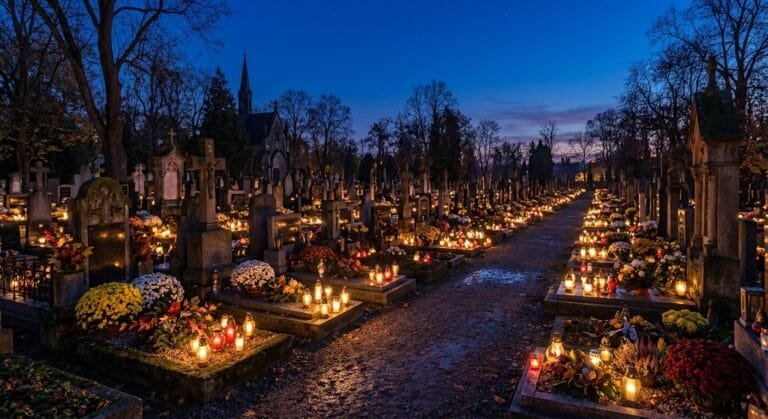
At the beginning of November, Czech cemeteries turn into a sea of light: thousands of candles, fresh chrysanthemums, wreaths, and quiet prayer. Dušičky — the popular name for the Commemoration of All the Faithful Departed (All Souls’ Day) — falls every year on November 2 and belongs among the most deeply rooted traditions of the Czech lands. But what does this day really mean? Why do we light candles, what does the Church teach about purgatory, and how exactly should we pray for the dead — for our parents, for those who died recently, and for those whom no one remembers anymore? In this guide you will find the history of Dušičky, their symbolism, the Church’s teaching, and concrete prayers for the dead that you can pray today.
1. What Dušičky Are and What They Mean
Dušičky, officially the Commemoration of All the Faithful Departed (Latin In commemoratione omnium fidelium defunctorum), is the day when the Church prays for the souls of all the dead who, according to Catholic faith, are still being purified in purgatory before they can enter heaven. The heart of this day is the conviction that the prayer of the living can truly help the dead — that love is stronger than death, and that our prayer, the sacrifice of the Mass, and almsgiving can ease the souls on their journey.
Dušičky is not a public holiday in the Czech Republic (unlike September 28), yet millions of people visit the cemeteries — believers as well as those outside the Church. It is a day when families gather at the graves of their loved ones and remember that death is not the final word of human life.
2. The Difference Between All Saints’ Day (Nov 1) and All Souls’ Day (Nov 2)
These two days are closely related, but their meaning is different:
• November 1 we celebrate the Solemnity of All Saints — we rejoice with all who are already in heaven: the canonized saints and the unknown saints of everyday life.
• November 2, on All Souls’ Day, we pray for all the other dead — especially for the souls who, according to Catholic teaching, are still being purified in purgatory.
• Simply put: on November 1 we celebrate those who are in heaven; on November 2 we pray for all the rest.
To these days also belongs the evening of October 31 — the vigil of All Saints’ Day, from which today’s commercial Halloween descends. Originally, however, it was the Celtic feast of Samhain, the end of summer and the beginning of the Celtic new year.
3. The History of Dušičky: From Samhain to Cluny
The roots of Dušičky reach deep into pre-Christian Europe. On the night of October 31 to November 1 the Celts celebrated Samhain — a time when, according to tradition, the souls of the dead return home. Relatives lit their way to the underworld with lanterns carved from turnips; to protect themselves from evil spirits, people disguised themselves in rags and painted their faces. Among the pagan Slavs, too, there existed ritualized celebrations and feasts held directly at burial sites in honor of the departed ancestors.
The Christian Dušičky in its present form was established in the year 998 by the Abbot of Cluny, Saint Odilo (†1048), who deliberately sought to Christianize the pagan tradition of remembering the dead. From Cluny the celebration spread through all Benedictine monasteries, and in the 13th century Rome adopted the commemoration of November 2. In the 15th century in Aragon, Dominican priests began to celebrate three Masses on this day; this custom was confirmed by Pope Benedict XIV (1748) and extended to priests in Spain, Portugal, and Latin America. In 1915 Pope Benedict XV permitted all priests to celebrate three Masses — one for the Pope’s intention, one for the souls in purgatory, and one for another intention. In that same period the processions to the cemeteries and the decorating of graves became established as we know them today.
4. Purgatory and Prayer for the Dead: What the Church Teaches
The heart of the religious content of Dušičky is faith in purgatory — a state in which the souls of the dead are purified from the consequences of sin before they can enter heaven. The prayer of the living helps them in this purification. This faith has deep roots: already in the Old Testament we find prayer for the dead (2 Maccabees 12:46: “It is therefore a holy and wholesome thought to pray for the dead, that they may be loosed from sins”), and the early Church prayed for the dead from its very beginnings.
The Orthodox perspective: The Orthodox Church has prayed for the dead since antiquity — it serves the panikhida (memorial service), commemorates the dead at the Divine Liturgy, and prays especially on the 3rd, 9th, and 40th day after death and on anniversaries. During the Paschal season a special commemoration of the dead called Radonitsa is served. Prayer for the dead is thus not the privilege of one confession, but a common treasure of the Christian East and West.
5. Traditions and Symbols of Dušičky
Visiting the cemetery is the chief custom of Dušičky: families clean and decorate the graves of their loved ones, lay wreaths and flowers, and light candles. Each symbol has its meaning:
• The candle is the heart of the whole feast: it represents the light of eternal life and the Resurrection of Christ. We light it not only as an honor, but with the faith that its light illumines the way of the souls out of darkness and gives them hope and peace.
• The wreath, without beginning or end, is a symbol of life that does not end with death.
• Chrysanthemums are the traditional All Souls’ flower — they bloom precisely at this season and in many cultures symbolize eternity and reverence.
• Cleaning the grave is a practical expression of love: caring for the grave is a sign that we do not forget the dead.
Folk customs and beliefs: according to one Czech folk belief, on the eve of Dušičky the souls used to rise from purgatory to rest from their suffering — so people filled oil lamps with butter and prepared cold milk so the souls could refresh themselves. Special bone-shaped pastries, called “dušičky,” were baked and given to the poor with a request to pray for the dead. Although these customs survive today only in memory, they remind us how deeply this day was rooted in the everyday life of our ancestors.
6. Indulgences for the Souls in Purgatory
According to Catholic teaching, the faithful who in the first days of November (especially from November 1 to 8) visit a cemetery, pray for the dead, and fulfill the prescribed conditions (Sacrament of Reconciliation, Holy Communion, and prayer for the Pope’s intention) can gain a plenary indulgence, which they can offer for the souls in purgatory. This is one of the most concrete spiritual gifts we can give the dead — and a tradition going back to the Middle Ages, when All Souls’ indulgences and alms for the poor who prayed for the souls were granted.
7. Prayers for the Dead: What to Pray on All Souls’ Day
Here are the most important prayers you can pray on All Souls’ Day — at the grave, in church, or at home:
1. Eternal Rest (Requiem aeternam) — the basic prayer for the dead:
“Eternal rest grant unto them, O Lord,
and let perpetual light shine upon them.
May they rest in peace.
Amen.”
Latin: Requiem aeternam dona eis, Domine, et lux perpetua luceat eis. Requiescant in pace. Amen.
2. Psalm 130 (De profundis) — the penitential psalm the Church prays for the dead:
“Out of the depths I cry to you, O Lord;
Lord, hear my voice!
Let your ears be attentive to my pleading voice!
If you, O Lord, keep a record of sins,
who can stand?
But with you there is forgiveness, so that you may be revered.
I wait for the Lord, my soul waits,
and in his word I put my hope;
my soul waits for the Lord
more than watchmen wait for the morning.
Yes, more than watchmen wait for the morning,
Israel waits for the Lord.
For with the Lord there is steadfast love,
and with him is plentiful redemption.
He will redeem Israel from all its iniquities.”
3. Prayer for deceased parents:
“O God, from whom all fatherhood and all motherhood proceeds, we thank you for our parents (names), who gave us life and love. Forgive them all in which they failed as human beings, and receive them into your light. Reward them for every sacrifice they made for us, and grant them eternal rest. And help us to live so that one day we may meet again in your heavenly home. Amen.”
4. Prayer for one who died recently:
“Merciful Father, receive the soul of your servant (name), whom you have called from this world. Wash it from every stain, forgive all committed out of human weakness, and grant it a share in eternal light. Comfort us who remain, and give us faith that we shall meet again. Eternal rest grant unto him/her, O Lord, and let perpetual light shine upon him/her. Amen.”
5. Short prayer (suitable when lighting a candle):
“Lord Jesus Christ, you rose from the dead and opened for us the gate of life. May the light of this candle shine upon the souls of our departed on their way to you. Eternal rest grant unto them, O Lord. Amen.”
8. Prayer for the Dead in the Orthodox Tradition
The Orthodox Church prays for the dead as fervently as the Western Church, but with its own rites:
• Panikhida — the memorial service, served at the grave and in the church; at its heart is the prayer “Memory Eternal” (Věčnaja pamjat’).
• Commemoration at the Divine Liturgy — the priest takes particles from the prosphora for the dead with the words “Remember, O Lord, the soul of your departed servant…”
• Special days of commemoration: the 3rd day (the soul takes leave of the earth), the 9th day, the 40th day (according to ancient tradition the decisive day for the soul’s fate), and anniversaries.
• Radonitsa — the Paschal commemoration of the dead, when the Church brings the joy of the Resurrection even to those who have departed.
In Orthodoxy, too, the prayer, grace, and alms of the living help the dead; a special place belongs to the prayer “Lord Jesus Christ, have mercy on us,” with which the faithful pray also for their departed ancestors.
9. How to Observe Dušičky in Practice: Step by Step
1. Clean and decorate the grave — the very care of the grave is a prayer of the hands.
2. Light a candle — let it be a moment of silence, not merely a ritual; say the name of your departed loved one as you do.
3. Pray — at the grave, the Eternal Rest or Psalm 130; at home you can pray the full prayer for parents or the departed.
4. Attend a Mass for the dead — the Mass is, according to Catholic faith, the most powerful help for the souls; you can also have one offered for a specific deceased person.
5. Remember also those whom no one remembers — the old All Souls’ tradition commands prayer also for the abandoned souls; it is one of the most beautiful works of mercy.
6. Do a work of mercy — almsgiving for the dead has, according to tradition, special value.
10. Dušičky and the Loss of a Loved One: Spiritual Comfort
For those who have lost a loved one this year, the first Dušičky are often the most painful. The Church offers not only prayer but also the comforting certainty: death is not the end, but a passage. As the ancient Christian prayer says: “Life is changed, not taken away.” The first All Souls’ evening is often the hardest — and that is precisely why it is good to be at the grave, light a candle, and say the name of the departed aloud. This is not an escape from pain, but surrendering it into the hands of the One who has power even over death.
If you are going through deep grief, a classic story of the journey of faith may also help: Honest Tales of a Pilgrim to His Spiritual Father — a book about how the prayer of the heart transforms pain into hope.
Frequently Asked Questions (FAQ)
When is All Souls’ Day in 2026?
Dušičky falls on Monday, November 2, 2026. The date is fixed — every year on November 2, the day after the Solemnity of All Saints.
Is Dušičky a public holiday?
No. In the Czech Republic, Dušičky (like All Saints’ Day) is not a public holiday, yet millions of people visit the cemeteries. The only public holiday in this period is October 28.
What is the difference between All Souls’ Day and All Saints’ Day?
On November 1 (All Saints’ Day) we celebrate those who are already in heaven; on November 2 (All Souls’ Day) we pray for the dead who, according to Catholic teaching, are still being purified in purgatory.
Why are candles lit on All Souls’ Day?
The candle is the symbol of the light of eternal life and of Christ’s Resurrection. We light it as an honor to the departed and with faith that its light shines upon the way of the souls out of darkness and gives them hope.
Which flower should I bring to the grave?
The traditional All Souls’ flower is the chrysanthemum, which blooms precisely at the beginning of November; evergreen wreaths and autumn flowers are also common. More important than the kind of flower is the care and remembrance we give to the graves.
How should I pray for the dead?
The most basic prayer is: “Eternal rest grant unto them, O Lord, and let perpetual light shine upon them. May they rest in peace. Amen.” Psalm 130 (De profundis) and the other prayers in section 7 of this article are also suitable; according to Catholic faith, the most powerful help is a Mass offered for the deceased.
What are indulgences for the dead?
According to Catholic teaching, the faithful who in the first days of November visit a cemetery, pray, and fulfill the prescribed conditions can gain a plenary indulgence and offer it for the souls in purgatory as spiritual help on their journey.
How do Orthodox Christians commemorate the dead?
The Orthodox Church serves the panikhida (memorial service with the prayer “Memory Eternal”), commemorates the dead at the Liturgy, and especially on the 3rd, 9th, and 40th day after death and on anniversaries; the Paschal commemoration of the dead is called Radonitsa.
Sources and Recommended Links
This article is based on the following sources:
1. Wikipedia: Dušičky (All Souls’ Day) — history, customs, and context of the feast: cs.wikipedia.org/wiki/Dušičky
2. Kudyznudy.cz: Památka zesnulých neboli Dušičky — the Czech tradition of remembering the dead: kudyznudy.cz
3. Marianne.cz: Kulturní poklady dušiček — traditions that keep the memory alive: marianne.cz
4. Autorskeperky.com: Dušičky — traditions and symbolism of November 2: autorskesperky.com
5. The Bible, 2 Maccabees 12:46 — the Old Testament foundation of prayer for the dead.
Related reading: Saint Wenceslas: Life, Prayer, and Feast Day; Honest Tales of a Pilgrim to His Spiritual Father.