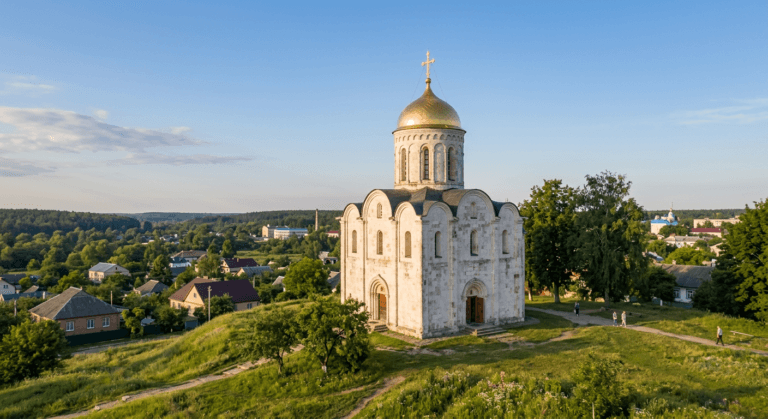
The Ovruch St Basil Monastery is a women’s community in the town of Ovruch in the Zhytomyr region, restored in 1991. Its heart is the renowned St Basil Church — a unique monument of pre-Mongol Rus, built around 1190 by Prince Ruryk Rostyslavych and restored at the beginning of the 20th century by the famous architect Oleksii Shchusev, with the participation of Emperor Nicholas II. [1][2]
Briefly about the monastery
- Name: Ovruch St Basil women’s monastery. [1]
- Address: Ovruch town, Zhytomyr Oblast. [1][2]
- Heart of the house: the St Basil Church, built around 1190. [1]
- Monastery founded: 1910 (a women’s community at the church). [1]
- Restoration: 1991 (after its closure in 1929 and subsequent persecution). [1]
- Status of the church: a monument of architecture of national significance. [1]
Legend and the founding of the church
According to the widespread church tradition, the first wooden church at this site was erected in 997 by Prince Volodymyr Sviatoslavych, who received the name Vasyl at baptism. The church was dedicated in honour of the prince’s baptismal name. [1][3]
Almost two centuries later, around 1190, Prince Ruryk Rostyslavych (baptized Vasyl) built in his feudal domain of Ovruch a masonry palace church on the site of the earlier wooden one. This is confirmed by a graffito found on the wall with a date corresponding to 1192. [1]
The masonry church was raised by Kyivan masters under the leadership, probably, of the prince’s court architect Petro Milonih. The church was part of the prince’s palace complex. At first the dome was gilded, which is why the people called the church “Zolotoverkha” (golden-topped). [2][3]
Destruction and wooden successors
The church suffered destruction many times, the last being in 1321 — at the hands of the army of the Grand Duke of Lithuania Gediminas. [1]
Among the ruins a wooden church was built in the 16th century, which soon burned down. The next wooden church, built on the same spot, was later dismantled because of its age (according to different sources, in 1734 or 1784). [1][3]
In 1842, during excavations, the vaults of the ruins of the pre-Mongol church collapsed. Three apses and a part of the north wall with an arch remained of it. [1]
The revival of the ancient shrine
In 1904, on the initiative of the Archbishop of Volyn and Zhytomyr Antoniy (Khrapovytsky), the Volyn diocesan brotherhood petitioned for the reconstruction of the St Basil Church. At the same time, by a decision of the Most Holy Governing Synod, the architect Oleksii Shchusev (then still unknown) was engaged, whose project was approved in 1908. [1][2]
Emperor Nicholas II approved the project and donated 10 thousand rubles of his personal funds for its implementation. The restoration was carried out in 1907–1911 with the participation of Shchusev’s assistants — architects among whom were V. Maksymov and, by some accounts, Mykola Rerikh. [1][2]
The founding of the women’s monastery
Already in 1904 the Zhytomyr Volodymyr-Vasylivske brotherhood resolved to establish a women’s monastic community at the church of St Basil, which would promote the speedy reconstruction of the ancient shrine. [4]
In 1910, the Ovruch St Basil women’s monastery was formed at the church. Beside the church, by the project of O. Shchusev and V. Maksymov, a two-storey masonry cell building with a bell tower was built. [1][2]
On 3 September 1911 the St Basil Church was solemnly opened with the participation of Nicholas II, who personally cared for the reconstruction of the church. In 1910, for a successful and original restoration of the church in Ovruch, O. Shchusev was awarded the title of academician of architecture. [1][2]
Persecution and restoration in the 20th century
The monastery was liquidated in 1929. In 1934 a warehouse was arranged in the closed St Basil Church. In 1941 the monastery resumed activity, and in 1947 the parish community returned the St Basil Church to the monastery. However, in 1958 the nuns were expelled from the house again and the monastery was closed. [1][2]
In 1963 the St Basil Church was declared a monument of architecture of republican (now national) significance. In 1984 restoration work was carried out in it. In 1990 the church was consecrated and services resumed, and the women’s monastery was restored in 1991. [1]
Architectural significance
The St Basil Church in Ovruch represents the beginning of the formation in the Dnieper region of a new architectural style at the final stage of Old Rus architecture before the Mongol-Tatar invasion. This style is consonant with European Gothic yet is based on the Byzantine heritage. [1]
The church is a five-bayed structure. The painting of the new church was done by the artist Oleksandr Blaznia; fragments of ancient frescoes are preserved. [2]
Practical information
- Address: Ovruch town, Zhytomyr Oblast. [1][2]
- Main shrine: the St Basil Church (around 1190) — a monument of architecture of national significance. [1]
- Monastery: women’s, restored in 1991. [1]
- How to get there: Ovruch is an historic town on the left bank of the Sluch in the north of Zhytomyr region. [2]
Frequently asked questions
When was the St Basil Church built?
Around 1190 by Prince Ruryk Rostyslavych on the site of a wooden church which, by tradition, was built in 997 by Volodymyr Sviatoslavych. [1][3]
Who restored the church?
The architect Oleksii Shchusev in 1907–1911; Emperor Nicholas II donated 10 thousand rubles and attended the consecration on 3 September 1911. [1][2]
When was the women’s monastery founded?
In 1910 at the rebuilt church; restored in 1991. [1][2]
What happened to the church under Soviet power?
In 1929 the monastery was liquidated and the church used as a warehouse; in 1990 services were resumed. [1]
Why is the church important?
It is a rare monument of pre-Mongol Rus, representing a new style at the boundary of Old Russian and Gothic architecture. [1]
Conclusion
The Ovruch St Basil Monastery with its St Basil Church is a union of Old Russian antiquity and national revival. From the church founded by Prince Volodymyr in 997 and rebuilt by Ruryk Rostyslavych around 1190, through destruction and Shchusev’s restoration at the beginning of the 20th century, to the women’s monastery restored in 1991 — a story of the indestructibility of a shrine that is reborn from the ruins every time. [1][2][3]