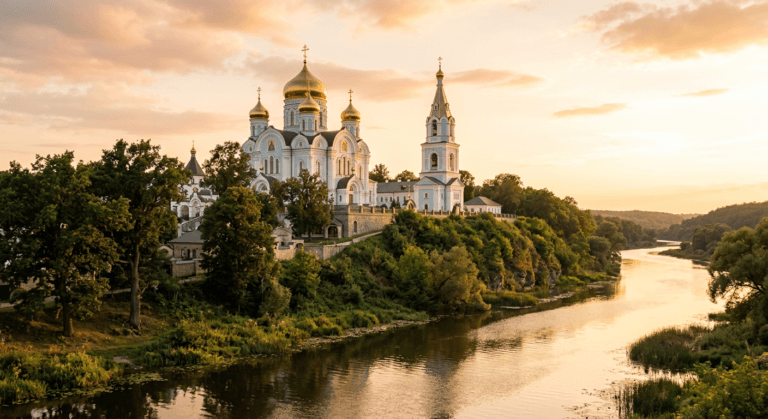
The Horodnytskyi St George Stauropegial Men’s Monastery stands on the bank of the Sluch river in the village of Horodnytsia, Zhytomyr Oblast. Its history runs from a wooden church of the 1774 and a women’s community of 1891 to a stauropegial monastery restored in 1994, whose chief shrine is the wonder-working icon of the Mother of God “Utaimy Moi Pechali” (“Sooth my sorrows”), brought from Mount Athos. [1][2][3]
Briefly about the monastery
- Full name: Horodnytskyi St George stauropegial men’s monastery. [2][4]
- Address: Horodnytsia village, Novohrad-Volynskyi district, Zhytomyr Oblast. [2][4]
- Status: stauropegial (since 1994). [2][4]
- Founded: a women’s community since 1891, a monastery in the 20th century. [1][4]
- Chief shrine: the icon of the Mother of God “Utaimy Moi Pechali”, brought from Mount Athos in 1903. [2]
- Brethren: about 40 monks and 46 nuns in the nearby women’s community. [4]
On the bank of the Sluch
The village of Horodnytsia is on the high bank of the Sluch river in the north of the Novohrad-Volynskyi district of the Zhytomyr region. The monastery has stood here for centuries, and the history of the St George parish goes deep into the past. [1][4]
Documents of the 16th–17th centuries testify that the ancient St George’s church stood in Horodnytsia. During the Northern War it was destroyed. [1]
The wooden church and the community of 1891
In 1774 (according to some sources 1744) a wooden St George’s church was built in Horodnytsia. Later, in 1891, a women’s community was formed at it. [1][3]
The community distributed grain, ran a church-parish school, and the sisters took care of the church and the cemetery. [1]
The building of the cathedral
On 6 May 1903 the St George’s Cathedral was built and consecrated at the expense of the landowner H. Hyzhytskyi. [1][3]
In those years about 10 nuns lived in the community; they kept a school and a farm. The main church of the cathedral is a five-bayed structure. The church was built in the Russian-Byzantine style and topped with a belfry. A side-altar of the church is dedicated to the holy Symeon the Stylite. [1][3][4]
The revival of 1979
In 1923 the St George’s church was closed and desecrated. During the war, in 1945, by the efforts of the believer community, the church was restored and services resumed, and the community was registered. [1][4]
In 1979, when the authorities banned the creation of new Orthodox communities, a secret revival of the monastery took place here. The community was revived by the monk Oleksandr, later archbishop of Horodnytsia, who now lives at the Horodnytskyi monastery. [1][4]
The stauropegial monastery
On 23 November 1989 the monastery was opened as a settled community. Then the monastery had a small church and it was not yet possible to say that it was a separate settlement — but the seeds were sown. [1][4]
By decision of the Holy Synod of the UOC, in 1994 the monastery was granted stauropegial status — it was proclaimed a stauropegial monastery in the direct administration of the Primate of the Ukrainian Orthodox Church. The well-known Metropolitan Volodymyr (Sabodan) blessed this decision. [1][2][4]
In 1995 a cell building was erected and in 1997 a warm church was built and consecrated. [4]
The chief shrine — “Utaimy Moi Pechali”
The chief shrine of the monastery is the wonder-working icon of the Mother of God “Utaimy Moi Pechali” (“Sooth my sorrows”). It is a copy of an Athonite icon. The icon was brought in 1903 by a cross procession from Novohrad-Volynskyi to the St George’s church in Horodnytsia. [2]
In 1923, when the church was closed, the wonder-working icon disappeared. But in 1944 it was found and returned to the house. [2]
The anniversary of 2003
On 6 May 2003 a grand celebration was held in Horodnytsia on the occasion of the centenary of the consecration of the St George’s Cathedral. The Divine Liturgy was led by the monks of the house together with the Metropolitan of Zhytomyr and Novohrad-Volynskyi. To this celebration the icon of the Mother of God “Utaimy Moi Pechali” was brought to the cathedral in the monastery. [4]
That day a memorial church on the ruins was also consecrated — in remembrance of all who suffered in the terrible years of persecution for their faith. [4]
Present life
Today the Horodnytskyi monastery has about 40 monks and, in the nearby women’s community, 46 nuns. The monastery is a stauropegial house in the direct administration of the Primate of the UOC. [1][4]
The monastery’s churches are consecrated in honour of the Protection of the Mother of God, a warm church, and the Dormition church; the hermitage of the monastery is the Dormition convent. [4]
Practical information
- Address: Horodnytsia village, Novohrad-Volynskyi district, Zhytomyr Oblast, on the bank of the Sluch. [2][4]
- Status: stauropegial monastery of the UOC. [2][4]
- Chief shrine: the wonder-working icon of the Mother of God “Utaimy Moi Pechali” from Mount Athos. [2]
- How to get there: the village of Horodnytsia on the high bank of the Sluch, in the north of the Zhytomyr region. [4]
Frequently asked questions
When was the church built?
In 1774 (by some sources 1744) a wooden St George’s church was built; the cathedral in masonry was consecrated on 6 May 1903. [1][3]
When was the community formed?
In 1891, a women’s community at the St George’s church. [1][3]
When did the monastery become stauropegial?
In 1994, under the blessed leadership of Metropolitan Volodymyr (Sabodan). [1][2][4]
What is the chief shrine?
The wonder-working icon of the Mother of God “Utaimy Moi Pechali”, brought from Mount Athos in 1903 and found again in 1944. [2]
How many monks live here?
About 40 monks in the house and 46 nuns in the nearby women’s community. [4]
Conclusion
The Horodnytskyi St George Stauropegial Men’s Monastery is a living story of revival. From the St George’s church destroyed in the Northern War, through the wooden church of 1774, the women’s community of 1891, the cathedral of 1903, the secret revival of 1979 and the stauropegial status of 1994 — it is one of the most significant spiritual centres of the Zhytomyr region, guarded by the wonder-working Athonite icon “Utaimy Moi Pechali”. [1][2][3][4]