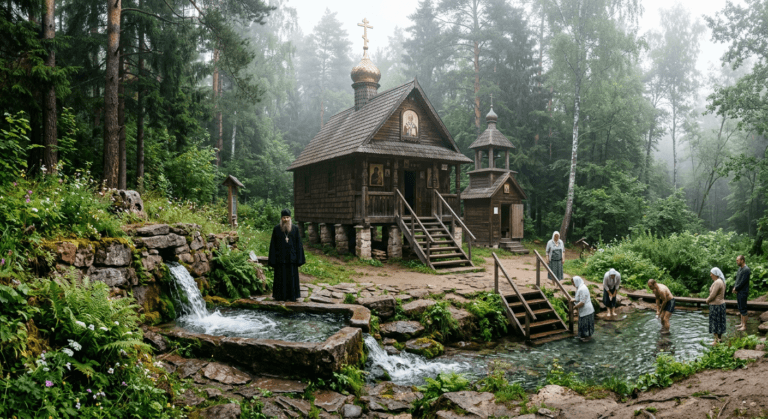
The Men’s Monastery of the Kazan Icon of the Mother of God is a community in the Kypiache tract in Polissia, about four kilometres from the settlement of Chopovychi in the Malyn district of the Zhytomyr region, on the left bank of the Irsha river. The place owes its name to a wonder-working spring beside which, in 1911, the Kazan Icon of the Mother of God appeared, and the water gushed forth so strongly that it seemed to “boil”. The house was founded in 1917, destroyed in 1934 and revived by a decision of the Holy Synod of 2002. [1][2]
Briefly about the monastery
- Full name: men’s monastery in honour of the Kazan Icon of the Mother of God (St Kazan). [1][2]
- Address: the Kypiache tract, near the settlement of Chopovychi, Malyn district, Zhytomyr Oblast. [2]
- Founded: 1917 (then the Transfiguration of the Saviour). [1][2]
- Revival: a decision of the Holy Synod of the UOC of 27.12.2002. [2]
- Chief shrine: the wonder-working spring and the place of the appearance of the Kazan Icon. [1][2]
- First abbot: Igumen Kostiantyn (Chopovskyi), an Athonite monk. [2][3]
The miracle at the Kypiache spring
By tradition, in 1911 two shepherds found in a spring of the Kypiache tract an icon with the Kazan image of the Mother of God. The icon did not soak in the water and from it shone light. The shepherds did not dare to take the shrine into their hands and asked a priest from the village of Chopovychi for advice; he, after serving a moleben, solemnly transferred the image to the church. [1][2]
During the appearance of the icon the water in the spring gushed forth with such force that it seemed to boil — for that reason the place was called “Kypiache”. [3]
After this event the water in the spring became healing. The memory of this miracle began to be celebrated on the tenth Friday after Easter. The fame of it spread across Polissia and reached the most remote corners of the Russian Empire. [1]
The founding of the house (1917)
In 1917, in the Kypiache tract, five kilometres from the village of Chopovychi, the Transfiguration of the Saviour (now Kazan) men’s monastery was founded by the efforts of local peasants. [1]
On 28 August 1918 Metropolitan of Kyiv and Halych Antoniy (Khrapovytsky) blessed its opening, suggesting that the house become an Athonite metochion. The first abbot was Igumen Kostiantyn (Chopovskyi), who had toiled for many years on the Holy Mountain and ordered the life of the community after the traditions of Athonite monasticism. [2]
In those hungry and hard years peasants of near and far villages supported the young monastery in every way. Monks and novices earned by their labour to support it and to help the needy. At the house they organized an orphanage for children from poor families, in which the pupils were taught crafts and the rudiments of the Christian life. A wooden church of the Beheading of St John the Baptist and monastic cells were built. [2][3]
The tragedy of 1921
On the night of 1–2 September 1921 (the 14th to the 15th in the new style) a band of 16 people attacked the house. In the church of the Beheading of St John the Baptist the bandits shot the Igumen Kostiantyn, the monk Iraklii (Skuativskyi) and the novice Petro Shchuka, wounded the watchman Yevhen Volkov, and then plundered and burned the monastery. [1][2]
In the local tradition this event is connected with the band of the ataman Lysytsia. After this the monks of the Kypiache house restored it with their own hands — and this in the years when monasteries were being closed and destroyed. [1]
Closure and martyrdom
In 1934 the liquidation of monastic communities was under way across the whole country. In March of that year the Transfiguration monastery was closed: the church of the Kazan Icon of the Mother of God was dismantled brick by brick, and the spring was filled with sand and stones, with the cross over it cut down. Monks were forbidden to live in the neighbouring villages. In 1937–1938 some of the inhabitants of the monastery accepted the martyr’s crown for Christ. [1][2]
However, the spring broke through the ruins, though no longer so violently. Human memory preserved what Soviet power vainly tried to erase. [3]
Revival (from 2002)
At the end of the 1990s the house revived. Old residents remembered this place, and in 2000 the well was found and cleared. [4]
With the decision of the Holy Synod of the UOC of 27 December 2002 on the construction of the St Kazan men’s monastery in the Kypiache tract, the revival of the house began. Archpriest Roman Baranovskyi, rector of the Kyiv St Michael’s church, took part in the creation of the new house. [2][3]
The monastic church stands on 12 pillars, laid of stone brought from Athos. In ascetic conditions — without conveniences, without light, sometimes without warm food — the men’s monastery in honour of the Kazan Icon of the Mother of God was revived. [3]
The spring and today
Today people from neighbouring villages and distant lands come to the wonder-working spring to draw and wash in its water. The water here always has a constant temperature — about plus four degrees all year. Beside the spring a bathing pool is arranged where everyone may immerse themselves. [4][5]
Here too is the icon of the Kazan Mother of God, before which prayers are read round the clock. In place of the old church a new one was built — wooden, small, but very beautiful. [5]
Practical information
- Address: the Kypiache tract, near the settlement of Chopovychi, Malyn district, Zhytomyr Oblast. [2]
- Chief shrine: the wonder-working spring and the place of the appearance of the Kazan Icon of the Mother of God. [1][2]
- Feast: the tenth Friday after Easter — the memory of the appearance of the icon. [1]
- How to get there: about 4 km from the settlement of Chopovychi, on the left bank of the Irsha river. [3]
Frequently asked questions
When did the icon appear in Kypiache?
In 1911 a Kazan image of the Mother of God was found in a spring; after that the water of the spring became healing. [1][2]
When was the monastery founded?
In 1917 as Transfiguration of the Saviour; in 1918 Metropolitan Antoniy blessed the transformation of it into an Athonite metochion. [1][2]
What happened in 1921?
A band attacked the house, killing the Igumen Kostiantyn and two inhabitants, wounding the watchman, plundering and burning the monastery. [1][2]
When was the monastery revived?
In 2000 the well was found and cleared, and in 2002 by a decision of the Synod of the UOC the men’s monastery was revived. [2][4]
What is special about the spring?
The water is healing and keeps a constant temperature of about +4 °C all year; beside the spring there is a bathing pool. [4][5]
Conclusion
The Monastery of the Kazan Icon of the Mother of God in Kypiache is a story of faith breaking through obstacles like water through a spring blocked by stones. From the appearance of the icon in 1911 and the founding of the house in 1917, through the tragedy of 1921, the closure of 1934 and the martyrdom of 1937–1938, to the revival of 2002 — this holy place of Polissia remains a living spring of hope and healing. [1][2][3]