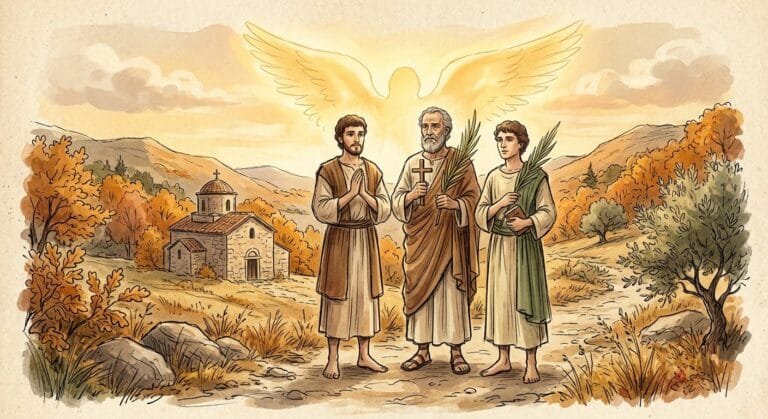
Every day, millions of believers ask: what holiday is today according to the Church calendar, what folk signs and customs belong to the day, what is forbidden, whose name day is being celebrated, and which prayer will help us ask God for protection. September 19 is a day of martyrs and a passion-bearing prince in the Orthodox calendar (new style / revised Julian calendar): the Church commemorates the Holy Martyrs Trophimus, Sabbatius, and Dorymedon — three confessors of the third century from Phrygia who did not renounce Christ even before the wild beasts — and Blessed Great Prince Igor of Chernihiv and Kyiv, a prince-monk who died for the faith in 1147. It is also the date that millions of people still search for as the Miracle of the Archangel Michael — we explain why, according to the new calendar, this feast now falls on September 6, and what folk traditions are connected with it. This complete guide tells the lives of the saints of the day, the traditions of Michael’s Day, and provides the canonical prayer texts.
Understanding the liturgical year helps us realize that every day is dedicated to a particular saint or a key Gospel event. Our ancestors always began the day with prayer, because prayer is the key to peace of soul. When we say the Lord’s Prayer or turn to the holy martyrs in the morning before work, or in the evening to quiet our hearts, we place our minds under God’s care and calm our souls before life’s worries and anxieties. The martyrs Trophimus, Sabbatius, and Dorymedon remind us: faithfulness to Christ does not depend on circumstances — it either is, or it is not.
To strengthen your faith and your spiritual watchfulness (nepsis) amid daily temptations, we invite you to the spiritual treasury of the Christian East: the Philokalia (Dobrotolyubiye), where the Holy Fathers teach how to stand in faith to the end.
The Orthodox Feast of September 19: Martyrs Trophimus, Sabbatius, and Dorymedon
The Lives of the Three Confessors of Synnada
The holy martyrs Trophimus, Sabbatius, and Dorymedon lived in the third century in the Phrygian city of Synnada (on the territory of present-day Turkey), in the time of the persecutions of the Christians. Once, during a pagan festival, they openly confessed themselves Christians and refused to offer sacrifice to the idols. They were arrested and subjected to cruel tortures, being demanded to renounce their faith, but the confessors remained unshaken [1][2].
Then the martyrs were thrown to wild beasts — but the beasts did not touch the saints. Finally Trophimus, Sabbatius, and Dorymedon were killed with spears, and they entered the Kingdom of Heaven as victors. The Church calls them martyrs, that is, witnesses: their death became a testimony that the grace of Christ is stronger than any fear [1][2].
Blessed Prince Igor of Chernihiv and Kyiv (†1147)
On the same day the Church commemorates Blessed Great Prince Igor of Chernihiv and Kyiv. Prince Igor Olgovich was for a short time Grand Prince of Kyiv, and after being removed from power he took monastic vows in the Kyiv-Pechersk Lavra, devoting the rest of his life to prayer and repentance. In 1147, during a popular uprising in Kyiv, he was killed, although he no longer had any political ambitions and was already a monk. The Church venerates Prince Igor as a passion-bearer — one who met death with Christian humility, not answering evil with evil [2][3].
The Miracle of the Archangel Michael: Why September 19 Is No Longer the Archangel’s Day
For many years, September 19 was one of the most beloved folk feasts — the Commemoration of the Miracle of the Archangel Michael at Chonae (Michael’s Miracle). According to tradition, in the fourth century, near the city of Colossae (Chonae), the pagans wanted to destroy a Christian church by directing river streams against it. The righteous Archippus, who served in the church, began to pray to the Archangel Michael — and the Archangel appeared, struck the mountain with his staff, opened a wide cleft, and directed the water into it, saving the church. From that time the place was called “Chonae,” which means “cleft” [4][5].
However, since September 2023, when the Orthodox Church of Ukraine moved to the revised Julian calendar, all fixed feasts have shifted thirteen days earlier. Therefore Michael’s Miracle is now celebrated on September 6, not on September 19 as it was according to the old style [4]. If you were looking for the feast of the Archangel Michael specifically — it is at the beginning of the month, and we have already prepared a large article about it: the Miracle of the Archangel Michael at Chonae — September 6. The folk traditions described below, however, lived for centuries precisely on September 19, and so many families still recall them on this day.
Folk Traditions of Michael’s Day: What People Did and What They Avoided
Michael’s Day in folk tradition was considered a strict and at the same time generous feast. The faithful went to church, lit a common candle, and served a prayer service (moleben) to the Archangel Michael, bringing pies with various fillings to the church. On this day it was customary to make peace and visit one another, for the Archangel Michael does not tolerate enmity and lies [5][6].
What Is Forbidden in the Folk Tradition of Michael’s Day
- Do not work or do household chores — sewing, washing, cleaning; the folk saying ran: “You must not work on Michael’s Day — God will punish” [5][6].
- A special prohibition concerned cutting objects: one should not cut, chop, or split [5].
- Do not quarrel, scandalize, deceive, swear, or wish evil on others — the negativity of this day comes back a hundredfold [5][6].
- Do not wash your hair — according to belief, you may “wash away your mind” [6].
- Do not throw away the leftovers from the table — they were given to the needy or to animals [5][6].
- Avoid lending money and making financial transactions, and spending large sums [6].
- It was forbidden to work the ground, dig potatoes, chop firewood, or gather blueberries [6].
- Do not refuse help to those who need it [4].
The Signs of Michael’s Day
- After Michael’s Day come the first frosts — the folk called them “Michael’s frosts”; they said: “The Archangel Michael has seized the earth with frost” [5][6].
- If there is frost on the trees in the morning — the winter will be snowy [6].
- If the leaves on top of the birch are still green — an early winter [6].
- Warm weather on Michael’s Day — the autumn will be long [6].
- Blue clouds in the evening — a change of weather [6].
- Morning fog — warm weather [5].
People also believed that on Michael’s Miracle any sincere request could be granted, and so they asked for the most important things: the health of their loved ones, prosperity in the home, and protection from all evil [6].
The Catholic Feast of September 19: Saint Januarius and the Miracle of the Blood in Naples
On September 19 the Roman Catholic Church celebrates the feast of Saint Januarius (San Gennaro), Bishop of Benevento, martyred around 305 during the persecution of Diocletian. According to tradition, during his execution the beasts did not touch him, and he remained unharmed when thrown into the fire. The most famous miracle connected with him still takes place in Naples: several times a year, including on his feast day, in a special reliquary the dried blood of the martyr becomes liquid — and thousands of people gather in the cathedral to see it with their own eyes. On the same day Catholics also recall the apparition of the Mother of God at La Salette (France, 1846).
The Spiritual Laws of This Day: Faithfulness and Reconciliation
The law of faithfulness. Trophimus, Sabbatius, and Dorymedon could have simply kept silent — and survived. But they knew: a silent betrayal of Christ destroys a person from within more than any torture. For us today this means: in every small situation where we could “lie a little for profit,” we choose either faithfulness or the loss of ourselves.
The law of reconciliation. On Michael’s Day our ancestors made peace and visited one another, for the Archangel Michael does not tolerate enmity. This is a very Gospel rule: “If you are offering your gift at the altar and there remember that your brother has something against you, first be reconciled to your brother” (cf. Matthew 5:23–24). If there is a person with whom you are at odds, this day is a good time to take the first step.
The law of Prince Igor: evil is not conquered by evil. Prince Igor could have fought for power to the end — but he chose the monastery, prayer, and finally met death without resistance. His path reminds us: sometimes the hardest and bravest battle is the battle not to become bitter.
Hesychast Watchfulness: Prayer as the Sword of the Archangel
The hesychast Fathers often compared the Jesus Prayer to a sword: it cuts off thoughts before they take root in the heart. The Archangel Michael, commander of the angelic hosts, is the image of how the heavenly power protects the praying soul. The venerable Fathers counseled: when anxiety or an attack of dark thoughts comes, stand inwardly like a warrior and speak the name of Jesus rhythmically, with your breath — and the darkness will retreat, as it retreats before a flame [7].
The practice of prayer with the chotki on this day is simple:
- Take your prayer rope and say 33 knots of the Jesus Prayer: “Lord Jesus Christ, Son of God, have mercy on me, a sinner.”
- Add a petition for protection: “Archangel Michael, defend us from all evil.”
- Dedicate one round of the prayer rope to a prayer of reconciliation — for those with whom you are at odds.
- Finish with thanksgiving: “Glory to You, O our God, glory to You.”
The short prayer of the day. “Holy martyrs Trophimus, Sabbatius, and Dorymedon, you feared neither tortures nor beasts — strengthen my faith too. Blessed Prince Igor, you met death without bitterness — teach me not to become bitter. Archangel Michael, protect my home and my family from all evil. Amen.”
Common Prayer on September 19 on Pray.ee
Prayer offered together has a special power: “For where two or three are gathered together in My name, there am I in the midst of them” (Matthew 18:20). On this day, invite your family to common evening prayer — even for a few minutes, even with one Lord’s Prayer. And if possible, gather around the table with neighbors or relatives, as the folk tradition of the day teaches: a common meal without quarrels is also a form of prayer.
On our prayer portal Pray.ee you can leave your prayer intention in the comments under this article — and the community of believers will pray for you and your loved ones. Write down whom or what you ask prayer for: for protection from evil, for reconciliation in the family, for health, for overcoming enmity. Do not remain alone with your cares — in common prayer we bear one another’s burdens.
A Living Testimony: A Story from Our Community
“My brother and I did not speak for seven years — over an inheritance, over silly offenses. Last year, on Michael’s Day, our mother said: ‘Either you make peace, or don’t come to my doorstep.’ We met in her kitchen, and the first thing my brother said was: ‘Forgive me.’ We talked until evening, and then went together to church to light a candle. Now I know for certain: reconciliation does not require heroism — it requires only one step.”
If you have your own testimony of God’s help, share it in the comments on Pray.ee. Your word may be the very spark of faith that someone is missing right now.
The Canonical Prayers of September 19
Troparion to the Martyrs Trophimus, Sabbatius, and Dorymedon, Tone 4
Your martyrs Trophimus, Sabbatius, and Dorymedon, O Lord, in their sufferings received imperishable crowns from You, our God; for having Your strength, they overcame the persecutors and destroyed the feeble insolence of demons. By their prayers save our souls.
Prayer to the Holy Martyrs (for home use)
O holy martyrs Trophimus, Sabbatius, and Dorymedon, you did not betray Christ either by word or by silence, and with your blood you witnessed to the truth. Pray for us sinners: grant us courage to confess the faith in deed and word, steadfastness in temptations, and faithfulness to the end. Obtain for us forgiveness of sins and great mercy. Amen.
Prayer to Blessed Prince Igor of Chernihiv
Blessed Prince Igor, you exchanged a prince’s throne for a monk’s cell and met death with prayer, without bitterness toward those who killed you. Pray for us: teach us not to seek power above truth, not to answer evil with evil, and in all things to hold fast to Christ. Amen.
FAQ: Frequently Asked Questions About September 19
What church feast falls on September 19, 2026?
According to the new style, the Orthodox Church on September 19 venerates the holy martyrs Trophimus, Sabbatius, and Dorymedon (third century, Phrygia), and Blessed Great Prince Igor of Chernihiv and Kyiv (†1147). The Roman Catholic Church celebrates the feast of Saint Januarius, Bishop of Benevento.
Why is Michael’s Miracle no longer celebrated on September 19?
Since the Orthodox Church of Ukraine moved to the revised Julian calendar in September 2023, all fixed feasts have shifted thirteen days earlier. Therefore the Commemoration of the Miracle of the Archangel Michael at Chonae (Michael’s Miracle) is now celebrated on September 6, not on September 19 as it was according to the old style.
Who were the martyrs Trophimus, Sabbatius, and Dorymedon?
Three Christians of the third century from the Phrygian city of Synnada, who openly confessed Christ during a pagan festival. They were tortured and thrown to wild beasts, but the beasts did not touch the saints; then the martyrs were killed with spears.
What folk traditions are connected with September 19 (Michael’s Day)?
In the folk tradition, on this day people went to church for the prayer service, made peace and visited one another, and brought pies to the church. It was forbidden to work, quarrel, wash one’s hair, throw away leftovers, or lend money. After Michael’s Day people expected the first frosts — “Michael’s frosts.”
Who was Prince Igor of Chernihiv and Kyiv?
Prince Igor Olgovich, for a short time Grand Prince of Kyiv, who after being removed from power took monastic vows in the Kyiv-Pechersk Lavra. In 1147 he was killed during an uprising in Kyiv; the Church venerates him as a passion-bearer who met death with Christian humility.
Sources
- [1] 24 Kanal — Orthodox calendar for September 2026, new and old style (in Ukrainian)
- [2] UNIAN — Orthodox calendar of church feasts for September: dates by new and old style (in Ukrainian)
- [3] Chas.news — Church calendar for September: the main feasts of the OCU (in Ukrainian)
- [4] Znaj.ua — Michael’s Miracle will be celebrated on September 6: the OCU changed the date of the feast (in Ukrainian)
- [5] NV — Michael’s Miracle: traditions, prohibitions and signs of the feast (in Ukrainian)
- [6] Khochu — Michael’s Miracle: main traditions, prohibitions and signs of the feast of September 19 (in Ukrainian)
- [7] The Philokalia (Dobrotolyubiye) — Pray.ee