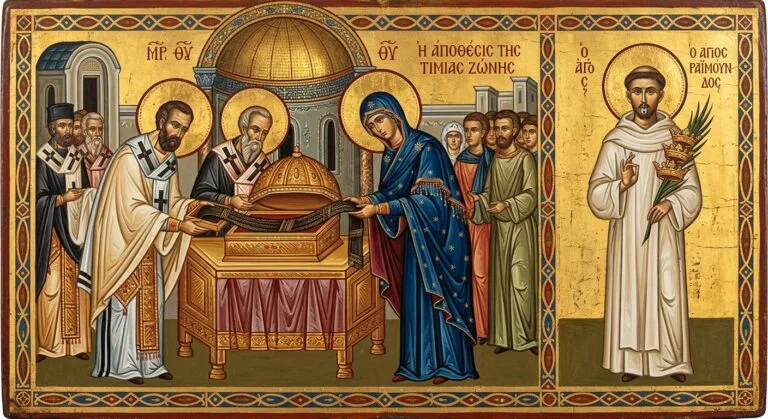
Every single day, millions of believers around the globe actively ask the essential question: what holiday is today in the official church calendar, what name days are celebrated, what traditional folk signs are associated with this day, and how can one employ a powerful, heartfelt prayer to obtain divine protection, health, and peace for the household. Dedicating our first thoughts of the day to the Savior acts as an anchor of quietude, enabling the soul to rise above the daily ocean of worries, anxieties, and debts. August 31 is an incredibly important, solemn, and highly revered day in both the Eastern Orthodox and Roman Catholic liturgical calendars. On this day, the entire Eastern Christian world celebrates the **Deposition of the Holy Belt (Cincture) of the Most Holy Theotokos** (Покладення чесного пояса Пресвятої Богородиці) and honors Saint Gennadius, Patriarch of Constantinople. Concurrently, the Western Catholic Church honors Saint Aidan of Lindisfarne and Saint Raymond Nonnatus — the beloved patron of pregnant women, safe childbirth, and newborns. This comprehensive guide deeply explores the biblical hagiography of these great saints, the cultural and folk traditions, clarifies popular misconceptions, examines fundamental spiritual laws of grace, and contains powerful canonical prayers.
Understanding the structure of the liturgical year helps us grasp that each day is dedicated to a specific saint or an essential salvation event. Our ancestors always began their days with prayer, as it is the key to mental rest. When we recite the Our Father or request the powerful intercession of the Virgin Mary before her Holy Belt in the morning before starting work or in the evening to quiet the soul, we establish a robust spiritual boundary around our family. Today we also recall the immense value of patristic wisdom for the daily sobering of our mind.
To strengthen your faith and mental sobriety (nepsis) amidst daily temptations, we highly recommend reading the Eastern Christian treasury of spirituality: The Philokalia translated into Ukrainian by S. Matiyash, where you will find invaluable patristic teachings on how to acquire inner peace.
1. Eastern Orthodox Feast — The Deposition of the Holy Belt of the Theotokos
In the Eastern Orthodox liturgical calendar, August 31 represents a significant feast day dedicated to one of the greatest Christian relics — the precious belt (cincture) of the Mother of God. According to tradition, this belt was handmade by the Virgin Mary herself from camel hair. Prior to her glorious Dormition, she presented it to Saint Thomas the Apostle, who arrived late to her burial, as a visible sign of her eternal protection and maternal blessing.
For several centuries, this relic was carefully preserved by devout Christians in Jerusalem. In the 5th century (during the reign of Emperor Arcadius), it was transferred to Constantinople and placed in a golden reliquary inside the magnificent Blachernae Church. In the 10th century (during the reign of Emperor Leo VI the Wise), his wife, Empress Zoe, fell severely ill with an incurable disease — tormented by evil spirits and physical paralysis. She had a vision that she would be healed if the Belt of the Theotokos was laid upon her. The Patriarch opened the reliquary, removed the incorrupt belt, and laid it upon the Empress, who was immediately cured. In thanksgiving, the annual celebration of the Deposition of the Holy Belt of the Virgin Mary was established on August 31. Today, portions of this holy belt are preserved in the Vatopedi Monastery on Mount Athos (Greece) and in Cyprus, working numerous miracles, especially for childless couples.
Saint Gennadius, Patriarch of Constantinople (peacefully reposed in 471 AD): Also on this day, the Church honors Patriarch Gennadius, who was famous for his great mercy, humility, and gentleness. He zealously purified the clergy from simony, worked miracles, and supported the poor. Through his prayers, an artistically gifted youth whose hand had withered due to sinful temptations received complete healing after performing public penance.
2. Roman Catholic Feast — Saint Aidan of Lindisfarne and Saint Raymond Nonnatus
In the Western Catholic liturgical tradition, August 31 is the day of remembrance for two great saints whose lives were models of evangelical love and mercy — Saint Aidan of Lindisfarne and Saint Raymond Nonnatus.
Saint Aidan of Lindisfarne (c. 590–651 AD): An Irish monk and missionary who became the first bishop of the island of Lindisfarne in Northumbria (England). Aidan was known for his extraordinary gentleness, modesty, and love for the poor. He traveled only on foot, preaching the Gospel to simple peasants, purchased freedom for slaves, established schools for children, and distributed all his property to the needy. He is considered the apostle of Northumbria and the patron saint of wild nature.
Saint Raymond Nonnatus (1204–1240 AD): A prominent Spanish saint from the Order of Mercedarians (defenders of captives). The nickname «Nonnatus» (*Non-natus*) means «unborn», as he was brought into the world by Caesarean section after the premature death of his mother. Raymond dedicated his life to ransoming Christian captives from Muslim captivity in North Africa. When he ran out of money, he voluntarily gave himself as a hostage in exchange for other captives. In captivity, he continued to preach Christ, for which his captors brutally tortured him and closed his mouth with an iron padlock, piercing his lips with a red-hot iron. Raymond is the patron saint of pregnant women, infants, safe childbirth, and those falsely accused or slandered.
3. What Not to Do on This Day — Traditions, Folk Signs, and Demystifying Superstitions
In traditional folklore, this day was considered the last day of summer. Peasants finished all field works, hay harvesting, and began active autumn preparations. This day was also called the «horse holiday» (honoring Saints Florus and Laurus under the old style calendar), when horses were freed from work, bathed, and treated with a special oat bread.
What is Strictly Forbidden to Do on August 31:
- Do not force horses or other working animals to labor — on this day, they must be given a complete rest and better feed, otherwise misfortune will strike the farm.
- Avoid arguing, slandering others, and spreading gossip — Saint Raymond Nonnatus suffered with a padlock on his lips, so speaking maliciously on this day can attract severe throat ailments.
- Do not borrow or lend money — this can lead to prolonged financial distress and unpaid debts.
- Never throw away leftover food, especially bread — it is better to feed it to animals to ensure abundance in the home.
Folk Signs for August 31:
- If the air is exceptionally fresh and transparent today, the weather will soon deteriorate and heavy rains will start.
- If the roots of wild mugwort are thick, the next year will be highly fertile and prosperous.
- If clouds are floating low above the ground, expect rapid cooling and early frosts.
- If horses are stamping their hooves and snorting, autumn will arrive quickly and be cold.
4. Spiritual Laws of Life: The Law of Gratitude and the Commandment of Love
Our prayer life yields fruit only when we obey the unyielding spiritual laws of the Creator. The first is the law of continuous gratitude to God in all circumstances, even the most difficult. Apostle Paul teaches: «In everything give thanks; for this is the will of God in Christ Jesus for you» (1 Thessalonians 5:18). Sincere gratitude to God for His protection before the Holy Belt of His Mother releases a great grace-filled power that shields our families from sickness, enemies, and debts.
The second law is the execution of the Commandments of Love to God and neighbor (Matthew 22:37-39). The holy patriarch Gennadius, Aidan of Lindisfarne, and Raymond Nonnatus dedicated their lives to sacrificial love: ransoming captives, educating orphans, preaching truth, and sharing their last piece of bread. Our love must manifest in practical deeds of mercy.
5. Hesychastic Practice and Mental Sobriety (Nepsis)
To acquire inner peace and overcome anxieties, Eastern monks practice the prayer of the heart and mental sobriety (nepsis). The Belt of the Theotokos in hesychasm symbolizes spiritual girding of the mind with purity and abstinence from passionate thoughts.
Hold a prayer rope (komboskini) in your hands, close your eyes, focus on the heart, and slowly recite on each knot: «Most Holy Theotokos, cover me with your holy belt and save me» or «Lord Jesus Christ, have mercy on me». This rhythmic prayer calms the heart, expels panic, and places the intellect under God’s protection, calming the heart before daily duties and debts.
6. The Power of Communal Prayer and Prayer Requests in the Comments
Communal prayer possesses an unyielding strength. Lord Jesus Christ promised: «For where two or three are gathered together in My name, I am there in the midst of them» (Matthew 18:20). When believers unite their spirits in faith, the Lord pours out His mercy, heals incurable illnesses, assists childless couples to conceive, and grants peace to troubled souls.
We invite you to participate in our communal prayer before the Holy Belt of the Virgin Mary and through the intercession of Saint Raymond Nonnatus. In the comments section of this article, please leave the names of your loved ones, children, sick relatives, pregnant women preparing for birth, soldiers, or anyone requiring protection from slander and gossip. All readers of our website and our pastoral guides will offer sincere prayers for each name left here.
7. Real Testimony of a Miraculous Childbirth
From the archival records of our parish community, we share a beautiful testimony from Oksana, who received a long-awaited pregnancy and safe delivery through prayers before the Belt of the Theotokos.
For over eight years, my husband and I could not have children. Doctors diagnosed us with infertility and gave no chances of natural conception. We went through numerous expensive treatments, but all was in vain. I was in complete despair, crying every day, and felt constant anxiety and emptiness. My grandmother advised me to pray before the Belt of the Most Holy Theotokos. I ordered a small ribbon blessed on the Belt of the Virgin Mary from Mount Athos, girded myself with it, and prayed daily on my knees, asking the Mother of God for a child. I also asked for the intercession of Saint Raymond Nonnatus — the patron of pregnant women. Within two months, I felt different, and a test showed the long-awaited positive result! The pregnancy was difficult, but I continued to pray and wear the belt of the Virgin. The delivery went extremely easily and quickly, and our healthy son Alexander was born. Doctors called it a miracle, as it was impossible with my diagnosis. Glory to the Most Holy Virgin for her holy belt and great mercy!
8. Powerful Canonical Prayers Before the Holy Belt of the Virgin Mary
For daily personal prayer during the feast and throughout the year, use these canonical prayers for intercession and protection.
Prayer Before the Holy Belt of the Theotokos for Healing and Gift of Children
O Most Blessed Virgin Theotokos, Mother of our Lord Jesus Christ! You presented Your cincture to Saint Thomas the Apostle as a sign of Your eternal protection. To You we run, and before Your holy belt on our knees we pray: heal our souls and bodies from severe illnesses, drive away despair, panic fears, and anxieties. Especially we pray to You, Merciful Mother: look down upon childless couples and grant them the blessed fruit of the womb, as You once granted a son to Empress Zoe. Cover us with Your holy mantle, protect our homes from fires, thieves, sickness, and enemies, deliver us from material debts and emotional worries, and teach us to always thank Your Son for His limitless love. For You are the defender of the Christian race and to You we ascribe glory, now and ever, and unto ages of ages. Amen.
Prayer to Saint Raymond Nonnatus for Pregnant Women and Protection from Slander
O holy Martyr Raymond Nonnatus, wonderful patron of pregnant women and defender of slandered souls! You were born in a miraculous way after the death of your mother, and dedicated your life to ransoming captives, suffering from tortures and an iron padlock on your lips. Look upon me, humble servant of God (name), in my life needs. Preserve the child in my womb (for pregnant mothers), grant easy and safe delivery, and robust health to the newborn infant. By your prayers before the Lord, protect us from evil tongues, slander, gossip, and enemy plots, closing the mouths of all our slandered enemies, just as your mouth was closed in captivity. Grant us peace of mind and teach us to always rely on God’s will. Amen.
9. Frequently Asked Questions (FAQ)
Where is the original Belt of the Most Holy Theotokos kept today?
The main part of the original Belt of the Mother of God is kept in the Vatopedi Monastery on Mount Athos in Greece, and another part is kept in the Trooditissa Monastery in Cyprus.
In what needs does Saint Raymond Nonnatus assist?
He is a special patron saint of pregnant women, safe childbirth, newborn babies, and also acts as a defender against gossip, slanders, and false accusations.
Who celebrates their name day on August 31?
Believers with the names John (Ivan), Alexander (Oleksandr), Paul (Pavlo), George (Heorhiy), and Arsenius (Arseniy) celebrate their name day today.
10. Canonical and Academic Sources
1. History of the Holy Belt of the Virgin Mary — Official portals of the Orthodox Church of Ukraine: pomisna.info (Belt of the Theotokos).
2. The Life of Patriarch Gennadius and Miraculous Healings — Patristic homilies and historical articles: parafia.org.ua (Patriarch Gennadius).
3. Saint Raymond Nonnatus in the Liturgical Year — Roman Catholic media portals CREDO: credo.pro (San Ramón Nonato).
4. Monastic Ascesis and Vatopedi Monastery — Historical research on mount Athos relics: osb.org (Vatopedi Relics).