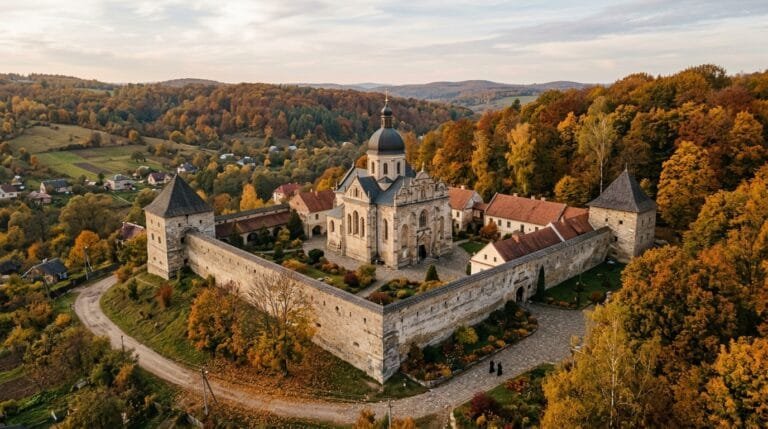
The Holy Dormition Univ Lavra is the only Greek Catholic lavra in Ukraine and one of only four in the country. It is a men’s monastery of the Studite Rule in Lviv Oblast: a fortified complex of the 16th–19th centuries, home to a wonderworking icon and a healing spring, revived by Metropolitan Andrey Sheptytsky, and turned by the Bolsheviks first into a concentration camp for clergy and then into a psychiatric hospital. [1][2][3]
The monastery at a glance
- Full name: Holy Dormition Univ Lavra of the Studite Rule.
- Location: the village of Univ, Peremyshliany district, Lviv Oblast (about 50 km east of Lviv).
- First written mention: a charter of King Władysław II Jagiełło dated 18 October 1395; archaeology attests a monastery here as early as the 13th century.
- Jurisdiction: UGCC; since 2008 a stauropegic monastery subject directly to the Head of the Church.
- Monastic order: the Studites (Studite Rule).
- Status: architectural monument of national significance; a fortified monastery.
- Relics: the wonderworking icon of the Mother of God Hodegetria and a healing spring.
History of the Univ Lavra
Beginnings: the Gediminids and the Lahodovskyi family
The exact date of foundation is unknown. Archaeological research confirms that a monastery already existed here in the 13th century, while the first written mention appears in a charter of King Władysław II Jagiełło of 18 October 1395; in 1401 the same king confirmed the estates of Mlyniv and Yaktoriv granted to the monastery. Prince Fedir Liubartovych is regarded as its founder and first patron. [3][4][5]
An important detail: the present site of the shrine dates from about the middle of the 16th century, while the old monastery stood two hundred metres away on Chernecha Hora (Monks’ Hill), where the monastic cemetery is today. [2][6]
Until the mid-15th century the monastery was under the patronage of the princes of the Gediminid house, and later of the Ukrainian noble family of the Lahodovskyi. By a special charter of 30 July 1542 King Sigismund I the Old legalised the status of the Univ archimandrite see: its estates and the right to elect the archimandrite remained exclusively with the monks. [3][7]
The Tatar fire of 1549 and the legend of healing
In 1549 the monastery was burned by the Tatars. Its rebuilding is linked to the Galician nobleman Oleksandr Vanko Lahodovskyi, who cared for the house until 1574. According to an old tradition, the nobleman, suffering from a severe disease of the legs, saw the Mother of God in a dream, who told him he would be healed by washing his feet in a miraculous spring in the nearby forest. Having been healed, in 1570 he built at his own expense a new masonry Dormition church over the spring. [1][2][3]
The wonderworking image of the Mother of God was, by tradition, revealed on the ashes of the monastery desecrated by the Tatars; from then on it was kept in the new church behind the altar — directly above the spring flowing from the ground at that spot. [1][8]
In 1648 the monastery again suffered from Tatars who came to Galicia. Among its visitors were the abbot of the Pochaiv Lavra, Job of Pochaiv, and the polemical writer and Athonite monk Ivan Vyshenskyi. [1]
The Sheptytskys and the transition to the Union
The monastery reached its greatest flourishing under the archimandrites Varlaam (1647–1715) and Atanasii (1686–1746) Sheptytsky. Varlaam was the first of the Univ figures to accept the Union in 1700, and in 1711 a council of monastic superiors at Univ decided to continue observing the ancient monastic traditions. From that time the monastery was Greek Catholic. The transition took place without the use of force, after a long rivalry between the Lahodovskyi and Balaban families over the right of patronage. [2][3][7]
Between 1648 and 1765 a printing house operated at the monastery — one of the important centres of book publishing in Galicia. [3]
The Austrian era: abolition and the metropolitan’s residence
After Galicia became part of the Austrian Empire, the government abolished the monastery in 1790: the monks were transferred to other houses and the monastery church became the village parish church. In 1816 the estates were handed to the Lviv Greek Catholic Metropolitanate, and the complex became the summer residence of the Lviv metropolitans. [3][6]
From 1818 to 1858 Metropolitan Mykhailo Levytskyi — the first Galician cardinal — lived here permanently. Under him the defensive ramparts and moats were levelled and the metropolitan’s palace was built. [3]
Andrey Sheptytsky and the Studites
At the beginning of the 20th century Metropolitan Andrey Sheptytsky, seeking to revive the Eastern tradition of monastic life within the UGCC, handed the Univ house over to the monks of the Studite Rule and soon granted the monastery the status of a lavra. Sources give different dates for this: some indicate 1913, while the Great Ukrainian Encyclopedia gives 1919, when Sheptytsky moved the Studites to Univ from the village of Sknyliv near Lviv. [1][2][3][6]
The Studite Rule is the rule of Saint Theodore the Studite — the same rule that Saint Theodosius of the Caves introduced at the Caves Monastery around 1070 and from which it spread to all the monasteries of Rus. In reviving it, Sheptytsky was deliberately returning Ukrainian monasticism to its most ancient source. [7]
The first hegumen and later archimandrite of the Univ Lavra was the metropolitan’s brother, Klymentii Sheptytsky (1869–1951), who was the spiritual father of the community for some thirty years. Under Andrey Sheptytsky an icon-painting workshop was founded, whose masters covered the church with distinctive frescoes; the printing house was revived and an orphanage opened. The lavra also founded several daughter monasteries. [1][3][7]
Soviet repression
The Soviet authorities closed the monastery (in 1947 or 1950, according to different sources) and arrested Archimandrite Klymentii Sheptytsky, who died in captivity in 1951. In 2001 Pope John Paul II declared him blessed — a new martyr of the UGCC. [2][6]
The fate of the house under Soviet rule is among the grimmest of any Ukrainian monastery. Immediately after its closure the lavra was turned into a concentration camp for Catholic clergy; later it housed a home for the elderly and then a hospital for the mentally ill. Gravestones and burials were desecrated, including that of Cardinal Mykhailo Levytskyi. To erase the memory of the shrine completely, the village was renamed Mizhhiria. [1][3][6]
Revival
After the collapse of the USSR the house was returned to the UGCC, and monastic life resumed in 1991, when the Studites again took charge. In 2008 His Beatitude Lubomyr Husar granted the Holy Dormition Univ Lavra the status of a stauropegic monastery, subject directly to the Head of the UGCC. On 29 June of the same year a new wooden church in honour of the blessed hieromartyrs Klymentii and Leontii — designed by the architect Roman Sulyk — was consecrated. [2][6]
Today about fifty monks live in the lavra, which receives tens of thousands of pilgrims each year. The monastery is governed by the Code of Canons of the Eastern Churches and by the monastic Typicon compiled by Metropolitan Andrey and Blessed Archimandrite Klymentii on the basis of the Studite tradition. [1][9]
Architecture
The Univ Lavra is a fortress monastery surrounded by high walls with loopholes and defensive towers — a monument of defensive architecture of the 16th–19th centuries of national significance. The complex consists of a church in the middle of a courtyard, with the fortress walls, cells and the metropolitan’s palace arranged around the perimeter. [3][6]
The ensemble today includes:
- the masonry church of the Dormition of the Mother of God (mid-16th century, repeatedly rebuilt after 1570) — architecturally a transitional style from Gothic to early Renaissance, with Baroque elements; [3][6]
- the monastic building with cells (17th–19th centuries);
- the metropolitan’s house (1820s);
- the wooden church of the Blessed Leontii and Klymentii (2008);
- the defensive walls and towers and a chapel;
- Chernecha Hora, 200 m away — the site of the ancient monastery, today the monastic cemetery. [6]
Relics
- The wonderworking icon of the Most Holy Theotokos Hodegetria. The original Univ icon has unfortunately not survived; pilgrims venerate a revered copy. [6]
- The healing spring — the same one over which the Dormition church was built in 1570 and which, by tradition, healed Oleksandr Lahodovskyi. [1][3]
- The memory of Blessed Klymentii Sheptytsky — archimandrite of the lavra and new martyr, beatified in 2001. [2]
Practical information
- Getting there: Univ lies about 50 km east of Lviv and 5 km from Peremyshliany. A car is most convenient; buses run from Lviv to Peremyshliany.
- Access: free, according to the schedule of services.
- Retreats. The lavra maintains a pilgrims’ house and is known as a place of silence and spiritual exercises; book in advance.
- Dress: modest. Greek Catholic houses are usually less strict than Orthodox ones, but shoulders and knees should be covered.
- Nearby: Chernecha Hora with the monastic cemetery, the spring, and the defensive towers.
- Main feast: the Dormition of the Most Holy Theotokos.
- Wartime note: check current security conditions and official advisories before travelling to Ukraine.
Frequently asked questions
How many lavras are there in Ukraine, and which are Greek Catholic?
Four: the Kyiv Caves, Pochaiv, Sviatohirsk and Univ lavras. Univ is the only Greek Catholic one. [1][2]
When was the Univ Lavra founded?
The exact date is unknown. Archaeology attests a monastery here in the 13th century; the first written mention is the charter of Władysław II Jagiełło of 18 October 1395. [3][4]
Who are the Studites?
Monks who live by the Studite Rule of Saint Theodore the Studite — the oldest Eastern monastic tradition, introduced at the Kyiv Caves Monastery around 1070 by Saint Theodosius. Metropolitan Andrey Sheptytsky revived it within the UGCC. [7]
What happened to the lavra under Soviet rule?
First a concentration camp for Catholic clergy, then a home for the elderly and a hospital for the mentally ill. The village was renamed Mizhhiria and the burials were desecrated. [1][3][6]
Who was Klymentii Sheptytsky?
The brother of Metropolitan Andrey, first hegumen and later archimandrite of the Univ Lavra and its spiritual father for about thirty years. Arrested by the Soviet authorities, he died in 1951 and was declared blessed in 2001. [2][3]
Can visitors stay at the lavra?
Yes, the monastery has a pilgrims’ house and hosts retreats. Arrangements must be made in advance.
Conclusion
The Univ Lavra survived Tatar fires, Austrian abolition, a Bolshevik concentration camp and a psychiatric hospital, and today is once again a living centre of Studite monasticism. Its history shows how Ukrainian monastic life returned to its own sources: the rule that Theodosius of the Caves brought to Kyiv in the 11th century was revived by Andrey Sheptytsky in a Galician village at the beginning of the 20th. [1][3][7]
Sources
- Univ: history, the legend of healing, the Sheptytsky family
- Holy Dormition Univ Lavra — cerkva.online
- Univ Holy Dormition Lavra — Great Ukrainian Encyclopedia
- Holy Dormition Univ Lavra: history and the present day
- Holy Dormition Univ Lavra — official UGCC map
- Univ Lavra: the architectural complex, defensive walls, Chernecha Hora
- Univ Lavra: the Studite Rule and the privilege of 1542
- Univ Lavra — Ukraina Incognita
- Univ Lavra: the Typicon of Andrey and Klymentii Sheptytsky