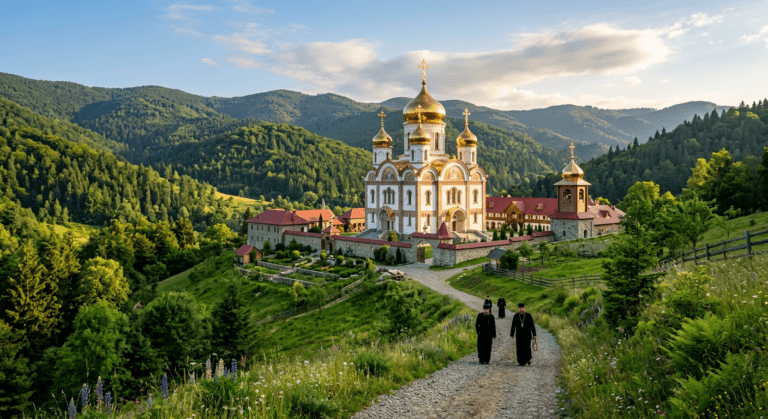
The Iza St Nicholas Men’s Monastery is one of the most famous houses of Transcarpathia, situated in the Karputlash tract a few kilometres from the village of Iza in the Khust district. Founded in 1919, it became a spiritual centre of the region, and since 2001 the relics of the Venerable Alexiy of the Carpathians rest here — the ascetic regarded as the “apostle of Transcarpathia” and the initiator of the revival of Orthodoxy in these lands. [1][2]
Briefly about the monastery
- Full name: Iza St Nicholas Men’s Monastery of the Ukrainian Orthodox Church. [1]
- Address: the Karputlash tract, near the village of Iza, Khust district, Transcarpathian Oblast. [2]
- Founded: 1919 at the Holy Dormition church of the village of Iza. [1]
- Relocation: 1926 — outside the village, to the Karputlash tract. [1]
- Chief shrine: the relics of the Venerable Alexiy of the Carpathians (Kabaliuk). [2][3]
- Canonization: October 2001, led by the Primate of the UOC Metropolitan Volodymyr. [2]
The founding (1919–1926)
An Orthodox men’s monastery in Iza was decided to be built by the hieromonks Alexiy, Amfilokhiy and Matviy, who had returned from Russian captivity after the First World War. Works, headed by hieromonk Matviy (Vakarov), began in 1920; in 1921 bishop Dosyfei confirmed him as igumen. [2]
At first the monastery arose at the Holy Dormition church in the village of Iza itself. However, in 1925 the cell building was decided to be built outside the village — in the Karputlash tract, which became the new location of the house, while the St Nicholas church remained a village church. In 1926 Archimandrite Matviy (Vakarov) was elected abbot. [1][2]
Interwar flourishing
In 1933–1937 diocesan courses for the clergy operated at the house under the direction of Bishop of Mukachevo-Priashiv Damaskyn (Hrdanichki). This was an important centre for the training of Orthodox pastors for the Carpathian region. [1]
In 1936 the renovated and expanded Holy Dormition church was consecrated. As of 1944 the number of the brethren reached 39 persons, of whom 23 served in the surrounding villages. From 1945 the monastery was under the jurisdiction of the Russian Orthodox Church. [1]
Closure and return to the Church
In 1959 the monastery was closed — at that time 64 inhabitants lived in it. After that a sanatorium was housed here, and later a tuberculosis dispensary, which still operates nearby. [1][2]
At the end of the 1980s and beginning of the 1990s the revival of the house began. In 1991 the monastery was returned to the Church. On the Sunday of the Triumph of Orthodoxy 1994, the foundation of a new cathedral church in honour of St Nicholas was laid; its construction was completed in 1998. [2]
In 1992 Bishop of Mukachevo and Uzhhorod Yevfymii (Shutak) appointed Archimandrite Stratonik (Lehach) as the abbot of the monastery. [1]
The canonization of the Venerable Alexiy
In October 2001, an event historic for all of Transcarpathia took place in the monastery — the canonization of the Venerable Alexiy of the Carpathians (Alexiy Kabaliuk), which was led by the Primate of the Ukrainian Orthodox Church, His Beatitude Volodymyr, Metropolitan of Kyiv and All Ukraine. [2]
The Venerable Alexiy Kabaliuk (1877–1947) is the most revered Transcarpathian ascetic of the 20th century. Born a Greek Catholic, he joined the movement for a return to Orthodoxy in his youth, visited Mount Athos several times, and endured imprisonment in camps. He is regarded as the initiator of the mass transition of Transcarpathians to Orthodoxy in the 1920s. [3]
The relics of the Venerable Alexiy now rest in the Iza monastery, and pilgrims from all over Ukraine come to them. [3]
Shrines and present life
The chief shrine of the house is the reliquary with the relics of the Venerable Alexiy of the Carpathians. Besides that, ancient icons and local shrines are venerated here. The monastery is also renowned for its ascetic order, which tends toward Athonite traditions. [2][3]
Today the Iza monastery is one of the centres of the spiritual life of the Khust region, a place of pilgrimage and spiritual revival of the whole region. [3][4]
Practical information
- Address: the Karputlash tract, near the village of Iza, Khust district, Transcarpathian Oblast. [2]
- Chief shrine: the relics of the Venerable Alexiy of the Carpathians. [2][3]
- Churches: the new St Nicholas cathedral (1994–1998), the Holy Dormition church. [1][2]
- How to get there: the village of Iza is about 5 km from Khust; the house is outside the village, in the Karputlash tract. [2]
Frequently asked questions
When was the monastery founded?
In 1919 at the Holy Dormition church of the village of Iza; in 1926 it was moved to the Karputlash tract. [1][2]
Why is the monastery connected with the Venerable Alexiy?
It was in this house that in October 2001 the canonization of the Venerable Alexiy of the Carpathians took place; here his relics are kept. [2][3]
What is the chief shrine?
The relics of the Venerable Alexiy of the Carpathians (Kabaliuk), an ascetic and apostle of Orthodoxy in Transcarpathia. [3]
What happened to the monastery in Soviet times?
It was closed in 1959; a sanatorium and a tuberculosis dispensary were housed in the building. It was returned to the Church in 1991. [1][2]
When was the present St Nicholas cathedral built?
The foundation was laid in 1994, and construction was completed in 1998. [2]
Conclusion
The Iza St Nicholas Men’s Monastery is a story of the revival of the Orthodox faith in Transcarpathia. From the founding in 1919 and the move to Karputlash, through the interwar diocesan courses, the closure of 1959 and the return to the Church in 1991, to the canonization of the Venerable Alexiy in 2001 — the house remains a living centre of spirituality and pilgrimage in the Khust region. [1][2][3]