There are Bible stories in which God delivers — and there are stories in which people say to God: “we trust You even if You do not deliver”. The second kind are the deepest. Such is the story of the three young men in the fiery furnace, in Daniel 3. Three foreign officials refused to bow to the golden image of the most powerful king in the world — not out of rebellion, but out of faithfulness. They were thrown into a furnace heated seven times over — and the fire did not touch them; it burned only their bonds. In this article we will walk through the story step by step, unpack the youths’ famous answer — “but even if He does not” — find out who the fourth man in the furnace was, why the fire left not even a smell, — and think about which “golden images” we stand before and how to learn not to bow.
1. The Story as It Is Written
King Nebuchadnezzar, ruler of Babylon, made a golden image sixty cubits high and six cubits wide (about 27 by 3 meters — the height of a nine-story building) and set it up on the plain of Dura in the province of Babylon. Satraps, prefects, governors, treasurers — the entire imperial elite — assembled for its dedication. The herald proclaimed the law: as soon as you hear the sound of the horn, flute, lyre, harp and all kinds of music — fall down and worship the golden image; whoever does not fall down and worship shall that very hour be cast into a blazing furnace (Dan. 3:4-6).
The music sounded — and all peoples, nations and languages fell down and worshiped. All — except three: Shadrach, Meshach and Abednego, Judeans whom Nebuchadnezzar had appointed over the affairs of the province of Babylon (Dan. 3:12). Certain Chaldeans immediately denounced them to the king: “There are Judean men… who pay no attention to your command, O king: they do not serve your gods or worship the golden image that you have set up” (Dan. 3:8-12).
Nebuchadnezzar summoned them and asked with one last chance: “Is it true that you do not serve my gods…? If you are ready to fall down and worship — it will be well with you. But if not — who is the god who will deliver you out of my hands?” (Dan. 3:14-15). And the three answered with words that became one of the highest confessions of faith in the whole Bible:
“Shadrach, Meshach and Abednego answered and said to the king: O Nebuchadnezzar, we have no need to answer you in this matter. Our God whom we serve is able to deliver us from the burning fiery furnace — and He will deliver us out of your hand, O king. But if He does not, let it be known to you, O king, that we will not serve your gods or worship the golden image that you have set up.” — Daniel 3:16-18
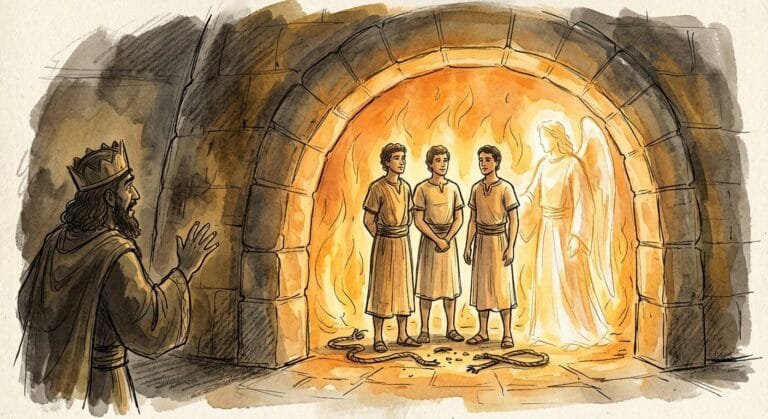
Then Nebuchadnezzar “was filled with fury”; the furnace was ordered to be heated seven times more than usual, and the strongest soldiers were told to bind the young men and cast them into the fire. The fire was so fierce that the flame killed the men who carried the youths — while the youths themselves fell bound into the midst of the furnace. And then the king leapt to his feet in amazement: “Did we not cast three men bound into the fire? Behold, I see four men loose, walking in the midst of the fire, and they have no hurt — and the form of the fourth is like the Son of God!” (Dan. 3:24-25). Nebuchadnezzar called them out: “Shadrach, Meshach and Abednego, servants of the Most High God, come out and come here!” — and they came out. And the satraps gathered and saw that “the fire had had no power over their bodies, the hair of their heads was not singed, their garments were not harmed, and no smell of fire had even come over them” (Dan. 3:27).
2. Who Were the Three: Daniel’s Friends from Chapter One
To understand their deed, we must recall who they were. In the first chapter of Daniel, a group of the finest Judean youths is taken to Babylon, among them Daniel, Hananiah, Mishael and Azariah (Dan. 1:6). They are renamed in Babylonian fashion: Daniel becomes Belteshazzar, Hananiah — Shadrach, Mishael — Meshach, Azariah — Abednego. Even then, as teenagers, together they “resolved in their hearts” not to defile themselves (Dan. 1:8) — refusing the royal food and wine, risking punishment and proposing a test. God gave them wisdom, and they became ten times wiser than all the magicians of the kingdom (Dan. 1:20).
Years pass. Daniel stands at court, and his three friends serve as officials of the Babylonian province. Here is an important detail: their feat in the furnace is not the first refusal in their lives. It is the second “no” to the empire, spoken by the same people with the same disposition of heart as the first, in their youth. Whoever knows how not to bow to the royal table in small things will not bow to the royal image in great ones. As for why Daniel himself is absent from Daniel 3 — whether he was away or his office exempted him from the ceremony — Scripture is silent; but it is silent also about any compromise on his part.
3. “But Even If He Does Not”: Unpacking the Boldest Answer in the Bible
The answer of the youths (Dan. 3:16-18) is only three verses, but within them are four movements of the heart, each worth noticing:
- “We have no need to answer you in this matter” — not insolence, but the absence of hesitation. For them the question “whether to bow” had already been decided — and decided not when the music began, but long before. The hardest decisions are made before the crisis, not inside it.
- “Our God… is able to deliver us” — they confess God’s power without any discount. Not “He can, though it is difficult”, but “He can” — both from the furnace and from the hand of the king himself. Faith begins with admitting that for God there are no hopeless situations.
- “But if He does not” — the core of their answer and one of the summits of the whole Bible. They refuse to set conditions for God. Their faithfulness does not depend on the outcome: even if deliverance does not come, they will not change their decision. This is faith that does not use God but serves Him.
- “We will not serve and we will not worship” — a calm, even decision without hatred of the king, without insults or curses. They do not despise Nebuchadnezzar — they simply know to Whom their deepest bow belongs.
These words are the direct answer to the question left by the story of Daniel in the lions’ den: does God always deliver? The youths say honestly: we believe that He can, but our faithfulness is not made dependent on it. In the Letter to the Hebrews they entered the hall of fame of faith precisely for this: “through faith… quenched the power of fire” (Heb. 11:34). About Daniel and the den, see also our article “Daniel in the Lions’ Den”.
4. Inside the Furnace: the Fire That Burned Only the Bonds
The furnace scene is written with stunning paradoxes. First, the fire killed those who cast the youths in and did not touch those who were cast: the force meant to be a weapon of punishment turned against the executioners. Second, Nebuchadnezzar sees in the flame four men instead of three — and all of them loose, although they had been cast bound. The fire did not burn the youths — it burned only what bound them. This is a recurring image in the Bible: God does not always take us out of the fire, but in the fire He always removes our bonds.
Third — the fourth man. Nebuchadnezzar, a pagan, describes him as he can: “the form of the fourth is like the Son of God” (Dan. 3:25). Christian tradition from earliest times has read this presence as an appearance of Christ before the Incarnation or of His angel; Jewish interpretations have named the fourth the archangel Gabriel or Michael. In any reading the main point is one: in the most terrible fire they were not alone — and this fulfills the promise given through Isaiah four centuries earlier: “when you walk through fire, you shall not be burned, and the flame shall not consume you” (Isa. 43:2).
And the final detail that strikes most of all: when the youths came out, the satraps examined them and stated — the hair of their heads was not singed, their garments were not harmed, and “no smell of fire had even come over them” (Dan. 3:27). God did not merely bring them out of the furnace — He removed even the trace from them. So it is in our lives: what was supposed to leave a burn, by God’s word can leave not even a smell — if we pass through it with Him.
5. The Song in the Flame: the Prayer of Azariah and the Song of the Three
In the Greek text of Daniel (the Septuagint) between verses 23 and 24 an ancient prayer insertion is preserved — the Prayer of Azariah and the Song of the Three Young Men (Dan. 3:24-90 in Greek numbering). In the midst of the flame Azariah prays not for rescue but on behalf of the whole people: “Blessed are You, O Lord, God of our fathers… for You are righteous in all that You have done to us” (Dan. 3:26-27, LXX), — he confesses the sins of the people and asks God to accept their offering of “a broken heart and a humbled spirit” (Dan. 3:39, LXX). And then the three begin the hymn the Church still sings:
“Bless the Lord, all you works of the Lord — praise and exalt Him above all forever! Bless the Lord, you heavens… Bless the Lord, you angels of the Lord… Bless the Lord, you dew and frost… Bless the Lord, you fire and heat… Bless the Lord, Shadrach, Meshach and Abednego — praise and exalt Him above all forever!” — Daniel 3:57-88 (LXX)
Notice: the hymn contains the line “bless the Lord, you fire and heat” — the youths praise God even with the fire in which they stand. This hymn (“Benedicite”, “All Works of the Lord”) entered the worship of both Orthodox and Catholic Churches: in Orthodox tradition it is read on Holy Saturday, and in the West it is sung as one of the biblical canticles. It is hard to imagine a stronger illustration of thanksgiving in trial — on the power of such thanksgiving, see our article “Give Thanks to the Lord, for His Mercy Endures Forever!”.
6. After the Furnace: Nebuchadnezzar’s Second Decree
As in the story of Daniel, the finale overturns the design. Nebuchadnezzar, who a moment earlier threatened death for not bowing, now confesses himself: “Blessed be the God of Shadrach, Meshach and Abednego, who has sent His angel and delivered His servants, who trusted in Him, and altered the king’s word, and yielded their bodies, that they might not serve or worship any god except their own God!” (Dan. 3:28). The king’s wording strikes by its honesty: he calls their refusal an alteration of his own word — and takes it as a lesson for himself. Then — a new decree to all peoples: whoever speaks blasphemy against the God of these youths shall be destroyed, “for there is no other god who is able to deliver in this way” (Dan. 3:29). And the king “promoted Shadrach, Meshach and Abednego in the province of Babylon” (Dan. 3:30).
The two chapters of Daniel — 3 and 6 — form a mirror pair: two kings, two deadly decrees, two refusals, two miracles and two new decrees in honor of the God of Israel. Both stories say the same thing: empires can command everything except one thing — to whom the heart belongs.
7. What This Story Means for Us Today
- Every age has its golden image and its music. In Babylon it was literally a statue and an orchestra. For us it is the pressure before which a bow is expected: demands against conscience, career compromises, the fear of being “not like everyone else”, the cult of success and money. The mechanics are the same: when “the music plays”, society demands worship. The first question of honesty: before what do I bow?
- Decisions are made before the music. The youths did not hesitate because their “no” had been spoken long before the furnace. Whoever trains faithfulness in small things will stand in great ones. And conversely: whoever bows in small things will not stand in great ones.
- One can refuse without hatred. The youths did not curse the king or despise him; their refusal was firm but respectful. Testimony is not war against people but faithfulness to God among people.
- Faith without guarantees is the purest faith. “But even if He does not” means: I serve God not for a reward. Modern culture offers insurance-faith (“believe — and all will be well”), while the youths show covenant-faith: “even if it is not”.
- God removes bonds in the fire. He does not always take us out of trials, but in trials He unties what binds us — and sometimes the very furnace burns our strongest chains: fear, dependence on others’ opinions, the desire to please everyone.
- The “smell of fire” may not come over us. The promise of Isaiah 43:2 (“when you walk through fire, you shall not be burned”) in life often looks like this: a person who has passed through the worst with God comes out not embittered but clean — without a burn in the heart. It is not automatic; it is the fruit of the presence of the fourth — the One who enters the fire with us.
8. Daniel 3 in the Mirror of Other Scripture
- Isaiah 43:2 — “when you walk through fire, you shall not be burned” — the promise given centuries before the furnace.
- Daniel 6 — the mirror story: the lions’ den, the same faithfulness and the same God (see our article “Daniel in the Lions’ Den”).
- Hebrews 11:33-34 — “through faith… stopped the mouths of lions, quenched the power of fire” — both stories in one list of heroes of faith.
- Matthew 10:28 — “Do not fear those who kill the body but cannot kill the soul” — the New Testament formula of the youths’ choice.
- Revelation 2:10 — “Be faithful unto death, and I will give you the crown of life” — the same word of faithfulness spoken to the Church under empire.
- Daniel 1:8 — the first “no” of the youths, from which the second grew: faithfulness in small things prepares for great ones.
9. Frequently Asked Questions (FAQ)
Why did the young men refuse to bow to the golden image?
Not out of political rebellion but out of faithfulness: the first commandment forbade them to serve other gods and bow to their images (Ex. 20:3-5). Their answer to the king was calm and firm at once: God can deliver, and even if He does not, the decision will not change. For them a bow was an act of worship, and worship belongs to God alone.
What did “but even if He does not” mean in their answer?
It was a refusal to set conditions for God. The youths believed God could save them from the furnace, but their faithfulness did not depend on the outcome: even without a guarantee of rescue they would not bow to the image. It is one of the purest formulas of faith in the Bible — service by covenant, not for reward.
Who was the fourth man in the fiery furnace?
Nebuchadnezzar sees four men in the flame instead of three and describes the fourth as a pagan can: “the form of the fourth is like the Son of God” (Dan. 3:25). Christian tradition has long seen in this figure an appearance of Christ before the Incarnation or His angel; Jewish interpretations have named the fourth an archangel. The main meaning of the image is this: in the most terrible fire the faithful are not alone.
Where was Daniel when his friends were cast into the furnace?
The text is silent about it. It is most often explained this way: Daniel held a higher office at court and was either absent from the ceremony on the plain of Dura or his position exempted him from participation. Scripture nowhere mentions any compromise by Daniel in this story.
What is the “Song of the Three Young Men” and where is it written?
It is the Prayer of Azariah and the hymn of the youths preserved in the Greek text of Daniel (the Septuagint) as the insertion 3:24-90 in Greek numbering. In the Orthodox and Catholic Churches this text belongs to the canonical prayers: in Orthodox tradition it is read on Holy Saturday, and in the West it is part of the biblical canticles of worship. The hymn begins with the words “Bless the Lord, all you works of the Lord”.
Does this story mean God always delivers from trials?
No — and it is the youths themselves who say this most honestly: “but even if He does not”. The Bible places side by side both “quenched the power of fire” (Heb. 11:34) and those who “suffered mocking and flogging, and even chains and imprisonment” (Heb. 11:36). The promise of Daniel 3 is not a guarantee of avoiding the furnace, but a guarantee that in the furnace we are not alone, and that the fire is able to burn our bonds rather than us.
10. Sources
1. Shadrach, Meshach and Abednego: narrative, names and interpretations — Wikipedia article: en.wikipedia.org (Shadrach, Meshach and Abednego).
2. Commentaries of the Church Fathers and classic interpreters on Daniel 3:17 — BibleHub: biblehub.com (Daniel 3:17).
3. Prayer of Azariah and Song of the Three Holy Children — Wikipedia article: en.wikipedia.org (Prayer of Azariah).
4. Book of Daniel: structure, context and theology — Wikipedia article: en.wikipedia.org (Book of Daniel).
5. Три юнаки у вогняній печі — Ukrainian-language version of this article: pray.ee (Даниїла 3).