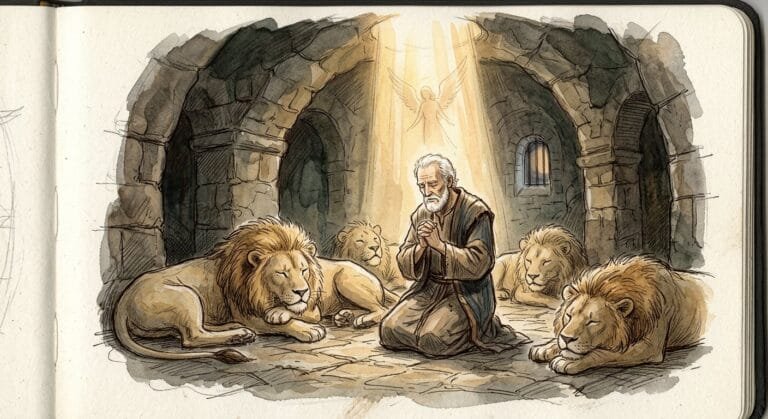
There are Bible stories you know from children’s Bibles — and which, reread as an adult, turn out to be far deeper than they seemed. The story of Daniel in the lions’ den, in Daniel 6, is exactly that kind. It is not simply a story about a miracle with lions. It is the story of a foreign official who lived sixty years under foreign thrones and never once betrayed his God; of envy that searched a man for fault and found none — and was forced to look for it in his prayers; and of a window that Daniel could have shut — but did not. In this article we will walk through the story step by step, unpack the famous verse Daniel 6:11, discover why his prayer was exactly as it was, — and consider what this story says to us whenever our own “decrees” demand that we shut the window.
1. The Story as It Is Written
The Persian empire has just replaced Babylon. King Darius sets over the realm one hundred and twenty satraps, and over them three commissioners — and Daniel distinguishes himself above them all, “because an excellent spirit was in him” (Dan. 6:3). The king is already planning to set him over the whole kingdom. Then the satraps and commissioners begin looking for a charge against Daniel. Scripture describes this search with merciless brevity: “They could find no charge or fault, because he was faithful; no error or fault was found in him” (Dan. 6:4).
Then the enemies say the words that became a verdict on the whole story: “We shall not find any charge against this Daniel unless we find it against him concerning the law of his God” (Dan. 6:5). The only vulnerable point of the blameless official is his faith. So they persuade the king to sign a decree: for thirty days no one may make a petition to any god or man except the king; whoever violates it shall be cast into the den of lions. Darius signs it — and the law of the Medes and Persians “cannot be revoked” (Dan. 6:8).
“When Daniel knew that the document had been signed” (Dan. 6:10), the moment of decision arrives. And this is what is recorded:
“Now when Daniel knew that the document was signed, he went into his house (and in his upper room the windows were open toward Jerusalem), and three times a day he knelt on his knees and prayed and gave thanks before his God, as he had done previously.” — Daniel 6:10-11
They seize him, remind the king of the decree, and Darius — distressed, for he honored Daniel — labors until sunset to rescue him, but the law is unchangeable. Daniel is cast into the den of lions, and the king says: “Your God, whom you serve continually, He will deliver you” (Dan. 6:16). Darius spends the night without sleep, without food, without music; “at dawn, when the sun rose, he got up and went in haste to the den of lions” — and cried with a trembling voice: “Daniel, servant of the living God, has your God, whom you serve continually, been able to deliver you from the lions?” (Dan. 6:20). And from the den came the answer: “O king, live forever! My God has sent His angel and shut the lions’ mouths, and they have not hurt me, because I was found innocent before Him; and also before you, O king, I have done no harm” (Dan. 6:21-22).
The finale: Daniel is taken up out of the den — “and no kind of wound was found on him, because he had trusted in his God” (Dan. 6:23) — and Darius issues a new decree, now to the whole empire: “Men are to tremble and fear before the God of Daniel, for He is the living God, enduring forever… He delivers and rescues; He works signs and wonders” (Dan. 6:26-27). On the day when they planned to destroy one man’s prayer, the empire received a decree to reverence the God to whom it belonged.
2. Who Was Daniel: Sixty Years of Faithfulness in Exile
To feel the weight of chapter 6, one must see the whole journey. Daniel was taken captive as a teenager when Babylon fell upon Jerusalem (Dan. 1:1-6), around 605 BC. The gifted youth was drafted into royal service, renamed, and reshaped into a Babylonian — but even then he “resolved in his heart” not to defile himself (Dan. 1:8). Then came decades of service at the most powerful thrones of the world: interpreting Nebuchadnezzar’s dreams, the deliverance of his three friends from the furnace (Daniel 3), the writing on the wall on the night Babylon fell (Daniel 5) — and now, under Persia, old Daniel (about eighty years old) stands again at the summit of power.
This is essential for understanding chapter 6: Daniel in the den is not a heroic burst of one night. It is the finale of sixty years of daily faithfulness. His prayer three times a day had been his life “as he had done previously”, long before any decree; his window toward Jerusalem had been open long before anyone decided to shut it. The miracle in the den did not become possible in the den — it was prepared by decades of ordinary, unnoticed faithfulness.
3. The Verdict of the Envious: “Only Concerning the Law of His God”
Perhaps the strongest compliment in the whole book of Daniel is spoken by his enemies. They searched for a charge in his affairs: corruption, abuse, errors of administration — and found nothing, “because he was faithful” (Dan. 6:4). There remained only one conclusion: he can be accused only of his faith. Notice how this works in every age: when there is nothing to catch a person on in substance, the only “compromise” left is what they honor most.
For Daniel himself this meant one simple thing: his faith was the most visible part of his life. At a court where everyone prayed to emperors and imperial gods, Daniel’s prayer was so well known that his enemies could predict with certainty: he will not stop. They were not guessing — they were calculating. That is what testimony is: when the people around you know whom you serve so precisely that they can predict your next step.
4. The Window Toward Jerusalem: Unpacking Daniel 6:11
- “He went into his house” — Daniel did not flee, did not hide, did not stage a demonstration. He simply returned to his ordinary day. Faithfulness does not need a stage.
- “The windows were open toward Jerusalem” — he prayed facing the city where the temple stood. This echoes Solomon’s prayer at the temple dedication: “when they pray toward the city which You have chosen and the house I have built for Your name… hear in heaven” (1 Kings 8:44). Even hundreds of miles from home, Daniel kept his heart turned homeward — and toward the God of home — every day.
- “Three times a day” — his prayer had a rhythm: morning, noon and evening. The same rhythm as the psalmist: “Evening and morning and at noon I utter my complaint and moan, and He will hear my voice” (Ps. 55:17). Three times a day is not a feat for display but a discipline of the heart that leaves no part of the day without God.
- “He knelt on his knees and prayed and gave thanks before his God” — he not only asked; he gave thanks. On the very day his death sentence was signed, his prayer remained a prayer of thanksgiving and praise — as on that night in Babylon when he “gave thanks” for the revealed mystery (Dan. 2:23).
- “As he had done previously” — the key words of the verse. Daniel changed nothing: he did not pray louder in protest, or quieter for concealment, or more often in panic. He simply continued — the same, in the same way, as always. The strongest form of courage often looks like a habit.
Why did he not shut the window? Not because he sought martyrdom or provocation. Scripture shows in Daniel neither defiance nor performance — he does not even change his schedule. He simply did not allow fear to rewrite his life. Shutting the window would have meant admitting that the king’s decree was stronger than his God. The open window was not a gesture — it was what it had always been. And therein lies the whole difference between testimony and self-advertisement.
5. The Night in the Den: the King Cannot Sleep, but God Acts
The den scene is written with striking symmetry. Inside — Daniel among hungry lions, and Scripture is silent about his night: no complaint, no recorded word. Outside — King Darius, who does not sleep, does not eat and refuses entertainment (Dan. 6:18). The lion in the den is calmer than the king on the throne: peace does not depend on circumstances; it depends on Who is in those circumstances with you.
At dawn the king runs to the den and calls out — and Daniel’s answer is again blameless: “O king, live forever!” — without a trace of bitterness for yesterday’s sentence. And then the key explanation: “My God has sent His angel and shut the lions’ mouths”, and why: “because I was found innocent before Him” (Dan. 6:22). Scripture does not hide that deliverance came to a man who had lived honestly — but it also says honestly in the Letter to the Hebrews that not all the faithful came out of dens: “through faith… stopped the mouths of lions” (Heb. 11:33), while others “were stoned, sawn in two… went about in skins of sheep and goats” (Heb. 11:37). Both are faith. God does not always deliver from the den, but He is always with us in the den — and it is that presence that makes the den a place where lions are silent.
6. After the Den: the Decree That Turned the Empire
The story ends the way all great stories of God end: the design of evil people turns into a testimony they could not foresee. The decree meant to kill one man’s prayer became the cause of a new decree — to the whole empire: “Men are to tremble and fear before the God of Daniel, for He is the living God, enduring forever… He delivers and rescues; He works signs and wonders in heaven and on earth — He who has saved Daniel from the power of the lions!” (Dan. 6:26-27). Millions of people who had never heard of the God of Israel heard of Him through one official who did not shut his window. “Then this Daniel prospered” (Dan. 6:28) — and this is said of a man whom lions were supposed to have eaten the day before.
7. What This Story Means for Us Today
- Faithfulness prepares for trials long before they arrive. Daniel was saved not by sudden courage but by sixty years of “three times a day”. Our trials too are not decided in the moment of crisis — they are decided by what fills our ordinary days: prayer, honesty, the Word.
- Character is also testimony. The enemies searched for a charge in his affairs and found none. A Christian at work, in business, in documents and words is the first line of apologetics. When there is nothing to catch us on in substance, even enemies are forced to admit that it is only about our God.
- Prayer with rhythm is stronger than prayer in panic. Three fixed times a day is a simple practice available to everyone: morning, noon, evening. Five minutes with God three times a day build what no decree can break.
- An open window is calm, not demonstration. Daniel neither shouted nor hid. True courage looks like normality: doing the same and in the same way, because God has not changed even though circumstances have.
- The fear of God heals the fear of people. Darius feared breaking his own decree more than killing his best subject. Daniel feared God more than lions. Each of us has our own “decrees” — the pressure of opinions, the fear of loss, the habit of silence — and the question is always the same: whose word weighs more for us.
- Even in the den one can give thanks. Daniel “prayed and gave thanks” — both in his upper room under a death sentence and among the lions. Thanksgiving in the darkest den is the loudest testimony that God is alive. On the power of thanksgiving in trials, see also our article “Give Thanks to the Lord, for His Mercy Endures Forever!”.
8. Daniel 6 in the Mirror of Other Scripture
- Daniel 3 — the three youths in the fiery furnace: a parallel story of the same book, the same principle — “Our God is able to deliver us… but even if He does not, we will not serve your gods” (Dan. 3:17-18).
- 1 Kings 8:44-49 — Solomon’s prayer explaining why Daniel prayed facing Jerusalem.
- Psalm 55:17 — “Evening and morning and at noon…” — the biblical source of prayer three times a day.
- Psalm 57:4 — “My soul is in the midst of lions…” — the prayer of a man among predators that ends in praise.
- Hebrews 11:33-37 — “through faith stopped the mouths of lions” and the list of those who did not come out of dens: faith is not a guarantee of survival but a guarantee of being with God.
- Matthew 10:28 — “Do not fear those who kill the body but cannot kill the soul” — the New Testament formula of Daniel’s choice.
9. Frequently Asked Questions (FAQ)
Why did Daniel pray facing Jerusalem?
This echoes Solomon’s prayer at the temple dedication: when the people in exile “turn toward the city which You have chosen and the house I have built for Your name” and pray, “hear in heaven their prayer” (1 Kings 8:44-49). For Daniel, Jerusalem was the sign of God’s presence and of the promise of return, so every day, three times a day, he kept his heart turned homeward.
How old was Daniel when he was cast into the den?
Daniel was taken to Babylon as a teenager around 605 BC (Dan. 1), and the events of chapter 6 took place after the fall of Babylon, under Darius the Mede — approximately in 539 BC. Thus Daniel was about eighty years old at the lions’ den, with six decades of service under foreign thrones behind him.
Why could the king not revoke his own decree?
Scripture explains this by the law of the Medes and Persians: no decree or statute the king confirms “can be revoked” (Dan. 6:8). The irrevocability of the royal word was a foundation of imperial stability — and the conspirators exploited exactly this, knowing that even the king could not step back. Interestingly, Darius still found a way: without revoking the decree, he issued a new one — about reverence for “the God of Daniel” throughout the realm.
Why did Daniel not shut the window or pray in secret?
He sought neither martyrdom nor confrontation: Scripture emphasizes that he simply continued doing “as he had done previously”. Shutting the window would have meant admitting that fear of the decree was stronger than his God. His testimony is not a demonstration but constancy: a faith that does not rewrite itself to fit circumstances.
How exactly did God save Daniel?
Daniel himself explains: “My God has sent His angel and shut the lions’ mouths, and they have not hurt me” (Dan. 6:22). When the king examined him, “no kind of wound was found on him, because he had trusted in his God” (Dan. 6:23). Deliverance came to a man whose faithfulness was visible to all — both to enemies and to the king.
Does this story mean God always rescues from danger?
No — and the Bible is honest about this. In Hebrews 11 stand side by side those who “through faith stopped the mouths of lions” (11:33) and those who “were stoned, sawn in two” (11:37) — and all of them are called heroes of faith. God does not always deliver from the den, but He is always present in the den; Daniel’s story is not a formula of guaranteed rescue but a promise that with God even a lions’ den can become a place of testimony.
10. Sources
1. Daniel in the lions’ den: the narrative, its sources and interpretations — Wikipedia article: en.wikipedia.org (Daniel in the lions’ den).
2. Book of Daniel: structure, historical context and theology — Wikipedia article: en.wikipedia.org (Book of Daniel).
3. Commentaries of the Church Fathers and classic interpreters on Daniel 6:11 — BibleHub: biblehub.com (Daniel 6:11).
4. Даниїл у лев’ячій ямі — Ukrainian-language version of this article: pray.ee (Даниїла 6).