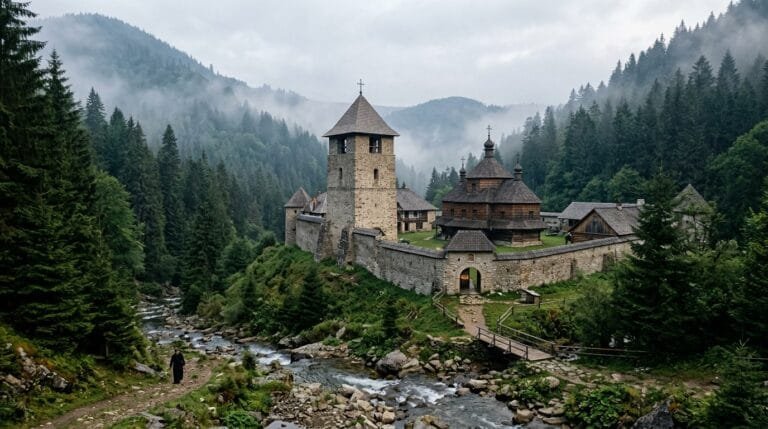
Maniava Skete is a monastery of the Exaltation of the Cross in the Carpathians near the village of Maniava, long known for the severity of its rule as the “Ukrainian Athos”. In the 17th century it held stauropegion from Constantinople, and 556 monasteries of Galicia, Bukovyna and Moldavia were subject to it. Closed by the Austrian authorities in 1785, the skete was revived only in 1998 — and, tradition says, the water returned to the Blessed Stone in that same year. [1][4][6]
The skete at a glance
- Full name: Maniava Monastery of the Exaltation of the Cross (Maniava Skete).
- Location: village of Maniava, Ivano-Frankivsk district, Ivano-Frankivsk Oblast, on the bank of the Maniavka river.
- Founders: Yov (Ivan) Kniahynytskyi (1550–1621) and Ivan Vyshenskyi.
- Foundation: 1606–1611 (sources differ).
- Closure: 1785, under the religious reform of Emperor Joseph II.
- Revival: 1998.
- Distinctive feature: the Blessed Stone — a grotto that was the monks’ first dwelling, with a healing spring.
History of Maniava Skete
Yov Kniahynytskyi and the foundation
The founder and first hegumen of the house was Yov (Ivan) Kniahynytskyi (1550–1621), a native of Tysmenytsia and one of that generation of churchmen who combined liturgical work with cultural and educational activity. A pupil of Mount Athos and a severe ascetic schemamonk, in 1606 he took a little bread, a staff and a book and set out into the mountains. [4][10]
The house was created together with Ivan Vyshenskyi — the celebrated polemicist and Athonite monk — and, according to some sources, Zakhariia Kopystenskyi. [2][9]
Foundation dates differ between sources. Wikipedia gives 1606; some sources give 1608, when Yov settled in the Markova hermitage; 1611 is often taken as the official date, when the first small church was built and consecrated here. Another date is 13 September 1612, when the house known as the Great Skete came into being. In 1612 the church of the Exaltation of the Cross was built on the grounds. [1][4][6][10]
An older legend also exists: that the skete was founded in 1240 by monks fleeing Kyiv during the Mongol invasion, that the first house stood by the holy spring beneath the Blessed Stone, and that it later fell empty and was revived at the beginning of the 17th century by Yov Kniahynytskyi. [8]
The “second Athos”: rule and stauropegion
In the new house Yov introduced the strictest rule of St Basil the Great. It was precisely for this severity and asceticism that Maniava Skete came to be called the “second Athos” and the “Ukrainian Athos”. [6][9]
In 1620–1621 the skete received a charter of stauropegion from the patriarch of Constantinople (sources name Patriarch Timothy II). This meant direct subordination to Constantinople: the house was subject neither to the bishop of Lviv nor to the metropolitan of Kyiv — a unique case in its history. The stauropegion was confirmed again later, in 1748. [1][4][6]
In 1628, at the Council of Kyiv, the skete was granted the rank of protos — presiding house over the monasteries of the Ruthenian (Galician), Belz and Kamianets-Podilskyi palatinates. 556 monasteries of Galicia, Bukovyna and Moldavia were then subject to it. Around 200 monks lived in the house itself. The skete became the heart of Galician Orthodoxy. [1][4]
The house also served as a spiritual tribunal, deciding questions of the election of metropolitans to the see of Lviv and of the publication of liturgical books. Its benefactors, patrons and sometimes monks included Kasiian Sakovych, Kyrylo Stavrovetskyi, Yov Zalizo (of Pochaiv) and Vasyl Turkul. [4]
A centre of art and books
The skete was renowned for its large library and for its schools of theology and painting, founded, according to Ivan Vahylevych, by Theodosius. The skete’s first church was painted by Yov Kniahynytskyi himself. [6][9]
The best-known artistic monument connected with the house is the Bohorodchany iconostasis, a masterpiece of Ukrainian sacred painting executed by Yov Kondzelevych between 1698 and 1705. After the monastery closed in 1785 the iconostasis was kept in the church of the town of Bohorodchany, and since 1924 it has been held in the Andrey Sheptytskyi National Museum in Lviv. [4][6]
Trials: plague and Turkish destruction
The first disaster came in 1652, during the “pestilential air” — an epidemic of plague that swept the skete and the whole Subcarpathian region. Linked to these events is the tradition of an apparition of the Mother of God and the icon “Abbess of Maniava”; the original image was lost after the monastery’s closure. [2][6]
The second disaster was complete destruction in 1676 during the Polish-Turkish war, in the hetmanate of Petro Doroshenko. Yet as early as 1681 the skete was revived through the efforts of Ukrainian hetmans, benefactors from Maniava and Moldavian patrons. [1][6]
From 1621 the monastery was enclosed by a stone wall with three defensive towers, behind which the inhabitants of the surrounding villages sheltered during Turkish and Tatar attacks. [1][4]
The closure of 1785
After the partitions of Poland these lands passed to Austria. The monks did not expect closure: shortly before, in 1781, they had repaired all the buildings — the words “Renewed in the year 1781”, cited by the scholar Yulian Tselevych, survived. [6][9]
Nevertheless, in 1785 the Austrian government closed the skete as part of the religious reform of Emperor Joseph II. Sources indicate that the closure was assisted by repeated appeals from the Uniate bishop Petro Bilianskyi, who reported to the imperial court that the monks of the house had supported the Koliivshchyna uprising. [6][9]
After the closure the skete fell into ruin and declined for centuries. Between 1970 and 1980 the monastery was restored and a museum of history and architecture was housed on its grounds. [1][7]
Revival
On 28 May 1998 the monastery was transferred in part, and from 30 November 1999 in full, to the Ivano-Frankivsk eparchy of the Ukrainian Orthodox Church of the Kyiv Patriarchate — which set in motion the second revival of the shrine. The house now belongs to the OCU. [1][6]
The Blessed Stone
Some 300–400 metres from the monastery’s outer gate, along a forest road past the monastery lake (1617), stands the Blessed Stone — a boulder with a grotto resembling an enormous horhan with a hollow roughly 10 × 3 metres. This was the monks’ first dwelling, the very skete where, in Ivan Franko’s words, “the first apostles of the Carpathian foothills” settled. [4][6]
By tradition it was beside this stone that the Mother of God appeared to the monks; the water from beneath the boulder was held to be healing — envoys of European monarchs came for it as a remedy for the eyes and for the relief of pain. [5][6]
The best-known part of the tradition: when the monastery was closed in 1785, the spring in the Blessed Stone dried up. For more than two hundred years the cave remained dry — and only with the revival of the house in 1998 did drops of water begin to gather again in the same place. This “balsamic dew” is said to appear when the Divine Liturgy is celebrated in the monastery church. [5][6][10]
Architecture and setting
The architectural complex of stone and wooden buildings is skilfully fitted into the mountain relief: the house lies between slopes covered in spruce forest and is washed on three sides by the waters of the Baters (Skytets) stream, a right tributary of the Maniavka. It was once a place for prayer, confession and communion and at the same time a reliable refuge during attacks. [4][8]
A remarkable original exhibit preserved in the skete is the tombstone beneath which the first two hegumens, Yov Kniahynytskyi and Theodosius, are buried. [4]
A separate historical puzzle: some scholars believe that Hetman Ivan Vyhovskyi is buried at Maniava Skete, since he personally asked for this during his lifetime. Attempts to find the grave in the 1930s uncovered no remains. [4]
The well-known Maniava waterfall lies nearby, a popular addition to the pilgrimage route.
Practical information
- Getting there: village of Maniava, Ivano-Frankivsk Oblast; GPS 48.655618, 24.39299. A car from Ivano-Frankivsk via Bohorodchany or Solotvyn is most convenient.
- Access: free, following the schedule of services. This is an active monastery, not merely a museum.
- The Blessed Stone: about 300–400 m along a forest road from the gate; sturdy footwear is needed.
- Dress: covered shoulders and knees, a headscarf for women.
- Principal feast: the Exaltation of the Holy Cross.
- Nearby: the Maniava waterfall and the monastery lake of 1617.
- Martial law: check the current situation before travelling.
Frequently asked questions
Why is Maniava Skete called the Ukrainian Athos?
Because of the strictest rule of St Basil the Great introduced here by the Athos-trained Yov Kniahynytskyi, and the general asceticism of the brotherhood’s life. [6][9]
When was the skete founded?
Sources differ: 1606, 1608, 1611 or 13 September 1612. Wikipedia gives 1606 as the foundation date and 1611–1621 as the building period. [4][6]
How many monasteries were subject to the skete?
After it received the rank of protos in 1628, 556 monasteries in Galicia, Bukovyna and Moldavia. Around 200 monks lived in the house itself. [1][4]
Who closed Maniava Skete?
The Austrian government in 1785, as part of the religious reform of Emperor Joseph II. [4][8]
What is the Blessed Stone?
A boulder with a grotto 300–400 m from the monastery — the monks’ first dwelling. By tradition the Mother of God appeared here, and the spring dried up after the closure of 1785 and returned after the revival of 1998. [4][5]
Where is the Bohorodchany iconostasis now?
In the Andrey Sheptytskyi National Museum in Lviv, where it was transferred in 1924. [4]
Is Hetman Vyhovskyi really buried here?
This is a hypothesis held by some researchers, since Vyhovskyi asked to be buried here. Searches in the 1930s found no remains. [4]
Conclusion
Maniava Skete is the place where Ukrainian Orthodoxy came closest to the Athonite ideal: severe asceticism, direct subordination to Constantinople and spiritual authority over hundreds of houses. The Austrian reform broke off that history for two centuries, but the stone in the forest, from which water seeps once more, remains the most eloquent sign that the house has come back. [1][4][6]
Sources
- Maniava Skete: history, stauropegion, the Blessed Stone — Dorohovkaz
- The icon “Abbess of Maniava” and the epidemic of 1652 — Telegraf
- Maniava Skete and the Blessed Stone — TravelForFun
- Maniava Skete — Wikipedia (Wikiwand)
- Maniava Skete and the waterfall — Vidviday
- The Ukrainian Athos. Maniava Monastery of the Exaltation of the Cross — 0342.ua
- Maniava Skete — Etnosvit
- Maniava Skete — official tourism portal of Ivano-Frankivsk region
- Maniava Skete — the Ukrainian Athos, a spiritual centre
- The Ukrainian Athos. Maniava Skete — cerkva.kharkov.ua