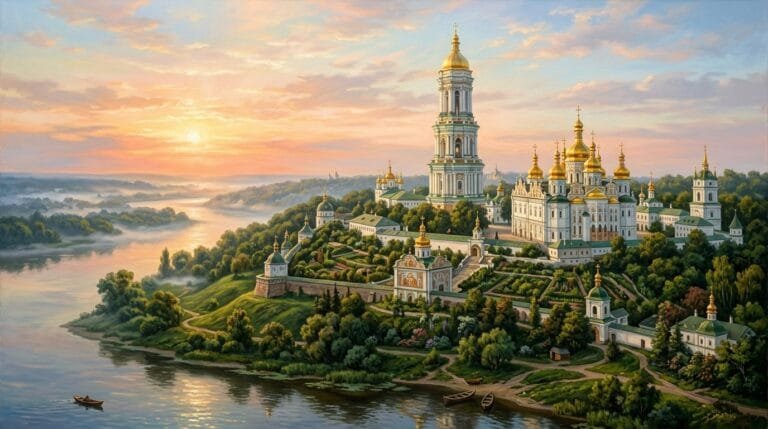
The Kyiv Pechersk Lavra (the Kyiv Monastery of the Caves) is the oldest and most important monastery in Ukraine, founded in 1051 as a cave monastery outside the walls of Kyiv. For almost a thousand years it has been a centre of monasticism, chronicle writing, printing and pilgrimage. Below is its full history, the caves with the relics of the saints, its architecture and a practical guide for visitors. [1][2][3]
The monastery at a glance
- Full name: the Kyiv Pechersk Lavra (Kyiv Monastery of the Caves).
- Founded: 1051 (a variant tradition gives 1036), under Prince Yaroslav the Wise.
- Founder: Saint Anthony, tonsured on Mount Athos, who settled in the cave of the priest Ilarion.
- Location: Kyiv, on the right bank of the Dnipro.
- Status: National Kyiv-Pechersk Historical and Cultural Reserve (national status since 1996); a UNESCO World Heritage site.
- Caves: the Near (Anthony’s) and Far (Theodosius’s) Caves — 73 and 51 tombs respectively.
- Main church: the Dormition Cathedral, founded 1073, rebuilt 1998–2000.
History of the Kyiv Pechersk Lavra
Anthony, Theodosius and the beginnings
The monastery arose near the ancient Varangian cave in 1051, when the monk Anthony, who had been tonsured on Mount Athos, settled in a cave dug by the priest Ilarion. It was one of the first monasteries of Rus and laid the foundation of Rus monasticism. [1][2]
Around 1062 Varlaam became the first hegumen, and around 1063 he was succeeded by Theodosius, who introduced the Studite Rule — the cenobitic constitution that then spread to the monasteries of Rus. In 1058, with Anthony’s blessing, Varlaam built a wooden church of the Dormition of the Theotokos above the caves. [1][2]
Two cave systems took shape: the Far (Theodosius’s) Caves and the Near (Anthony’s) Caves. In the 11th century the monastery became a centre for the spread and consolidation of Christianity in Kyivan Rus. Its chroniclers included Nykon the Great, Nestor — author of the Tale of Bygone Years — and Sylvester. [2][3]
The Dormition Cathedral and the medieval monastery
The stone Dormition Cathedral was founded in 1073 and built in 1072–1078; a defensive wall followed in 1077, and in 1108 Prince Hlib Vseslavych funded the refectory. The monastery received the title of lavra in 1169 (confirmed in 1598 and again in 1688). [1][3]
Its history was repeatedly interrupted by catastrophe: an attack in 1096, an earthquake in 1230 and the invasion of Batu Khan in 1240. The cathedral was restored in 1470 at the expense of Prince Semen Olelkovych. [3]
The early modern period: printing and learning
Around 1615 Archimandrite Yelysei Pletenetskyi established the Lavra printing house, which became one of the most influential publishing centres in Eastern Europe. In 1631 Petro Mohyla founded a school at the monastery, later merged into what became the Kyiv-Mohyla Academy. In 1593, under Archimandrite Nykyfor Tur, one of the first inventories of the monastery’s property was made: it owned two towns and 54 villages. [2][3]
The lavra’s canonical position changed several times: it was a stauropegion of the Ecumenical Patriarchate of Constantinople from 1592 to 1688, then under Moscow from 1688, and from 1786 under the metropolitans of Kyiv. [1][3]
The 18th and 19th centuries
In 1731–1744 the Great Lavra Bell Tower was built to a design by Johann Gottfried Schädel; at roughly 96.5 metres it was for a long time the tallest structure in the Russian Empire. The refectory church was erected in 1893–1895 to a design by Volodymyr Nikolaiev. [3]
Revolution, Soviet rule and the destruction of the cathedral
On 25 January 1918 Metropolitan Volodymyr was murdered at the lavra — the first bishop killed in the revolutionary turmoil. In 1930 the monastery was closed and turned into the “All-Ukrainian Museum Town”. [3]
On 3 November 1941 the Dormition Cathedral was blown up. Responsibility remains disputed: some evidence points to NKVD demolition teams, other accounts to the German occupying forces; the USSR never acknowledged its own involvement. Monastic life had been restored on 27 September 1941 and continued until the monastery was closed again in February 1961. A state reserve had operated on the site since May 1944. [3]
Independence and the present day
Monastic life revived in 1988. In 1996 the complex received national status, and in 1998–2000 the Dormition Cathedral was rebuilt on its historical foundations. In 2023 the Orthodox Church of Ukraine established a stauropegion at the lavra, and the question of which community uses the state-owned buildings has remained a matter of public and legal debate. [3][4]
The caves and the relics
The caves are the heart of the lavra and the reason for its name. They are narrow corridors cut in loess at a depth of 5–15 metres, with underground churches, cells and burial niches.
- The Near (Anthony’s) Caves — about 383 m of passages, with 73 tombs, including those of Nestor the Chronicler and Ilya Muromets.
- The Far (Theodosius’s) Caves — about 293 m of passages, with 51 tombs.
The bodies of the monks buried there underwent natural mummification in the stable microclimate of the caves — a constant temperature of about 10–12 °C and low humidity. For Orthodox believers these are the incorrupt relics of the Venerable Fathers of the Caves; for scholars, a unique object of study. [1][3]
Architecture
The ensemble is divided into the Upper Lavra (the reserve) and the Lower Lavra (the caves). Its principal monuments are:
- the Dormition Cathedral (1073–1078; rebuilt 1998–2000) — the compositional centre;
- the Great Lavra Bell Tower (1731–1744, J. G. Schädel), about 96.5 m high;
- the Gate Church of the Trinity (12th century) above the Holy Gates — one of the few surviving structures of Kyivan Rus;
- the Refectory Church (1893–1895, V. Nikolaiev) with its distinctive dome;
- the All Saints Church (late 17th century), a masterpiece of Ukrainian Baroque;
- the fortress walls, the Kovnirivskyi block and the bell towers of the Near and Far Caves.
Practical information for visitors
- Getting there: Arsenalna metro station, then a short walk or a bus along Ivana Mazepy Street.
- Two parts, two tickets: the Upper Lavra is a museum reserve with paid admission; entry to the territory of the Lower Lavra and the caves is free.
- Visiting the caves: candles are the traditional light source and are sold at the entrance. The passages are narrow and low — not recommended for those with claustrophobia.
- Dress code: covered shoulders and knees; headscarves for women in the caves and churches.
- Photography: forbidden in the caves.
- Time needed: allow at least 3–4 hours for the whole complex; the museums require more.
- Wartime note: Kyiv is subject to air-raid alerts. Follow shelter instructions and check the reserve’s current opening arrangements before your visit.
Frequently asked questions
When was the Kyiv Pechersk Lavra founded?
In 1051, according to the Tale of Bygone Years, when the monk Anthony settled in a cave near Berestove; a variant tradition gives 1036. [1][2]
Why is it called “Pechersk”?
From the Ukrainian word pechera, “cave”: the first monks lived and were buried in caves dug into the hillside. [1]
Who is buried in the caves?
The Venerable Fathers of the Caves — 73 tombs in the Near Caves and 51 in the Far Caves — among them Nestor the Chronicler and, by tradition, Ilya Muromets. [3]
Who destroyed the Dormition Cathedral?
It was blown up on 3 November 1941. Two versions exist — NKVD demolition groups or the German occupiers — and the question has never been definitively settled; the USSR did not admit responsibility. The cathedral was rebuilt in 1998–2000. [3]
When did the monastery become a lavra?
It received the title in 1169, with later confirmations in 1598 and 1688. [3]
Is the lavra on the UNESCO list?
Yes, together with Saint Sophia Cathedral it forms a UNESCO World Heritage site inscribed in 1990. [3]
Conclusion
The Kyiv Pechersk Lavra is where Ukrainian monasticism, chronicle writing and book printing began. It has been sacked by the Horde, shaken by earthquakes, closed by Soviet power and had its greatest church blown up — and it has been rebuilt every time. Today it remains both a living monastery and the country’s foremost historical and cultural reserve. [1][3]