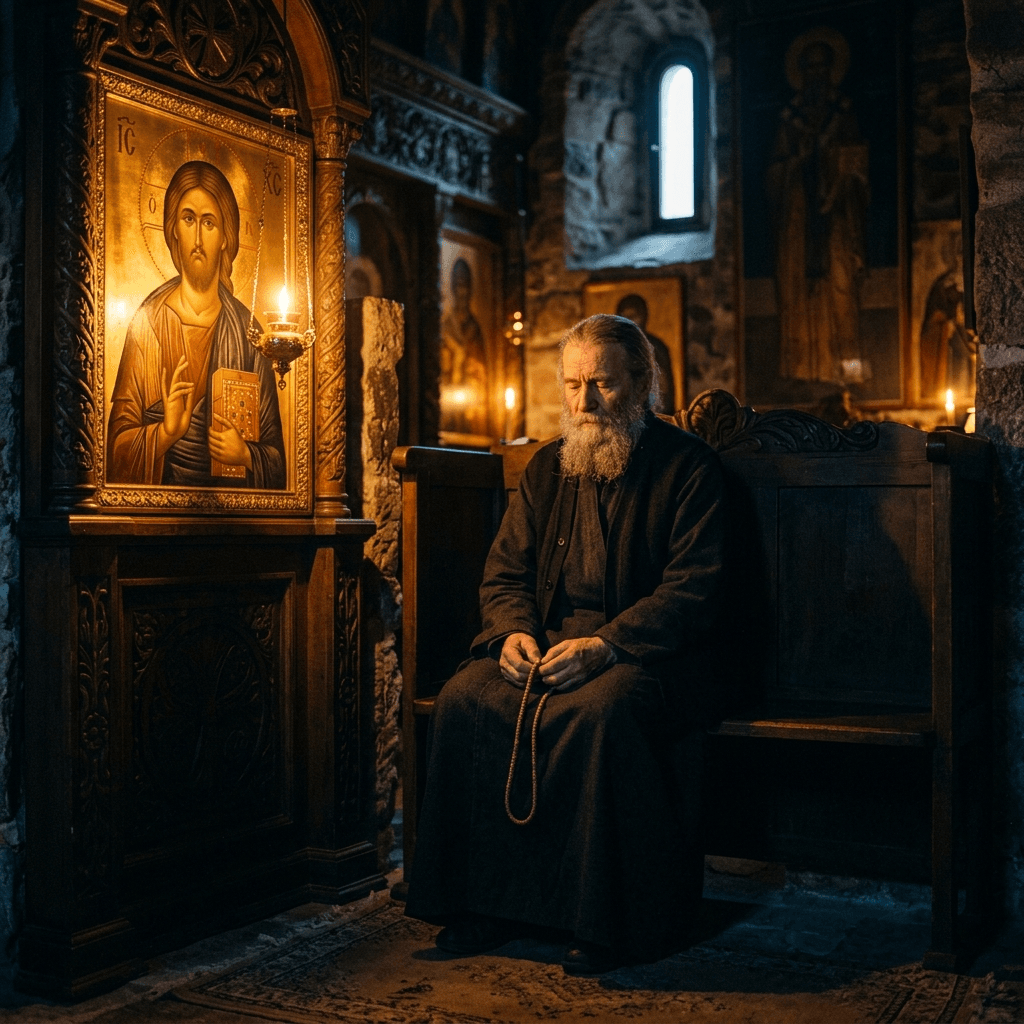
How to Practice Hesychasm: My Journey from Manifestation and Neville Goddard to Christian Contemplation
In today’s world, saturated with information noise, we are constantly searching for tools to calm our minds and realize our potential. My own journey in these searches began with the study of metaphysics. I was deeply interested in the topic of manifestation, read the works of Neville Goddard about the power of imagination and the Law of Assumption, and explored how our subconscious works.
However, the more I immersed myself in Christianity and read the Gospels, the more I realized: most modern “secrets” of psychology and esotericism are actually just simplified echoes of a much deeper, time-tested spiritual practice. And this pearl of the Christian East is called Hesychasm.
Hesychasm is not just dry theological theory. It is an amazing practical tradition of “mental action” and continuous prayer, which has a massive history and real, proven fruits. It teaches how to turn off the chaos in your head, cleanse your heart from destructive emotions, and connect with the Living God.
In this article, I want to share my knowledge on how to practice Hesychasm in the modern world, using the experience of the Holy Fathers and adapting it to our daily lives.
—
1. What is Hesychasm? Etymology and Roots
The word “Hesychasm” comes from the Greek ἡσυχία [hesychia] — peace, quiet, silence, inner solitude.
A Hesychast is one who seeks inner silence. But this silence is not just the physical absence of sounds around you. It is a special state of mind and heart when the continuous internal dialogue subsides, passionate images, anxieties, and memories disappear, freeing up space to contemplate the Divine presence.
Historical Genesis and Spiritual Roots
The practice originated in the 4th–5th centuries among the Egyptian and Sinai hermits. The first ascetic fathers realized that man’s greatest enemy is his own uncontrolled mind, which constantly generates thousands of thoughts (logismoi).
In the 14th century on Mount Athos, Hesychasm reached its peak. St. Gregory Palamas theologically proved that through the practice of pure contemplation, a person is able to actually unite with God through His uncreated energies (for example, to see the Tabor Light that the apostles saw during the Transfiguration of Christ).
All the practical wisdom of this tradition was collected in the anthology Philokalia (known in Ukrainian as “Dobrotolubiye”), which remains the main manual for anyone seeking inner peace.
—
2. The Main Tool: The Jesus Prayer
While in Eastern practices or popular meditation the mind is forced to concentrate on abstract objects or just breathing, in Hesychasm the main anchor of attention is the Jesus Prayer:
“Lord Jesus Christ, Son of God, have mercy on me, a sinner”
This short prayer is an ideal tool to keep the mind gathered in any situation — in transport, on a walk, or during routine work.
The Way from Quantity to Self-Moving Prayer of the Heart
In the wonderful book The Way of a Pilgrim (A Pilgrim’s Candid Stories to His Spiritual Father) describes a unique way of mastering this practice through the number of repetitions. The elder teaches the pilgrim to say the prayer first 3,000 times a day, then 6,000, then 12,000 times, until the prayer passes from the tongue to the mind, and from the mind to the heart itself, beginning to sound there continuously, even during sleep, merging with the rhythm of breathing and heartbeat.
—
3. Detailed Overview of the Philokalia and the Teachers of Hesychasm
The Philokalia is not just a collection of pious reflections. It is a multi-century encyclopedia of the human mind. Different authors enriched Hesychasm with unique focuses:
Anthony the Great (4th Century) — Pioneer of the Desert
St. Anthony laid the foundation of Christian asceticism. His main contribution was the understanding that spiritual life begins with a complete shutdown of external noise. He taught that an undisciplined mind is like a wild donkey that runs wherever it pleases. Anthony was the first to formulate the concept of watchfulness of the heart (nepsis) and showed that solitude is a necessary condition to hear the quiet voice of God.
Evagrius Ponticus (4th Century) — The First Psychologist of Asceticism
Evagrius classified human thoughts brilliantly. He formulated the doctrine of the eight principal passionate thoughts (gluttony, lust, avarice, anger, sadness, acedia, vainglory, and pride). Evagrius explained in detail how passions distort our perception of reality, and defined “pure prayer” as a state of mind completely free from any images or concepts.
John Climacus (6th Century) — Systematizer of Spiritual Ascent
The author of the famous “Ladder of Divine Ascent”. St. John described the spiritual path as a ladder of 30 steps. For Hesychasm, his work is vital because he deeply explored “stillness” (hesychia) and the “remembrance of death” as means to restrain the distraction of the mind. He wrote the classic definition: “A hesychast is one who strives to confine his incorporeal mind within his bodily house (the heart)”.
Nikiphoros the Monk (13th Century) — Father of the Psychophysical Method
St. Nikiphoros was the first to describe the relationship between breathing and attention in detail. Observing how the minds of beginners constantly run away into the outer world, he proposed using the natural slowing down of breath and concentration on the cardiac center to artificially keep the mind inside the body. His method became revolutionary for the practical mastery of hesychia.
Gregory of Sinai (14th Century) — Popularizer of Athonite Contemplation
St. Gregory brought the Sinaitic practice of unceasing prayer to Mount Athos and made it accessible to many monks. He wrote practical instructions on body posture during prayer, breath control, and the fight against demonic delusion (prelest). His works are the clearest practical guides to Hesychasm.
—
4. The Tabor Light and the Great Theological Controversy of the 14th Century
Hesychasm is not just a psychological exercise. The ultimate goal of this practice is Theosis (Deification) — the complete union of man with God, where man becomes god by grace. The main experience of this union is the contemplation of the Tabor Light.
What is the Tabor Light?
This is the same Divine Light that the Apostles Peter, James, and John saw during the Transfiguration of Jesus Christ on Mount Tabor (Matthew 17:1-9). Hesychasts claimed that this light is not a physical, created phenomenon (like the light of the sun or a lamp). It is the uncreated Divine Light, the manifestation of God Himself, which becomes visible to the purified eye of the practitioner’s intellect (nous).
The Controversy: Gregory Palamas vs. Barlaam of Calabria
In the 14th century, Hesychasm faced fierce criticism from the Italian philosopher Barlaam of Calabria. Barlaam, raised on Western scholastic philosophy, asserted:
- God is absolutely unknowable to humans.
- Any light that monks see during prayer is either physical (created) or a hallucination.
- It is impossible to have a direct experience of union with God.
Defending the Hesychasts, St. Gregory Palamas formulated a fundamental distinction that saved Eastern Christian mysticism: the distinction between the Essence and the Energies of God.
- Essence (Ousia): Absolutely unknowable, transcendent, inaccessible to creation.
- Energies (Energeia): Uncreated manifestations of God (His Light, Love, Grace), through which He reveals Himself in the world and unites with human beings.
Palamas explained this using a beautiful metaphor of the Sun:
- The Essence of God (Ousia) is the sun itself. A person cannot touch it or approach it closely, or they will burn. The Essence of God remains forever inaccessible and unknowable.
- The Energies of God (Energeia) are the sun’s rays and warmth. They are not something other than the sun. When a sunbeam hits you, you experience the sun itself, get warmed by it, and see thanks to it.
The Tabor Light is the Divine Energy. Contemplating it, the Hesychast truly unites with God, becoming a partaker of the Divine nature (2 Peter 1:4), while the essence of God remains a mystery. This victory of Palamas’s teaching at the Councils of Constantinople established Hesychasm as the official doctrine of the Orthodox Church.
—
5. The Psychophysical Method of Hesychasts: Engaging the Body
Unlike many modern approaches that separate the physical and spiritual, Athonite elders created a unique psychophysical method of prayer. They understood that our physiological state directly affects brain activity.
Step-by-Step Instructions of the Contemplative Method:
- Prayer Posture:
- Sit on a low stool (about 20–30 cm high).
- Incline your head (chin to chest), directing your inner gaze to the heart area. This helps to physically “lock” attention inside the body, preventing the eyes and mind from scattering.
- Breathing Control:
- Start breathing slowly, naturally, and without strain.
- Coordinate the words of the prayer with your breathing rhythm:
On inhale: “Lord Jesus Christ, Son of God…”*
On exhale (or retention): “…have mercy on me, a sinner”*.
- Bringing the Mind into the Heart:
- Move the center of consciousness from the head (where our mental dialogues usually spin) down to the heart. Keep your attention in the center of the chest, as if you are standing there on guard and observing every thought.
—
6. Neurobiology of Hesychia: How the Practice Affects the Brain
Modern research in the field of neurobiology (neurotheology) confirms the amazing physiological effects that Hesychasts discovered empirically hundreds of years ago.
Activation of the Vagus Nerve
Slowing down breathing during prayer (especially the exhale phase and slight breath retention) instantly activates the parasympathetic nervous system via the vagus nerve. This leads to:
- A decrease in heart rate (HR).
- A reduction in the production of stress hormones (cortisol and adrenaline).
- Activation of recovery processes in the body.
Effect on the Default Mode Network (DMN)
The DMN is a network of neurons that activates when we are not occupied with anything. It is responsible for “mind wandering,” constant replaying of the past, anxiety about the future, self-analysis, and egocentric thoughts (exactly what Hesychasts call the chaos of logismoi).
Neuroimaging shows that deep focus on the words of the Jesus Prayer completely suppresses DMN activity. The mind enters a state of deep peace and focus, analogous to the flow state.
Alpha and Theta Brain Waves
During the prayer of the heart, the brain lowers its wave frequency to alpha (8–12 Hz) and theta waves (4–7 Hz). This is a state of deep relaxation that typically occurs before sleep or during a deep phase of sleep, but the person remains fully conscious and alert (the state of watchfulness — nepsis). This opens access to the deep layers of the subconscious, allowing the name of Christ to heal old psychological traumas and fears.
—
7. Nepsis (Watchfulness) — Christian Mind Control
The process of spiritual vigilance and guarding the heart in Hesychasm is called Nepsis (or Watchfulness, spiritual alertness). This is an active spiritual guard. The Philokalia describes in detail how thoughts (logismoi) penetrate our hearts and turn into destructive passions through 4 stages:
- Assault (Provocation / Image): A neutral thought or memory suddenly arises in the mind. There is no sin here yet.
- Interaction (Dialogue): We begin to contemplate this image, to be interested in it.
- Consent (Pleasure): The mind agrees to the thought’s suggestion, we begin to experience it in our imagination.
- Captivity (Passion): The emotion completely captures our will (for example, resentment, anger, or fear).
The Hesychast learns to intercept thoughts at the assault stage. Instead of entering into a discussion with the thought, he immediately applies the power of the Jesus Prayer, which “burns” the assault at the very beginning.
—
8. The Trap of “Prelest” (Spiritual Delusion)
During prayer, it is strictly forbidden to accept any images, dreams, visions, or voices. True prayer is absolutely “imageless” (formless). If you see something supernatural, ignore it and hold only to the words of the prayer. Accepting visions leads to a dangerous state of spiritual delusion (prelest).
—
9. How Can a Modern Layperson Practice Hesychasm?
To receive the fruits of this tradition, there is no need to leave the world. It is enough to take a few simple steps:
- Dedicate 10-15 minutes to silence in the morning and evening. Turn off gadgets, sit comfortably and quietly repeat the prayer, focusing on its words.
- Practice during daily tasks. Use the time of walks, trips in transport, or housework for quiet Jesus Prayer.
- Use the “5 Word Rule”. If it is difficult to keep concentration, shorten the phrase to: “Lord Jesus, have mercy on me”.
- Limit information noise. The mind will not be able to enter a state of hesychia (peace) if we constantly feed it with a news feed or meaningless short videos.
Hesychasm is a time-tested path to inner harmony, deep concentration, and union with the Creator. Start small, and you will feel how a real, living Divine silence fills your life.
—
This article was prepared with the help of artificial intelligence (AI) and edited by the author of the pray.ee project.