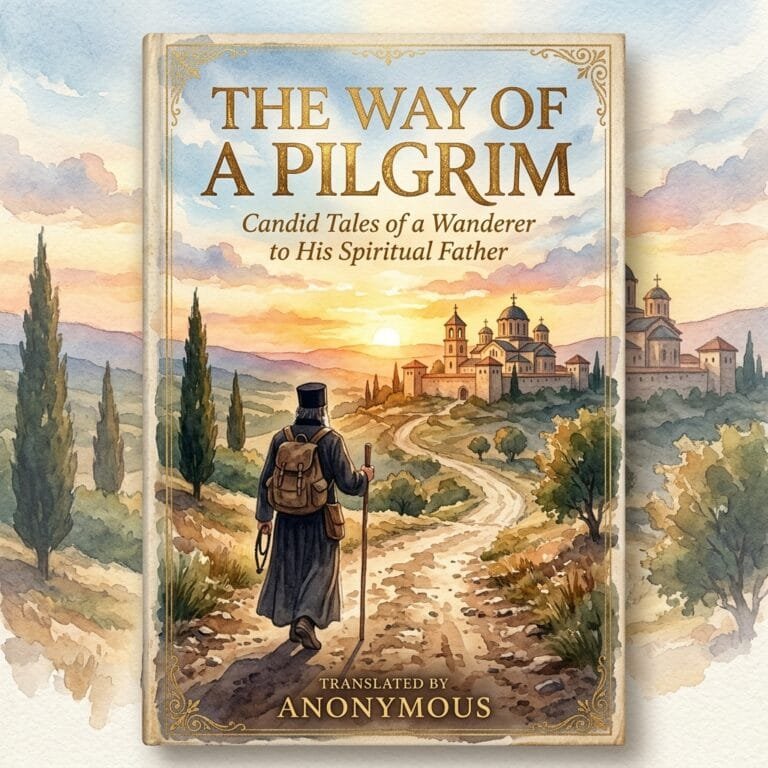
The First Narrative
The beginning of the wandering and the search for unceasing prayer
By the grace of God I am a Christian man, in my deeds a great sinner, by calling a homeless wanderer of the humblest station, roaming from place to place. My whole estate is this: a satchel of dried bread on my back and the Holy Bible inside my coat — that is all. On the twenty-fourth week after Pentecost I came into a church at the time of the Liturgy to pray; the Epistle was being read, from the letter to the Thessalonians, in which it is said: pray without ceasing. That saying fastened itself upon my mind, and I began to consider how a man can pray without ceasing, when every man must also busy himself with other matters in order to sustain his life. I looked it up in the Bible, and there I saw with my own eyes the very thing I had heard — namely, that one must pray unceasingly, pray at all times in the spirit, and lift up praying hands in every place. I thought and thought, and could not resolve it.
What am I to do, I wondered — where shall I find someone to explain it to me? I will go the round of the churches where good preachers are renowned; perhaps there I shall hear something to my purpose. And so I went. I heard a great many excellent sermons on prayer. But they were all instructions about prayer in general: what prayer is, how one must pray, what the fruits of prayer are; yet of how one comes to succeed in prayer, no one spoke. There was a sermon on prayer in the spirit and on unceasing prayer; but how to attain such prayer was not shown. Thus the hearing of sermons did not bring me to what I sought. And so, having listened my fill of them and gained no notion of how to pray without ceasing, I gave up listening to public sermons and resolved, with God’s help, to seek out an experienced and knowledgeable man who would explain unceasing prayer to me, for the longing after that knowledge would not leave me.
For a long while I wandered through various places, always reading the Bible and asking whether there might not be somewhere a spiritual instructor, some devout and experienced guide. In time I was told that in a certain village there had long been living a gentleman who was working out his salvation: he had a church in his own house, he never went anywhere, he prayed to God continually and read soul-saving books without ceasing. Hearing this, I no longer walked but ran to that village; I reached it and came to the landowner.
— What is it you want of me? he asked me.
— I have heard that you are a devout and understanding man; and so I beg you, for God’s sake, to explain to me what is meant by the Apostle’s words, pray without ceasing, and in what manner one can pray unceasingly. I greatly desire to learn this, and I cannot understand it.
The gentleman was silent, looked at me intently, and then said: unceasing inward prayer is the continual striving of the human spirit toward God. To succeed in this sweet exercise, one must more often ask the Lord to teach us to pray without ceasing. Pray more, and more fervently; prayer itself will reveal to you how it may become unceasing; for this, time is needed.
Having said this, he ordered me to be fed, gave me something for the road, and let me go. And he did not explain.
Again I set out; I thought and thought, read and read, pondered and pondered over what the gentleman had told me, and still could not understand; and I wanted so much to understand that I did not sleep at night. I walked some two hundred versts and came at last to a large provincial town. There I saw a monastery. Stopping at an inn, I heard that the abbot of that monastery was a good man, hospitable and devout. I went to him. He received me kindly, sat me down, and began to offer me food.
— Holy father! said I.
— Well, how is one to be saved? Live by the commandments and pray to God — and you will be saved!
— I hear that one must pray without ceasing, but I do not know how to pray unceasingly, and I cannot even understand what unceasing prayer means. I beg you, my father, to explain this to me.
— I do not know, dear brother, how else to expound it to you. Ah! wait — I have a book in which it is explained. And he brought out St. Dimitry’s Spiritual Instruction of the Inward Man. Here, read this page.
I began to read as follows: “Those apostolic words, pray without ceasing, are to be understood of the prayer that is performed by the intellect; for the intellect can always be fixed upon God and pray to Him unceasingly.”
— Explain this to me: in what way can the intellect always be fixed upon God, without being distracted, and pray unceasingly?
— That is a very hard thing, unless God Himself grant it to a man, said the abbot. And he did not explain.
Having spent the night with him, and having thanked him in the morning for his kind hospitality, I set out again on my way, not knowing myself where I was going. I grieved over my lack of understanding, and for comfort I read the Holy Bible. I walked thus for five days along the high road; at last, toward evening, an old man overtook me, who by his appearance seemed to be of the clergy.
In answer to my question he said that he was a schema-monk from a hermitage some ten versts off the high road, and he invited me to come with him to their hermitage. With us, he said, wanderers are received, given rest and fed together with the pilgrims at the guest house.
Somehow I did not wish to go, and I answered his invitation thus: my peace depends not upon lodging but upon spiritual instruction; and I am not chasing after food — I have plenty of dried bread in my satchel.
— And what sort of instruction are you seeking, and what perplexes you? Come, come with us, dear brother; we have experienced elders who can give spiritual nourishment and set a man on the true path by the light of the word of God and the discernment of the holy fathers.
The meeting with the elder and the first lessons in prayer
You see, father, about a year ago, when I was standing at the Liturgy, I heard in the Epistle this commandment: pray without ceasing. Not knowing how to understand it, I began to read the Bible. And there too, in many places, I found God’s injunction that one must pray unceasingly — always, at every time, in every place, not only during all one’s occupations, and not only while awake but even in sleep: I sleep, but my heart is awake. This greatly astonished me, and I could not grasp how it might be carried out or by what means; a strong desire and curiosity were stirred up in me, and day and night it would not leave my mind. And so I began to go about the churches and listen to sermons on prayer; but however many I heard, in none of them did I receive instruction on how to pray without ceasing. It was all only about the preparation for prayer, or its fruits, and such things, without teaching how to pray unceasingly and what such prayer means. I often read the Bible and tested by it what I had heard; but even so I did not find the knowledge I desired. And thus until now I have remained in perplexity and disquiet.
The elder crossed himself and began to speak: give thanks to God, beloved brother, for this revealing in you of an irresistible longing for the knowledge of unceasing inward prayer. Recognize in it the call of God, and be at peace, being assured that until now what has been taking place in you was a testing of the consent of your will to the voice of God, and you were being given to understand that it is not by the wisdom of this world nor by outward curiosity that men attain the heavenly light of unceasing inward prayer, but on the contrary, by simplicity of heart. And therefore it is not at all surprising that you could hear nothing about the essential work of prayer, nor learn the science of how to attain its unceasing operation. And, to speak the truth, although not a few preach about prayer, and there are many instructions on it by various writers, yet since all their reasonings are founded for the most part upon speculation and upon the reflections of natural reason, and not upon active experience, they instruct rather concerning what belongs to prayer than concerning its essence. One reasons excellently on the necessity of prayer; another on its power and its benefit; a third on the means to perfection in prayer — that is, that for prayer there must be diligence, attention, warmth of heart, purity of thought, reconciliation with enemies, humility, contrition and the rest. But what is prayer? and how does one learn to pray? To these questions, though they are the first and the most necessary, one may very rarely seek detailed answers from the preachers of our time; for they are harder to grasp than all the above-mentioned reasonings, and they require a mysterious knowledge and not schoolroom learning alone. And what is still more to be regretted, vain and elemental wisdom compels men to measure the things of God by a human measure. Many reason about the work of prayer quite the wrong way about, supposing that the preparatory means and the ascetic labours produce prayer, and not that prayer gives birth to the labours and to all the virtues. In this case they wrongly take the fruits or consequences of prayer for the means and methods toward it, and thereby they belittle the power of prayer. And this is by no means in accord with the Holy Scripture; for the Apostle Paul gives instruction about prayer in these words: I exhort therefore, first of all, that supplications be made. Here the first teaching in the Apostle’s saying about prayer is that he sets the work of prayer before all else: I exhort, first of all, that supplications be made. Many are the good works required of a Christian, but the work of prayer must come before all, for without it no other good work can be accomplished. Without prayer one cannot find the way to the Lord, nor understand the truth, nor crucify the flesh with its passions and lusts, nor be enlightened in the heart with the light of Christ, nor be savingly united with Him — not without frequent prayer going before. I say frequent, because both the perfection and the rightness of prayer are beyond our power, as the holy Apostle Paul also says: we know not what we should pray for as we ought. Therefore only frequency, only constancy, is left to the lot of our own power, as the means of attaining purity in prayer, which is the mother of every spiritual blessing. Gain the mother, and she will bear you children, says St. Isaac the Syrian: learn first to acquire prayer, and you will easily fulfil all the virtues. But of this those who are little acquainted with practice and with the mysterious teachings of the holy fathers have no clear knowledge, and they speak of it but little.
In this conversation we had come, without noticing it, almost to the hermitage itself. And so as not to lose this wise elder, and the sooner to obtain the resolving of my desire, I hastened to say to him: do me the kindness, honoured father, of explaining to me what unceasing inward prayer means, and how one is to learn it; I see that you know this in detail and by experience.
The elder received my request with love and called me in to him: come now into my cell, and I will give you a book of the holy fathers, from which you can clearly and thoroughly understand and learn prayer with God’s help. We went into the cell, and the elder began to speak as follows: unceasing inward prayer to Jesus is the continual and never-ceasing calling upon the divine name of Jesus Christ with the lips, the intellect and the heart, while picturing His constant presence and asking His mercy, during all one’s occupations, at every hour and in every place. It is expressed in these words: Lord Jesus Christ, have mercy on me! And if a man grows accustomed to this calling, he will feel great consolation and such a need to say this prayer always that he can no longer be without it, and it will pour itself out in him of its own accord.
— Now, is it clear to you what unceasing prayer is? — Very clear, my father! For God’s sake teach me how to attain it! I cried out for joy.
The reading of the Philokalia and spiritual progress
— How to learn prayer — of this we shall read here in this book. This book is called the Philokalia. It contains the full and detailed science of unceasing inward prayer, set forth by twenty-five holy fathers; and it is so lofty and profitable that it is reckoned the chief and foremost teacher in the contemplative spiritual life, and, as St. Nikephoros puts it, it “leads a man into salvation without toil and sweat.”
— Is it then higher and holier than the Bible? I asked.
— No, it is neither higher nor holier than the Bible, but it contains luminous explanations of what is mysteriously contained in the Bible and is not comprehensible, by reason of its height, to our short-sighted understanding. Let me give you an example. The sun is the greatest, most brilliant and most magnificent of luminaries; but you cannot gaze upon it and examine it with a simple, unshielded eye. You need a certain artificial glass, though it be a million times smaller and dimmer than the sun, through which you may look upon that glorious king of the luminaries, delight in it and receive its flaming rays. So the Holy Scripture is that brilliant sun, and the Philokalia is the needful glass.
— Now listen, I shall read to you how one learns unceasing inward prayer. The elder opened the Philokalia, found the instruction of St. Symeon the New Theologian and began: “Sit down in silence and solitude, bow your head, close your eyes; breathe more softly, look with your imagination within your heart, bring your intellect — that is, your thought — down from your head into your heart. As you breathe, say: Lord Jesus Christ, have mercy on me. Drive away thoughts, keep a calm patience, and repeat this exercise often.”
Then the elder explained all this to me, showed me an example of it, and we read further in the Philokalia from St. Gregory of Sinai, and from Sts. Callistus and Ignatius. Everything we read in the Philokalia the elder explained to me further in his own words. I listened attentively and with delight, drinking it into my memory and trying to remember it in as much detail as I could. Thus we sat the whole night through and, without sleeping, went to matins.
As he let me go, the elder blessed me and told me that while I was learning prayer I should come to him with sincere confession and disclosure, since without the checking of an instructor it is unprofitable and of little use to take up the inward work on one’s own authority.
Standing in the church, I felt within me a burning zeal to learn inward unceasing prayer as diligently as I could, and I prayed God to help me. Then I began to wonder how I should go to the elder for counsel or for the disclosure of my soul; for at the guest house they do not let one stay more than three days, and near the hermitage there are no lodgings. At last I heard that some four versts away there was a village. I went there to look for a place; and to my good fortune God showed me a convenient one. I hired myself out there for the whole summer to a man, to watch his vegetable garden, so that I might live alone in a hut in that garden. Glory to God! — I had found a quiet place. And so I began to live and to learn inward prayer in the manner shown to me, and to go to the elder.
For about a week I diligently worked alone in the garden at learning unceasing prayer, exactly as the elder had explained to me. At first the thing seemed to go well. Then I felt a great heaviness, sloth, boredom, an overpowering drowsiness, and thoughts of every sort came upon me like a cloud. In sorrow I went to the elder and told him my condition. He met me kindly and began to say: this, beloved brother, is the war of the world of darkness against you; for nothing in us is so terrible to that world as prayer of the heart, and therefore it strives by every means to hinder you and to turn you away from the learning of prayer. However, the enemy acts only by God’s will and permission, and only so far as is needful for us. Evidently you still need this testing unto humility; and therefore it is still too early for you to approach with immoderate zeal the higher entrance of the heart, lest you fall into spiritual avarice.
— Here, I shall read you an instruction from the Philokalia on this very case. The elder found the teaching of St. Nikephoros the monk and began to read: “If, after labouring a little, you cannot enter into the region of the heart in the way that has been expounded to you, then do what I tell you, and with God’s help you will find what you seek. You know that every man’s faculty of speech is in the throat. Drive away all thoughts from it, and give it, unceasingly, this to say: Lord Jesus Christ, have mercy on me!”
— There, you hear how the holy fathers instruct us in such a case, said the elder. And therefore you must now receive the injunction with confidence, to say the Jesus Prayer with the lips as much as ever you can. Here is a prayer rope for you; with it say at first at least three thousand prayers a day. Whether you are standing, sitting, walking or lying down, say without ceasing: Lord Jesus Christ, have mercy on me — not loudly and not hurriedly; and be sure to fulfil faithfully three thousand a day, neither adding nor diminishing on your own authority. God will help you through this to attain also the unceasing action of the heart.
With joy I accepted this injunction and went back to my place. I began to carry it out properly and exactly as the elder had taught me. For a couple of days it was rather hard, and then it became so easy and so desirable that whenever I was not saying the prayer there was a kind of demand in me to say the Jesus Prayer again; and it began to be uttered more readily and with ease, no longer with constraint as before.
I reported this to the elder, and he directed me now to say six thousand prayers a day, saying: be at peace, and only strive as faithfully as you can to fulfil the appointed number of prayers; God will show His mercy to you.
For a whole week, in my solitary hut, I went through six thousand Jesus Prayers a day, caring for nothing and paying no heed to the thoughts, however they warred against me; I strove only to fulfil the elder’s injunction exactly. And what happened? I grew so used to the prayer that when I stopped saying it even for a short while, I felt as though something were missing, as though I had lost something; and when I began the prayer, at that very minute it became easy and consoling again. If I met anyone, I had no wish to talk, and I longed only to be alone and to say the prayer — so accustomed to it had I become in a week.
Not having seen me for some ten days, the elder came himself to visit me; I explained my condition to him. Having listened, he said: now you have grown used to the prayer; see that you maintain and strengthen this habit, do not waste time in idleness, and with God’s help resolve to fulfil without fail twelve thousand prayers a day. Keep to solitude, rise earlier and lie down later, and come to me for counsel every two weeks.
I began to do as the elder had told me, and on the first day I barely managed, late in the evening, to finish my rule of twelve thousand. On the second day I completed it easily and with satisfaction. At first, from the unceasing utterance of the prayer, I felt weariness, or a kind of stiffness of the tongue and a certain tightness in the jaws — though not unpleasant; then a light, fine ache in the roof of my mouth; and after that I felt a slight pain in the thumb of my left hand, with which I told the beads, and a pleasant sensation in the whole hand. And all this seemed to stir me up and urge me to say the prayer the more. And so for some five days I faithfully fulfilled twelve thousand prayers, and together with the habit I received both pleasure and eagerness.
Once, early in the morning, it was as though the prayer woke me. I began to read the morning prayers, but my tongue did not utter them readily, and all my desire strove of itself to say the Jesus Prayer. And when I began it, how easy and consoling it became, and my tongue and lips seemed to utter it of themselves without any constraint from me! I spent the whole day in gladness and was as though estranged from everything else, as though on another earth, and I finished the twelve thousand prayers easily in the early evening. I greatly wished to say the prayer still more, but I did not dare to go beyond what the elder had appointed. And so on the following days too I continued calling upon the name of Jesus Christ with ease and with attraction toward it.
Then I went to the elder for disclosure and told him everything in detail. Having listened, he began to speak: glory to God, that eagerness and ease in prayer have been opened in you. This is a natural thing that comes of frequent exercise and effort, as with a machine whose main wheel, once given a push or an impulse, goes on working of itself for a long while; but to keep up its motion the wheel must be oiled and pushed again. See, then, with what wonderful faculties the God who loves mankind has furnished even the sensible nature of man — faculties which can be felt even apart from grace, and in a sensuality not yet purified, and in a sinful soul, as you yourself have now experienced. And how much more wonderful, marvellous and delightful is it when the Lord is pleased to open to a man the gift of self-acting spiritual prayer and to cleanse the soul of the passions! That state cannot be described, and the disclosure of this mystery of prayer is a foretaste of the sweetness of the land of heaven. This is granted to those who seek the Lord in the simplicity of a loving heart! Now I permit you: say the prayer as much as you wish, as much as ever you can; try to devote to prayer all your waking hours, and call upon the name of Jesus Christ now without counting, humbly giving yourself up to the will of God and awaiting help from Him. I believe that He will not abandon you and will direct your path.
Having received this instruction, I spent the whole summer in unceasing oral prayer to Jesus, and I was very much at peace. In sleep I often dreamed that I was saying the prayer. And by day, if I happened to meet anyone, all without exception seemed to me as dear as my own kin, though I had no dealings with them. The thoughts themselves grew altogether quiet, and I thought of nothing but the prayer, to the hearing of which my intellect began to incline; and my heart of itself began to feel warmth and a certain sweetness. If I happened to come to church, the long hermitage service seemed short and was no longer wearisome to my strength as it had been before. My solitary hut seemed to me a splendid palace, and I did not know how to thank God for having sent to me, wretched sinner that I am, such a saving elder and instructor.
The death of the elder and the beginning of the journey alone
But not for long did I enjoy the guidance of my kind and God-wise elder — at the end of the summer he died. Having taken leave of him with tears, and having thanked him for his fatherly teaching of me, wretched as I am, I begged for myself, as a blessing after him, the prayer rope with which he had always prayed. And so I was left alone. At last the summer too came to an end, and the garden was harvested. There was nowhere left for me to live. The man settled with me, gave me two roubles for my watching, filled my satchel with dried bread for the road, and again I went off to wander through various places; but I no longer walked as before in want. The calling upon the name of Jesus Christ gladdened me on the road, and all people grew kinder toward me; it seemed as though everyone had begun to love me.
One day I began to consider where I should put the money I had received for guarding the garden, and what use it was to me. Ah! wait! The elder is gone now, and there is no one to teach me; I will buy myself a Philokalia and study inward prayer by it. I crossed myself and went on my way with the prayer. I came to a provincial town and began to ask for a Philokalia in the shops; I found one in a certain place, but there they asked three roubles, and I had only two. I bargained and bargained, but the merchant would not come down in the least; at last he said: go along to that church there and ask the church warden; he has an old copy of that book, perhaps he will let you have it for two roubles. I went, and indeed I bought a Philokalia for two roubles, all battered and old; and I was overjoyed. I mended it as best I could, sewed a cloth cover on it and put it in my satchel with my Bible.
And so now I go about and say the Jesus Prayer unceasingly, which is dearer and sweeter to me than anything in the world. Sometimes I walk seventy versts and more in a day and do not feel that I am walking; I feel only that I am saying the prayer. When a hard frost grips me, I begin to say the prayer more intently, and soon I am warm all over. If hunger begins to overcome me, I call more often upon the name of Jesus Christ, and I forget that I wanted to eat. When I fall ill, and an aching begins in my back and legs, I set myself to listen to the prayer, and I do not feel the pain. If anyone offends me, I have only to remember how sweet the Jesus Prayer is, and at once the offence and the anger pass and I forget it all. I have become a kind of half-witted man; I have no care about anything, nothing occupies me, I would look at nothing of all the world’s bustle, and I would be alone in solitude; only by habit do I want one thing — to say the prayer without ceasing; and when I am occupied with it I am very glad. God knows what is happening to me. Of course all this is of the senses, or, as my late elder used to say, natural and artificial, coming from habit; but I do not yet dare to set about learning and assimilating spiritual prayer within the heart, because of my unworthiness and folly. I await the hour of God’s will, hoping in the prayers of my departed elder. And so, although I have not attained unceasing self-acting spiritual prayer in the heart, yet glory to God, I now clearly understand what that saying means which I heard in the Epistle:
“Pray without ceasing.”
The Second Narrative
The journey through Siberia and the tale of the captain
For a long while I wandered through various places with the Jesus Prayer as my companion, which heartened and consoled me on every road, in every meeting and in every circumstance. At last I felt that it would be better to settle somewhere in one place, both for the sake of convenient solitude and for the study of the Philokalia, which I did read a little at a time, when I lay down for the night or rested during the day; yet I had a strong desire to be constantly immersed in it, and with faith to draw from it true instruction for the salvation of the soul through prayer of the heart. But since, in accordance with this desire of mine, I could nowhere hire myself out for any work within my strength, because my left arm had been useless since my early childhood, and since therefore I was unable to have a settled shelter, I set off for the lands of Siberia, to St. Innocent of Irkutsk, with the intention that through the forests and steppes of Siberia my walking would be silent, and that therefore it would be more convenient to occupy myself with prayer and reading. And so I walked, saying the oral prayer without ceasing. At last, after no long time, I felt that the prayer had somehow begun of itself to pass into the heart; that is, the heart, in its ordinary beating, began as it were to utter within itself the words of the prayer at each of its strokes, thus: (1) Lord, (2) Jesus, (3) Christ, and so on. I stopped saying the prayer with my lips and began to listen attentively to what the heart was saying, remembering how my late elder had explained to me how delightful this was. Then I began to feel a fine pain in the heart, and in my thoughts such love for Jesus Christ that it seemed to me that if I were to see Him, I would throw myself at His feet and would not let them out of my hands, kissing them sweetly and giving thanks with tears that He grants such consolation for His name’s sake to His name.
Then a kind of beneficent warmth began to appear in the heart, and this warmth spread through all my breast. This turned me especially to the diligent reading of the Philokalia, both in order to test my feelings and to learn the further work of inward prayer of the heart; for without such testing I was afraid of falling into delusion, or of taking natural workings for those of grace, and of growing proud at the quick acquisition of prayer, as I had heard from my late elder. And therefore I now walked more by night, and spent the days mostly in reading the Philokalia, sitting in the forest under the trees. Ah, how much that was new, how much that was wise and until then unknown, that reading opened to me! Exercising myself in it, I tasted such delight as until then I could not even have imagined. True, some passages were unintelligible to my witless mind as I read; but the consequences that came from prayer of the heart explained to me what I had not understood. Besides, from time to time I saw my late elder in dreams, and he explained much to me, and always inclined my foolish soul the more toward humility. For some two summer months I was thus in bliss. I travelled mostly through forests and by-roads; if I came to a village, I would ask for a satchel of dried bread and a handful of salt, and fill my flask with water, and again I would go off for a hundred versts.
Whether for the sins of my wretched soul, or because I needed something for the spiritual life, some better instruction and experience, toward the end of the summer temptations began to appear. Namely: I came out onto the high road, and at dusk two men overtook me, who looked by their heads to be soldiers; they began to demand money. When I said that I had not a single kopeck, they did not believe it and shouted insolently: “You are lying! Wanderers collect a lot of money!” One of them said: “What is the good of talking to him?” — and struck me on the head with a cudgel so that I fell senseless. I do not know how long I lay unconscious; but when I came to, I saw that I was lying at the edge of the forest by the road, all tossed about, and that my satchel was gone; only the cut cords remained on which it had been carried. Glory to God that they had not taken my passport, which lay in my old cap, in case it should be needed for showing quickly where it is demanded. Getting up, I wept bitterly, not so much from the pain in my head as because I had been deprived of my books, the Bible and the Philokalia, which had been in the satchel. Neither by day nor by night did I cease to grieve and weep. Where now is my Bible, which I had read from childhood and always carried with me? Where is my Philokalia, from which I drew both instruction and consolation? I have lost, unhappy man, both the first and the last treasure of my life, without yet having had my fill of it. Better that they had killed me outright than that I should live without this spiritual food! I cannot now acquire them again!
For two days I could hardly drag my feet along, exhausted with this grief; and on the third, utterly worn out, I fell down under a bush and went to sleep. And here I see in a dream that I am in the hermitage, in my elder’s cell, lamenting my grief. The elder, consoling me, began to say: this is a lesson to you in detachment from earthly things, for an easier walking toward heaven. This has been allowed to you so that you should not fall into spiritual self-indulgence. God wills that a Christian should utterly renounce his own will and desire and every attachment to it, and give himself up wholly to His divine will. He arranges every circumstance for the profit and the salvation of man. He wills that all should be saved. And therefore take heart and believe that with the temptation the Lord will also make a way of escape. And you will soon be consoled far more than you now grieve. At these words I awoke, felt strength returning to me, and in my soul as it were a kind of dawn and a settling of peace. Let the will of the Lord be done, I said; I crossed myself, got up and went on. The prayer began to work in my heart as before, and for three days I wandered in peace.
Suddenly I overtook on the road a party of convicts being led under escort. Coming level with them, I saw the two men who had robbed me; and since they were walking at the edge of the group, I fell at their feet and begged them earnestly to tell me where my books were. At first they paid no attention to me, and then one of them began to say: if you give us something, we will tell you where your books are. Give us a rouble. I swore that I would give it, that I would certainly give it, even if I had to beg for it in Christ’s name about the world; here, if you like, take my passport in pledge. They said that my books were being carried in the baggage cart, along with the other stolen goods found on them. How can I get them? Ask the captain who is escorting us. I rushed to the captain and explained everything in detail. Among other things he asked me: can you really read the Bible? Not only can I read anything, I answered, but I can write too: you will see the inscription in the Bible saying it is mine; and here in my passport is the same name and surname. The captain began to say: these rogues are runaway soldiers, they lived in a dugout and robbed many people. A sharp coachman caught them yesterday, when they tried to seize his team of three. Very well, I will give you your books, if they are here; but come with us to the night halt; it is not far, some four versts, for I am not going to stop the whole party and the baggage train for you. I went gladly beside the captain’s horse, talking with him. I saw that he was a good and honest man, and no longer young. He asked me who I was, where I came from and where I was going. I answered everything truthfully; and so we reached the halting house for the night. Having found my books, he gave them back to me and said: where are you to go now at night? Spend the night here with me in the anteroom. I stayed.
Having got my books back, I was so glad that I did not know how to thank God; I pressed the books to my breast and held them so long that my hands even grew numb. Tears poured from my eyes for joy, and my heart beat sweetly with delight!
The captain, looking at me, asked: evidently you love to read the Bible. For joy I could answer nothing to this, and only wept. He went on: I myself, brother, read the Gospel carefully every day. With that he unbuttoned his uniform and took out a small Gospel book of Kiev printing, all bound in silver. Sit down, I will tell you what brought me to this. And let us have supper!
We sat down at the table, and the captain began his tale: from my young years I served in the army, and not in a garrison; I knew the service and was liked by my superiors as a capable ensign. But I was young, and so were my friends; and to my misfortune I got into the habit of drinking, and at last so badly that I fell into bouts of it; when I did not drink, I was a capable officer, but once I started, I would lie drunk for six weeks. For a long time they bore with me; at last, for rudeness to my commanding officer committed while drunk, I was reduced to the ranks for three years and transferred to a garrison; and if I did not mend my ways and give up drink, I was threatened with the severest punishment. In that wretched state, however much I tried to restrain myself, and however much I was treated for it, I could in no way abandon my passion, and so they wanted to transfer me to the convict companies. Hearing this, I did not know what to do with myself.
One day I was sitting in the barracks, deep in thought. Suddenly a monk came in to us with a book, collecting for a church. Everyone gave what he could. Coming up to me, he asked: “Why are you so sad?” Falling into conversation with him, I told him my trouble; and the monk, sympathizing with my condition, began: the same thing happened to my own brother, and this is what helped him: his spiritual father gave him a Gospel book and strictly charged him that whenever he wanted wine, he should first read a chapter of the Gospel; and if he wanted it again, he should read the next chapter. My brother began to do so, and in a short time his passion for drink disappeared, and now for fifteen years he has not taken a drop of strong drink into his mouth. Do the same, and you will see the benefit. I have a Gospel book; I will bring it to you.
Hearing this, I said to him: how can your Gospel help, when neither all my efforts nor any medical remedies could restrain me? I said this because I had never read the Gospel. Do not say that, the monk objected; I assure you that there will be benefit. The next day the monk brought me this very Gospel book. I opened it, looked at it, read a little and said: I will not take it; I can understand nothing here, and I am not used to reading the Church print. The monk went on urging me that in the words of the Gospel there is a power of grace; for what is written in it was spoken by God Himself. It does not matter that you do not understand; only read it diligently. One of the saints said: if you do not understand the word of God, the demons understand what you are reading and tremble; and the passion for drink certainly comes from the stirring of the demons. And here is something more I will tell you: John Chrysostom writes that even the very dwelling in which the Gospel is kept frightens the spirits of darkness and becomes inaccessible to their wiles. I do not remember what I gave that monk; I took the Gospel book from him, put it in my chest with my other things and forgot about it. Some time later the hour came when I had to drink; I longed desperately for wine, and I hurriedly unlocked the chest to get money and run to the tavern. The first thing that caught my eye was the Gospel book, and I quickly remembered all that the monk had said; I opened it and began to read the first chapter of Matthew. Having read it to the end, I understood nothing; and I remembered that the monk had said: it does not matter that you do not understand, only read diligently. Let me read another chapter, I thought; I read it, and it became clearer. Let me read a third; but as soon as I began it, suddenly the bell rang in the barracks: to your places on the beds. And so it was no longer possible to go out of the gates; and I stayed.
Getting up in the morning and setting out to go for wine, I thought: let me read a chapter of the Gospel — what will come of it? I read it, and I did not go. Again I wanted wine; I began to read once more, and it grew easier. This heartened me; and at every urge toward wine I began to read a chapter of the Gospel. The further I went, the easier it became; and at last, as soon as I had finished all four Evangelists, the passion for drink passed altogether, and I felt a loathing for it. And now for exactly twenty years I have not touched any strong drink at all.
Everyone marvelled at such a change; after three years they restored me to officer’s rank, and then to the ranks that followed, and at last made me a commander. I married; my wife turned out to be a good woman; we have acquired means, and now, glory to God, we live and help the poor as far as our strength allows, and receive wanderers. And now my son is already an officer, and a fine young man.
Listen, then: from the time I was healed of my drinking, I made a vow to read the Gospel every day, all my life, a whole Evangelist in a day and night, in spite of any hindrance. And so I do to this day. If I have a great deal of duty and grow very tired, then in the evening, when I have lain down, I have my wife or my son read a whole Evangelist over me; and thus I keep this rule of mine without fail. In thanksgiving and to the glory of God I had this Gospel bound in pure silver, and I always wear it on my breast.
With delight I listened to these words of the captain, and said to him: I too have seen a like example. In our village at the factory there was a craftsman, very skilled in his trade, a good and valuable workman; but to his misfortune he too took to drink, and often. A God-fearing man advised him that whenever he wanted wine, he should say thirty-three Jesus Prayers, in honour of the Most Holy Trinity, and after the number of the thirty-three years of the earthly life of Jesus Christ. The craftsman obeyed and began to do this, and soon gave up drinking. And what is more? Three years later he entered a monastery.
— And which is higher, asked the captain, the Jesus Prayer or the Gospel? — It is all one and the same, I answered; what the Gospel is, that the Jesus Prayer is; for the divine name of Jesus Christ contains in itself all the truths of the Gospel. The holy fathers say that the Jesus Prayer is an abridgement of the whole Gospel.
At last we said our prayers; the captain began to read the Gospel of Mark from the beginning, and I listened and said the prayer in my heart. At two o’clock after midnight the captain finished the Evangelist, and we parted for the night.
As always, I got up early in the morning; everyone was still asleep, and as soon as it began to grow light I rushed to my beloved Philokalia. With what joy I opened it! It was as though I had met my own father, who had been in a far country, or as though I had met a friend risen from the dead. I kissed it and thanked God for having given it back to me; and at once I began to read “Theoleptos of Philadelphia” in the second part of the Philokalia. His instruction astonished me, in which he proposes that at one and the same time, one and the same man should perform three different things: sitting at table, he says, give food to the body, reading to the hearing, and prayer to the intellect. But the memory of the past evening, so full of gladness, resolved this thought for me by actual experience. And there was revealed to me here the mystery that the intellect and the heart are not one and the same.
When the captain got up, I went out to thank him for his kindness and to take my leave of him. He gave me tea, gave me a rouble and said goodbye. And so I went on my way rejoicing.
Having gone about a verst, I remembered that I had promised the soldiers a rouble, which I now unexpectedly had. Should I give it to them or not? One thought said to me: they beat you and robbed you, and besides they cannot use it for their own benefit, since they are under guard. But another thought suggested otherwise: remember what is written in the Bible: If your enemy is hungry, feed him. Being persuaded, I turned back; and just as I was approaching the halting place, all the convicts were being led out to be driven on to the next station. I ran up quickly, thrust into their hands the rouble I had, and said: repent and pray; Jesus Christ loves mankind, He will not abandon you! And with that I left them and went off the other way on my road.
Having gone some fifty versts along the high road, I decided, for the sake of greater solitude and convenient reading, to turn onto a by-road. For a long time I walked through forests; here and there, now and then, small villages came my way. Sometimes I would sit a whole day in the forest, diligently reading the Philokalia; and much wonderful knowledge I drew from it. My heart was kindled toward union with God through inward prayer, which I longed to learn under the guidance and testing of the Philokalia; and together with this I grieved that I had not yet found a shelter where I might quietly occupy myself with reading all the time.
During this time I also read my Bible, and I felt that I had begun to understand it more clearly, not as before, when a great deal seemed to me unintelligible and I often met with perplexity. Rightly do the holy fathers say that the Philokalia is the key to the opening of the mysteries in the Holy Scripture. Guided by it, I began in part to understand the hidden meaning of the word of God; it began to be revealed to me what the inward, secret man of the heart is, what true prayer is, what worship in spirit is, what the kingdom within us is, what the unutterable intercession of the sighing Holy Spirit is, what “abide in Me” means, what “give Me your heart” means, what it means to put on Christ, what the pledge of the Spirit in our hearts means, the cry of “Abba, Father,” and much else besides. And when at this I began to pray with the heart, everything around me appeared to me in a delightful form: the trees, the grasses, the birds, the earth, the air, the light — all seemed to be telling me that they exist for man, that they bear witness to God’s love for man, that all things pray and all things sing the glory of God. And I understood from this what the Philokalia calls “the knowledge of the language of creation,” and I saw the way in which one may converse with God’s creatures.
The meeting with the forester in the deep forest
For a long time I wandered thus. At last I came into so remote a place that for three days not a single village came my way. My dried bread was all gone, and I grew very anxious lest I should die of hunger. But when I began to pray with the heart, the despondency passed; I laid myself wholly upon the will of God, and became cheerful and at peace. Having gone some way along a road that ran beside an immense forest, I saw ahead of me a yard dog that had run out of that forest; I called to it, and it came up and began to fawn upon me. I was glad and thought: here is God’s mercy! There must surely be a herd grazing in this forest, and of course this is the tame dog of a shepherd; or perhaps a hunter is about here after game. Either way, at the least I may beg a little bread, for I have not eaten for a whole day and night; or else I may ask where there is a settlement nearby. Having turned about beside me, and seeing that there was nothing to be had from me, the dog ran back into the forest along the same narrow path by which it had come out onto the road. I followed it; and having gone some two hundred fathoms, I saw among the trees that the dog had gone into a burrow, out of which it looked and began to bark.
And here from behind a thick tree comes out a peasant, thin, pale, of middle years. He asked me how I had come there. I asked him what he was doing there; and we talked kindly together. The peasant called me into his dugout and told me that he was a forester and was guarding this forest, which had been sold for felling. He offered me bread and salt, and a conversation began between us. I envy you, said I, that you can live so conveniently apart from men — not as I do, roaming from place to place and jostling among all sorts of people. If you have a mind to it, says he, then live here too; there is an old dugout not far off, that belonged to the former watchman; it has fallen in somewhat, but in summer one can still live in it. You have a passport. There will be bread enough for us; they bring it to me every week from our village; and there is the brook, which never dries up. I myself, brother, have eaten nothing for ten years now but bread alone and drunk water, and nothing else ever. But here is the thing: in the autumn, when the men have finished their work, some two hundred labourers will come here and fell this forest, and then there will be nothing for me here, and they will not let you live here either.
Hearing all this, I was so glad that I could have fallen at his feet. I did not know how to thank God for such mercy. What I had grieved over, what I had longed for, I now unexpectedly receive. Until deep autumn there were still a good four months, and therefore in that time I could make use of the silence and quiet, so convenient for the attentive reading of the Philokalia, for learning and attaining unceasing prayer in the heart. So with joy I remained for the time to live in the dugout that had been shown to me. We talked further with this simple brother, and he began to tell me his life and his thoughts.
I was, said he, no last man in my village; I had a trade, I dyed red calico and made blue dye, and I lived in plenty, though not without sin: I cheated much in trade, I swore false oaths, I cursed foully, I got drunk and I fought. There was in our village an old sacristan who had a very ancient book about the Last Judgement. He used to go round the Orthodox folk and read it, and they gave him money for it; he came to me too. Sometimes you would give him ten kopecks, and he would read till cockcrow. So I would sit at my work and listen, and he would read what torments await us in hell, how the living will be changed and the dead will rise, how God will come down to judge, how the angels will sound the trumpets, and what fire and pitch there will be, and how the worm will devour sinners. Once, as I was listening to this, I grew afraid and thought: I shall not escape the torments! Wait, I will make my soul work for salvation; perhaps I may pray away my sins. I thought and thought, and I gave up my trade, sold my cottage and, being alone in the world, went off to be a forester, so that the world might give me bread, clothing and wax candles for my prayers.
And so I have lived here more than ten years; I eat only once a day, and then only bread with water; every night I rise at the first cockcrow and until daylight I make prostrations; when I pray, I light seven candles before the icons. And by day, when I go about the forest, I wear chains of two poods next to my bare body. I do not curse foully, I drink neither wine nor beer, I fight with no one, and women and girls I have never known in my life.
At first I was more willing to live so, but latterly there fall upon me thoughts that will not leave me. God knows whether one can pray away one’s sins, and life is hard. And is it true, what is written in that book? How can it seem possible for a man to rise again? Another has been dead a hundred years or more, and there is not even dust left of him. And who knows whether there is a hell or not? For no one has come back from that world; it seems that when a man dies and rots, then he simply vanishes without trace. Perhaps the book was written by the priests and the authorities themselves, to frighten us fools, so that we should live more modestly. So here on earth you live in toil and have no comfort in anything, and in that world there will be nothing either — then what comes of it? Would it not be better to live at least on earth more easily and more merrily? These thoughts assail me, he went on, and I am afraid that I may take up my old trade again!
Listening to this, I pitied him and thought within myself: they say that only the learned and the clever become freethinkers and believe in nothing — and here are our own brethren, simple peasants, contriving unbelief! Evidently the world of darkness is permitted access to all men, and perhaps it assails the simple even more easily. So far as one can, one must be made wise and strengthened against the enemy of the soul by the word of God. And so, to help and support the faith in this brother as much as I could, I took the Philokalia from my satchel, found the chapter of St. Hesychios, read it, and began to explain to him that abstaining from sins out of fear of torment is unfruitful and brings no success, and that it is impossible for the soul to be freed from sins in thought, or to be kept from the sins of the mind, in that way. All this, I said, is gained by inward prayer; and moreover, I added, if a man undertakes saving labours even out of desire for the Kingdom of Heaven and not only out of fear of the torments of hell, the holy fathers call this too the work of a hireling. They say that fear of torment is the way of a slave, and desire for reward in the Kingdom is the way of a hireling. But God wills that we should go to Him by the way of sons — that is, that out of love and zeal for Him we should behave honourably and delight in a saving union with Him in soul and heart.
However much you exhaust yourself, whatever bodily labours and ascetic feats you may go through, yet if you do not always have God in your mind and the unceasing Jesus Prayer in your heart, you will never find rest from thoughts, and you will always be inclined to sin at the least occasion. Set about saying the Jesus Prayer without ceasing, brother; for this is possible and convenient for you in this solitude, and you will soon see the benefit. Godless thoughts will no longer come; faith and love for Jesus Christ will be opened to you; you will learn how the dead will rise, and the Last Judgement will appear to you as it truly will be. And there will be such lightness and joy in your heart from the prayer that you will marvel, and you will no longer be weary or troubled in your saving way of life.
Then, as best I could, I explained to him how to begin and how to continue the unceasing Jesus Prayer, and how the word of God enjoins this and the holy fathers teach it. He seemed to show his agreement with this and grew calm. After that I parted from him and shut myself up in the old dugout that had been shown to me.
The practice of the Jesus Prayer in solitude
My God! what joy, what peace and delight I felt as soon as I stepped over the threshold of that cave — or rather, that grave; it seemed to me a splendid royal palace, filled with every consolation and gladness. With joyful tears I thanked God and reflected: now, in such peace and stillness, I must attentively set about my work and ask the Lord for understanding. And so I began, first of all, to read the Philokalia, all of it in order, from beginning to end, with great attention. In no long time I had read it all, and I saw what wisdom, what holiness and what depth are contained in it. But since it is written about many different subjects and with the varied instructions of the holy fathers, I could not understand it all, nor gather into one place everything I especially wished to learn about inward prayer, so as to draw from it the way of learning unceasing self-acting prayer in the heart. And I greatly desired this, according to God’s commandment through the Apostle: Earnestly desire the greater gifts, and again: Do not quench the Spirit. I thought and thought — what was I to do? My understanding was not enough, nor my grasp of it, and there was no one to explain it to me. I will importune the Lord with prayer; perhaps the Lord will give me understanding somehow. After this I did nothing for a whole day and night but remain in unceasing prayer, not ceasing for the least moment; my thoughts grew quiet, and I fell asleep. And here I see in a dream that I am in the cell of my late elder, and he is explaining the Philokalia, and he says: this holy book is full of great wisdom. It is a mysterious treasury of understanding of the hidden judgements of God. It is not accessible in all its parts, nor to everyone; yet according to each man’s capacity it contains such instruction as suits him — for the wise, wise things; for the simple, simple things. And therefore you wanderers should read it, not in the order in which the books of the holy fathers are set out in it one after another. That order is theological; but an unlearned man who wishes to learn inward prayer from the Philokalia must read it in the following order:
1) First, read the book of Nikephoros the monk (in the second part); then 2) the whole book of Gregory of Sinai, except the short chapters; 3) Symeon the New Theologian on the three forms of prayer, and his discourse on faith; and after that 4) the book of Callistus and Ignatius. In these fathers is contained the full instruction and teaching about inward prayer of the heart, intelligible to everyone.
— And if you wish to see an instruction on prayer that is plainer still, then find in the fourth part the brief teaching on the form of prayer by the holy Patriarch Callistus of Constantinople. In my dream I seemed to hold my Philokalia in my hands and began to look for the instruction he named, but I could not find it quickly. The elder himself turned over several leaves and said: here it is! I will mark it for you; and picking up a piece of charcoal from the ground, he made a line in the margin of the book beside the passage he had found. Everything the elder said I listened to attentively and tried to remember as firmly and as fully as I could.
I awoke, and since it was not yet light, I lay there and went over in my memory all that I had seen in the dream and all that the elder had told me. At last I began to reflect: God knows whether it is the soul of my departed elder that appears to me, or whether my own thoughts arrange themselves so, since I think often and much about the Philokalia and about the elder. With this wonder I got up; it was already beginning to grow light. And what do I see? On the stone that served instead of a table in my dugout lay the Philokalia, open at the very place the elder had shown me, and marked with charcoal, exactly as I had seen in the dream — and the very piece of charcoal lay beside the book. This astonished me, for I firmly remembered that the evening before the book had not been there; it had lain folded shut at my head, and I know just as surely that there had been no mark before at the place indicated. This incident assured me of the truth of the dream and of the God-pleasing life of my elder of blessed memory. And so I began to read the Philokalia in the very order the elder had shown me. I read it once, and I read the same again a second time; and this reading kindled in my soul eagerness and zeal to put everything I had read to the test in practice. It was opened to me plainly and clearly what inward prayer is, what the means to attaining it are, what comes of it, how it delights the soul and the heart, and how one is to discern that delight — whether it is from God, or from nature, or from delusion.
And so, first of all, I set about finding the place of the heart, according to the instruction of Symeon the New Theologian. Closing my eyes, I looked with my intellect — that is, with my imagination — into the heart, wishing to picture it as it is in the left half of the breast, and I listened attentively to its beating. I did this at first for half an hour at a time, several times a day; at first I noticed nothing but darkness; then before long the heart began to be represented to me and I began to note the movement within it. After that I began to draw the Jesus Prayer into the heart and to send it out again together with my breathing, according to the instruction of St. Gregory of Sinai and of Callistus and Ignatius; that is, drawing in the air, with my intellect looking into the heart, I pictured and said: Lord Jesus Christ; and letting the air out: have mercy on me. At first I did this for an hour or two at a time; then, as time went on, I exercised myself in it more and more often, and at last I spent almost the whole day in this occupation. Whenever heaviness, or sloth, or doubt fell upon me, I at once began to read in the Philokalia those passages that give instruction about the work of the heart, and again there came eagerness and zeal for prayer. After three weeks I began to feel a pain in the heart, then a kind of pleasant warmth in it, and comfort and peace. This stirred and encouraged me to exercise myself in prayer with ever greater diligence, so that all my thoughts were taken up with it and I felt great gladness. From that time I began to feel various weathers in the heart and in the mind. Sometimes it happened that there was a kind of delightful bubbling in the heart, such lightness, freedom and consolation in it, that I was wholly changed and caught up in rapture. Sometimes I felt a burning love for Jesus Christ and for all God’s creation. Sometimes sweet tears of thanksgiving poured out of themselves to the Lord, who had shown mercy to me, a wretched sinner. Sometimes my former dull understanding became so clear that I easily grasped and reflected upon things which before I could not even have conceived. Sometimes a sweet warmth of the heart poured through my whole frame, and I felt with compunction the presence of God everywhere about me. Sometimes I felt the greatest joy from calling upon the name of Jesus Christ, and I came to know what is meant by His words: The Kingdom of God is within you.
Experiencing such delightful consolations and others like them, I noticed that the effects of prayer of the heart are revealed in three forms: in the spirit, in the feelings and in revelations. In the spirit, for example: the sweetness of the love of God, inward peace, rapture of the intellect, purity of thought, the sweet remembrance of God. In the feelings: a pleasant warming of the heart, a filling of all the members with sweetness, a joyful bubbling in the heart, lightness and vigour, the pleasantness of life, insensibility to illnesses and sorrows. In revelations: the enlightenment of the intellect, the understanding of Holy Scripture, the knowledge of the language of creation, freedom from vanity, the knowledge of the delight of the inward life, and assurance of the nearness of God and of His love for us.
Having spent some five months alone in this work of prayer and in the enjoyment of the feelings I have described, I grew so accustomed to prayer of the heart that I exercised myself in it unceasingly; and at last I felt that the prayer was already being produced and uttered of itself, without any prompting on my part, in my intellect and in my heart; and not only when I was awake, but even in sleep it works in the same way, and is interrupted by nothing — it does not cease for a single moment, whatever I may be doing. My soul gave thanks to the Lord, and my heart stood in unceasing gladness.
The time came for the felling of the forest; people began to flock in, and I had to leave my silent dwelling. Having thanked the forester, I said my prayers, kissed that patch of ground on which God had granted His mercy to me, unworthy as I am, put on my satchel of books and went my way. For a very long time I wandered through various places until I reached Irkutsk. The self-acting prayer of the heart was my comfort and consolation along the whole road, at every meeting; it never ceased to delight me, though in different degrees, wherever I might be, whatever I might be doing, with whatever I might be occupied. It hindered nothing and was diminished by nothing. If I am at some work, the prayer goes on of itself in the heart and the work goes the faster; if I am listening attentively to something, or reading, the prayer still does not cease, and at one and the same time I am aware of both, as though I were divided in two, or as though there were two souls in my one body. My God! how mysterious a thing is man!
How magnified are Thy works, O Lord: in wisdom hast Thou made them all! Many wonderful incidents and events came my way on my journey. To tell them all would take more than a day and a night. Here, for example: once in winter, toward evening, I was walking alone through a small wood to a village where I meant to spend the night, and which was already some two versts off, in sight. Suddenly a great wolf fell upon me. In my hands was my elder’s woollen prayer rope (I always had it with me). And so I struck at the wolf with it. And what happened? The prayer rope was torn out of my hands and somehow caught right around the wolf’s neck; the wolf sprang away from me and, leaping through a thorn bush, got its hind legs tangled in the bush, while the prayer rope caught on the branch of a dry tree; and it began to struggle, but it could not free itself, for the prayer rope was drawn tight about its neck. I crossed myself in faith and went up with the intention of freeing the wolf — but more because I thought that if it broke the prayer rope and ran off with it, my precious prayer rope would be lost. As soon as I came up and took hold of the prayer rope, the wolf indeed broke it and ran off out of sight. And so, having thanked God and remembered my blessed elder, I came safely to the village; I went to the inn and asked for a night’s lodging. I went into the cottage. In the corner at the table sat two men, one an old man, the other stout and of middle years, who by their look were not simple folk. They were drinking tea. I asked the man who was with their horse who they were. He told me that the old man was a teacher at the district school, and the other a clerk of the district court: both were gentlemen. I am taking them to a fair some twenty versts from here. Having sat a while, I asked the woman of the house for a needle and thread, went up to the candle and began to sew together my torn prayer rope. The clerk looked and said: evidently you have been bowing to the ground so hard that you have torn your prayer rope. — It was not I who tore it, but a wolf. — What, do wolves pray then? said the clerk with a laugh. I told them in detail how it had happened, and how precious that prayer rope was to me. The clerk laughed again and began to say: you sanctimonious folk always have miracles! And what is holy here? You simply threw something at it, and the wolf took fright and went off; for both dogs and wolves are afraid of things thrown at them, and it is no wonder that it caught on something in the forest. All sorts of things happen in the world — are we to believe that they are all miracles? Hearing this, the teacher began to argue with him: do not conclude so, my dear sir! You are not acquainted with the scholarly side of it. But in this peasant’s story I see a mystery both of sensible and of spiritual nature. — How so? asked the clerk. — Well, look: though you have had no further education, you were of course taught the short sacred history of the Old and New Testaments, published in questions and answers for schools. The elder whose prayer rope this was, was a holy man; and what does holiness mean? Nothing else than the restoration in sinful man, through ascetic labours, of the innocent state of the first man. When the soul is sanctified, the body is sanctified too. The prayer rope was always in the hands of a sanctified man; and therefore, through the touch of his hands and his exhalations, a holy power was imparted to it — the power of the innocent state of the first man. There is the mystery of spiritual nature! That power all animals feel naturally, by inheritance, to this day, and they feel it by smell; for the nose in all beasts and animals is the chief instrument of the senses. There is the mystery of sensible nature! — With you learned men it is all forces and wisdom; but with us it is all simple: pour out a glass of vodka and toss it off, and there is your force, said the clerk, and went off to the cupboard. That is your affair, said the teacher; but scholarly matters I beg you to leave to us. I liked what the teacher said; and going up to him, I said: may I make bold, sir, to tell you something more about my elder? And I explained to him how the elder had appeared to me in a dream, how he had taught me and how he had marked the Philokalia. The teacher listened to all this with attention. But the clerk, lying on the bench, muttered: “They speak truly, that men go out of their minds from reading the Bible too much. There it is! What wood-goblin is going to draw lines in your books at night? You simply dropped the book on the floor in your sleep and got it dirty with soot. There is your miracle for you! Oh, these sly ones!” Having mumbled this, the clerk turned to the wall and fell asleep. Hearing him, I turned to the teacher and said: if you like, I will show you the very book, in which it is properly underlined and not smeared with soot. I took the Philokalia out of my satchel and showed him, saying: I marvel at this wonder — how could a bodiless soul take charcoal and write? The teacher, having looked at the mark, began to say: this too is a mystery of spirits. I will explain it to you; look: when spirits appear in bodily form to a living man, they take and compose for themselves a tangible body out of air and luminous matter, and when they have made their appearance, they return what they have borrowed to those elements from which the substance of their body was drawn. And since air has elasticity, a power of contraction and expansion, the soul, clothed in it, can take anything, and act, and write. — But what book is this of yours? Let me have a look! He opened it, and it fell open at a discourse of Symeon the New Theologian. — Ah! it must be a theological book. I have never seen it. — This book, sir, consists almost entirely of teaching about inward prayer of the heart in the name of Jesus Christ; it is set out here in full detail by twenty-five holy fathers. — And inward prayer I know about, said the teacher. I bowed to his feet and begged him to tell me something about inward prayer. — Well, it is said in the New Testament that man and all creation are subjected to vanity not willingly, and that all things naturally sigh and strive and desire to enter into the freedom of the children of God; and this mysterious sighing of creation and the inborn striving of souls is inward prayer. There is no need to learn it; it is in all men and in all things! — But how is one to find it, to open it and to feel it in the heart, to become aware of it and receive it by one’s own will, and to attain that it should work distinctly, and delight, enlighten and save? I asked. — I do not remember whether anything is written about that in the theological treatises, answered the teacher. — But here — here it is all written down, I showed him. The teacher took a pencil, wrote down the title of the Philokalia and said: I shall certainly order this book from Tobolsk and look into it. And so we parted.
As I went on my way, I thanked God for the conversation with the teacher; and for the clerk I prayed that the Lord might so arrange it that he should read the Philokalia at least once, and be taught by it unto salvation.
The meeting with a devout priest
Then again, once in the spring, coming to a certain village, I happened to stop with a priest. He was a kind man and lived alone; I spent three days with him. Having observed me during that time, he began to say to me: stay with me, I will pay you wages; I need a conscientious man; you have seen that we are building a new stone church beside the old wooden one. I cannot find a trustworthy man to look after the workmen and to sit in the chapel collecting alms for the building; and I see that you would be fit for this, and it would be a good life for you, according to your bent: you would sit alone in the chapel and pray to God; there is even a separate little room there for the watchman. Stay, if you please, at least until the church is finished. Long as I refused, at the priest’s insistent request I had to agree. And so I stayed for the summer until autumn. So I began to live in the chapel. At first it was peaceful and convenient for me to exercise myself in prayer, though many people came into the chapel, especially on feast days, some to pray, some to gape, and others to filch something from the collection plate. And as I sometimes read either the Bible or the Philokalia, some of those who came, seeing this, would fall into conversation with me, and others would ask me to read something to them.
After some time I noticed that a certain peasant girl often came to the chapel and prayed to God for a long while. Listening to her muttering, I found that she was reciting some strange prayers, and others quite garbled. I asked who had taught her this. She said it was her mother, who was of the Church, while her father was a schismatic of the priestless sect. Feeling pity for all this, I advised her to say her prayers properly, according to the tradition of the holy Church, and so I expounded to her the Our Father and the Hail Mary, O Virgin Theotokos. And at last I said: say the Jesus Prayer more often and more, for it is more profitable than all prayers to God, and through it you will obtain the salvation of your soul. The girl received my advice attentively and began to do so in simplicity. And what happened? Not long after she told me that she had grown accustomed to the Jesus Prayer, that she felt drawn to occupy herself with it unceasingly, if only that were possible, and that when she prays she feels a pleasantness, and afterwards also gladness and a desire to pray again. I rejoiced at this and advised her to continue further in prayer in the name of Jesus Christ.
The time was drawing on toward the end of summer; many of those who came to the chapel began to come to me as well, not only for reading and advice, but with all kinds of worldly sorrows, and even to learn where lost and missing things might be found; evidently some took me for a fortune-teller. At last the girl I have mentioned came in distress for advice as to what she should do. Her father intended to marry her off against her will to a schismatic, also of the priestless sect, and a peasant was to perform the wedding. What sort of lawful marriage is that? she exclaimed; it is simply cohabitation! I want to run away, wherever my eyes may lead me. I said to her: and where will you run? They will find you again. Nowadays there is nowhere to hide without papers; they will track you down everywhere. It is better to pray to God more earnestly about this, that He by His own judgements may destroy your father’s intention and preserve your soul from sin and from heresy. That will be surer than your running away.
Time went on, and it became unbearably noisy and full of temptations for me. At last the summer came to an end, and I resolved to leave the chapel and to continue on my way as before. I came to the priest and began to say to him: you know, father, what my bent is. I need stillness for prayer, and here there is much distraction for me, and it is harmful. I have fulfilled your obedience and lived out the summer: now let me go and bless me for my solitary road. The priest was unwilling to let me go, and began to persuade me: what hinders you from praying here too? After all, you have no work but to sit in the chapel, and you have your bread ready. Why, pray there day and night; live, brother, with God! You are fit and useful for this place; you do not chatter with the trifling folk who come, and you bring in an income for God’s church and collect it faithfully. That is better before God than your solitary prayer. What is solitude to you? It is more cheerful to pray with people. God did not create man that he should know himself alone, but that men should help one another and lead one another to salvation, each as he can. Look at the saints and the universal teachers: they laboured and cared for the Church day and night and preached everywhere; they did not sit in solitude and hide from people.
— To each, father, God gives his own; there have been many preachers, and there have been many hermits too. Each did as he found the inclination in himself, and believed that God Himself was showing him therein the way of salvation. And how will you account to me for this: that many saints abandoned even the rank of bishop, of abbot and of priest, and fled into solitary wildernesses, so as not to be put to shame among people? So St. Isaac the Syrian fled from his episcopal flock; so St. Athanasius of Athos left his populous monastery; and precisely because those places were a temptation to them, and because they truly believed the voice of Jesus Christ: What is a man profited, if he shall gain the whole world, and lose his own soul?
— But they were saints, said the priest. — If the saints, I answered, were on their guard lest they be harmed by dealings with people, what is a powerless sinner to do? At last I took my leave of this good priest, and he sent me on my way with love.
The story of the girl who was saved
When I had gone some ten versts, I stopped for the night in a village. At that lodging I saw a peasant who was desperately ill, and I advised those about him that he should be given communion of the holy Mysteries of Christ. They agreed, and toward morning they sent for the priest to their parish village. I stayed to wait, so as to bow before the holy Gifts and to pray at this great Mystery. I went out into the street, sat down on the earthen bank by the wall and waited to meet the priest. Suddenly, from behind the yard, that same girl who used to pray in the chapel came running out to me.
— How did you come here? I asked.
— They had appointed the betrothal, to give me to the schismatic, and I ran away. And with that she bowed to my feet and began to say: do me this kindness, take me with you and bring me to some women’s monastery; I do not want to marry, I will live in a monastery and say the Jesus Prayer. There they will listen to you and will receive me.
— Have mercy, I said, where am I to take you? I know of no women’s monastery in these parts; and how am I to go with you when you have no passport? For one thing, they will not receive you anywhere; and there is nowhere for you to hide in these times — they will catch you at once and send you back under escort to your own place, and punish you besides for vagrancy. Go home rather and pray to God; and if you do not want to marry, pretend to some infirmity. That is called saving pretence; so did St. Clement’s mother, and St. Marina, who was saved in a men’s monastery, and many others.
While we were sitting and talking, we saw four men driving fast along the road with a pair of horses, and they galloped straight up to us. They seized the girl, put her in the cart and sent her off with one of the men; while the other three bound my hands and drove me back to the village where I had lived through the summer. To all my protests they only shouted: we will teach you, you sanctimonious fellow, how to lure girls away! Toward evening they brought me to the village office, put irons on my feet and shut me in the lock-up until morning, when they should gather to judge me. The priest, learning that I was in the lock-up, came to visit me; he brought me supper, comforted me and said that he would intercede for me and would testify, as my spiritual father, that I was not of such a character as they supposed. Having sat with me a while, he went away.
Later in the evening the district officer, driving somewhere through the village, stopped at the elder’s house; and they told him what had happened. He ordered a village assembly to be called and me to be brought to the court cottage. We came in, and stood waiting. Then the officer came in, already merry with drink, sat down at the table in his cap and shouted: hey, Epiphan! did the girl, your daughter, carry anything off from the yard? — Nothing, your honour! — Was she caught in any wicked business with this fool? — No, your honour! — Well then, this is how we shall judge the matter and decide it: you deal with your daughter yourself; and this fine fellow we shall give a lesson tomorrow and drive him out, and order him firmly never to show himself here again. That is all! Having said this, the officer got down from the table and went off to his lodging to sleep; and I was put back in the lock-up. Early in the morning two men came, the hundredman and the tenthman, gave me a flogging and let me go; and I went off, thanking God that He had counted me worthy to suffer for His name. This comforted me and warmed my unceasing prayer of the heart still more.
All these events did not offend me in the least; it was as though they had happened to someone else and I only looked on; even when they were flogging me, that too could be borne; the prayer that gladdened my heart allowed me to attend to nothing else.
When I had gone some four versts, I met the girl’s mother, driving home from market with her purchases. Seeing me, she said: our bridegroom has refused her; he took offence, you see, at Akulka for running away from him. Then she gave me bread and a pie, and I went on.
The weather was dry, and I did not want to spend the night in a village; but seeing in the evening two fenced haystacks in the wood, I settled down beneath them for the night. When I had fallen asleep, I saw in a dream that I was walking along the road and reading the chapters of Anthony the Great from the Philokalia. Suddenly the elder overtook me and said: that is not the place to read; read here — and he pointed to the thirty-fifth chapter of John of Karpathos, in which the following is written: sometimes he who teaches is given over to dishonour and endures temptations for the sake of those who have profited spiritually from him. And he pointed also to the forty-first chapter of the same father, where it is said: those who apply themselves most fervently to prayer are the very ones who are assailed by fearful and violent temptations.
Then he began to say: watch in spirit and do not be downcast! Remember what the Apostle said: Greater is He that is in you, than he that is in the world. Now you have learned by experience that no temptation is permitted beyond a man’s strength; but God with the temptation also makes a way of escape. Hope in this help of God has strengthened and guided the zeal and diligence of the holy men of prayer, who not only spent their own lives in unceasing prayer, but out of love taught it and revealed it to others also, as occasion and time allowed. Of this St. Gregory of Thessalonica speaks thus: not only does it befit us ourselves, according to God’s commandment, to pray unceasingly in the name of Christ, but we must also teach it and reveal it to others, to all alike — monks and laypeople, the learned and the simple, men, women and children — and stir up zeal in all. In like manner St. Callistus Angelikoudes says: neither the work of the intellect in the Lord (that is, inward prayer), nor contemplative knowledge, nor the means of raising the soul on high should be kept in one’s own mind alone, but should be written down, committed to writing and set forth for the common benefit. And the word of God says of this: A brother helped by a brother is as a strong and high city.
Only in this case one must by all means flee vainglory and take care that the seed of divine teaching be not sown to the wind. When I awoke I felt great joy in my heart and strengthening in my soul, and I went further on my way.
After this, a long time later, there was yet another incident; I will tell that too. Once, on the twenty-fourth of March, I felt an irresistible desire to receive communion of the holy Mysteries of Christ on the morrow, that is, on the day dedicated to the Most Pure Mother of God in memory of her divine Annunciation. I asked whether a church was far off; they said thirty versts. And so I walked the rest of that day and all the night, so as to be in time for matins. The weather was of the worst, now snow, now rain, and besides a strong wind and cold. On the road I had to cross a small stream, and no sooner had I stepped out into the middle of it than the ice broke under my feet and I plunged into the water up to my waist. Soaked in this way, I came to matins; I stood through them and through the Liturgy, at which God granted me to communicate.
So as to spend that day in peace, without hindrance to my spiritual joy, I begged the church watchman to let me stay in the watch-house until the next day. All that day I was in unspeakable joy and sweetness of heart; I lay on the shelf-bed in that unheated watch-house as though I were resting in Abraham’s bosom: the prayer worked mightily. Love for Jesus Christ and for the Mother of God surged like sweet waves in my heart and seemed to plunge my soul in consoling rapture. Toward night I suddenly felt a severe aching in my legs, and remembered that they were wet. Disregarding this, I began to listen still more attentively to my heart with the prayer, and I ceased to feel the pain. In the morning I tried to get up, but I saw that I could not even stir my legs; they had wholly failed and gone slack, like whips; the watchman could hardly drag me down from the shelf. So I sat two days without moving. On the third day the watchman began to drive me out of the watch-house, saying: if you die here, I shall have to answer for you. I barely crawled out somehow on my hands and lay down on the church porch.
So I lay here too for two days. The people who passed by me paid not the least attention either to me or to my entreaties.
At last a certain peasant came up to me, sat down and fell into talk. Among other things he said: what will you give me? I will cure you. The very same thing happened to me; I know a remedy for it. — I have nothing to give you, I answered. — And what is in your bag? — Only dried bread and books. — Well, will you work for me at least one summer, if I cure you? — I can do no work at all; you see that I have the use of only one arm, and the other has all but withered away. — Then what can you do? — Nothing, except that I can read and write. — Write, can you! Well then, teach my boy, my little son, to write; he knows a little reading, but I should like him to write. Only the masters ask a high price, twenty roubles for the teaching. I agreed, and he and the watchman dragged me off and put me in this man’s back yard, in an old empty bath-house.
And so he began to cure me. He gathered from the fields, from the yards and from the rubbish pits a whole tubful of various mouldering bones, both of cattle and of birds and of every kind; he washed them, broke them small with a stone and put them into a great earthen crock; he covered it with a lid in which there was a hole, and turned it upside down over an empty pot sunk in the ground; then he plastered the crock thickly over with clay, and having heaped firewood about it, kept it burning for a full day and more; and as he laid on the wood he said: this will be a tar out of bones. On the second day he dug the pot out of the ground, and into it there had run through the hole from the crock about half a bottle of thick liquid, reddish, oily and smelling as of live raw meat; while the bones that were in the crock, from being black and rotten, had become white, clean and translucent, like mother-of-pearl or pearls. With this liquid I rubbed my legs some five times a day. And what happened? On the second day I felt that I could move my toes; on the third I could already bend and straighten my legs; and on the fifth day I stood upon them and walked about the yard with a stick. In a word, within a week my legs were as strong as before. I thanked God for this, and thought within myself: what wisdom of God there is in creatures! Dry bones, rotted away and all but wholly given back to the earth, preserve in themselves such vital power, colour, smell and action upon living bodies, and as it were impart life to deadened limbs. This is a pledge of the future resurrection of bodies. How I should have liked to show this to that forester with whom I lived, when he doubted the general resurrection!
Having recovered in this way, I began to teach the boy; I wrote out the Jesus Prayer instead of a copy-heading, and made him copy it, showing him how to form the letters well. Teaching him was restful for me, because by day he served at the steward’s house and came to me to learn only at the time when the steward was asleep, that is, from daybreak until the late Liturgy. The boy was quick and soon began to write tolerably. Seeing that he was writing, the steward asked him: who is teaching you? The boy said, the one-armed wanderer who lives in our old bath-house. The steward, a Pole and a curious man, came to look at me and found me reading the Philokalia. Falling into conversation with me, he asked: what are you reading? I showed him the book. — Ah! this is the Philokalia, he said. I saw this book at our priest’s when I lived in Vilna; however, I have heard about it that it contains certain strange tricks and arts for prayer, written by Greek monks, in the same way as in India and Bukhara the fanatics sit and puff themselves up, striving to get a tickling in the heart, and out of foolishness they venerate this natural feeling. One must pray simply, with a view to fulfilling our duty before God: get up and say the Our Father, as Christ taught; there you are right for the whole day, and not go grinding out one and the same thing without ceasing; that way you will surely go out of your mind and injure your heart besides.
— Do not think so, sir, about this holy book. It was written not by simple Greek monks, but by great and holy men of old, whom your church also honours — such as Anthony the Great, Macarius the Great, Mark the Ascetic, John Chrysostom and others. And as for the Indian and Bukharan monks, they took over from them the method of the heart for inward prayer, but they only spoiled it and distorted it themselves, as my elder told me. In the Philokalia all the instructions about the prayerful working of the heart are drawn from the word of God, from the Holy Bible, in which the same Jesus Christ who commanded us to say the Our Father also enjoined unceasing prayer of the heart, saying: Thou shalt love the Lord thy God with all thy heart and with all thy mind; Take heed, watch and pray; Abide in Me, and I in you. And the holy fathers, citing the testimony of the holy king David from the Psalter, O taste and see that the Lord is good, interpret it in this way: that a Christian must by every means seek and attain sweetness in prayer, and unceasingly seek consolation in it, and not simply read the Our Father once a day. Here, I will read you how these saints condemn those who take no pains to acquire and to learn the sweet prayer of the heart. They write that such men sin in this: 1) that they contradict the God-inspired Scriptures; 2) that they do not admit a higher and more perfect state for the soul, but, contenting themselves with the outward virtues alone, they can have no hunger and thirst for righteousness, and therefore are deprived of blessedness and of joy in the Lord; and priding themselves upon their outward virtues, they often fall into delusion or pride and so go astray. — What you are reading is something lofty, said the steward; how are we men of the world to keep up with it! — Then I will read you something simpler, and about how good people in worldly life too learned unceasing prayer. I found in the Philokalia the discourse of Symeon the New Theologian about the youth George, and began to read.
The steward liked this, and said to me: give me this book to read in my spare time, when I may look it over. — For a day and a night I may give it, but no longer, for I read it every day and cannot be without it. — But at least copy out for me what you have just read; I will pay you. — I need no payment from you, but I will copy it out with love, if only God should give you zeal for prayer. At once I gladly copied out the discourse I had read. He read it to his wife, and both of them liked it. And so from time to time they began to send for me. I would go to them with the Philokalia; I read there, and they, sitting over their tea, listened. Once they kept me to dine. The steward’s wife, a kindly old lady, sat with us and was eating fried fish. Somehow, through carelessness, she choked on a bone; whatever help they gave her, they could in no way free it; she felt a severe pain in her throat and after some two hours took to her bed. They sent for a doctor thirty versts away; and I, feeling sorry for her, went home, already in the evening.
In the night, in a light sleep, I hear the voice of my elder, though I see no one; the voice said to me: see, your host cured you, and why do you not help the steward’s wife? God has commanded us to feel compassion for our neighbour. — I would gladly help her, but with what? I know of no remedy. — Then do this: from the very beginning of her life she has had a loathing for olive oil, and not only can she not take it, she cannot bear the smell of it without nausea; and therefore give her a spoonful of olive oil to drink, she will vomit, the bone will be thrown up, and the oil will anoint the wound in her throat which the bone has scratched, and she will get well. — But how am I to give it, when she loathes it — she will not drink it? — Tell the steward to hold her head, and then all at once, even by force, pour it into her mouth. Waking, I went at once to the steward and told him this in detail. He said: what will your oil do now? She is already wheezing and delirious, and her neck is all swollen. Still, let us try it; oil is a harmless medicine, even if it brings no help. He poured olive oil into a glass and somehow we got her to swallow it. At once violent vomiting began and soon the bone came up with blood; she grew easier and fell into a sound sleep.
In the morning I came to see her, and found her sitting calmly over her tea; and together with her husband she marvelled at the cure, and still more that it had been told me in a dream that she does not like olive oil, for no one but the two of them knew this. Then the doctor arrived; the steward’s wife told him what had happened to her, and I told him how a peasant had cured my legs. The doctor, having heard us out, said: neither the one case nor the other is remarkable; in both of them the power of nature itself was at work; but I will write it down for the record; and he took out a pencil and noted it in his memorandum book.
After this a rumour soon spread all through the neighbourhood that I was a seer, and a physician, and a wise man; from every side people began to come to me without ceasing with their various affairs and troubles; they brought me gifts and began to honour me and to entreat me. For about a week I watched this, and taking fright lest I fall into vainglory and be harmed by distraction, I went away from there secretly by night.
So once more I set out on my solitary road, and I felt such lightness as though a mountain had fallen from my shoulders. Prayer consoled me more and more, so that sometimes my heart boiled over with a measureless love for Jesus Christ, and from that sweet boiling it was as though consoling streams poured through all my joints. The remembrance of Jesus Christ was so imprinted in my mind that, meditating upon the events of the Gospel, I seemed to see them before my eyes; I was moved to compunction and wept for joy; and sometimes I felt such gladness in my heart that I cannot even tell it. It happened that sometimes for three days at a stretch I did not enter any human settlement, and in my rapture I felt as though I alone were on the earth, one wretched sinner before the merciful and man-loving God. This solitude consoled me, and the delight of prayer in it was far more perceptible than among people.
At last I reached Irkutsk. Having bowed before the holy relics of St. Innocent, I began to consider with myself: where am I to go now? I did not wish to live long here, for the town is full of people. As I walked thoughtfully along the street, a certain merchant of the place met me, stopped me and began to say: are you a wanderer? Why do you not come in to me? We went together into his rich house. He asked me what sort of man I was, and I told him my story. Having heard me out, he began to say: you ought to make your way to old Jerusalem. There is a holiness there such as is nowhere else! — I would go gladly, I answered, but I have no means for it by land; I can walk as far as the sea, but I have nothing to pay for the crossing, and much money is needed. — If you wish, said the merchant, I will provide you the means; last year I already sent one old man of our townsfolk there. I fell at his feet, and he began to say: listen then; I will give you a letter to my own son in Odessa; he lives there and has trading connections with Constantinople; he has ships of his own, and he will gladly carry you to Constantinople, and there he will tell his agents to hire you a place on a ship to Jerusalem and will pay the money. It does not cost so very much. Hearing this, I rejoiced, and thanked this benefactor of mine greatly for his kindnesses, but still more I thanked God, that He shows me such fatherly love of His and such care for me, a wretched sinner who does no good either to himself or to others, and who eats another man’s bread in idleness. And so I stayed as a guest with this beneficent merchant for three days. He wrote me, according to his promise, a letter about me to his son; and now I am going to Odessa with the intention of reaching also the holy city of Jerusalem: but I do not know whether the Lord will let me bow before His life-giving Tomb.
The Third Narrative
Before leaving Irkutsk I went once more to the spiritual father with whom I had held my conversations, and said to him: here I am now fairly on the road to Jerusalem; I have come to take my leave and to thank you for your Christian love toward me, an unworthy wanderer. He said to me: God bless your journey. But how is it that you have told me nothing about yourself — who you are and whence? I have heard much from you about your travels; it would be interesting to learn about your origin and your life before your wandering.
— Very well, I said, I will gladly tell you that too. It is not a long story.
The pilgrim’s life story and his former life in the world
I was born in a village of the province of Orel. After our father and mother there were two of us left, myself and my elder brother. He was ten years old, and I was two, going on three. So our grandfather took us to himself to bring us up; he was an old man, well-off and honest, and kept an inn on the high road, and because of his kindness many travellers stayed with him. So we began to live with him; my brother was lively and was always running about the village, but I kept more about my grandfather. On feast days we went with him to church, and at home he often read the Bible — this very one that I have. My brother grew up and went to the bad — he took to drink. I was already seven years old; once I was lying with my brother on the stove, and he pushed me off it, and I injured my left arm. From that time to this I have had no use of it — it has quite withered.
My grandfather, seeing that I should be unfit for country work, began to teach me my letters; and since we had no primer, he taught me from that same Bible — that is, pointing out the letters, he made me put together the words and note the characters. I do not myself understand how it was, but repeating after him, in course of time I learned to read. And at last, when my grandfather began to see badly, he often made me read the Bible while he listened and corrected me. There often stayed with us a district clerk who wrote beautifully; I would watch him, and I liked the way he wrote. So I too, after his example, began to form the letters; he showed me how, gave me paper and ink and mended my pens. So I learned to write as well. My grandfather was glad of this, and instructed me thus: now God has opened learning to you, you will be a man; therefore give thanks to the Lord for it and pray more often. And so we went to church for all the services, and at home too we prayed very often; they made me read Have mercy upon me, O God, while my grandfather and grandmother made prostrations or stood on their knees. At last I was already seventeen, and my grandmother died. My grandfather began to say to me: here we have no mistress in the house, and how can it be without a woman? Your elder brother has gone to ruin; I want to marry you. I made objections, thinking of my crippled arm, but my grandfather insisted, and they married me; they chose a steady and good girl of twenty. A year passed, and my grandfather fell mortally ill. Calling me, he began to take his leave and said: here is the house and all the inheritance for you; live conscientiously, deceive no one, and above all pray to God, for everything is from Him. Hope in nothing but God; go to church, read the Bible, and remember us and the old woman. And here is a thousand roubles for you; take care of it, do not spend it in vain, but do not be miserly either; give to beggars and to the churches of God.
So he died, and I buried him. My brother grew envious that the inn and the property had been given to me alone; he began to be angry with me, and the enemy so helped him in this that he even intended to kill me. At last this is what he did, one night when we were asleep and there were no lodgers: he broke into the storeroom where the money was kept, took it out of the chest and set the storeroom on fire. We heard of it only when the whole house and yard were ablaze, and we barely leaped out of the little window in what we had slept in.
The Bible lay under our heads, and we snatched it out with us. Watching our house burn, we said to one another: glory to God! at least the Bible has survived, at least we have something to console us in our grief. And so all our property was burned, and my brother went off from us none knew where. Only afterwards did we learn, when he began to drink and to boast that he had taken the money and set fire to the yard.
We were left naked and barefoot, utter beggars; somehow we put up a little hut on credit, and began to live as landless folk. My wife was a skilful needlewoman: she could weave, spin and sew; she took in work from people and laboured day and night, and fed me. As for me, with my crippled arm I could not even plait bast shoes. She would be spinning, and I would sit beside her and read the Bible, and she would listen, and sometimes weep. When I asked, what are you weeping for? after all, thank God, we are living. Then she would answer: it is because what is written in the Bible is so very beautiful that I am moved. We also remembered my grandfather’s charge: we fasted often, every morning we read the akathist to the Mother of God, and at night we made a thousand prostrations, so as not to be tempted. So we lived quietly for two years. But here is what is strange: though we had no notion whatever of inward prayer performed in the heart, and had never heard of it, and prayed simply with the tongue alone, and made our prostrations without understanding, tumbling about like blockheads — yet there was eagerness for prayer, and the long outward prayer, unaccompanied by understanding, did not seem difficult. Evidently a certain teacher told me the truth, that there is a hidden prayer within a man, of which he himself does not know, and which works of itself unnoticed in the soul, and stirs it up to pray, each as he knows and as he is able.
After two years of such a life, my wife suddenly fell ill of a violent fever, and having received communion, died on the ninth day. I was left utterly alone, and could do nothing; it came to going about the world, and yet I was ashamed to beg alms; besides, such grief for my wife came upon me that I did not know what to do with myself. When I would come into my hut and see her clothes, or some kerchief of hers, I would howl aloud and fall down senseless. And so I could bear my sorrow no longer, living at home, and therefore I sold my hut for twenty roubles, and all the clothing that was mine and my wife’s I gave away to the poor. On account of my crippled arm they gave me a permanent discharge passport, and I at once took my beloved Bible and went wherever my eyes should lead me. Having set out, I thought: where shall I go now? I will go first of all to Kiev, bow before the saints of God and ask their help in my sorrow. When I had resolved on this, I felt easier, and I came to Kiev with joy. From that time, for thirteen years now, I have wandered without ceasing through various places; I have gone round many churches and monasteries, but now I roam more and more over the steppes and the fields. I do not know whether the Lord will grant me to reach holy Jerusalem. There, when it shall be God’s will, it would be time to bury even these sinful bones.
— And how old are you? — Thirty-three years.
— The age of Christ!
The Fourth Narrative
It is good for me to cleave unto God, to put my hope in the Lord of my salvation.
— The Russian proverb is a true one: man proposes and God disposes, I said, when I had come once more to my spiritual father. I supposed that today I should be walking on the road to the holy city of Jerusalem, and see, it has turned out otherwise; an occurrence altogether unforeseen has kept me another three days in this same place. And I could not forbear coming to you, to tell you of it and to receive counsel in the decision I must make in this matter, which came about so unexpectedly in the following way.
Having taken leave of everyone, I set out with God’s help on my road, and had just reached the town gate when, by the gates of the last house, I saw a man I knew, who had once been a wanderer like myself, and whom I had not seen for some three years. Having greeted me, he asked where I was going. I answered: I want, if it please God, to go to old Jerusalem. — Glory to God! he broke in; here is a good travelling companion for you. — God be with you and with him, I said; do you not know that, according to my bent, I never travel with companions, but am used to wandering always alone? — But listen: I know that this companion will be to your liking; it will be as good for you with him as for him with you. Look: the father of the master of this house, where I am hired as a workman, is going by vow also to old Jerusalem, and you will get on well with him. He is a townsman of this place; the old man is good and, moreover, quite deaf, so that however you shout, he can hear nothing; if you want to ask him anything, you must write it for him on a slip of paper, and then he will answer; and so he will not weary you on the road, he will say nothing to you — at home too he is mostly silent; but for him you will be indispensable on the journey. His son is giving him a horse and cart as far as Odessa, so as to sell them there. Though the old man wishes to go on foot, yet for his baggage and for certain parcels for the Sepulchre of the Lord the horse will go with him; so you can put your satchel on it too. Now consider: how is it possible to let an old and deaf man go off with a horse alone on so long a road? They looked and looked for a guide, but they all ask a very high price, and it is dangerous to send him off with an unknown man, for he has money and goods with him. Agree, brother, it will truly be a good thing; resolve upon it for the glory of God and out of love for your neighbour. And I will vouch for you to the family, and they will be unspeakably glad of it; they are good people and are very fond of me; I have been hired by them these two years. Having talked in this way at the gates, he brought me into the house to the master, and seeing that it must be an honest family, I agreed to their proposal. And so now we have arranged, on the third day of the feast of the Nativity, if God bless it, having heard the divine Liturgy, to set out on our way.
Such are the chance occurrences that come about on life’s road! And in all of them it is God and His holy providence that govern our affairs and our intentions, as it is written: it is God which worketh in you both to will and to do. Having heard this, my spiritual father said: I rejoice from my heart, dear brother, that the Lord has arranged that I should see you again unexpectedly after so short a time. And since you are now free, I will keep you with me longer with love, and you shall tell me still more about the instructive meetings you have had on your long wandering road. All your former stories too I have listened to with pleasure and attention. — That I am glad to do, I answered, and began to speak.
There have been many things of all kinds, good and bad; it would take long to tell them all, and much has already gone out of my memory, for I tried to remember especially only what guided and stirred up my slothful soul to prayer, while all the rest I seldom called to mind — or rather, I tried to forget the past, according to the instruction of the holy Apostle Paul, who said: I press toward the mark of the high calling, forgetting those things which are behind, and reaching forth unto those things which are before. And my departed blessed elder used to say that hindrances to prayer of the heart attack from two sides, from the left hand and from the right; that is, if the enemy does not succeed in turning us away from prayer by vain thoughts and sinful designs, then he brings back to mind instructive recollections, or suggests fine ideas, so as by any means to draw us away from prayer, which is intolerable to him. And this is called theft from the right hand, in which the soul, scorning converse with God, turns to a pleasing conversation with itself or with created things. And therefore he taught me not to admit during prayer even the finest spiritual thought; and if at the end of the day it should happen that I saw that the time had been spent more in instructive reflection and conversation than in the essential, imageless prayer of the heart, then I should reckon this too as intemperance, or as spiritual greed. And this he said above all for beginners, for whom it is needful that the time spent in prayer should greatly exceed in quantity the time spent in occupation with other works of piety. Yet it is not possible to forget everything. Some things of themselves have been so deeply cut into my memory that, though I have not called them to mind for a long while, I remember them — as, for example, one devout family with whom God granted me to spend several days on the following occasion.
The meeting with the pious family of a landowner
During my wandering in the province of Tobolsk I happened to pass through a certain district town. My dried bread was running very low, and so I went into a house to ask for bread for the road. The master said to me: glory to God, you have come at the right moment; my wife has just this minute taken the loaves out of the oven; here is a warm loaf for you, pray to God for us. Having thanked him, I began to put the bread into my satchel; and the mistress, seeing this, said: what a poor bag you have, it is quite worn out; I will change it for you — and she gave me a good, strong bag. Having thanked them from my heart, I went on. On my way out, at a small shop, I asked for a little salt, and the shopkeeper poured me out a small bagful. I rejoiced in spirit and thanked God that He shows me, unworthy as I am, such good people. Here, I thought, now for a whole week I need have no care about food; I shall sleep and be content. Bless the Lord, O my soul!
Having gone some five versts from this town, I saw by the road a poor village and a poor wooden church, but well adorned on the outside and painted. Passing by, I wished to make my reverence to the temple of God, and going up onto the church porch, I said my prayers. At the side of the church, on a little meadow, two small children of about five or six were playing. I thought they must be the priest’s children, though they were very well dressed. And so, having prayed, I went on. I had not gone ten paces from the church when I heard behind me a shout: beggar! beggar! wait! It was the children I had seen who were shouting and running to me — a boy and a girl; I stopped, and they, running up, seized me by the hand: come to mama, she loves beggars. — I am not a beggar, I said to them, but a man passing through. — Then why have you a bag? — That is my bread for the road. — No, come without fail, mama will give you money for your journey. — But where is your mama? I asked. — Over there, behind the church, behind that little grove.
They led me into a beautiful garden, in the middle of which I saw a large manor house; we went into the very rooms — what cleanliness and adornment there was! And out ran the lady to us. — Welcome! welcome, I beg you! whence has God sent you to us? Sit down, sit down, my dear! She herself took the satchel from me, laid it on the table and seated me in a soft armchair. — Will you not eat something? or take tea? and have you any needs? — I thank you most humbly, I answered; I have a whole bagful of food; and as for tea, though I do drink it, in our peasant way I am not accustomed to it; your zeal and kindly treatment are more precious to me than any entertaining; I shall pray God to bless you for such evangelical love of strangers. As I said this, I felt a strong stirring to turn within. Prayer boiled up in my heart, and I needed quiet and stillness to give room to this self-kindled flame of prayer, and to hide from people the outward signs of prayer, such as tears, sighs and unusual movements of the face and lips.
And therefore I rose and said: forgive me, madam, it is time for me to go; may the Lord Jesus Christ be with you and with your dear children. — Ah, no! God forbid that you should go; I will not let you. This evening my husband will come from town; he serves there by election as judge in the district court. How glad he will be to see you! He considers every wanderer a messenger of God. And if you go, he will be very grieved not to have seen you: besides, tomorrow is Sunday, you shall pray with us at the Liturgy, and you shall taste with us whatever God may send; on every feast day we have as many as thirty guests, poor brethren of Christ. But why have you told me nothing about yourself — whence you are and whither you are going? Talk with me; I love to hear spiritual conversation from God-pleasing people. Children, children! take the wanderer’s satchel and carry it to the icon room; he will spend the night there. Listening to these words of hers, I marvelled, and thought: is it a human being I am talking with, or some apparition?
And so I stayed to wait for the master. I told her briefly of my journey, and that I was going to Irkutsk. — That is most opportune, said the lady; you will certainly pass through Tobolsk, and my own mother is there, a nun in the women’s monastery, and now indeed a schema-nun; we will give you a letter, and she will receive you. Many come to her for spiritual counsel; and this too is opportune — you shall take her the book of John Climacus, which we ordered for her from Moscow at her request. How well everything will fall out! At last the dinner hour drew near, and we sat down to table. Four more ladies came in and began to eat with us. When the first course was finished, one of the ladies who had come rose, bowed to the icon, then bowed to us, went out and brought in another course, and sat down again; then another lady went in the same way for the third course. Seeing this, I began to say to the mistress: may I make bold, madam, to ask — are these ladies kinswomen of yours, or what? — Yes, they are sisters to me: this is the cook, this the coachman’s wife, this the housekeeper, and this my chambermaid; and all of them are married; in my whole house there is not a single unmarried girl. Hearing and seeing this, I marvelled the more, and thanked God for showing me such God-pleasing people; and I felt the strong working of prayer in my heart; and therefore, so as to be alone as soon as possible and not hinder the prayer, I rose from the table and said to the lady: you must rest after dinner, but I, by my habit of walking, will go and take a stroll in the garden. — No, I do not rest, said the lady; and I will go with you into the garden, and you shall tell me something instructive. And if you go alone, the children will give you no peace; when they see you they will not leave you for a minute, so fond are they of beggars, of the brethren of Christ, and of wanderers.
There was nothing to be done, and we went. Having entered the garden, so that it might be easier for me to keep silence and not to talk, I bowed to the lady’s feet and said: I beg you, madam, in God’s name tell me, is it long that you have been leading such a God-pleasing life, and how did you attain to this piety? — Very well, I will tell you everything. You see, my mother is the great-granddaughter of the holy hierarch Joasaph, whose relics lie exposed at Belgorod. We had a large house in town, a wing of which was rented by a nobleman of small means. At last he died, and his wife, who was left with child, gave birth and herself died after the birth. The newborn child was left an utter and destitute orphan; my mother out of pity took him to herself to bring up, and a year later I was born. We grew up together and studied together with the same tutors and governesses, and became so used to one another as though we were brother and sister by blood. After some time my father also died, and my mother, leaving town life, moved with us here to this village of hers to live. When we came of age, my mother gave me in marriage to her ward, made over this village of hers to us, and herself, having built a cell for herself, entered a monastery. Giving us her parental blessing, she laid this charge upon us: that we should live as Christians, pray diligently to God, and above all strive to fulfil the chief commandment of God, that is, love for our neighbours; that we should feed and help the poor brethren of Christ; that we should bring up our children in simplicity and humility. And so we have lived here in solitude for ten years now, trying as far as possible to fulfil our mother’s charge. We have also an almshouse, in which more than ten crippled and sick people now live; tomorrow, if you like, we will go to them.
After this account I asked: and where is that book of John Climacus which you wish to send to your mother? — Let us go into the house, I will find it for you. We had scarcely sat down to read when the master arrived. Seeing me, he embraced me kindly, and we kissed one another as brothers, as Christians; he led me to his room and said: come, dear brother, into my study, bless my cell. I think she (he pointed to his wife) has wearied you. As soon as she sees a wanderer, man or woman, or anyone who is sick, she is glad not to leave them day or night; in all her family it has long been the custom. We went into the study. There were many books, beautiful icons, a life-giving cross of full height and beside it the Gospel; I said my prayers and then said: here, sir, you have God’s paradise. Here is the Lord Jesus Christ Himself, His Most Pure Mother and His holy saints, and these (pointing to the books) are their divine, living and unsilenced words and instructions; I think you often delight in heavenly converse with them. — Yes, I confess, answered the master, I am fond of reading. — And what books have you here? I asked. — I have many spiritual ones too, answered the master; here is a whole yearly cycle of the Lives of the Saints, the works of John Chrysostom, of Basil the Great, many theological and philosophical works, and many sermons of the new famous preachers as well. My library has cost me some five thousand roubles.
— Have you not, I asked, some writer on prayer? I very much love to read about prayer. — There is a new book on prayer, the work of a certain Petersburg priest. The master took out an interpretation of the Lord’s Prayer, Our Father, and we began it with pleasure. A little later the lady also came to us, bringing tea, and the little ones dragged in a whole basket, all of silver, of some sort of dry cakes, such as I had never eaten in my life. The master took the book from me, handed it to his wife and said: here, we shall make her read; she reads beautifully, and we will take some refreshment. The lady began to read, and we began to listen. Listening to the reading, I listened also to the prayer that was working within my heart; the further the reading went, the more the prayer unfolded and delighted me. Suddenly I saw someone flit swiftly before my eyes, as though in the air, as it were my departed elder. I started; but to hide it I said: forgive me, I dozed a little. Then I felt as though the spirit of the elder had penetrated my spirit, or had kindled it; I felt a kind of light in my intellect and a multitude of thoughts about prayer. I had just crossed myself and wished to drive these thoughts away when the lady finished the whole book, and the master asked whether I had liked this work. And a conversation began between us. — I like it very much, I answered; and the Lord’s Prayer, Our Father, is the highest and most precious of all the written prayers we Christians possess; for it was set forth by the Lord Jesus Christ Himself, and the interpretation we have read is very good, only it is directed for the most part to Christian activity; whereas I have happened to read in the holy fathers a contemplative and mystical explanation of it.
— And in which fathers have you read this? — Well, for example, in Maximus the Confessor, and in the Philokalia in Peter of Damascus. — Pray, if you remember anything, tell us! — If you please. The beginning of the prayer, Our Father, who art in heaven: in the book we have read it is interpreted as meaning that under these words we should understand the inspiring of brotherly love toward our neighbours, as children of one father. That is very true; but in the holy fathers it is explained further and more spiritually — namely, they say that in this phrase we must raise the intellect to heaven, to the heavenly Father, and remember our duty every minute to place ourselves in the presence of God and to walk before God. The words hallowed be Thy name the book explains as care not to utter the name of God without reverence, or in a false oath — in a word, that the holy name of God should be spoken in holiness and not used in vain; but the mystical interpreters see here a direct petition for inward prayer of the heart, that is, that the most holy name of God should be imprinted within the heart, and by the self-acting prayer should be hallowed and should hallow all the senses and powers of the soul. The words Thy kingdom come the mystical interpreters explain thus: may there come into our hearts inward peace, tranquillity and spiritual joy. In the book it is interpreted that by the words give us this day our daily bread we must understand a petition for the things needful to bodily life — not superfluous things, but only what is necessary and sufficient for helping our neighbours. But Maximus the Confessor understands by the name of daily bread the nourishing of the soul with the bread of heaven, that is, with the word of God, and the union of the soul with God through meditation on God and unceasing inward prayer of the heart.
— Ah! this is a great matter and almost impossible for those who live in the world, to attain to inward prayer, exclaimed the master; if only the Lord would help us to perform even the outward prayer without sloth. — Do not think so, sir. If it were impossible and unbearably difficult, God would not have enjoined it upon all. His power is made perfect in weakness; and the experienced holy fathers propose means for it that make easier the way of attaining prayer of the heart. Of course, for hermits of the world they indicate special and higher means; but for those in the world also they prescribe convenient means that lead to the attainment of inward prayer. — Nowhere have I happened to read about this in detail, said the master. — If you please, I will read you a passage from the Philokalia. I brought my Philokalia, found the article of Peter of Damascus in the third part on page forty-eight, and began to read the following: “One must learn to call upon the name of God more than to breathe, at every time and in every place and in every work. The Apostle says: Pray without ceasing; that is, he teaches us to have the remembrance of God at all times, in all places and in all things. If you are making something, you must remember the Creator of things; if you see the light, remember Him who gave it to you; if you see the heaven, the earth, the sea and all that is in them, marvel and glorify the Creator. So let every thing that happens be for you an occasion for the remembrance and glorification of God — and behold, you are praying without ceasing, and from this your soul will always rejoice.” There, be pleased to see how convenient, easy and accessible this way to unceasing prayer is for everyone who has any human feeling at all.
This pleased them greatly. The master embraced me with delight, thanked me, looked at my Philokalia and said: I shall certainly buy myself such a book; I shall soon get it from Petersburg; but now, for the sake of remembrance, I will copy out this passage which you have read — dictate it to me. And there and then he quickly and beautifully copied it out. Then he exclaimed: my God! why, I even have an icon of St. Damascene (it was probably an icon of John of Damascus). He took a frame, put the written sheet under the glass and hung it beneath the icon, saying: here, the living word of the saint of God beneath his image will often remind me to put this saving counsel into practice.
After this we went to supper. At table, as before, all the household sat with us, men and women. What reverent silence and quiet there was during the meal! When we had supped, we all, both the household and the children, prayed for a long time. They made me read the akathist to the Sweetest Jesus.
When it was over, their servants went to their rest, and the three of us remained in the room. Then the lady brought me a white shirt and stockings; I bowed to her feet and said: I will not take the stockings, madam; I have never worn them in my life, we are used to going always in foot-cloths. She ran off again and brought her own old coat of fine yellow cloth, and cut it into two foot-cloths; and the master, saying, look, the poor man’s shoes are almost falling to pieces, brought his own new galoshes, the large ones which he wears over his boots, and then said to me: go into that room. I went, changed and came out to them again. They seated me on a chair and began to put on my footwear; the master began to wrap the foot-cloths about my feet, and the lady began to put on the shoes. At first I would not let them, but they ordered me to sit and said: sit and be silent, Christ washed the feet of His disciples. There was nothing for me to do, and I began to weep, and they wept too.
After this the lady stayed to spend the night in the rooms with the children, while the master and I went out into the garden to the summer-house. For a long time we could not sleep; we lay and talked, the master and I. And he began to press me: tell me, for God’s sake, in all truth and in conscience, who are you? You must surely be of good family, and only put on the appearance of folly for Christ’s sake. You read and write well, and you speak and reason correctly; that cannot come of a peasant upbringing. — I have told you and your lady my origin in real truth and sincerely; I never thought to lie to you or to deceive you. And why should I? And what I say is not my own, but what I have heard from my departed God-wise elder and read attentively in the holy fathers; above all, it is the inward prayer that gives light to my ignorance — which I did not acquire of myself, but the mercy of God and my elder’s teaching planted it in my heart. And this is possible for every man; one need only sink silently into one’s own heart and call as much as possible upon the enlightening name of Jesus Christ, and at once everyone will feel an inward light, and everything will become clear to him, and in that light he will see even some of the mysteries of the Kingdom of God. And it is already a deep and enlightening mystery when a man learns this capacity to sink into himself, to see himself within, to delight in self-knowledge, to be moved to compunction and to weep sweetly over his fall and his corrupted will. To reason and speak sensibly with people is no very hard or impossible thing, for the intellect and the heart existed before human learning and wisdom. If there is intellect, it may be cultivated either by learning or by experience; but if there is no intellect, no education will help. The trouble is that we are far from our own selves, and have little desire to draw near to ourselves; we run away, so as not to meet ourselves, and we exchange truth for trifles, and think: I would gladly occupy myself with spiritual matters, or with prayer, but there is no time, the bustle and cares of life do not allow it. But which is more important and more needful — the saving eternal life of the soul, or the passing life of the body, about which we take such pains? It is just what I have said that brings people either to good sense or to foolishness.
The story of the landowner’s conversion and his life
— Forgive me, dear brother, I asked you not out of mere curiosity, but out of goodwill and Christian concern for you, and also because some two years ago I saw an example from which my question to you arose. You see, there came to us a beggar with the passport of a retired soldier, an old, old man, and so poor that he was almost naked and barefoot; he spoke little and so simply, as if he were a peasant of the steppes. We took him into the almshouse; some five days later he fell gravely ill, and so we carried him here into this summer-house, made him comfortable, and my wife and I began ourselves to nurse him and to tend him. At last he was evidently drawing near to death; we prepared him, calling our priest to hear his confession, to give him communion and to anoint him. On the day before his death he raised himself, asked me for a sheet of paper and a pen, and begged me to lock the door and let no one in until he should have written a testament to his son, which he asked me to send after his death to Petersburg to an address. I was astonished when I saw that he wrote not only in a beautiful, most cultivated hand, but that his composition too was excellent, correct and very tender. Tomorrow I will read you his testament; I have a copy of it.
All this astonished me and roused my curiosity to ask him about his origin and his life. Having bound me by an oath not to disclose it to anyone before his death, he told me his life, to the glory of God. — I was a prince, possessing a very rich estate, and I led the most splendid, luxurious and dissipated life. My wife died, and I lived with my son, who served with distinction as a captain in the Guards. Once, as I was getting ready to drive to a ball at the house of an important personage, I was angered by my valet; not restraining my passion, I struck him cruelly on the head and ordered him to be sent away to the village. This was in the evening, and on the next morning the valet died of inflammation of the brain. But the matter passed off, and I, having regretted my rashness, soon forgot about it. Six weeks go by, and that dead valet began to appear to me, at first in dreams; every night he troubled me and reproached me, repeating without ceasing: you have no conscience, you are my murderer! Then I began to see him also in waking life. The further it went, the more often he began to appear to me, and afterwards he troubled me almost unceasingly. At last, together with him, I began to see also other dead men whom I had cruelly wronged, and women whom I had seduced. All of them reproached me continually and gave me no peace, so that I could neither sleep, nor eat, nor occupy myself with anything; I was utterly exhausted in strength, and my skin clung to my bones. All the efforts of skilful doctors did not help in the least. I went abroad for treatment, but having been treated there for half a year, I obtained no relief whatever, and the tormenting visions kept multiplying cruelly. They brought me back from there barely alive; and I felt in full measure the horrors of the hellish torments of the soul, even before its separation from the body. Then I was convinced that there is a hell, and I learned what it means.
Being in such a tormented state, I acknowledged my iniquities, repented, made my confession, gave freedom to all the people who served me, and bound myself by an oath for the rest of my life to torment myself with every kind of labour and to hide myself in the guise of a beggar, so that for my iniquities I might be the last servant of people of the lowest class. As soon as I had firmly resolved on this, the visions that troubled me came to an end there and then. I felt such consolation and delight from being reconciled with God that I cannot fully describe it. And here too I learned by experience what paradise means, and in what way the Kingdom of God is disclosed within our hearts. Soon I recovered, carried out my intentions and, with the passport of a retired soldier, secretly left my native place. And now for fifteen years I have wandered over all Siberia. Sometimes I hired myself out to peasants for such work as I could do, sometimes I fed myself in the name of Christ. Ah! amid all these privations, what blessedness, happiness and peace of conscience I have tasted! This can be fully felt only by one who, out of the torment of hell, has been brought by the mercy of the Mediator into the paradise of God. Having told me this, he handed me his testament to send to his son, and on the next day he died. — And here is the copy of his testament, now in my satchel, laid in my Bible. If you would like to read it, I will get it out at once. — Please do!
I unfolded it and read: In the name of God glorified in Trinity, the Father and the Son and the Holy Spirit.
My dear son!
It is now fifteen years since you have seen your father; but he in his obscurity, learning of you from time to time, has cherished toward you a fatherly love, which moves him to send you these dying lines also, that they may be a lesson to you in life.
You know how I suffered for my rashness and my heedless life; but you do not know how blessed I have been in my unknown wandering, tasting the fruits of repentance.
I die in peace in the house of my good benefactor, who is yours also, for the benefits poured out upon the father must touch a sensitive son. Render him my thanks as best you can.
Leaving you my fatherly blessing, I adjure you to remember God, to keep your conscience, to be prudent, kind and considerate; to treat the people under you as graciously and kindly as possible; not to despise beggars and strangers, remembering that your dying father too found consolation and peace of soul in destitution and wandering alone.
Calling down upon you the grace of God, I peacefully close my eyes in the hope of life eternal, through the mercy of the Mediator between God and men, Jesus Christ.
Your father.
So the good master and I lay and talked. And I asked him: I suppose, sir, that receiving strangers is not without trouble and not without anxiety for you? For many of our brother wanderers also go about out of idleness, or out of laziness to work, and play the fool on the road, as I have happened to see. — There have been few such cases; for the most part genuine wanderers have come our way, answered the master. But we are the more affectionate with such idlers and keep them to live with us. Having lived among our good beggars, the brethren of Christ, they often mend their ways and leave the almshouse humble and gentle men. Here is an example of this from not long ago. A townsman of this place here had grown so dissolute that positively everyone drove him from their gates with sticks, and no one would give him even a piece of bread. He was a drunken, riotous and quarrelsome man, and a thief besides. In this condition, and hungry, he came to us; he asked for bread and for wine, of which he was an extraordinary lover. We received him kindly and said: live with us, we will give you as much wine as you want, but only on this condition, that when you have drunk you shall go at once and lie down to sleep; and if you make the least uproar or riot, then not only will we drive you out and never receive you again, but I shall even report you to the district officer or the mayor as a vagrant. Agreeing to this, he stayed with us. For a week or more he indeed drank a great deal, as much as he wanted; but always, according to his promise and out of his attachment to wine (so as not to lose it), he lay down to sleep, or went out into the kitchen garden, lay there and kept silent. When he had sobered, the beggar brethren would persuade him and give him counsel that he should restrain himself, at first at least a little. And so gradually he began to drink less, and at last, after three months, he became a temperate man, and now he is hired somewhere and does not eat another man’s bread in idleness. Only two days ago he came to me with his thanks. — What wisdom, accomplished under the guidance of love! I thought, and exclaimed: blessed be God, who shows His mercy within the fence of your enclosure!
After these conversations the master and I dozed for an hour or an hour and a half, then heard the bells for matins, got up and went; and as soon as we entered the church, the lady had long been there already with her little ones. We stood through matins; and after it the divine Liturgy soon began. The master and I, with one of the little ones, stood in the sanctuary, while the lady with the little girl stood by the sanctuary window, so as to see the elevation of the holy Gifts. My God! how they prayed on their knees and were bathed in tears of joy! How enlightened their faces became, so that, looking at them, I wept my fill.
When the service of the Lord was over, the priest, the servants and all the beggars went together to the dinner table, and there were some forty beggars; here were cripples, and those with diseased faces, and children. All sat down at the table. What quiet and silence there was! Taking courage, I said softly to the master: in the monasteries they read the lives of the saints during the meal; it would be well for you too, and you have the whole cycle of the Lives of the Saints. The master, turning to his wife, says: truly, Masha, let us establish such an order. It will be edifying. At the first dinner I shall read, then you, then the priest, and afterwards the brethren in turn, those who can. The priest, as he ate, began to say: I love to listen, but as for reading, your humble servant — I have no free time. When you run home, you do not know how to turn about, there are so many cares and worries; this must be done, and that must be done; a heap of children, and cattle enough besides; the whole day in a bustle, there is no time for reading or study. Whatever I learned in the seminary, even that I have long since forgotten. Hearing this, I shuddered; but the lady, sitting beside me, seized me by the hand and began to say: the priest says this out of humility, he always disparages himself so; but he is the kindest of men and lives in a way most pleasing to God; he has been a widower these twenty years and is bringing up a whole family of grandchildren, and moreover he serves often. At these words there came into my mind the following saying of Nikitas Stithatos in the Philokalia: the nature of things is measured by the inward disposition of the soul; that is, as a man is himself, so he judges of others. And further he says: he who has attained true prayer and love makes no distinction among things, does not separate the righteous from the sinner, but loves all equally and does not judge, as God also does; as the sun shines and the rain falls upon the righteous and the unrighteous.
Silence set in again; opposite me sat a wholly blind beggar from the almshouse. The master fed him, cut up his fish, gave him a spoon and poured out his soup. Looking attentively, I noticed that this beggar’s mouth was always open, and his tongue moved without ceasing and seemed to tremble; I thought, is he not a man of prayer? and I began to observe him more closely. Toward the end of dinner one old woman was taken ill; she was seized violently and began to groan. The master and mistress led her into their own bedroom and laid her on the bed; the lady stayed to tend her; the priest went, in case of need, for the reserved holy Gifts; and the master ordered the carriage to be harnessed and galloped off to town for a doctor. Everyone dispersed.
I felt as it were a hunger for prayer, a strong need for prayerful outpourings, and for a second day now there had been no solitude or silence. I felt in my heart as it were a flood, which strove to break through and pour out into all my members; but as I held it back, there came a strong pain in my heart — a consoling pain, however, which demanded silent stillness and the satisfaction of prayer. Here it was disclosed to me why true practisers of the prayer that works of itself within them fled from people and hid themselves in obscurity; and I understood also why St. Hesychios calls even spiritual and profitable conversation, when immoderate, idle talk, as St. Ephraim the Syrian also says: good speech is silver, but silence is pure gold. Reflecting on all this, I went off to the almshouse; there everyone was resting after dinner. I climbed up into the loft, grew calm, rested and prayed. When the beggars got up, I found the blind man and led him out beyond the kitchen garden; we sat down alone and began to talk.
The conversation with the blind pilgrim and his way of prayer
— Tell me, for God’s sake, for the profit of my soul, do you say the Jesus Prayer? — I have long said it without ceasing. — And what do you feel from it? — Only this, that I can be neither day nor night without prayer. — How did God reveal this occupation to you? Tell me, dear brother, in detail. — You see, I am a tradesman of this place; I earned my bread by tailoring, I went about other provinces, through the villages, sewing peasants’ clothes.
In one village I happened to live for a long while with a peasant, sewing for his family. On a certain feast day I noticed three books on the icon shelf, and I asked: who reads here? — No one, they answered me. These books were left by our uncle: he was a learned man. Taking one of the books, I opened it at random and read — as I remember to this day — these words: unceasing prayer is to call upon the name of God always, whether a man is conversing, or sitting, or walking, or working, or eating, or doing anything else — in every place and at every time it is fitting.
Having read this, I began to think that this would be very convenient for me, and I began, over my sewing, to say the prayer in a whisper, and I liked it. Those who lived with me in the cottage noticed it and began to laugh at me: are you a sorcerer, that you keep whispering all the time? or what are you muttering? To hide it, I stopped moving my lips and began to say the prayer with the tongue alone. At last I grew so used to the prayer that my tongue itself says it day and night, and this is pleasant to me.
For a long time I went about like this, and then suddenly I went completely blind. In our family almost everyone gets cataract in the eyes. And so our community, because of my poverty, assigned me to the almshouse which is in our provincial town of Tobolsk. Now I am setting out there; the gentlefolk have stopped me because they want to give me a cart to Tobolsk.
— What was the name of that book you read — was it not the Philokalia? — Truly I do not know; I did not even look at the title page. I brought my Philokalia, found in the fourth part, in Callistus the Patriarch, the very words he had recited to me from memory, and began to read them to him. — That is the very thing! cried the blind man. Read on, brother, how very good this is. When I came to the line where it is said that one must pray with the heart, he began to press me: what does this mean? and how is it done? I told him that all the teaching about prayer of the heart is set forth in detail in this same book, the Philokalia — and he zealously begged me to read it to him.
— This is what we shall do, I said. When do you intend to set out for Tobolsk? — Why, this very minute, he answered. — Well then, tomorrow I too think of taking the road; we shall go together, and I will read you everything that concerns prayer of the heart and show you the way to seek the place of the heart and to enter it. — But what about the cart? he asked. — Eh, what do you want with a cart, as though it were heaven knows how far to Tobolsk — only a hundred and fifty versts; we shall go quietly, and you know how good it is for two to walk alone; and it is easier to talk and to read about prayer as we walk.
So we agreed; in the evening the master himself came to call us all to supper, and after supper we announced that the blind man and I were setting out on the road, and that we did not need a cart, so that it might be easier to read the Philokalia. At this the master began to say: I too liked the Philokalia very much; I have already written a letter and got the money ready, so that tomorrow, when I drive to the court, I may send to Petersburg for the Philokalia to be sent me by the first post. And so in the morning we set out on our way; I thanked these good people warmly for their exemplary love and mercy; and both of them walked a verst with us from their dwelling. So we took our leave.
The blind man and I went on, walking little by little and slowly, some ten or fifteen versts a day, and the rest of the time we would sit in solitary places and read the Philokalia. I read him everything about prayer of the heart in the order my departed elder had shown me — that is, beginning with the book of Nikephoros the monk, then Gregory of Sinai, and so on. With what avidity and attention he listened to it all, and how everything pleased and delighted him! Then he began to put such questions to me about prayer that my understanding was not equal to answering them.
Having read what was needed from the Philokalia, he began earnestly to beg me to show him in practice the way to find the heart with the intellect, and how to bring into it the divine name of Jesus Christ, and how to pray inwardly in the heart with delight. And I began to tell him: you see, you can see nothing, yet you can conceive and picture with your mind what you saw before — that is, a man, or some object, or some member of your own, for instance a hand or a foot; you can picture it as vividly as though you were looking at it, and you can turn and direct upon it even your blind eyes? — I can, answered the blind man. — Then in the same way picture your heart, direct your eyes as though you were looking at it through your breast, and picture it as vividly as you can, and with your ears listen attentively to how it beats and strikes, stroke by stroke. When you have got used to this, then begin to fit the words of the prayer to each beat of the heart, looking into it. Thus, with the first beat say, or think, Lord; with the second, Jesus; with the third, Christ; with the fourth, have mercy; and with the fifth, on me; and repeat this many times over. This will be easy for you, for you already have the beginning and the preparation for prayer of the heart. When you have grown used to this, then begin to bring the whole Jesus Prayer into the heart and out again together with the breath, as the fathers teach; that is, drawing in the air, say and picture: Lord Jesus Christ; and breathing out: have mercy on me! Occupy yourself with this more often and more, and you will soon feel a slight and pleasant pain in the heart, and afterwards there will be warmth in it and a kindling glow. So, with God’s help, you will attain to the self-acting, delighting inward prayer of the heart. But in doing this guard yourself by every means from images in the mind and from visions of any kind. Accept no representations; for the holy fathers firmly enjoin that in inward prayer we keep ourselves free of images, so as not to fall into delusion.
The blind man, having heard all this attentively, began zealously to act according to the way I had shown him, and at night, when we stopped for our lodging, he occupied himself with it especially and for a long while. Some five days later he began to feel a strong warmth and an unspeakable pleasantness in his heart, and besides that a great eagerness to occupy himself unceasingly with this prayer, which also disclosed in him love for Jesus Christ. From time to time he began to see a light, though he made out no objects or things in it; sometimes it seemed to him, when he entered into his heart, as though a strong flame, like that of a lighted candle, blazed up sweetly within the heart and, darting out through the throat, lit up everything about him; and by this flame he could see even distant things, as happened once.
We were walking through a wood, and he was silently absorbed in prayer. Suddenly he said to me: what a pity! the church is already burning, and now the bell tower has fallen. I said to him: stop imagining empty things; this is a temptation for you, all such fancies must be cast away at once. How can you see what is happening in the town? We are still twelve versts from it. He obeyed, prayed on and fell silent. Toward evening we came into the town, and I indeed saw several burnt houses and a fallen bell tower which had been built on wooden piles, and people crowding about and marvelling how the falling tower had crushed no one. By my reckoning, all this misfortune had happened at the very time when the blind man spoke to me of it. And he began to say to me: you said that my vision was empty, and see, it is just as I said. How can one not give thanks and not love the Lord Jesus Christ, who reveals His grace even to sinners, and to the blind, and to the foolish! I thank you too, for teaching me the work of the heart.
I said to him: love Jesus Christ, indeed, and give thanks to Him; but beware of taking various visions for direct revelations of grace; for this may often happen, and quite in the order of things. The human soul is relatively unbound by place and by matter. It can see both in darkness and at a great distance, as well as what happens close by. Only we do not give power and scope to this capacity of the soul, and we stifle it, either with the fetters of our coarsened body or with the tangle of our thoughts and scattered imaginings. But when we are gathered into ourselves, when we are drawn away from all that surrounds us and refined in intellect, then the soul enters upon its proper vocation and acts in the highest degree; and so this is a natural thing. I heard from my departed elder that even people who are not men of prayer, but who are capable of it, or who are ill, see in a dark room a light coming out of all things, and distinguish objects, and are aware of their own double, and penetrate the thoughts of another. But what in prayer of the heart comes directly from the grace of God is so delightful that no tongue can utter it, and it can be applied to nothing material and likened to nothing; everything of the senses is base in comparison with the sweet feelings of grace in the heart. My blind man listened to this with zeal, and became still more humble; prayer developed in his heart more and more and delighted him. I rejoiced at this from my whole heart and gave thanks to God, that He had counted me worthy to see such a blessed servant of His.
At last we reached Tobolsk; I brought him to the almshouse, left him there and, having taken an affectionate leave, went on further.
For about a month I walked quietly on, and felt deeply how instructive and encouraging good living examples can be; I often read the Philokalia and verified everything I had said to the blind man of prayer. His instructive example kindled in me zeal, gratitude and love for the Lord; the prayer of the heart delighted me so much that I did not think there could be anyone happier than I upon the earth, and I wondered what greater and better delight there could be in the Kingdom of heaven. Not only did I feel this within my soul, but everything outward too appeared to me in a beautiful aspect, and everything drew me to the love and thanksgiving of God; people, trees, plants, animals — all were as kin to me, and on everything I found the imprint of the name of Jesus Christ. Sometimes I felt such lightness as though I had no body, and were not walking, but joyfully floating in the air; sometimes I entered wholly into myself and saw clearly all my inward parts, marvelling at the wise structure of the human body; sometimes I felt such joy as though I had been made a king, and amid all such consolations I wished that God would grant me to die as soon as might be and to pour myself out in thanksgiving at His footstool in the world of spirits.
Trials on the road and the story of the old soldier
Evidently I took an immoderate delight in these feelings, or else such was the indulgence of God’s will; but after some time I felt in my heart a certain trembling and fear. Might there not, I thought, be some misfortune or calamity for me again, such as happened over that girl whom I taught the Jesus Prayer in the chapel? Thoughts came upon me like a cloud, and I remembered at the same time the words of St. John of Karpathos, who says that he who often teaches is given over to dishonour and endures calamities and temptations for the sake of those who have profited spiritually from him. Having struggled with these thoughts, I strengthened the prayer, with which I drove them off altogether; and I took courage and said within myself: the will of God be done! I am ready to endure everything that Jesus Christ may send me for my wretchedness and pride. And those to whom I lately disclosed the mystery of entering the heart and of inward prayer had been prepared, even before my meeting with them, by the direct secret teaching of God. Having grown calm at this, I went on again with consolation and prayer, and was gladdened as before. For two days the weather was rainy, and the road became so miry that one could barely drag one’s feet out of the mud; I was walking over the steppe and for several versts met no settlement; at last, toward evening, I saw a single farmstead right by the road; I rejoiced and thought: here I shall ask for rest and spend the night, and tomorrow morning, whatever God grants: perhaps the weather too will be better.
Coming up, I saw a tipsy old man in a soldier’s greatcoat sitting on the earthen bank by one of the yards, and I bowed to him and said: might one ask someone here for a night’s lodging? — Who can let you in but me? shouted the old man; I am the chief man here! This is a post station, and I am the keeper. — Then allow me, sir, to spend the night with you! — And have you a passport? Hand over your lawful papers. I gave him my passport, and he holds it in his hands and asks again: where then is the passport? — In your hands, I answered. — Well then, let us go into the cottage. The keeper put on his spectacles, read it and said: the papers seem lawful; spend the night; you see, I am a kind man; here, I will pour you out a glass too. — I have never drunk in my life, I answered. — Well, never mind then; at least have supper with us. We sat down at table, he and the cook, a young woman also well in drink, and they seated me with them. All through supper they quarrelled, reproached one another, and toward the end they even came to blows. The keeper went off to sleep in the storeroom in the entry, and the cook began to clear away, to wash up the cups and spoons, and cursed her old man.
Having sat a while, I thought that she would not soon quiet down, and said to her: where, mother, might I lie down? I am tired from the road. — Here is a bed for you, father; and pushing a bench up against the bench by the front window, she spread out a felt mat and laid down a pillow. I lay down and closed my eyes, as though asleep. For a long time still the cook clattered about; at last she cleared away, put out the light and came up to me. Suddenly the whole window that was in the front corner — frame, panes and splinters of the jambs — flew apart with a crash and came showering down with a fearful noise; the whole cottage shook, and beyond the window there rang out an agonized groaning, shouting and floundering. The woman leapt back in terror to the middle of the floor and fell down. I jumped up beside myself, thinking the earth had opened beneath me. Then I see two coachmen carrying into the cottage a man all covered in blood, so that even his face could not be seen. This threw me into still greater horror. It was a courier who was galloping through to change horses here. His driver, having failed to turn correctly into the gates, had knocked out the window with the shaft; and as there was a ditch in front of the cottage, the carriage overturned, and the courier, falling, tore his head deeply on the sharpened stake with which the earthen bank was fastened. The courier demanded water and wine to wash out his wound, bathed it with wine, drank a glass himself, and shouted: horses! I stood beside him and said: how can you travel, sir, with such an injury? — A courier has no time to be ill, he answered, and galloped off. The coachmen dragged the woman into the corner by the stove, senseless, covered her with a mat and said: this is a fit that has come on her from fright; she will come round. And the keeper took a hair of the dog and went back to sleep it off.
I was left alone.
Soon the woman got up and began to walk from corner to corner, and like a mad thing went out of the cottage. I, having prayed, felt relief, and before daybreak slept a little.
In the morning, having taken leave of the keeper, I set out; I walked and sent up my prayer with faith, hope and thanksgiving to the Father of mercies and of all consolation, who had delivered me from a misfortune so near at hand.
Six years after this event, passing by a women’s monastery, I went into the church to pray. The abbess, a hospitable woman, took me in to her after the Liturgy and ordered tea to be served. Suddenly guests arrived unexpectedly; she went out to them and left me with the nuns, her cell attendants. A humble nun who was pouring the tea stirred my curiosity to ask: is it long, mother, that you have been in this house? — Five years, she answered; they brought me here out of my mind, and God had mercy on me here. Then the mother abbess kept me by her cell and tonsured me. — And from what did your madness come? I asked. — From fright. I was hired at such and such a post station, and at night, while I slept, the horses knocked out the window; I took fright and lost my reason. For a whole year my relatives took me round the holy places, and only here was I healed. Hearing this, I rejoiced in soul and glorified God, who wisely orders all things for our profit.
— There have been many events of many kinds, I said, turning to my spiritual father. If I were to tell them in order, I should not get through them all in three days and nights. Perhaps I may tell one more instance.
The meeting with a village priest and a devout woman
On a clear summer day I saw a churchyard by the road — or what is called a pogost, that is, a church and only the houses of the clergy. The bells were ringing for the Liturgy; and I went there. Some of the people round about were going there too; while others, not reaching the church, sat on the grass and, seeing me hurrying along, said to me: do not hurry; you will stand about your fill before the service begins; here they serve for a very long time, the priest is sickly and such a slow one. Indeed, the service lasted a very long time; the priest, though young, was thin and pale, and celebrated very slowly — but very reverently, however, and with feeling; and at the end of the Liturgy he preached a beautiful and plain sermon on the means of acquiring love for God.
The priest invited me to his house and kept me for dinner. At table I said to him: how reverently and how long you celebrate, father! — Yes, he answered; though the parishioners do not like it and murmur, yet there is nothing to be done; for I love first to reflect upon every word of prayer and to taste its sweetness, and only then to utter it aloud; otherwise, without inward feeling and sympathy, every word uttered will be useless both to oneself and to others; everything depends upon the inward life and attentive prayer! — And how few, he said, occupy themselves with the inward work! — That is because they do not wish it, they take no care for spiritual, inward cultivation, said the priest. I asked again: but how is one to attain it? It seems very difficult. — Not at all; in order to be enlightened spiritually and to be an attentive and inward man, one should take some one text from Holy Scripture, and for as long as possible keep upon it alone all one’s attention and reflection, and the light of understanding will be opened. One must do the same in prayer too: if you wish it to be pure, right and consoling, you should choose some short prayer, of few but strong words, and repeat it many times and for a long while, and then you will feel a taste for prayer. I liked this teaching of the priest very much — how practical and simple it was, and yet at the same time deep and wise! I gave thanks to God in my mind for showing me such a true pastor of His church.
When the meal was over, the priest said to me: sleep after dinner, and I will occupy myself with reading the word of God and preparing tomorrow’s sermon. So I went out into the kitchen; there was no one there, only an old woman sat hunched in the corner, coughing. I sat down under the little window, took my Philokalia out of my satchel and began to read quietly to myself; at last I heard that the old woman sitting in the corner was whispering the Jesus Prayer without ceasing; I rejoiced to hear the most holy name of the Lord so often uttered, and began to say to her: how good it is, mother, that you keep saying the prayer! This is the most Christian and saving work. — Yes, father, she answered; in my old age this is my only joy, to say Lord, forgive me! — Is it long that you have grown used to praying so? — From my youth, father; and without it I cannot even live, for the Jesus Prayer delivered me from ruin and from death. — How was that? Tell me, if you please, to the glory of God and to the glorifying of the gracious power of the Jesus Prayer. I put the Philokalia away in my satchel, sat down nearer to her, and she began to tell her story:
— I was a young and beautiful girl; my parents had betrothed me in marriage: the wedding was to be on the morrow, the bridegroom was coming to us, and suddenly, not ten paces short of the house, he fell down and died without drawing a single breath! I was so frightened by this that I renounced marriage altogether and resolved to live in maidenhood and to go about the holy places praying to God. Yet I was afraid to set out on the road alone, lest, being young, wicked men should ill-treat me. Then an old woman I knew taught me that wherever I might be walking on the road I should always say the Jesus Prayer without ceasing, and she firmly assured me that with this prayer no misfortune could befall me on the road. I believed this, and indeed I journeyed always safely, even to distant holy places; my parents gave me money for it.
In my old age I fell ill, and now the father here of his kindness keeps me and feeds me.
Listening to this with delight, I did not know how to thank God for that day, which had disclosed to me such instructive examples. Then, having asked the blessing of the good and reverent priest, I went on my way rejoicing.
The story of the conversion of an old official of Kazan
Not so very long ago, when I was coming here through the province of Kazan, I had occasion to learn once more how the power of prayer in the name of Jesus Christ is clearly and vividly revealed even in those who occupy themselves with it unconsciously, and how frequency and length of prayer are the sure and shortest way to the attainment of its blessed fruits. Once I happened to spend the night in a Tatar village. On entering it, I saw beneath the window of one cottage a travelling carriage and a Russian coachman; the horses were feeding beside the carriage. Rejoicing at this, I intended to ask at once for a night’s lodging, thinking that at least I should spend the night among Christians. I went up and asked the coachman who was travelling. He answered that a gentleman was passing from Kazan to the Crimea. While we were talking with the coachman, the gentleman, drawing back the leather curtain, looked out of the carriage, glanced at me and said: I too am spending the night here, but I have not gone into the cottage, for it is very bad among the Tatars, and I have decided to stay the night in the carriage. Then the gentleman got out to take a stroll — the evening was fine — and we talked.
Among many enquiries he told me this about himself: until I was sixty-five I served in the navy as a captain of the first rank; in my old age an incurable illness came upon me — gout; and having retired, I lived in the Crimea on my wife’s farm, almost constantly ill. My wife was a capricious woman of a frivolous character, and a great card-player. It became dull for her to live with a sick husband; and she abandoned me and went off to Kazan to our daughter, who had been married there to an official. She stripped me of everything, and even took the house serfs away with her, leaving me only an eight-year-old boy, my godson.
So I lived alone for some three years. The boy who served me was of quick abilities and managed all my household affairs, tidied the room, heated the stove, cooked me porridge and heated the samovar. But at the same time he was extraordinarily lively and a restless mischief-maker: he was forever running about, banging, shouting and playing pranks, and so he greatly disturbed me; while I, because of my illness and out of boredom, always loved to read spiritual books. I had a beautiful book of Gregory Palamas on the Jesus Prayer; I read it almost without ceasing, and little by little I said the prayer too. My boy hindered me, and no threats or punishments would keep him from his pranks. So I devised this expedient: I began to set him on a bench in the room, ordering him to say the Jesus Prayer without ceasing. At first he disliked this very much, and he shirked it in every way and often fell silent.
To make him carry out my order, I laid a birch rod beside me. When he was saying the prayer, I read my book quietly or listened to him saying it; but as soon as he fell silent, I would show him the rod, and taking fright he would set to the prayer again; and this greatly quieted me, for silence began in my dwelling. After some time I noticed that the rod was no longer needed: the boy began to carry out my order more willingly and diligently; further, I saw a complete change in his lively character — he became quiet and silent, and performed the household work more successfully. This comforted me, and I began to give him more freedom. And what came of it in the end? He grew so used to the prayer that he said it almost always and at every task without any compulsion from me. When I questioned him about it, he answered that he had an irresistible wish to say the prayer always. — And what do you feel from it? — Nothing; only I feel that it is good for me when I say the prayer. — But how, good? — I do not know how to say. — Is it cheerful, or what? — Yes, cheerful.
He was already twelve when the war began in the Crimea; I went to my daughter in Kazan and took him with me. Here they put him in the kitchen with the other servants, and he grieved greatly at this and complained to me that the people, playing and joking among themselves, molested him too and laughed at him, and thus hindered him from occupying himself with prayer. At last, after some three months, he came in to me and said: I am going home; it is unbearably dull and noisy for me here. I said to him: how can you go alone so far, and in winter? Wait until I go, and then I will take you too. On the next day my boy disappeared. They sent to look for him everywhere, but nowhere could he be found. At last I receive a letter from the Crimea, from the people who had stayed at our farm, saying that the boy was found dead on the fourth of April, the second day of Easter, in my empty house. He was lying on the floor in my room, his hands folded on his breast, his cap under his head, and in that same thin coat in which he went about with me and in which he had left. And so they buried him in my garden. Receiving this news, I marvelled greatly at how quickly the boy had reached the farm. He left on the twenty-sixth of February and was found on the fourth of April. To cover about three thousand versts in one month would be much even on horseback. It would come to a hundred versts a day. And that too in thin clothing, without a passport and without a kopeck of money. Suppose that someone may have given him a lift along the road, yet all this is not without God’s special providence and care for him. — So my boy, said the gentleman at last, tasted the fruit of prayer, while I in my old age have not yet come to his measure.
After this I began to say to the gentleman: it is a beautiful book, sir, that of St. Gregory Palamas which you were pleased to read; I know it. But in it there is more discussion of the Jesus Prayer of the lips alone; do you read the book called the Philokalia; there you will find the full and perfect science of how to attain also the spiritual Jesus Prayer in the intellect and the heart, and to taste its most sweet fruit; and with that I showed him my Philokalia. He, I noticed, accepted my advice with pleasure and promised to obtain such a book for himself.
My God, I reflected within myself, what wonderful manifestations of God’s power come from this prayer! And how wise and instructive this occurrence is: a rod taught the boy prayer, and even served as a means to consolation! Are not our sorrows and calamities, which meet us on the way of prayer, these very rods of God? And therefore, why do we fear and are troubled, when the hand of our heavenly Father, filled with boundless love, shows them to us, and when these rods teach us to learn prayer more diligently and lead us to unspeakable consolation?
Having ended these stories, I said to my spiritual father: forgive me, for God’s sake, I have talked too much, and the holy fathers call conversation, even spiritual conversation, idle talk when it is immoderate. It is time for me to go and see my companion for Jerusalem. Pray for me, a wretched sinner, that the Lord in His great mercy may order my road for good.
— With all my soul I wish it, brother beloved in the Lord, he answered; and may the greatly loving grace of God shine upon your way and accompany you, as the angel Raphael accompanied Tobias!
Three Keys to the Inner Treasury of Prayer
Found in the spiritual riches of the holy fathers
Thy words have I hid in mine heart (Ps. 119:11).
The intellect must strive by every device to stretch itself upward (Kathigiotis, ch. 19).
If each man has his own particular qualities, inclinations and abilities, then the attainment of one and the same goal comes about along different paths and by different ways that lead to it. So too the attainment of the goal of inward prayerful activity comes about by means of many paths, as we read in the observations of the holy fathers.
Some of these means are common both to progress in prayer and to progress in the Christian life — such as: unconditional obedience, as Symeon the New Theologian says; the labours of virtue and of ascetic struggle, as the Church proclaims in her hymns: “Thou hast found action, O God-inspired one, to be the ascent to contemplation” (Troparion for a holy martyr); outward prayer for inward prayer: Lord, teach us to pray; special actions of grace, as for example: Maximus Kapsokalyvites, having once venerated an icon of the Mother of God, after two years of importuning her in prayer, suddenly felt a sweetness and warmth fall into his heart; the youth George, in simple prayer, suddenly saw an inward light and received unceasing self-acting prayer, and so on.
There are also other essential means to inward prayer, which as it were belong to it directly. There are three such, as we find in the holy fathers.
1) Frequency in calling upon the name of Jesus Christ;
2) Attentiveness to this calling; and
3) Entering within oneself, or, as the fathers of the Church express it, the entering of the intellect into the heart.
Since these means, more than any others, open the Kingdom of God within us swiftly and conveniently and disclose the treasure of inward spiritual prayer in our heart, it is very fitting to call them the keys to this hidden ark.
The first key: calling upon the name of Jesus Christ
If quantity leads to quality, then frequent, almost unceasing calling upon the name of Jesus Christ, though at the beginning it be distracted, can lead to attentiveness and to warmth of heart; for human nature is able to assimilate a given disposition by means of frequent use and habit. In order to learn to do something well, one must do it as often as possible, said a certain spiritual writer; and St. Hesychios says that frequency begets habit and turns into second nature (ch. 7). This, as is evident from the observations of experienced men, comes about with regard to inward prayer in the following way: he who desires to attain inward prayer resolves to call upon the name of God often, almost unceasingly — that is, to say aloud the Jesus Prayer: Lord Jesus Christ, Son of God, have mercy on me a sinner; or sometimes in a shortened form, that is, Lord Jesus Christ, have mercy on me, as St. Gregory of Sinai teaches. He adds also that the shortened invocation is more convenient for the beginner, though he rejects neither the one nor the other, advising only that the words of the prayer be not often changed, so that one may the more easily grow accustomed to the invocation. And in order to be stirred up still more to the unceasing making of the prayer, the learner sets himself a rule, looking at the time, to call upon the name a certain number of times — that is, to say so many hundreds or thousands of prayers on the prayer rope by day and by night, not hurriedly, but speaking with effort of tongue and lips. After some time the lips and tongue of the practiser acquire such a habit and, as it were, self-movement, that already without special effort they will move of themselves in the utterance of the name of God, even without voice. Further, the intellect will begin to listen to this movement of the tongue and will gradually be cleansed of distraction and come to attentiveness in prayer. At last there may follow also the descent of the intellect into the heart, as the fathers express it — that is, the intellect, having turned into the heart, will warm it with the warmth of divine love, and the heart itself, without constraint, freely and with unspeakable delight, will call upon the name of Jesus Christ and pour itself out in supplication: I sleep, but my heart waketh. Of the fruitfulness of frequent calling upon the name of Jesus Christ with the intellect, St. Hesychios has spoken beautifully: as rain, the more abundantly it falls upon the earth, so much the more softens it, so also does the name of Christ, called upon by us, gladden and rejoice the earth of our heart, the more frequently it is invoked.
Although the way that has been shown, founded upon the experiments and observations of the holy fathers, is sufficient as a convenient guide for attaining the desired goal of inward prayer, yet there are still higher means, namely: attentiveness, and the bringing of the intellect into the heart. This first way belongs chiefly to those who have not yet been trained in attentiveness and are not yet able to work successfully upon the heart; or else it may be an introduction and a preparation for the ways that follow. However, according to the difference of qualities and abilities, each chooses what is more convenient for him, as Nikephoros the monk says.
The second key: the attentiveness of the intellect in the heart
Attentiveness is the guarding (the keeping) of the intellect, as Nikephoros the monk has expressed it; or attentiveness is the gathering of the intellect into itself and its deepening into some one object, while all extraneous thoughts and imaginings are set aside. How necessary it is in the occupation of prayer, of this Sts. Callistus and Ignatius assure us, adducing the words of St. Nilus, that attentiveness which seeks prayer will certainly draw prayer to it; for prayer follows attentiveness more than anything else, and therefore one must labour for it (Philokalia, part 2, ch. 24). Something similar is written also by St. Hesychios: listen with utmost care to your thoughts, and you will pray to Jesus with desire (ch. 90); and again: the air of the heart is filled with joy and stillness by extreme attentiveness (ch. 91), which is “as necessary for prayer as the wick for the light of the lamp” (ch. 102). Nikephoros the monk also, after setting forth his teaching about inward prayer, concludes at last that if it should not be convenient, according to the pattern he has shown, to enter into the heart, then one must employ every attentiveness in prayer, which without any doubt will open the entry of the heart and unfold inward prayer — as is confirmed also by experience. And the word of God confirms this truth, that without attentiveness one cannot be united with God, saying: Be still, and know that I am God.
And so, whoever desires by means of attentiveness to attain inward prayer must keep, so far as possible, to solitude, avoid conversations with people, say the prayer without haste and not many at once, but with a certain deliberateness; he must deepen his intellect into the words of the prayer in the same way as happens in the attentive reading of a book; as far as he can he must keep in mind the presence of Him whom he invokes and whose mercy he asks; sometimes, having made one prayer, he should be silent a little, as if waiting for God’s answer; he must strive to hold his attention even in case of distraction, and always to remember that he has resolved for the Lord’s sake to abide in unceasing attentiveness of prayer, while cleansing the intellect of thoughts.
The third key: quiet breathing and rhythm
The third key is the entering within oneself, or into the heart. Without enlarging upon this with reasonings of our own, let us set forth the description and teaching of the holy fathers concerning self-deepening and entering into the heart, according to the ways tested by them as sure guides to true spiritual inward prayer. The instructions of the holy fathers about this we shall set forth here in their own words, dividing them for convenience into three groups and arranging them in the following order:
The first group will be made up of the fathers who have left us a complete instruction on the Jesus Prayer, namely: 1) Symeon the New Theologian, 2) Gregory of Sinai, 3) Nikephoros the monk, and 4) the monks Callistus and Ignatius Xanthopoulos.
The second group — the fathers who have left brief sayings about inward prayer, namely:
1) Hesychios, presbyter of Jerusalem, 2) Philotheos of Sinai, 3) Theoleptos the metropolitan, and 4) Barsanuphius and John.
In the third place we shall set the saving narrative about Abba Philemon. He brings to mind the whole path of ascetic struggle.
Patristic Instructions on Inward Prayer of the Heart
First group of instructions
1) The instructions of St. Symeon the New Theologian
St. Symeon the New Theologian sets forth the way of entering into the heart in his description of the third form of prayer, in his sixty-eighth discourse (p. 163, in the Russian translation, second edition):
The third form of prayer is truly wonderful and hard to explain; and to those who do not know it by experience it is not only difficult, but seems even incredible. And indeed in our times this form of prayer is met with in but few, whereas by it are destroyed all the snares and devices which the demons may use to draw the intellect away to thoughts many and various. For then the intellect, being free from all things, has leisure to examine without any hindrance the thoughts brought upon it by the demons, and with great ease to drive them away and with a pure heart to offer its prayers to God.
Having then set forth the conditions for success in this form of prayer — namely, perfect obedience, and the keeping of one’s conscience pure both toward God, and toward men, and toward things — and having urged us to do everything as though we stood before God, he continues:
Acting in this way, you will make level for yourself the true and unerring path to the third form of prayer, which is as follows: let the intellect keep guard over the heart at the time when it prays, and let it turn within the heart without departing, and thence, from the depth of the heart, let it send up prayers to God.
In this is everything: labour thus until you taste the Lord. When at last the intellect there, within the heart, tastes and feels with the heart that the Lord is good, then it will no longer wish to withdraw from the place of the heart; then it too will say, as St. Peter did: It is good for us to be here; and it will always look there, within the heart, and dwell there unceasingly, driving away all the thoughts sown by the devil.
To those who have no notion whatever of this work and do not know it, it seems for the most part somewhat hard and oppressive. But those who have tasted the sweetness it holds and have delighted in it in the depth of their heart, these cry out with St. Paul and say: who shall now separate us from the love of Christ? and the rest. Therefore our holy fathers, hearing the Lord say that out of the heart proceed evil thoughts, murders, adulteries, fornications, thefts, false witness, blasphemies: these are the things which defile a man, and hearing also that in another place of the Gospel we are commanded to cleanse the inside of the cup, that the outside of it may be clean also, left every other spiritual work and applied themselves wholly to this one labour, that is, to the guarding of the heart, being assured that together with this labour they would easily acquire every virtue, and that without it they could not succeed in a single one. In this above all they exercised themselves and about this they wrote. Whoever wishes, let him read their writings; let him read what Mark the Ascetic wrote about it, what John Climacus said, and St. Hesychios, Philotheos of Sinai, Abba Isaiah, Barsanuphius the Great and others.
If you wish to learn how this is to be done (that is, to enter into the heart and to be there), I will tell you of it.
Three things you must observe before all else: freedom from care about everything, even about what is lawful, and not only about what is unlawful and vain — or in other words, deadness to all things; a conscience pure in all things, so that it convict you of nothing; and perfect dispassion, so that your thought incline to no thing whatever. Then sit down alone in some private and silent place, shut the door, withdraw your intellect from every temporal and vain thing, lean your head upon your breast, and thus stand with attention within your very self (not in the head, but in the heart), turning thither both your intellect and your bodily eyes, and restraining a little your breathing. Keeping your intellect there, strive by every means to find where the heart is, so that, having found it, your intellect may abide there wholly. At first you will find there within a certain darkness and hardness; but afterwards, if you continue this work of attentiveness unceasingly day and night, you will acquire an unceasing joy. The intellect, struggling in this, will hit upon the place of the heart, and then it will at once see there within such things as it has never seen nor known. From that moment, from whatever side some thought may arise and appear, before it enters within and is thought or imagined, the intellect will at once drive it away thence and destroy it with the name of Jesus, that is: Lord Jesus Christ, have mercy on me; from that time the intellect will begin to have anger against the demons, to pursue them and to strike them. As for the rest that usually follows upon this labour, with God’s help you will learn it yourself from experience, keeping attentiveness and holding Jesus, that is, His prayer: Lord Jesus Christ, have mercy on me!
2) The instructions of St. Gregory of Sinai
St. Gregory of Sinai sets forth his teaching about inward prayer in the heart and about the way of acquiring it in three of his writings on stillness and prayer, placed in the Philokalia, part 1, pp. 112–119. Here is a shortened extract from them:
We ought, having received the spirit of life in Christ Jesus, to converse with the Lord like the cherubim, with pure prayer in the heart; but we, not understanding the greatness, the honour and the glory of the grace of regeneration, and taking no care to grow spiritually through the fulfilling of the commandments and to rise up to the state of contemplation with the intellect, give ourselves over to negligence, whereby we fall into the habits of the passions and are cast into the abyss of insensibility and gloom. It even happens that we scarcely remember whether God exists; and what we ought to be, as children of God by grace, of that we know nothing at all. We believe, but with a faith that is not active; and after our renewal by the Spirit in baptism we do not cease to live according to the flesh. If sometimes, having repented, we begin to fulfil the commandments, we fulfil them only outwardly and not spiritually, and we grow so unaccustomed to the spiritual life that its manifestations in others seem to us untruths and errors. So until our very death we remain dead in spirit, living and acting not in Christ, and not answering to that definition, that what is born of the Spirit must be spiritual.
Meanwhile what we received in holy baptism in Christ Jesus is not destroyed, but only buried, like a treasure in the ground. And prudence and gratitude require that we take care to uncover it and to bring it to light. How is this to be done?
Two ways lead to this: first, this gift is uncovered by the laborious fulfilling of the commandments, so that in the measure in which we fulfil the commandments, in that measure this gift reveals its brightness and its radiance; secondly, it comes to light and is disclosed by the unceasing calling upon the Lord Jesus, or, what is the same thing, by the unceasing remembrance of God. The first means is powerful; but the second is more powerful, so that even the first receives from it its full strength. Therefore, if we sincerely wish to uncover the seed of grace hidden within us, let us hasten the sooner to grow accustomed to this last exercise of the heart and to have in the heart this one work of prayer, without images and without imaginings, until it warms our heart and enkindles it to an unspeakable love for the Lord.
The action of this prayer in the heart comes about in two ways: sometimes the intellect goes first, cleaving to the Lord in the heart by unceasing remembrance; sometimes the action of prayer, having first been moved by the fire of gladness, draws the intellect into the heart and binds it to the calling upon the Lord Jesus and to reverent standing before Him. In the first case the action of prayer begins to be disclosed, as the passions are diminished through the fulfilling of the commandments, by warmth of heart, as a result of the intensified calling upon the Lord Jesus; in the second the Spirit draws the intellect to the heart and places it there in the depths, holding it back from its usual wandering. From these two kinds of prayer the intellect too becomes now active, now contemplative: by action it overcomes the passions with God’s help, and by contemplation it beholds God, so far as this is accessible to man.
Active prayer of the intellect in the heart is performed thus: sit on a stool a span high, cast your intellect down from your head into your heart, and hold it there; and thence cry out with intellect and heart: “Lord Jesus Christ, have mercy on me!” Restrain also your breathing while you do this, so as not to breathe boldly, for this may scatter your thoughts. If you see thoughts arising, do not attend to them, even though they be simple and good, and not only when they are vain and impure. Enclosing the intellect in the heart and calling upon the Lord Jesus often and patiently, you will soon destroy such thoughts and blot them out, smiting them invisibly with the Divine name. St. John Climacus says: with the name of Jesus scourge your foes; there is no stronger weapon than this, either in heaven or on earth.
When in such labour the intellect grows weary, and the body and the heart begin to ache from the strained frequency of calling upon the Lord Jesus, then rise and chant, or exercise yourself in reflection upon some passage of Scripture, or in the remembrance of death, or occupy yourself with reading, or with handiwork, or with something else.
When you have taken up this work of prayer, then it is fitting for you to read only such books as set forth teachings about the inward life, about watchfulness and prayer — namely, the Ladder, the discourses of Isaac the Syrian, the ascetic books of Maximus the Confessor, of Symeon the New Theologian, of Hesychios, of Philotheos of Sinai and others. Writings of another kind leave aside for a time, not because they are bad, but because it is not seasonable for you to occupy yourself with them in your present disposition and striving: they can lead your intellect away from prayer. Read little, but with depth and assimilation.
Do not abandon prayer either. Some keep a great rule of prayer, others leave the prayer book altogether, praying to the Lord with the prayer of the intellect alone. Choose you the middle way: do not take on many prayers, for from this comes confusion; but do not abandon them either, in case of weakness and slackness. If you see that prayer is working in you and does not cease to move of itself in your heart, do not abandon it and do not take up the prayer book. That would be to leave God within, to go out thence and to address Him from without. To those who as yet have not the action of prayer, much prayer-saying is needed, and even without measure, so as to be unceasingly in this abundance and variety of prayers, until, from such painful labour of prayer, the heart is warmed and the action of prayer begins within it. But he who at last has tasted this grace must say his prayers in measure, and abide rather in prayer of the intellect, as the fathers have enjoined. In case of inward slackness, one must say prayers or read the writings of the fathers. The use of oars is superfluous when the wind has filled the sails: they are needed when the wind drops and the boat comes to a stop.
He has a great weapon against the enemies who keeps in prayer a contrite mourning, so as not to fall into conceit through the gladness given by prayer. He who preserves such joy-making sorrow will escape every harm. True and undeluded inward prayer is that in which the warmth issuing from the Jesus Prayer lays fire in the ground of the heart and burns up the passions like thorns. It illumines the soul with gladness and peace, and comes neither from the right hand nor from the left, nor even from above, but breaks forth from the heart like a spring of water, from the life-giving Spirit. This alone love, and strive to acquire it in your heart, keeping your intellect always free of fancies. With it fear nothing; for He who said, “Be of good cheer, it is I; be not afraid,” is Himself with us.
3) The instructions of Nikephoros the Monk
Nikephoros the monk sets forth his teaching about entering into the heart in his writing on watchfulness and the guarding of the heart (Philokalia, part 2, pp. 36–43).
You who desire to receive the heavenly fire in your heart with feeling, and to know by experience what the Kingdom of heaven is that is within you — come, and I will tell you the science of the heavenly life, or rather the art which without labour and sweat leads its worker into the haven of dispassion. Through the fall we have gone outside; let us return to ourselves, turning away from what is outward. Reconciliation and kinship with God are impossible for us unless we first return to ourselves and enter within. Only the inward life is truly the Christian life. Of this all the fathers bear witness.
Thus a brother asked Abba Agathon: which is more important, bodily labour or the guarding of the heart? The elder answered: man is like a tree; bodily labour is the leaves, and the guarding of the heart the fruit. And since, according to the Scripture, every tree that bringeth not forth good fruit is hewn down and cast into the fire, it is evident that you must turn all your care to the fruit, that is, to the guarding of the heart. Yet we need the raiment of leaves too, that is, bodily labour.
St. John Climacus says: shut the door of your cell against the body, the door of your lips against the tongue, and the inward door against the evil spirits. Sitting on high (that is, having established your attention above the heart), watch, if you are practised, what and how many thieves are coming to enter the vineyard of your heart and to steal the clusters. When he has grown weary, let the watchman (that is, he who listens to his heart) rise and pray, and then sit down again and manfully take up the same work (that is, attention to the heart and to prayer).
St. Macarius the Great teaches: the chief work of the ascetic consists in this, that entering into his own heart he should there wage war with Satan and withstand his thoughts and fight against him.
St. Isaac the Syrian writes: strive to enter into your inward treasury, and you will see the treasury of heaven. The ladder to the Kingdom of heaven is hidden within you, that is, in your heart. Therefore wash yourself clean of sin and gather yourself into your heart: there you will find the steps by which you may ascend on high.
Here is a saying of John of Karpathos: much struggle and labour are needed in prayers to find the untroubled state of the thoughts — this is another heaven of the heart, where Christ dwells, as the Apostle says: know ye not that Christ dwelleth in you?
Here are the words of St. Symeon the New Theologian: from the time when man was driven out of paradise and departed from God, the devil with his demons received freedom to shake invisibly, day and night, the imaginative power of every man. From this the intellect can be defended in no other way than by the unceasing remembrance of God. Whoever has the remembrance of God firmly rooted in him can restrain also his imaginative power from its wandering.
So teach all the holy fathers too. This work, greatest of all works, almost all men take over from others through instruction. Very rarely have men received it, and do receive it, untaught, directly from God, because of the fervour of their faith. Therefore one must seek out an instructor who knows the work. But if there is no such instructor, then, having called upon God for help in contrition of heart and in tears, do what I shall tell you.
It is known that the breath with which we breathe carries the air through the lungs to the heart. Sit down, then, and gathering your intellect, lead it in by that path of the breath within, compel it, together with the air breathed in, to descend into the very heart, and hold it there, not letting it have the freedom to come out, as it would wish. And holding it there, do not leave it idle, but give it these sacred words: Lord Jesus Christ, Son of God, have mercy on me! And let it repeat them day and night. Take pains to grow accustomed to this abiding within with the said prayer, and see to it that your intellect does not come out thence too soon, for at the beginning it will be much grieved by such a confined imprisonment within. But when it has grown accustomed, it will be cheerful and glad to abide there, and will itself wish to remain there. As a man returning from a foreign land to his own house is beside himself with joy at seeing again his wife and children, so the intellect, when it is united with the heart, is filled with unspeakable joy and gladness.
If you succeed in entering the heart by the way I have shown you, give thanks to God, and hold to this work always: it will teach you what you never thought of. But if, even after much labour, you cannot enter into the region of the heart by the way I have shown you, then do what I shall further tell you, and with God’s help you will find what you seek. It is known that a man’s faculty of speech (the inward word, the word with which he converses with himself) is in the breast: for there, within the breast, when the lips are silent, we speak with ourselves and take counsel; there we make our prayers (when we say them by heart in our thoughts), and there we carry on our psalmody and all other converse with ourselves. To this faculty of speech, then, having taken from it every thought, give this to say without ceasing: Lord Jesus Christ, Son of God, have mercy on me; and compel yourself, instead of any other speech, to cry out this one thing within. Hold out patiently in this work only for a while, and through it the entry into the heart will be opened to you without any doubt, as we ourselves have learned by experience.
Together with such longed-for and joyful entering into the heart, and with its guardian, attentiveness, there will come to you the whole company of the virtues: love, joy, peace, long-suffering, meekness and the rest.
4) The instructions of Callistus and Ignatius Xanthopoulos
The monks Callistus and Ignatius Xanthopoulos set forth their lessons on the inward work of the heart in a full hundred chapters, contained in the Philokalia (part 2, pp. 56–131). Here is the chief of what we need from them:
The beginning of life according to God is zeal and every diligent effort to live according to the saving commandments of Christ; and the end is the perfect manifestation of what was implanted in us by divine grace in baptism, or, what is the same, to put off the old man with his deeds and lusts, and to put on the new, the spiritual man, that is, the Lord Jesus Christ, as the divine Paul says: my little children, of whom I travail in birth again until Christ be formed in you.
When we are baptized, says St. Chrysostom, then our soul shines brighter than the sun, being cleansed by the Holy Spirit. As pure silver, lying against the rays of the sun, itself sends out rays — not by its own nature, but through the shining of the sun upon it — so also the soul, cleansed in baptism, receives rays from the glory of the Spirit and is itself inwardly glorious. But alas! this glory, unspeakable and awesome, remains in us only a day or two, and then we quench it, bringing on the storm of life’s cares and passionate affairs.
In the divine womb, that is, in the holy font, we receive freely the perfect divine grace. If afterwards we hide it under the darkness of life’s cares and passions, we can restore it again and cleanse it by repentance and the fulfilling of the divine commandments, and behold its natural brightness. This comes to pass in the measure of each man’s faith and of the fervour of his diligence to live according to faith, and above all by the blessing of the Lord Jesus Christ. St. Mark says: Christ, being perfect God, gave to those who were baptized the perfect grace of the Holy Spirit, which requires no increase from us; it is uncovered in us and manifestly works in us in the measure of our fulfilling of the commandments, until we attain to the measure of the stature of the fulness of Christ.
And so, since the beginning and root of saving action is to live according to the commandments of the Lord, and the end and fruit is to restore the perfect grace of the Spirit granted us at the outset in baptism — which is in us, but is buried by the passions, and is uncovered again by the fulfilling of God’s commandments — it befits us to cleanse this gift and to behold it more clearly. The bosom friend of the Lord, John, says that he who keeps the commandments of the Lord abides with the Lord and the Lord with him. And the Lord Himself sets this forth still more fully, saying: He that hath My commandments and keepeth them, he it is that loveth Me; and he that loveth Me shall be loved of My Father, and I will love him, and will manifest Myself to him. If a man love Me, he will keep My word: and My Father will love him, and We will come unto him, and make Our abode with him.
This exact fulfilling of the saving commandments is impossible for us without the Lord Jesus Christ, as He Himself says: without Me ye can do nothing; and as the Apostle confessed, that there is no other salvation. He is for us the way, the truth and the life. Therefore our glorious instructors and teachers, with the all-holy Spirit living in them, wisely teach us before every other work to pray to the Lord and without doubting to ask mercy of Him, and to have His all-holy and most sweet name unceasingly and to bear it always in the heart and in the intellect and on the lips, whether we sleep or wake, walk, eat or drink. For as at the time when this invocation is not in us, everything evil and destructive flows into us, so at the time when it is in us, everything hostile is driven away, nothing good is lacking, and there is nothing that we could not accomplish, as the Lord Himself said: he that abideth in Me, and I in him, the same bringeth forth much fruit.
Therefore, having recognized our weakness and laid all our hope on the Lord, and having so loved the commandments that we are ready sooner to lay down our life than to break any one of them, let us turn all our diligence to growing accustomed to and being established in this unceasing calling upon the saving name of the Lord, which destroys every evil and builds up every good. To make this labour easier, the holy fathers indicated a certain special work, calling it an art, and even the art of arts. We set forth here the natural art of the most wonderful Nikephoros — how to enter within the heart by the way of the breath, which greatly helps the gathering of the thoughts.
His rule is this: sit in a solitary place, and gathering your intellect, lead it in by the way of the breath into the heart, and having stopped there in attentiveness, cry out unceasingly: Lord Jesus Christ, Son of God, have mercy on me! Do this until this invocation is grafted into the heart and becomes unceasing.
So taught all the holy fathers. St. Chrysostom says: I beseech you, brethren, never to cease from fulfilling the rule of this prayer. In another place: everyone, whether he eats or drinks, sits or serves, travels or does anything else, must cry out unceasingly: Lord Jesus Christ, Son of God, have mercy on me — so that the name of the Lord Jesus Christ, descending into the depth of the heart, may humble the serpent that rules over the pastures of the heart, and may save and quicken the soul. Persevere then unceasingly in calling upon the name of the Lord Jesus, that the heart may swallow up the Lord and the Lord the heart, and these two become one. And again: do not separate your heart from God, but keep in it always the remembrance of our Lord Jesus Christ, until the name of the Lord is established within the heart, and think of nothing else but that Christ may be magnified in you. St. John Climacus says: let the remembrance of Jesus be united with your breath. And St. Hesychios writes: if you wish to cover with shame the thoughts of the enemy and to be watchful in heart without ceasing, let the prayer to the Lord Jesus cleave to your breath, and in a few days you will see your desire fulfilled.
Be it known that if we train our intellect to descend into the heart together with the breath, we shall notice also that, descending thither, it becomes single and bare, holding to the one remembrance and invocation of our Lord Jesus Christ; whereas going out thence and stretching toward outward objects, it is unwillingly divided among many imaginings and recollections. To preserve this simplicity and singleness of the intellect, the fathers experienced in this work have enjoined that he who is zealous to acquire the habit of being watchful in the intellect within the heart should sit in a silent and unlighted place, especially at the beginning of this good struggle. For the sight of outward objects is naturally a cause of the scattering of the thoughts. But when a silent and dark chamber hides from us what is outward, the thought ceases to be distracted and is more easily gathered into itself, as Basil the Great says: the intellect that is not spread abroad through the senses upon the world returns to itself.
Note carefully that the essence of this struggle consists in the single-minded, heartfelt, pure and undistracted calling with faith upon our Lord Jesus Christ, and not in this alone — the descent into the heart by the way of the breath and the sitting in a silent and dark place. All this and the like was devised by the fathers for no other reason than that in it they saw a certain help toward the gathering of the thoughts and their return to themselves from their customary soaring. And from the habit of being gathered and of attending to oneself there is born also the habit of praying purely and without distraction with the intellect in the heart.
Know this too, that all such adaptive positions of the body are prescribed, defined by detailed rules and considered necessary only until pure and undistracted prayer in the heart appears. But when by the good pleasure and grace of our Lord Jesus Christ you attain to this, then, leaving many and various practices, you will be, beyond words, united with the one Lord in pure and undistracted prayer of the heart, having no need of those adaptations.
Therefore, if you wish in very deed to be counted worthy of life in Christ Jesus, strive to attain this: that at every time and at every hour, and in every task, you may pray purely and undistractedly to the Lord in your heart, so that in this way, from the age of infancy, you may grow up into a perfect man, unto the measure of the stature of the fulness of Christ. Do not forget, moreover, that when at times pure prayer comes to you of its own accord, you must on no account destroy it with your rules of prayer-saying. So teaches Philemon: whether by night or by day the Lord shall count you worthy to feel pure and undistracted prayer, then abandon your rules and strive with all your strength to cleave to the Lord God, and He will enlighten your heart in the spiritual work.
And when you are counted worthy of the unceasing abiding of prayer in the heart, then, as Isaac the Syrian says, you have attained the end of all the virtues and have become a dwelling place of the Holy Spirit; then prayer will not cease, whether you sit or walk, eat or drink or do anything else; even in deep sleep the fragrance of prayer will rise easily from the heart; and if it fall silent in sleep, yet within it will always be secretly celebrated, without interruption.
Second Group of Instructions
1) The sayings of Hesychios the Presbyter
1) Attentiveness is the unceasing stillness of the heart from every thought, in which the heart, by Christ Jesus, the Son of God and God, and by Him alone, always without interruption and unceasingly breathes and calls upon Him, manfully arrays itself with Him against the enemies, and to Him who has authority to forgive sins confesses its own.
2) Watchfulness is the firm setting and standing of the intellect at the door of the heart; so that it sees how alien thoughts approach, those thieves and robbers, and hears what these destroyers say and do, and what image the demons trace and set up, striving through it to seize the intellect in fancies and to seduce it. If we labour with difficulty at such a work, it will clearly show us the art of the noetic warfare (ch. 6).
3) The forms of watchfulness: the first is to look unremittingly upon fancy, or upon the mental image; the second is always to keep the heart deeply silent and still from every thought, and to pray; the third is unceasingly to call upon the Lord Jesus Christ for help in humility; the fourth is to have in the soul the unceasing remembrance of death; the fifth, the most effective of all, is to look only to heaven, accounting the earth as nothing (chs. 14–18).
4) He who labours within must have at every moment these four workings: humility, extreme attentiveness, contradiction of thoughts, and prayer. Humility — because his warfare is with adversaries who are proud demons, so that he may always have in the hand of his heart the help of Christ; for the Lord hates the proud. Attentiveness — so as always to keep his heart free of any thought, even though it should seem good. Contradiction — so that, as soon as the keen sight of the intellect perceives who has come, it may at once with anger contradict the evil one, as it is said: and I shall answer them that reproach me a word; shall not my soul be subject unto God? Prayer — so that, after the contradiction, it may at once cry out to Christ from the depth of the heart with sighing that cannot be uttered. And then the struggler himself will see how, by the adored name of Jesus, the enemy with his fancies is scattered like dust before the wind, or vanishes like smoke (ch. 20).
5) He who has not prayer pure from thoughts has no weapon for the warfare — that prayer, I say, which would work unceasingly in the inward secret places of the soul and, by the calling upon the Lord Jesus Christ, would scourge and scorch the enemy who wars in secret (ch. 21).
6) It befits you with keen and strained gaze of the intellect to look within, so as to recognize those who enter. As soon as you recognize them, at once by contradiction crush the head of the serpent, and at the same time cry out to Christ with sighing. And then you will receive the experience of the invisible divine defence (ch. 22).
7) If with humble wisdom, remembrance of death, self-reproach, contradiction of thoughts and calling upon Jesus Christ you always abide in your heart, and with these weapons daily walk the noetic path — narrow, yet joyful and sweet — then you will enter into the holy contemplations of the saints, in whom are hid all the treasures of wisdom and knowledge. For in Christ Jesus you will feel that the Holy Spirit has descended into your soul, by whom a man is enlightened to behold with unveiled face the glory of the Lord (ch. 29).
8) The devil as a roaring lion walketh about with his hosts, seeking whom he may devour. Let there never cease in us, then, attentiveness of heart, watchfulness, the gainsaying of thoughts, and prayer to Christ Jesus our God. For better help than that of Jesus you will not find in all your life, since He alone as Lord, being God, knows the demons’ wiles, their circumventions and their cunning (ch. 39).
9) As material salt seasons bread and every food, preserves meat from decay and keeps it whole for a long time, so understand also concerning the noetic guarding of the noetic sweetness and the wondrous working in the heart. For it too seasons divinely both the inward and the outward man, drives away the stench of evil thoughts and keeps us constant in the good (ch. 87).
10) In the measure in which you attend vigilantly to your intellect, in that measure you will pray to Jesus with warm desire; and again, in the measure in which you watch over your intellect negligently, in that measure you will be far from Jesus. And as the former strongly illumines the air of the intellect, so the latter — that is, the turning away from watchfulness and from the sweet calling upon Jesus — usually darkens it utterly (ch. 90).
11) The unceasing calling upon Jesus, with a certain warm desire full of sweetness and joy, brings it about that the air of the heart, through extreme attentiveness, is filled with consoling stillness. But that the heart should be wholly cleansed — of this the author is Jesus Christ, the Son of God and God, the Author and Creator of all good. For He Himself says: I am God that maketh peace (ch. 91).
12) The divine state is born of the unceasing remembrance and calling upon our Lord Jesus Christ, if you do not neglect constant supplication to Him in the intellect and unceasing watchfulness, as the one urgently necessary work. And truly, one and the same work we must always have — the calling upon Jesus Christ our Lord; crying out to Him with a burning heart, that He may grant us to partake of and to taste His name. For frequency is the mother of habit, both in virtue and in vice; and habit afterwards rules like nature. Having come into such a state, the intellect already seeks out its adversaries, as a hunting dog seeks the hare in the bushes; but the dog seeks in order to devour, and the intellect in order to smite and drive away (ch. 97).
13) Great David, experienced in these works, says to the Lord: My strength, I will keep it unto Thee. So also the keeping in us of the strength of the heart and of noetic stillness, from which all the virtues are born, depends upon the help of the Lord, who gave us the commandments and drives away from us, when we call upon Him unceasingly, that unprofitable forgetfulness which most often destroys the stillness of the heart as water destroys fire. Therefore do not give yourself over to sleep out of negligence, to your own destruction, but with the name of Jesus scourge your adversaries. Let this most sweet name cleave to your breath; and then you will know the profit of stillness (ch. 100).
14) When we, unworthy as we are, are counted worthy with fear and trembling to partake of the divine and most pure Mysteries of Christ our God and King, then above all let us show watchfulness, guarding of the intellect and strict attentiveness, that this divine fire — that is, the body and blood of our Lord Jesus Christ — may consume our sins. For entering into us, He immediately drives out of the heart the evil spirits of malice and forgives us our former sins; and our intellect then remains free from the troublesome importunity of evil thoughts. And if after this, standing at the door of the heart, you diligently guard your intellect, then, when again you are counted worthy of the holy Mysteries, the divine body will more and more enlighten our intellect and make it shine like a star (ch. 101).
15) One must care with the whole heart for the keeping of what is precious; and truly precious for us is only that which keeps us from every evil, whether of the senses or of the intellect. Such is the guarding of the intellect with the calling upon Jesus Christ — to look always into the depth of the heart and unceasingly to keep the thought silent; indeed, I would say, to strive to be empty even of thoughts that seem right, and of all thoughts whatsoever, lest thieves be hidden beneath them (ch. 103).
16) One must always turn the name of Jesus Christ about in the space of our heart, as lightning turns about in the space of the air before the rain. This is well known to those who have spiritual experience of the inward warfare. This inward warfare must be waged in the same way as an ordinary war is waged. First, attentiveness; then, when we notice that a hostile thought has approached, let us hurl at it with anger words of cursing from the heart; the third thing after this is to pray against it, turning the heart to the calling upon Jesus Christ, that this demonic phantom may be scattered at once, lest otherwise the intellect follow after this fancy, like a child beguiled by some skilful conjuror (ch. 105).
17) Behold the wondrous fruit for the intellect from stillness: that the sins which at first knock at the intellect only as thoughts, so as, if they be received by the heart, to become afterwards gross sins of the senses — all these are cut off by the noetic virtue of watchfulness in our inward man, which does not allow them to enter within and to be admitted, by the power of our Lord Jesus Christ (ch. 111).
18) As the valleys bring forth wheat abundantly, so the Jesus Prayer will abundantly bring forth in your heart every good; or rather, our Lord Jesus Christ Himself will bestow this on you, without whom we can do nothing. And at first you will find it a ladder, then a book in which you will read, and at last, flourishing more and more, you will find it the heavenly Jerusalem, the city of the King of hosts with His consubstantial Father and the adored Holy Spirit (ch. 117).
19) The soul, having risen after death through the air to the gates of heaven, will not be put to shame by its enemies there either, having Christ with it and for it; but then, as now, it will speak boldly to them in the gate. Only let it not grow weary, until its very end, of crying out day and night to the Lord Jesus Christ, the Son of God; and He will avenge it speedily, according to His true divine promise, which He gave in the parable of the unjust judge: yea, I say unto you, He will avenge them speedily — both in the present life and after its departure from the body (ch. 149).
20) If, having begun to live in attentiveness of the intellect, we join humility to watchfulness and unite prayer with gainsaying, then we shall walk well in thought with the adored and holy name of Jesus Christ, as with a lamp of light. But if we hope in our watchfulness or attentiveness alone, then, soon yielding to the assault of the enemies, we shall fall, being cast down. And then these crafty thieves will begin to overcome us in everything, and we shall be entangled more and more in evil desires, as in nets, or shall easily be given over by them to utter slaughter, having not in us the conquering sword, the name of Jesus Christ. For only this sacred sword, being unceasingly turned about in a heart emptied of every image, knows how to turn them back and to cut them down, to scorch and to consume them, as fire consumes straw (ch. 152).
21) The work of unceasing watchfulness, profitable to the soul and abundant in fruit, is to perceive at once the fanciful thoughts that take shape in the intellect. The work of gainsaying is to expose and put to shame the thought which has attempted to enter the air of our intellect by means of the image of some object of the senses. But that which at once quenches and scatters every intention of the adversaries, every word, every fancy, every idol and every pillar of malice, is the calling upon the Lord. And we ourselves see, in the intellect, how mightily Jesus, our great God, smites them, and how He defends us who are humble, poor and good for nothing (ch. 153).
22) A ship does not sail many miles without water; nor will the guarding of the intellect succeed without watchfulness together with humility and constant prayer to Jesus Christ (ch. 168).
23) From unceasing noetic prayer the air within us is cleansed of gloomy clouds and of the winds of the spirits of malice. And when the air of the heart is pure, then nothing any longer hinders the divine light of Jesus from shining in it — if only we are not lifted up by vainglory and self-conceit, and do not rush toward what is beyond our reach, and are not for that deprived of the help of Jesus; for Christ hates such things, being the pattern of humility (ch. 175).
24) As one must not write letters on the air, but must engrave them with a chisel upon some hard body, that they may be preserved for a long time, so must we join the Jesus Prayer to our laborious watchfulness, that the beautiful virtue of watchfulness may abide whole in us together with Him, and through Him may remain whole in us for ever (ch. 183).
25) The guarding of the intellect, working with God’s help and for God alone, when it has been established in the soul, gives the intellect wisdom for the labours that are according to God; and it furnishes him who partakes of it in no small measure with the ability to order outward deeds and words according to God, with blameless discernment (ch. 194).
26) Truly blessed is he who has so cleaved in thought to the Jesus Prayer, crying out to Him unceasingly in his heart, as the air clings to our bodies, or the flame to the candle. The sun, passing over the earth, makes the day; and the holy and venerable name of the Lord Jesus, shining unceasingly in the soul, begets a multitude of sun-like thoughts (ch. 196).
27) When the clouds are scattered, the air is pure; and when by the Sun of righteousness, Jesus Christ, the passionate fancies are scattered, then there are usually born in the heart thoughts full of light and starlike, through the illumining by Jesus of the air of the heart (ch. 197).
2) The sayings of Philotheos of Sinai
1) To the worker of piety such speech belongs, and this aim must be pursued by the intellect: that, like a pearl or a precious stone, the remembrance of God may be perfectly stilled in the heart. It is fitting to leave all things, even the body, and to despise the present life, that God alone may be acquired in one’s heart (ch. 1).
2) From the morning one must stand manfully and unremittingly at the door of the heart, with firm remembrance of God and unceasing prayer to Jesus Christ in the soul, and with this thought slay all the sinners of the earth — that is, with faithful, intensified remembrance of God that draws us upward, cut down the beginnings of evil thoughts (ch. 2).
3) Watchfulness is rightly called a way, because it leads into the Kingdom — both that which is within us and that which is to come; and a noetic workshop (a spiritual craftroom), because it works and polishes spiritual habits and transforms what is passionate into what is dispassionate. It is like also to a window of light, through which God looks down upon the intellect (ch. 3).
4) Where there is humility, remembrance of God with watchfulness and attentiveness, and prayer often directed against the enemies, there is the place of God, or the heaven of the heart, in which the host of demons fears to stand, because in that place God dwells (ch. 4).
5) The first door that leads into the noetic Jerusalem, into the attentiveness of the intellect, is the deliberate silence of the lips, even though the intellect be not yet silent; the second is measured temperance in food, drink and sleep; the third is the unceasing remembrance of and reflection upon death, which cleanses the intellect and the body (ch. 6).
6) The sweet remembrance of God, that is, of Jesus Christ, with anger of heart and saving enmity (toward everything sinful) usually destroys all the enchantments of thoughts, the various suggestions, words and fancies, the shameful imaginings and, to say it briefly, everything with which the all-destroying enemy arms himself and, in his hostility, seeks to devour our souls. Jesus, being called upon, burns everything up easily. For in none other is there salvation but in Christ Jesus. This the Saviour Himself said, saying: without Me ye can do nothing (ch. 22).
7) At every hour and every moment let us keep our heart with all diligence from thoughts that darken the mirror of the soul, in which Jesus Christ alone, who is the wisdom and the power of God the Father, must be imprinted and inscribed in light. Let us unceasingly seek the Kingdom of heaven within the heart; and assuredly we shall mystically find within ourselves the grain, and the pearl, and the leaven, and all the rest, if we cleanse the eye of our intellect. For this reason our Lord Jesus Christ also said: the Kingdom of God is within you, meaning by this the Godhead that dwells within the heart (ch. 23).
8) In waging the inward warfare do thus: join prayer to watchfulness, and watchfulness will strengthen prayer, and prayer watchfulness. Watchfulness, unceasingly overseeing all that is within, notices how the enemies strive to enter there, and, barring their entry as far as its strength allows, calls at the same time for the help of the Lord Jesus Christ, that He may drive away these evil warriors. In this, attentiveness bars the entrance in the form of contradiction; and Jesus, being called upon, drives away the demons with their fancies (ch. 25).
9) With extreme strain of attentiveness guard your intellect. As soon as you notice a hostile thought, contradict it at once; but at the same time hasten to call upon Christ the Lord for vengeance. And the most sweet Jesus, while you are still speaking, will say: Behold, I am with you, to give you help. But even after all these enemies have been quelled by your prayer, continue again to attend diligently to your intellect. Behold, again the waves of thoughts, more numerous than the former, will rush upon you one after another, so that from them the soul seems already to sink into the abyss and is ready to perish. But Jesus, awakened by His disciples, again as God rebukes the evil winds of the thoughts, and they are stilled. And you, having found freedom from hostile assaults, for an hour or a minute, glorify Him who has saved you, and sink deep into thoughts of death (ch. 26).
10) With every attentiveness of heart, in spiritual feeling, you will accomplish your way. Attentiveness and prayer, being daily joined together, do something like the fiery chariot of Elijah, raising to the height of heaven him who shares in them. And what do I say? In him who is established in watchfulness the pure heart becomes a noetic heaven, with its own sun, moon and stars, and becomes the dwelling place of the uncontainable God through mystical vision and ascent (the rapture of the intellect) (ch. 27).
3) The sayings of Theoleptos, Metropolitan of Philadelphia
1) The setting of the sun makes night; and when Christ departs from the soul, then the darkness of the passions embraces it, and the noetic beasts begin to tear it. The sun of the senses rises, and the beasts hide in their dens. Christ shines in the firmament of the praying intellect; and every custom of this world departs, and the intellect goes forth to its work, that is, to divine meditation until the evening (fol. 45 verso).
2) Refrain from outward conversations, and fight with inward thoughts, until you find the place of pure prayer, and the house in which Christ dwells, who enlightens you and delights you with His knowledge and His visitation (ibid.).
3) The imprint of feet upon the snow either melts from the sun that shines out, or is destroyed by the water that soaks in; and the recollections imprinted in the thought by voluptuous deeds are destroyed by Christ shining out in the heart through prayer, and by the rain of tears of compunction (fol. 46).
4) Frequent prayers, performed in the mind with warm compunction, blot out the remembrance of former deeds. The enlightenment of the soul by the remembrance of God, with faith and contrition of heart, consumes evil recollections like a razor (ibid.).
5) Having withdrawn outwardly, strive further to enter into the inward watch-post (the watchtower) of the soul, which is the house of Christ, where peace, joy and stillness are always present. The noetic Sun, Christ, sends forth these gifts, as it were rays out of Himself, and gives them as a kind of reward to the soul that receives Him with faith and love of the good (fol. 46 verso).
6) Sitting in your solitude, remember God, drawing your intellect away from all things and directing it to God alone; pour out before Him the whole affection of your heart, and cleave to Him with love. The remembrance of God is the noetic beholding of God, which draws to itself the sight and the desire of the intellect and illumines it with light out of itself. The intellect, turning to God, after all the imaginative representations of existing things have ceased in it, beholds God without images (ibid.).
7) Prayer is a noetic converse with the Lord, which utters the words of prayer with the present striving of the intellect toward God. When the thought often utters the name of the Lord, and the intellect clearly attends to the invocation of the divine name, then the light of the knowledge of God, like a shining countenance, illumines the whole soul (ibid.).
8) Believe me, I tell you the truth: if in every work of yours you keep inseparable from you the mother of every good — prayer — then she will not slumber until she has shown you the outskirts of that Kingdom, has led you within it and has filled you with unspeakable glory and gladness. She, having removed all hindrances, smooths the path of virtue and makes it easy for him who seeks (fol. 48).
9) As you walk in thought, read the words of the prayer and converse with the Lord, crying out constantly and not growing weary; praying unremittingly, imitating the shamelessness of that widow who entreated the unyielding judge. Then (this will mean that) you walk in the Spirit, do not attend to the lusts of the flesh, and do not interrupt the continuity of prayer with worldly thoughts, but are a temple of God, in which God is silently hymned. Praying thus in the mind, you will be able at last to attain to the unceasing remembrance of God, to enter into the inaccessible secret places of the intellect, in mystical contemplations to behold the Invisible, alone serving the Alone in solitude, in noetic outpourings of love known to you alone (fol. 48 verso).
4) The sayings of Barsanuphius the Great and John the Prophet
1) By the calling upon the name of God the enemies are made powerless. Knowing this, let us not cease to call upon the name of God for help. This is prayer, and the Scripture says: pray without ceasing (answer 422).
2) Remember that God is the knower of hearts and looks upon the heart, and call upon Him in your heart. This is what is said in Scripture: shut thy door and pray to thy Father in secret. Let us then shut our lips and pray to Him in the heart; for he who shuts his lips and calls upon God, or prays to Him in his heart, fulfils the commandment indicated (answer 427).
3) Your labour of the heart must consist in praying unceasingly to God. Do you desire to succeed in this? Make a beginning and seek without slothfulness, in hope, and God will bless you with success (answer 26).
4) The unceasing calling upon the name of God is a medicine that slays not only the passions, but their very action. As a physician devises a fitting remedy or plaster for the wound of the sufferer, and they take effect while the sick man does not even know how it is done, so exactly the name of God, being called upon, slays all the passions, though we do not know how it comes about (answer 421).
5) The Lord said: ask, and it shall be given you. Pray then to the All-good God, that He may send you the Holy Spirit, the Comforter, and He, having come, will teach you all things and reveal to you all mysteries. Take Him for your guide; He will not permit delusion in the heart, or distraction; He will not allow negligence, slackness or drowsiness in the thought; He will enlighten the eyes, strengthen the heart, raise up the intellect. To Him cleave, in Him believe, Him love (answer 136).
6) When you see that the enemy’s assault hinders you from praying, do not enter into debate with him, but strive to call upon the name of God, and God will help you and will destroy the wiles of the enemies (answer 424).
7) Perfect prayer consists in conversing with God without being scattered in thought, gathering all one’s thoughts and feelings. A man enters into such a state when he has died to all men, to the world and to everything that is in it. Such a man during prayer has nothing in his thought, save that he waits upon God and converses with Him (answer 79).
A Profitable Word on Abba Philemon
1) It was said of Abba Philemon the hermit that he shut himself up in a certain cave not far from the Lavra called the Lavra of the Romans, and gave himself to ascetic struggles, repeating to himself in his mind the same thing which, as is related, Arsenius the Great used to say to himself: Philemon, why have you come here? He spent a considerable time in this cave. His work was to twist ropes and to plait baskets, which he gave to the steward, and from him he received small loaves, on which he fed. He ate nothing but bread with salt, and that not every day. Of the body, evidently, he had no care at all; but exercising himself in contemplation, he abode in divine illumination, and being counted worthy thence of unspeakable mystical vision, he dwelt in spiritual enlightenment. Going to church on Saturdays and Sundays, he always walked alone in self-deepening, allowing no one to draw near him, lest his intellect be torn away from its work. In church, standing in a corner with his face bowed to the ground, he poured out fountains of tears, having unceasing lamentation and turning in his intellect the remembrance of the heart and the image of the holy fathers, especially of Arsenius the Great, in whose footsteps he strove by every means to walk.
2) When heresy appeared in Alexandria and its environs, he departed thence and withdrew to the Lavra of Nikanor. Receiving him, the God-loving Paulinus gave him his own solitary place and arranged stillness for him. For a whole year he let no one see him, and he himself did not trouble him in the least, save at the time when he brought him the bread he needed. The holy Resurrection of Christ came; and when at their meeting a conversation arose between them, and the talk touched upon the hermit’s life, then Philemon understood that this reverent brother Paulinus also cherished a beautiful intention (to live as a hermit), and he sowed in him many words of ascetic struggle — written and unwritten — showing in everything that without perfect solitude it is not possible to please God; and that ascetic struggle begets mourning, mourning fear, fear humility, humility foresight, foresight love; and love makes the soul whole and dispassionate, and then a man knows that he is not far from God.
3) He (Philemon) said to him: it befits you by means of stillness to cleanse the intellect completely and to give it unceasing spiritual work. As the eye, turning to what is of the senses, marvels at what is seen, so the pure intellect, turning to what is noetic, is caught up by what is spiritually contemplated, so that you cannot tear it away from it. And in the measure in which, by means of stillness, it is stripped of the passions and cleansed, in that measure it is counted worthy also of knowledge (the spirit of spiritual things). The intellect becomes perfect when it tastes essential knowledge and is united with God. Then, having the dignity of a king, it no longer feels poverty and is not carried away by earthly desires, even if you were to offer it all the kingdoms. Therefore, if you wish to attain such good things, flee from the world and walk zealously the way of the saints; abandon care for your outward appearance, have poor clothing and humble adornment. Keep your manner simple, your speech artless, your step unassuming, your voice unfeigned. Love to live in poverty and to be neglected by all. Above all take care for the guarding of the intellect and for watchfulness; be patient in every straitness, and by all means keep the spiritual goods already acquired unharmed and unshaken. Attend to yourself diligently and admit none of the passions that steal in secretly. For although stillness bridles the passions of the soul, yet if they are allowed to flare up and grow sharp, they usually rage the more and drive those who permit this into sin with still greater force. So bodily wounds too, when rubbed and torn, become incurable. Even a single word can draw the intellect away from the remembrance of God, when the demons press for it and the senses agree with them. Great is the struggle and the fear of guarding the soul. Therefore it befits you to withdraw wholly from the world, and, having torn your soul away from all sympathy with the body, to become without city, without home, without possessions, without silver, without gain, without cares, without company, ignorant in human affairs, humble, compassionate, good, gentle, quiet, ready to receive in your heart the imprint of spiritual knowledge. For it is impossible to write on wax without first smoothing away the letters traced on it, as Basil the Great teaches us. Such was the manner of the saints, who, having withdrawn entirely from all worldly customs and keeping within themselves the heavenly mind undisturbed, were enlightened by the divine laws and shone with pious deeds and words, having mortified their members which are upon the earth by continence, by the fear of God and by love. For by unceasing prayer and meditation in the divine Scriptures the noetic eyes of the heart are opened and behold the King of hosts, and there is great joy, and the divine desire flames up strongly and irresistibly in the soul, and with it the flesh too is drawn thither by the action of the Spirit, and the whole man becomes spiritual. This is what those are counted worthy of who work blessed stillness and the strictest ascetic life, who, having withdrawn themselves from all human consolation, converse alone and unceasingly with the one Master who is in the heavens.
4) Having heard this, that God-loving brother, being smitten in soul with divine love, leaves his place and together with him (Philemon) comes to Scetis, where the greatest of the fathers accomplished the way of piety. They settled to live in the Lavra of St. John Kolobos, entrusting the care of themselves to the steward of the Lavra, since they wished to abide in stillness. And they dwelt here by the grace of God in complete stillness, on Saturdays and Sundays coming up to the common church assembly, and the rest of the days remaining by themselves; and each performed his prayer and his service apart.
5) The holy elder (Philemon) had this rule of service: by night he chanted the whole Psalter and the canticles (the nine that are contained in the Psalter), without haste and without fuss; he read one reading from the Gospel, then sat down and remained sitting, saying within himself: Lord, have mercy! with all attention and for a long while, until he could no longer utter this invocation; and at last he allowed himself to fall asleep. Then again at dawn he chanted the first hour, and sitting on his seat with his face to the east, he alternately chanted (psalms) and read, at his own will, from the Apostle and the Gospel. So he spent the whole day, unceasingly chanting, praying and delighting in the contemplation of heavenly things; his intellect was often so led into contemplation that he did not know whether he was upon the earth.
6) The brother, seeing that he applied himself so wholeheartedly to prayerful service and was sometimes wholly transformed by divine thoughts, said to him: is it not hard for you, father, in such old age so to mortify and enslave your body? He answered him: “Believe me, God has put such zeal and such love for prayerful service into my soul that I am not able fully to satisfy its striving toward it; and the weakness of the body is overcome by love for God and by hope of the good things to come.” Thus all his desire was to soar noetically into the heavens, and this even during meals, and not only at other times.
7) Once a certain brother who was with him asked him what the mysteries of contemplation are. And he, seeing his persistence and that he sincerely sought instruction, said to him: I tell you, child, that to him whose intellect has been wholly cleansed, God reveals the vision of the ministering powers and orders (of the angels).
8) He asked him also the following: why, father, do you delight in the Psalter more than in all the divine Scripture, and why, when you chant softly, do you appear as though you were conversing with someone? To this he said to him: “God has so imprinted the power of the psalms in my soul as in the prophet David himself, and I cannot tear myself away from the delight of the manifold contemplations hidden in them; for they embrace the whole of divine Scripture.” This he confessed with great humility, for the sake of profit, and after long and persistent entreaty.
9) A certain brother named John, setting out from the seaboard, came to this holy and great father Philemon, and embracing his feet, said to him: What shall I do, father, that I may be saved? For my intellect is carried about and soars hither and thither, where it should not. And he, having kept silence a little, said: this sickness (of the soul) belongs to those who are outward, and in them it abides. It is in you too, because you have not yet acquired perfect love for God, and the warmth of love for Him and of the knowledge of Him has not yet come to you. The brother says to him: What then am I to do, father? He said to him: Go, take up the secret meditation in your heart, and it will cleanse your intellect of this. The brother, not being initiated into what was meant by this, says to the elder: what is this secret meditation, father? And he said to him: Go, be watchful in your heart, and in your thought say with fear and trembling in watchfulness: Lord Jesus Christ, have mercy on me! So blessed Diadochos also sets it forth for beginners.
10) The brother went away and, with God’s help and through the elder’s prayers, having grown calm, delighted for a little while in such meditation. But afterwards this delight departed from him, and he could no longer perform this work in watchfulness or pray. Therefore he went again to the elder and told him what had happened. The elder says to him: now you have come to know the way of stillness and of the work of the intellect, and have tasted the sweetness that comes of it. Keep this then always in your heart — whether you eat or drink, or converse with someone, or are on the road, or sit in your cell, do not cease with watchful thought and unwandering intellect to pray with this prayer, to chant and to meditate in prayers and psalms; even when attending to your most necessary needs, do not let your intellect be idle, but compel it secretly to meditate and to pray. So you can grasp the depths of divine Scripture and the power hidden in it, and give the intellect unceasing work, that you may fulfil the apostolic word which enjoins: “Pray without ceasing.” Attend then to yourself diligently and guard your heart from receiving evil thoughts, or any that are vain and unprofitable; but always, whether you sleep or rise, whether you eat or drink or hold converse, let your heart secretly in thought either meditate in psalms or pray: Lord Jesus Christ, Son of God, have mercy on me! Likewise, when you chant psalms with your tongue, take heed that you do not say one thing with your lips while your thought soars in another.
11) The brother asked him further: I see many vain fancies during sleep. The elder said to him: Do not be slothful and do not be faint-hearted; but before you fall asleep make many prayers in your heart and withstand the thoughts and the attempts of the devil to lead you at his will, that God may receive you. As far as your strength allows, take care to fall asleep with psalms on your lips and with meditation of the intellect, and never out of negligence allow your intellect to receive alien thoughts; but with the thoughts with which you have prayed, meditating in them, lie down upon your bed, that even while you sleep they may abide in you, and when you awake they may shine forth in you. Say also the holy Symbol of the Orthodox faith before you fall asleep, for right belief about God is the source and the safeguard of all good things.
12) Again the brother asked him: do me this love, father, and tell me what work your intellect is engaged in? Teach me, that I too may be saved. He said to him: Why is it that you are curious to know this? The brother rose, embraced the saint’s feet and, kissing them, entreated him to tell him this. After a long while the elder said: You cannot yet bear it. To give to each sense its fitting work belongs to a man who has the habit of moving among the good things of righteousness; and it is impossible for him to be counted worthy of this gift who has not become wholly pure of the vain thoughts of the world. Therefore, if you truly desire this, keep the secret meditation in a pure heart. For if prayer and meditation in the Scriptures abide in you unceasingly, then the eyes of your soul will be opened, and there will be great joy in it, and a certain unspeakable and burning feeling, as the flesh too is warmed by the Spirit, so that the whole man becomes spiritual. Therefore, whether by night or by day God counts you worthy to pray undistractedly with a pure intellect, abandon your rule of prayer, and as far as your strength allows strive to cleave to God. And He will enlighten your heart in the spiritual work which you have taken up.
To this he added: once a certain elder came to me, and when I asked him about the ordering of his intellect, he said to me: for two years I abode in prayer before God, entreating Him earnestly from my whole heart that He would grant me that this prayer should be imprinted in my heart unceasingly and undistractedly; and God, looking upon my labour and my patience, granted me my request.
And this too he said to him: thoughts about vain things that arise in the soul are a sickness of the idle soul that has given itself over to negligence; wherefore it befits us, according to the Scripture, with all diligence to keep our intellect, to chant with the intellect without distraction and to pray with a pure intellect. Therefore, brother, God wishes us to show Him our zeal — first by labours (of ascetic struggle and of virtue), then by love and unceasing prayer — and He will give us the way of salvation. It is evident that there is no other way leading up to heaven, save the perfect withdrawal from all evil, the acquiring of every good, perfect love toward God and abiding with Him in holiness and righteousness; so that when a man has this, he will quickly rise up to the heavenly choir. But at the same time everyone who desires to be taken up on high must straightway mortify his members that are upon the earth. For when our soul delights in the contemplation of the true good, it no longer turns back to any of the passions stirred up by sinful sweetness; but turning away from every bodily lust, with pure and undefiled thought it receives the manifestation of God. Therefore we need great self-guarding, many bodily labours and the cleansing of the soul, that we may make God dwell in our hearts, so that we may thereafter fulfil His divine commandments without sin, and that He Himself may teach us to keep His laws, sending out upon us, like the rays of the sun, His own workings by the grace of the Spirit implanted in us. By labours and temptations we must cleanse the image according to which we were created, endowed with intellect and able to receive every understanding and likeness to God, bearing our senses cleansed of every defilement through their refining, as in a furnace of temptations, and being clothed in royal dignity. God made human nature also a partaker of every good, able noetically to contemplate the joys of the angels — glory, dominion, powers, principalities, authorities, the unapproachable light, the most radiant glory. But when you have achieved some virtue, take heed that your thought be not lifted up above your brother, because you have achieved it and he has neglected it; for this is the beginning of pride. When you fight with some passion, take heed that you be not grieved and faint-hearted because the warfare stands stubborn; but rising up, set yourself before the face of God, saying from your whole heart with the prophet: Judge, O Lord, them that wrong me, for I am not strong against them. And He, seeing your humility, will soon send you His help. When you walk on the road with someone, do not admit vain conversation, but give the intellect the spiritual work it had, that this good habit may abide in it, and the forgetfulness of worldly sweetnesses, and that it may not go out of the harbour of dispassion.
With these and many other words the elder armed the brother and let him go.
13) But after a little while he came again and, beginning his speech, asked: What am I to do, father? In my night service sleep weighs me down and does not let me pray and chant in watchfulness; and I want to take work in my hands while I chant. To this the elder said: when you can pray in watchfulness, do not touch handiwork; but when you are embraced by drowsiness, then, having resisted the thought a little and rebuked it, take up handiwork. He asked again: Are you yourself, father, not weighed down by sleep during your service? The elder said: it is not so easy; yet when drowsiness sometimes attacks, I resist a little, but I begin to read from the beginning the Gospel according to John, raising to God the eye of my intellect, and it vanishes at once. I do something like this against thoughts also — namely, when one of them comes upon me, I meet it like fire with tears, and it vanishes. But you cannot yet arm yourself so against them; rather keep the secret meditation and strive to fulfil the services established by the holy fathers, both the daily prayers — that is, the hours: the third, the sixth, the ninth and vespers — and the night services. And with all your strength strive to do nothing to please men, and beware of having enmity with any of the brethren, lest you separate yourself from your God. Strive also to keep your thought undistracted, attending with all your heart to your inward thoughts. When you are in church and intend to partake of the holy Mysteries of Christ, do not go out of it until you have received perfect peace. Having taken your stand in one place, do not move from there until the dismissal; and within yourself consider that you are in heaven and with the holy angels are waiting upon God, about to receive Him into your heart; prepare yourself for this with fear and trembling, that you may not unworthily be a communicant of the holy powers.
Having thus well armed the brother, and having committed him to the Lord and to the Spirit of His grace, the elder let him go.
14) To this the brother who lived with him related also the following. Sitting once beside him, I asked him whether he had been tempted by demonic slanders while living in the wilderness. And he said: forgive me, brother — if God should permit temptations from the devil to come upon you such as I was subject to, I do not think you could bear their bitterness. I am in my seventieth year, or even more; I have endured many temptations, living in various wildernesses in perfect stillness; and what I have experienced and suffered from these demons — it is not profitable to relate the bitterness of it to those who have not yet tasted stillness. In such temptations I always did thus: I laid all my hope upon God, to whom I had given also the vows of renunciation, and He quickly saved me from every distress. Wherefore, brother, I now make no provision at all for myself; but knowing that He cares for me, I bear very lightly the temptations that come upon me. And this alone I bring Him from myself, that I pray unceasingly. Not a little help in this is also the hope that the greater the sorrows and misfortunes that fall upon us, the greater the crowns they prepare for him who endures: for with the righteous Judge the one and the other balance each other. Knowing this, brother, do not give way to faint-heartedness. You have entered the arena in order to fight; fight then, taking heart also in this, that those who fight for us against the enemy of God are very many, more than the hosts of the enemy. And how indeed could one dare to withstand so fearful an adversary of our race, if the mighty right hand of God the Word did not embrace us, fence us about and cover us? How would human nature endure his slanders? For as Job says: Who can open the doors of his face? Who can come within his double bridle? Out of his mouth go burning lamps, and sparks of fire leap out. Out of his nostrils goeth smoke, as out of a seething pot or caldron. His breath kindleth coals, and a flame goeth out of his mouth. In his neck remaineth strength, and sorrow is turned into joy before him. His heart is as firm as a stone; yea, as hard as a piece of the nether millstone. He maketh the deep to boil like a pot: he maketh the sea like a pot of ointment. He beholdeth all high things: he is a king over all the children of pride. Behold against whom our warfare is, brother! Behold how and in what measure the word has depicted this tyrant! And yet for all that, victory over him is easy for those who rightly pass their solitary life, since they have nothing in themselves that belongs to him, through their renunciation of the world; through their high virtues, and because we have Him who fights for us. For who, tell me, having drawn near to the Lord and received His fear into his intellect, has not been transformed in his nature and shone about with the divine laws and works, and made his soul bright and able to shine with divine understandings and thoughts? Yet he never allows it to be at ease, having in himself God who stirs the intellect to strive insatiably toward the light. And thus, working unceasingly upon the soul, the Spirit does not allow it to grow soft with the passions; but like some king breathing fearful wrath and hostility, he cuts them down without mercy. Such a man never turns back, but by the practice (of the virtues), with hands lifted up to heaven and with prayer of the intellect, gains victory in the struggle.
15) That brother related also that among his other virtues Abba Philemon had this: he could not bear to hear an idle word, and if anyone, forgetting himself, told something not relating to the profit of the soul, he made no answer to it at all. Likewise, when I went off on some errand, he did not ask: for what purpose are you going? And when I returned, he did not say: where have you been? or what did you do and how? Thus once I sailed to Alexandria on a necessary matter, and thence, on a certain church affair, I set off for Constantinople, without letting the servant of God know of it; then, having spent a considerable time there and visited the reverent brethren of the place, I at last returned to him in Scetis. Seeing me, the elder rejoiced, and with the usual greeting, having said a prayer, sat down; but he asked me nothing at all, and was occupied with his usual work of the intellect.
16) Once, wishing to test him, I did not bring him bread to eat for several days. He neither asked for bread nor said anything about it. Then, having made a prostration, I asked him: do me this love, father, and tell me, were you not offended that I did not bring you food as usual? He said: forgive me, brother! If for twenty days you gave me no bread to eat, I would not ask you for it; for as long as I endure in soul, I endure also in body. So taken up was he with the contemplation of the true good.
17) He used to say: from the time I came to Scetis, I did not allow my thought to go beyond the walls of my cell; nor did I admit into my thought any other thought save the fear of God and the judgement seats of the age to come, holding in memory the judgement that threatens sinners, and the eternal fire and the impenetrable darkness, and how the souls of sinners and of the righteous live, and what good things are prepared for the righteous, and how each receives his reward — one for his labours, another for almsgiving and unfeigned love, another for poverty and perfect stillness, that one for extreme obedience, this one for his wandering. Holding all this in thought, I do not allow another thought to work in me, and I can no longer be with people or occupy my intellect with them, lest I be separated from divine thoughts.
18) To this he added also a tale about a certain solitary, saying that he had already attained even dispassion and received bread for his food from the hand of an angel, but through slackening (the relaxing of attention) he lost such honour. For when the soul relaxes the vigilant and strained attention of the intellect, then night overtakes that soul. Where God does not shine, everything is poured out as in darkness; and then the soul cannot look toward God alone and tremble at His words. I am a God at hand, says the Lord, and not a God afar off. Can any hide himself in secret places that I shall not see him? Do not I fill heaven and earth? And of many others who had suffered the like he made mention. He brought up also the fall of Solomon, who, he said, had acquired such wisdom and, being glorious to all, like the morning star that rises at dawn, illumined all with the brightness of his wisdom, and yet for a small pleasure lost such glory. Therefore it is fearful to indulge slackness; but one must pray unceasingly, lest some other thought come upon us and separate us from God, and set something else before our intellect in His place. Only a pure heart, having become the dwelling place of the Holy Spirit, sees purely within itself, as in a mirror, God Himself.
19) Hearing this, says the brother who lived with Abba Philemon, and looking upon his deeds, I understood that in him the bodily passions had already ceased entirely to work, and that he was a diligent lover of every perfection, so that he was always to be seen transfigured by the divine Spirit and passing from glory to glory. This is the mark of one who understands and weighs himself (or holds himself level, as on a balance) and labours by every means that nothing coming from without should trouble the purity of his intellect, and that no evil thing should secretly strike into it. Seeing this, he says, and being stirred to zeal for such a way of life, I turned to him with an earnest request, saying: how might I acquire purity of intellect like you? And he said: Go and labour, for this requires labour and pain of heart. Spiritual goods, worthy of diligent seeking and of labour, will not fall to us if we lie on our beds and sleep. Earthly goods too fall to no one easily. Therefore he who wishes to come to success must first of all renounce his own wishes and acquire unceasing mourning and poverty, not attending to the sins of others but only to his own, and weeping over these alone day and night, and having vain friendship with no man: for a soul stricken by the remembrance of former sins is dead to the world, as the world too dies to it — that is, then the bodily passions are inactive and man is no longer subject to these passions. Moreover, he who has renounced the world and been united with Christ, and in stillness loves God, preserves His image and is enriched with His likeness; for from on high he receives from Him the alms of the Spirit and becomes a house of God, not of demons, and presents righteous works to God.
But in whom, at the beginning of his renunciation, there is not settled in the heart mourning, nor spiritual tears, nor the remembrance of the endless torments, nor true stillness, nor unceasing prayer, nor psalmody and meditation in the divine Scriptures — in whom this has not become a habit, so that through its unceasingness the intellect is turned away from the earth — and in whose soul the fear of God does not reign: such a man still rests in fellowship with the world and cannot have a pure intellect in prayer; for only piety and the fear of God cleanse the soul of the passions and, setting the intellect free, bring it into its natural contemplation and let it touch upon theology, which it receives in the form of blessedness (blessed are the pure in heart, for they shall see God) — and this for those who are counted worthy to have this (spiritual state) unshaken.
Let us then with all our strength take care for the practical work (of virtues and struggles), by which we are led up to piety, which is purity of the intellect, whose fruit is theological contemplation, natural (to the intellect). For action is the ascent to contemplation, as says the penetrating and theological intellect (of Gregory the Theologian). Therefore, if we neglect to do this, we shall be strangers to all love of wisdom; for even if one should reach the very summit of virtue, he still needs the labour of ascetic struggle, which bridles the disorderly strivings of the body, and the strict guarding of the thoughts. And by this means we can scarcely acquire the indwelling of Christ. For the more our righteousness is multiplied, the more our spiritual manhood grows; and at last the intellect, having come to perfection, cleaves wholly to God and is illumined with divine light, and the unspeakable things of the mysteries are revealed to it. Then it truly knows where wisdom is, where strength, where understanding for the knowledge of all things, where length of days and life, where the light of the eyes and peace. For so long as it is engaged in the war with the passions, so long it has no possibility of delighting in this; for both virtues and vices make the intellect blind — the latter that it may not see the virtues, and the former that it may not see the vices. But when it receives rest from the warfare, and is counted worthy of spiritual gifts, then, working unceasingly by grace, it becomes wholly full of light, and is not to be turned aside from the contemplation of spiritual things. Such a man is not attached to anything here, but has passed from death to life.
He who has taken up a life worthy of imitation and is zealous to draw near to God must have an undefiled heart and pure lips, so that the word, coming out pure from pure lips, may worthily hymn God; for the soul that has cleaved to God converses with Him unceasingly. Let us then desire, brethren, to attain such a height of virtues, and let us cease to creep upon the earth, cleaving to the passions. He who struggles and has attained nearness to God, having partaken of His holy light and been smitten with love for Him, delights in a certain lordly and inconceivable spiritual gladness, as the divine psalm says: Delight thou in the Lord, and He shall give thee the requests of thy heart: and He shall bring forth thy righteousness as the light. And what love is so strong and irresistible as that which is poured from God into a soul cleansed of every evil? Such a soul, out of the true disposition of the heart, says: I am wounded with love. Unspeakable and inexpressible are the radiances of the divine beauty! No word can depict them, nor can the hearing contain them! Whether you point to the brightness of the morning star, or to the light of the moon, or to the light of the sun — all this is unworthy in comparison with that glory, and more paltry before the face of the true light than the deep night or a gloomy mist before pure noonday. So Basil too, wondrous among teachers, handed down to us, having come to know this by experience and having learned it.
20) This and more than this the brother who lived with the Abba related. But who would not marvel in him also at the following, as a proof of his great humility? Having been counted worthy of the priesthood long, long ago, and having so sincerely touched upon heavenly things both in life and in intellect, he avoided by every means the divine celebration of the Mysteries as a burden, so that in the course of many years of his ascetic life he very rarely consented to approach the holy table (to celebrate). Nor did he partake of the divine Mysteries, in spite of such a life of constant danger, when it happened that he entered into fellowship and conversed with people — although nothing earthly was spoken by him then, but only what was profitable to those who sought conversation with him. And when he intended to partake of the divine Mysteries, he first importuned God for a long while, propitiating Him with prayers, psalmody and confessions. He was struck with awe at the voice of the priest, who cries out at that moment saying: the holy things unto the holy. For at that time, he said, the whole church is filled with holy angels, and the King of hosts Himself secretly celebrates the Mysteries, and having transformed the bread and wine into His body and blood, through holy communion dwells within our hearts. Wherefore, he added, it befits us only with a clear conscience and purely, and being as it were outside the body, without any doubt or hesitation, to dare to approach the holy communion of the most pure Mysteries of Christ, that we may become partakers of the illumination that comes from them. Many of the holy fathers saw holy angels who watched over them (against all that was unseemly): wherefore they too bore themselves in deep silence, speaking with no one.
21) And this too he said (that brother): that when the elder had need to sell his handiwork himself, then, lest there should occur some untruth, or an oath, or a superfluous word, or some other kind of sin from talking and bargaining, he would stand pretending to be a fool for Christ’s sake in appearance; and everyone who wished to buy his handiwork took it from him and gave for it what he pleased. He made small baskets; and what was given for them he accepted with thanks, saying nothing at all, this lover of wisdom.
A Summary of the Patristic Lessons
In conclusion we set forth a summary of the fathers’ lessons expounded in this book.
Here is what the fathers have indicated to us as the way of practising prayer and the conditions of success in it:
Frequency, that is, the repeated saying of the Jesus Prayer many times over.
Attentiveness, or the immersing of the intellect in Jesus Christ with the driving away of other thoughts.
Variation of the words of the prayer, that is, the saying of the Jesus Prayer sometimes in full, sometimes in shortened form.
Alternation of times, that is, that there should be now prayer, now the reading of psalms, now sitting, now standing with hands outstretched, then again the Jesus Prayer and the afternoon reading of the fathers.
Walking before God, that is, that one should always feel the presence of God and in every action remember God.
The rejection of the world, together with the remembrance of death and of the delight of prayer.
The unceasing calling upon the name of Jesus Christ in every case and at every time — when alone, aloud; and among people, with the intellect alone.
Falling asleep upon one’s bed with the Jesus Prayer.
Outward prayer for inward prayer.
And so, O soul that desirest to acquire inward prayer and thirstest for unceasing union and most sweet fellowship with Jesus Christ, come, resolve upon it and fulfil the instructions of the holy fathers in this manner:
1) Sit, or better stand, in an unlighted and silent corner in the posture of prayer.
2) Before beginning, make several prostrations and do not let your limbs be slack.
3) Find with your imagination the place of the heart beneath the left breast, and establish yourself there in attentiveness.
4) Bring the intellect down from the head into the heart and say: “Lord Jesus Christ, have mercy on me,” softly, with the lips, or with the intellect alone, as may be convenient for you; say it without haste, with reverent fear.
5) Strive at this time, as far as possible, to keep your attention and to admit no thoughts at all, neither evil nor good.
6) Have quiet patience, having resolved to stand for a long time in forgetfulness of all things.
7) Keep a moderate temperance, and make prostrations according to your strength.
8) Hold to silence.
9) After dinner read a little of the Gospel and of those fathers who discourse of the inward work and of prayer.
10) Take five or six hours of sleep in the twenty-four.
11) Sometimes with outward prayer ask for the working of the inward.
12) Do not take up handiwork that scatters the mind.
13) As often as possible test your own experiences by the instructions of the fathers.
“O Lord! give strength unto my goodness,” the holy prophet David once cried out. Cry out thou also, O my soul: O Lord, give firm resolve to my inclination toward attentiveness! For from Thee is both the willing and the doing; that with Thy help and Thy furtherance, having cleansed the intellect and the heart by means of attentiveness, I may prepare them as a dwelling place for Thee, the Three in One!
Fifth Meeting: The Wanderer’s Narrative
A year had already passed since the last meeting with the wanderer, when at last a quiet knock at the door and a prayerful voice announced the coming of this blessed fellow-brother, to the heartfelt content of him who met him.
— Come in, beloved brother! Let us together thank the Lord, who has blessed your journey and your return!
— Glory and thanksgiving to the Most High Father of mercies for all that He orders according to His own sight — always for our profit, wanderers and sojourners as we are in “a strange land”! Here I am, a sinner, having parted from you last year, again counted worthy by God’s mercy to see you and to hear your kindly greeting. And of course you expect from me a detailed account of the holy city of God, Jerusalem, whither my soul was drawn and my unwavering intention was set; but not always is that fulfilled which we desire. So it turned out with me too, and no wonder, for how should I, a wretched sinner, be counted worthy to tread that hallowed ground on which were imprinted the divine footsteps of the Lord Jesus Christ?
You remember, father, that I set out from here last year with a companion, a deaf old man, having a letter from the Irkutsk merchant to his son in Odessa, that he might send me on to Jerusalem. And so we safely reached Odessa in no long time. My companion at once hired a place on a ship to Constantinople and set off; while I, remaining behind, went to look, by the letter, for the son of the Irkutsk merchant. Soon finding his lodging, I found, to my great astonishment and sorrow, that this benefactor of mine was no longer among the living: three weeks had already passed since he had died after a short illness and been buried. This grieved me deeply, but I gave myself up to the will of God. All the household were in distress; the widow of the deceased, left with three small children, sorrowed so that she wept unceasingly, and several times a day would fall down and be in torment; it seemed that she too had not long to live from such deep grief. Nevertheless she received me kindly; and having no means, in their circumstances, to send me to Jerusalem, she kept me to stay with them for a couple of weeks, until the father of the deceased, according to his promise, should come here to Odessa to settle, reckon and order the trading affairs of the orphaned family. So I stayed.
I live a week, a month and another: but instead of coming, the merchant sent a letter, in which he informs them that owing to his circumstances he cannot come to them, and advises them to make up the accounts with the clerks and all to set out at once to him in Irkutsk. Preparations and bustle began, and as I noticed that they had no time for me, I thanked them for their hospitality, took my leave of them and went off to wander through Russia again.
I thought and thought: where am I to go now? And at last I settled upon the idea of going first of all to Kiev, where I had not been for many years. And so I went.
Of course, though at first I grieved that my desire to be in Jerusalem had not been fulfilled, yet even this was not without God’s providence, I reflected, and I found rest in the hope that the man-loving Lord accepts the intention as the deed, and will not leave my poor road without instruction.
And so indeed it turned out, for I met such people as opened to me much that I did not know, and enlightened my dark soul unto salvation. Had I not been directed upon this road by necessity, I should never have met these benefactors of my soul.
And so by day I walked with prayer, and in the evening, stopping for the night, I read my “Philokalia” for the strengthening and rousing of my soul in the struggle with the invisible enemies of salvation.
At last, having gone some seventy versts from Odessa, I met with a remarkable occurrence: a great convoy of goods was travelling — some thirty carts — and I overtook them. One driver went in front, as leader, beside his horse, while the others walked together in a group some way behind. We had to pass by a flowing pond, in which the broken spring ice was whirling and spreading with the water in a circle with a fearful noise. Suddenly the young driver in front stopped his horse, and after him the whole convoy had to stop. All the drivers ran up to him and see that he had begun to undress. They asked him why he was undressing. And they received the answer that he very much wanted to bathe in the pond. The astonished drivers — some began to laugh at him, others to abuse him, calling him mad; and the eldest, the own brother of the driver who was undressing, began to hinder him and to push him to make him drive on. He resisted and would not obey. Some of the young drivers, for a joke, began with the buckets from which they water the horses to scoop up water from the pond and to splash it over the one who wanted to bathe — one on his head, another down his collar, saying: “there, we will give you your bath.” As soon as the water touched his body, he cried out: “Ah, how good!” and sat down on the ground; they splashed him still more; then presently he lay down and quietly died. Everyone took fright, not understanding why this had happened. The elder men were anxious and said that it must be reported to the court, while others concluded that such a death had been written for him at his birth.
Having stood with them an hour, I went on. Having gone five versts, I saw a village on the high road, and entering it, I met an old priest walking along the street. I had a mind to tell him of the occurrence I had seen and to hear his reflection upon it. The priest took me in to his house, and having told him what I had seen, I asked him to explain to me the cause of this event.
— I can tell you nothing about it, dear brother, except this: that there is much in nature that is wonderful and incomprehensible to our reason. This, as I think, is so ordered by God in order to show man more clearly the governance and providence of God over nature, in the unnatural and direct changes of her laws on certain occasions. I myself once happened to be a witness of a like event: not far from our village there is a very deep and steep ravine, though not a large one; it is even fearful to look at its dark bottom. For those on foot a footbridge has been thrown across it somehow. A peasant of my parish, a family man of good behaviour, suddenly and for no reason felt an irresistible desire to throw himself from that bridge into that deep ravine. For a whole week he struggled with this thought and this urge; at last, being unable to endure this strong impulse any longer, he rose in the morning, went hastily out and leapt into the ravine. Soon, hearing groans, they carried him with difficulty out of the ravine with his legs broken. When he was asked the cause of his fall, he answered that though he now felt severe pain, yet in his soul he was at peace, that he had fulfilled his irresistible urge, which all that week had so stirred him up that he was ready to give his life only to fulfil his desire. For more than a year he was treated in the town hospital; I visited him, and often, seeing the doctors beside him, I wished, just as you do, to hear from them the cause of this case. The doctors answered me with one voice that it was “a frenzy.” When I asked them to explain to me from their science what this is and from what it comes upon a man, I heard nothing more from them than that this is a mystery of nature not yet disclosed by science. And I for my part remarked to them that if in the presence of this mystery of nature a man had turned to God with prayer and had disclosed his condition to those close to him, then this irresistible “frenzy” of yours would not have attained its end. Indeed, in our life there are many occurrences that are not subject to clear understanding.
While we were talking thus, it grew dark, and I stayed there for the night. In the morning the district officer sent his clerk to ask permission to bury the dead man in the cemetery, and to say that the doctor at the dissection of the body had found no signs of madness, and ascribes his death to a sudden stroke.
— There, you see, said the priest to me, medicine too could not determine the cause of his irresistible urge toward the water.
And so, having taken leave of the priest, I went on.
Having travelled several days and being sufficiently tired, I came into a large trading town called Bila Tserkva. As it was already evening, I began to look for a lodging for the night. In the very market place I met a man who also looked like a wanderer, and who was asking at the shops where the house of a certain townsman was. Seeing me, he came up and said: “evidently you too are a wanderer, so let us go together and find the townsman here whose name is Yevreinov; he is a good Christian, keeps a well-appointed inn and loves to receive wanderers; here, I have a note about him.” I gladly agreed, and we soon found it. Though we did not find the master of the house himself, yet his wife, a kind old lady, received us affectionately and gave us for our rest a separate little room in the attic. We settled in and rested a little; the master came and invited us in to supper. Over supper we talked of who we were and whence, and somehow the talk came round to why he was called Yevreinov. — “I will tell you a remarkable case about that,” he answered, and began his story. “You see, my father was a Jew, a native of the town of Shklov, and a hater of Christians. From his earliest years he was preparing to be a rabbi and diligently studied all the Jewish slanders for the refutation of Christianity. Once he happened to be passing through a Christian cemetery; he saw lying there a human bone with the jaw (with teeth), evidently dragged out of a recently dug grave. Wishing to mock it, he took it up and hurled it away, and even spat upon it. Coming home, he fell asleep, and suddenly there stood before him a man unknown to him, who reproached him with menace, saying: ‘How did you dare to mock the corruptible remains of my bones? I am a Christian, and you are an enemy of Christ!’ Several times in the night this vision was repeated and deprived him of sleep and peace. His parents were troubled, took him to the rabbis, prayers and incantations were read over him, but the vision not only did not leave him, but was repeated still more often and more menacingly. At last he opened his soul to a certain Christian who was known to him, and he began to urge him to accept Christianity, saying that in no other way could he free himself from this fearful vision. My father was unwilling; yet he answered thus: ‘I would gladly do whatever you wish, only to be free of this tormenting and unbearable vision.’ Then the Christian advised him to write out a petition to the local bishop for admission to holy baptism. Once he had written and signed the petition, the vision ceased and never troubled him again. Rejoicing at this, he was baptized with all his heart, and afterwards moved to live in this place, married my mother here, a good Christian woman, and spent his life piously and in plenty.”
With reverence and compunction I listened to this story, and thought within myself: my God! how merciful is our Lord Jesus Christ and how great is His love! By what various ways He draws sinners to Himself, and how wisely He turns insignificant occurrences into a guidance to great things! Who could have foreseen that a Jew’s mockery of a dead bone would serve him to the true knowledge of Jesus Christ and would be a guidance to a pious life?
When supper was over, having thanked God and our host, we went to our little room to rest. We did not yet wish to sleep, and my companion and I talked. He told me that he was a merchant of Mogilev, that he had lived two years in Bessarabia as a novice in one of the monasteries there, but only on a temporary passport, and now was going home to obtain from the merchants’ guild a permanent release for the monastic life. He praised to me the monasteries of that place, their rule and order, and the strict life of many pious elders who dwell there, and assured me that the monasteries of Bessarabia compared with the Russian ones are as heaven from earth. He urged me to go there too. At this time, while we were engaged in these conversations, a third lodger was brought to us; this was a non-commissioned officer, released from the army for a time and going home on leave. We saw that he was very tired from the road. Having prayed to God together, we lay down to sleep. Rising early in the morning, we began to make ready for the road. And just as we were about to go and thank our host, we suddenly heard the bells for matins. My merchant and I began to consider: how shall we go, having heard the bells and not been in God’s church? Better let us stand through matins, and having prayed in the holy temple, it will be more consoling for us to go. So we resolved, and we called the sergeant to come with us. And he says to us: “what sort of pilgrimage is this on the road, and what profit is it to God that we should be in church? We shall come home, and there we shall pray! Go if you wish, but I will not go. While you are standing through matins, I shall go five versts ahead, and I want to get home sooner.” To this the merchant said to him: “Look, brother, do not settle beforehand, but as God may bring it about!”
And so we went to church, and the sergeant went on his way. Having stood through matins (the early Liturgy followed at once), we returned to our little room and began to make up our satchels. We look: the mistress had brought us a samovar and says: “where are you off to? Have a drink of tea and dine with us; shall we let you go hungry?” Not half an hour had passed as we sat over the samovar, when suddenly our sergeant runs in to us, out of breath.
— I have come to you with bitterness and with joy.
— What is it? we asked him.
— Well, here is what! When I had taken leave of you and gone off, I wanted to look into a tavern to change a banknote for small coin and to drink a drop of vodka, so as to walk more easily. Going in, I changed my money and flew off like a falcon on my way. Having gone three versts, I wanted to count my money, whether the innkeeper had given me the right change. I sat down at the side of the road, took out my purse, counted it and all was right. Suddenly I felt for my passport, which had been lying there too, and it was as if it had never been; only the notes and the money. I was so frightened, as though I had lost my head. And I guessed at once: of course, I dropped it when I was settling up in the tavern. I must run back. I run and run, and again grief takes me: well, what if it is not there! there will be trouble for me! Running up, I ask the innkeeper, and he says: “I have not seen it.” Again grief took hold of me. I had to search and rummage about in those places where I had been standing and pushing about. And what? To my good fortune I found my passport: just as it had been folded, so it lay among the straw and rubbish on the floor, all trodden into the dirt. Glory to God! I rejoiced; it was as though a mountain had fallen from my shoulders! Though for the untidiness and the dirt they may knock me about the teeth, that is nothing; at least I shall come home and back again with my eyes. And I came in to you to tell you of this, and moreover, running in my fright, I rubbed my foot so raw, to the quick, that I cannot walk at all; and for this to ask for some fat to bind upon the sore.
— So there it is, brother! This is for you, because you did not listen and did not go with us to pray, the merchant began to say. There you wanted to go far ahead of us, and instead you have come back to us, and gone lame besides. I told you not to settle things beforehand, and so it has turned out! And it is not enough that you did not go to church, but you even said such words: “what profit is it to God that we should pray?” That, brother, is not good. Of course, God does not need our sinful prayer; yet, in His love toward us, He loves it when we pray. And not only is that sacred prayer pleasing to Him which the Holy Spirit Himself helps us to offer and stirs up within us — for He requires this of us, commanding: “Abide in Me, and I in you” — but precious before Him is even every seemingly small deed done for His sake, every intention toward salvation, every thought of our own about our salvation. For all this the boundless mercy of God rewards abundantly. The love of God repays with benefits a thousand times more than the human deed deserves; if you do for God as little as a mite, He will repay you with a piece of gold. If you only prepare to go to the Father, He is already coming out to meet you. You say in a short and dry word: “receive me! have mercy on me!” and He is already embracing your neck and kissing you. Such is the love of the heavenly Father toward us unworthy ones! And out of this love alone He rejoices even in each and the smallest saving movement of ours. It seems to you: what glory is it to the Lord and what profit to you if you pray a little and then are distracted again, or even if you do some slight good deed — for instance, read some prayer, make five or ten prostrations, sigh from the heart and call upon the name of Jesus Christ, or notice some good thought, or dispose yourself to read something saving, or refrain from food, or bear a small offence in silence? All this seems to you insufficient for your perfect salvation and as it were fruitless. No! Not one of these small deeds is lost in vain; it will be reckoned by the all-seeing Eye of God and will receive a hundredfold reward, not only in eternity but in this life also. This is affirmed by St. John Chrysostom too. “No good thing,” he says, “however slight it be, will be despised by the righteous Judge. If sins are examined in such detail that we shall give an answer for words, for desires and for thoughts, how much more will good deeds, however small they may be, be reckoned with special detail and taken into account by our Judge, who loves mankind.”
I will set before you an example seen by myself last year. In the Bessarabian monastery where I lived there was an elder monk of good life. Once a temptation fell upon him: he very much wanted some dried fish. And since in the monastery at that time it could not be got, he intended to go to the market and buy some. For a long while he struggled with this thought and reflected that a monk should be content with the common food of the brethren and by every means keep away from indulgence, and that it is unbecoming for a monk to walk about the market among a crowd of people. At last the enemy’s slander gained the upper hand over his reflection, and giving way to self-will, he made up his mind and went for the fish. Coming out of the monastery and walking along the town street, he noticed that he had no prayer rope in his hands, and began to reflect: “how shall I go, like a soldier without a sword? This is unseemly, and worldly people meeting me will condemn me and be scandalized, seeing a monk without a prayer rope.” He wanted to turn back to fetch it, but looking in his pockets, he found it there. He took it out, crossed himself, put it on his hand and went on peacefully. Coming up already to the market, he saw a horse standing by the shops with a great cart of huge barrels. Suddenly this horse, taking fright at something, rushed away with all its might and began to strike with its hooves; it dashed at him and, catching his shoulder, threw him to the ground, though it did not hurt him badly. Immediately after this, two paces from him, this cart overturned and was smashed to pieces. Rising quickly, he was of course frightened, but at the same time amazed at how God had preserved his life; for if the cart had fallen one small second earlier, he too would have been smashed to splinters, like the cart. Not reflecting further upon this, he bought the fish, returned, ate and, having prayed, lay down to sleep. In a light sleep there appeared before him a certain noble elder unknown to him, who says: “Listen: I am the protector of this monastery, and I wish to bring you to your senses, that you may understand and remember the lesson. See how your weak struggle against sensual pleasure and your slothfulness in the exercise of self-understanding and self-denial gave the enemy the opportunity to approach you, and he had prepared for you that ruinous accident which burst before your eyes. But your guardian angel foresaw this and put into your mind the thought of prayer and of the remembrance of God and of your calling; and since you did not disdain this suggestion, but obeyed it and carried it out in deed, this very thing saved you from death.” Having said this, the elder who had appeared went hastily out of the cell, and the monk bowed to his feet, and with that awoke, finding himself no longer on his bed but stretched out on his knees at the threshold of the door. This vision he told at once, for the profit of their souls, to many, including myself.
Truly boundless is God’s love toward us sinners! Is it not wonderful that for such a very small deed — for taking a prayer rope out of his pocket and putting it on his hand and calling once upon the name of God — for this little thing life was given to a man! And in the balance of human destiny one short minute of calling upon Jesus Christ outweighed many hours wasted in slothfulness. Truly here was repaid for a small mite — a piece of gold. Do you see, brother, how strong prayer is, and how mighty is the name of Jesus Christ, upon which we call! St. John of Karpathos in the book “Philokalia” says that when in the Jesus Prayer we call upon the name of Jesus and say: “Have mercy on me, a sinner,” then to each such petition the secret voice of God answers: “Child, your sins are forgiven you.” And he adds that at the moment when we say the prayer we are in nothing distinguished from the saints, the venerable ones and the martyrs; for, as St. Chrysostom also says, “prayer, though it be uttered by us who are full of sins, cleanses us at once” (Homily 2). Great is God’s mercy toward us; and we sinners and negligent ones do not wish to give Him even a small hour in thanksgiving, and we exchange the time of prayer, which is the most important thing, for the cares and worries of life, forgetting God and our duty! For this we often fall into misfortunes and calamities; but even this the greatly loving providence of God appoints for our understanding and for our turning to God.”
When the merchant had finished his conversation with the sergeant, I said to him: — Well, my good sir, you have so delighted even my sinful soul that I bow to your feet for it. Hearing this, he began to talk with me too. “So you are a lover of spiritual tales? Wait then, I will read you at once something like what I have been telling. Here I have with me a travelling book called ‘Agapios,’ or ‘The Sinner’s Salvation.’ In it there are many remarkable occurrences.”
He took the book out of his pocket and began to read a wonderful tale about a certain pious Agathonikos, who from childhood had been trained by his pious parents to read every day without fail before the icon of the Mother of God the prayer “Rejoice, O Virgin Theotokos” and the rest. This he fulfilled daily. Then, having come to full age, he began to live on his own and, cast into cares and the bustle of life, he read the said prayer more and more rarely, and at last abandoned it altogether. One evening he received a wanderer for the night, who declared to him that he was a hermit from the Thebaid and had seen a vision that he should go to Agathonikos and reproach him for abandoning the prayer to the Mother of God. Agathonikos gave as his reason for abandoning it that he had read this prayer for many years and had seen no profit from it. Then the hermit said to him: “Remember, blind and ungrateful man, how many times this prayer has helped you and delivered you from misfortunes! Remember how in your youth you were miraculously saved from drowning? Do you not remember how in your neighbours’ house an infectious disease carried off so many people, and you remained whole? Do you not remember how, driving out with a companion, you fell together with him from the cart? He broke his leg, and you suffered nothing.” And having reminded Agathonikos of much else, at last he said: “Know that all such misfortunes were turned away from you by the intercession of the Most Holy Theotokos, for the sake of that short prayer with which you daily stirred your soul to union with God. Take heed then, continue from now on and do not abandon it, lest you be abandoned by her.”
After this reading we were called to dinner, and having taken refreshment and thanked our host, we set out on the road and parted, each to his own side, wherever he had need to go.
After this I walked for some five days, delighting in the remembrance of the stories I had heard from the pious merchant of Bila Tserkva; then I was already drawing near to Kiev when suddenly, for no reason, I felt a certain heaviness, slackness and gloomy thoughts; prayer went with difficulty, a kind of sloth fell upon me. And so, in order to rest, seeing at the side of the road a little wood and thick undergrowth, I went there to sit down somewhere behind a solitary bush and read the “Philokalia” for the strengthening of my weakened soul and for the calming of my faint-heartedness. Having found a quiet spot, I began to read St. John Cassian the Roman, in the fourth part of the “Philokalia,” on the eight thoughts. Having read with consolation for half an hour, I suddenly saw, some fifty fathoms from me, in the depth of the wood, a man standing motionless on his knees. I rejoiced at this, thinking that of course he was praying to God, and began again to read. Having read for an hour or more, I glanced again at this man, and he was still standing motionless on his knees. This moved me greatly and I thought: see what pious servants of God there are. While I was reflecting on this, suddenly this man fell to the ground and lay still. This astonished me; and as I had not seen his face, since he was kneeling with his back to me, curiosity took me to go and look at what sort of man this was. Coming up, I found him in a light sleep. He was a country lad of about twenty-five, with a clean and noble face, but pale, in a peasant’s coat, girded with a bast cord, and he had nothing else with him — neither bag nor even a staff. Hearing the rustle of my coming, he awoke and stood up. I asked him who he was. He told me that he was a state peasant of the province of Smolensk, and that he was coming from Kiev.
— And where are you wandering now? I asked.
— I do not know myself, he answered: “wherever God may lead.”
— Is it long since you left home?
— Yes, this is the fifth year.
— And where have you lived all this time?
— I have gone about various holy places, monasteries and churches, for there is nothing at home to live on: I am a kinless orphan, and besides, I am lame in one leg, and so I roam about the wide world!
— Evidently some God-pleasing man taught you to go not simply about the world, but to holy places, I said to him.
— You see, he answered: from childhood, in my orphanhood, I went out as a shepherd in our village, and for ten years all went well. At last, once, having driven the flock home, I did not notice that the village elder’s best sheep was missing. And our elder was a wicked and inhuman peasant. When he came home in the evening and saw that his sheep was not there, he ran up to me, began to abuse me and to threaten me, that I should go and find his sheep, or else he promised: “I will beat you to death, I will break your arms and legs.” Knowing that he was so wicked, I went after the sheep in those places where I had pastured the flock during the day. I searched and searched, on past midnight, but nowhere was there any trace. The night was so dark, for the time was toward autumn. As I went into the depth of the forest — and the forests in our province are impassable — suddenly a storm arose. It was as though all the trees were swaying! In the distance the wolves began to howl, and such fear fell upon me that my hair stood on end; the further it went, the worse it grew, and it came to the point where I was ready to fall down from terror and fright. So I fell on my knees, crossed myself and with all my strength said: “Lord Jesus Christ, have mercy on me.” As soon as I said this, suddenly it became easy for me, as though there had been no sorrow at all, and all my timidity passed away, and in my heart I felt so well, as though I had flown up to the heavens. I rejoiced at this, and set to saying this prayer without ceasing. And I do not remember how long the storm lasted, or how the night passed; and I look — broad day had already come, and I was standing on my knees in one place. So I got up quietly; I see that I shall not find the sheep, and so I went home, and in my heart all was well and I kept wanting to say the prayer. As soon as I came into the village, the elder, seeing that I had not brought the sheep, beat me half to death; it was then that he put my leg out of joint. And after this beating I lay for six weeks almost without moving, and knew nothing but to say the prayer, and it consoled me. Then I recovered a little and began to go about the world; and as it seemed to me tedious to be forever jostling among people, and there is much sin in it, I went off to wander about the holy places and the forests. And so I have been going about now for five years.
Listening to this, I rejoiced in soul that the Lord had counted me worthy to see such a graced man, and I asked him: “And do you often occupy yourself with that prayer even now?”
— Why, I cannot be without it, he answered; as soon as I remember how good it was for me in the forest that time, it is as though someone pushes me to my knees, and I begin to pray. I do not know whether my sinful prayer is acceptable, for when I have prayed I sometimes feel great gladness, and I myself do not know why, and lightness, and it is well with me; and at other times there is heaviness and sadness; but with all this I always want to pray until death.
— Do not be troubled, dear brother: everything is pleasing to God and everything is salutary, whatever may happen during prayer, say the holy fathers — whether lightness or heaviness, all is good; no prayer, neither good nor bad, is lost before God. Lightness, warmth and sweetness show that God rewards and consoles us for this labour; while heaviness, gloom and dryness mean that God is cleansing and strengthening the soul, and by this profitable endurance saves it, preparing it in humility for the enjoyment of the grace-given sweetness to come. Here, in proof of this, I will read you a passage from St. John Climacus.
I found the passage there and read it to him. He listened with attention and pleasure and thanked me warmly for it. And so we took our leave. He went off into the very depths of the forest, and I, coming out onto the road, continued my way, thanking God, who had counted me, a sinner, worthy to receive such instruction.
On the next day, with God’s help, I came to Kiev. My first and chief desire was to make my preparation, to confess and to receive communion of the holy Mysteries of Christ in this place of grace, and therefore I stopped nearer to the saints of God, so that it might be easier to go to God’s temple. A kind old Cossack received me into his cottage, and as he lived alone, it was quiet and silent for me there. During the week in which I was preparing myself for confession, it came into my mind to confess in as much detail as possible. So I began to remember from my youth and to go over all my sins in the greatest detail, so as not to forget any of them; I began to write down everything I could recall to the smallest particular, and I wrote a large sheet. I heard that seven versts from Kiev, in the Kitayev Hermitage, there was a confessor of ascetic life, very wise and discerning — that whoever goes to him for confession comes to compunction and returns with saving instruction and lightness in the soul. This greatly comforted me and I went to him at once. Having taken counsel and talked with him, I gave him my sheet to look over. Having read it, he said to me: “You, dear friend, have written much that is empty. Listen: 1) one must not name in confession those sins of which you have already repented and been absolved, and which you have not repeated; otherwise this will be a distrust of the power of the mystery of confession; 2) you must not recall other persons who were involved in your sins, but judge yourself alone; 3) the holy fathers forbid the naming of sins with all their surrounding circumstances, but bid us confess them in general, so as not to stir up temptation in ourselves and in the confessor by the detailed examination of them; 4) you have come to repent, but you do not know how to repent, and you do not know what repentance is; for you have gone through everything, but the most important thing you have overlooked: you have not declared the gravest sins, you have not recognized and have not written down that you do not love God, you hate your neighbour, you do not believe the word of God and are full of pride and ambition. In these four sins is contained the whole abyss of evil and all our spiritual corruption. They are indeed the chief roots from which grow all the shoots of our falls into sin.”
Hearing this, I was astonished and began to say: “Have mercy, reverend father, how is it possible not to love God, our Creator and Protector! What is there to believe if not the word of God, in which all is true and holy! I wish good to every one of my neighbours, and why should I hate them? I have nothing to be proud of; besides my countless sins I have nothing praiseworthy.”
— It is a pity, my dear, that you have understood so little of what I explained to you. So as to teach you the sooner, here, I will give you a little list, by which I myself always confess. Read it, and you will clearly see exact proofs of what I have just said to you.
The confessor gave me the little list, and I began to read it.
Confession of the Inward Man, Leading to Humility
“Turning my gaze attentively upon myself and observing the course of my inward state, I have been convinced by experience that I do not love God, that I have no love for my neighbour, that I believe nothing of religion, and that I am full of pride and voluptuousness. All this I truly find in myself by a detailed examination of my feelings and of my deeds, namely:
1) I do not love God. For if I loved Him, I should unceasingly reflect upon Him with heartfelt satisfaction; every thought of God would bring me consoling delight. On the contrary, I much more often and much more willingly reflect upon worldly things, while the thought of God is for me a labour and a dryness. If I loved Him, converse with Him in prayer would nourish me, delight me and draw me to unceasing communion with Him; but, on the contrary, not only do I take no delight in prayer, but even in occupying myself with it I feel labour, I struggle with unwillingness, I am relaxed by sloth and am ready eagerly to occupy myself with anything unimportant, only to shorten prayer or to leave off. In empty occupations my time flies unnoticed, but when I am occupied with God, when I set myself in His presence, every hour seems to me a year. He who loves someone thinks of him unceasingly throughout the day, pictures him, cares for him, and in all his occupations his beloved friend does not go out of his thoughts; but I in the course of the day scarcely set aside even one hour to plunge deeply into reflection upon God and to kindle myself in His love, while twenty-three hours I willingly bring as fervent sacrifices to my passionate idols! In conversations about vain things, about worthless matters, I am cheerful and it gives me pleasure; but in the consideration of God I am dry, dull and slothful. And if I am even drawn against my will by others into divine conversation, I try quickly to pass to a conversation that flatters my passions. I am tirelessly curious about news, about civil ordinances, about political events; I greedily seek the satisfaction of my curiosity in worldly sciences, in the arts, in acquisitions; but instruction in the Law of the Lord, the knowledge of God and of religion makes no impression upon me, does not nourish my soul, and I consider it not only an unessential occupation for a Christian, but as it were an incidental one, with which one may occupy oneself only in spare time, at leisure. In short, if love for God is known by the keeping of His commandments — “If ye love Me, keep My commandments,” says the Lord Jesus Christ — and I not only do not keep His commandments, but scarcely even try to do so, then by the purest truth it must be affirmed that I do not love God. This St. Basil the Great also confirms, saying: “The proof that a man does not love God and His Christ is that he does not keep His commandments” (Moral Rules, 3).
2) I have no love for my neighbour. For not only can I not resolve to lay down my life for the good of my neighbour (according to the Gospel), but I will not even sacrifice my honour, my welfare and my peace for my neighbour’s good. If I loved him according to the Gospel commandment, as myself, then his misfortune would smite me too, and his prosperity would fill me too with delight. But, on the contrary, I listen with curiosity to unhappy tales about my neighbour; I am not grieved, but remain indifferent, or, what is still more criminal, I find as it were satisfaction in it; and my brother’s evil deeds I do not cover with love, but noise them abroad with condemnation. His welfare, honour and happiness do not delight me as my own, but, being altogether alien to me, awaken in me no joyful feeling, but rather subtly stir up in me something like envy or contempt.
3) I believe nothing of religion. Neither in immortality nor in the Gospel. If I were firmly convinced and believed without doubt that beyond the grave there is eternal life with recompense for earthly deeds, then I should reflect upon this unceasingly; the very thought of immortality would fill me with awe, and I should pass this life as a sojourner preparing to enter his homeland. On the contrary, I do not even think of eternity, and I regard the end of the present life as the boundary of my existence. A secret thought nestles in me: who knows what will be after death? If I say that I believe in immortality, I say it only with my reason, while my heart is far from a firm conviction of it, as my deeds and my constant care for the comfortable ordering of the life of the senses openly testify. If the holy Gospel, as the word of God, had been received with faith into my heart, I should occupy myself with it unceasingly, I should study it, delight in it and with deep reverence even look upon it. The wisdom, the goodness and the love hidden in it would call me forth to rapture; I should delight in meditating on the Law of God day and night, I should feed on it as on daily food, and be drawn from my heart to the fulfilling of its rules. Nothing earthly would be strong enough to turn me from it. On the contrary, if I rarely read or hear the word of God, then even that is either from necessity or from curiosity, and, not entering with deep attention into it, I feel dryness and indifference, and, as with any ordinary reading, I leave it without any fruit and am willingly ready to exchange it for worldly reading, in which I take more pleasure and find subjects that are new and to my liking.
4) I am full of pride and of sensual self-love. All my deeds confirm this: seeing something good in myself, I wish to bring it into view, or I exalt myself with it before others, or inwardly admire myself for it; though I show outward humility, yet I ascribe everything to my own powers and consider myself better than others, or at least not worse; if I notice a vice in myself, I try to excuse it, to cover it with the mask of necessity or of innocence; I grow angry with those who do not respect me, considering them unable to value people; I am vainglorious about my gifts; I regard failures in my undertakings as insults to myself; I murmur, and I rejoice at the misfortune of my enemies; if I do strive for something good, my aim is either praise, or spiritual self-interest, or worldly consolation. In a word, I unceasingly make of myself my own idol, to whom I render unceasing service, seeking in everything the pleasures of the senses and food for my voluptuous passions and desires.
From all that I have listed I see myself proud, voluptuous, unbelieving, not loving God and hating my neighbour. What state can be more sinful? The state of the spirits of darkness is better than my condition: though they do not love God, hate man and live and feed upon pride, yet at least they believe and tremble with faith. And I? Can there be a lot poorer than that which belongs to me? And for what will the sentence of judgement be more severe and punishing, if not for such heedlessness and senseless living as I recognize in myself?”
Having read this confession given me by the confessor, I was horrified, and thought within myself: “My God, what fearful sins lie hidden in me, and till now I have not noticed them!” And so the desire to be cleansed of them made me beg instruction of this great spiritual father, as to how, having learned the causes of all these ills, I might find the means to correct them. And he began to explain to me.
— You see, dear brother, the cause of not loving God is unbelief; the cause of unbelief is lack of conviction; and the cause of lack of conviction is the failure to seek clear and true knowledge, negligence about spiritual enlightenment. In a word: not believing, one cannot love; without being convinced, one cannot believe. And in order to be convinced, it is necessary to acquire full and thorough knowledge of the subject in question; it is necessary, by means of reflection, of the study of the word of God and of experienced observations, to awaken in the soul a thirst and desire, or, as some express it, an “astonishment,” which produces an insatiable wish to know things more closely and more perfectly, to penetrate more deeply into the properties of the subject.
A certain spiritual writer reflects on this thus: “love,” he says, “is usually developed by knowledge, and the greater the depth and the breadth of the knowledge, the more love there will be, and the more easily the soul is softened and disposed to divine love, as it diligently examines the most perfect and boundless divine beauty and love for mankind.”
— Now you see that the cause of the sins you have read of is slothfulness in reflecting upon spiritual subjects, which quenches the very sense of the need for them. If you wish to learn also the means of overcoming this evil, then strive by every way for spiritual enlightenment; attain it by diligent occupation with the word of God, with the teaching of the holy fathers, with reflections and with spiritual counsel or conversation with those who are wise in Christ. Ah, dear brother, how many ills we meet with because we are too slothful to enlighten our soul with the word of truth, do not meditate on the law of the Lord day and night, and do not pray for this diligently and unremittingly! And from this our inward man is both hungry and cold and exhausted, having no strength for a vigilant walking on the way of righteousness toward salvation. And so, in order to make use of these means, let us resolve, beloved, to fill our intellect as often as possible with reflections upon heavenly subjects, and love, poured out from on high upon our hearts, will unfold and be kindled in us. And together with this let us pray as often as we can, for prayer is the chief way and the strongest means for our renewal and progress. Let us pray as the holy Church teaches: “O Lord, grant me now to love Thee as once I loved sin itself!”
Having listened attentively to all this, in compunction I begged this holy father to hear my confession and to grant me the holy Mysteries of Christ. And so in the morning, having been counted worthy of communion, I wished to return to Kiev with this grace-filled provision; but this good father of mine, intending to go in a few days to the Lavra, left me for that time in his hermit’s cell, so that I might give myself without hindrance to prayer in that stillness. And indeed, all those days I spent as though in heaven: by the prayers of my elder, I, unworthy as I am, enjoyed perfect calm. Prayer poured itself out in my heart so easily and so soothingly that at that time, it seems, I forgot everything and myself as well; I thought only of Jesus Christ alone!
At last the confessor returned, and I asked him for his instruction and counsel as to where I should now continue my wandering way. He blessed me thus: “Go to Pochaiv, venerate there the wonder-working Footprint of the Most Pure Mother of God, and she will direct thy feet into the way of peace.” And so, having received his counsel with faith, three days later I set out for Pochaiv.
It was not without tedium that I walked some two hundred versts, for the road lay through taverns and Jewish settlements, and Christian dwellings were rarely met with. In one hamlet I saw a Russian Christian inn and, rejoicing at it, I went in there to spend the night and to ask for bread for the road, for my dried bread was already coming to an end. Here I saw the master — an old man, evidently well-to-do — and heard that he was himself from my own province of Orel. When I came into the room, his first question was: “of what faith are you?”
I answered that I was of the Orthodox Christian faith.
— What sort of Orthodoxy have you! he said with a smile; “your Orthodoxy is only on the tongue, but in deeds you have a heathen belief. I know your faith, brother! A learned priest once tempted me and led me astray, and I entered your church; but having been there half a year, I turned back again. It is like a lure, everything looks well outwardly, but inside it is not so. The reading in your churches is such that neither the reader himself nor anyone else can make out what has been read: the clerks mumble the divine service anyhow, and all with omissions and without understanding; and the singers in the villages are no better than in the taverns; the people stand anyhow, men and women all mixed together, they talk during the service, look about, turn round, walk about, and give no peace to those who pray. What sort of divine service is that? It is nothing but sin! But with us, in the Old Believers’ way, the service is edifying: the reading is audible, nothing is omitted, the singing is moving, the people stand decently, the men on one side, the women on the other. When you come into our church, you truly feel that you have come to serve God; but when you come into yours, you cannot make out where you have come — into a temple or into a market place!”
Listening to this, I understood that this old man was an Old Believer; but as he spoke plausibly, I could not argue with him and convert him, and only thought within myself that it is not possible to convert the Old Believers to the true Church until our church services are set right and until the clergy in particular show an example of this. The Old Believer knows nothing of what is inward, he leans upon what is outward, and we neglect even that.
And so I wished to go away from there, and had already come out into the entry, when unexpectedly I saw through an open door, in a separate little room, a man who by his look was not Russian, lying on a bed and reading a book. He beckoned me to him and asked who I was. I told him. Then he began to say: “Listen, my dear, would you not agree to serve me, a sick man, for a week at least, until with God’s help I recover? I am, as you see, not well, and I am travelling to Pochaiv. Here, as it happens, the master’s son, who drove me, has got drunk and fallen ill, and I am left alone. Do not refuse, servant of God!”
— I need no payment; I will serve you zealously with whatever I can, for the sake of God’s name. And so I stayed with him. I heard much from him about saving matters. He told me of the holy Mount Athos, of the great strugglers there and of the many hermits and solitaries. He had with him the “Philokalia” in Greek and the book of Isaac the Syrian. We read together and compared the Slavonic translation of Paisius Velichkovsky with the Greek original, whereupon he remarked that it is not possible to translate from the Greek more exactly and faithfully than the “Philokalia” has been translated by Paisius into Slavonic. As I noticed that he prayed unceasingly and was practised in the inward prayer of the heart (and spoke Russian purely), I questioned him about this subject. He willingly spoke about it, and I listened attentively, and even wrote down many of his words. Here, for example, is how he spoke of the excellence and greatness of the Jesus Prayer:
— “The greatness of the Jesus Prayer,” he said, “is disclosed even by its very form, which consists of two parts: in the first of them, that is, Lord Jesus Christ, Son of God, it leads the intellect into the history of the life of Jesus Christ or, as the holy fathers express it, it contains within itself in brief the whole Gospel; in the second part, that is, have mercy on me, a sinner, it sets before us the history of our weakness and sinfulness. And here it is remarkable that one cannot express more wisely, more essentially and more clearly the desire and petition of a poor, sinful and humble soul than by this word: have mercy on me! No other expression would be so full and satisfying as this one. For example, if one were to say: ‘forgive me,’ ‘remit my iniquities,’ ‘blot out my transgressions,’ ‘cleanse my sins’ — all this expresses only a petition for deliverance from punishment, only the fear of a faint-hearted and feeble soul; but to say have mercy on me means not only the desire for forgiveness, arising from the fear of sin, but is the sincere cry of filial love, which hopes in God’s mercy and humbly acknowledges its own weakness for the breaking of its own will and for spiritual vigilance over itself. It is a cry for mercy, that is, for grace, which is shown to the sinner who acknowledges his guilt: as one condemned to death asks for mercy and for a change of punishment; as a bankrupt debtor entreats forgiveness of his debt; as a lost prodigal begs to be received again into his father’s house; as a beggar asks alms, seeing his utter poverty — so this deep expression have mercy on me says, as it were: ‘Merciful Lord! Forgive me my sins and help me to amend my life; open in my soul an unquenchable striving to follow Thy commands; do me the kindness of forgiving the sins I have committed and of turning my scattered intellect, will and heart to Thee alone.’”
After this, when I had marvelled at his wise discourse and thanked him for the instruction of my sinful soul, he explained to me one more remarkable thing.
— If you wish, he said, I will tell you also (and he named it somehow in a learned way, for he said that he had studied in the Academy of Athens) about the intonation of the Jesus Prayer.
Look: many times it has happened to me to hear how many God-fearing Christians say the Jesus Prayer with the lips, according to the commandment of God’s word and the tradition of the holy Church, and fulfil this not only in prayer at home, but also in the temple of God. Listening attentively and with pleasure to this soft utterance of the prayer, one may notice, for the profit of the soul, that the note of this prayerful voice is different in different people, namely: some, raising the tone on the very first word of the prayer, that is, having said Lord, finish all the remaining words with a lowering. Others, beginning the prayer in a lower tone, raise it in the middle of the prayer, that is, on the word Jesus, and making an exclamation, finish the remaining words again with a lowering of the tone, as they began. Others, having begun and continued the preceding words of the prayer in a low, even tone, raise the tone with rapture on the last words, that is, have mercy on me. And some, pronouncing the whole prayer in full, that is, Lord Jesus Christ, Son of God, have mercy on me a sinner, make the raising on one word alone — Son of God.
Now look: the prayer is one and the same; Orthodox Christians hold one and the same confession of faith; the general understanding, that this prayer, the most important and highest of all prayers, contains within itself two subjects — the Lord Jesus and His mercy — is equally known to all. Why then do not all express it alike in intonation, that is, in utterance? Why is it not on one and the same, but on a place particular to each, that the soul is especially moved to compunction and reveals itself in a specially raised and strained tone? Perhaps many will say to this that it comes about from habit, or from an example taken from others, or from the understanding that corresponds to each one’s different view, or, finally, that each utters it as is easier and more convenient for him according to the state of his faculty of speech. But I think quite otherwise about this. I wish here to seek out something higher, something unknown not only to the hearer but even to the one who prays — is there not here a secret movement of the Holy Spirit, who “maketh intercession with groanings which cannot be uttered” in those who know not how or for what to pray? And if everyone prays in the name of Jesus Christ by the Holy Spirit, according to the Apostle’s announcement, then the Holy Spirit, secretly working and “giving prayer to him that prayeth,” may together with this bestow upon each, according to his strength, His own gift of grace: to one a reverent fear of God, to another love, to another firmness of faith, to another deep humility, and so on. And therefore he who has received the gift of reverencing and glorifying the might of the Almighty expresses in his prayer with special feeling and rapture the word “Lord,” in which he has in mind the greatness and power of the Creator of the world. He who has received the mysterious outpouring of love in his heart is above all carried away and filled with sweetness at the exclamation “Jesus Christ” — like a certain elder who could not even hear the name “Jesus”, uttered even in simple conversation, without a special rapture of love and sweetness. He who unshakably believes in the Divinity of Jesus Christ, consubstantial with God the Father, is kindled and grows still firmer in faith as he utters the words “Son of God.” He who has received the gift of humility and deeply acknowledges his own powerlessness at the words “have mercy on me” grieves, humbles himself and pours himself out with a predominant intensity at these last words of the Jesus Prayer, nourishing hope in the mercy of God and abhorring his own falls. These are the causes, as I suppose, of the difference of intonation in the utterance of the prayer in the name of the Lord Jesus Christ! And from this observation one may, in hearing it, understand (to the glory of God and for one’s own instruction) who is especially filled with which feeling and who has which spiritual gift. To this some have said to me: “why then are not all these signs of secret spiritual gifts presented together, in their sum? Then not one word, but every word of the prayer would be filled with the same rapturous intonation of the one who prays.” I answered this in the following way: “because the grace of God distributes its gifts wisely and according to each man’s strength, as is testified in Scripture; and who can search this out and enter with a limited intellect into the dispositions of grace?”
Five days I spent with this elder, and little by little he began to grow stronger in health. This time was so instructive for me that I did not notice how it flew by, for in that little room, as though in a silent enclosure, we occupied ourselves with absolutely nothing else but secret prayer, calling upon the name of Jesus Christ, or conversation on that one and the same subject, that is, on inward prayer.
Once a certain pilgrim came in to us and complained bitterly, grieved and abused the Jews, through whose settlements he had passed and from whom he had suffered unpleasantness and deceits. He was so embittered against them that he cursed them and even declared them unworthy to live upon the earth because of their stubbornness and unbelief; and at last he said that he had an irresistible loathing for them. Having heard him out, this elder of mine began to instruct him:
“It is in vain, my friend,” he said, “that you so abuse and curse the Jews; they are the same creatures of God as we are; one must pity them and pray for them, and not curse them. Believe me, your loathing for them comes from this, that you are not established in the love of God and have not inward prayer, and therefore have no inward peace. I will read you about this from the holy fathers. Listen to what Mark the Ascetic writes: ‘the soul that is inwardly united with God, out of its great joy becomes like a guileless and simple-hearted child, and no longer condemns anyone, neither Greek, nor Jew, nor sinner, but looks upon all with a pure eye and rejoices over the whole world and desires that all — Greeks and Jews and pagans — should glorify God.’ And Macarius the Great of Egypt says that inward contemplatives ‘are so inflamed with love that, if it were possible, they would take every man into their own bosom, making no distinction between the evil and the good.’ So you see, God-loving pilgrim, how those who are established in inward prayer think and feel; and therefore I counsel you, laying aside your anger, to look upon everything as being under the providence of the all-knowing God, and, when you meet with sorrows, above all to blame yourself for your lack of patience and humility.”
At last a week and more had passed. The elder recovered, and I sincerely thanked him for all his good instructions and took my leave of him. He set off for his own place, and I went on my way.
Now I began to draw near to Pochaiv. Some hundred versts short of it, a soldier overtook me. I asked him where he was going; he told me that he was going home to the province of Kamianets-Podilskyi. Having gone some ten versts with him in silence, I noticed that he sighed heavily, as though grieving over something, and was very gloomy. I asked him: “Why are you so sad?” And he began to press close to me and to say: “Good man! if you have already noticed my sorrow, then swear to me firmly and give your oath that you will inform against me to no one, and I will tell you everything about myself, for death is coming upon me and there is no one with whom to take counsel.”
I assured him in Christian fashion that I had no need to inform anyone of anything, and that out of brotherly love I would gladly give him such counsel as I could.
“You see,” he said, “I was given up as a soldier from among the manorial peasants. Having served five years, it became unbearably hard for me, and I was often beaten for negligence and for drunkenness. I took it into my head to run away. And now it is the fifteenth year that I have been a fugitive. For six years I hid and concealed myself here and there; I stole from storehouses, from cellars, from carts; I stole horses, broke into shops and lived by this — always alone, and I sold what I had stolen to various rogues. Once, having drunk away everything and being in extreme need, I wandered about the towns, begging alms. Then I met a soldier who was going home with an honourable discharge to a distant province. Falling ill on the road, he could go no further and asked me to bring him to the nearest village to an inn. There we put up. Two days later my soldier died and was quite stiff. I took away his discharge papers and all his money, and boldly set off for the distant province of Astrakhan. There I grew more prudent and hired myself out as a labourer. I found a widow with a house, no longer young, and married her; I lived a year, and then began to drink again, and my wife too, and in a year we had drunk away all that was left after the old man. Once, having had no luck for a long while, I led away from a landless peasant an old thin nag and sold it for half a rouble to the knacker. With the money I got I went off drinking; and when I had drunk it away and it was already toward evening, I did not want to go home, but went into the wood to wait for midnight. Lying down there, I fell fast asleep. And I see in a dream that I am on a vast and beautiful meadow; suddenly a fearful cloud comes up out of the sky, and then such a terrible thunderclap struck that the earth shook beneath my feet, and it was as though someone thrust me into the ground up to my shoulders and pressed me from all sides; only my head and my hands remained outside. Then this menacing cloud, as it were, came down to the earth, and out of it came my old grandfather, dead these twenty years. He was a most upright man and for thirty years was the village elder in our village. With a face full of anger he came up to me and said sternly: ‘What is this? Answer for yourself!’ and he pointed to several heaps of things which I had stolen at various times. I was still more frightened. Then he shouted: ‘Press him harder!’ And suddenly the earth from all sides began to squeeze and press me so hard that, unable to bear the pain, the anguish and the exhaustion, I groaned and cried out: ‘Have mercy!’ ‘Press him harder!’ And I felt such a strong pain and anguish that no torment on this earth can be compared with it. At last this grandfather of mine led up close to me that nag which I had stolen the day before, and shouted: ‘And what is this? Press him as painfully as you can!’ And I was squeezed so agonizingly from all sides that I cannot even tell how cruel, fearful and exhausting it was; it was as though my sinews were being drawn out of me, and I was being choked with a horrible pain, so that it was impossible to endure, and I should have fallen senseless if this torment had yielded even a little. Then that nag which stood before me kicked out with its hind hoof and struck me on the cheek, and split it open. At that instant, at this blow, I awoke in utter terror and, trembling as though paralysed, I saw that it was already growing light and that I was lying in the wood; and blood was flowing from my cheek and had run down onto my breast. My knees, which had been in the dew, had gone numb. From fright I barely got up and went home. My cheek was sore for a long while; look, even now there is a scar which was not there before. From that time such fits of shuddering and terror began to come upon me that I cannot describe it. As soon as I remember that torment, again the anguish and the shudder come upon me, and often to such a degree that I do not know where to put myself. Then this began to happen more and more often, and at last I began to be afraid of people and to feel shame, as though everyone had come to know my former rascality. From this misery I could neither eat nor sleep nor rest for a single minute. I resolved to go and confess to my wife’s relatives and to beg them to take me back into the village community; but they would not accept me, saying that I was a runaway and had no papers. And so, losing all patience, I wanted to hang myself. But the thought came that I had not long to live in any case and should soon die, since all my strength had gone; and so I made up my mind to go and take leave of my native place and to die there. I have already been on the road these five weeks. And the anguish and the terror have not left me. What am I to do now, good man? For my patience is at an end!”
Hearing all this, I marvelled within myself and glorified the wisdom and grace of God, seeing how by various ways she converts sinners, and I began to say to him: “Dear brother! At the time of this anguish and terror of yours you should pray; that is the strongest means of all and takes away all our sorrows.”
— But that is quite impossible, he said to me: “I think that if I begin to pray, then God will destroy me at once.”
— Nonsense, brother! These thoughts the devil puts into you. God is infinitely merciful and has compassion on sinners and quickly forgives those who repent. Surely you know the Jesus Prayer, that is: “Lord Jesus Christ, have mercy on me, a sinner.” There, say that without ceasing.
— How should I not know that prayer! There was a time when I even said it as I went out to steal, so as to be bolder.
— Then look now: God did not destroy you even when, going out to lawlessness, you said the prayer; and will He destroy you when on the way of repentance you pray? Now you see that your thoughts come from the enemy! Believe me, dear man, if you say this prayer, no matter what may pass through your mind, you will soon feel consolation, all your terror and heaviness will pass, and at last you will be wholly at peace and will be a reverent man. I assure you of this, because I have seen it many times in experience.
With that I told him several instances in which the Jesus Prayer had worked a wonder-working power upon sinners. At last I began to persuade him that before going to his native place he should go with me to the Mother of God of Pochaiv, the refuge of sinners, and there confess and receive communion. All this my soldier listened to attentively and, as could be seen, with joy. And so he agreed to everything. We went to Pochaiv together, on this condition, that neither should say anything to the other, but should unceasingly say the Jesus Prayer. In such silence we walked a whole day and night. On the next day he told me that he felt easier; evidently he was calmer than before. On the third day we came to Pochaiv, and I again confirmed to him that neither by day nor by night, until he fell asleep, should he cease the prayer, and I assured him that the most holy name of Jesus is unbearable to the enemies, and is mighty to save him; and with that I read to him from the “Philokalia” that we must cleave to the prayer with predominant diligence at the time when we prepare for communion of the holy Mysteries of Christ. So he did, and at once confessed and communicated. Although thoughts often still assailed him, yet they were easily driven off by the Jesus Prayer. On Sunday, so as to rise more easily for matins, he lay down early in the evening and said the Jesus Prayer without ceasing; while I still sat in the corner and by a night-lamp read my “Philokalia.” An hour passed and he fell asleep, and I began to pray. Suddenly, some twenty minutes later, he started and, waking, quickly leapt up, ran to me all in tears and with great joy said: “Ah, brother, what I have just seen! How light and joyful it is for me! I believe that God does not torment sinners, but has mercy on them. Glory to Thee, O Lord, glory to Thee!”
I, astonished and consoled at this, asked him to tell me in detail what had happened to him.
— Well, this is what: as soon as I fell asleep, I saw myself in that very meadow where I was tormented. At first I was frightened, but I see that instead of the cloud a bright sun is rising; a wondrous light shone over the whole meadow, and I saw upon it red flowers and grasses. Suddenly my grandfather came up close to me, so handsome that one could not look enough at him, and so kindly and gently he said to me softly: “Go to Zhitomir, to the church of George the Victorious; there they will take you as a church watchman; live there to the end of your life and pray without ceasing; God will have mercy on you!” Having said this, he crossed me and at that very moment vanished. I felt such joy that it is impossible to tell, as though something had fallen from me and I had flown up to the heavens. With that I suddenly awoke, feeling that it was light for me, and my heart does not know what to do for joy. What am I to do now? I shall go at once, immediately, to Zhitomir, as my grandfather told me. And it will be easy for me to walk with the prayer!
— Have mercy, dear brother, where will you go in the middle of the night? Stand at least through matins, and then, having prayed, go with God. So we did not sleep, and after this conversation we went to church. All through matins he prayed diligently with tears and said that it was very light and joyful for him, and that the Jesus Prayer was said with delight. Then at the Liturgy he communicated again, and after dinner I saw him off on the Zhitomir road, where we parted with tears and with joy.
After this I began to reflect within myself and to think where I should now go. At last I settled upon the thought of returning again to Kiev. To this I was drawn by the wise instructions of my confessor there, and also by this, that having stayed with him, he might perhaps find some Christ-loving benefactors to send me to Jerusalem, or at least to Mount Athos. And so, having lived another week in Pochaiv, spending the time in recalling those instructive meetings I had had on my way, and in writing down some edifying matters, I made ready for the road, put on my satchel and went to church, in order to venerate the Mother of God as a send-off and to pray at the Liturgy.
I stood at the back of the church. Then a certain man came out, not very richly dressed, but by his look like a gentleman, and asks me where candles are sold. I showed him. The Liturgy ended, and I stayed to pray at the Footprint of the Mother of God. I prayed and went on my way. Having gone a little along the street, I saw in one house an open window, beneath which a gentleman was sitting and reading a book. I had to pass by this window, and I saw that the one sitting there was he who in church had asked me about the candles. As I passed, I took off my cap, and he beckoned me to him and asked: “You must be a wanderer?” and calling me in, he enquired who I was and where I was going; then he offered me tea and says: “Listen, my dear! I advise you to go to the Solovetsky monastery. There is a very silent and secluded hermitage there. It is called Anzersky. It is a second Athos, and everyone is received there. The obedience required is this: to read the Psalter for six hours at the kliros. I am setting out there myself and am going on foot by vow. Let us go together: it will be safer for me, and we shall be company for one another; besides, people say that the road is very deserted, and that no one lives there for a long stretch. And I have money with me, three hundred roubles for the journey, and I am afraid to go alone. And with you, brother, it will be more cheerful, and we shall talk on the road, and it will be for our common profit.”
Hearing this invitation, I considered it, in this unexpected occurrence, an indication of my way from the Mother of God, whom I had asked to guide me into good paths; and without thinking anything further, I agreed at once.
And so on the next day we set out on our march. We walked three days and nights, as we had agreed, one after the other; he read without ceasing a book which he did not let out of his hands either by day or by night, and sometimes he reflected upon something. At last we stopped in one place to dine. He was eating, and the book lay open before him, and he often glanced into it. I saw that this book was the Gospel, and I said to him: “May I make bold, sir, to ask why it is that you never let the Gospel out of your hands, by day or by night, and always keep it with you and carry it?”
— Because, he answered, I learn almost unceasingly from it alone.
— And what do you learn? I went on.
— The Christian life, which consists in prayer; prayer I consider the chief and most necessary means for salvation and the first duty of every Christian. Prayer is both the first step and the crown of a pious life; therefore the Gospel commands us to pray unceasingly, always. For other works of piety a set time is appointed, but for prayer there is no empty time; without prayer nothing good can be done, and without the Gospel one cannot learn to pray as one should. Therefore all who have attained salvation by the way of the inward life — the sacred preachers of the word of God, and hermits and solitaries, and even all God-fearing Christians — had as their unfailing and constant occupation meditation in the depths of the word of God, and the reading of the Gospel was their essential work. Many of them kept the Gospel unceasingly in their hands, and to those who asked their instruction in salvation they gave this counsel: “sit in a silent cell and read and read again the Gospel.”
I liked this reasoning of his and his striving for prayer very much, and I asked him further: “from which of the Gospel instructions in particular do you draw the teaching about prayer?”
— From all four Evangelists, he answered — in a word, from the whole New Testament, reading it in order. Reading it long and having read myself into it, it was disclosed to me what a gradation and what a right connection there is in the teaching about prayer throughout the Gospel, beginning with the first Evangelist; and so it goes on in a right order (in a system). For example: at the very beginning is set forth the approach or introduction to the teaching about prayer; then the form or outward expression in words; further, the condition necessary for prayer; the means of learning it; and examples. At last, the mystical teaching about inward, spiritual, unceasing prayer in the name of Jesus Christ, which is presented as higher and more beneficial than prayer in set forms; then its necessity, its good fruits and so on. In a word, the whole detailed and complete knowledge of the exercise of prayer is set forth in systematic order or sequence in the Gospel from beginning to end.
Hearing this, I resolved to ask him to point all this out to me in detail, and so I began to say to him: “since I love above all to hear and to talk about prayer, I greatly desire to see this secret connection of the teaching about prayer in all its detail. Show me, for the Lord’s sake, all this from the Gospel itself.”
He willingly agreed to this and said to me: “open your Gospel, look into it and mark what I shall say” (he gave me a pencil too). Be pleased to look at these notes of mine. — Now find, he began to say, first of all in the Evangelist Matthew the sixth chapter, and read in it from the fifth verse to the ninth (Matt. 6:5–9). Do you see here the preparation for prayer, or the introduction, teaching that not for the sake of vainglory and not in noise, but in a solitary place and in quiet, one should begin prayer, and pray only for the forgiveness of sins and for union with God, and not invent many and superfluous petitions about various needs of life. Then read further in this same chapter from the ninth verse to the fourteenth (Matt. 6:9–14). Here is set forth the form of prayer, that is, in what words it should be uttered. In it is wisely joined all that is necessary and needful for our life. Then continue further and read the fourteenth and fifteenth verses of this same chapter, and you will see the condition that must be kept for prayer to be effectual; for without our forgiving those who offend us the Lord will not forgive our sins either. Passing to the seventh chapter, you will find from the seventh to the twelfth verse the means for success in prayer and the encouragement of hope: “ask, seek, knock”; this intensified expression depicts the frequency of prayer and the predominance of the exercise of it, so that prayer should not only accompany all our occupations, but should even exceed them in time. This constitutes the chief property of prayer. An example of this you will see in the fourteenth chapter of the Evangelist Mark, from the thirty-second to the fortieth verse, where Jesus Christ Himself repeats many times over one and the same words of prayer. A similar example of frequency in prayer is presented also by the Evangelist Luke (Luke 11:5–14) in the parable of the persistent request of the friend, and also in the repeated importunate petition of the widow to the judge (Luke 18:1–15), setting forth the commands of Jesus Christ, that we must pray always, in every case, at every time, and not be slothful, that is, not grow weary.
After this thorough instruction there is further disclosed in the Gospel of John the essential teaching of the mystical inward prayer of the heart; and first of all it is offered in the wise history of the conversation of Jesus Christ with the Samaritan woman, where there is disclosed the inward worship of God in spirit and in truth, which God desires, and which is unceasing prayer, as living water flowing into eternal life (John 4:5–25). Further, in the fifteenth chapter, from the fourth verse to the eighth, the power, the might and the necessity of inward prayer is depicted still more clearly — that is, the abiding of the soul in Christ, in the unceasing remembrance of God. Finally, read in the sixteenth chapter of this same Evangelist from the twenty-third to the twenty-fifth verse. See what a mystery is disclosed from this! Do you see that prayer in the name of Jesus Christ, or the so-called Jesus Prayer, that is, Lord Jesus Christ, have mercy on me, often and repeatedly said, has immense power and with the greatest ease opens the heart and sanctifies it? This can be seen reliably from the example of the Apostles, who, though they had been for more than a year disciples of the Lord Jesus and had already been taught by Him the Lord’s Prayer, that is “Our Father,” known to us from them, yet at the end of His earthly life Jesus Christ disclosed to them the mystery of what was still lacking in their prayer, that their prayer might be wholly effectual. He said to them: “Hitherto have ye asked nothing in My name. Whatsoever ye shall ask the Father in My name, He will give it you.” And so it came to pass with them; for afterwards, when the Apostles had learned to offer prayer in the name of the Lord Jesus Christ, then what wondrous works of power they performed, and how abundantly they themselves were enlightened! Now do you see the connection and the fulness of the teaching about prayer, so wisely set forth in the holy Gospel? And if after this you go on to read the Apostolic epistles too, you will find in them also a consistent teaching about prayer.
To continue the foregoing remarks I will point out to you some passages which disclose what belongs to prayer. Thus in the Acts of the Apostles there is described the practice, that is, the diligent and constant exercise in prayer of the first Christians, enlightened by faith in Jesus Christ (Acts 4:31); and there is told the fruit or the consequence of this constant abiding in prayer, that is, the outpouring of the Holy Spirit and of His gifts upon those who pray. The like you will see also in the sixteenth chapter, verses 25 and 26. Then follow in order the Apostolic epistles, and you will see: 1) how necessary prayer is in every circumstance of life (James 5:13–16); 2) how the Holy Spirit helps us to pray (Jude 1:20–21) and (Rom. 8:26); 3) that one must always pray in the spirit (Eph. 6:18); 4) how needful is calm, or inward peace, in prayer (Phil. 4:6–7); 5) how necessary it is to pray unceasingly (1 Thess. 5:17); and 6) finally, let us note that one must pray not only for oneself but for all men (1 Tim. 2:1–5).
Thus, by reading long and attentively, one may find still many more disclosures of the mysterious knowledge hidden in the word of God, which escape a rare or cursory reading of it. From what I have now pointed out, have you noticed how wisely and how consistently — that is, in a secret systematic connection — the New Testament of our Lord Jesus Christ discloses its teaching on this subject, which we have now traced? In what wondrous order of sequence it is laid out among all four Evangelists! See, for example: in St. Matthew we see the approach or introduction to prayer, the form itself, the conditions and so on; going further, in St. Mark we find examples; in St. Luke, parables; and in St. John, the mystical exercise of inward prayer — although in all the Evangelists (more briefly or more at large) all of this is to be found. In the Acts the practice and the consequences of prayer are set forth; in the Apostolic epistles, as also in the Apocalypse itself, many things belonging to it are inseparably bound up with the work of prayer!.. This is why I content myself with the Gospel alone in learning all the ways of salvation.
All the time that he was pointing this out and expounding it to me, I marked all the passages he indicated in my Gospel, which is bound with my Bible. All this seemed to me most wonderful and instructive, and I thanked him much for it.
Then we went on for another five days in silence. This companion of mine had his feet very badly hurt, evidently from being unused to long walking, and so he hired a cart with a pair of horses and took me along with him. So we came to your parts and stopped here for three days, in order, having rested, to set out at once for Anzersky, where he longs to go beyond bearing.
— What a wonderful companion this of yours! Judging by his piety, he must be very well educated; I should like to see him.
— We are lodging in the same quarters; I will bring him to you tomorrow, if it please God. But now it is late… Forgive me!
Sixth Meeting
A brother helped by a brother is like a strong
and high city; and it is as strong
as a well-founded kingdom.
(Prov. 18:19).
— Here, then, according to the word and promise I gave yesterday, having come to you I have brought with me that worthy companion who lightened my wandering way with soul-saving conversation, and whom you wished to see.
— It is very pleasant both to me and, I hope, to these my most honoured visitors, to see you both and to hear your profitable and experienced word. Here, look, with me: this is a venerable monk of the great schema, and this is a reverent priest. And so, where two or three are gathered together in the name of Jesus Christ, there He Himself has promised to be; and now we are already five in His name, so that His grace, of course, will be poured out upon us all the more abundantly!
Yesterday’s account by your companion, dear brother, of your ardent devotion to the holy Gospel is very remarkable and instructive. It would be interesting to hear in what manner this great mystery of piety was disclosed to you.
— The Lord, who is full of love, who wills that all should be saved and come to the knowledge of the truth, disclosed this knowledge to me, of His great mercy, in a wondrous manner, without any human mediation. For five years I was a professor in a Lyceum, passing my life along the gloomy paths of dissipation, carried away by a vain philosophy after the way of the world and not after Christ; and I should perhaps have perished altogether, had I not been somewhat upheld by the fact that I lived together with my pious mother and my own sister, an attentive young woman… One day, as I was walking on the public boulevard, I met and became acquainted with a fine young man, who declared of himself that he was a Frenchman, a certified student, newly arrived from Paris and looking for a place as a tutor. His excellent education pleased me very much, and I invited him to my house as a stranger in the city, and we became friends. In the course of two months he often visited me, and we sometimes walked out together, played the fool, and went out together into society — of the most immoral sort, needless to say. At last he came to me with an invitation to one of these same gatherings and, in order to persuade me the sooner, began to extol the particular gaiety and pleasantness of the place to which he was inviting me. Having said a few words about this, he suddenly began to beg me to come out with him from my study, in which we were sitting, and to sit in the drawing-room. This seemed strange to me, and having said that I had more than once noticed his unwillingness to be in my study, I asked him what the reason for it was; and I kept him there the longer because the drawing-room was next to the room of my mother and sister, and it would therefore be unseemly to talk of empty matters there. He maintained his wish with various evasions, and at last said to me frankly the following: “See, there on that shelf among your books the Gospel is set; I so revere that book that it is hard for me to talk in its presence about our dissipated subjects. Carry it out of here, please, and then we shall talk freely.” In my thoughtlessness I smiled at these words of his, took the Gospel from the shelf and said: you should have told me this long ago! And handing it to him I added: here, put it in the other room yourself!.. Scarcely had I touched him with the Gospel when at that very instant he began to shudder and vanished. This struck me so violently that from fright I fell to the floor senseless. Hearing the noise, the household ran in to me and for a full half hour could not bring me to my senses. At last, coming to myself, I felt a strong fear, trembling, a restless agitation and a complete numbness of my arm and leg, so that I could not move them. The doctor who was called determined the illness by the name of paralysis, resulting from some violent shock or fright. For a whole year after this occurrence, under careful treatment by many doctors, I lay and received not the least relief from the illness, which afterwards made it necessary for me to retire from the academic service. My aged mother died at this time, and my sister resolved to devote herself to the monastic life. And so all this weighed down my illness the more. One comfort only had I in that time of sickness — the reading of the Gospel, which from the beginning of my illness never left my hands, as the pledge of the wondrous thing that had happened to me.
One day an unknown hermit, who went about collecting alms for his monastery, unexpectedly came in to me. He said to me persuasively that I should not hope in medicines alone, which without the help of God have no power to give aid, but should ask God and pray diligently about it, for prayer is the most powerful means for the healing of all diseases, both of body and of soul. “But how can I pray in such a state, when I have no strength either to make a prostration or to lift my hand for the sign of the cross?” I objected to him in my heedlessness. He said to me in reply: “pray somehow, at least!” And further he could not explain to me in substance how to pray… After this visitor had gone, I began as though involuntarily to reflect upon prayer and upon its power and effects, recalling the lectures in theology which I had heard long before in the institution, when I was still a student. This occupied me very consolingly, renewed in my memory bright religious knowledge, warmed my soul; and at that very time I began to feel some relief from my painful attacks. Since the Gospel was continually beside me, then by my faith in it, because of the miracle, and also remembering that the whole construction of the treatise on prayer which I had heard in the lectures was founded on Gospel texts, I judged it the very best thing to learn prayer and Christian piety solely from the instructions of the Gospel. Reading myself into it, I drew from it, as from an abundant spring, the complete system of a saving life and of true inward prayer. Having reverently marked all the passages and texts on this subject, from that time I strive unceasingly to study these divine ordinances and, as far as I am able, though with difficulty, to put them into practice. Under this occupation of mine my illness began gradually to grow lighter, and at last, as you see, I recovered altogether. Left alone, in thanksgiving to God for His fatherly mercies, for my healing and my instruction, I resolved, after the example of my sister and by the drawing of my soul, to devote myself to the life of a solitary, so that I might without hindrance receive and make my own those sweet words of eternal life which have been shown me in the word of God.
So now I am making my way to the secluded hermitage by the Solovetsky monastery on the White Sea, called Anzersky, of which I have heard on good authority as of the most convenient place for the contemplative life. And I will say to you further: it is true that the holy Gospel consoles me on this journey of mine and abundantly enlightens my unripe intellect, warming my cold heart also; but, acknowledging my own powerlessness, I will say frankly that the conditions for fulfilling the works of piety and for gaining salvation which the Gospel prescribes — conditions demanding perfect self-denial, extraordinary ascetic labours, the most profound humility of mind — terrify me by their loftiness, and because of the infirmity and the corruption of my heart. And so, standing now between despair and hope, I do not know what will become of me hereafter!..
THE SCHEMA-MONK. — With so binding a pledge of God’s special and wondrous mercy, and with your scholarly education, it is unpardonable not only to fall into despondency, but even to admit into your soul the shadow of a doubt about God’s protection and His help! Do you know what the God-enlightened Chrysostom says of this? “No one ought to be despondent (he teaches) or to plead as an excuse that the commandments of the Gospel are impossible or hard to fulfil! God, in predestining the salvation of man, certainly did not prescribe commandments to him with the intention of making him a transgressor by the difficulty of fulfilling them. No! but that by their holiness and their fitness for our need He might make us blessed, both in this life and in eternity.”
Of course, the regular and unswerving fulfilment of God’s prescriptions appears to our nature exceedingly difficult, and consequently salvation hard to attain; but that same word of God which laid down the commandments presents in itself also the means not only for the easy fulfilment of them, but even for consolation in fulfilling them. If at first glance this is covered with a veil of mystery, that too is certainly so that the practiser may the better be turned to humility, and the more conveniently be brought near to union with God by the indication of an immediate refuge in Him, in prayer and in the asking of His fatherly help. In this consists the mystery of salvation, and not in hoping in one’s own efforts.
THE WANDERER. — How I should like, feeble and powerless as I am, to learn this mystery, so that through it, as through a means, I might in some measure amend my slothful life to the glory of God and my own salvation!
THE SCHEMA-MONK. — This mystery is known to you, beloved brother, from your book the “Philokalia.” It consists in unceasing prayer, which you have studied so firmly and in which you have laboured and found comfort so zealously, has it not?
THE WANDERER. — I fall at your feet, venerable father! For God’s sake, count me worthy to hear from your lips what is profitable concerning this saving mystery and concerning the sacred prayer, of which above all I thirst to hear and love to read, for the strengthening and consolation of my greatly sinful soul.
THE SCHEMA-MONK. — Although I cannot satisfy your desire by my own reasoning about this lofty occupation, because I am as yet little experienced in this matter, yet I have a very intelligible notebook of a certain spiritual writer upon this very subject. If it be pleasing to our companions, I will fetch it at once and, if you wish, I can read it out before you. Be so good!
ALL. — Do us this kindness, venerable father! Do not deprive us of such saving knowledge.
The Mystery of Salvation through Unceasing Prayer
How is one to be saved? This devout Christian question is born naturally in the mind of every man, as a consequence of the sense of his corrupted and enfeebled nature and of the remnant in it of the primal striving after truth and righteousness. Everyone who has even a little faith in immortality and in the recompense of eternal life meets involuntarily with the thought of how he may be saved, whenever he turns his gaze toward heaven… Finding this question hard to resolve, he asks about it of the judicious and the well-informed; then, at their direction, he reads instructive books by spiritual writers on this subject, and he certainly resolves to follow unswervingly the truths and rules he has read of. In all these instructions he meets, set before him as necessary conditions of salvation: a devout life, ascetic labours and toils upon oneself for the sake of a decisive self-denial that leads to the doing of good works, to the constant fulfilment of all God’s commandments, which bears witness to the unshakenness and firmness of faith; and further, that all these conditions must of necessity be fulfilled with profound humility and all together, for since all the virtues depend one upon another, they must also support one another, perfect and inspire one another, just as the rays of the sun only then show forth their power and produce flame when they are gathered by a glass into one point. Otherwise, “he that is unfaithful in the least is unfaithful also in much.”
Moreover, for the greater conviction of the necessity of this complex and combined activity, he hears high praise of the excellence of the virtues and condemnation of the baseness and grievousness of the vices. All this is sealed with the unfailing promise either of a magnificent reward and blessedness, or of tormenting punishment and misery in the life eternal.
Such is the character in particular of the preaching of our time!
Directed in this way, the ardent seeker of salvation sets about with all gladness to fulfil the instructions and to apply to experience all he has heard and read. But alas! even at the first step of his striving he finds no possibility of attaining his goal, foreseeing and even feeling that his corrupted and enfeebled nature will gain the upper hand over the convictions of his reason; that his free will is bound, his inclinations corrupted, the strength of his spirit in exhaustion. With this experienced self-knowledge of his own powerlessness he passes naturally to the thought whether there may not be some means to help him fulfil what the law of God commands, what Christian piety requires, and what all who have been counted worthy to obtain salvation and holiness have fulfilled. And so, in order to reconcile within himself the demand of reason and conscience with the infirmity of his executive powers, he turns again to the preachers of salvation with the question: how is one to be saved? How is one to justify conditions of salvation that are beyond his reach? And is the preacher himself able unswervingly to fulfil all that he teaches?.. “Ask God, pray to God, that He may help you!” Then would it not be more fruitful, he concludes, if beforehand, or always and in all things, one were taught prayer, as the source of the fulfilment of all that Christian piety requires and by which salvation is gained? So the enquirer concludes and, together with this, sets about the study of prayer — he reads, reflects, considers the teaching of those who have written on this subject. It is true that he finds in them many bright thoughts, deep knowledge and forceful expressions. One reasons excellently about the necessity of prayer; another about its power and beneficence, about the duty of praying, about the fact that for prayer there is needed diligence, attention, warmth of spirit, purity of thought, reconciliation with enemies, humility, contrition and the rest of what should accompany prayer…
But what is prayer in itself, and how is one essentially to pray? Since to these questions, though they are the first and the most needful, one can very seldom find thorough and generally intelligible explanations, the zealous seeker of prayer again remains under the veil of mystery. From his general reading there will be rooted in his memory only the outward side of prayer, devout though it be; and he will come to this conclusion or inference: that in order to pray one must go to church, cross oneself, bow, kneel, read the Psalter, the canons, the akathists…
Such is the common notion of prayer among those who are not acquainted with the writings on inward prayer and with the contemplative works of the holy fathers. At last the seeker comes upon the book called the “Philokalia,” in which twenty-five holy fathers have intelligibly set forth the science of true and essential prayer of the heart. Here the mystery of salvation and of prayer begins to lift its veil for him, and he sees that truly to pray means to direct the intellect and the memory to an unfailing remembrance of God, to walk in His divine presence, to stir oneself up to His love by the thought of God, and to join the name of God to the breath and to the movement of the heart, being guided in all this by the calling upon the most holy name of Jesus Christ, or by the saying of the Jesus Prayer at every time and in every place and at every occupation unceasingly.
Although these bright truths, having illumined the knowledge of the seeker and opened to him the way to the study and attainment of prayer, will persuade him to set about at once fulfilling these wise instructions, yet in his attempts, acting by fits and starts, he will still not be without difficulty until an experienced guide discloses to him from that same book the whole fulness of the mystery: namely, that only frequency, only the unceasingness of prayer (however it may be uttered at the beginning) is the one powerful means both for the perfection of inward prayer and for the salvation of the soul. Frequency of prayer is the base or foundation which upholds the whole circle of saving activity, as St. Symeon the New Theologian also confirms: “He who prays unceasingly,” he says, “has in this one thing gathered together all that is good.”
And so, to present the truth of this disclosure in all its fulness, the guide unfolds it in the following manner:
For the salvation of the soul there is needed, first of all, true faith. Holy Scripture says: without faith it is impossible to please God (Heb. 11:6).
But from that same Scripture it is evident that man cannot of himself engender faith within himself, even to the measure of a grain of mustard seed; that faith is not from us, for it is the gift of God; that faith, as a spiritual gift, is given by the Holy Spirit.
What then is to be done? How is one to reconcile man’s need of faith with the impossibility of engendering it in himself by man’s own side? In that same Scripture the means for this is disclosed and examples are shown: “ask, and it shall be given you.” The Apostles could not of themselves stir up perfection of faith within themselves, but they besought Jesus Christ: “Lord, increase our faith.” Here is an example of the acquiring of faith. From this it is evident that faith is acquired by prayer.
For the salvation of the soul there are needed, together with true faith, good works also — the virtues; for “faith without works is dead,” since by works a man is justified and not by faith only, and if thou wilt enter into life, keep the commandments: Thou shalt do no murder, Thou shalt not commit adultery, Thou shalt not steal, Thou shalt not bear false witness, honour thy father and thy mother, and thou shalt love thy neighbour as thyself. And all these commandments must be fulfilled together. “For whosoever shall keep the whole law, and yet offend in one point, he is guilty of all.” So teaches the holy Apostle James.
And the holy Apostle Paul, setting forth human weakness, says that “by the deeds of the law there shall no flesh be justified.” For we know that the law is spiritual: but I am carnal, sold under sin. For to will is present with me; but how to perform that which is good I find not. How then is fallen and powerless man to justify the commandments in himself, when he has no possibility of doing so?
He has no possibility only so long as he does not ask it, so long as he does not pray for it. “Ye have not, because ye ask not,” the holy Apostle sets forth as the reason. And Jesus Christ Himself says: “without Me ye can do nothing.” And how one is to be with Him, He teaches thus: “Abide in Me, and I in you.” “He that abideth in Me bringeth forth much fruit.” And to be in Him means constantly to feel His presence, constantly to ask in His name: “Whatsoever ye shall ask in My name, that will I do.” And so the possibility of fulfilling good works is likewise acquired by prayer! An example of this is seen in the Apostle Paul himself, who three times prayed for victory over temptation, who bowed his knees before God the Father that He would grant strengthening in the inward man, and who at last commanded that first of all supplications be made and that we pray without ceasing about all things. From all that has been said above it follows that the whole salvation of a man’s soul depends upon prayer; and therefore prayer is, first of all and before all else, needful, for by it faith is quickened, and through it all the virtues are fulfilled. In a word, with prayer everything prospers; but without it no work of Christian piety can be accomplished.
For this reason unceasingness and constancy are exclusively ascribed to prayer alone; the other virtues have each their own time, but of prayer it is commanded that we practise it without interruption: “Pray without ceasing.” It befits us to pray always, to pray at every time and in every place.
True prayer has its own conditions: it should be offered with purity of thoughts and heart, with fervent diligence, with firm attention, with trembling reverence and with profound humility. But who, in the honest awareness of his conscience, will not agree that he is far from the above-named conditions for true prayer — that he performs his prayer more from necessity, more by forcing himself, than by inclination, by delight in prayer, by love of prayer? Of this too the Holy Scripture bears witness, that man is not able to hold back and altogether cleanse his intellect from unbecoming thoughts: “For the imagination of man’s heart is evil from his youth”; that God alone gives us a new heart and puts a new spirit within us, for “it is God which worketh in you both to will and to do.” And the Apostle Paul himself said: “My spirit (that is, my voice) prayeth, but my understanding is unfruitful.” And “we know not what we should pray for as we ought,” he likewise confirms. From this it follows that we cannot show forth in our prayer the essential properties belonging to it!
What then, in such powerlessness of every man, remains possible on the side of his will and his strength for the salvation of his soul? Faith he cannot acquire without prayer; good works likewise; and finally, he is not able even to pray truly. What then is left for his portion, what is committed to his freedom and his powers, that he may not perish but be saved?
Since in every matter there is a quality, this the Lord has reserved to His own will and gift. And in order to show more clearly man’s dependence upon the will of God, and to plunge him more deeply into humility of mind, God has left to man’s will and strength the quantity of prayer alone, commanding him to pray unceasingly, at every time and in every place. And by this very thing there is disclosed the mysterious way to attain true prayer, and together with it faith also, and the fulfilment of the commandments, and salvation. And so, to man’s portion is given quantity. The frequency of prayer is committed to his will… Precisely so the fathers of the Church also teach. St. Macarius the Great says: “to pray somehow (but often) lies in our will, but to pray truly is a gift of grace.” St. Hesychios says that frequency of prayer takes on the form of a habit and is turned into nature; that without frequent invocation of the name of Jesus Christ it is impossible to cleanse the heart.
Saints Callistus and Ignatius counsel that, before all ascetic labours and virtues, one should begin the prayer in the name of Jesus Christ often, unceasingly, for frequency brings even an impure prayer to purity. The Blessed Diadochos affirms that if a man were to invoke the name of God (to pray) as often as possible, he would not fall into sins. How experienced, how wise and how near to the heart are these practical instructions of the Fathers! In their tried simplicity they shed light upon the ways and means to the perfecting of the soul. What a lofty contrast there is between them and the moral instructions of theoretical reason! Reason urges: do this and that good thing, arm yourself with courage, employ the strength of your will, be convinced by the good consequences of virtue — for instance, cleanse your intellect and heart from vain dreams, fill their place with instructive reflections, do good and you will be honoured and at peace, live as reason and conscience require. But alas! with all its striving, all this does not attain its goal without frequent prayer, without the drawing down of God’s help by it. Now let us open the teachings of the Fathers again and see what they say, for example, about the cleansing of the soul. St. John Climacus writes: “when the soul is darkened by impure thoughts, overcome your adversaries by the name of Jesus, repeating it often. A stronger and more effectual weapon than this you will find neither in heaven nor on earth.” St. Gregory of Sinai teaches: “know that no one can restrain his own intellect by himself; therefore, in impurity of thought, call upon the name of Jesus Christ often and many times over, and the thoughts will subside of themselves.” What a simple and convenient, yet experienced, method — and how contrary to the counsel of theoretical reason, which strives to attain purity by its own self-activity! Having understood these experienced instructions of the holy fathers, we come to this true conclusion: that the chief, the only and the most convenient means for acquiring the works of salvation and spiritual perfection is frequency, the unceasingness of prayer, however feeble it may be.
Christian soul! If you do not find in yourself the strength to worship God in spirit and in truth; if your heart does not yet feel warmth and sweet savour in intellectual and inward prayer, then bring as your prayerful sacrifice what you can, what lies within your will, what is proportionate to your strength. Let the lowlier organ of your lips first grow familiar with the unremitting call of prayer; let it call often and unceasingly upon the mighty name of Jesus Christ. This is no great labour, and it is within the power of everyone. Besides, this is what the experienced commandment of the holy Apostle requires: “let us offer the sacrifice of praise to God continually, that is, the fruit of our lips giving thanks to His name.” Frequency of prayer will without fail form a habit and will turn into nature; in time it will draw the intellect and the heart into the proper disposition. Imagine, moreover, that if a man were unfailingly to fulfil this one commandment of God concerning unceasing prayer, then in this one he would fulfil all the commandments; for if he were to perform prayer unceasingly at all times and in all his affairs and occupations, secretly calling upon the divine name of Jesus Christ — though at the beginning without wholeness of soul, only with the lips — then he would no longer have time for sinful delights of the senses. Every criminal thought of his would meet with a hindrance to its growth; every sinful deed would not be so fruitfully contrived as in an empty mind; verbosity and idle talk would be shortened or altogether destroyed, and every fault would at once be cleansed by the grace-filled power of the name of God. Frequent exercise in prayer would draw the soul away from sinful deeds and would attract it to its essential knowledge — to union with God! Do you see now how important and necessary quantity is in prayer? Frequency in prayer is the only means of acquiring pure and true prayer; it is the best and most effectual preparation for prayer and the surest way to attain the goal of prayer and salvation!
For a further and as firm as possible conviction of the necessity and fruitfulness of frequent prayer, note: 1) that every stirring, every thought about prayer is the action of the Holy Spirit and the voice of your guardian angel; 2) that the name of Jesus Christ, invoked in prayer, contains within itself a self-existent and self-acting beneficent power, and therefore 3) do not be troubled by the impurity or the dryness of your prayer, but with patience await the fruit of the frequent invocation of the name of God. Do not listen to the inexperienced, senseless suggestion of the vain world, as though a call that is unremitting but cold were empty verbosity… No! The power of God’s name and the frequency of the invocation will show forth their fruit in their own time!
One of the spiritual writers reasons excellently about this. “I know,” he says, “that to many so-called spiritual, falsely wise philosophers, who seek everywhere a false grandeur and exercises that are noble, as it seems, in the eyes of reason and of pride, the simple, oral and single but frequent exercise in prayer appears an insignificant matter, or a lowly occupation. But they are deceived, poor souls, and they forget the instruction of Jesus Christ: ‘Except ye become as little children, ye shall not enter into the Kingdom of God.’ They compose for themselves some science of prayer upon the shaky foundations of natural reason. Was it not such frequent prayers that our Divine Teacher Himself commended? ‘Ask, and it shall be given you.’ If your prayer is but half attentive and half in the world — there is no need to despair! Only continue it, do not fall silent, and be not troubled: it will of itself grow pure from its very frequency.”
And so, after all these convictions — that frequency of prayer, mighty as it is for all its weakness, is unconditionally accessible to man and lies wholly within his will — resolve to make trial, at least for one day at first, of passing that day in watching over yourself, over the frequency of your prayer, so that far more time is given to the prayerful invocation of the name of Jesus Christ than to any other occupation; and this predominance of prayer over the affairs of life in point of time will without fail prove to you that this day was not lost but gained for salvation; that in the scales of God’s justice frequent prayer outweighs the pan of your weaknesses and deeds, blots out the sins of that day in the memorial book of conscience, places you upon the step of righteousness and grants you the hope of receiving sanctification in the life eternal also. (From the manuscript of the author, received from Father Ambrose of the Dobry monastery.)
THE WANDERER. — With all my soul I thank you, holy father! You have made my sinful soul glad with this reading. For the Lord’s sake, bless me to copy out this little text for myself — in a few hours I shall have written it out. All that you have read is so wonderful and consoling, and to my dull mind so intelligible — and exactly as the holy fathers reason about it in the “Philokalia” too. Here, for example, John of Karpathos in the fourth part of the “Philokalia” likewise says that if you have not the strength for abstinence and active ascetic labours, then know that the Lord wills to save you by prayer. And in your notebook how beautifully and intelligibly all this is set out at length. I thank God first of all, and then you, that I have been counted worthy to hear this!
THE PROFESSOR. — And I too have listened to your lecture with great attention and satisfaction, respected father! All the arguments, true by the strictest logic, are excellent in my view; but with all this it seems to me that the possibility of unceasing prayer is conditioned chiefly by circumstances favourable to it and by an entirely peaceful solitude. For I agree that frequent or unceasing prayer is a mighty and unique means of obtaining grace-filled help in all the works of piety and in the sanctification of the soul, and is accessible to man’s powers; but this means can only be employed when a man enjoys the possibility of solitude and quiet: when he is removed from occupations, cares and distractions; he has then only one struggle — with sloth, or with weariness from his thoughts. But if a man is bound to an office, bound by unceasing affairs, and must of necessity be in the noisy society of men, and would diligently wish to pray often, he cannot fulfil this because of the unavoidable distraction. And so the unique means of frequent prayer, being conditioned only by favourable circumstances, cannot be used by all and does not belong to all.
THE SCHEMA-MONK. — You conclude thus without cause! Not to speak even of the fact that a heart trained in inward prayer can always, at every occupation (both bodily and intellectual) and in any noise, pray without hindrance and call upon the name of God (he who knows this knows it by his own experience, while he who does not know it must be taught it by degrees) — it may be affirmed that no outward distraction can interrupt prayer for one who wishes to pray; for man’s secret thought is not subject to any outward bond, and being wholly free in itself, it can at any time be felt and turned into prayer. Even the tongue itself can secretly, without outward sound, express prayer in the presence of many and amid outward occupations; and besides, our occupations are not so important, and our conversations not so interesting, that we could not find the convenience, in the midst of them, of calling from time to time and often upon the name of Jesus Christ, even if the intellect be not yet accustomed to unceasing prayer. Though of course removal from men and from scattering objects constitutes the chief condition for attentive and unceasing prayer, yet, if it be impossible to make use of this, one must not excuse oneself for the rarity of one’s prayer, since quantity, being frequent, is within the possibility of everyone — the healthy and the sick alike — and lies within his will. Proofs of this are those who, though burdened with duties, with distracting offices, with cares, troubles and work, not only always called upon the divine name of Jesus Christ, but even through this were taught and attained unceasing inward prayer of the heart. Thus the patriarch Photius, raised from the senatorial rank to the patriarchal dignity, while governing the great flock of Constantinople, remained unceasingly in the invocation of God’s name, and even attained through this to self-acting prayer of the heart. Thus Callistus on the holy mountain of Athos, while passing through the troublesome obedience of a cook, learned unceasing prayer. Thus the simple-hearted Lazarus, burdened with unceasing labours for the brethren, uttered the Jesus Prayer unceasingly amid all his noisy occupations and was at peace. And many others likewise trained themselves in the unceasing invocation of the name of God. If it were impossible to pray amid distracting occupations, or in the society of men, then surely the impossible would not have been commanded. St. John Chrysostom in his instruction on prayer says the following: “No one should offer as an excuse that a man occupied with the cares of life cannot always pray, or that he cannot be in the temple. Everywhere you may be, you can set up an altar to God in your mind by means of prayer.” In every place one may pray. And indeed, if a man will turn diligent attention upon himself, he will find everywhere convenience for prayer, if only he be convinced that prayer ought to be his chief occupation before all his other duties. Then, of course, he would arrange his affairs with more resolution; in necessary conversations he would keep to brevity and silence, avoiding verbosity; he would not fuss excessively over his cares, in order through all this to gain more time for quiet prayer. Then all his deeds too would be crowned with success by the power of the invocation of the name of God. And so let us be convinced that the quantity of prayer is set before man’s possibility and will, and that at every time, in every condition and in every place one may pray; and that it is convenient to ascend from frequent oral prayer to prayer of the intellect, and from this to prayer of the heart, which opens the kingdom of God within us.
THE PROFESSOR. — I agree that at all mechanical occupations one may, and even conveniently may, perform frequent or even unceasing prayer; for handiwork done by rote does not require strained concentration or much reflection, and therefore my intellect can while doing it be plunged into unceasing prayer and my lips can follow it. But when I have to occupy myself with something exclusively intellectual — such as attentive reading, or the pondering of a deep subject, or composition — how can I pray at such a time with my intellect and my lips? And since prayer is preeminently a work of the intellect, how can I at one and the same time give the one intellect occupations of different kinds?
THE SCHEMA-MONK. — The resolving of this question of yours will be no great difficulty if we take into consideration that those who pray are divided into three ranks: 1) beginners, 2) those who are making progress, and 3) those who have been taught prayer. And so beginners may, even during intellectual exercises, have from time to time a frequent stirring of the intellect and heart toward God, and the utterance of a short oral prayer; while those who are making progress, or who have come into a constant disposition of the intellect, may occupy themselves with reflection or composition in the unceasing presence of God, which is the foundation of prayer. This may be expressed by the following example. Imagine that a stern and exacting King has commanded you to compose a treatise upon some deep matter given by him — in His presence, at the foot of His throne. However fully occupied you might be with your subject, still the presence of the King, in whose hand your life is, would master you and would not permit you for a single moment to forget that you are reflecting, considering and composing not by yourself alone, but in a place demanding especial reverence, respect and seemliness. This feeling, this living sense of the King’s nearness, expresses very clearly the possibility of occupying oneself with unceasing inward prayer even during intellectual exercises.
As for those who by long habit or by God’s mercy have passed from prayer of the intellect to prayer of the heart, such men do not interrupt their unceasing prayer even in the deepest occupation of the intellect — nay, even in sleep itself, as the Wise Man testifies: “I sleep, but my heart waketh”… The name of God, being stirred of itself to prayer, draws the intellect and the whole soul into an unceasing outpouring of prayer, in whatever state he who prays may find himself and with whatever abstract and intellectual matter he may be occupied.
THE PRIEST. — Permit me too, venerable father, to express my thoughts in my turn. In the article you have read it is excellently expressed that the sole means to salvation and perfection is frequency of prayer — “whatever kind it may be”… For me this is not clear, and so it seems to me: what profit will there be if I pray unceasingly and call upon the name of God with my tongue only, but not with my intellect? This will be nothing but idle talk! The consequence of this will only be that the tongue will be worn out with chatter, while the intellect, hindered by this in its reflections, will likewise suffer harm to its active faculty. God requires not words, but an attentive intellect and a purified heart. Would it not be better, though rarely, or only at appointed times, to perform even a short prayer, but with attention, with diligence, with warmth of soul and with worthy understanding? Otherwise, though you utter the prayer day and night, if you have not purity of soul and works of piety, you will gain nothing that is saving; but remaining with nothing but outward chatter, and at last growing tired and bored, you will come to this result: that having wholly cooled in your faith toward prayer, you will abandon this fruitless exercise altogether. Further, the vanity of merely oral prayer may be seen also in the reproofs set forth in Holy Scripture; for instance: “This people honoureth Me with their lips; but their heart is far from Me.” “Not every one that saith unto Me, Lord, Lord, shall enter into the Kingdom of Heaven.” “I had rather speak five words with my understanding, than ten thousand words in an unknown tongue,” and so on. All this expresses the fruitlessness of outward, inattentive prayer of the lips.
THE SCHEMA-MONK. — The conclusion you have set forth might have some foundation if unceasingness, or constancy, were not joined to the counsel of oral prayer; if prayer in the name of Jesus Christ had not a self-acting power, and if attention and diligence toward it were not acquired by degrees in the exercise of prayer… But since the matter here concerns the frequency, the long duration and the unceasingness of prayer (even though at the beginning it be accompanied by inattention or dryness), by this very thing the incorrect conclusions you have drawn are overthrown. Let us examine this in more detail. A certain spiritual writer, urging the very great profit and fruitfulness of frequent prayer expressed in unvarying words, says at last: “Although many who are falsely enlightened regard this oral and frequent saying of one and the same prayer as useless and even trifling, calling it a mechanical and senseless occupation of simple folk; yet unhappily they do not know the mystery which is afterwards disclosed by this mechanical exercise, they do not know how this oral but frequent cry insensibly becomes a true cry of the heart, sinks into the inward parts, becomes ever more delightful, becomes as it were natural to the soul, enlightens it, feeds it and leads it to union with God. It seems to me that these detractors are like those little children whom someone thought to teach the alphabet and reading; growing weary of this teaching, they cried out one day: is it not a hundred times better for us to go and catch fish, as our fathers do, than to spend the day in endlessly repeating A, B, C, or scratching paper with a bird’s quill? The profit and the enlightenment through reading which was to come to them from this tedious learning of the letters by heart was a mystery to them. In like manner the simple but frequent invocation of the name of God is a hidden mystery to those who have no knowledge and no conviction of the very great profit that follows from it. They, measuring the work of faith by the strength of their own inexperienced and short-sighted reason, forget that man consists of body and soul… Why, for example, when you desire to cleanse the soul, do you first cleanse the body: lay a fast upon yourself and deprive your body of nourishing and stimulating food? Surely in order that it may not hinder, or rather that it may further, the purity of the soul and the enlightenment of the reason; that the unceasing sensation of bodily hunger may remind you of your resolve to seek inward perfection and an occupation pleasing to God, which you so easily forget… And you feel by experience that through the outward fasting of your body you acquire an inward refinement of reason, tranquillity of heart, a weapon for the taming of the passions, and a reminder of spiritual exercise. And so by means of outward matter you obtain inward spiritual profit and help. Understand the same of oral, unceasing, frequent prayer, which by its long duration develops the inward prayer of the heart: it disposes and helps toward intellectual union with God. It is in vain that they imagine we merely wear out the tongue by frequency and, growing bored with dry incomprehension, shall have to abandon this useless outward exercise of prayer. No! experience shows here the very opposite: those who practise unceasing prayer assure us that it happens thus: he who has resolved unceasingly to call upon the name of Jesus Christ, or, what is the same, to utter the Jesus Prayer without interruption, at first, of course, experiences labour and struggles with sloth; but the further and the more he exercises himself in this, the more insensibly he grows akin to this occupation, so that afterwards his lips and tongue acquire such a self-movement that already, without the help of effort, they move of themselves irresistibly and utter the prayer without voice. And together with this the mechanism of the muscles of the throat is so attuned that he who prays begins to feel that the making of the prayer is his constant, essential property, and even at every leaving off of it he feels that something is lacking in him; and this is the very ground on which the intellect too begins of itself to incline and to listen to this involuntary action of the lips, being stirred by it to attentiveness, which at last becomes the source of sweetness of heart and of true prayer. Here is the true and beneficent consequence of unceasing or frequent oral prayer, wholly contrary to the conclusion of those who are inexperienced and do not understand this matter! As for the passages of Holy Scripture which you cite in witness of your objection, this is explained by a proper examination of them. The hypocritical honouring of God with the lips, that vainglory or crafty self-exaltation in the cry, “Lord, Lord!” Jesus Christ reproved for this reason, that the proud Pharisees had faith in God upon their tongue only, and in no way justified this faith of theirs, and did not acknowledge it in their heart. This was said to them, and does not refer to the saying of the prayer, concerning which Jesus Christ directly and positively, or definitely, commanded thus: “Men ought always to pray, and not to faint” (that is, not to lose heart). In like manner the holy Apostle Paul gives preference to five words spoken intelligibly, rather than to a multitude of words uttered either without sense or in an unknown tongue in church, meaning this of public instruction and not of prayer properly speaking, of which he says affirmatively: “I will that (Christians) pray in every place,” and counsels generally: “Pray without ceasing.” Do you see now how fruitful frequent prayer is, for all its simplicity? And what strict consideration the right understanding of Holy Scripture requires?..
THE WANDERER. — Truly so, most honoured father! I have seen many who simply, without any enlightening instruction, and without knowing what attentiveness is, saying the Jesus Prayer unceasingly with their lips of their own accord, attained to this: that their lips and tongue could not keep back the utterance of the prayer, which afterwards so gladdened and enlightened them, and out of weak and slothful men made them ascetics and champions of virtue…
THE SCHEMA-MONK. — Yes! Prayer as it were makes a man anew. Its power is so mighty that nothing — no force of passion — can stand against it. If it be pleasing to you, then at parting I shall read to you, brethren, a short but interesting little article which I brought with me.
ALL. — With reverent pleasure we shall listen!
THE SCHEMA-MONK.
Confession on the Power and Action of Prayer
Prayer is so strong and mighty that you may pray and do what you will, and prayer will lead you up to right and righteous action.
For pleasing God nothing more is needed than to love — love, and do all that you will, says the blessed Augustine: for he who truly loves cannot even wish to do anything displeasing to his beloved… And since prayer is the outpouring and the action of love, then truly the like may be said of it also: for salvation nothing more is needed than constant prayer: pray and do what you will, and you will attain the goal of prayer, you will gain sanctification by it!
To develop the notion of this subject more fully, let us explain it by examples:
1) Pray, and think whatever you will, and your thought will be cleansed by prayer. Prayer will grant you enlightenment of the intellect, will quieten and drive away all unfitting thoughts. — This is affirmed by St. Gregory of Sinai: “If you wish,” he counsels, “to drive away thoughts and to cleanse the intellect, drive them away by prayer, for apart from prayer there is nothing by which thoughts can be restrained.” Of this St. John Climacus also says: “By the name of Jesus scourge your mental foes; apart from this weapon you will find no other.”
2) Pray, and do what you will, and your works will be pleasing to God, and profitable and saving for you.
Frequent prayer, of whatever kind it be, will not remain without fruit (Mark the Ascetic), since in it itself there is the power of grace. “Holy is His name, and whosoever shall call upon the name of the Lord shall be saved.” For instance, one who prayed without success while in impiety received, through this prayer, understanding and a call to repentance. A pleasure-loving young woman prayed as she was returning home, and prayer showed her the way to a life of virginity and to the hearing of the instructions of Jesus Christ.
3) Pray, and labour not overmuch by your own strength to conquer the passions. Prayer will destroy them in you: “Greater is He that is in you, than he that is in the world,” says the Holy Scripture. And St. John of Karpathos teaches that if you have not the gift of abstinence, be not grieved; but know that God requires of you diligence in prayer, and prayer will save you.
The elder described in the Patericon, who “having fallen, conquered” — that is, having stumbled into sin, did not despond, but turned to prayer and by it was steadied — serves as a convincing example of this.
4) Pray and fear nothing, dread no misfortunes, be not terrified by calamities; prayer will defend and avert them. Remember Peter of little faith as he sank; Paul praying in prison; the monk delivered by prayer from the temptation that came upon him; the young woman saved from an evil-minded soldier by prayer, and the like cases: this confirms the power, the might and the all-embracing nature of prayer in the name of Jesus Christ.
5) Pray somehow, at least, only always, and be troubled by nothing; be spiritually cheerful and at peace: prayer will order all things and will teach you. Remember what the saints — John Chrysostom and Mark the Ascetic — say about the power of prayer: the first affirms that “prayer, even though it be offered by us who are filled with sins, cleanses at once”… And the second speaks of it thus: “To pray somehow lies within our strength; but to pray purely is a gift of grace.” And so, sacrifice to God what lies within your strength; offer Him at first at least the quantity (which is possible for you) as a sacrifice, and God’s power will be poured out into your feeble strength; and prayer that is dry and scattered, but frequent and constant, having found habit and having turned into nature, will become prayer that is pure, bright, fervent and worthy.
6) And then, finally, that if the time of your waking were accompanied by prayer, then naturally there would remain no time not only for sinful deeds, but even for thoughts of them.
Do you see now how many deep thoughts are concentrated in this wise saying: “love, and do what you will. Pray, and do what you will!”… How gladdening and consoling is all that has been said for the sinner burdened with weaknesses — for him who groans under the load of warring passions!
Prayer — behold all that is given, as an all-embracing means for the salvation and perfecting of the soul… Yes! But with the name of prayer there is closely joined here its condition also: “Pray without ceasing,” commands the word of God. Consequently prayer will then show forth its all-effecting power and fruit, when it is performed often, unceasingly; for the frequency of prayer belongs unconditionally to our will, just as the purity, the diligence and the perfection of prayer are a gift of grace.
And so let us pray as often as we can, let us devote all our life to prayer, though at the beginning it be distracted! Frequent exercise in it will teach attentiveness; quantity will without fail lead to quality.
To learn to do anything well, one must do it as often as possible, said a certain experienced spiritual writer.
THE PROFESSOR. — Truly, prayer is a great matter! And zeal for its frequency is the key for opening its beneficent treasures. But how often do I find within myself a struggle between zeal and sloth! How desirable it would be to find a means and a help for gaining the victory, and for persuading and stirring myself to cleave unceasingly to prayer!
THE SCHEMA-MONK. — Many spiritual writers set forth various means, founded upon sound understanding, for stirring up diligence in prayer, as for example:
1) They counsel that one should be plunged into reflection upon the necessity, the excellence and the fruitfulness of prayer for the salvation of the soul.
2) That one should firmly convince oneself that God unconditionally requires prayer of us, and that His word preaches this everywhere.
3) That one should constantly remember that through sloth and negligence about prayer one cannot make progress in the works of piety nor gain peace and salvation; and that therefore one must inevitably suffer this both as a punishment on earth and as torment in the life eternal.
4) That one should inspire one’s own resolve by the examples of the Saints of God, who all by the way of unceasing prayer attained sanctification and salvation, and so forth.
Although all these means have their worth and flow from a true understanding, yet the pleasure-loving soul that is sick with negligence, receiving and employing them, rarely sees their fruitfulness, for this reason: that these remedies are bitter to its pampered taste and are weak for its deeply corrupted nature. For who among Christians does not know that one must pray often and diligently, that God requires this; that for sloth toward prayer we shall bear punishment; that all the saints prayed zealously and unceasingly? And yet all this knowledge so rarely shows forth its beneficent consequence! Every observer sees in himself that either little or not at all does he justify by his activity these promptings of reason and conscience, and though he often remembers this, he lives just as badly and slothfully as before…
For this reason the experienced and God-wise holy Fathers, knowing the weakness of the will and the grossness of man’s pleasure-loving heart, act upon it in a particular way and from this side; like physicians who season a bitter medicine with sweet syrups and sweeten the rim of the medicine cup with honey, they disclose the easiest and most effectual means for destroying sloth and negligence toward prayer — a means which consists in the hope, with God’s help, of attaining perfection and the sweet trust of a prayerful love for God. They counsel that one should reflect as often as possible upon such a state of the soul, and read attentively the narratives of the Fathers about it, who encouragingly assure us how accessible and how easy it is to attain these sweet inward sensations in prayer, and how desirable they are, such as: the sweetness that wells up from the heart; the delightful warmth and light that are poured out within; the unutterable rapture, joy, lightness, deep peace and the essential blessedness and contentment of life which are instilled by the action of prayer in the heart. By plunging into these reflections, the weak and cold soul is warmed, is strengthened, is encouraged toward success in prayer, and is as it were enticed to the trial of the exercise of prayer, as St. Isaac the Syrian says of this: “the bait for the soul is the joy produced by hope flourishing in the heart; and the advancement of the heart is meditation upon its hope.” He continues: “at the beginning of this work and to the end there is presupposed some way and hope of accomplishment… and this it is that moves the intellect to lay the foundation of the work; and in the sight of this goal the intellect borrows consolation for itself in the work.” Likewise St. Hesychios, describing the stumbling caused by sloth toward prayer and the coming to one’s senses for the renewal of diligence toward it, says in conclusion directly the following: “For then we are ready to desire the stillness of the heart for no other cause than for the sweet sense and gladness of it in the soul” (ch. 120).
And from this it follows that, as an encouragement to care for prayer, this Father sets forth “its sweet sense and gladness”… In like manner Macarius the Great also teaches, “that our spiritual labours (prayer) we ought to fulfil with the aim and hope of fruits, that is, with delight in our hearts” (hom. 3, ch. 5).
A clear example of this way, as a mighty means, is to be seen in very many places of the “Philokalia” in the detailed descriptions of the delights of prayer; and these it is needful to read as often as possible for one who is struggling with the sickness of sloth or dryness in prayer, while yet accounting oneself unworthy of these delights and ever reproaching oneself for negligence about prayer.
THE PRIEST. — Will not such reflection lead the inexperienced into spiritual sensuality — as theologians call that striving of the soul which hungers for excessive consolations and for the caresses of grace, not being content to fulfil the work of piety out of obligation and duty, without dreaming of a reward?
THE PROFESSOR. — I think that theologians in this case warn against immoderation or greed for spiritual delights, and do not reject altogether sweetness and consolation in the virtues: for although to desire a reward is not perfection, yet God does not forbid man to think about reward and consolation, and even Himself employs the thought of reward to encourage man to fulfil the commandments and to attain perfection. — “Honour thy father and thy mother” — here is the commandment! — And here, following upon it, is the reward that encourages its fulfilment: “That it may be well with thee.” “If thou wilt be perfect, go and sell that thou hast, and give to the poor” — here is the demand of perfection. — And immediately after this the reward that encourages the attainment of perfection: “Thou shalt have treasure in heaven” (Matt. 19:21).
“Rejoice ye in that day when men shall hate you and shall cast out your name as evil, for the Son of man’s sake” — here is a great demand of ascetic labour, for which an extraordinary strength of spirit and unshakable patience are needed. And for this, behold, there is a great reward and consolation, able to stir up and to uphold that extraordinary strength of spirit: “for behold, your reward is great in heaven.” Therefore I think that some striving after sweetness in the prayer of the heart is needful too, and constitutes the chief way to attain both diligence and progress in it. And so all this incontestably confirms the practical reasoning of the father schema-monk upon this subject, which we have just heard…
THE SCHEMA-MONK. — With the clearest word one of the great Theologians, namely St. Macarius of Egypt, speaks of this subject thus: “As in the planting of a vineyard diligence and labour are applied with the aim of gathering fruits, and if there be none, then the whole work will be in vain; so also in prayer: if you do not perceive in yourself spiritual fruits, that is, love, peace, joy and the rest, our labour will be useless: and therefore our spiritual labours, that is, prayer, we ought to fulfil with the aim, or the hope, of fruits, that is, of delighting in sweetness in our hearts” (hom. 3, ch. 5). Do you see how clearly this holy Father has resolved the question of the need of delight in prayer?.. And here, moreover, there has come opportunely to my memory a view I recently read of a certain spiritual writer, namely that the naturalness of prayer for man constitutes the chief cause of his being drawn to pour it out; and therefore the consideration of this naturalness may also serve as a powerful means for stirring up diligence in prayer — such means as the professor is so desirous of seeking out. What I remember I shall now briefly retell to you of what I noted from that little treatise: for example, this spiritual author writes that reason and nature bring man to the knowledge of God. The first, investigating that there can be no effect without a cause, and ascending by the ladder of tangible things from the lower to the higher, at last attains to the chief cause, God. The second, disclosing at every step a wondrous wisdom, harmony, order and gradation, gives a solid material for the ladder that leads from finite causes to the infinite. In this way natural man comes naturally to the knowledge of God. Therefore there never has been and there is not a single nation, not a single savage tribe, without some notion of God. — As a consequence of this notion the most savage islander, without any outward prompting, as though involuntarily lifts his gaze to heaven, falls upon his knees, brings forth a sigh incomprehensible to himself but necessary, feels immediately something particular, something drawing him upward, something urging him toward something unknown… From this foundation arise all the natural religions; and it is most remarkable in this, that everywhere the essence or the soul of every religion consists in a secret prayer, showing itself by some kind of movements and by a visible sacrifice, more or less distorted by the darkness of the coarse and savage notions of heathen men!.. How wondrous this phenomenon is in the eyes of reason, and how much the more it demands of that same reason the disclosure of the hidden cause of this wondrous phenomenon, which expresses itself in a natural striving after prayer.
The psychological answer to this is not difficult: the root, the head and the strength of all the passions and actions in man is inborn self-love. This is clearly confirmed by the fundamental and universal idea of self-preservation. Every desire, every undertaking, every human action has for its aim the satisfying of self-love, the seeking of one’s own good. The satisfying of this need accompanies the whole life of the natural man. But the spirit of man is satisfied with nothing sensible, and the inborn self-love never falls silent in its striving; therefore desires develop more and more, the striving after good grows, fills the imagination and attunes the feeling to it. The pouring out of this inward sensation and desire, which unfolds of itself, is the natural stirring toward prayer; it is the need of a self-love that attains its ends with difficulty. The less a man succeeds and the more he has his own good in view, the more he desires, and the more strongly he pours out his desire in prayer; he turns with his petition for what he desires to the unknown cause of all that is. And so inborn self-love — the chief element of life — is the root cause that stirs natural man to prayer!
The all-wise Creator of nature poured into man’s nature the faculty of self-love precisely as a bait, in the words of the Fathers, which should attract and lead the fallen human being up to communion with things on high. —
Oh, if only man did not spoil this faculty and kept it in subjection to his spiritual nature! Then he would have a strong encouragement and means upon the way toward moral perfection. But alas! how often does he make of this noble faculty the base passion of self-love, when he turns it into an instrument of the animal side of his nature!
— I thank you heartily, my dear visitors! Your soul-saving conversation has greatly gladdened me and has imparted much that is instructive to me, who am of little experience. May the Lord repay you by His grace for your instructive love.
All took their leave.
Seventh Meeting: Spiritual Conversations
“Pray one for another, that ye
may be healed” (James 5:16).
THE WANDERER. — My pious companion the professor and I could not overcome our common desire not to set out upon the road without calling on you to take our final leave and to ask your prayers for us…
THE PROFESSOR. — Yes, your sincerity is plain to us, and those saving conversations which we enjoyed in your house among your friends. This memory will be preserved in our souls as a pledge of communion and of Christian love even in that distant land to which we are making our way.
— I thank you for your remembrance and your love; and meanwhile, how opportune your coming is! Two wanderers have stopped with me: a Moldavian monk and a hermit who lived twenty years in silence in the forest. They wish to see you; I will call them at once…
Here they are!
THE WANDERER. — Ah, how blessed is life in the wilderness! And how convenient for bringing the soul without hindrance into union with God! The silent forest is like the Paradise of Eden, in which the sweet tree of life grows in the prayerful heart of the hermit. If I had but some little means of sustenance, it seems to me that I should never part with the life of a hermit.
THE PROFESSOR. — Everything seems to us particularly good from a distance, but in experience everyone is assured that every place, having its conveniences, has also its disadvantages. Of course, for one who has a melancholy temperament and an inclination to stillness the solitary life is consoling; but how many dangers also lie along that path! Ascetic history sets forth many examples in which it may be seen how many solitaries and recluses, having wholly deprived themselves of communion with men, fell into self-deception and profound delusion.
THE HERMIT. — I marvel how often in Russia, not only in monastic houses but even from some God-fearing lay people, one has to hear that many who are drawn to the desert life, or to the exercise of the inward work of prayer, are held back from following this drawing by the fear of perishing through delusion. Insisting upon this, they set forth examples in support of their conditions; and so they both shun the inward life themselves and turn others away from it… I think this arises from two beginnings: either from a want of understanding of the matter and from spiritual ignorance, or from their own sloth toward the labour of contemplation and from envy, lest others who stand on a lower level in comparison with them should surpass them in this higher knowledge. It is a pity that, insisting upon this, they do not enter into the reasoning of the holy fathers upon this subject, who directly and decisively teach that one must not fear or doubt when calling upon God. If some have fallen into self-deception or frenzy of the intellect, this has happened to them from pride, from the absence of a guide and from taking apparitions and fancies for the truth. And even should such a temptation come to pass (they continue), it would lead to experience and to a crown; for God’s swift help stands by us in such permitted trials. “Be of good courage! I am with you, fear not!” says Jesus Christ. (Gregory of Sinai.) From this it follows that fear and intimidation away from the inward life on the pretext of self-deception are vain: for the humble acknowledgement of one’s sins, openness of soul to a guide, and freedom from images in prayer are a firm and safe bulwark against that delusion which so many fear greatly, and because of which they do not enter upon the inward work of prayer. Many indeed are in such delusion, according to the experienced word of St. Philotheos of Sinai, who says the following: “Many monks do not understand the delusion of their own intellect, which they suffer from the demons; that is, they diligently exercise themselves in activity alone (in the outward virtues), but of the intellect, that is, of inward contemplation, they take no care, for they are unenlightened and unfeeling.” “And if they even hear of others, that grace has acted inwardly in them, they account this delusion, out of envy,” confirms the holy Gregory of Sinai.
THE PROFESSOR. — Permit me to ask you: the acknowledgement of one’s sins is, of course, easy for everyone who listens to himself; but what is one to do in the case where there is no such guide as could experiencedly direct one upon the inward way and, receiving the disclosure of the soul, could impart right and trustworthy knowledge concerning the spiritual life? In such a case, surely, it is better not to touch contemplation at all than to attempt it self-willed and without a guide?.. Further: it is not clear to me how, in setting oneself in the presence of God, one can preserve a perfect freedom from images? This is not natural, for our soul or intellect can imagine nothing without form, without image. And why, when the intellect is plunged in God, should one not picture in the imagination Jesus Christ or the Most Holy Trinity and the like?
THE HERMIT. — Although the guidance of an experienced and knowledgeable teacher in spiritual matters, or of an elder, to whom one might daily and without hindrance, with trust and profit, disclose one’s soul, one’s thoughts and the encounters upon the way of inward learning — although this constitutes the chief condition for one who strives in stillness at the exercise of prayer of the heart, yet the holy fathers who command this present at the same time an exception. St. Nikephoros the Monk teaches clearly of this thus: “in the exercise of the inward work of the heart a true and knowledgeable guide is needed. If there is none such, then one must diligently seek him: and if you do not find one, then with contrition of heart call upon God for help, and, praying with humility, draw instruction and guidance from the teaching of the holy Scriptures.” With this one must also take into consideration that to the truly diligent desire of a seeker a profitable and instructive word may be heard even from simple folk; for the holy Fathers likewise assure us that if you ask with faith and a right intention even of a Saracen, then he too can impart a profitable word; but if you seek instruction without faith and without a just aim, then even a prophet will not satisfy you… An example of this we see in Macarius the Great of Egypt, to whom a simple peasant once gave understanding and thereby put an end to a passion. As for freedom from images — that is, that one should not imagine nor accept any apparitions during contemplation, neither light, nor an angel, nor Christ, nor any saint, and should turn away from every fancy — this the experienced holy Fathers command, of course, for this reason, that the faculty of imagination can readily embody, or as it were enliven, its representations; and therefore the inexperienced man may easily be carried away by these fancies, may honour them as grace-filled apparitions, and may fall under self-deception; and besides, as the Holy Scripture declares, “even Satan himself is transformed into an angel of light.” And that the intellect may naturally and conveniently abide in freedom from images and preserve it, even while remembering the presence of God, this may be seen from the fact that the power of imagination can feelingly represent something without image and hold to that representation in attending to objects that are not subject to the sense of sight and have no outward form. So, for example: the representation and the self-sensation of our soul — of air, of heat, of cold; being in the cold, one can quickly imagine warmth in the mind, although it has no form, is not subject to sight, is not measured by the touch of one who is in the cold! In like manner the presence of the spiritual and incomprehensible Being of God may be represented in the mind and known in the heart without image.
THE WANDERER. — I too have had occasion in my wandering to hear from devout people who seek salvation that they are afraid, at the mention of delusion, to touch the inward work. To some of them I read with profit from the “Philokalia” the instruction of St. Gregory of Sinai, who says that “the action of the heart cannot be a delusion (not as the action of the intellect can), for even if the enemy should wish to change the warmth of the heart into his own disordered burning, or to replace the gladness of the heart with a slimy pleasure, yet time, experience and feeling will of themselves expose these wiles of his, even for one who is not very…”
I have met others also who, to my great regret, having even come to know the way of stillness and of prayer of the heart, at any stumbling or sinful weakness fall into despondency and abandon the inward work of the heart which they had come to know!
THE PROFESSOR. — But that is very natural! I myself sometimes feel this in me, when it happens that I turn aside from an inward disposition into distractions, or commit some fault… For since the inward prayer of the heart is a holy work and a union with God, is it seemly, and is it not presumptuous, to bring a holy work into a sinful heart — without first cleansing it by contrite repentance and preparing it in a fitting way for communion with God? It is better to be dumb before God than to bring forth “senseless words” from a heart darkened and distracted.
THE MONK. — It is a great pity that you reason thus! This thought of “despondency,” which is more criminal than any sin, constitutes the chief weapon of the dark world against us… Our experienced holy Fathers in this case give an altogether different teaching. St. Nikitas Stithatos says that even if you should fall, and fall into the very depth of hellish evil, then even so do not despair, but turn the more quickly to God, and He will speedily restore your fallen heart and will give you strength greater than before (ch. 54). And so, after every fall and sinful wounding of the heart, one must at once set it in the presence of God for healing and cleansing, just as infected things, having lain some time under the influence of the sun’s rays, lose their infectious sharpness and power. Of this many spiritual teachers affirm the same. In the struggle with the enemies of salvation — with our passions — we must in no wise withdraw from the life-giving work, that is, from the invocation of Jesus Christ present in our hearts! Our faults ought not only not to turn us away from walking in the presence of God and from inward prayer by stirring up disquiet, despondency and grief, but rather to further our swift return to God. An infant led by its mother, when it begins to walk, turns to her the more quickly and holds fast to her when it stumbles.
THE HERMIT. — This is how I think of it: that the spirit of grief and doubting thoughts are most conveniently stirred up by a scattering of the intellect and by not keeping to silent converse with oneself. The ancient God-wise fathers gained the victory over despondency, received inward illumination and strengthening in hope in God, in tranquil stillness and solitude; and they have given us in this case a profitable and wise counsel: “sit silently in your cell and it will teach you everything.”
THE PROFESSOR. — In my confidence toward you, I should greatly like to hear your critical examination of my thoughts concerning that stillness which you extol and the beneficent profit of solitude, to which hermits so love to hold. Here is how I reason about it: since all men, by the law of nature ordained by the Creator, stand in a necessary dependence one upon another, and therefore are obliged to help one another in life, and to labour for one another and to be of use one to another — then it is upon this sociability that the well-being of the human race and love for one’s neighbour are founded. But the silent recluse who has withdrawn from communion with men, whom can he serve in his inactivity, and what profit does he bring to the well-being of human society? He utterly destroys in himself the law of the Creator concerning the bond of love toward those like himself and the beneficent influence upon his fellow-men!..
THE HERMIT. — Since such a view of yours upon stillness is not correct, then the conclusion too is not right; let us examine this in detail:
1. The solitary keeper of stillness not only does not abide in an inactive and empty state, but acts preeminently, and even more than one who takes part in social life. He acts tirelessly with his highest, rational nature: he observes, considers, follows the state and the course of his own moral being. This is the true aim of stillness! And this is as profitable for his neighbours as it is for his own perfecting; for they are deprived of the possibility of plunging undistractedly into themselves for the development of the moral life, whereas the observant keeper of stillness, imparting his inward experiences either by word (on exceptional occasions) or by handing them down in writing, brings blessing and benefit to souls, and does so more and more highly than the public or private benefactor; because the private, sensible benefaction of worldly men is always limited to a small number of those benefited, while the benefactor in the moral sphere, by the acquisition of convictions and of experienced ways to the perfecting of the spiritual life, becomes the benefactor of whole peoples; his experiences and his teachings pass from generation to generation, as we see and as we have profited from of old. And in this it is in no way inferior to generous almsgiving for Christ’s sake out of Christian love, but even surpasses it in its consequences.
2. The beneficent and profitable influence of the keeper of stillness upon his neighbours is disclosed not only in the imparting of his instructive observations upon the inward life, but even the very example of his withdrawn life profits the attentive layman, bringing him to self-knowledge and turning him to a feeling of reverence… A worldly man, hearing of a solitary or of one who keeps stillness, feels a stirring toward a devout life; he remembers what man may be upon the earth, and how accessible it is for man to return to that primal contemplative state in which he came forth from the hands of the Creator. The silent hermit teaches by his silence, profits by his very life, edifies and persuades men to seek God…
3. The profit here shown comes from a stillness that is true, enlightened and illumined by the light of grace. But even if the keeper of stillness had not these gifts of grace, so as to be a lamp of the world; even if he entered upon the way of stillness only with the aim of hiding himself from the society of those like him because of his own sloth and negligence and his bad and tempting example, then even so he would do a great good and would have a beneficent influence upon society; just as the good gardener cuts off the dry and fruitless branches and casts out harmful plants so that the better and more useful ones may grow unhindered. And this too is already much, and this too is already a public good: that the keeper of stillness by his solitude takes away the temptation which would inevitably have proceeded from his tempting life among men, and would have damaged the morals of his neighbours.
Of the importance of stillness St. Isaac the Syrian speaks thus: “When we lay on one side of the scales all the works of this life, and on the other silence, then we shall find that it outweighs them” (hom. 41). “Do not compare those who work signs and wonders and mighty deeds in the world with those who keep silence with understanding.” “Love the idleness of stillness above satisfying the hungry in the world and the turning of many peoples to God.”
Even the wise men of this world’s elements were aware of the profit of stillness: the philosophical school of the Neoplatonists, which had many famous followers under the guidance of the philosopher Plotinus, deeply developed the contemplative, inward life, which is attained preeminently in stillness… One spiritual writer said that if a state were developed to the utmost measure of enlightenment, then even so it would have need of men set apart for other, contemplative aims, besides the public civic activity, in order to uphold the spirit of truth, and to receive it from all past ages, to preserve it for ages to come and to hand it on to posterity. Such men, in the Church, are the hermits, the solitaries and the recluses.
THE WANDERER. — It seems that no one has appraised the excellence of stillness so distinctly as St. John Climacus: “Silence,” he says, “is the mother of prayer, a return from the captivity of sin, an imperceptible progress in the virtues, and an unceasing ascent to heaven.” And Jesus Christ Himself, in order to show us the profit and the necessity of silent solitude, often left His public preaching and went away into silent places for prayer and quiet.
Contemplative keepers of stillness are as pillars upholding the piety of the Church by their unceasing prayers: even in the most ancient times it is evident that many pious lay people, and even the emperors themselves and their dignitaries, set out to visit hermits and keepers of stillness, in order to ask their prayers for strengthening and salvation. And so the silent solitary too can serve his neighbours and further the profit and good of society by his solitary prayer.
THE PROFESSOR. — Here is yet another thought that is not clear to me: all of us Christians have the common custom of asking one another’s prayers; of wishing that another should pray for me, and especially some member of the Church in whom I trust. Is this not simply a need of self-love, or a custom merely taken over, of saying what we have heard from others, as it comes into the mind without any further reflection? Does God require human intercession, since He foresees all things and acts according to His all-good Providence, and not according to our wish; knowing and determining all things before our asking, as the holy Gospel says? Can the prayer of many prevail over His determination more strongly than the prayer of one? In such a case would God be a respecter of persons? And can another’s prayer save me, when each one is either glorified or put to shame by his own works? And so the asking of another’s prayer is (as I think) only a devout fruit of spiritual teaching, which sets forth humility and the wish to please by preferring one man to another — nothing more!
THE MONK. — By outward reasoning and by the philosophy of this world’s elements it may appear so; but the spiritual understanding, illumined by the light of religion and enlightened by the experience of the inward life, penetrates more deeply, contemplates more brightly and mysteriously discloses the very opposite of the conclusions you have indicated!.. To understand this the sooner and the more clearly, let us explain it by an example and verify it by the word of God. For instance: a pupil went to a certain teacher to take lessons in learning. Weak abilities, and no less his sloth and inattention, hindered the pupil in his progress in study and set him in the rank of the lazy and unsuccessful. Grieved by this, he did not know what to do, or how to struggle with his own faults. Once, meeting another pupil, a classmate more able, more diligent and more successful, he told him his sorrow. This one, taking part in it, invited him to study together: “let us study together,” he said; “it will be more willing and more cheerful for us, and therefore more successful”…
And so they began to study together, each imparting to the other what he had understood; the subject of study was one and the same. And what happened after a few days? The negligent one became diligent, came to love his study; his neglect was turned into diligence and quickness of understanding, which had a favourable influence upon his character and his morals too. And his quick-witted companion became still more capable and industrious. In their action one upon the other they gained a common profit… And this is natural; for man is born into the society of men, develops his rational notions through men; the customs of life, the disposition of the feelings, the striving of the desires — in a word, all he receives after the pattern of those like him. And therefore, since the life of men consists in the closest correlation and the mightiest influence of one upon another, whoever lives among certain men grows accustomed to their manners, their acts and their customs. And so the cold man may be warmed, the dull may be sharpened, the slothful may be stirred to activity by the living participation of a man like himself. Spirit can impart itself to spirit, can act beneficently one within another: can draw the other into prayer, into attentiveness, encourage him in despondency, turn him away from vice and stir him to holy activity; and thus, being helped one by another, a man may become more devout, more active and more pleasing to God. Behold the mystery of that motive by which Christians of old were instructed to pray one for another and to ask a brother’s prayer!
And from this it may be seen that it is not that God is satisfied by many petitions and intercessions (as happens with the mighty of the earth), but that the very spirit and power of prayer cleanses and stirs up the soul for which men pray, and presents it as capable of union with God.
If mutual prayer for those living on earth is so fruitful, then it follows of itself that prayer for the departed is likewise mutually beneficent, by the closest bond of the world above with the world below; in the same way it can draw into communion the souls of the Church militant with the souls of the Church triumphant; or, what is the same, with those who have departed.
Although all I have said is a psychological judgement, yet if we open the Holy Scripture we shall be convinced of the truth of it!.. 1) Thus says Jesus Christ to the Apostle Peter: “I have prayed for thee, that thy faith fail not.” Here the power of Christ’s prayer strengthens Peter’s spirit and encourages him in the temptation against faith. 2) When the Apostle Peter was in prison: “but prayer was made without ceasing of the church unto God for him.” Here the help of a brother’s prayer in the sorrowful circumstances of life is disclosed… 3) But the clearest commandment concerning prayer for our neighbours is expressed by the holy Apostle James thus: “confess your faults one to another, and pray one for another, that ye may be healed. The effectual fervent prayer of a righteous man availeth much.” Here the psychological conclusion set forth above is distinctly confirmed…
And what shall be said of the example of the Apostle Paul, given us as a pattern of praying one for another? One writer notes that this example of the holy Apostle Paul should teach us how needful is mutual prayer one for another, when even this holy and strong spiritual ascetic acknowledges for himself the need of this spiritual help of prayer. In his epistle to the Hebrews he expresses his request thus: “Pray for us: for we trust we have a good conscience, in all things willing to live honestly.” Considering this, how unreasonable it would be to lean upon our own prayers and successes alone, when a holy man filled with grace, guided by humility, asks that the prayer of his neighbours (the Hebrews) be joined to his own! And therefore, with what humility, simplicity and bond of love ought we not to reject nor despise the prayerful help even of the least among believers, when the far-seeing spirit of the Apostle Paul did not use discrimination in this case, but asked the common prayer of all, knowing that the power of God is made perfect in weakness; and consequently that it may sometimes be at work in those who to all appearance are feeble men of prayer.
Being convinced by this example, let us note further that prayer one for another upholds the bond of Christian love commanded by God, bears witness to the humility and the spirit of him who prays, and by this mutual prayer is kindled.
THE PROFESSOR. — Excellent and exact are your examination and your proofs; but it would be interesting to hear from you the very manner and form of prayer for our neighbours. For I think that if the fruitfulness and the attracting power of prayer depend upon a living participation in our neighbours, and preeminently upon the constant influence of the spirit of him who prays upon the spirit that needs the entreaty, then will it not be too little merely to name our neighbour once in the setting of oneself in the imageless presence of God, and in the outpouring of the soul before God in its own need? And if only once or twice in the day one brings one’s neighbour to remembrance with participation in him and asking God’s help for him, will this be sufficient for the attracting and the strengthening of the soul for which one prays? To put it shortly: I should like to know in what manner, or how, one is to pray for one’s neighbours?
THE MONK. — Prayer, of whatever sort it be, which is offered to God ought not, and indeed cannot, lead one out of the setting of oneself before God: since, if it is poured out to God, then it is certainly made in His presence… As for the manner of praying for our neighbours, it must be noted that the power of this prayer consists in a sincere Christian participation. And therefore, at the remembrance of him (of our neighbour), or at the hour appointed for this, one should lift the gaze of the intellect to God and offer prayer in the following form: Merciful Lord! Thy will be done, who willest that all should be saved and come to the knowledge of the truth: save and have mercy on Thy servant (such a one). Accept this desire of mine as a cry of that love which Thou hast commanded.
Usually these words are repeated according to the movements of the soul, or one may tell the prayer rope with this prayer. I have learned by experience how beneficently such praying acts upon him for whom it is uttered.
THE PROFESSOR. — This instructive conversation and the bright thoughts drawn from your views and reflections lay upon me the duty of preserving them in unforgetting memory, and of holding for all of you respect and thankfulness in my grateful heart…
THE WANDERER AND THE PROFESSOR. — And so the time of our departure has now come; we earnestly ask your prayers for our setting out and our journeying!
— Now the God of peace, that brought again from the dead our Lord Jesus Christ, that great Shepherd of the sheep, through the blood of the everlasting covenant, make you perfect in every good work to do His will, working in you that which is wellpleasing in His sight, through Jesus Christ; to whom be glory for ever and ever.
Amen.
[…] practice of unceasing prayer is integrated into the daily life of an ordinary layperson, the book A pilgrim’s candid stories to his spiritual father is highly recommended. It describes a real-life experience of practicing the Jesus Prayer and […]