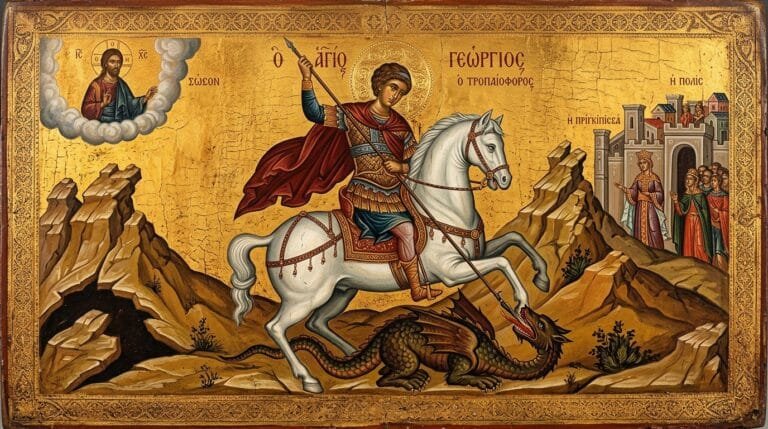
The Akathist to the Holy Great Martyr and Trophy-Bearer George is one of the oldest and most beloved hymns of praise to the soldier-martyr whom the Church calls the “Victory-Bearer.” Below you will find the complete canonical text of the Akathist in English (13 kontakia and 12 ikoi), the troparion and kontakion of the feast, the prayer to the saint, his life according to Church tradition, and practical guidance on when and how to read the Akathist. [1][2][3]
Who was Saint George the Victory-Bearer?
Saint George was a Christian martyr of the early fourth century, executed during the persecution of the Emperor Diocletian. The earliest reference to a nobly born young man who died in Nicomedia in 303 comes from Eusebius of Caesarea (around 322), which places the saint on historical, and not merely legendary, ground. [4]
According to Church tradition, he was born in Cappadocia (Asia Minor) to devout Christian parents. After his father died a martyr, his mother moved with her son to Palestine, to the city of Lydda, where she owned an estate. George entered military service and, through intelligence, courage and valour, became a tribune and a commander under Diocletian while still young. [5][6]
When the persecution of Christians began, the saint distributed his property to the poor, freed his slaves and openly confessed Christ before the emperor. Tradition records that when an official repeated Pilate’s question, “What is truth?”, George answered: “The Truth is Christ Himself, Whom you persecute”; and to promises of earthly glory he replied: “Nothing and no one will weaken my faith.” [5]
After prolonged tortures — the wheel, being cast into a pit of quicklime, poisoning — he was beheaded on 23 April (6 May, New Style) in the year 303 at Nicomedia; he was not yet thirty. His body was taken to Lydda, and under the Emperor Constantine the Great a church was built there in honour of the Great Martyr, where his relics were placed. [5][6][7]
Why “Victory-Bearer,” and why the spear and the dragon?
- Victory-Bearer (Trophy-Bearer) — for the unbreakable steadfastness of his faith under torture, and for the victory of the spirit over death, not for military conquests. [4][5]
- The miracle of the dragon — the most famous posthumous account: the saint on a white horse pierces the dragon’s jaws with his spear, rescues the princess and converts an entire city. Iconographically it signifies the victory of Good over Evil. [4][5]
- The spread of his veneration — in the fourth century in Palestine (Lydda holds one of the probable burial sites), then in Syria, Egypt, Greece, Georgia, the Balkans and Kyivan Rus; universal recognition of the saint is dated to around the year 900. [4]
- Patron of soldiers — among the warrior saints, Saint George holds the foremost place as the embodiment of military valour, courage and manliness. He is also the patron of the city of Lviv in Ukraine. [4][8]
What an Akathist is and how it is built
The word “akathist” comes from the Greek Ο Ακάθιστος Ύμνος: “a” is a negation and “kathizo” means “I sit.” Literally it is the “unseated hymn” — a hymn sung or read standing, as a mark of special reverence toward the one addressed. [9][10]
The first and archetypal hymn of the genre was the Great Akathist to the Most Holy Theotokos, most likely composed around the year 626 (in the reign of the Emperor Heraclius) after the miraculous deliverance of Constantinople from an enemy siege. Later akathists to the Lord, to the saints and to wonderworking icons were composed on its model. [9][11]
The classical structure never changes: [9][10]
- 13 kontakia — short hymns, each of which (except the thirteenth) ends with “Alleluia”;
- 12 ikoi — extended hymns with a series of salutations called chairetismoi, each beginning with “Rejoice”;
- a refrain — in our case: “Rejoice, Saint George, great trophy-bearer!”;
- Kontakion 13 is read three times, after which Ikos 1 and Kontakion 1 are repeated.
Troparion and Kontakion to the Holy Great Martyr George
Before the Akathist it is customary to read the troparion and kontakion of the feast (23 April / 6 May): [12]
Troparion, Tone 4:
As the deliverer of captives and defender of the poor, physician of the sick and champion of the faithful, O Great Martyr George, intercede with Christ God that our souls be saved.
Kontakion, Tone 4:
Cultivated by God, thou wast shown to be a most honourable husbandman of piety, gathering for thyself the sheaves of virtue; for having sown in tears, thou reapest with joy; and having suffered unto blood, thou didst receive Christ, and by thy prayers, O holy one, thou grantest to all forgiveness of transgressions.
Akathist to the Holy Great Martyr and Trophy-Bearer George — full text
The text below follows the established English liturgical translation, which corresponds to the classical Church Slavonic akathist beginning “Vzbrannomu voevode i Pobedonostsu Georgiyu…” [1][2][3]
Kontakion 1
To thee, O Champion leader and trophy-bearer, O Saint George, do we offer a hymn of praise, as to our intercessor and speedy helper; and do thou, O holy Great Martyr, as one who hath boldness before the Lord, deliver us from dangers of all kinds, that we may cry to thee:
Rejoice, Saint George, great trophy-bearer!
Ikos 1
The Creator of angels and Maker of all creation, having revealed thee to His Church as a champion of the faith and an unvanquished passion-bearer for the faith, inspireth us to lift up praises to thee for the ascetic labours of thy sufferings, Saint George, in this manner:
- Rejoice, thou who didst love to the end Jesus, the Son of God!
- Rejoice, thou who didst lay down thy life with love for His Name!
- Rejoice, confessor called forth by God!
- Rejoice, spiritual athlete glorified by the Grace of God!
- Rejoice, thou who dwellest with the angels!
- Rejoice, thou who art the equal of the prophets!
Rejoice, Saint George, great trophy-bearer!
Kontakion 2
Beholding the wicked persecuting the Christians, thou didst not fear their wiles and tortures, O divinely wise one, but as a good soldier of Christ, thou didst distribute all thy possessions to the poor, and didst voluntarily run to that ungodly assembly, singing unto Christ, thy Commander and God: Alleluia!
Ikos 2
Mentally comprehending the one God, divinely worshipped in three Persons, with a firm mind thou didst confess Him before the assembly of the ungodly, and thus thou didst expose the foolish king’s foolish worship of creation. Therefore, for thy lofty love of wisdom, accept from us, Saint George, these fervent praises:
- Rejoice, preacher of the One True God!
- Rejoice, faithful advocate of the All-Holy Trinity!
- Rejoice, thou who didst manifest the great mystery of Orthodoxy to the non-believers!
- Rejoice, thou who didst expose the deception of idolatry!
- Rejoice, rhetorician divine!
- Rejoice, orator filled with wisdom!
Rejoice, Saint George, great trophy-bearer!
Kontakion 3
The power of God, which enlighteneth every man that cometh into the world, didst visit thee also, whilst thou wast suffering in prison, O George wise in humility; for thou hadst despised all the corruptible things of this life as chaff, and didst cling unto Christ alone, that after fighting the good fight for His Name, thou mightest be granted eternally to chant with the angels: Alleluia!
Ikos 3
Possessing a mind and heart enlightened by the Holy Spirit, by His inspiration thou wast fervent to struggle for the Name of Christ, even unto blood; for standing courageously in the faith, thou didst expose the puffed-up pride of the ungodly congregation. Therefore, we praise thee, O most wise George, thus:
- Rejoice, shield lifted for preservation of piety!
- Rejoice, sword raised for the beheading of evil!
- Rejoice, pillar of faith!
- Rejoice, wall and confirmation of the Christian Church!
- Rejoice, encouragement of the faithful!
- Rejoice, fear and disgrace of the unbelievers!
Rejoice, Saint George, great trophy-bearer!
Kontakion 4
The mad persecutor, breathing murder against thee, O passion-bearer George, longed for thy blood like a thirsty dog, ordering thy body stretched out on a wheel and giving thee over to the most evil torments; but thou, taking strength in the Lord, with hope in God didst cry aloud: Alleluia!
Ikos 4
When Diocletian and the priest of the idols heard words of wisdom from thee, they were enraged with hatred for thee, and even more so when thou didst say: O tormentor king! Wherefore dost thou torture me in vain? For me to live is Christ and to die is gain; but it is painful for thee to kick against the goads. Therefore, we cry to thee, O George of great fame, in this way:
- Rejoice, thou who didst shed thy blood on the wheel for thy courageous confession of the faith!
- Rejoice, thou who didst magnify the triumph of the faith by thy blood!
- Rejoice, zealot together with the Apostles!
- Rejoice, imitator of the voluntary Passion of Christ!
- Rejoice, unshakable champion of the faith!
- Rejoice, passion-bearer harder than adamant!
Rejoice, Saint George, great trophy-bearer!
Kontakion 5
Thou wast as a star sent by God, O Saint George, for by thy miraculous healing and release from the wheel by an angel before the eyes of all, thou didst teach the unbelievers to believe in the Trinity in One Essence, and to sing to Him together with thee: Alleluia!
Ikos 5
The people beheld the miracles of the power of God so clearly taking place upon thee, and meekly accepted the teaching of Christ from thee, and they cried aloud, saying: Truly great is the God of the Christians! Therefore, we also, singing praises to thee, O George worthy of glory, cry out thus:
- Rejoice, thou who didst disperse the darkness of unbelief by the radiant word of salvation!
- Rejoice, thou who didst convert unbelievers to Christ by thy martyr’s confession of faith!
- Rejoice, thou who didst lead legions of earthly soldiers to the heavenly army!
- Rejoice, thou who dost dwell with the heavenly hosts as a soldier of Christ!
- Rejoice, glory of soldiers!
- Rejoice, beauty of the all-radiant choir of martyrs!
Rejoice, Saint George, great trophy-bearer!
Kontakion 6
Being zealous like unto those Spirit-bearing preachers of the faith, the Apostles, thou wast crucified unto the world, O passion-bearer; for as Jonah in the belly of the sea monster, so wast thou hurled headlong into the furnace of the lime pit, that for thy sake might be manifested the glory of the Lord Who is wondrous in His saints, to Whom thou, in the lime pit as in a temple of glory, didst noetically cry out: Alleluia!
Ikos 6
Having shone forth in His resurrection from the tomb on the third day, Jesus, the Almighty Conqueror of Hades and death, didst save thee from the corruption of Hades, O passion-bearer George; for after three days thou wast found alive in the lime pit, with thy hands lifted and singing unto God; therefore, the ungodly were sore afraid and stricken with terror. But we, rejoicing, compose a hymn of victory to thee:
- Rejoice, thou who didst cast down the puffed-up pride of the devil by thy being cast down in disgrace into the lime pit!
- Rejoice, thou who didst overcome the persecutor’s bestiality by thy miraculous salvation from God!
- Rejoice, for as one without guile, thou didst pray as for benefactors for those who worked evil against thee!
- Rejoice, for thou wast zealous for their conversion as Paul was for the Jews!
- Rejoice, man of spiritual desires!
- Rejoice, chosen vessel!
Rejoice, Saint George, great trophy-bearer!
Kontakion 7
Desiring by any means to ensnare thy heart for the deception of the idols, the wicked persecutor contrived to deceive thee by magical spells; but thou, chosen of God, didst cry out with David: In God is my salvation and my glory, and didst faithfully chant unto Him: Alleluia!
Ikos 7
That evil servant of Satan Diocletian revealed a new villainy, when, in his insane zeal for the idols, he ordered thee given poison, O Saint George; but thou wast filled with faith and hope, and even though thou didst drink the deadly poison, yet thou didst remain unharmed, O praised-one of God. Therefore we also cry unto thee:
- Rejoice, for thou wast not disgraced by hoping in the living God!
- Rejoice, for thou didst count thy tormentor as nothing!
- Rejoice, expeller of demons!
- Rejoice, destroyer of the wiles of magicians!
- Rejoice, for through thee God is shown to be wondrous in His saints!
- Rejoice, for through thee the name of Christ is piously glorified!
Rejoice, Saint George, great trophy-bearer!
Kontakion 8
There came to the wicked king a strange and terrible counsel from a certain wizard, that he command thee, as proof of the truth of the Christian faith, by thy word to resurrect a dead man; but thou, O Saint George, having no doubt whatsoever, didst sing unto Him Who is not God of the dead but God of the living: Alleluia!
Ikos 8
The All-Desirable and Sweetest Jesus, Whom thou didst love with all thy soul and heart, O most blessed George, attending to the fervent prayer of thy faith, speedily commanded the resurrection of the dead man at thy word, for the glorification of His Name and the confirmation of the faithful, that the unbelievers and blind might be astounded and come to the knowledge of God. For this reason, we dutifully cry unto thee:
- Rejoice, for the Lord of Hosts manifested wonders through thee!
- Rejoice, for through thee He resurrected a dead man from the tomb!
- Rejoice, thou who didst grant the mental vision of faith to the blinded wizard!
- Rejoice, thou who didst show the way to the Holy of Holies to many who suffered for Christ!
- Rejoice, astonishment of Rome!
- Rejoice, exaltation of the Christian race!
Rejoice, Saint George, great trophy-bearer!
Kontakion 9
All the angels rendered praise unto God, Who granted thee such courage, O Saint George, that even when locked up in prison thou didst not cease to keep vigil in prayer. Therefore, as a great communicant of the mystery of Divine Grace, thou wast vouchsafed to behold the Lord in a vision, as He crowned thy head with the crown of incorruption, that we might cry out with thee: Alleluia!
Ikos 9
The learned orators are unable with their rhetorical tongues to render worthy praises to thee, O Saint George, for thy labours and sufferings which thou didst assume voluntarily for Christ and the Church. Therefore, we also, while at a loss as to how properly to praise thee, chant this hymn:
- Rejoice, for by thy voluntary suffering for Christ and the Church thou didst crucify the old Adam in thyself!
- Rejoice, for through thy courageous suffering thou didst receive a crown of righteousness from the Lord!
- Rejoice, rule of pious zeal!
- Rejoice, model of spiritual poverty!
- Rejoice, for thou didst well please not thyself, but Christ alone!
- Rejoice, for thou wast prepared for any form of death for the sake of Christ!
Rejoice, Saint George, great trophy-bearer!
Kontakion 10
Desiring to save the souls perishing in idolatry, O George, lover of God, thou wast zealous with zeal for God like Elijah; for entering into the temple of the idols, by the power of God thou didst drive out the demons, shattering the idols and putting the priests to shame, and as conqueror, not with men but with angels, thou didst chant unto God: Alleluia!
Ikos 10
More unfeeling than a wall, thy hard-hearted tormentor, O Saint George, did not see God, Who so clearly worked miracles through thee, but to the end remained as an asp, stopping his ears. Therefore, he commanded thee to be executed as a criminal by beheading; but thou, grieving over the loss of his soul, joyfully accepted thine end, for which we praise thee thus with love:
- Rejoice, thou who didst keep faith, hope, and love to the end!
- Rejoice, thou who didst work many great miracles at thy beheading!
- Rejoice, thou who wast crowned by the instrument of God’s good will on the earth!
- Rejoice, thou who wast adorned with glory and majesty in Heaven!
- Rejoice, man of God!
- Rejoice, good soldier of Christ!
Rejoice, Saint George, great trophy-bearer!
Kontakion 11
Thou didst render a hymn to the Most Holy Trinity exceeding others, holy Great Martyr George, not in word and mind only, but by the living sacrifice of thy whole self; for imitating Him Who was crucified for us, Christ, the Lamb without blemish, thou didst voluntarily lay down thy life for thy friends. Even though we are incapable of praising such courage as thine, for no man hath greater love than this, being grateful we sing unto Him Who is wondrous in the saints: Alleluia!
Ikos 11
A light-receiving lamp of the true Light art thou to those on earth, O George chosen of God, for thou dost enlighten the hearts of the faithful and dost guide them all to divine understanding, instructing us also to joyfully cry aloud:
- Rejoice, for thou dost dwell in the all-radiant angelic mansions!
- Rejoice, for thou dost commune of the unwaning Light of the Trinity not in a mirror, but face to face!
- Rejoice, provider for the needy and defender of the wronged!
- Rejoice, healer of the infirm and champion of kings!
- Rejoice, champion of Orthodox soldiers in battle!
- Rejoice, fervent intercessor for the salvation of sinners!
Rejoice, Saint George, great trophy-bearer!
Kontakion 12
Knowing the Grace granted by God, we celebrate thy memory, O Great Martyr George, and running with fervent prayer to thy miraculous icon, we are protected by thine all-powerful help in the Lord as by an invincible wall. Therefore, praising thee, we fervently cry unto God: Alleluia!
Ikos 12
Hymning thy glorious end, by which thou wast magnified as a good soldier of Christ, we pray thee, O passion-bearer George: be a helper in all good for us and hear us, as we fervently cry unto thee:
- Rejoice, for by thee the Church of the faithful is enlightened!
- Rejoice, for thy name is praised even among the infidels!
- Rejoice, wondrous glory of the confessors!
- Rejoice, lofty praise of the martyrs!
- Rejoice, healer of our bodies!
- Rejoice, intercessor for our souls!
Rejoice, Saint George, great trophy-bearer!
Kontakion 13
O most blessed and holy Great Martyr George, accept this our hymn of praise and deliver us from every evil by thy fervent intercession with God, that we may sing with thee: Alleluia!
This kontakion is read three times. Then Ikos 1 (“The Creator of angels…”) and Kontakion 1 (“To thee, O Champion leader…”) are repeated. [1][2]
Prayer to the Holy Great Martyr George
After the Akathist it is customary to read the prayer to the saint: [1][13]
O most praised and holy Great Martyr and Wonderworker, Saint George! Look down upon us with thy speedy help and implore the man-loving God that He not condemn us sinners according to our offenses, but that He treat us according to His great mercy. Despise not our prayer, but beseech for us of Christ our God a quiet life pleasing to God, health of body and soul, fertility of the earth and abundance in all things, and that we may not turn to evil purposes the good things granted to us by the All-Merciful God, but that they may be for the glory of His Holy Name and for the glorification of thy mighty intercession. May He grant God-loving soldiers victory over the enemy, and may He secure our land with unchanging peace and blessing. Especially may He defend us by His holy angels at our departure from this life from the snares of the evil one, that we may stand uncondemned before the throne of the Lord of Glory. Hear us, O passion-bearer of Christ, Saint George, and pray for us without ceasing unto the Master of all, God in three Persons, that by His Grace and love for mankind, and by thy help and intercession, we may find mercy and may stand with the angels and archangels and all the saints at the right hand of the Righteous Judge, and glorify Him with the Father and the Holy Spirit, now and ever and unto the ages of ages. Amen.
When and for what needs is this Akathist read?
Church practice does not restrict a layperson’s choice of akathist: it is read whenever the heart asks for prayer. The Akathist to the Great Martyr George is most often read: [14]
- on his feast day — 23 April / 6 May (and 3/16 November, the consecration of his church in Lydda);
- for soldiers and defenders — Saint George has long been regarded as the patron of the military;
- for protection from visible and invisible enemies, from dangers in travel and in service;
- in hopeless circumstances — when courage and the strength not to break are needed;
- for healing of illnesses of soul and body;
- in spiritual warfare against passions, fears and despondency — the symbolism of victory over the dragon is direct here.
How to read an Akathist at home: practical rules
- Standing. The very name “unseated hymn” indicates the posture. Exceptions are illness, infirmity, old age or extreme exhaustion: in such cases one may read seated, for God looks at the heart, not the posture. [9][10]
- Begin with the usual beginning: “In the Name of the Father, and of the Son, and of the Holy Spirit,” “O Heavenly King,” the Trisagion, “Our Father,” then the troparion to the saint — and the Akathist itself.
- Do not hurry. An akathist is not a text to be “gotten through” but a dialogue. Read aloud or in a half-voice, pondering each chairetismos.
- Kontakion 13 three times, then Ikos 1 and Kontakion 1; conclude with the prayer to the saint. [1][2]
- No ordination is required. The akathist is a form of prayer accessible to every believer, alone or with the family. [10]
- How many days. There is no rubrical prescription. A widespread pious practice is 40 consecutive days in a grave need, or 9 days (a novena); but this is a devout custom, not a dogma. [14]
- During Great Lent akathists are not chanted in church on weekdays by the Typikon (with the exception of the Saturday of the Akathist, the Praises of the Theotokos); at home, however, reading is not forbidden, though it is best discussed with one’s spiritual father. [9]
The theology: a victory that has nothing to do with violence
The most important element of this Akathist is its redefinition of victory. The saint is called Victory-Bearer not because he won battles, but because he did not renounce Christ. Kontakion 11 states it plainly: he offered God a hymn “not in word and mind only, but by the living sacrifice of thy whole self,” imitating “Christ, the Lamb without blemish,” and laying down his life for his friends, “for no man hath greater love than this” — a direct allusion to the words of Christ in the Gospel of John (John 15:13). [1]
A second recurring motif is prayer for one’s enemies. In Ikos 6 the saint is praised because, “as one without guile, thou didst pray as for benefactors for those who worked evil against thee,” being zealous for their conversion “as Paul was for the Jews” (cf. Romans 9:1–3). This moves the Akathist out of the register of “victory over people” and into that of victory over the evil in the human heart. [1][2]
A third motif is the weaponry of faith. Ikos 3 calls the saint a “shield lifted for preservation of piety” and a “sword raised for the beheading of evil”: this is the imagery of the spiritual armour of the Apostle Paul (Ephesians 6:11–17), not of literal weapons. The liturgical sticheron of the Menaion likewise sings of him as “armed with the breastplate of faith, the shield of grace and the spear of the Cross.” [1][12]
Frequently Asked Questions
How does an akathist differ from a canon?
A canon consists of nine odes with irmoi and troparia and has a penitential, didactic character; an akathist consists of 13 kontakia and 12 ikoi, is built on the “Rejoice” chairetismoi, and is above all a hymn of praise and thanksgiving. A canon may be heard seated, an akathist standing. [9][10]
May an akathist be read sitting down?
By tradition, no — “akathist” itself means “not sitting.” However, in cases of illness, infirmity, pregnancy or physical inability to stand, the Church does not hold this against anyone: it is better to pray seated than not to pray at all. [9][10]
How many days in a row should the Akathist to Saint George be read?
The Typikon gives no special directions for the private reading of akathists. The most common pious practices are 9 or 40 consecutive days for a particular need; one may also read it annually on the saint’s feast day. [14]
When is the feast of Saint George?
The principal feast is 23 April on the Julian calendar, corresponding to 6 May on the New Style; in churches that have adopted the Revised Julian calendar the feast falls on 23 April New Style. [5][6][12]
Are George, Yurii and Jiří the same saint?
Yes. The Greek name Γεώργιος (“farmer”) appears as George in English, Yurii or Heorhii in Ukrainian, Jorge in Spanish and Jiří in Czech. It refers to one and the same Great Martyr from Cappadocia. [4][5]
Did Saint George really slay a dragon?
The account of the dragon (“The Miracle of Saint George and the Dragon”) belongs to the posthumous miracles and appears in the hagiographical tradition later than the martyrdom accounts. The Church interprets it chiefly symbolically — as the victory of faith over evil, which is what became fixed in the iconography of the warrior on a white horse. [4][5]
May one pray this Akathist for soldiers at the front?
Yes. Ikos 11 contains a direct address: “Rejoice, champion of Orthodox soldiers in battle!” The prayer to the saint traditionally includes petitions for victory over the enemy and for peace for one’s land. [1][13]
Is fasting required before reading an akathist?
No, an akathist requires no special fast. What is needed is attentiveness, reconciliation with one’s neighbours and a sincere heart; fasting is appropriate as a voluntary ascetic effort, not as a precondition.
Conclusion
The Akathist to the Holy Great Martyr George the Victory-Bearer is a hymn of steadfastness. It does not promise an easy life; it teaches the essential thing: victory begins where a person refuses to betray the truth even under torture, and it is completed where that person finds the strength to pray for his executioners. [4][8]
Sources
- Akathist to the Holy Great Martyr and Trophy-Bearer George — Akathists.com (full English liturgical text and prayer)
- Akathist to the Holy Great Martyr and Trophy-Bearer George (PDF), Saints Peter and Paul Orthodox Church
- Akathist to the Holy Great Martyr George (Church Slavonic original for collation), Azbyka very
- Saint George the Dragon-Slayer: the historical figure and the cult — Local History
- The life and martyrdom of Saint George — Vgolos
- Eastern-tradition Churches honour the Great Martyr George — RISU
- Day of the Great Martyr George: relics in Lydda and the church of Constantine the Great
- Saint George as the patron of Lviv — Photos of Old Lviv
- What an akathist is: the history of the genre, the Great Akathist of 626, structure
- What an akathist is: meaning of the word, structure, who may read it
- The Akathist to the Most Holy Theotokos: the term and the chairetismoi
- Festal Menaion: 23 April, Saint George the Victory-Bearer (troparion, kontakion, stichera)
- The Akathist to the Holy Great Martyr George the Trophy-Bearer — Parish of the Kazan Icon, Cardiff
- Rules for reading akathists to the saints