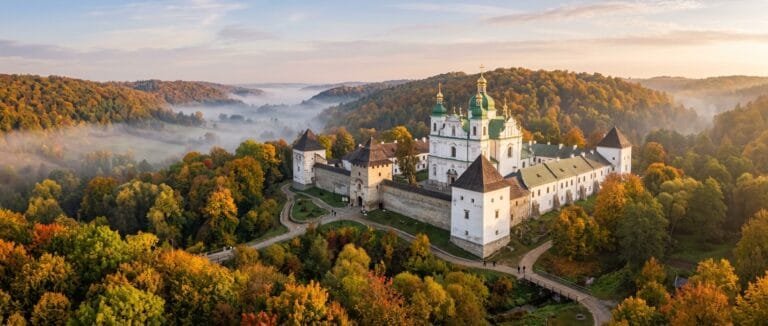
The Krekhiv Monastery of St Nicholas in Lviv Oblast is one of the best-known Basilian monasteries in Ukraine. It was founded by two monks who came from the Kyiv Caves Lavra and settled in a cave hewn out of a rock. Half a century later the house had become a fortress, defended in 1672 by the young Ivan Mazepa. [1][3][9]
The monastery at a glance
- Full name: Krekhiv Monastery of St Nicholas of the Order of St Basil the Great.
- Location: village of Krekhiv, Zhovkva district, Lviv Oblast; about 12 km from Zhovkva and 40 km from Lviv.
- Founders: the monks Yoil (died 1638) and Sylvester.
- Foundation: turn of the 16th–17th centuries; the dates given are the 1590s, 1612, 1613 or 1618.
- Jurisdiction: UGCC, Order of St Basil the Great (Basilians).
- Relics: the miracle-working Verkhrata icon of the Mother of God and the icon of St Nicholas of Myra.
- Distinctive feature: the rock caves by the “stone of Tymish” — the founders’ original dwelling.
History of the Krekhiv Monastery
Yoil and Sylvester: life in a cave
The story of the house begins with two priest-monks, Yoil and Sylvester, whom tradition holds to have come from the Kyiv Caves Lavra. They came to Mount Pobiina and settled in a cave they cut into the rock themselves. It was not the rock as such but the caves within it that determined the choice of place. The rock has long been called the “stone of Tymish”; the cave in which the founders lived lies to its right. [1][3][5]
The precise date of foundation is unknown. Sources give various markers: around 1590, 1612, 1613 or 1618. Wikipedia records 1612 as the conventional foundation date. [4][6][9]
Valuable evidence comes from Yoil’s spiritual testament of 1637. From it we learn that he became a monk by receiving the angelic habit from the hands of Joasaph, archbishop of Monemvasia in Greece. Yoil also mentions Bishop Jeremiah Tysarovskyi (1608–1641), with whose blessing he built the church of the Holy Apostles Peter and Paul. The beginnings of monastic life at Krekhiv are therefore to be sought in the first years of the 17th century. [1]
Anticipating their departure from this world, Yoil and Sylvester saw to the writing of a spiritual testament for the brotherhood on the Friday after Easter 1637. [1]
Land from Żółkiewski and the move
So as not to be a burden on the local people who supported them from their own means, Yoil and Sylvester approached Stanisław Żółkiewski, starosta of Belz and later Grand Crown Hetman of the Polish-Lithuanian Commonwealth, with a request for land for a monastery. Żółkiewski granted the monks a plot below Mount Pobiina, and the house was moved a little lower than its original site on the rock. [1][2][5]
The reason for the move was the growing number of monks and the need for defence. A legend survives of the blind elder Herasym — “a God-inspired elder, blind in his eyes but enlightened by heavenly light” — who showed Yoil the place where a great stronghold should be raised to shelter people from enemy attacks. [3][4][10]
In the mid-17th century, as the number of monks grew, wooden churches were built on the grounds: St Nicholas, the Holy Trinity and the Transfiguration, along with a chapel of the Mother of God and cells. [5]
A fortress monastery and the siege of 1672
The building works that shaped the present appearance of the monastery began in 1658. At the monks’ request King Michał Korybut Wiśniowiecki issued them a charter on 15 October 1669 instructing them to build the monastery and church in masonry for defence against the enemy; permission for a stone church had already been granted in 1667, but funds were lacking, and the project was realised only decades later. [1]
From the 1660s, with the king’s support, the monastery was ringed by powerful fortress walls with four tall towers; a deep moat was dug around them and a drawbridge installed. The house became one of the finest fortifications in the Ukraine of its day. Many people took refuge behind its walls, especially during Tatar raids. [5][9]
The most famous episode is the siege of 1672, when Turkish forces besieged the monastery but failed to take the stronghold. Cossacks helped to defend Krekhiv, among them the young Ivan Mazepa, the future hetman. [8][9]
A cultural centre
The celebrated engraver Nykodym Zubrytskyi (1688–1724), author of some 400 engravings, worked at Krekhiv. The Transfiguration church was painted by the artist Vasyl, whose icon of the Mother of God in the lower tier of the iconostasis was particularly renowned but has not survived; he was later invited to the court of King John III Sobieski. [1][9]
Building in the 18th–20th centuries
- 1755 — the first range of cells was built, adjoining the presbytery of St Nicholas church.
- 1775–1780 — a second range for the brotherhood.
- 1898–1902 — a third range to a design by the architect T. Vyshnevskyi, along the south-western wall. [5]
Under Soviet rule the monastery, like the whole UGCC, was liquidated and its relics removed. The miracle-working icons of the Verkhrata Mother of God and of St Nicholas were handed to churches in Lviv and returned to the house only in 1990. [5]
The miracle-working icons
Krekhiv was renowned for four miraculous images — three icons of the Mother of God and one of St Nicholas. [9]
- The icon of St Nicholas of Myra — according to the Basilian scholar Fr Mykhailo Vavryk, it has been kept in the house since the time of the founder Yoil, who by tradition brought it from White Rus’. [1][5]
- The Verkhrata (“weeping”) icon of the Mother of God — brought to Krekhiv in 1808, after the Verkhrata Basilian monastery was abolished. It is regarded as the principal relic of the house; pilgrims came to it from Volhynia, the Dnipro region, Bukovyna and even Greece. [5]
- The Krekhiv icon of the Mother of God — a small image of the Most Pure Virgin given in 1660 by the Krasovskyi family, burghers of Lviv, in gratitude for a miracle: their daughter regained her sight while praying before it. The icon has vanished without trace. [1][5]
Architecture and surroundings
The ensemble took shape between the 17th and 20th centuries: masonry defensive walls with towers, three ranges of cells, and the churches of St Nicholas and the Transfiguration. The complex is listed as an architectural monument. [5]
A special part of any visit is the rock monastery: caves in the cliffs a little above the spring in the forest, among them the stone of Tymish with the founders’ cave. The place shows what the house began from — not walls, but two men who, “renouncing the world, in fasting and angelic purity kept up unceasing prayer”. [1][6]
Practical information for pilgrims
- Getting there: Krekhiv lies about 12 km from Zhovkva and 40 km from Lviv. A car is most convenient; buses run from Lviv to Zhovkva.
- Access: free, following the schedule of services. The monastery is active and Basilian.
- Accommodation: the house runs a guest building for pilgrims; book in advance.
- The rock complex: a forest path leads to the caves and the stone of Tymish — sturdy footwear is needed.
- Dress: modest; requirements in Greek Catholic houses are gentler than in Orthodox ones.
- Principal feast: the day of St Nicholas.
- Martial law: check the current situation before travelling.
Frequently asked questions
When was the Krekhiv Monastery founded?
There is no exact date. Sources name the 1590s, 1612, 1613 or 1618. Yoil’s testament of 1637 indicates that monastic life here began in the first years of the 17th century. [1][6][9]
Who founded the monastery?
The monks Yoil (died 1638) and Sylvester, whom tradition holds to have come from the Kyiv Caves Lavra. They settled in a cave cut into the rock on Mount Pobiina. [3][9]
Did Mazepa really defend Krekhiv?
Yes; according to the surviving evidence, during the Turkish siege of 1672 the monastery was defended with the help of Cossacks, among them the future hetman Ivan Mazepa. [8][9]
What relics does the monastery hold?
The miracle-working Verkhrata icon of the Mother of God (brought in 1808) and the icon of St Nicholas of Myra. Both returned to the house in 1990. The Krekhiv icon of the Mother of God, given by the Krasovskyi family in 1660, has disappeared. [5][7]
What is the stone of Tymish?
A rock with caves near the monastery where the founders Yoil and Sylvester settled. It is the original site of the house, reached by a forest path. [1]
Who are the Basilians?
The Order of St Basil the Great, the principal monastic order of the UGCC, which after the Dobromyl reform of 1882 became the leading monastic force in Galicia.
Conclusion
Krekhiv shows the full life cycle of a Ukrainian monastic house: the cave of two ascetics, development funded by a magnate, a fortress defended by Cossacks, a cultural centre with engravers and painters, Soviet liquidation, and the return of its relics in 1990. Today it is an active Basilian monastery, visited both on pilgrimage and for the rock caves in the forest. [1][5][9]
Sources
- History of the monastery — official website of Krekhiv Monastery
- Krekhiv Monastery: an ancient history — Etnosvit
- The monastery at Krekhiv favoured by Ukrainian hetmans — Tvoye Misto
- Krekhiv Monastery: history and description — KruhoLviv
- Krekhiv Basilian fortified monastery — Drymba
- Krekhiv Monastery of St Nicholas of the Basilian Fathers
- On the miracle-working icons of Krekhiv Monastery — CatholicNews
- The siege of Krekhiv Monastery in 1672
- Krekhiv Monastery — Wikipedia
- The monastery founded by monks of the Kyiv Caves Lavra — Velych Lvova