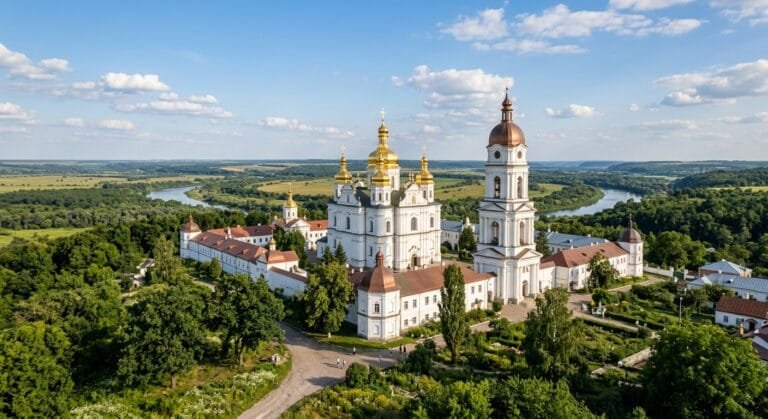
The Mhar Transfiguration Monastery near Lubny in Poltava Oblast is an outstanding monument of Ukrainian Baroque and one of the most important spiritual centres of the Left Bank. Two patriarchs of Constantinople are buried here, a son of Bohdan Khmelnytskyi lived here as a monk, and for centuries the brotherhood consisted largely of former Zaporozhian Cossacks. [1][2][3]
The monastery at a glance
- Full name: Mhar Transfiguration Monastery (men’s).
- Location: village of Mhar, Lubny district, Poltava Oblast, on the right bank of the Sula river, about 6 km from Lubny.
- Foundation: 1619 (other sources give 1624).
- Founders: Princess Raina Mohylianka-Vyshnevetska (funding) and Hegumen Isaiah Kopynskyi (development).
- Style: Ukrainian Baroque (cathedral), Classicism (bell tower).
- Jurisdiction: UOC (Moscow Patriarchate).
- Notable residents: Yurii Khmelnytskyi (as the monk Hedeon).
History of the Mhar Monastery
Foundation: the princess’s dream
On 18 January 1619 Princess Raina Mohylianka-Vyshnevetska (1589–1619) issued a charter founding an Orthodox monastery in the Mhar forest, six kilometres from Lubny. Raina was a first cousin of Peter Mohyla, wife of the Kyivan castellan Mykhailo Vyshnevetskyi — owner of vast holdings on both banks of the Dnipro — and mother of Jeremi Wiśniowiecki. [3][7]
The Great Ukrainian Encyclopedia records a tradition about her motive: the princess dreamed she was in paradise, but angels led her out and told her she would enter it only when she had built a church of God at her own expense on her lands near Lubny, on the Mhar hill. [9]
Raina entrusted the development of the house to Hegumen Isaiah Kopynskyi, then hegumen of Hustynia and Pidhirtsi, who in 1631 became Metropolitan of Kyiv. [3][6]
A centre of resistance to Catholicisation
In 1622 Isaiah Kopynskyi founded a brotherhood at Mhar that actively resisted the Catholicisation of Left-Bank Ukrainians. The brotherhood operated at the monastery from its very foundation. A telling detail: the monastery’s population consisted largely of former Zaporozhian Cossacks — the house was not only a centre of prayer but a social centre of the Cossack Left Bank. [2][4][9]
In 1628 the first wooden Transfiguration church was laid. [3]
Patriarch Athanasius Patelarios
In April 1654, while returning from Moscow, Patriarch Athanasius (Patelarios) of Constantinople (1560–1654) died and was buried at the Mhar monastery. In 1662 he was numbered among the saints. His relics are now kept in the Annunciation Cathedral in Kharkiv. [3][5]
Mhar became the resting place of other hierarchs too: Patriarch Seraphim II (Anin) of Constantinople (died 1779), Metropolitan Joseph (Neliubovych-Tukalskyi) of Kyiv (1676), Archbishop Ambrose (Kelembet) of Tobolsk (1826) and Archbishop Methodius (Pisniachevskyi) of Poltava, later of Pskov (1845). [3][9]
Yurii Khmelnytskyi
In 1663 Hedeon — Yurii Khmelnytskyi, son of Hetman Bohdan Khmelnytskyi, lived at the Mhar monastery as a monk, having taken vows after renouncing the hetman’s mace. [9]
The stone cathedral and further building
In 1683–1684 the stone Transfiguration Cathedral was laid. Its construction involved the Lubny colonel Leontii Svichka, the Hadiach colonel Mykhailo Borokhovych and the Myrhorod colonel Danylo Apostol — a future hetman. The design is attributed to the architect Johann Baptist Sauer (Ivan Baptist). The Ukrainian painter I. Maksymovych took part in decorating the monastery buildings. [3][6]
Later stages of construction:
- 1762–1765 — a new iconostasis was made by the carver and sculptor Sysoi Shalmatov.
- 1785–1844 — a three-tier bell tower in the Classicist style, crowned with a hemispherical dome (some sources date the bell tower to 1837–1844).
- 1846 — a single-storey bishop’s residence.
- Second half of the 19th century — a two-storey hostel block for pilgrims.
- Late 19th century — a thorough renovation of the heated Annunciation church in the pseudo-Byzantine style. [1][3]
The ensemble also includes ranges of cells for the brotherhood, the superior’s house in the Classicist style, and the single-domed church of St Athanasius, built on the site of a former chapel. [1]
Cultural heritage
The monastery kept its own archive and the Mhar Chronicle, compiled in the 17th–18th centuries — a valuable source for the history of the house and of Ukraine at large. [3]
Taras Shevchenko mentioned Mhar in his writings, including during his years of exile. The house was also visited by Ukrainian hetmans and Russian monarchs. [1][3]
The Soviet era and revival
In 1923 the monastery was closed. In the 1930s various institutions occupied the grounds, later a military unit, and from 1986 a Young Pioneer camp. Restoration research was carried out by the research and design sector of the republican special scientific restoration workshops. [3]
After Ukraine gained independence the house was returned to the Church and monastic life resumed. Today it is an active men’s monastery of the UOC (MP); its superior is Metropolitan Filip of Poltava and Myrhorod. [6]
Architecture
The Transfiguration Cathedral is the heart of the ensemble and one of the outstanding monuments of Ukrainian Baroque on the Left Bank. Construction began at the end of the 17th century to a design by Johann Baptist Sauer. [1][6]
The bell tower is a three-tier vertical crowned with a hemispherical dome; stylistically it is classed as Classicist. It forms the second height accent of the complex. [1][6]
The ensemble is completed by the ranges of cells, the superior’s house (Classicism), the heated Annunciation church of the late 19th century in the pseudo-Byzantine style, the single-domed church of St Athanasius, and the monastery cemetery. [1][3]
Practical information for pilgrims
- Getting there: Mhar lies about 6 km from Lubny; Poltava is some 100 km away and Kyiv about 200 km along the Poltava highway.
- Access: free, following the schedule of services.
- Dress: women — a skirt and headscarf; men — long trousers.
- Accommodation: the monastery historically ran a hostel for pilgrims; arrange an overnight stay in advance.
- Principal feast: the Transfiguration of the Lord.
- What to see: the Transfiguration Cathedral, the bell tower, the Annunciation and St Athanasius churches, and the monastery cemetery with the graves of hierarchs.
- Martial law: check the current security situation before travelling.
Frequently asked questions
When was the Mhar Monastery founded?
In 1619 (other sources give 1624). Princess Raina Vyshnevetska issued the foundation charter on 18 January 1619. [3][9]
Who was Raina Vyshnevetska?
Raina Mohylianka-Vyshnevetska (1589–1619) was a first cousin of Peter Mohyla, wife of the Kyivan castellan Mykhailo Vyshnevetskyi and mother of Jeremi Wiśniowiecki. She founded the monastery at her own expense on her own lands. [3][7]
Which patriarchs are buried at Mhar?
The patriarchs of Constantinople Athanasius (Patelarios), who died here in 1654 and was canonised in 1662, and Seraphim II (Anin), who died in 1779. Metropolitan Joseph (Neliubovych-Tukalskyi) of Kyiv is also buried here. [3][9]
Did a son of Bohdan Khmelnytskyi really live here?
Yes. In 1663 Hedeon — Yurii Khmelnytskyi — lived at the monastery as a monk. [9]
Where are the relics of St Athanasius Patelarios now?
In the Annunciation Cathedral in Kharkiv. [3]
What became of the monastery under Soviet rule?
It was closed in 1923; the grounds later held various institutions, a military unit, and from 1986 a Young Pioneer camp. [3]
Conclusion
Mhar is a monastery founded by a woman of the Mohyla family, built up by Cossack colonels and populated by former Zaporozhians. It combined Baroque architecture, its own chronicle writing and the memory of two patriarchs of Constantinople who found their rest here, far from Tsargrad. After seventy years of Soviet decline the house has returned to life. [3][6][9]
Sources
- Mhar Monastery: history, cathedral, bell tower — Telegraf
- Mhar Monastery — Ukraina Incognita
- Mhar Transfiguration men’s monastery — Encyclopedia of Modern Ukraine
- Mhar Monastery: the brotherhood of Isaiah Kopynskyi
- Historical note — Lubny City Council
- Mhar Transfiguration Monastery — Wikipedia
- Mhar — Travelling Ukraine
- Mhar Monastery — Dorohovkaz
- Mhar Transfiguration Monastery — Great Ukrainian Encyclopedia