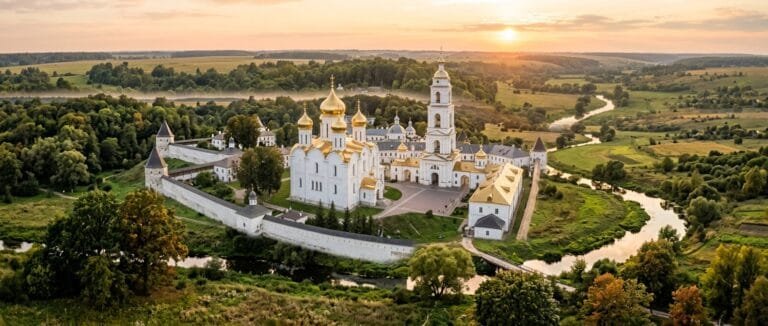
The Zymne Holy Dormition Monastery in the village of Zymne in Volhynia is one of the oldest monastic houses in Ukraine, a contemporary of the Tithe Church in Kyiv. It preserves the miracle-working Zymne Icon of the Mother of God, with which, according to tradition, the Byzantine princess Anna was blessed for her marriage to Prince Volodymyr. The monastery is also a monument of defensive architecture: its walls and towers make it look like a castle. [1][2][3]
The monastery at a glance
- Full name: Holy Mountain Dormition Convent of Zymne.
- Location: village of Zymne, Volodymyr district, Volyn Oblast, on the bank of the Luha river.
- Foundation: by tradition, 1001, by Prince Volodymyr the Great.
- First written mention: the Life of St Theodosius of the Caves (late 11th century).
- Chief relic: the miracle-working Zymne Icon of the Mother of God.
- Distinctive feature: a cave complex with the underground church of St Varlaam.
- Status: architectural monument of national importance; an active convent.
History of the Zymne Monastery
Prince Volodymyr and the winter residence
According to Volhynian tradition, in 1001 the Kyivan prince Volodymyr the Great came to a high hill above the Luha river, baptised the local pagans and ordered two churches and a winter princely residence to be built here. The name of the place — Zymne, from the Ukrainian word for winter — derives from that residence: the prince liked to spend the cold season here. The hill came to be called the Holy Mountain, which gives the monastery the second part of its name. [1][3][4]
Wikipedia offers a more cautious version: the grand prince may have founded the monastery in 992–993, when he was establishing the see of Volodymyr in the city named after him. The documents give no precise date. [6]
The caves and the first ascetics
The house began not with walls but with caves cut into the hill — these were the first monastic cells. The caves of Zymne are structurally close to those of Kyiv; ancient inscriptions and early burials survive in them, evidence of the monastery’s pre-Mongol age. [3][7][10]
The first written mention of the Holy Mountain monastery appears in the Life of St Theodosius of the Caves, written by Nestor the Chronicler at the end of the 11th century. It records that in 1073 St Varlaam, the first hegumen of the Kyiv Caves Lavra, died here while returning from Constantinople. His memory is preserved by the underground church of St Varlaam. [2][3]
Other ascetics laboured in the caves of Zymne and were later glorified as saints: Stephen and Amphilochius of Volodymyr-Volynskyi, and St Niphont, later bishop of Novgorod. From 1090 to 1094 Zymne was the residence of Bishop Stephen of Volodymyr. [2][3]
The fortress monastery of the Chortoryiskyi princes
In the mid-15th century Prince Fedir Chortoryiskyi replaced the cave and wooden house with a stone fortress monastery, for Tatar raids were frequent. Under Prince Fedir Chortoryiskyi of Lutsk, in 1495, a masonry Dormition Cathedral rose on the summit of the Holy Mountain, with four corner towers and one central tower, resembling a monumental stone castle. [2][6][7]
The complex also came to include the Trinity Church (1465–1475), defensive walls with towers (15th–16th centuries) and a refectory (15th–16th centuries). The Trinity church stood outside the walls; it is believed that monastic life began precisely from the caves and this church. According to research by the art historian Hryhorii Lohvyn, the Dormition church was originally domeless, with four corner defensive towers at its angles: a square lower tier, an octagonal upper one, crowned with low tented roofs. [2]
The Uniate period and Starosta Chatskyi
In 1724 the monastery became Uniate, and the village passed to the Volhynian starosta Mykhailo Chatskyi. The Dormition church was remodelled in the Catholic manner: two eastern defensive towers were dismantled, leaving the two western ones, and the church took on the appearance of a Latin-rite church. [2][9]
A well-known legend is attached to this period: Chatskyi is said to have stripped the costly setting from the Zymne icon and, mocking it, cried out, “So you could not save your own Orthodox monastery?” — and went blind that very moment. The account is recorded in local tradition and has no documentary confirmation. [10]
The 20th century: closure and revival
During the First World War Zymne found itself in the front-line zone, and in 1914 the monastery was closed. Abbess Maria and the nun Iulania took the miracle-working icon and left for Zhytomyr. [9]
The most famous account of the icon’s protection belongs to that time: three artillery shells struck the church simultaneously, but none exploded — they lodged in the wall, harming neither property nor people. [4][6]
After the Second World War, in 1949, the monastery was closed for good; the miraculous image was saved by nuns who left for the Korets convent. As of 1991 the house lay in ruins: the Dormition Cathedral had no roof and its walls were half-destroyed. The nuns gradually restored the monastery, and on 24 September 1995 the icon was returned to the cathedral. Later the relics of the protomartyr Stephen and of Arsenius of the Caves were brought here. [7]
The Zymne Icon of the Mother of God
The chief relic of the house is among the oldest and most venerated icons of the Mother of God in Ukraine. It is a work of Greek late-Byzantine painting, executed on a cypress panel covered with a gold ground. The Mother of God is shown in dark crimson robes with the infant Jesus on her left arm. Its dimensions are small — 36.5 × 29.8 × 2.5 cm. [5][7]
The tradition of its origin
According to the chronicle account, in 987, during the capture of Korsun, Prince Volodymyr went blind. A year later the Byzantine princess Anna brought him an icon of the Mother of God with which the patriarch of Constantinople, Nicholas II Chrysoberges, had blessed their marriage. At his baptism in the font of Chersonesus, tradition says, Volodymyr saw an extraordinary light from the image — and his sight returned. In 1006, on the day the newly built church was consecrated, the prince gave his family relic to the Zymne monastery. [5][6]
In 1757 the icon was set in gold and silver revetments inlaid with pearls and precious stones — gifts from grateful pilgrims. The first documentary mentions of the relic date from the 17th century. The icon’s feast is 24 September. [5][7]
Architecture and caves
The complex forms a quadrangle with towers at its corners; the southern wall holds two more defensive towers, one square and one round. From a distance the house resembles an impregnable castle. There are five churches on the grounds, one of them subterranean. [7][8]
Beneath the main church ancient caves of the Kyivan type survive. Tradition holds that the underground labyrinth was once so extensive that “a horseman could ride through it”; some passages led to the Trinity Church, others out into the forest. Today only a small section has been restored. The bones of the first monks that were found have been laid in open niches in the walls of the crypt. [9]
The church of St Varlaam in the caves deserves separate mention: during the Second World War the nuns walled it up, fearing that enemy troops would use the underground as a shelter. [8]
Practical information for pilgrims
- Getting there: Zymne is a suburb of the city of Volodymyr in Volhynia, about 5 km from the centre. Regular buses run from Volodymyr; Lutsk is about 80 km away.
- Access: free, following the schedule of services. This is an active convent, so keep quiet.
- Dress: women — a skirt below the knee and a headscarf; men — long trousers.
- Caves: visited with a guide, by arrangement with the convent.
- Principal feasts: the Dormition of the Mother of God; the feast of the Zymne icon on 24 September.
- Nearby: the Zymne hillfort, a settlement fortified with ramparts and ditches that existed some 1,500 years ago.
- Martial law: check the current security situation before travelling.
Frequently asked questions
When was the Zymne Monastery founded?
By tradition, in 1001 by Prince Volodymyr the Great; another version gives 992–993. The first written mention is the Life of St Theodosius of the Caves from the late 11th century. [3][6]
Why is it called the Holy Mountain monastery?
Because of its position on a hill long known as the Holy Mountain, beneath which lay the caves that served as the monks’ first cells. [3]
What is the Zymne icon known for?
By tradition it is the family image of Prince Volodymyr, brought from Constantinople by Princess Anna. It is venerated as a healer, particularly in diseases of the eyes and in cancer; the faithful also pray before it for children. [5][7]
Which saints are connected with Zymne?
St Varlaam, the first hegumen of the Kyiv Caves Lavra, who died here in 1073; Sts Stephen and Amphilochius of Volodymyr-Volynskyi; and St Niphont. [2][3]
Can the caves be visited?
Yes, the surviving section with the underground church of St Varlaam is shown to pilgrims; arrange in advance. [9]
Is it a men’s or a women’s monastery?
Founded as a men’s house, it now functions as a convent. [3][7]
Conclusion
Zymne is a rare case of a monastery older than most in Ukraine and at the same time barely known to the wider public. Three layers of history meet here: caves of the pre-Mongol era, the castle walls of the Chortoryiskyi princes, and the community of nuns who raised the ruin of the 1990s. And the Byzantine icon on its cypress panel remains what pilgrims from across the country come for. [3][6][7]
Sources
- Zymne Holy Mountain Dormition Monastery — Volyn
- Zymne: the buildings of the Holy Mountain monastery, 15th–20th centuries — Landmarks
- The monastery of Volodymyr the Great (Zymne): a historical outline
- The Zymne monastery in Volhynia: a contemporary of the Tithe Church — Zaxid.net
- The Zymne Icon of the Mother of God — Zruchno.Travel
- Zymne Monastery — Wikipedia
- Dormition Holy Mountain Monastery, Zymne — Drymba
- Facts about the Zymne shrine in Volhynia
- Holy Mountain Dormition Monastery of Zymne — Infomix
- The Zymne icon: traditions and veneration — Vysokyi Zamok