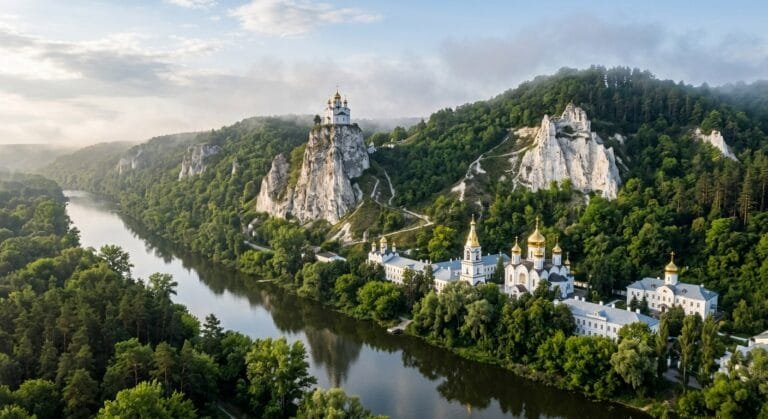
The Holy Dormition Sviatohirsk Lavra is an Orthodox monastery in Sviatohirsk, Donetsk Oblast, carved into the chalk cliffs above the Siverskyi Donets river. It is the youngest of Ukraine’s lavras by status (2004) and at the same time one of the oldest by origin: cave dwellings appeared here long before the first written records. In 2022 the lavra became one of the shrines most severely damaged by the Russian invasion. [1][2][3]
The monastery at a glance
- Full name: Holy Dormition Sviatohirsk Lavra.
- Location: Sviatohirsk, Donetsk Oblast; the right bank of the Siverskyi Donets, the Sviati Hory (Holy Mountains) tract.
- First mention of the locality: 1526; of the monastery itself: 1624.
- Lavra status: since 9 March 2004 (decision of the UOC-MP Synod).
- Jurisdiction: Ukrainian Orthodox Church (Moscow Patriarchate).
- Distinctive feature: a multi-tier cave complex inside a chalk cliff about 90 m high.
- Landmark: St Nicholas Church perched on the summit of the chalk pinnacle.
History of the Sviatohirsk Lavra
The earliest period and the debate over its beginnings
The exact date of foundation is unknown. Church tradition holds that the first monks settled here in the 14th or 15th century; another widespread version is that the monastery was founded by Kyivan monks who fled after the destruction of Kyiv in the 13th century. Some researchers argue for an even earlier origin of the caves. [2][3][4]
The first written mention of the locality “Sviati Hory” dates to 1526, in the notes of the Austrian diplomat Sigismund von Herberstein. That reference, however, concerns a river crossing and a watch post, not a monastery. The Sviatohirsk monastery itself is first documented in 1624, in a tsarist charter granting land holdings and an annual allowance. [3][5]
A fortress monastery on the edge of the Wild Field
At first the entire monastery was contained within the caves: in the 17th century the cave complex had at least four tiers. The first monks cut churches and cells in the upper tier; through small window openings light fell on a niche for an icon, a ledge for sleeping and a step hewn in the chalk. The cells connected to a square refectory with a vault resting on a massive central pillar. The lower tier houses the Alexius cave church, up to 4 metres high. [3][5]
In 1637 the Holy Dormition cathedral church was arranged in the upper part of the chalk mountain. The monastery had fortress walls and artillery, so it served as a forward fortified post on the border with the Wild Field, an observation point and a refuge for those escaping Tatar captivity. [5]
Crimean forces attacked the monastery at least five times — in 1664, 1679, 1680, 1691 and 1737. In 1679 the Tatars captured and devastated it, but it was quickly rebuilt. The Azov and Dnipro campaigns of 1695–1696 put an end to Tatar raids, and the monastery gradually lost its strategic importance. [3][5]
In the 1670s the monks built a wooden church of Saints Peter and Paul at the foot of the mountain by the river — the beginning of the move down from the caves. By the end of the 17th century only hermits remained in the cave cells. [5]
Closure by Catherine II and the “Potemkin estate”
As a result of the secularisation of church property under Catherine II, the monastery was closed in 1786–1787, and its villages, lands and holdings were transferred to the state treasury. The empress gave the Holy Mountains to her favourite, Prince Grigory Potemkin, who turned the former monastery into one of his southern residences, though he kept the Dormition and St Nicholas churches in use. The estate later passed to the Engelhardt family. [2][3][5]
Restoration in 1844 and the golden age
In 1844 the monastery was restored under the name of the Sviatohirsk Holy Dormition Hermitage. The revival was carried out by the hieromonk Arsenii and twelve monks who moved here from the Hlynsk Hermitage near Hlukhiv. Substantial help came from the local landowner Count Oleksandr Potemkin and his wife — a descendant of the family that had once received these lands. The most significant construction took place after 1844. [5]
In the second half of the 19th century the monastery became a well-known place of pilgrimage and retreat. Among its visitors were Ilya Repin, Fyodor Tyutchev, Ivan Bunin, Vladimir Nemirovich-Danchenko, Marina Tsvetaeva and the historian Dmytro Bahalii; in the spring of 1887 Anton Chekhov stayed at the monastery. [5]
The Soviet era
The monastery was liquidated in 1922; its buildings housed a rest home and, in the post-war years, the Artem sanatorium. Part of the monastic complex was demolished. In addition, between the 17th and 20th centuries the chalk ridge suffered major collapses that changed the landscape and caused the irreversible loss of several tiers of the cave complex. St Nicholas Church was restored in 1973–1979, and in 1980 the ensemble was incorporated into the Sviatohirsk State Historical and Architectural Reserve. [5]
Revival and lavra status
The monastery resumed activity in 1992. The traces of the militant-atheist era were cleared from the ancient cave walls, and the church of Saint Alexius the Man of God and St Nicholas Church on the chalk summit were restored. In 1997 the Sviati Hory National Nature Park was created around the site. [3][5]
On 9 March 2004, after hearing a report by Metropolitan Ilarion of Donetsk and Mariupol, the Holy Synod of the UOC (MP) resolved to grant the Holy Dormition Sviatohirsk monastery the status of a lavra. A year earlier the town that had grown up around the monastery had been named Sviatohirsk. [2][3]
The Russian invasion of 2022
The full-scale war inflicted the heaviest losses in the lavra’s modern history. The monastery found itself in a zone of active combat: buildings were shelled and damaged, and a fire destroyed the All Saints Skete, a unique wooden church complex. From June to September 2022 Sviatohirsk was occupied, and although the lavra stands on the opposite bank of the river and remained under Ukrainian control, it came repeatedly under fire. Hundreds of civilian refugees sheltered in the monastery, and some of the monks were among those killed. [1][3][6]
Architecture and the cave complex
St Nicholas Church
The oldest surviving structure and the lavra’s emblem. It was originally the cave cathedral church of the Dormition of the Theotokos, founded in 1637. At the end of the 17th century the upper part of the cliff collapsed; at that time, in 1698–1708, a masonry Dormition cathedral was built on the lower terrace at the expense of Fedir Shydlovskyi, colonel of the Izium regiment, and the remains of the old cave church were rebuilt as St Nicholas Church. It is tripartite and three-domed, in the Kharkiv-Izium style of Ukrainian architecture; the domes over the sanctuary and the narthex are decorative. [5]
Legend has it that the church was built behind a stone wall, and when the wall collapsed it suddenly stood revealed to astonished pilgrims as though created overnight — and at that moment an icon of Saint Nicholas appeared in the sanctuary. [2]
The caves
The whole mountain is pierced by a labyrinth of passages and cells. From the cave church of Saints Anthony and Theodosius the corridors branch out: one leads to a square refectory, another to the third tier where the Dormition church stood, a third down to the Alexius church. Reaching the summit of the cliff means walking more than a kilometre underground. [3]
The lower ensemble
The main buildings stand below on a narrow floodplain terrace, forming a linear structure along the bank: the Dormition Cathedral, the bell tower, the brethren blocks, the refectory and the service yard. The mountain rises about 90 metres above them. [5]
Practical information
- Safety first. Sviatohirsk lies in the front-line zone of Donetsk Oblast. Travel is possible only when the security situation allows; always check current official advisories before setting out.
- Condition of the complex. Some buildings are damaged and certain sites are inaccessible; restoration work is ongoing.
- The caves. They may be visited only with permission and an escort; the passages are narrow with a changeable microclimate.
- Dress code. Standard monastic requirements: covered shoulders and knees, headscarves for women.
- Nature. The lavra is the centrepiece of the Sviati Hory National Nature Park, known for its chalk outcrops and relict chalk pine.
Frequently asked questions
When was the Sviatohirsk Lavra founded?
The exact date is unknown. The locality “Sviati Hory” is first mentioned in 1526 by Sigismund von Herberstein, and the monastery itself in a tsarist charter of 1624. Church tradition dates the first monks to the 14th–15th centuries. [3][5]
Why is it called a cave monastery?
Because it was originally contained entirely within caves cut into the soft chalk — at least four tiers of churches, cells and refectories. Only at the end of the 17th century did the monks begin moving to the surface. [3][5]
When did it become a lavra?
On 9 March 2004, by decision of the Synod of the UOC (MP). It is the youngest of Ukraine’s lavras by status. [2][3]
Who closed the monastery first?
Catherine II, during the secularisation of 1786–1787; the Holy Mountains were granted to Prince Grigory Potemkin. The monastery was restored only in 1844. [3][5]
Was the lavra damaged in the war?
Yes. Since 2022 it has suffered shelling and damage, the All Saints Skete burned down, and there were fatalities. Hundreds of civilians sheltered in the monastery. [1][3][6]
Which famous people visited the lavra?
In the 19th century Ilya Repin, Fyodor Tyutchev, Ivan Bunin, Marina Tsvetaeva and Dmytro Bahalii came here; Anton Chekhov stayed in the spring of 1887. [5]
Conclusion
The Sviatohirsk Lavra is a monastery hewn from living chalk that over five centuries was destroyed by Tatars, closed by an empress, liquidated by Soviet power and shelled by the Russian army. Each time it returned to life. Today it is at once a working lavra, a unique monument of cave architecture and a reminder of how war reaches even the quietest places in Ukraine. [3][5][6]
Sources
- NV: the Sviatohirsk Lavra after Russian shelling and air strikes
- Holy Dormition Sviatohirsk Lavra — history, Potemkin, St Nicholas Church
- Holy Dormition Sviatohirsk Lavra — Wikipedia
- Sviatohirsk Lavra: the first mention of the “monastery in the rock” in 1624
- Sviatohirsk Holy Dormition Lavra — Encyclopedia of the History of Ukraine
- Sviatohirsk Lavra: the caves, St Nicholas Church and the 2004 Synod decision