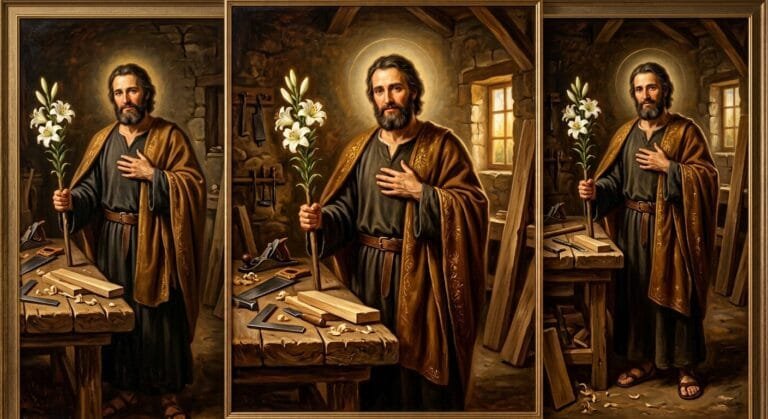
Saint Joseph the Betrothed (Saint Joseph of Nazareth) is one of the most beloved and unique saints in the Christian world. Not a single word of his is recorded in the Holy Gospels—he stands before us as a man of holy silence, deep contemplative peace, and unreserved active faith. As the legal husband of the Most Holy Virgin Mary and the earthly father (guardian) of our Lord Jesus Christ, he accepted an immense responsibility for protecting the Holy Family during times of grave threats. Today, millions of believers run to him as a powerful patron of families, fathers, honest labor, refugees, and a happy death.
This complete canonical guide has been created to unfold the magnificent character of Saint Joseph beyond standard superficial views. Here, you will find a deep biblical exploration of his lineage and role as a righteous man, examine the concept of ‘holy silence’ within the context of hesychasm, explore the theology of work as a pathway to holiness, compare Catholic and Orthodox traditions of his veneration, read the complete canonical prayer texts for family and employment, read authentic testimonies, and access free downloadable digital booklets for print.
1. Biblical Portrait: Righteousness, Dreams, and Silence of Saint Joseph
In the Gospel of Matthew, Saint Joseph is characterized by one key Greek word—δίκαιος (dikayos), which is translated as **”righteous”** or **”just” (Matthew 1:19)**. In the Old Testament tradition, a righteous man was not someone who merely performed external legal rites of the Law of Moses, but one whose heart was in complete harmony with the divine will, manifesting mercy that transcended the severity of the letter of the law. When Joseph learned of Mary’s pregnancy, the law permitted him to accuse her publicly, subjecting her to stoning. Yet his righteousness was proven in his decision to divorce her quietly, shielding her from public shame.
A prominent feature of Joseph’s life is his **divine dreams**. God spoke to him four times through an angel in dreams: first, to dispel his doubts and command him to take Mary as his wife (Matthew 1:20); second, to warn him of Herod’s threat and command him to flee to Egypt (Matthew 2:13); third, to announce the death of the tyrant (Matthew 2:19); and fourth, to guide the family back to Galilee (Matthew 2:22). Each time, Joseph arose and acted immediately, showing absolute obedience without hesitation or complaint. His silence in the Gospels is not a sign of weakness, but of massive spiritual strength that knows how to hear God’s voice in the quietness of conscience.
2. Joseph and Hesychastic Spirituality: Silence as a Space for God
Our website is dedicated to Hesychasm—the ancient Christian teachings on inner silence, watchfulness of mind (nepsis), and unceasing prayer of the heart. The character of Saint Joseph perfectly embodies the hesychastic ideal. In a world dominated by the noise of endless words and conflicts, Joseph teaches us the **art of silence**.
His silence was not passive, but filled with deep contemplation. Beholding the life of the Holy Family in Nazareth, hesychastic writers view the carpenter’s workshop as a monastic cell, where daily physical labor was joined with the continuous contemplation of the incarnated Word—Jesus Christ, who grew before his eyes. Joseph kept his mind in total purity and sobriety, allowing him to discern God’s revelations from simple human dreams. For a modern Christian holding a prayer rope (komboskini), Saint Joseph stands as a model of how to maintain an unbroken inner silence (hesychia) amidst daily family responsibilities and hard work.
3. Theology of Work: Sanctifying Our Daily Craft
Before Christ, physical labor in the Greco-Roman world was often despised, viewed as a task fit only for slaves. Saint Joseph, through his humble craft as a carpenter (Greek: *τέκτων* – tekton), forever changed human history, laying the foundation for the **Theology of Work**. Because the Son of God did not disdain becoming known as a carpenter’s son and working with His own hands in the workshop of Nazareth, daily labor received the status of a canonical path to holiness.
The workshop of Nazareth was a place where every strike of the hammer and every shaving of wood became a silent prayer. Joseph’s work teaches us that holiness is attained not only in monastic retreats, but at our daily workplaces—whether in an office, factory, hospital, or construction site. By performing our professional duties honestly, professionally, and out of love for God and neighbor, we become co-workers of the Creator, sanctifying the material world around us.
4. Veneration of Saint Joseph: Catholic, Orthodox, and Protestant Traditions
The understanding of Saint Joseph’s role possesses deep historical and theological differences across various Christian traditions:
Catholic Church: Possesses an extraordinarily deep and elaborate devotion to Saint Joseph. Pope Pius IX declared him Patron of the Universal Church in 1870. Pope Francis dedicated 2020-2021 as the Year of Saint Joseph, writing the famous apostolic letter *Patris corde* (With a Father’s Heart). Catholics pray the Novena to St. Joseph, the Litany, the Rosary of St. Joseph, and venerate him as the patron of a happy death (Patronus Bonae Mortis), believing he died peacefully in the arms of Jesus and Mary.
Orthodox Church: Venerates him as Saint Joseph the Betrothed. His memory is celebrated on the Sunday after the Nativity of Christ, alongside King David (his ancestor) and Apostle James (the Brother of the Lord). In Orthodox iconography, Joseph is depicted as an elderly man with a halo, and occasionally a shepherd clad in skins is painted near him, representing the devil tempting Joseph with doubts regarding Mary’s virginity. Orthodox honor him as a model of chastity, faithfulness, and the protector of the Incarnation.
Protestant Churches: Respect Saint Joseph as a prominent biblical figure, an outstanding model of faith, obedience, and family responsibility, yet do not offer intercessory prayers to him, focusing all prayer requests on the Triune God alone.
5. Canonical Prayers to Saint Joseph the Betrothed
Prayer to Saint Joseph for the Family and Fatherhood
O Saint Joseph, guardian of families and protector of purity! To you God entrusted His Only Begotten Son and His Most Pure Mother. We beg you: take our family under your powerful protection. Obtain for us from the Lord the grace of mutual love, peace, harmony, and deep respect for one another. Guard our children from the temptations of this world, strengthen the faith of parents, and grant us all the strength to live according to God’s commandments, that we may be deemed worthy of eternal joy in the Kingdom of Heaven. Amen.
Prayer to Saint Joseph for Work and Employment
Saint Joseph, you earned your bread with honest labor for Jesus and Mary in the workshop of Nazareth. You know the weight of hard work and the worry of daily bread. Look upon my need and help me find honest and worthy employment, which will allow me to support myself and my family, benefiting society. Bless my efforts, strengthen my hands, and grant me patience in times of difficulty. May my labor be for the glory of God and the salvation of my soul. Amen.
Litany to Saint Joseph (Canonical)
Lord, have mercy! Christ, have mercy! Lord, have mercy!
Christ, hear us! Christ, graciously hear us!
God the Father of Heaven, have mercy on us.
God the Son, Redeemer of the world, have mercy on us.
God the Holy Spirit, have mercy on us.
Holy Trinity, One God, have mercy on us.
Holy Mary, pray for us.
Saint Joseph, pray for us.
Noble scion of David, pray for us.
Light of Patriarchs, pray for us.
Spouse of the Mother of God, pray for us.
Guardian of the Redeemer, pray for us.
Joseph most just, pray for us.
Joseph most courageous, pray for us.
Joseph most obedient, pray for us.
Pillar of families, pray for us.
Solace of the wretched, pray for us.
Hope of the sick, pray for us.
Patron of the dying, pray for us.
Lamb of God, who takest away the sins of the world, spare us, O Lord. Amen.
6. Communal Prayer in the Comments
Communal prayer holds special power before God, as the Savior taught: “For where two or three are gathered together in My name, there am I in the midst of them” (Matthew 18:20). If you need prayer support, seek a job, undergo family crises, or pray for fathers and husbands, we invite you to join our spiritual circle:
- Leave your prayer requests in the comments below. Write down the names of those who need prayer (e.g., “Please pray for my husband Oleg, to find a stable job” or “For peace in our family”).
- Other readers of this guide will see your petition and reply with an ‘Amen,’ raising their voices to God on your behalf.
7. Real-Life Testimonies: Miraculous Help of Saint Joseph
Testimony of Roman, Ivano-Frankivsk (Parish Archives):
“I was unemployed for over six months. Supporting a wife and three little children, I fell into deep despair. Our debts were mounting, and every day brought heavy anxiety. A friend advised me to start praying to Saint Joseph, the patron of workers. I committed to reciting the prayer for work and the Litany every morning. On the ninth day of my prayer, I received a phone call from a company that had rejected my resume months ago. They invited me for a second interview and offered me a position with a salary that exceeded my initial expectations! I am fully convinced that Saint Joseph heard my quiet sighing and obtained this miracle from God for our family.”
8. Free Downloads: Printable Prayer Booklets
You can download beautifully formatted digital files of these canonical prayers to print or save on your device for daily use:
9. Frequently Asked Questions (FAQ)
1. Why is Saint Joseph called the patron of a happy death?
According to Christian Tradition, Saint Joseph departed this life before Jesus began His public ministry. He passed away in Nazareth, being lovingly cared for by Jesus and the Virgin Mary. No human being in history had such a blessed, holy, and peaceful departure, which is why he is petitioned for a peaceful transit of the soul into eternity.
2. What branch does Saint Joseph hold in his hands on icons?
On many icons, Saint Joseph is depicted holding a blooming lily. This stems from an ancient tradition: when the high priest gathered the staffs of the suitors of Mary, it was Joseph’s staff that miraculously blossomed with white lilies, showing God’s choice and symbolizing his perfect chastity and purity.
3. Is Saint Joseph commemorated in Orthodox Churches?
Yes, Saint Joseph the Betrothed is deeply honored in Orthodox Liturgy. His commemoration is held on the Sunday after the Nativity of Christ (the Sunday of the Holy God-fathers), celebrating his fidelity and protection over the mystery of Incarnation.
References (Canonical Links and Literature)
1. Orthodox Heritage of Saint Joseph the Betrothed — Synodal research and liturgical studies of the Orthodox Church. Available online: pomisna.info.
2. Apostolic Letter Patris corde of Pope Francis — Deep theological studies on the father’s heart of Saint Joseph. Available online: credo.pro.
3. Lives of the Saints and Righteous of the Church — Detailed historical biography of Saint Joseph of Nazareth. Available online: parafia.org.ua.