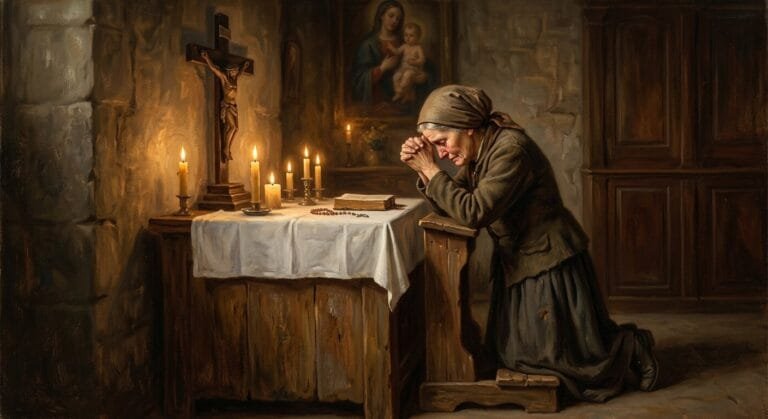
The Act of Contrition (prayer of sincere repentance) is a foundational spiritual moment in the life of every Christian preparing to receive the Sacrament of Penance and Reconciliation. Sincere contrition for sins is not merely an emotional reaction or a psychological feeling of guilt, but a deep, conscious decision of the will to turn away from evil and return to God. Without genuine contrition, even the most detailed confession loses its sacramental efficacy. This complete theological guide is designed to unfold the true essence of repentance, explain the critically important difference between perfect and imperfect contrition, provide canonical prayer texts in multiple languages, and assist you in preparing your heart for divine forgiveness.
This complete guide has been crafted to provide you with comprehensive theological insights, authentic sources, and certified prayer texts. Here, you will discover the biblical foundations of repentance (the examples of King David, Saint Peter, and the Prodigal Son), explore the critical theological differences between perfect and imperfect contrition (contritio and attritio), examine cross-confessional perspectives, read the full texts of the prayers in English, Latin, and Ukrainian, discover practical guidelines for daily life, read real-life testimonies, and access free downloadable digital booklets for print.
1. Theology of Repentance: What is Contrition and Why is It the Key to Forgiveness?
In Christian theology, repentance (Greek: *metanoia* — change of mind, transformation of thinking) is the primary condition for restoring our relationship with the Creator, which has been fractured by sin. The Catechism teaches that contrition is “sorrow of the soul and detestation for the sin committed, together with the resolution not to sin again.” This means that repentance is not reduced to emotional distress; it is an act of the intellect and the will that recognizes the objective evil of sin and strives toward the restoration of holiness.
Sincere contrition necessarily includes three core components:
- Acknowledgment of Sin: An honest examination of conscience before God, calling things by their true names without excuses or rationalization.
- Sorrow of Heart: Realizing that sin offends God’s infinite love and inflicts pain upon the Sacred Heart of Jesus Christ.
- Purpose of Amendment: A firm decision of the will to avoid near occasions of sin, combat spiritual passions, and bring forth worthy fruits of repentance (restoring justice to neighbors).
2. Perfect vs. Imperfect Contrition: A Critically Vital Distinction for the Soul’s Salvation
Theology divides contrition into two distinct kinds, and understanding this division carries immense importance for our salvation, especially in critical life-and-death circumstances (such as war, sudden accidents, or severe illness):
Perfect Contrition (Latin: *contritio*): Arises from a pure love of God, Who is infinitely good and deserving of all our love above all things. When we grieve over our sins because they have offended our loving Heavenly Father and crucified Jesus Christ, our contrition is perfect. The theological truth is that a sincere act of perfect contrition immediately restores a person to a state of sanctifying grace and forgives even mortal sins prior to physical confession, provided that the penitent possesses a firm intention to confess their sins to a priest as soon as a real opportunity arises. This is a magnificent manifestation of divine mercy for soldiers on a battlefield or sick patients who are physically isolated from the sacraments.
Imperfect Contrition (Latin: *attritio*): Arises from less elevated motives—such as realizing the ugliness and filth of sin, fear of eternal damnation in hell, loss of heaven, or shame before others. Such sorrow is good and useful (a gift of the Holy Spirit), and is completely sufficient to obtain valid absolution in the Sacrament of Confession before a priest. However, by itself, outside the Sacrament of Confession, imperfect contrition does not forgive mortal sins or restore the soul to a state of grace.
3. Biblical Examples of Sincere Contrition
The Holy Scriptures present beautiful models of how divine mercy responds to the sincere contrition of a human heart:
- King David: After his grave fall (adultery with Bathsheba and the murder of Uriah), upon hearing the rebuke of Prophet Nathan, he did not offer self-justifications, but sincerely cried: “I have sinned against the Lord!”. His penitential weeping became the basis of **Psalm 51 (50)**, containing the golden words: “A broken and contrite heart, O God, Thou wilt not despise”.
- The Prodigal Son: Residing in extreme degradation, he makes a decision of the will: “I will arise and go to my father, and will say unto him, Father, I have sinned against heaven, and before thee…” (Luke 15:18-21). The father does not demand excuses, but runs to embrace him, restoring him to filial dignity. This is how God receives our Act of Contrition.
- Saint Peter: After denying Christ thrice in the night of His passion, meeting the gaze of his Savior, he remembered His words, went out, and “wept bitterly” (Matthew 26:75). His tears were an act of perfect contrition, grounded in profound love for his Master, allowing him to be restored as the chief of apostles.
4. Repentance Across Confessions: Orthodox, Catholic, and Protestant Views
While the core of repentance is identical—reconciling with God—liturgical and theological practices differ across confessions:
Roman Catholic Church: The Act of Contrition is an official, mandatory part of the Sacrament of Penance. Before receiving absolution, the penitent recites a canonical prayer aloud (“O my God, I am heartily sorry…”). Catholic theology explicitly defines and guides the practice of making perfect contrition in emergency situations.
Eastern Orthodox Church: Emphasizes repentance (metanoia) as a continuous process of purifying the mind and heart. The equivalent of the Western Act of Contrition is found in private penitential prayers before confession, the reading of Psalm 50, and the Penitential Canon to our Lord Jesus Christ. Orthodox fathers, such as Saint John Climacus, taught about “joy-creating sorrow” and the “gift of tears” as a second baptism washing the soul through love-based contrition.
Protestant Churches: Reject confession before a priest, asserting that every believer should bring their Act of Contrition directly to God in private. They emphasize immediate justification by faith in the redemptive sacrifice of Christ on the cross, which fully covers the sins of the contrite believer.
5. Canonical Texts of the Act of Contrition and Prayers
Traditional Act of Contrition (English)
O my God, I am heartily sorry for having offended Thee, and I detest all my sins because of Thy just punishments, but most of all because they offend Thee, my God, Who art all-good and deserving of all my love. I firmly resolve, with the help of Thy grace, to sin no more and to avoid the near occasions of sin. Amen.
The Latin Original (Actus Contritionis)
Deus meus, ex toto corde paenitet me tibi offendisse, ac detestor omnia peccata mea, quia tuam iustam poenam promeritus sum, sed praesertim quia te offendi, summum bonum, ac dignum qui super omnia diligatur. Ideo firmiter propono, adiuvante gratia tua, de cetero me non peccaturum peccandique occasiones proximas fugiturum. Amen.
The Prayer of the Publican (Luke 18:13)
God, be merciful to me a sinner. Cleanse my sins, O Lord, and have mercy on me. I have sinned without number, O Lord, forgive me. Amen.
6. How to Make an Act of Perfect Contrition in Daily Life: Practical Guide
Making an act of perfect contrition is an exceptionally useful spiritual practice, highly recommended as part of a nightly examination of conscience before sleep. It maintains the soul in constant purity and readiness for meeting the Lord. Here is a simple step-by-step guide:
- Quiet Your Mind: Sit in silence, cast away all daily worries, gaze upon a crucifix or an icon, and remember that you are in the immediate presence of a loving God.
- Make a Brief Examination: Recall all your thoughts, words, and deeds of the past day. Thank God for His blessings and acknowledge your failures.
- Focus on God’s Love: Gaze upon the crucified Jesus. Realize that your sins of today were the cause of His suffering on Calvary. Fill your heart not with fear of hell, but with grief that you have wounded His infinite love.
- Recite the Act of Contrition: Slowly, mindfully, pouring the love of your heart into every single word, recite the text of the Act of Contrition.
- Form a Firm Resolution: Promise the Lord that you will make every effort to avoid these sins tomorrow, and that you will receive the Sacrament of Confession as soon as a real opportunity arises.
7. Communal Prayer in the Comments
Communal prayer carries an extraordinary promise of power: “For where two or three are gathered together in My name, there am I in the midst of them” (Matthew 18:20). If you seek spiritual deliverance, pray for strength to overcome habitual sins, wish to return to God after years of wandering, or pray for the conversion of your loved ones, we invite you to join our circle:
- Leave your prayer petitions in the comments below. Write down your needs (e.g., “Please pray for my son, that God may grant him the grace of repentance” or “Pleading for strength to overcome anger”).
- Other readers of this guide will see your comment and reply with a brief ‘Amen,’ establishing a live chain of spiritual solidarity and love before God.
8. Real-Life Testimonies: Delivered Through Perfect Contrition
Testimony of Andrew, Ivano-Frankivsk (Parish Archives):
“During a combat mission in Eastern Ukraine, our squad came under heavy artillery bombardment. I found myself buried under dirt in a collapsed trench, wounded, unable to move or call for help. Shells were exploding all around, and I clearly realized these were my final moments. I had not been to confession in over a year. Terror of death and God’s judgment seized my mind. Suddenly, I remembered our chaplain’s words about the power of perfect contrition. I closed my eyes and turned to Jesus with total sincerity. I said: ‘Lord, I am sorry for all my sins, not because I fear hell, but because I wounded Your love for me. Forgive me, my crucified Savior! If You save me, I will immediately go to confession.’ In that exact moment, an extraordinary, supernatural peace enveloped me. The fear of death vanished, replaced by warm tranquility. Hours later, my brothers-in-arms dug me out. I survived, and the very first thing I did in the hospital was call a priest for Confession and Communion. Perfect contrition is a real spiritual lifeline God throws us in our darkest hours.”
9. Free Downloads: Printable Contrition Booklets
You can download beautifully formatted digital files of these canonical prayers of repentance to print or save on your device for daily use:
10. Frequently Asked Questions (FAQ)
1. Can an act of perfect contrition replace sacramental Confession?
No, perfect contrition does not replace Confession, but it temporarily forgives even mortal sins in emergency situations when access to a priest is physically impossible. However, it strictly requires the firm resolution to go to confession as soon as possible. If one willfully neglects going to confession afterward, the contrition was not perfect, and the forgiveness is forfeited.
2. What if I do not feel emotional sorrow during the prayer?
Contrition is not an emotional feeling of sadness or physical weeping; it is an act of your intellect and your will. If your mind recognizes sin as an objective evil, and your will decides to reject sin out of love for God, your contrition is fully valid and complete, even if you did not shed a single tear.
3. What is the difference between repentance and guilt?
Guilt is a psychological state of self-condemnation leading to despair, anxiety, and distancing from God (modeled by Judas, who felt remorse but fell into despair). Repentance is a grace-filled spiritual act that leads to hope, reconciliation, and joy (modeled by Apostle Peter, who wept with love and hope).
References (Canonical Links and Literature)
1. Repentance and Confession in the Orthodox Church — Studies and publications of the Theological Commission of the Orthodox Church of Ukraine. Available online: pomisna.info.
2. Catechism of the Catholic Church: Sacrament of Penance — Detailed dogmas regarding perfect and imperfect contrition (*contritio* and *attritio*). Available online: credo.pro.
3. Writings of the Church Fathers on the Tears of Repentance — Teachings of Saint John Climacus and Saint Symeon the New Theologian. Available online: parafia.org.ua.