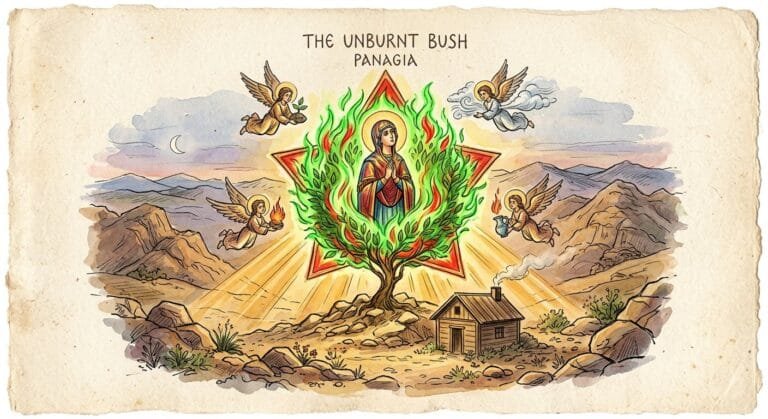
Every day millions of believers ask an important question: what holiday is today in the Church calendar, what are the folk signs and customs, what is strictly forbidden on this day, whose name day is celebrated, and how to call down God’s blessing on the family through a strong prayer. September 4 is an especially rich day in the Orthodox calendar (new calendar / Revised Julian): the Church commemorates the Prophet Moses the God-seer, the Hieromartyr Babylas, Bishop of Antioch, with the three youths and their mother Christodula, and a great sanctuary — the wonderworking icon of the Mother of God “the Unburnt Bush”, protectress from fire, thunder and every calamity. This guide explores the lives of the saints of this day, the meaning of the icon of the Unburnt Bush, the folk traditions, and offers the canonical prayers.
1. The Orthodox Feast — the Prophet Moses the God-seer
Saint Prophet Moses the God-seer (13th century BC) is one of the greatest figures of the whole Old Testament. Saved as an infant from death in the Nile, raised in the house of Pharaoh and choosing the fate of his people instead of honors, at the age of eighty he heard the voice of God from the bush that burned and was not consumed — that same Unburnt Bush that became the image of the Most Holy Theotokos. Moses led Israel out of Egyptian slavery, crossed the Red Sea, received the Ten Commandments on Mount Sinai and led the people through the wilderness for forty years, speaking with God “as a man speaks with his friend” (Ex. 33:11). For this the Church tradition calls him the God-seer — one who saw God as much as a human being can see. The prophet died at the age of one hundred and twenty, “his eye was not dim, nor his natural force abated” (Deut. 34:7). The Church commemorates him on September 4, and his life is a school of faithfulness, gentleness and patience for every generation.
On this day the Church also commemorates the Hieromartyr Babylas, Bishop of Antioch (3rd century), who fearlessly defended the sanctity of the Church: according to tradition, he did not admit to the temple an emperor who had not repented of a murder he committed, and for this accepted imprisonment and martyr’s death during the persecution of Decius, around 251. Together with him suffered three youths — Urban, Prilidian and Epolonius — and their mother Christodula. Also on September 4 the Church commemorates the martyr Hermione, daughter of the apostolic deacon Philip, the martyr Babylas of Nicomedia with his 84 disciples, and the finding of the relics of Saint Joasaph, Bishop of Belgorod, an ascetic of the 18th century whose incorrupt relics became a great sanctuary.
2. The Icon of the Mother of God “the Unburnt Bush”: Protectress from Fire and Thunder
The image of “the Unburnt Bush” goes back to the Old Testament event: the prophet Moses saw in the wilderness a bush that burned with fire and was not consumed, and from that fire God called him to deliver Israel (Ex. 3:2-4). The Fathers of the Church saw in this bush an image of the Theotokos: as the bush burned and was not consumed, so the Virgin bore God and remained a Virgin — the Fire of the Godhead did not consume Her. On the icon the Theotokos is depicted inside a star of two squares — green and red, the colors of bush and flame — and around her the angels of the elements and the symbols of the evangelists. Before this image people have prayed from ancient times for protection from fires, lightning, thunder and every natural calamity, especially for the preservation of the home from fire; in our days people also pray before the Unburnt Bush for firefighters and rescuers and for the protection of homes from war fires.
In Ukraine the icon of the Unburnt Bush belongs to the most beloved images of the Theotokos: it was hung above the entrance of the house, taken on journeys, and new homes were blessed with it. Today, when many families know what the fire of war is, prayer before the Unburnt Bush sounds especially sincere: people ask not only for the preservation of walls, but also that no fire may burn hearts — neither with fear nor with hatred.
3. The Catholic Feast — Saint Rosalia of Palermo
In the Roman Catholic Church, September 4 honors Saint Rosalia of Palermo (12th century), a noble Sicilian maiden who refused wealth and marriage and went to live as a hermit in a cave on Mount Pellegrino, devoting her life to prayer and fasting. According to tradition, several centuries after her death, during a plague epidemic in Palermo, her relics were found and carried through the city — and the epidemic stopped; since then Saint Rosalia is the patroness of Palermo and an intercessor in times of pestilence. Her life reminds us that the power of prayer does not depend on visible success: the quiet prayer of a hermitess became, centuries later, the salvation of a whole city.
4. What Is Forbidden on September 4 — Folk Signs and Customs
In the folk calendar September 4 is connected above all with the Unburnt Bush, so the day was also called Kupyna Day. The main customs: to pray before the icon for the protection of the home from fire and thunder, to check the stove and chimneys before the autumn heating season (the practical side of the feast!), and to treat fire with care in general — not to light great bonfires nor to leave fire untended. By belief, on this day one must not scold fire nor throw rubbish into it, and whoever honors the element, the element does not harm. Folk signs for September 4: much skin on the onions — a cold winter; the rowan trees all covered with berries — a rainy autumn and a harsh winter; clear and calm weather — a warm September; late mushrooms — a lingering winter.
What is forbidden on September 4: one must not quarrel or swear — by belief this brings troubles and illness; one should not handle fire carelessly, light great bonfires or burn rubbish; one should not swear or wish evil on one’s neighbor; it is forbidden to refuse help to those who need it; one must not forget about the home: the day is well given also to practical care for the house. Instead, the day is best spent in prayer before the Unburnt Bush, in thanksgiving to God and in gentle relations with one’s family.
5. The Spiritual Laws of Life: the Law of Thanksgiving and the Commandment of Love
The prayer life of a Christian obeys unshakable spiritual laws. The first is the law of thanksgiving and spiritual abundance. The Apostle Paul teaches: “In everything give thanks, for this is the will of God in Christ Jesus for you” (1 Thess. 5:18). The prophet Moses, leading the people through the wilderness for forty years, taught them daily to give thanks for the manna — the bread of one day; in the same way the feast reminds us: one must give thanks for today, for tomorrow has its own grace. When we sincerely thank God for the years lived, for the home that stands and for the family that is near, we release the power of His grace, which protects our homes from fire, dangers and material want. The second is the fulfilment of the Commandments of Love for God and neighbour (Mt. 22:37-39): Babylas was not afraid to speak the truth even to the emperor, for he loved the Church more than his own life. Let us care this day for the safety of our home and help those who have lost their homes — and our prayer will become a deed.
6. Hesychast Watchfulness (Nepsis) and Prayer on the Rope
In Orthodox hesychasm and the Athonite tradition, spiritual watchfulness (nepsis) is the foundation of the soul’s salvation. Moses for forty days on Sinai kept his mind in God amid fire and cloud, and Babylas amid threats kept his heart unbroken — both show that true peace rests not on the absence of danger but on the presence of God. When our mind is attacked by anxious thoughts about home, safety and the future, the hesychasts advise immediately cutting them off with the short, rhythmic prayer on the rope (komboskini). A short prayer for the day:
Lord Jesus Christ, Son of God, by the prayers of Your prophet Moses, of the hieromartyr Babylas and of Your Most Pure Mother of the Unburnt Bush, protect our home from every fire and calamity, and have mercy on me, a sinner.
7. The Power of Communal Prayer
Communal prayer has the promise of extraordinary power from the Lord Himself: “For where two or three are gathered together in My name, there am I in the midst of them” (Mt. 18:20). Dear brothers and sisters! We invite you to join the prayer circle on Pray.ee. If you wish to pray for the protection of your home from fire and war calamities, if your loved ones serve in rescue services or at the front, or if you are going through illness, hardship or danger, write the names (for health and God’s protection) and your needs in the comments below. Our great Christian family will remember them daily in prayers before the Throne of God, asking the intercession of the Most Holy Theotokos “the Unburnt Bush”, peace for the homes and a good year.
8. A Living Testimony: Prayer before the Unburnt Bush
Parish chronicles and home testimonies preserve many stories of the Theotokos’ protection before the icon of the Unburnt Bush. The family of Taras from the Kyiv region tells one of them. Last year, as a result of shelling, two houses next door caught fire in their village; the fire spread quickly, the wind blew toward their yard, and the firefighters had not yet arrived. “Mother carried the icon of the Unburnt Bush out into the yard, knelt before it and began to read the prayer, while my father and I watered the roof with well water,” Taras recalls. The fire came almost close: the fence and the garden bench burned, but on the house, according to the family, not even the slate caught fire. “I do not know how to explain it,” says Taras. “The wind changed just when mother finished reading the prayer. The neighbors say it was luck. But every year on September 4 mother lights a candle before the icon and says: ‘It was not the fire that stopped — it was She who stopped it.’” Now their icon of the Unburnt Bush passes from house to house in the village — each family keeps it for a week and prays before it for protection.
9. The Strongest Canonical Prayers of the Day
Troparion of the Prophet Moses, Tone 2:
Celebrating the memory of Your prophet Moses, O Lord, we beseech You through him: save our souls.
Prayer before the Icon of the Unburnt Bush for the Protection of the Home (home prayer of the day)
O Most Holy Lady Theotokos, Unburnt Bush! As the bush in the wilderness burned and was not consumed, so You received the Fire of the Godhead in Your womb and were not burned. Hear our sinful prayer: protect our home, our family and all our possessions from fire, thunder and lightning, from conflagration and every natural calamity, from war fire and every evil. Cover us with Your honorable veil, as once the bush unburnt, and teach us, like the prophet Moses, to hear the voice of God amid the flame of trials and to follow Him, so that by Your prayers we may glorify the Father, and the Son, and the Holy Spirit, now and ever and unto ages of ages. Amen.
10. Frequently Asked Questions (FAQ)
Why is the prophet Moses called the God-seer, and why is his memory on September 4?
Moses is called the God-seer because he spoke with God “as a man speaks with his friend” (Ex. 33:11) and saw His glory as much as a human being can bear. The Church memory of the prophet Moses is established on September 4 by the new calendar (September 17 by the old) — on this day the Church commemorates him within the September cycle.
What is prayed for before the icon of the Unburnt Bush?
Before the icon of the Unburnt Bush people pray for protection from fires, lightning and thunder, for the preservation of home and property from fire and natural disasters, for firefighters and rescuers, and in our days also for the protection of homes from war fires and that no fire may burn hearts with fear or hatred.
Who else is commemorated on September 4, and whose name day is it?
On this day the Church also commemorates the hieromartyr Babylas of Antioch with the three youths and their mother Christodula, the martyr Hermione, the martyr Babylas of Nicomedia with his 84 disciples, and the finding of the relics of Saint Joasaph of Belgorod. Babylas and Moses celebrate their name days, and by folk custom many other names are congratulated on this day.
11. Sources
1. Moses: life, the Exodus and the Sinai legislation — Wikipedia article: en.wikipedia.org (Moses).
2. Our Lady of the Burning Bush: meaning and iconography — Wikipedia article: en.wikipedia.org (Our Lady of the Burning Bush).
3. Saint Rosalia of Palermo: life and veneration — Wikipedia article: en.wikipedia.org (Saint Rosalia).
4. 4 вересня: пророк Мойсей, ікона «Неопалима Купина» — Ukrainian-language version of this article: pray.ee (4 вересня).