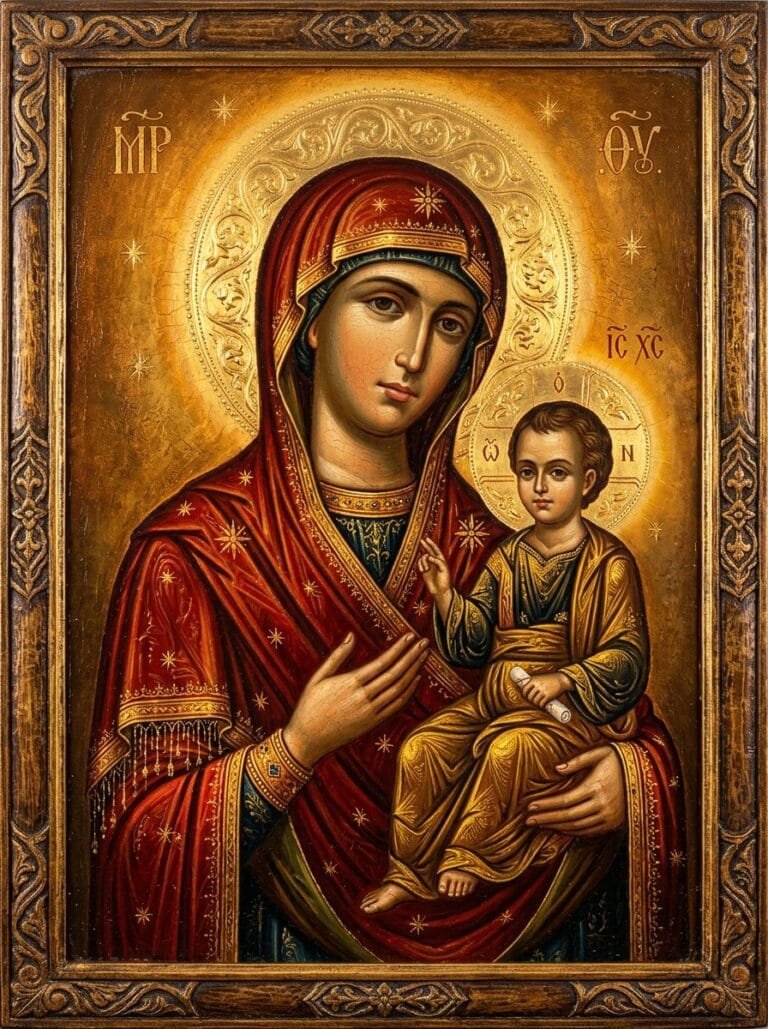
The Short Prayer Rule of Saint Seraphim of Sarov for Laity is one of the most accessible and spiritually profound treasures of Orthodox asceticism. Recognizing the physical weakness, constant busyness, and worldly distractions of Christians living in the world who cannot manage lengthy monastic prayer books each morning and evening, the great elder of Sarov gave this simple yet radiant rule of prayer [1].
Saint Seraphim taught: «By keeping this modest rule, any Christian—whether a laborer, an official, or the infirm—can attain the measure of Christian perfection. For these three prayers constitute the unshakable foundation of all Christianity: the first was given by Christ Himself; the second was brought by the Archangel from Heaven; and the third contains all the dogmas of our saving faith» [2].
This complete guide details the canonical schema of the rule, the authentic texts of the prayers, and the Saint’s instructions for maintaining the Jesus Prayer amidst daily work.
1. Daily Schema: Three Times a Day with Remembrance of God
Saint Seraphim commanded that this rule be performed three times daily—morning, noon, and evening—intertwined with interior heart prayer throughout the working hours:
| Time of Day | Vocal Prayer Rule | Interior Activity During Work |
|---|---|---|
| Morning (upon rising) | 3 «Our Father», 3 «O Virgin Theotokos», 1 «Creed» | Peace of thoughts, thanksgiving for the gift of a new day |
| Until Noon (during any labor) | — | Quietly in the heart repeat the Jesus Prayer: «Lord Jesus Christ, Son of God, have mercy on me, a sinner» |
| Before Lunch | 3 «Our Father», 3 «O Virgin Theotokos», 1 «Creed» | Thanksgiving for food, subduing fleshly passions |
| After Lunch until Evening | — | Quietly in the heart repeat: «Most Holy Theotokos, save me, a sinner» |
| Evening (before sleep) | 3 «Our Father», 3 «O Virgin Theotokos», 1 «Creed» | Examination of conscience, forgiveness of enemies, sleep with sign of the cross |
2. Full Canonical Texts of the Prayers
Begin by signing yourself with the Sign of the Cross: «In the Name of the Father, and of the Son, and of the Holy Spirit. Amen», with three metanias.
1. The Lord’s Prayer («Our Father») — Recited Three Times
Saint Seraphim: «This prayer was delivered by the Lord Jesus Christ Himself to His disciples, and therefore it is the divine foundation of all Christian prayer».
Our Father, who art in heaven, hallowed be Thy name; Thy kingdom come; Thy will be done on earth as it is in heaven. Give us this day our daily bread; and forgive us our debts, as we forgive our debtors; and lead us not into temptation, but deliver us from the evil one. Amen.
2. Hymn to the Mother of God («O Virgin Theotokos, Rejoice!») — Recited Three Times
Saint Seraphim: «With these heavenly words the Holy Archangel Gabriel announced the Incarnation of the Son of God—the most joyful event in the history of mankind».
O Virgin Theotokos, Rejoice, Mary full of grace, the Lord is with thee! Blessed art thou among women, and blessed is the Fruit of thy womb, for thou hast borne the Savior of our souls.
3. The Symbol of Faith (The Nicene Creed) — Recited Once
Saint Seraphim: «In the Creed, the Holy Fathers assembled all the saving dogmas of the Christian faith, which must be known and confessed for the salvation of the soul».
I believe in one God, the Father Almighty, Maker of heaven and earth, and of all things visible and invisible.
And in one Lord Jesus Christ, the Son of God, the Only-begotten, begotten of the Father before all ages; Light of Light, true God of true God; begotten, not made; of one essence with the Father, by Whom all things were made;
Who for us men and for our salvation came down from heaven, and was incarnate of the Holy Spirit and the Virgin Mary, and became man;
And was crucified also for us under Pontius Pilate, and suffered and was buried;
And the third day He rose again, according to the Scriptures;
And ascended into heaven, and sitteth at the right hand of the Father;
And He shall come again, with glory, to judge the living and the dead; Whose kingdom shall have no end.
And in the Holy Spirit, the Lord, the Giver of Life, Who proceedeth from the Father; Who with the Father and the Son together is worshipped and glorified; Who spake by the prophets.
In One, Holy, Catholic, and Apostolic Church. I acknowledge one baptism for the remission of sins. I look for the resurrection of the dead, and the life of the world to come. Amen.
3. Instructions on the Unceasing Jesus Prayer During Work
The true essence of Saint Seraphim’s rule is not mere mechanical recitation, but the sanctification of the entire day through prayer [3]. Saint Seraphim counseled:
«While walking, working in the fields, or attending to household affairs, let the mind constantly repeat: “Lord Jesus Christ, Son of God, have mercy on me, a sinner.” If other people are present, say only mentally: “Lord, have mercy.” After noon until bedtime, let the mind repeat: “Most Holy Theotokos, save me, a sinner.” When a person lives in this way, the grace of the Holy Spirit takes up residence in the soul, evil spirits flee, and every endeavor succeeds with divine peace» [4].
4. Spiritual Wisdom: Quality Over Quantity
Saint Seraphim recognized the spiritual peril of taking on too great an ascetic burden. When people burden themselves with long rules they cannot sustain, they rush through the words, become irritable, and ultimately abandon prayer altogether.
The Saint reiterated: «It is far better to recite these few prayers with sincere repentance, attention, and contrition of heart, than to rush through hundreds of canons while the tongue speaks and the thoughts wander. In a small rule lies great divine power, provided it is held constantly!» [5].
Sources and References
- Hieromartyr Seraphim (Chichagov). Chronicle of the Saint Seraphim-Diveyevo Monastery. St. Petersburg, 1903.
- Metropolitan Veniamin (Fedchenkov). The Worldwide Luminary: Saint Seraphim of Sarov. Moscow: Palomnik, 1996.
- Saint Theophan the Recluse. What Is the Spiritual Life and How to Attune to It. St. Panteleimon Monastery, 1897.
- Saint Nicodemus of the Holy Mountain & Saint Macarius of Corinth. The Philokalia. Volume 5.
- Archimandrite John (Krestiankin). Experience of Constructing a Confession. Pskov-Caves Monastery, 1993.