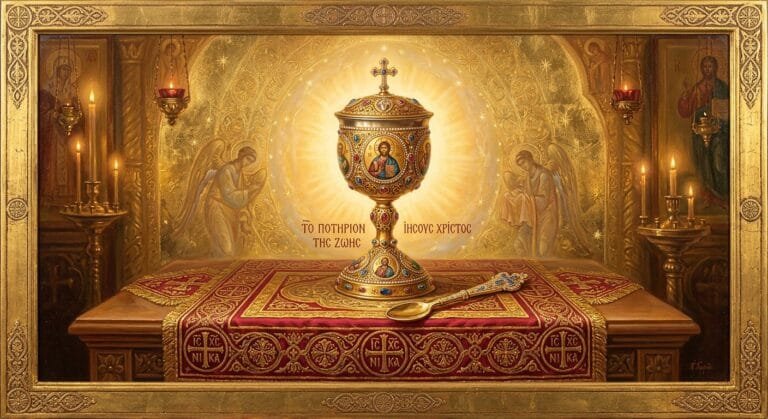
Preparation for Confession and Holy Communion (Goveniye) is one of the most vital spiritual practices of every Orthodox Christian, requiring a deep and serious attitude. The Eucharist (Holy Communion) is the Sacrament in which believers partake of the true Body and Blood of our Lord Jesus Christ under the appearances of bread and wine, for the healing of soul and body and for eternal life. Approaching this Sacrament unworthily or casually, according to Holy Scripture, is a grave transgression. This guide is compiled based on the canonical liturgical practice of the Orthodox Church, providing you with clear, practical, and real rules of preparation.
1. Who Can Receive Holy Communion
Baptized Orthodox Christians who are in peace with the Church (not under canonical ban or excommunication), have confessed their sins before a priest on the eve or morning before the liturgy, and have observed the rules of preparation may receive Holy Communion. A vital canonical exception: children under the age of 7 (infants) may receive Holy Communion without prior oral confession.
2. Rules of Fasting and Bodily Preparation Before Communion
Bodily preparation is an essential part of spiritual purification and includes strict limits:
- Bodily Fasting (Goveniye): Typically lasts from 2 to 3 days. During this period, all animal-derived foods (meat, poultry, lard, dairy, cheese, butter, eggs) are completely excluded. Only plant-based foods are permitted. For those who communicate frequently (e.g., weekly), the duration of the fast may be shortened to 1 day or limited to general church fasts, by blessing of a priest.
- Eucharistic (Liturgical) Fast: Begins from 12 midnight on the eve of communion. From this moment on, it is strictly forbidden to eat any food, drink any water (even a single drop), or smoke tobacco. One must approach the Chalice strictly on an empty stomach. Exceptions are made only for infants and the gravely ill who require food or medication at specific times.
- Marital Abstinence: Spouses are expected to abstain from physical (intimate) relations on the day before and the day of Holy Communion.
3. Examination of Conscience Before Confession
Confession should not be a mechanical list of sins. Before approaching the priest, one must perform a serious examination of conscience. You can utilize our special detailed guide: Examination of Conscience Before Confession. In Orthodox manuals, sins are traditionally grouped into three categories:
- Sins Against God: lack of faith, doubts, practicing occultism (consulting astrologers or fortune tellers), neglecting daily morning and evening prayers, making the sign of the cross carelessly, missing Sunday and feast services without a serious reason, and grumbling against God in trials.
- Sins Against Neighbors: anger, irritation, offending others, holding grudges, gossiping, lying, envying, laziness, disrespecting parents and elders, theft, and unkindness toward the poor and suffering.
- Sins Against Oneself: pride, vanity, greed, gluttony, alcohol abuse, smoking, impure thoughts, and wasting time in sloth.
4. The Liturgical Prayer Rule: Three Canons and the Order of Preparation
Prayer preparation is mandatory and consists of reciting the established rules from the Prayer Book:
On the Evening Before Communion:
In addition to evening prayers, three canons must be read:
- The Canon of Repentance to our Lord Jesus Christ
- The Canon of Supplication to the Most Holy Theotokos
- The Canon to the Guardian Angel
On the Morning of Communion:
Following standard morning prayers, the complete **Order of Preparation for Holy Communion** (Prayers of Preparation) is read. It consists of Psalms 22, 23, and 115, the canon of preparation, and the special prayers of the Holy Fathers (Saint Basil the Great, Saint John Chrysostom, Saint John of Damascus, and others). In practice, reading this rule takes approximately 20-30 minutes.
5. Canonical Texts of Prayers
Prayer Before Confession (Saint Symeon the New Theologian)
O God and Lord of all! Who hast power over every breath and soul, Thou alone canst heal me. Hear the prayer of me, a humble sinner, and let Thy Holy Spirit descend upon me, granting me sincere repentance and contrition of heart. Grant me, O Lord, tears of repentance, that I may wash away my transgressions before Thee. Vouchsafe me to confess with a sincere heart and a pure conscience all my sins before my spiritual father, and to receive through him Thy divine forgiveness. For Thou art blessed unto the ages of ages. Amen.
Primary Prayer Before Holy Communion (Saint John Chrysostom)
I believe, O Lord, and I confess that Thou art truly the Christ, the Son of the Living God, Who didst come into the world to save sinners, of whom I am chief. Of Thy Mystical Supper, O Son of God, accept me today as a communicant; for I will not speak of Thy Mystery to Thine enemies, neither like Judas will I give Thee a kiss; but like the thief will I confess Thee: Remember me, O Lord, in Thy Kingdom. May the communion of Thy Holy Mysteries, O Lord, be unto me not for judgment or condemnation, but for the healing of soul and body. Amen.
Prayer Verses of Saint Symeon the Translator (recited before the Chalice)
Behold, I approach the Divine Communion. O Creator, burn me not as I partake; for Thou art a fire consuming the unworthy; but rather cleanse me from every defilement.
Thanksgiving Prayer After Holy Communion
I thank Thee, O Lord my God, that Thou hast not rejected me, a sinner, but hast vouchsafed me to be a communicant of Thy Holy Mysteries. I thank Thee that Thou hast permitted me, unworthy though I am, to partake of Thy most pure and heavenly gifts. O Sovereign Master, Who didst die and rise again for us, keep me under Thy holy protection. May this communion be unto the healing of my soul and body, the banishment of every adversary, the enlightenment of the eyes of my heart, and the strengthening of my faith and love. Amen.
6. Order of Conduct at the Chalice and After Communion
When partaking of Communion in church, the following reverent order must be maintained:
- Approach the Chalice when the priest proclaims: “With the fear of God and faith draw near!” Permit infants, children, and the elderly to go first.
- Make a low bow before the Holy Gifts from a distance. Then, cross your arms over your chest (right over left). Do not make the sign of the cross near the Chalice to avoid bumping the priest’s hand and risking spilling the Gifts.
- Approach and state your baptismal name clearly, then open your mouth wide.
- The priest will place the portion of the Body and Blood of Christ (using the spoon/lzhica) in your mouth. Consume it carefully. After the server wipes your lips with the cloth, reverently kiss the bottom edge of the Chalice, which represents the pierced side of the Savior. Do not kiss the priest’s hand.
- Without crossing yourself, step aside to the designated table to drink warm water with wine and consume a piece of antidoron (blessed prosphora) to rinse your mouth completely.
- Conduct After Communion: Do not leave the church before the conclusion of the Liturgy, and listen to the thanksgiving prayers. On the day of Communion, out of respect, do not perform prostrations (earthly bows). Spend the day in quietness, peace, and prayer.
7. Download the Complete Rule of Preparation for Free
You can download beautifully formatted digital files of the complete prayers and rules of preparation to print or read offline:
8. Frequently Asked Questions (FAQ)
1. Is Confession mandatory before every Holy Communion?
Yes, in Orthodox practice, Confession is standard before Communion, though spiritual fathers may permit frequent communicants to confess less frequently. Children under 7 are exempt from oral confession.
2. Is it permitted to receive Communion on weekdays during Great Lent?
The full Liturgy is not performed on weekdays of Great Lent. However, on Wednesdays and Fridays, believers may receive Communion during the Liturgy of the Presanctified Gifts.
3. What if I accidentally consumed water on the morning of Communion?
In such a case, Communion must be postponed to another day, as the Holy Eucharist is strictly received on an empty stomach.
References (Canonical Links and Literature)
1. The Orthodox Prayer Book of the Orthodox Church of Ukraine (OCU) — Canonical rules of preparation and texts of Communion Prayers. Available online: pomisna.info.
2. Prayers of Preparation for Holy Communion — Parish of Saint Archangel Michael (OCU, Kyiv). Complete liturgical texts. Available online: parafia.org.ua.
3. The Holy Scriptures — Gospel of Matthew (Institution of Eucharist, Chapter 26), 1 Corinthians (unworthy communion, Chapter 11), 1 Thessalonians (5:18).