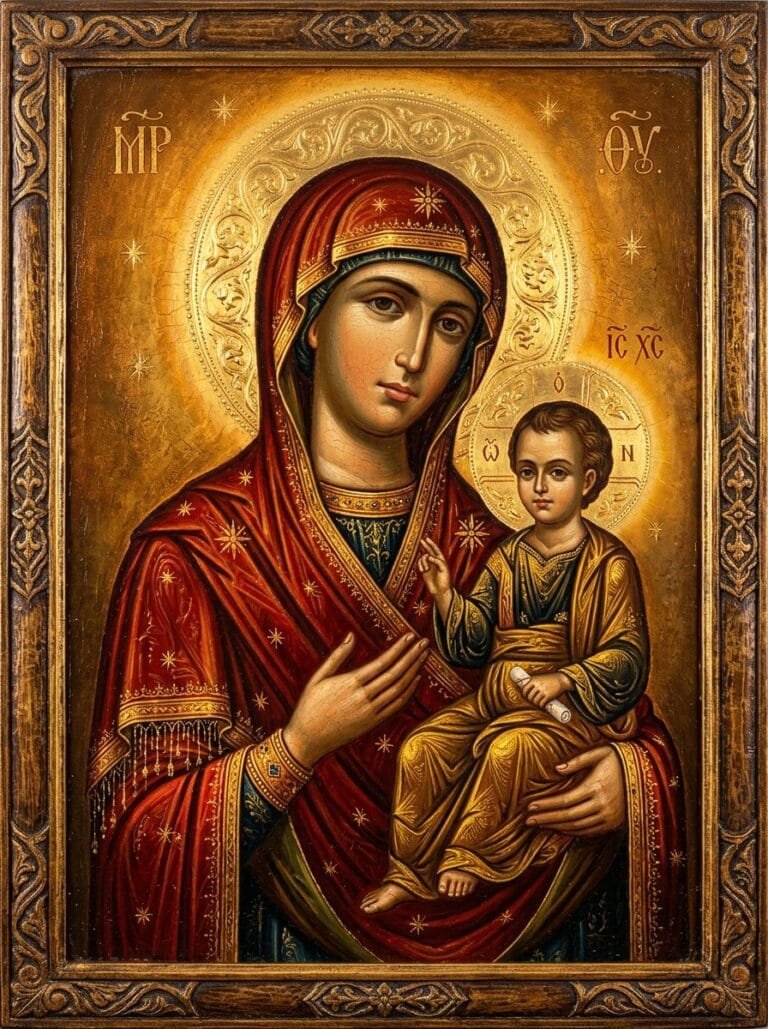
Introduction: The Phenomenology and Paradox of Christian Rhythmic Prayer. In Christian ecumenical dialogue and comparative liturgical theology, prayer disciplines often serve as an apparent dividing line between East and West. In popular perception, the Latin Catholic Church is symbolized by the Holy Rosary, while Eastern Orthodoxy is identified with the Jesus Prayer on the prayer rope (chotki / komboskini) and the solemn public chanting of liturgical akathists. Yet, a rigorous patristic and historical investigation reveals a profound unity: rhythmic, repetitive vocal prayer centered upon the Archangelic Salutation to the Virgin Mary, coupled with contemplation of the salvific mysteries of Christ, shares a common, undivided heritage rooted in the early Christian monasticism of the first millennium [1].
This theme has received extraordinary illumination through the groundbreaking historical and theological research of American theologian Fr. Donald H. Calloway, MIC, in his work «Champions of the Rosary: The History and Heroes of a Spiritual Weapon» [2]. Analyzing the Rosary not as a sentimental devotion, but as a strategic «spiritual weapon» and theological battering ram against anti-incarnational heresies, Fr. Calloway invites a deeper theological synthesis. The objective of this academic study is to examine Calloway’s thesis, demonstrate its profound Eastern Christian counterpart—most notably the Theotokos Rule of Saint Seraphim of Sarov (150 prayers), examine the mystical witness of Saint Padre Pio of Pietrelcina, and provide a comparative analysis contrasting the Rosary with the Byzantine Akathist tradition and hesychastic prayer.
1. Fr. Donald Calloway’s Thesis: Genesis and Phenomenology of a «Spiritual Weapon»
1.1. The Historical Crisis: Saint Dominic and the Albigensian Heresy
As Fr. Donald Calloway demonstrates, the Holy Rosary did not emerge as an arbitrary pious practice, but as an existential defense of Christian orthodoxy against the existential threat of the Albigensian (Cathar) heresy in 13th-century southern France [3]. At its doctrinal core, Catharism was a revival of radical Manichaean dualism. The Cathars posited two eternal, co-equal deities: a good god who created the invisible spiritual realm, and an evil god (demiurge) who created the visible, material universe.
From this anti-material presupposition followed devastating Christological distortions:
- Denial of the Real Incarnation: If physical matter is intrinsically evil, Jesus Christ could not have assumed genuine human flesh, could not have been born of a woman, and could not have truly suffered, died, and physically risen from the grave (docetism).
- Rejection of the Theotokos: Mary’s motherhood was mocked as an illusion, or worse, as an instrument of the evil demiurge to imprison pure souls in corrupt flesh.
- Abhorrence of the Sacraments: Holy Water, the Cross, the Holy Eucharist, and Holy Matrimony were condemned as demonic pollutions.
Saint Dominic de Guzmán (1170–1221), founder of the Order of Preachers (Dominicans), initially attempted to convert the Cathars through rigorous scholastic argumentation and austere penance. Yet academic disputations produced minimal fruit. Tradition recounts that around 1214, Dominic retreated into the forest of Bouconne near Prouille, weeping and fasting for three days in anguish [4].
The Blessed Virgin Mary appeared to him and declared: «Wonder not that you have obtained so little fruit by your labors; you have spent them on barren soil, not yet softened by the dew of divine grace. When God willed to renew the world, He first sent the dew of the Angelic Salutation. Preach my Psalter, and your preaching will bear abundant fruit» [5]. Our Lady called this prayer a «battering ram against heresy» and a «spiritual sword».
1.2. The Theological Antidote: Contemplating the Word Made Flesh
The genius of the Rosary, emphasized by Calloway, is that it directly dismantled dualistic heresy by forcing the mind to contemplate the tangible, physical reality of Christ’s earthly life. As the believer repeatedly recited «Blessed is the fruit of thy womb, Jesus», they were systematically guided through His physical conception, birth in Bethlehem, circumcised flesh, sweat of blood in Gethsemane, torn flesh at the pillar, and bodily Resurrection. The Rosary restored the foundational truth of 1 John 4:2: «Every spirit that confesses that Jesus Christ has come in the flesh is of God» [6].
1.3. Monastic Evolution: The Marian Psalter of 150 Prayers
Calloway traces the historical development of the practice through four key stages:
- The Monastic Lay Psalter (8th–12th centuries): In Benedictine and Cistercian abbeys, lay brothers who could not read Latin were assigned 150 Our Fathers or 150 Hail Marys counted on knotted cords to substitute for the 150 Psalms of the Divine Office [7].
- Saint Dominic’s Synthesis (13th century): Uniting vocal recitation with public preaching of the Gospel scenes.
- Blessed Alan de la Roche and Dominic of Prussia (15th century): Alan de la Roche (1428–1475) organized the Confraternities of the Rosary and divided the 150 Hail Marys into 15 decades with the Our Father between them. Dominic of Prussia, a Carthusian, attached meditative clauses to each Ave.
- Papal Canonization by Saint Pius V (1569): In the Papal Bull «Consueverunt Romani Pontifices», Pope Pius V fixed the form of the Dominican Rosary with its 15 Joyful, Sorrowful, and Glorious mysteries [8].
2. Historical Victories and Modern Confirmations
Fr. Calloway documents numerous historical crises where the corporate recitation of the Rosary altered the course of history:
| Historical Event | Year | Role of the Rosary |
|---|---|---|
| Battle of Muret | 1213 | Simon de Montfort defeated an overwhelming Cathar force while Saint Dominic and the clergy prayed the Rosary in the church of Saint-Jacques. |
| Great Siege of Malta | 1565 | The Knights Hospitaller repelled an invading Ottoman armada of 40,000 soldiers, sustaining their defense through constant Marian prayer. |
| Battle of Lepanto | 1571 (October 7) | Pope Saint Pius V called all of Christendom to pray the Rosary as the Christian fleet confronted the Ottoman navy off western Greece. Following a miraculous shift in wind and total victory, the Pope established the Feast of Our Lady of the Rosary [9]. |
| Battle of Vienna | 1683 (September 12) | King Jan III Sobieski liberated besieged Vienna after consecrating his troops to the Queen of the Holy Rosary. |
| Liberation of Austria | 1947–1955 | Fr. Petrus Pavlicek led the Rosary Reparation Crusade, uniting 500,000 Austrians in daily prayer. In 1955, Soviet forces peacefully withdrew from Austria without armed conflict. |
Modern Miracles: Nigeria and Hiroshima
- Bishop Oliver Dashe Doeme (Maiduguri, Nigeria, 2014): While praying in his chapel amidst the brutal terror campaign of Boko Haram, Bishop Doeme saw a vision of Christ holding a sword. As the Bishop reached out, the sword transformed into a Rosary, and Jesus repeated three times: «Boko Haram is gone». The Bishop mobilized a diocesan Rosary crusade, followed by the factional collapse and retreat of the militants [10].
- The Jesuit Miracle of Hiroshima (August 6, 1945): Eight Jesuit priests living in their rectory just 1 kilometer from the hypocenter of the atomic blast survived completely unscathed, with no radiation poisoning. Fr. Hubert Schiffer famously stated: «We survived because we were living the message of Fatima and praying the daily Rosary in that home».
3. Eastern Christian Parallels: The Theotokos Rule of Saint Seraphim of Sarov
The common assumption that repetitive Marian meditation is alien to Eastern Orthodoxy is thoroughly refuted by historical evidence. The direct Eastern twin of the Western Rosary is the Theotokos Rule (Богородичное правило) [11].
3.1. 8th-Century Byzantine Tradition
As documented by Hieromartyr Seraphim (Chichagov) in the Chronicle of the Seraphim-Diveyevo Monastery and Schema-Abbot Seraphim (Belousov), the Theotokos Rule traces back to an 8th-century revelation received by Byzantine monks. In that period, Eastern Christians commonly recited 150 Angelic Salutations, though the practice waned over time.
3.2. Saint Seraphim’s Revival and the Diveyevo Canal
Saint Seraphim of Sarov (1754–1833) revived the 150-prayer rule as an essential monastic and lay spiritual discipline. He commanded the sisters of Diveyevo to walk along the Holy Canal (Kanavka) daily, reciting 150 times «O Virgin Theotokos, Rejoice!» divided into 15 decades with the «Our Father» and «Open unto us the door of thy compassion» between them [12].
The complete English text and liturgical schema is available here: The Theotokos Rule of Saint Seraphim of Sarov (150 Prayers): Full Canonical Text, 15 Decades, Troparia, and Daily Schema.
3.3. Comparative Matrix of the 15 Mysteries
A comparison between the 15 traditional Rosary mysteries and the 15 decades of Saint Seraphim’s rule demonstrates an astonishing structural symmetry:
| Decade | St. Seraphim’s Orthodox Theotokos Rule | Traditional Dominican Rosary |
|---|---|---|
| 1 | Nativity of the Most Holy Theotokos | The Annunciation |
| 2 | Entrance of the Theotokos into the Temple | The Visitation |
| 3 | The Annunciation to the Theotokos | The Nativity of Jesus Christ |
| 4 | Meeting of the Theotokos with Elizabeth | The Presentation in the Temple |
| 5 | The Nativity of Our Lord Jesus Christ | Finding Jesus in the Temple |
| 6 | The Meeting of the Lord (Sretenie) | Agony in the Garden |
| 7 | Flight of the Holy Family into Egypt | Scourging at the Pillar |
| 8 | Finding the Twelve-Year-Old Jesus in the Temple | Crowning with Thorns |
| 9 | The First Miracle at Cana of Galilee | Carrying of the Cross |
| 10 | The Theotokos Standing at the Cross | The Crucifixion and Death |
| 11 | The Glorious Resurrection of Christ | The Resurrection |
| 12 | The Ascension of Christ into Heaven | The Ascension |
| 13 | Descent of the Holy Spirit at Pentecost | Descent of the Holy Spirit |
| 14 | The Dormition of the Most Holy Theotokos | The Assumption of Mary |
| 15 | The Coronation and Heavenly Glory of the Theotokos | Coronation of Mary in Heaven |
While the Western Rosary devotes more individual decades to the Passion (Scourging, Crowning with Thorns), the Eastern Rule opens with Mary’s own Nativity and Entrance into the Temple. Both traditions follow the identical salvific arch: from the anticipation of the Incarnation to the eternal glory of Heaven.
3.4. St. Seraphim’s Short Rule for Laity
For lay Christians in worldly employment, Saint Seraphim established a concise daily rule: 3 Our Fathers, 3 Hail Marys, and 1 Creed recited morning, noon, and evening, accompanied by the unceasing Jesus Prayer during manual labor. Full text: The Short Prayer Rule of Saint Seraphim of Sarov for Laity: Full Canonical Text and Daily Schema.
4. Saint Padre Pio: The Rosary as «L’Arma» and the Sacred Heart Chaplet
In the 20th century, Saint Padre Pio of Pietrelcina (1887–1968) exemplified the mystical continuity of this prayer weapon. Reciting dozens of Rosaries daily, he declared: «The Rosary is the weapon given by the Virgin to defeat Satan» [13]. Furthermore, his daily practice of the Efficacious Novena (Coroncina) to the Sacred Heart of Jesus served as the spiritual engine behind thousands of documented miracles. Full text: Saint Padre Pio’s Prayer Rule: Efficacious Novena to the Sacred Heart, the Rosary, and Daily Prayers.
5. Comparative Analysis: Rosary vs. Byzantine Akathist and Hesychasm
5.1. Akathist vs. Rosary: Liturgical Hymnography vs. Interior Meditation
The Akathist Hymn (Greek: Ακάθιστος, «not sitting»), composed in Constantinople in the 6th–7th century (attributed to Saint Romanos the Melodist or Patriarch Sergius), was written as an ecstatic victory thanksgiving for the deliverance of Constantinople in 626 [14].
Fundamental theological distinctions exist between the Akathist and the Rosary/Theotokos Rule:
- Form and Structure: The Akathist consists of 24 strophes (12 kontakia and 12 ikoi) arranged alphabetically in Greek, featuring complex dogmatic paradoxes («Rejoice, container of the Uncontainable»). The Rosary and Theotokos Rule, conversely, utilize a single, rhythmic, repetitive vocal phrase.
- Liturgical Mode: The Akathist is an ecstatic, corporate, standing hymn of praise. The Rosary and Theotokos Rule represent interior, rhythmic cell meditation, where the vocal words provide a rhythmic foundation for the mind to enter deep contemplation.
5.2. Hesychasm, the Jesus Prayer, and the Question of Imagination
In Eastern hesychasm (Saint Gregory Palamas, Saint Ignatius Brianchaninov), spiritual fathers strictly prohibit the fabrication of mental images or sensory phantasms during the Jesus Prayer («formless prayer», apophatic stillness) to prevent spiritual delusion (prelest) [15].
Does the meditation of the Rosary and Theotokos Rule conflict with hesychastic sobriety? No, because authentic Christian meditatio is not psychological fantasy, but liturgical anamnesis (holy remembrance) of historical, biblical facts. Saint Seraphim of Sarov—the supreme hesychast of modern Orthodoxy—embraced both the formless Jesus Prayer and the Theotokos Rule, proving their spiritual complementarity.
6. Comprehensive Comparative Matrix
| Dimension | The Holy Rosary | The Theotokos Rule of St. Seraphim | The Great Akathist to the Theotokos | The Jesus Prayer (Chotki) |
|---|---|---|---|---|
| Tradition | Western (Latin Catholic) | Eastern (Orthodox) | Byzantine (Orthodox & Eastern Catholic) | Eastern (Hesychasm) |
| Core Repetition | 150 / 200 «Hail Mary» with Our Father & Glory Be | 150 «O Virgin Theotokos» with Our Father & Troparia | 24 strophes (kontakia/ikoi) with «Rejoice!» | 100–1000 «Lord Jesus Christ, have mercy on me» |
| Mental Focus | Contemplation of 20 Gospel Mysteries | Remembrance of 15 Marian/Christological Events | Doctrinal praise of the Incarnation | Apophatic, formless awareness of God |
| Setting | Personal, family, or processional | Cell rule, monastic canal procession | Solemn liturgical assembly (standing) | Cell, unceasing interior prayer during work |
| Ultimate Aim | Christocentric renewal through Mary | Shield of the Queen of Heaven & Holy Spirit grace | Solemn thanksgiving and doctrinal doxology | Purification of the heart and theosis (deification) |
7. Conclusion: The Unified Shield of Christian Prayer
Fr. Donald Calloway’s investigation and comparative patristic analysis bring us to a profound ecumenical realization: the Holy Rosary and the Orthodox Theotokos Rule are two wings of a single universal Marian Psalter [16]. Both practices preserve the historic reality of the Incarnation, provide an unyielding spiritual weapon against demonic deception, and elevate the soul through the maternal intercession of the Virgin Mary into the radiant light of Jesus Christ.
Sources and Academic Bibliography
- Meyendorff, John. Byzantine Hesychasm: Historical, Theological and Social Problems. London: Variorum Reprints, 1974.
- Fr. Donald H. Calloway, MIC. Champions of the Rosary: The History and Heroes of a Spiritual Weapon. Marian Press, 2016.
- Vicaire, Marie-Humbert, OP. Saint Dominic and His Times. Green Bay, WI: Altamira Press, 1964.
- Alanus de Rupe. De dignitate et utilitate Psalterii praecelsae Virginis Mariae. Gripsholm, 1498.
- St. Louis-Marie Grignion de Montfort. The Secret of the Rosary. Montfort Publications, 1954.
- John Paul II, Pope. Apostolic Letter «Rosarium Virginis Mariae». Vatican City: Libreria Editrice Vaticana, 2002.
- Winston-Allen, Anne. Stories of the Rose: The Making of the Rosary in the Middle Ages. Pennsylvania State University Press, 1997.
- Pius V, Pope. Papal Bull «Consueverunt Romani Pontifices». Rome, 1569.
- Chesterton, G.K. Lepanto. San Francisco: Ignatius Press, 2003.
- Doeme, Oliver Dashe, Most Rev. Pastoral Letter on the Rosary in Maiduguri. Catholic Diocese of Maiduguri, Nigeria, 2015.
- Hieromartyr Seraphim (Chichagov). Chronicle of the Saint Seraphim-Diveyevo Monastery. St. Petersburg, 1903.
- Metropolitan Veniamin (Fedchenkov). The Worldwide Luminary: Saint Seraphim of Sarov. Moscow: Palomnik, 1996.
- Ruffin, C. Bernard. Padre Pio: The True Story. Our Sunday Visitor, 1991.
- Wellesz, Egon. A History of Byzantine Music and Hymnography. Oxford: Clarendon Press, 1961. Chapter: «The Akathistos Hymn».
- Saint Ignatius Brianchaninov. On the Jesus Prayer: The Arena. Holy Trinity Monastery, 1991.
- Ware, Kallistos, Bishop. The Inner Kingdom: The Mystery of the Human Person. St. Vladimir’s Seminary Press, 2000.