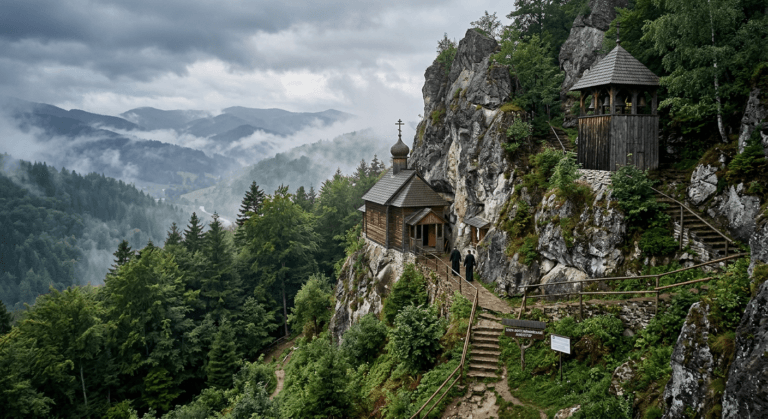
The Holy Panteleimon Men’s Monastery is located in the Kolesarovo tract on a hill five kilometres west of Khust in Transcarpathia. The founder of the skete in 1934 was hieromonk Meletii (sec. Mykhailo Rushchak), who visited Mount Athos three times and introduced strict Athonite rules here. The house, closed in Soviet times, was revived at the beginning of the 1990s; among its shrines is a cave church of the Venerable Job of Pochaev hewn into the rock. [1]
Briefly about the monastery
- Full name: Holy Panteleimon Men’s Monastery. [1]
- Address: the Kolesarovo (Kamin) tract, five kilometres west of the city of Khust, Transcarpathian Oblast. [1]
- Founded: 1934 (the skete of hieromonk Meletii). [1]
- Chief shrine: the cave church of the Venerable Job of Pochaev (consecrated 1995). [1]
- Order: strict Athonite rules. [1]
- Abbot: Archimandrite Dionysii (Bon). [1]
The founder — hieromonk Meletii
The founder of the skete in Khust-Kolesarovo was hieromonk Meletii (in the world Mykhailo Fedorovych Rushchak), who was born on 26 August 1902 in the city of Khust. Under the influence of his sister, he converted to Orthodoxy at the age of 16. [1]
Having met Fr Alexiy (Kabaliuk), Mykhailo went to the Holy Mountain Athos in 1925, where he became a novice of the St Panteleimon Monastery. By his behaviour he drew the attention of Archimandrite Misaïl, who tonsured Mykhailo a monk under the name Meletii on 8 August 1926. Having stayed on Athos until 1927, he returned home because of illness. [1]
On 29 April 1931 he was ordained a hierodeacon, and on 1 May a hieromonk by Bishop Yosif. In 1934, Fr Meletii went to Athos again, where he received the great schema under the name Luka, and after a six-month stay returned on foot to Khust. In all, Fr Meletii visited Athos three times. [1]
The founding of the skete (1934)
With the permission of Bishop Damaskin, on 18 June 1934 he settled in a forest wilderness five kilometres west of Khust in the Kolesarovo tract (or Kamin), where he dug a cave in the rock and began a hermit’s life. [1]
Later people saw that every night at the same hour a light shone on the hill, and they came to look — they saw Fr Meletii praying in the cave. A man of Khust, Vasyl Rosokha, learned of this and offered him his half-hectare plot of land. Fr Meletii turned to the diocesan administration for permission to build a monastery, and it was granted. [1]
Thus in 1934 the skete was founded. Fr Meletii began the construction of a small cell and a chapel in honour of St Panteleimon, introducing Athonite rules here. Services began at 12 o’clock at night and lasted until morning, and on feasts — all night; one could eat only twice a day, and meat was completely avoided. [1]
The monastery before closure
By his ascetic life Fr Meletii attracted young people. In 1950, six monks and one novice already lived in the skete. The monks built a wooden church measuring 11 by 5 metres, and in 1951 a bell tower and two houses. The monastery kept a household and did various handwork. [1]
In 1946 Serafim (Shandra) became the abbot of the skete. In 1952 the skete was closed and turned into the third parish of the city of Khust. The monks led by Fr Meletii did not want to leave their native skete until 1956. The wooden church was struck off the register on 1 June 1961 and dismantled on 8 August. [1]
Revival in the 1990s
The monastery in Kolesarovo resumed its activity at the beginning of the 1990s. On 9 August 1991, Bishop of Mukachevo-Uzhhorod Yevfymii (Shutak) consecrated the first stone of the church in honour of St Panteleimon. [1]
Archimandrite Dionysii (Bon), born in 1936 in the village of Monastyrets, was placed at the head of the monastery. He had been a novice at the skete from the age of 12; when the house was closed, he went to Russia, where for 15 years he served as rector of parishes in the Kostroma Oblast. [1]
Having consecrated the first stone and gathered donations, the monks led by Archimandrite Dionysii, with the help of the Khust architect I. D. Melnyk, began in 1992 the construction of the church of St Panteleimon — on the very place where the old church had formerly stood. [1]
The monks repaired the old wooden houses and structures, preserved by three nuns who had settled here in 1961 after the closure of the church and guarded the monastery’s property for a full 30 years. After buying three bells in Voronezh, the monks placed them on a wooden frame bell tower. [1]
The cave church
To make the church of St Panteleimon larger, the monks decided to remove the slope of earth that overhung the church. But in front of them stood a solid rock over 13 metres high. Seeing that the rock was very hard, the monks decided to hew a cave church. [1]
In 1993 the work on the cave church began; within two months the workers dug out and loaded tonnes of earth onto carts. In 1995 the cave church in honour of the Venerable Job of Pochaev was ready and consecrated by Bishop Methodii. [1]
Present life
Strict Athonite rules are preserved in the monastery, and not everyone can endure them. The prayers of the monks are so strong that people who come with serious illnesses, as testified here, receive healing. [1]
The Holy Panteleimon Men’s Monastery is one of the most ascetic centres of Transcarpathia, living according to its own internal statute, based on Athonite rules. [1]
Practical information
- Address: the Kolesarovo (Kamin) tract, five kilometres west of Khust, Transcarpathian Oblast. [1]
- Chief shrine: the cave church of the Venerable Job of Pochaev (consecrated 1995). [1]
- Church: the church of St Panteleimon (construction from 1992). [1]
- How to get there: the Kolesarovo tract on a hill five kilometres west of Khust. [1]
Frequently asked questions
Who founded the monastery?
Hieromonk Meletii (Mykhailo Rushchak), who visited Athos three times, in 1934. [1]
What is the order in the house?
Strict Athonite rules: night services, two meals a day, abstinence from meat. [1]
When was the monastery closed and revived?
The skete was closed in 1952; the house was revived at the beginning of the 1990s, the first stone consecrated on 9 August 1991. [1]
What is the chief shrine?
A cave church of the Venerable Job of Pochaev hewn into the rock, consecrated in 1995. [1]
Who was the abbot after the revival?
Archimandrite Dionysii (Bon), a former novice of the skete. [1]
Conclusion
The Holy Panteleimon Men’s Monastery in Khust-Kolesarovo is the embodiment of Athonite hermitage in Transcarpathia. From the founding of the skete by hieromonk Meletii in 1934, through the closure of 1952 and the revival at the beginning of the 1990s, to the cave church of the Venerable Job of Pochaev — the house preserves strict Athonite rules and is renowned for the power of the monastic prayer. [1]