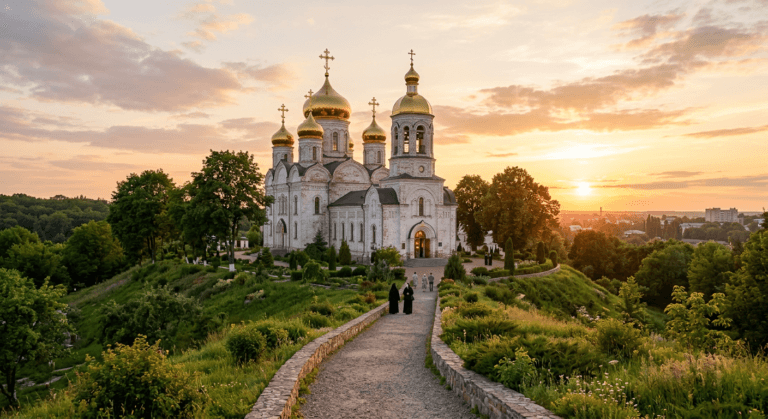
The Zhytomyr Monastery of St Anastasia of Rome is a stauropegial women’s monastery on the outskirts of Zhytomyr, in the Maliovanka district. Opened in 1999, it became the first women’s monastery in the city’s history. The house is dedicated to the holy virgin-martyr Anastasia of Rome, regarded as the heavenly patroness of Zhytomyr, and since 2011 it holds the status of a stauropegial monastery. [1][2]
Briefly about the monastery
- Full name: Zhytomyr stauropegial women’s monastery in honour of the virgin-martyr Anastasia of Rome. [1][2]
- Address: Zhytomyr city, 13-a Sosnova Street, 10003. [1][2]
- Founded: 1999 (the first women’s monastery of the city). [1]
- Status: stauropegial (since 10.02.2011). [2]
- Abbess: Igumenia Mykhaila (Furmanets). [2]
- Patroness: the holy virgin-martyr Anastasia of Rome, patroness of Zhytomyr. [2]
St Anastasia of Rome — patroness of Zhytomyr
St Anastasia of Rome lived in the days of the emperor Decius and his co-ruler Valerian. After the death of her parents she was raised in a women’s monastery not far from Rome, in a secluded place. Upon coming of age the girl became so beautiful that many noble Romans longed to take her as a wife. But the ascetic, rejecting worldly blessings, entered the monastic life. [2][3]
Indignant pagans slandered her before the commander Prov, and he ordered the young nun to be brought. The maiden was subjected to cruel tortures: by Prov’s command she was stretched and tied to four pillars, beaten with sticks and burned with fire, yet she prayed. They tied her to a wheel and, turning it, broke all her bones — but the wheel suddenly stopped, and the saint, freed by an invisible power, rose up whole. The commander did not relent: her ribs were scraped, her tongue torn out and finally her head cut off. [2][3]
The sacred head of the saint
In the 1860s the sacred head of St Anastasia arrived in Zhytomyr: as a gift from the Antioch Patriarch Hierotheos, it was brought by the Archbishop of Volyn and Zhytomyr Modest (Strelbytsky). [1][3]
In 1903, through the efforts of Bishop Antoniy (Khrapovytsky), the head of the saint was placed in a silver reliquary in the St Anastasia church in the lower (basement) part of the Transfiguration Cathedral. On 13/26 June 1903, by a decision of the Most Holy Synod, a locally venerated feast of the transfer of the relics of the holy virgin-martyr Anastasia of Rome was established. [3]
Before the revolution the shrine was in the lower church of the cathedral. Through prayers to St Anastasia countless miracles and healings occurred; at her reliquary soldiers took their oath before going to the front. [2][3]
Disappearance and return
In 1935 the cathedral was closed and the relics disappeared. But in 1941, during the occupation, when the cathedral was reopened, the head of the saint returned. After the war the cathedral was not closed again, but its lower church was taken from the community and the relics vanished once more. There is a tradition of their later return. [1][2]
From a sanatorium to a monastery
In the spring of 1999, on the outskirts of Zhytomyr, in the Maliovanka district, on the site of a former count’s estate where an anti-tuberculosis sanatorium had stood in Soviet times, the first women’s monastery in the city’s history was opened. The decision of the Holy Synod of the Ukrainian Orthodox Church of 30 March 1999 became a milestone in the history of Zhytomyr region. [1][2]
The sisters constantly sense the invisible presence of their heavenly patroness — St Anastasia of Rome, who is also the patroness of Zhytomyr. About 20 sisters serve in the house. [2]
The monastery churches
The monastic church is arranged as a house church: several rooms were united into one space, arches set apart the solea (the outer part of the altar), and the iconostasis was covered with gold. In one of the old buildings a warm church of the Venerable Sergius of Radonezh was arranged. [1][2]
In August 2002 the cathedral in honour of the holy virgin-martyr Anastasia of Rome — the patroness of Zhytomyr — was laid, with a lower side-altar of the Venerable Seraphim of Sarov. [1]
Shrines
On 25–26 June 2003 celebrations were held in Zhytomyr for the transfer of particles of the relics of the holy virgin-martyr Anastasia of Rome from Mount Athos for the Transfiguration Cathedral and the St Anastasia women’s monastery. The particles were set in two icons depicting the holy virgin-martyr, with which a crowded cross procession passed through the city. [2]
Present life
Today the St Anastasia monastery is one of the centres of spiritual life of Zhytomyr and the whole region. It combines monastic prayer with social service and the reception of pilgrims who come to venerate a particle of the relics of St Anastasia — the intercessor of the city. [2][4]
Practical information
- Address: Zhytomyr city, 13-a Sosnova Street, 10003. [2]
- How to get there: the Maliovanka district on the edge of Zhytomyr; the monastery stands on the site of a former sanatorium. [1]
- Main shrine: a particle of the relics of the holy virgin-martyr Anastasia of Rome (brought from Athos in 2003). [2]
- Services: in the warm monastic church; the lower side-altar of the cathedral is of the Venerable Seraphim of Sarov. [1][2]
Frequently asked questions
When was the monastery founded?
In 1999 by a decision of the Holy Synod of the UOC of 30.03.1999; it is the first women’s monastery in the history of Zhytomyr. [1][2]
Why is the house dedicated to St Anastasia?
The holy virgin-martyr Anastasia of Rome is regarded as the heavenly patroness of Zhytomyr; her sacred head was brought to the city in the 1860s. [1][3]
What is the main shrine?
A particle of the relics of St Anastasia, brought from Mount Athos in June 2003. [2]
Who is the abbess?
Igumenia Mykhaila (Furmanets). [2]
Is the monastery stauropegial?
Yes, on 10 February 2011 the house received the status of a stauropegial monastery. [2]
Conclusion
The Zhytomyr St Anastasia monastery is the revival of a centuries-old veneration of a saint whose sacred head became one of the chief shrines of the city. From the first women’s house of 1999, opened on the site of a former sanatorium in Maliovanka, to the stauropegial monastery of 2011 and the Athonite particle of relics of 2003, the community has grown into the spiritual heart of the Zhytomyr region, joining the ancient cult of the city’s patroness to modern monastic life. [1][2]