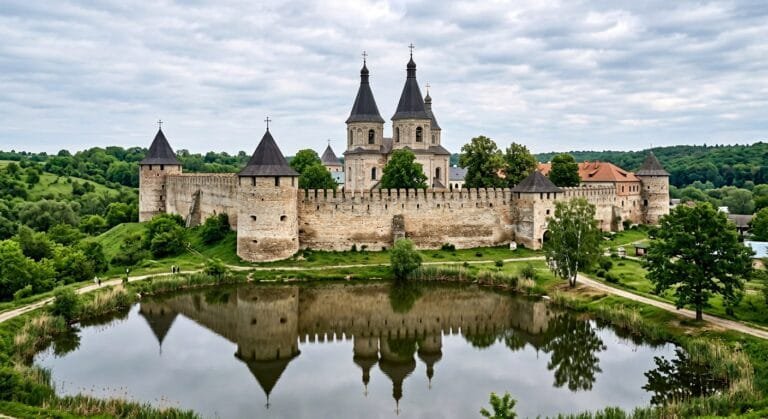
The Mezhyrich Holy Trinity Monastery in Rivne Oblast is one of the most impressive fortified monasteries in Ukraine from the 15th–17th centuries. Thick walls with loopholes, round towers and two kilometres of earthen ramparts make it look more like a castle than a monastic house. Its history is closely bound up with the princely house of Ostrozkyi, with the Franciscan order, and even with Bohdan Khmelnytskyi. [1][4][5]
The monastery at a glance
- Full name: Holy Trinity Monastery of Mezhyrich (men’s).
- Location: village of Mezhyrich, Rivne district, Rivne Oblast, about 5 km from Ostroh.
- Foundation: by tradition, monks of the Kyiv Caves Lavra; first mentioned in chronicles in the 13th century.
- Construction: 15th–17th centuries (masonry church from 1454; cells, walls and towers 1606–1612).
- Jurisdiction: UOC (Moscow Patriarchate).
- Chief relic: the miracle-working icon of the Mother of God Hodegetria (“Giver of Life”).
- Status: architectural monument of national importance; part of the Ostroh State Historical and Cultural Reserve.
History of the Mezhyrich Monastery
Origins in the Kyiv Caves
No precise foundation date has survived. According to established tradition, the Orthodox monastery here was founded by monks of the Kyiv Caves Lavra who came during the Mongol invasion; the first mention appears in chronicles of the 13th century, after 1240. Some researchers suggest the house existed here even earlier, in the pre-Mongol period. [1][6][10]
The site was not chosen at random: a headland formed by the confluence of the rivers Viliia and Zbytenka, among rolling hills — a position convenient for defence. [3][8]
The Ostrozkyi princes and the stone church
Medieval Mezhyrich, like most towns of its time, had a castle; in the 14th century it belonged to Fedir Ostrozkyi. In the 15th century Vasyl Ostrozkyi, nicknamed the Handsome, raised the stone walls of the fortress, and his son Ivan built a wooden Trinity church. When the wooden church burned down, construction of a stone Trinity church began in 1454 — already conceived as part of the castle’s fortifications. [6]
Documents survive recording that Prince Kostiantyn Ostrozkyi allocated funds in favour of the Mezhyrich monastery. Work on the church continued into the 1530s. [1][5]
Researchers note the resemblance of the Trinity church in Mezhyrich to the Epiphany church of Ostroh Castle — in size and plan alike; both are thought to have been raised by the same builder at roughly the same time. [5][6]
Janusz Ostrogski and the Franciscans
The last of the Ostrozkyi line — Janusz (Ivan in Orthodoxy), castellan of Kraków, who converted to Catholicism — changed the monastery’s fate. In 1605, through his efforts, Mezhyrich formally received Magdeburg rights: the town was permitted to build a town hall, shops and a bathhouse, to hold fairs twice a year and markets every Sunday. [7][9]
Janusz handed the Orthodox monastery over to the Catholic order of Franciscans. The Trinity church was turned into a Latin-rite church, and between 1606 and 1612 ranges of cells, defensive walls and towers were erected. The architect Paweł Grodzicki is considered their author. During the rebuilding of 1606–1610 defensive galleries with keyhole loopholes for firearms were added above the church, while the western and sanctuary sections received Gothic rib vaults with Renaissance decoration. [5]
Because Mezhyrich suffered badly from Crimean Tatar raids, Janusz Ostrogski did everything he could to strengthen its defences: the walls were surrounded by earthen ramparts more than 2 km long. The monastery was to shield Ostroh from the south — and in this lies its distinctiveness. Beside the walls the prince built himself a palace, which has not survived. [1][3][6]
The Franciscan monastery of Mezhyrich became one of the most powerful Catholic monastic centres in Volhynia: the friars owned a large library and a prosperous estate. In 1850 twenty friars served here. [5]
Bohdan Khmelnytskyi
One of the monastery’s walls bears a plaque recording the presence here in the 17th century of Bohdan Khmelnytskyi. According to tradition, the hetman attacked the village and destroyed almost everything, yet spared the Holy Trinity monastery: he drove out the Franciscan friars and quartered himself and his troops in the house. [1]
Return to Orthodoxy and modern times
In 1856 (other sources give 1866) the Russian authorities took the monastery from the Franciscans, and the church became an Orthodox parish church. In the mid-19th century the complex suffered a fire and long remained neglected. [5][6][8]
At the end of the First World War German troops were billeted in the monastery; it was then that the rich monastic archives were destroyed or vanished without trace. [5]
Today the Holy Trinity Monastery of Mezhyrich again serves its original purpose as a men’s house of the UOC (MP) and is in good condition. [4]
Architecture
The ensemble combines the traditions of old Rus’ construction with elements of Gothic-Renaissance architecture of the 15th–17th centuries and belongs to the Volhynian architectural school. [8]
- The Trinity church (15th–16th centuries) — the central building; frescoes of the 16th century survive, along with later murals painted by pupils of Viktor Vasnetsov, who decorated St Volodymyr’s Cathedral in Kyiv. The interior is in the Baroque style. [2]
- Ranges of cells (1606–1612) with two two-storey wings to the north and south, and powerful round towers. [9]
- Defensive walls with towers, crowned with merlons, and an entrance gate.
- Earthen ramparts more than 2 km long.
- Crypts holding the remains of the Franciscan friars; 18th-century altars inherited from the Franciscans were partly reused to create the iconostasis. [5]
- The Renaissance chimney — an enormous open-air oven standing in a field, preserved almost in its original form. Sentries warmed themselves beside it and food was cooked here; by tradition, pitch was also boiled in it to pour on the heads of attackers. [2][6]
A legend attaches to the monastery of an underground passage supposedly linking the Mezhyrich fortress with the castle and fortifications of Ostroh. [4][9]
Relics
The chief relic is the ancient miracle-working icon of the Mother of God Hodegetria, also known as the “Giver of Life”. By tradition the image was created as early as the 14th century; it reached Volhynia from Mount Athos as a gift to Prince Kostiantyn Ostrozkyi, who later passed it to the monastery. The panel itself is dated to the 15th–16th centuries. The icon was once adorned with gold and emeralds, but that precious setting was lost during the First World War. [2][4][10]
Practical information
- Getting there: Mezhyrich lies about 5 km from Ostroh; from Ostroh you can take a bus or walk. Regular buses run to Ostroh from Rivne and Khmelnytskyi.
- Access: free, following the schedule of services; this is an active men’s monastery.
- Dress: the usual monastic requirements — covered shoulders and knees, a headscarf for women.
- What to see: the Trinity church with its frescoes, the walls and towers, the crypts, the Renaissance chimney in the field, and the remains of the Zaslav town gates.
- Nearby: Ostroh with its castle and the Ostroh Academy — an essential addition to the route.
- Martial law: check the security situation before setting out.
Frequently asked questions
When was the Mezhyrich Monastery founded?
The exact date is unknown. By tradition the house was founded by monks of the Kyiv Caves Lavra, and the first chronicle mention dates from the 13th century, after 1240. The stone church was built from 1454. [6][10]
Why does the monastery look like a fortress?
Because it was built as one: between 1606 and 1612 Janusz Ostrogski surrounded it with walls and towers and ramparts more than 2 km long, to shield Ostroh from the south against Tatar raids. [1][3]
Was the monastery ever Catholic?
Yes. At the beginning of the 17th century Janusz Ostrogski handed it to the Franciscan order, and it remained Catholic until 1856–1866, when the Russian authorities returned the church to the Orthodox. [5][7]
What is known of Bohdan Khmelnytskyi at Mezhyrich?
By tradition the hetman, having destroyed the village, spared the monastery: he drove out the Franciscans and quartered himself there with his troops. A plaque on the wall records his stay. [1]
What is the monastery’s chief relic?
The miracle-working icon of the Mother of God Hodegetria, by tradition brought from Athos as a gift to Kostiantyn Ostrozkyi and given by him to the monastery. [2][10]
Is there really an underground passage to Ostroh?
That is a legend. There is no documentary evidence of a tunnel between Mezhyrich and Ostroh. [4]
Conclusion
Mezhyrich is an example of how, in Ukrainian history, a church and a fortress could be one and the same thing. Over five centuries the monastery was Orthodox, then Franciscan, then Orthodox again; it survived Tatar raids, Cossack wars, fire and a German billet. Today it is an active house and one of the best-preserved monuments of fortified sacred building in Ukraine. [4][5][6]
Sources
- Holy Trinity Monastery of Mezhyrich — MD-Ukraine
- Mezhyrich — a fortress monastery in Rivne region — ye.ua
- The building history of the Holy Trinity church — official monastery website
- Holy Trinity fortress monastery, Mezhyrich — Drymba
- Mezhyrich Monastery — Wikipedia
- Holy Trinity Monastery of Mezhyrich — OGO.ua
- Mezhyrich (Rivne district) — Wikipedia
- Mezhyrich Holy Trinity fortress monastery — Travels.in.ua
- Holy Trinity men’s monastery (Mezhyrich) — OGO.ua
- Trinity monasteries of Rivne region — RISU