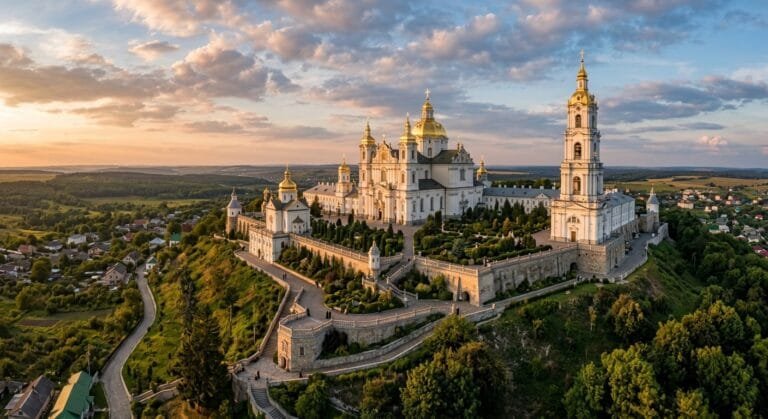
The Holy Dormition Pochaiv Lavra is the greatest Orthodox shrine in western Ukraine and the country’s second most important lavra. Its history is remarkable for a fact often passed over in silence: the main cathedral and the entire present-day appearance of the monastery were created during its Greek Catholic, Basilian period. Below is the full history of Pochaiv, its relics — the Footprint of the Theotokos and the Pochaiv Icon — its architecture and practical information for pilgrims. [1][2][3]
The monastery at a glance
- Full name: Holy Dormition Pochaiv Lavra.
- Location: Pochaiv, Kremenets district, Ternopil Oblast, Ukraine.
- First written mention: 1527; documented endowment: 1597.
- Jurisdiction: Ukrainian Orthodox Church (Moscow Patriarchate).
- Lavra status: since 1833.
- Principal relics: the Healing Footprint of the Most Holy Theotokos, the Pochaiv Icon of the Mother of God, the relics of Saints Job and Amphilochius of Pochaiv.
- Main church: the Dormition Cathedral (1771–1783), Baroque with Rococo elements.
History of the Pochaiv Lavra
The legend of 1240 and the apparition of the Theotokos
According to a tradition recorded between the 16th and 19th centuries, the monastery was founded by monks of the Kyiv Caves Monastery who fled to Volhynia after Batu Khan destroyed Kyiv in 1240. They settled on the high Pochaiv hill. There, the tradition says, the Most Holy Theotokos appeared in a pillar of fire to several monks and a shepherd named Ivan Bosyi. On the rock where she stood an imprint of her foot remained, and a spring began to flow from it. [1][2][4]
A second legend places the foundation around 1220 and credits the Athonite monk Methodius, venerated as the first founder of Pochaiv. Historians stress that both accounts come from later centuries and have no documentary support. [4][5]
Documented history: Anna Hoyska and the wonderworking icon
The first reliable mention of the monastery dates to 1527, when a small stone Dormition church already stood here. The monastery was documentarily founded in 1597, when the local landowner Princess Anna Hoyska (Hostska) deeded it estates, serf families and funds, and donated an icon of the Mother of God that later became famous as the Pochaiv Icon and the monastery’s chief relic. [5]
Saint Job of Pochaiv
The monastery’s flourishing is associated with abbot Job (Zalizo) of Pochaiv (1550–1651), who led the community in the first half of the 17th century. He introduced cenobitic life, surrounded the monastery with walls and five towers, and founded a printing house to defend Orthodoxy in the polemic with the Union, as well as a school. Several churches and cells were built under him. [1][2][5]
In 1649 a masonry Trinity church was erected over the place of the Footprint, funded by Fedir and Yeva Domashevski. [5]
A tragic page: in July 1651 the monks sheltered Cossack officers. During the pursuit they were discovered by Prince Jeremi Wiśniowiecki and Crown Field Hetman Marcin Kalinowski, and the Cossacks were executed. [2]
The Basilian period (1712/1713–1831): how today’s lavra came to be
In 1712 the brotherhood expressed the wish to join the Union, and from 1713 until 1831–1832 the Pochaiv monastery belonged to the Ukrainian Greek Catholic Church and to the Order of Saint Basil the Great. This was the era of its greatest construction: practically everything a pilgrim sees today was built by the Basilians. [2][4][6]
- 1730 — the Pochaiv printing house began operating, issuing 187 books and becoming one of Ukraine’s most important publishing centres. [3][5]
- 1720s–1740s — the architect P. Hizhytskyi built two-storey brethren cell blocks with a refectory; he also conceived the ensemble’s new dominant — a cathedral modelled on Melk Abbey in Austria. [5]
- 3 July 1771 — the cornerstone of the Dormition Cathedral was solemnly laid.
- 1773 — after Pope Clement XIV recognised the icon as wonderworking, Bishop Sylvester Rudnytskyi performed the solemn coronation of the Pochaiv Icon. [2][5]
- 1771–1783 — the Dormition Cathedral was erected to a design by Gottfried Hoffmann; the work was carried out by the Lviv masters, brothers Petro and Matvii Poleiovskyi, and by Franciszek Ksawery Kulchytskyi, under whose direction the terrace with its parapet and the refectory were formed. [1][2][6]
The chief patron was Count Mykola Vasyl Potocki (1712–1772), who gave the monastery more than 2,200,000 zlotys, personally supervised the construction and, following the custom of the time, was buried in the crypt beneath the cathedral, to the left of the main entrance. [2][4]
Transfer to the Russian Church and lavra status
During the November Uprising of 1830–1831 the monks supported the anti-Moscow insurgents, supplying provisions, horses, fodder and money; nine Basilian monks and 45 monastery subjects joined the insurgent army. Retribution was swift: in the course of the liquidation of the Greek Catholic Church on the Right Bank, the monastery was handed over to the Russian Orthodox Church in 1831 and received the status of a lavra in 1833. From 1833 to 1841 it housed the see of the Volhynian bishops. [2][5]
In the synodal period the lavra maintained an icon-painting workshop, a crafts school, three hotels and a hospital for pilgrims. After a fire in 1869 a group of artists — G. Bosse, S. Komarov, I. Horbunov, M. Nesterov, S. Verkhovtsev and others — executed the wall paintings of 1876 that survive to this day. [2][5]
The 20th and 21st centuries
In interwar Poland the lavra’s existence as an Orthodox house was threatened by “revindication” — the transfer of churches to the Roman Catholic Church; the entire Orthodox community opposed it and the shrines were retained. A monastic school operated from 1925. [2]
In 1992 the lavra’s vicegerent Yakiv (Panchuk) supported the creation of the Ukrainian Orthodox Church of the Kyiv Patriarchate; he was forcibly removed and the lavra was given to the UOC (MP), whose jurisdiction it remains under. The question of the monastery’s lease of state property has been repeatedly raised since 2022. [5][6]
Relics of the Pochaiv Lavra
The Healing Footprint of the Theotokos
An imprint of a foot in stone, left according to tradition during the apparition of the Mother of God. A spring continually fills it, and the water is distributed to pilgrims. The Footprint is kept in the Dormition Cathedral. [2]
The Pochaiv Icon of the Mother of God
Donated by Anna Hoyska in 1597 and glorified by numerous healings. It was solemnly crowned in 1773 — a rare case of a relic crowned during the Greek Catholic period and venerated today by the Orthodox. The icon is set in a case above the royal doors of the Dormition Cathedral and is lowered for veneration. [2][5]
The relics of the saints
- Saint Job of Pochaiv (1550–1651) — abbot, printer and defender of Orthodoxy.
- Saint Amphilochius of Pochaiv (1894–1971) — a confessor of the Soviet era, known for the gift of healing.
- Saint Methodius of Pochaiv — by tradition, the monastery’s first founder. [2]
Architecture
The Dormition Cathedral, built in 1771–1783, is the ensemble’s dominant. The concept drew on the Austrian abbey of Melk, while the execution combined Baroque and Rococo: Ionic columns and pilasters, broken entablatures, segmental pediments, cartouches, decorative vases and lavish stucco. Round openings cut into the ceilings of the side corridors reveal three tiers of choir galleries. A cave church is arranged beneath the cathedral. [1][5][7]
The ensemble also includes the brethren blocks with the refectory (1720s–1740s), the episcopal building (1825), the Holy Gate (1836), the Trinity Cathedral, the bell tower and terraces with parapets descending the hillside. The lavra stands on high ground and is visible for tens of kilometres — one of Ukraine’s most striking sacred landscapes. [5]
Practical information for pilgrims
- Getting there: Pochaiv lies about 70 km from Ternopil and 24 km from Kremenets, with regular buses from Ternopil, Lviv and Rivne.
- Dress code: stricter than at most monasteries. Women need a long skirt (not trousers) and a headscarf; men, long trousers. Wraps are provided at the entrance.
- Accommodation: the lavra runs a pilgrims’ hostel; places should be booked in advance.
- Relics: queues to the Footprint and the icon can be long, especially on great feasts.
- Main feasts: the Dormition of the Theotokos is the lavra’s patronal feast; also the commemoration days of Saints Job and Amphilochius.
- Photography: normally forbidden inside the churches during services.
- Wartime note: check the current security situation and official travel advisories before planning a pilgrimage to Ukraine.
Frequently asked questions
When was the Pochaiv Lavra founded?
There is no exact date. Legend places the foundation in 1240 (monks fleeing Kyiv) or around 1220. The first written mention is 1527, and the documented endowment by Anna Hoyska is 1597. [2][5]
Was the Pochaiv Lavra ever Greek Catholic?
Yes. From 1713 until 1831–1832 the monastery belonged to the UGCC and the Basilian Order. That is precisely when the Dormition Cathedral was built and the present ensemble took shape — a period often omitted from monastery narratives. [4][6]
Who built the Dormition Cathedral?
The design is attributed to Gottfried Hoffmann; the work was executed by the brothers Petro and Matvii Poleiovskyi and Franciszek Ksawery Kulchytskyi. It was financed by Count Mykola Potocki, who spent over 2.2 million zlotys. [2][6]
What is the Footprint of the Theotokos?
An imprint of a foot in stone, left according to tradition during the apparition of the Most Holy Theotokos; a spring continually fills it with water venerated as healing. [2]
Who owns the Pochaiv Lavra today?
The complex is state property, granted for use to a community of the Ukrainian Orthodox Church (Moscow Patriarchate). [5]
When did it receive lavra status?
In 1833, after the monastery had already been transferred to the Russian Orthodox Church. [5]
Conclusion
Pochaiv is a place where Ukrainian religious history refuses to be simplified: an Orthodox monastery whose greatest church was built by Greek Catholic Basilians at the expense of a Polish magnate, with an icon crowned by the blessing of a Roman pope. Today it is at once a working monastery, a masterpiece of Baroque architecture and one of the country’s largest pilgrimage centres. [2][5][6]
Sources
- Pochaiv Lavra: history, legends, the Dormition Cathedral
- Pochaiv Dormition Lavra — Wikipedia
- Holy Dormition Pochaiv Lavra — Seven Wonders of Ukraine
- Radio Liberty on the Basilian period of the Pochaiv Lavra
- Pochaiv Holy Dormition Lavra — Encyclopedia of the History of Ukraine
- Suspilne: who owned the Pochaiv Lavra and the lease question
- The architectural ensemble of the Pochaiv Lavra