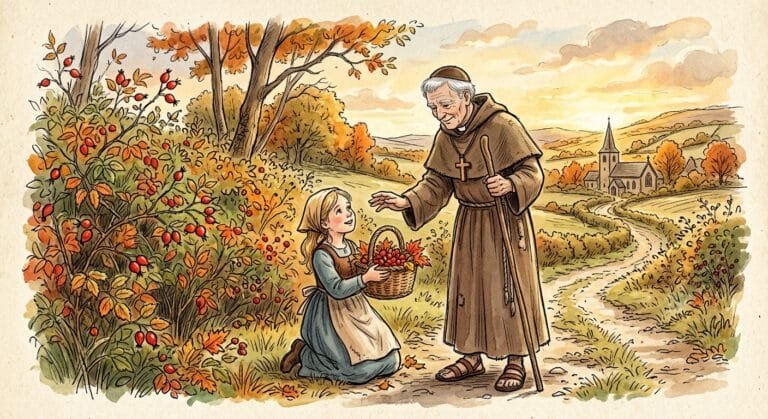
Every day, millions of believers ask the same important question: what holiday is today according to the Church’s liturgical calendar, what folk signs and customs belong to the day, what is forbidden, whose name day is being celebrated, and which prayer will help us ask God for protection and peace of heart. September 18 is a day of quiet saints in the Orthodox calendar (new style / revised Julian calendar): the Church commemorates Venerable Eumenes, Bishop of Gortyna — a Cretan pastor of the seventh century who gave away all his property to the poor and lived in simplicity — and Saint Ariadne of Phrygia, a slave woman of the second century who did not renounce Christ even before torture. In folk tradition the day was called Irina the Rosehip Day, because from this day people began gathering rosehips for the winter. This complete guide recounts the lives of the saints of the day in detail, gathers the folk customs, and provides the canonical prayer texts.
Understanding the liturgical year helps us realize that every day is dedicated to a particular saint or a key Gospel event. Our ancestors always began the day with prayer, because prayer is the key to peace of soul. When we say the Lord’s Prayer or turn to Venerable Eumenes and Saint Ariadne in the morning before work, or in the evening to quiet our hearts, we place our minds under God’s care and calm our souls before life’s worries and anxieties. Both saints of this day teach one thing: true strength lies in simplicity, generosity, and quiet faithfulness.
To strengthen your faith and your spiritual watchfulness (nepsis) amid daily temptations, we invite you to the spiritual treasury of the Christian East: the Philokalia (Dobrotolyubiye), where the Holy Fathers teach how to live in simplicity and without attachment to earthly things.
The Orthodox Feast of September 18: Venerable Eumenes, Bishop of Gortyna
The Life of the Saint: A Pastor Who Gave Everything Away
Venerable Eumenes lived in the seventh century on the island of Crete, in the city of Gortyna. From his youth he sought to serve God: he avoided the temptations of the world, kept high moral principles, and helped the poor by giving away his property. For his kindness, wisdom, and zealous faith he was chosen Bishop of Gortyna and became famous as a wise pastor who always stood in defense of the faith [2][5].
Becoming bishop, the saint did not change his way of life: he continued to live in simplicity, to preach Christian values, and to care for the poorest of his flock. It was said of him that his door was never closed to those in need of help. Saint Eumenes fell asleep in peace, and the Church feels his prayerful intercession to this day [2][5].
What Believers Ask of Venerable Eumenes
Believers pray to Venerable Eumenes for wisdom in managing family and affairs, for generosity of heart and freedom from attachment to wealth, for protection from temptations, and also for the pastors of the Church. His life reminds us: it is not property that makes a person rich, but an open hand and an open heart.
Saint Ariadne of Phrygia: A Slave Who Became Free in Christ
Saint Ariadne lived in the second century in Phrygia — a Roman province on the territory of present-day Turkey. She was a Christian and served as a slave in the house of a nobleman named Tertillus, in the time of Emperor Hadrian [1][4].
Once Tertillus held a feast in honor of the pagan gods and demanded that Ariadne take part in it and offer sacrifice to the idols. The slave woman refused to renounce her faith, saying that she served the one living God. The enraged master subjected her to cruel tortures and threw her into prison, and later to further torments. But Ariadne endured everything, because bodily slavery could not touch the freedom of her heart, which belonged to Christ. She died for the faith in the first half of the second century, and the Church venerates her as a martyr [1][5].
Saint Ariadne is prayed to for inner freedom — freedom from fear of people, from the pressure of circumstances, from the need to please everyone. She is the intercessor of those who suffer pressure at work, in the family, or in society for their faith or convictions, and, according to folk tradition, the patroness of modest people who do not boast but quietly do good [5].
What Else the Church Commemorates on September 18
On this day, according to the new style, the Church also recalls [1]:
- The martyrs Sophia and Irene, and the martyr Castor.
- The martyrs Bidzina, Shalva, and Elizbar, princes of Ksani — Georgian saints who died for the faith in the seventeenth century in Persia.
- The Molchansk Icon of the Mother of God — a wonderworking icon from Putyvl, known since the end of the fourteenth century.
- According to older calendars, this day also honored the Georgian icon of the Mother of God called “The Healer” [4].
The Catholic Feast of September 18: Saint Joseph of Cupertino — Patron of Aviators
On September 18 the Roman Catholic Church celebrates the feast of Saint Joseph of Cupertino (1603–1663) — an Italian Franciscan who was called “Brother Ecstasy”: during prayer he was so rapt in God that, according to many witnesses, he rose above the ground. For this reason he is honored as the patron of aviators, astronauts, and students taking examinations (Joseph himself, in his youth, barely passed the simplest exams, but God raised him above all earthly difficulties). His life echoes the feast of the day: both Eumenes and Joseph show that God lifts up those who humble themselves before Him.
The Folk Feast of Irina the Rosehip Day: Traditions, Signs, and Prohibitions
In the folk calendar, September 18 is known as Irina the Rosehip Day. The name comes from the name of Saint Ariadne (Irina in the folk form) and is connected with the main occupation of the day: from this time people began gathering rosehips to dry them and to prepare a healing tea for the winter. Our ancestors believed that this day was especially good for health and longevity: whoever gathered rosehips on Irina’s day and drank their decoction would pass the winter without colds [3][5].
What Is Forbidden on September 18
- Do not quarrel, swear, or settle scores — the conflict risks dragging on for a long time [1][2][3].
- Do not gossip, envy, or think evil [2].
- Do not boast of your successes or display your wealth — according to belief, you may lose it all [1][2].
- Avoid cutting your hair [3][4].
- Do not water or repot house plants — otherwise they may die [3].
- Do not lend money — it was believed that this would “carry happiness out of the house” and bring financial problems [2][4].
- Avoid beginning great undertakings without prayer and blessing [2].
- Avoid heavy physical labor — it could turn into exhaustion and illness [2].
- Do not refuse those who ask for help [2].
- Do not shout at children or compare them with others — the relationship with the child will worsen in the future [4].
- Do not ask God for more than you need — the day teaches contentment with what is given [1].
Weather Signs for September 18
- If there is fog in the morning — the autumn will be warm and long [2].
- The birch has not yet shed its leaves — the winter promises to be mild [1][3].
- The weeds stand tall — there will be much snow in winter [1][3].
- The cranes have flown to warmer lands — frosts are possible by the end of the month [1][3].
- Warm and sunny all day — expect a late winter [3].
- If on a clear day the cattle hide under shelter and leave the field — bad weather is coming soon [4].
Name days on September 18 are celebrated by Eumenes, Ariadne, Basil, Mary, Sophia, and Irene, and according to broader folk calendars also by Arcadius, Boris, Vladimir, John, Constantine, Michael, Alexis, Peter, and Sergius [2][4]. If your loved ones bear these names, greet them on their name day with a warm prayer and a kind word.
The Spiritual Laws of This Day: Simplicity and Inner Freedom
The law of simplicity. Eumenes, a bishop of a great diocese, lived as though he had nothing — and that is why he had everything: the trust of his flock, peace of heart, and a memory for ages. Simplicity is not poverty, but the absence of what is superfluous: superfluous things, superfluous worries, superfluous masks. On this day it is good to do one simple deed: give away what you have long not used to those who need it.
The law of inner freedom. Ariadne was a slave by position but the freest by spirit: no master could force her to betray her conscience. “Whoever commits sin is the slave of sin” (John 8:34), and whoever holds to the truth is free even in chains. If someone is pressing on you today, remember Ariadne: your choice belongs to you.
The commandment of love. “Let not the mighty glory in his might” (cf. 1 Corinthians 1:31). Irina the Rosehip Day taught people not to boast but to give thanks. Thanksgiving is the best remedy against envy and pride: say “thank you” to God today for three simple things — the roof over your head, the bread on your table, and the person who loves you.
Hesychast Watchfulness: Prayer in Simplicity of Heart
The hesychast Fathers taught that prayer does not need many words — it needs attention. The venerable Fathers said: “Do not seek eloquence in prayer; seek purity.” The simplicity of Eumenes and the quiet steadfastness of Ariadne are the best examples of such watchfulness: to stand before God without masks, with what you have, and to ask only for what is needful [7].
The practice of prayer with the chotki on this day is simple:
- Take your prayer rope and say 33 knots of the Jesus Prayer: “Lord Jesus Christ, Son of God, have mercy on me, a sinner.”
- At each decade ask for only one simple thing: peace in the heart, health for your loved ones, wisdom in your affairs — nothing superfluous.
- Dedicate one round of the prayer rope to thanksgiving: “Glory to You, O our God, glory to You.”
The short prayer of the day. “Venerable Father Eumenes, you gave everything away to the poor and found riches in God — teach me too not to cling to earthly things. Holy martyr Ariadne, you kept the freedom of your heart in slavery — help me too not to betray my conscience before people. Amen.”
Common Prayer on September 18 on Pray.ee
Prayer offered together has a special power: “For where two or three are gathered together in My name, there am I in the midst of them” (Matthew 18:20). On this quiet September day, invite your family to common evening prayer — even for a few minutes, even with one Lord’s Prayer, with a cup of rosehip tea on the table, as the folk tradition teaches.
On our prayer portal Pray.ee you can leave your prayer intention in the comments under this article — and the community of believers will pray for you and your loved ones. Write down whom or what you ask prayer for: for health for the winter, for wisdom in affairs, for freedom from fear, for peace in the family. Do not remain alone with your cares — in common prayer we bear one another’s burdens.
A Living Testimony: A Story from Our Community
“My grandmother always gathered rosehips on Irina’s day and dried them in the attic. People say it’s a simple custom, but she used to say: ‘It is not about the berries; it is about thinking of winter today.’ She taught me the same — not only to gather berries, but to prepare the heart: to forgive offenses before winter, to share warmth. Last year, for the first time, I gave the neighbors a jar of dried rosehips each, and it was then that I felt: winter is no longer frightening, when there is someone to warm.”
If you have your own testimony of God’s help, share it in the comments on Pray.ee. Your word may be the very spark of faith that someone is missing right now.
The Canonical Prayers of September 18
Troparion to Venerable Eumenes, Tone 8
By your tears you cultivated the barren desert, and by sighs from the depths of your soul you made your labors bear fruit a hundredfold, and you became a luminary to the whole universe, shining with miracles, O our Father Eumenes. Entreat Christ God for the salvation of our souls.
Troparion to the Martyr Ariadne, Tone 4
Your lamb Ariadne, O Jesus, cries out to You with a loud voice: You, my Bridegroom, I love, and seeking You I suffer. Accept me as an unblemished sacrifice, offered to You with love. By her prayers, as the Merciful One, save our souls.
Prayer to Venerable Eumenes (for home use)
Venerable Father Eumenes, you gave your property to the poor and enriched your soul with mercy; you lived in simplicity and taught many to seek first the Kingdom of God. Entreat Christ God for us: grant us a generous heart free from greed, hands open to the needy, and the wisdom to value heavenly things above earthly. Amen.
Prayer to Saint Ariadne (for home use)
O holy martyr Ariadne, you were a slave in body but free in spirit, and you did not betray Christ either before your master or before the torments. Pray for us: grant us inner freedom from human fear, from the pressure of circumstances, and from the need to please sin. Obtain for us steadfastness of conscience and forgiveness of sins. Amen.
FAQ: Frequently Asked Questions About September 18
What church feast falls on September 18, 2026?
According to the new style, the Orthodox Church on September 18 venerates Venerable Eumenes, Bishop of Gortyna (Crete, seventh century), and Saint Ariadne of Phrygia (second century), and also recalls the martyrs Sophia and Irene, the martyr Castor, the Ksani princes Bidzina, Shalva, and Elizbar, and the Molchansk Icon of the Mother of God. The Roman Catholic Church celebrates the feast of Saint Joseph of Cupertino.
Who was Venerable Eumenes of Gortyna?
A bishop of the seventh century from the island of Crete who from his youth served God, gave his property to the poor, and lived in simplicity. He became famous as a wise pastor who always stood in defense of the faith, and as an intercessor for the poor.
Why is September 18 called Irina the Rosehip Day?
The folk name comes from the name of Saint Ariadne (Irina in the folk form). From this day people began gathering rosehips, drying them, and preparing a healing tea for the winter. The day was considered especially good for health and longevity.
What is forbidden on September 18?
One must not quarrel or settle scores, gossip or envy, boast of successes, cut hair, water or repot plants, lend money, begin great undertakings without prayer, do heavy labor, refuse help, or shout at children.
Who celebrates name days on September 18?
Name days are celebrated by Eumenes, Ariadne, Basil, Mary, Sophia, and Irene, and according to broader folk calendars also by Arcadius, Boris, Vladimir, John, Constantine, Michael, Alexis, Peter, and Sergius.
Sources
- [1] UNIAN — The church feast of September 18: prohibitions, customs and signs (in Ukrainian)
- [2] RBC-Ukraine — What holiday is celebrated on September 18: prohibitions, signs and name days (in Ukrainian)
- [3] 1+1 — September 18: church feast, signs and prohibitions (Irina the Rosehip Day) (in Ukrainian)
- [4] RBC-Ukraine — The feast of September 18: main signs and prohibitions, name days (in Ukrainian)
- [5] Inseinin — What holiday is September 18: Ariadne and Eumenes of Gortyna (in Ukrainian)
- [6] The Philokalia (Dobrotolyubiye) — Pray.ee