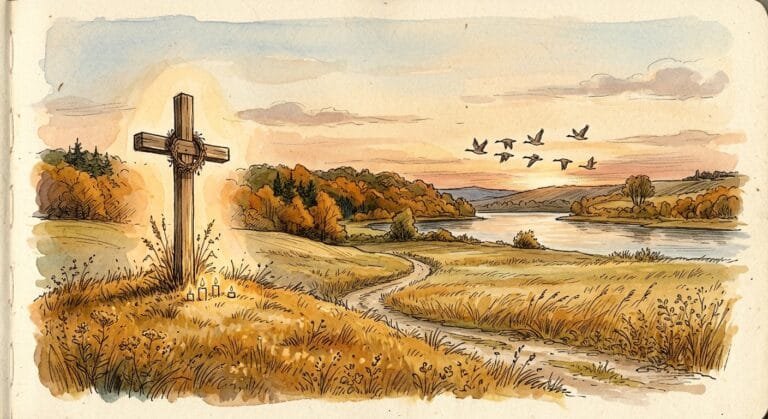
Every day, millions of believers ask the same important question: what holiday is today according to the Church’s liturgical calendar, what folk signs and customs belong to the day, what is forbidden, whose name day is being celebrated, and which prayer will help us ask God for protection and peace of heart. September 15 is a day of strong faith in the Orthodox calendar (new style / revised Julian calendar): the Church commemorates the Great Martyr Nicetas the Goth — a Gothic warrior of the fourth century who openly confessed Christ before a pagan king and accepted a martyr’s death in the fire, while his body remained unharmed. In folk tradition the day was called Nicetas the Goose Day, for it was the time when people began preparing dishes of fowl. On this day the Roman Catholic Church keeps the moving memorial of Our Lady of Sorrows. This complete guide recounts the life of Great Martyr Nicetas in detail, gathers the folk customs of the day, and provides the canonical prayer texts.
Understanding the liturgical year helps us realize that every day is dedicated to a particular saint or a key Gospel event. Our ancestors always began the day with prayer, because prayer is the key to peace of soul. When we say the Lord’s Prayer or turn to Great Martyr Nicetas in the morning before work, or in the evening to quiet our hearts, we place our minds under God’s care and calm our souls before life’s worries and anxieties. The life of Saint Nicetas reminds us: faith tempered in trials is stronger than any fire.
To strengthen your faith and your spiritual watchfulness (nepsis) amid daily temptations, we invite you to the spiritual treasury of the Christian East: the Philokalia (Dobrotolyubiye), where the Holy Fathers teach how to stand unshaken in faith amid persecutions and temptations.
The Orthodox Feast of September 15: Great Martyr Nicetas the Goth
The Life of the Saint: A Warrior Who Chose Christ
Saint Nicetas lived in the fourth century on the banks of the Danube, in the lands of present-day Romania, and was a Goth — a warrior of one of the most warlike peoples of that age. He received the Christian faith from Bishop Theophilus, a participant of the First Ecumenical Council, and after his baptism became a zealous preacher of the Gospel among his fellow Goths. Through his word, many pagans turned to Christ [2][5].
In those days the Goths were ruled by the pagan chieftain Athanaric. When his rival, who supported the Christians, was defeated, Athanaric regained power and began a cruel persecution of the Christians. Saint Nicetas did not keep silent: he openly denounced the cruelty of the ruler and called on the Goths not to betray Christ. For this he was arrested and subjected to severe tortures, in an attempt to make him renounce the faith. But Nicetas remained unshaken [2][4].
The Martyr’s Death and the Miracle in the Fire (372)
Unable to break the will of the confessor, the pagans condemned Nicetas to death by burning. But even here God glorified His servant: the fire did no harm to the saint’s body — it remained untouched by the flames. A Christian named Marianus, a friend and fellow tribesman of the martyr, secretly took the body in order to bury it with honor, and carried it to Cilicia [2][4]. Later the relics of Great Martyr Nicetas were transferred to Constantinople, and part of them eventually reached the monastery of Visoki Dečani in Serbia. Numerous healings took place at the relics, and a church was built in their honor [4][6].
What Believers Ask of Great Martyr Nicetas
Believers pray to Great Martyr Nicetas for courage and steadfastness in faith, for protection in times of war and persecution, for soldiers and captives, and for the strength to resist pressure when the world around us demands that we betray our convictions. His life is an example for everyone who stands before the choice between easy silence and the truth: Nicetas chose the truth, and that is why his memory has lived for more than sixteen centuries.
What Else the Church Commemorates on September 15
Besides Great Martyr Nicetas, according to the new calendar the Church also recalls on this day: the finding of the relics of Saint Acacius, Bishop of Melitene; the martyrs Maximus, Theodotus, and the martyr-woman Asclepias; the martyr Porphyrius of Ephesus; the finding of the relics of the protomartyr archdeacon Stephen; the venerable Philotheus, a priest in Asia Minor; Saint Symeon, Archbishop of Thessalonica, and the New Nicetas Icon of the Mother of God [3]. So September 15 is a true treasury of saintly names, and in the churches many intercessions sound on this day.
The Catholic Feast of September 15: Our Lady of Sorrows
On September 15, immediately after the feast of the Exaltation of the Cross, the Roman Catholic Church keeps the memorial of Our Lady of Sorrows (Mater Dolorosa) — a day dedicated to the sufferings of the Mother of God, especially her standing at the Cross of her Son. This memorial recalls the seven principal sorrows of the Mother of God described in the Gospel: from the prophecy of Simeon to the burial of Christ. The classic hymn of this day, the “Stabat Mater” (“Stood the sorrowful Mother beside the Cross”), is one of the most moving texts of Western spiritual poetry.
For Ukraine this day sounds with particular pain and, at the same time, hope: how many mothers stand today in prayer for their sons and daughters — at the front, in captivity, in occupation. Our Lady of Sorrows is their intercessor, for she, like no one else, knows what it means to wait and to pray for one’s child when the heart is pierced by a sword (cf. Luke 2:35). If you are a mother who prays for her children every day, this day is yours.
The Folk Feast of Nicetas the Goose Day: Traditions, Signs, and Prohibitions
In the folk calendar, September 15 is known as Nicetas the Goose Day. The name is connected with the fact that at this time people traditionally began hunting wild geese, and the hostesses prepared dishes of fowl — the baked goose was the main dish on the table. On this day people also took care of their livestock, thanking God for the fruits of summer and preparing for autumn [1][5].
What Is Forbidden on September 15
Folk tradition preserved a clear list of prohibitions for Nicetas the Goose Day [3][4][5]:
- Do not quarrel, swear, envy, or gossip — this invites misfortune into the home.
- Avoid deep cleaning — you might “sweep away” your luck.
- Do not carry things out of the house or lend anything to the neighbors — this leads to losses.
- Avoid boasting of your successes, wealth, or beauty — according to belief, you may lose it all.
- Do not begin new undertakings — they will fail.
- Do not go to the market or bargain — deals will turn out badly.
- Avoid chopping trees and cutting branches.
- It is not advised to hold a wedding — such a marriage will not be strong.
- Avoid spending the day alone — it is better to gather with family around the table [4].
Weather Signs for September 15
- Clear weather on Nicetas’s day — the autumn will be warm and long.
- Morning frost on the grass — cold weather is coming soon.
- Rain has fallen — the autumn will be dry, and spring late and damp [3][4].
- Low clouds — bad weather is coming.
- Many anthills in the forest — the winter will be harsh.
- A cold wind blowing — next summer will be warm.
- Geese flying high — floods are possible in winter; on this day people watched the geese most carefully of all [3][4].
Name days on September 15 are celebrated by Andrew, Valerian, Bessarion, Gerasimus, Gregory, Demetrius, Eudocia, John, Ignatius, Joseph, Leonid, Ludmila, Macarius, Maximus, Mary, Nicetas, Nicholas, Peter, Porphyrius, Simon, Stephen, Theodore, and James [4][5]. If your loved ones bear these names, greet them on their name day with a warm prayer and a kind word. This day is truly crowded with name days!
The Spiritual Laws of This Day: Steadfastness and Faithfulness
The law of steadfastness. Nicetas was tortured and thrown into the fire, and he did not renounce Christ. In our lives there are rarely bonfires, but every day there are small flames of pressure: the demand to keep silent about the truth, the temptation to be cunning, the fear of being inconvenient. Steadfastness begins with these small choices: whoever is faithful in little will be faithful also in much (cf. Luke 16:10).
The law of faithful friendship. Marianus, the friend of Saint Nicetas, at risk to himself, secretly took the martyr’s body and buried it with honor. This is Gospel love in action: “Greater love has no one than this, that someone lay down his life for his friends” (John 15:13). Thanksgiving, faithfulness, and help to one’s neighbor are the three steps by which we imitate Marianus in our daily lives.
The commandment of love. “A new commandment I give to you, that you love one another” (John 13:34). On Nicetas the Goose Day our ancestors gathered with their families around the festive table, sang songs, and shared with their neighbors. Do not remain alone on this day: call your loved ones, invite your neighbors, share a meal — shared joy is multiplied, and shared pain grows smaller.
Hesychast Watchfulness: Standing in Prayer as Nicetas Stood in the Fire
The hesychast Fathers taught that the heart of the believer should be like a pillar: outside there may be wind of temptations and fire of circumstances, but inside — silence and attention to God. It was precisely such a standing that Nicetas showed: amid the tortures he did not lose his inner prayer. The venerable Fathers counseled: when anxiety or fear comes, stand before God as a soldier before his commander, and speak the name of Jesus — and the thoughts will retreat, as the fire retreated from the martyr’s body [7].
The practice of prayer with the chotki on this day is simple:
- Take your prayer rope and say 33 knots of the Jesus Prayer: “Lord Jesus Christ, Son of God, have mercy on me, a sinner.”
- Add a petition for soldiers and captives, in memory of the saintly warrior Nicetas: “O Lord, protect and deliver Your servants.”
- One round of the prayer rope may be devoted to the prayer of mothers for their children, in honor of Our Lady of Sorrows.
- Finish with thanksgiving: “Glory to You, O our God, glory to You.”
The short prayer of the day. “Holy Great Martyr Nicetas, you did not renounce Christ either in tortures or in fire — help me too to stand unshaken in faith amid my trials. Most Holy Mother of Sorrows, cover with your veil all mothers who pray for their children. Amen.”
Common Prayer on September 15 on Pray.ee
Prayer offered together has a special power: “For where two or three are gathered together in My name, there am I in the midst of them” (Matthew 18:20). On this day, when the Church recalls the courage of the saintly warrior Nicetas and the sorrow of the Mother of God, invite your family to common evening prayer — even for a few minutes, even with one Lord’s Prayer.
On our prayer portal Pray.ee you can leave your prayer intention in the comments under this article — and the community of believers will pray for you and your loved ones. Write down whom or what you ask prayer for: for the protection of soldiers, for the release of captives, for the health of children, for peace in the family. Do not remain alone with your cares — in common prayer we bear one another’s burdens.
A Living Testimony: A Story from Our Community
“My son was in captivity for a year and a half. All that time I read the akathist every day and prayed to Great Martyr Nicetas — he too was a warrior, he too stood before enemies and did not renounce his faith. On Nicetas the Goose Day, September 15, he was exchanged. When he came home, the first thing he said was: ‘Mom, I was praying there too.’ Now every year on September 15 we set the table, bake a goose, and thank God. And we thank Nicetas, and Marianus, who was not afraid of his friend.”
If you have your own testimony of God’s help, share it in the comments on Pray.ee. Your word may be the very spark of faith that someone is missing right now.
The Canonical Prayers of September 15
Troparion to Great Martyr Nicetas, Tone 4
Your martyr Nicetas, O Lord, in his suffering received an imperishable crown from You, our God; for having Your strength, he overcame the persecutors and destroyed the feeble insolence of demons. By his prayers save our souls.
Prayer to Great Martyr Nicetas (for home use)
O holy Great Martyr Nicetas, brave warrior of Christ, you feared neither tortures nor fire, and you kept your faithfulness to the Lord to the end. Entreat Christ God for us sinners: grant us courage in trials, steadfastness in faith, and love for our neighbors. Protect our soldiers and captives, deliver the sorrowful, and console the despairing. Obtain for us forgiveness of sins and great mercy. Amen.
Prayer to Our Lady of Sorrows (following the Catholic tradition of the day)
Most Holy Virgin, Mother of Sorrows, you stood beside the Cross of your Son and did not turn away from Him in the hardest hour. Look upon all mothers who stand in prayer for their children, and upon all who carry their cross alone. Obtain for them strength, patience, and hope, for you know how the heart aches, and you know how it will rise again. Amen.
FAQ: Frequently Asked Questions About September 15
What church feast falls on September 15, 2026?
According to the new style (revised Julian calendar), the Orthodox Church on September 15 commemorates Great Martyr Nicetas the Goth (†372) and also recalls a number of other saints, in particular the finding of the relics of the protomartyr archdeacon Stephen. The Roman Catholic Church keeps the memorial of Our Lady of Sorrows.
Who was Great Martyr Nicetas the Goth?
A Gothic warrior of the fourth century from the banks of the Danube, who received baptism from Bishop Theophilus and preached Christ among the Goths. Under King Athanaric he was tortured and burned in 372, but his body remained unharmed by the fire. Marianus, his friend, buried him with honor, and later the saint’s relics were glorified by healings.
Why is September 15 called Nicetas the Goose Day?
In folk tradition, on this day people began hunting wild geese and preparing dishes of fowl — the baked goose was the main dish. They also watched the geese: if they flew high, floods were possible in winter. Families gathered around a common table, sang songs, and prepared for autumn.
What is forbidden on September 15?
One must not quarrel or swear, do deep cleaning, carry things out of the house or lend to neighbors, boast of successes, begin new undertakings, go to the market or bargain, chop trees or cut branches, or hold a wedding. It is also not advised to spend the day alone.
Who celebrates name days on September 15?
Name days are celebrated by Andrew, Valerian, Bessarion, Gerasimus, Gregory, Demetrius, Eudocia, John, Ignatius, Joseph, Leonid, Ludmila, Macarius, Maximus, Mary, Nicetas, Nicholas, Peter, Porphyrius, Simon, Stephen, Theodore, and James.
Sources
- [1] ChasDiy — September 15: what feast is today, traditions and prohibitions (in Ukrainian)
- [2] Bukvy — September 15: the memory of Saint Nicetas the Goth, his life (in Ukrainian)
- [3] UNIAN — The church feast of September 15: prohibitions, customs and signs (in Ukrainian)
- [4] RBC-Ukraine — The church feast of September 15: what is forbidden and name days (in Ukrainian)
- [5] 1+1 — September 15: why the folk name of this day is Nicetas the Goose Day (in Ukrainian)
- [6] TSN — What holiday is September 15: the relics of Saint Nicetas (in Ukrainian)
- [7] The Philokalia (Dobrotolyubiye) — Pray.ee