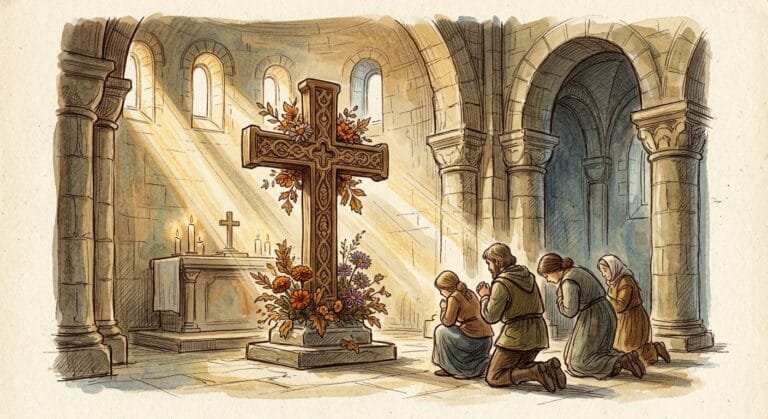
Every day, millions of believers ask: what holiday is today according to the Church calendar, what traditions and prohibitions belong to it, how to keep it properly, and which prayer will help us ask God for protection and peace of heart. September 14 is one of the greatest days of the church year: the Orthodox Church (new style / revised Julian calendar) and the Roman Catholic Church together celebrate the Universal Exaltation of the Precious and Life-Giving Cross of the Lord — one of the Twelve Great Feasts, dedicated to the very instrument of our salvation. On this day the Church recalls two great events: the finding of the Cross of the Lord by the holy Empress Helena in Jerusalem in 326, and the return of the Cross from Persian captivity by the Emperor Heraclius in 628. The Exaltation is the only one of the Twelve Feasts that carries a strict one-day fast, because it turns our gaze toward Golgotha. This great guide recounts the history of the feast in detail, explains its services and spiritual meaning, gathers the folk traditions, signs and prohibitions, and provides the canonical prayer texts.
The very word “exaltation” means “lifting up,” “solemn elevation.” On the day of the feast, the Cross is carried out to the center of the church, the clergy lift it up toward the four corners of the world, and the faithful bow before the shrine crying out, “Lord, have mercy.” It is not a mournful day, even though it is strict: the Church looks upon the Cross as the instrument of victory, for through the Cross joy came to all the world — the Resurrection. So September 14 is a day of prayer, worship, fasting, and quiet inner work of the heart.
To strengthen your faith and your spiritual watchfulness (nepsis) amid daily temptations, we invite you to the spiritual treasury of the Christian East: the Philokalia (Dobrotolyubiye), where the Holy Fathers teach how self-denial, taken up with Christ, becomes the road to peace of soul.
What Is the Exaltation of the Cross of the Lord: The Essence of the Feast
The Exaltation of the Precious and Life-Giving Cross of the Lord belongs to the Twelve Great Feasts — the twelve most important events of the church year after Pascha. Yet among them this feast stands apart, and here is why [1][3]:
- It is the only one of the Twelve Feasts with a strict fast. Even when the Exaltation falls on a Sunday, the Church prescribes abstinence from meat, dairy, eggs, and fish — in remembrance of the Savior’s sufferings on the Cross.
- It is a feast not about an event from the earthly life of Christ or the Mother of God, but about an event of Church history: the finding and the glorification of the very instrument of salvation.
- It is a feast of worship. In the churches, prostrations are made before the Cross on this day — a rare case for one of the Twelve Feasts.
- The feast has an afterfeast. For a week after the Exaltation, the services continue to glorify the Precious Cross, and the leave-taking of the feast comes on September 21.
For every Christian, the Exaltation is a chance to stop and look upon the Cross not as an ornament or a symbol, but as the real meeting place of God’s love with human pain. “If anyone desires to come after Me, let him deny himself, and take up his cross, and follow Me” (Mark 8:34) — these words are read in the churches on this day with special depth.
The History of the Feast: From the Digs on Golgotha to a Universal Feast
How Saint Helena Found the Cross of the Lord (326)
The beginning of the history of the feast reaches back to the fourth century. Emperor Constantine the Great — the first Roman emperor to put an end to the persecutions of the Christians — saw a sign in the sky: a cross with the inscription “By this you will conquer.” Desiring to find the Cross on which Jesus Christ had been crucified, he sent to Jerusalem his mother, the pious Empress Helena [6][7].
In 326, the Equal-to-the-Apostles Helena arrived in Jerusalem in search of the shrine. The local inhabitants showed her the likely place: over Golgotha and the Sepulchre of the Lord the pagans had piled up earth and built a shrine of the goddess Venus, to erase the memory of Christ. When the excavations reached the rock, they found three crosses, the nails, and the inscription reading “Jesus of Nazareth, King of the Jews.” To determine which cross was the Cross of the Lord, the crosses were brought one by one to a gravely ill woman — and when she touched the Cross of the Lord, she was instantly healed (according to another account, a dead man being carried to burial came back to life at the touch of the Cross). Thus the Life-Giving Cross was found and glorified by its first miracle [2][6].
According to tradition, Helena divided the Cross she had found into two parts: one she placed in a silver reliquary and left in Jerusalem, and the other she sent to her son Constantine in Constantinople. On the place of the finding of the Cross, Constantine commanded that a majestic Church of the Resurrection of Christ be built, and the construction lasted about ten years [3][6].
The First Exaltation: The Consecration of the Church of the Resurrection (335)
The Church of the Resurrection of Christ on Golgotha was solemnly consecrated on September 13, 335, under Macarius, Patriarch of Jerusalem. And on the next day, September 14, the first solemn exaltation of the Cross of the Lord that had been found took place: Patriarch Macarius stood on an elevated place and lifted the Cross high, turning it toward all four corners of the world, so that the enormous crowd of pilgrims could see the shrine and worship it. The people, moved to tears, cried out with thousands of voices: “Lord, have mercy!” From that very moment the feast takes its beginning, and with it the rite of the exaltation of the Cross, which the Church preserves to this day [1][7].
The Return of the Cross from Persia: Emperor Heraclius (614–628)
The second event that gave the feast its present universal meaning happened three centuries later. In 614, the Persian king Khosrow captured Jerusalem, slaughtered its inhabitants, and carried the Life-Giving Cross away to his capital, Ctesiphon. The shrine remained in captivity for fourteen years, until in 628 the Byzantine Emperor Heraclius defeated the Persians and returned the Cross to Jerusalem, where on September 14 a second solemn elevation of the Cross took place. From that time on, the feast has been called the Universal Exaltation of the Precious and Life-Giving Cross of the Lord [1][2].
With the return of the Cross an instructive tradition is connected. When Heraclius, in his splendid imperial robes, wished to carry the Cross solemnly into Jerusalem, he suddenly found himself unable to take a single step through the city gate. Then Patriarch Zacharias reminded the emperor that Christ had carried His Cross in poverty and humility. Heraclius took off his imperial regalia, removed his sandals, and barefoot, in simple clothing, carried the shrine without hindrance into the church. The Church preserves this tradition as a reminder: the Cross does not endure pride; it opens itself only to the humble [2].
How the Exaltation Is Kept in Church: The Services and the Veneration of the Cross
The services of the Exaltation are among the most solemn of the year. At the all-night vigil on the eve of the feast, after the Great Doxology, the clergy carry out of the altar, to the center of the church, the Cross adorned with flowers, singing “Holy God, Holy Mighty, Holy Immortal, have mercy on us.” Then the bishop or priest, standing on the elevated place, exalts the Cross toward the four corners of the world, while the choir answers repeatedly with “Lord, have mercy.” After that, the faithful come forward one by one to kiss the Cross, making prostrations in sign of worship [5][6].
Throughout the whole week after the feast, the Cross remains in the center of the church, and the services continue to glorify it. At the Divine Liturgy of the feast itself, instead of the usual “Come, let us worship,” a special hymn is sung: “Your Cross we worship, O Master, and Your holy Resurrection we glorify” — a short expression of the whole Christian faith: worship of the Cross is inseparable from the joy of the Resurrection. The leave-taking of the feast falls on September 21.
What the believer should do on this day: attend the Liturgy, venerate the Cross, keep the strict fast, read at home the prayer to the Life-Giving Cross and the Creed, and — according to the ancient custom — bless one’s house with the sign of the Cross and with prayer [4][5].
The Catholic Feast of September 14: The Exaltation of the Holy Cross — A Day Shared by East and West
It is noteworthy that September 14 is one of those rare days when East and West celebrate the same event at the same time: on this day the Roman Catholic Church keeps the Feast of the Exaltation of the Holy Cross (Exaltatio Sanctae Crucis). It has the same historical roots — the finding of the Cross by Saint Helena and the dedication of the basilicas of Jerusalem in 335 — and likewise reminds us that the Cross, the instrument of a shameful execution, became for humanity the sign of victory and salvation. In Catholic churches on this day the passage from the Gospel of John is read, saying that “God so loved the world that He gave His only-begotten Son” (John 3:16), and the Cross is honored as the most precious treasure of the Church.
For Ukraine this feast has a special dimension as well: for centuries our lands have stood at the crossroads of two Christian traditions, and this common feast of the Cross reminds us that at the center of both stands one and the same Cross of the Lord — and one hope for peace.
Folk Traditions of the Exaltation: Signs, Customs, and Prohibitions
In folk tradition the feast was simply called the Exaltation. It was believed that on this day autumn finally arrives: the earth “closes up” for the winter, the birds fly away to warmer lands, the bears go to their dens, and the snakes hide in their burrows until spring. In ancient belief, a struggle between honor and godlessness takes place on the Exaltation, and so, to protect themselves from calamity, communities made processions with the Cross around the villages and prayed for the coming harvest [4][7].
What Is Forbidden on the Exaltation
On this day the church and folk prohibitions are interwoven particularly closely [3][4][5]:
- Do not break the fast. The Exaltation is a strict fast: we abstain from meat, fish, dairy, eggs, and alcohol. Whoever keeps the fast, folk belief says, will receive the forgiveness of seven sins.
- Do not quarrel, swear, gossip, take revenge, or envy — evil thoughts on this day, it was believed, bring illness and drive away luck.
- Do not hold noisy feasts — the day is given to prayer and silence.
- Do not begin important new undertakings — according to folk belief, they will fail.
- Do not lend or borrow money — so as not to “carry prosperity out of the house.”
- Avoid setting out on long journeys — unforeseen problems may arise.
- Do not go into the forest — it was believed that on this day the snakes gather for the winter and become especially dangerous, and that a wood-spirit might wait for the careless.
- Do not do heavy labor, and especially do not work with wood (chopping, sawing, planing), for this recalls the Cross, and do not dig the earth, which “closes up” for the winter.
- Do not leave the doors open — according to belief, a snake might crawl into the house [5].
What Is Good to Do on the Exaltation
- Attend the Liturgy in church and venerate the Cross.
- Read the prayer to the Life-Giving Cross and the Creed.
- Bless the house with the sign of the Cross and with prayer, sprinkling it with holy water.
- Prepare a Lenten but festive meal and share it with those who are lonely or in need.
- Be reconciled with those with whom you are at odds — the Cross asks this in a special way.
Weather Signs on the Exaltation
- A warm and sunny day — the autumn will be long and golden.
- The birds fly away south — winter is not far off.
- The bears go to their dens, the snakes hide in their burrows — nature prepares for the cold.
- If the Exaltation is warm, winter will come late; if cold — expect early frosts [1][4].
And on the Exaltation, from old times, young people’s evening gatherings were held: the girls set a Lenten table, and the young men looked for brides — for the wedding season, after the feast of the Protection, was not far away [1].
The Spiritual Laws of This Day: The Law of the Cross
The law of self-denial. “If anyone desires to come after Me, let him deny himself, and take up his cross” (Mark 8:34). The Exaltation reminds us: the cross of each of us is not so much our outward circumstances as our daily consent to give God the very thing that is hardest to give up — an offense, pride, laziness, fear. A cross taken up willingly ceases to be a burden and becomes wings.
The law of humility. Heraclius could not enter Jerusalem with the Cross while dressed in his imperial robes — he could only do so barefoot and humble. Before the Cross, all titles and regalia vanish: everyone becomes simply a human being, like Adam at the beginning. Humility is not self-abasement, but the truth about oneself before God.
The commandment of love. The Cross is not a theory about love, but love in action: “God so loved the world that He gave His only-begotten Son” (John 3:16). The Christian’s answer to such love is simple: to love those who are near — patiently, without keeping score of offenses. Thanksgiving, forgiveness, and almsgiving are the three steps by which we daily “lift up” our cross, as Patriarch Macarius lifted up the Cross of the Lord.
Hesychast Watchfulness: The Cross and the Prayer of the Heart
The hesychast Fathers taught that the sign of the Cross is the oldest and strongest weapon against intrusive thoughts. The venerable Fathers of Egypt and Athos counseled: when an anxious or sinful thought draws near, the first thing the hand should make is the sign of the Cross, and the first thing the heart should speak is the name of Jesus. That is why prayer with the chotki joins so naturally with the worship of the Cross: the prayer rope is a string of little crosses made of knots, and the praying heart is a temple in whose midst the Cross stands [7].
The practice of prayer on the Exaltation:
- Stand before the icon of the Cross (or make the sign of the Cross) and say three times: “Your Cross we worship, O Master, and Your holy Resurrection we glorify” — with a prostration.
- Take the chotki and say 33 knots of the Jesus Prayer: “Lord Jesus Christ, Son of God, have mercy on me, a sinner,” uniting each word with the breath and with attention in the heart.
- At the end, read the troparion of the feast (given below) and give thanks: “Glory to You, O our God, glory to You.”
The short prayer of the day. “Lord Jesus Christ, as You sanctified the Cross by Your sufferings, sanctify my heart by patience; as You lifted me up out of the abyss of sin upon Your arms, lift me up today above my fears and my doubts. Precious and Life-Giving Cross — be my protection by day and by night. Amen.”
Common Prayer on September 14 on Pray.ee
Prayer offered together has a special power: “For where two or three are gathered together in My name, there am I in the midst of them” (Matthew 18:20). On the day of the Exaltation, when the whole Church — from Jerusalem to the smallest village — bows before one Cross, let us become part of that great prayer: let us invite our family to church or to common prayer at home before the icon of the Cross.
On our prayer portal Pray.ee you can leave your prayer intention in the comments under this article — and the community of believers will pray for you and your loved ones. Write down whom you ask prayer for: for health, for the protection of soldiers, for peace in the family, for overcoming sorrow or illness. The Cross of the Lord is our common hope, and in praying for one another we bear one another’s crosses.
A Living Testimony: A Story from Our Community
“A few years ago, on the Exaltation, I went into church for the first time in many years — just to light a candle for my mother. The clergy were carrying out the Cross, and when I bowed down to kiss it, something inside me broke — but not in a bad way. What broke was the pride that had kept me far from God for years. I came out of the church a different person. Since then, every Exaltation for me is like a second conversion: I remember that the Cross is not a sentence, but a hand held out.” — Halyna, Lviv.
If you have your own testimony of the power of the Life-Giving Cross, share it in the comments on Pray.ee. Your word may be the very spark of faith that someone is missing right now.
The Canonical Prayers of the Exaltation of the Cross
Troparion of the Exaltation, Tone 1
Save, O Lord, Your people and bless Your inheritance; grant victory to the faithful Christians over their adversaries, and preserve Your people by Your Cross.
Kontakion of the Exaltation, Tone 4
Being voluntarily lifted up upon the Cross, O Christ God, bestow Your compassions upon Your new people who bear Your name; gladden by Your power the faithful people, granting them victory over their enemies — may they have from You Your help, the weapon of peace, the invincible trophy.
The Worship of the Cross
Your Cross we worship, O Master, and Your holy Resurrection we glorify. (Sung three times with prostrations.)
Prayer to the Life-Giving Cross (for home use)
O precious and life-giving Cross of the Lord, you were the helper of our Savior on Golgotha — be my helper in my sorrows too. Overshadow me with your power, drive away from me every dark power, keep my soul in purity and my home in peace. For by you we are saved, O Christ our God, and to You we send up glory, with the Father and the Holy Spirit, now and ever and unto ages of ages. Amen.
FAQ: Frequently Asked Questions About the Exaltation of the Cross
What holiday falls on September 14, 2026?
On September 14 the Orthodox Church, according to the new style, and the Roman Catholic Church together celebrate the Universal Exaltation of the Precious and Life-Giving Cross of the Lord — one of the Twelve Great Feasts, established in memory of the finding of the Cross by Saint Helena (326) and of its return from Persian captivity (628). It is a day of strict fasting and worship of the Cross.
Why is the Exaltation the only one of the Twelve Feasts with a strict fast?
Because the feast is dedicated to the sufferings of the Savior on the Cross: the Church prescribes a one-day strict fast (without meat, fish, dairy, or eggs) even when the Exaltation falls on a Sunday. The fast is combined with worship of the Cross and prayer.
What does the word “exaltation” mean, and what happens in the churches on this day?
“Exaltation” means a solemn lifting up. At the all-night vigil the Cross is carried to the center of the church, the clergyman lifts it toward the four corners of the world while the repeated singing of “Lord, have mercy” sounds, and the faithful bow before the shrine with prostrations and kiss the Cross. Throughout the week the Cross remains in the midst of the church.
What is forbidden on the Exaltation?
One must not break the strict fast, quarrel or swear, hold noisy feasts, begin important new undertakings, lend or borrow money, set out on long journeys, go into the forest, do heavy labor, or work with wood. The day is best spent in prayer, humility, and mercy.
What signs are connected with the Exaltation?
It was believed that on the Exaltation autumn finally arrives: the birds fly away, the bears go to their dens, the snakes hide in their burrows. A warm sunny day promises a long golden autumn; cold — early frosts. Whoever keeps the fast, folk belief says, receives the forgiveness of seven sins.
Sources
- [1] Informator — The Exaltation of the Precious and Life-Giving Cross: what this feast is and what traditions exist on this day (in Ukrainian)
- [2] Kryvbas City — The Exaltation of the Cross of the Lord: history, symbolism and folk traditions (in Ukrainian)
- [3] Glavcom — The Exaltation of the Precious Cross: what is forbidden (in Ukrainian)
- [4] 1+1 — The Exaltation of the Cross of the Lord: what is permitted and what is forbidden, signs and customs (in Ukrainian)
- [5] SvitStyle — What is forbidden on the Exaltation: a complete guide to prohibitions and traditions (in Ukrainian)
- [6] Hal-Info — The Exaltation of the Cross of the Lord: history of the feast, customs and prohibitions (in Ukrainian)
- [7] ZIK — The Exaltation of the Cross of the Lord: history, prohibitions, signs (in Ukrainian) and The Philokalia — Pray.ee