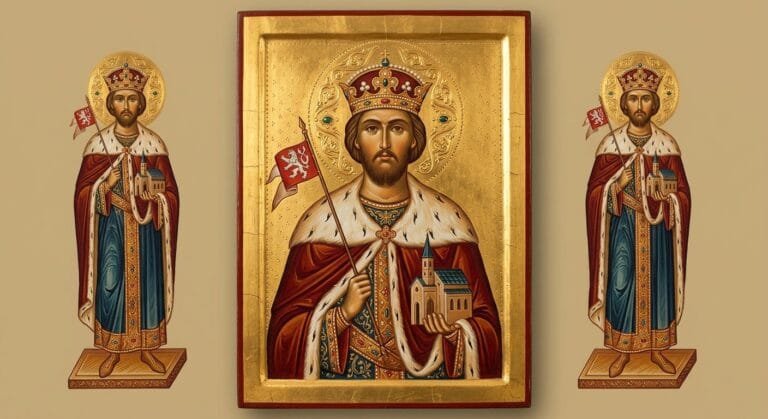
Every year on September 28, the Czech Republic marks two feasts in one: the Church memorial of Saint Wenceslas — duke, martyr, and principal patron of the Czech land — and the national holiday, the Day of Czech Statehood. Wenceslas is the only Czech saint whose feast is part of the worldwide calendar of the Roman Catholic Church; his name is borne by the oldest Czech song, by the coronation jewels, and by Prague’s main square. But who was this duke, who ruled for only ten years and died at the hands of his own brother? Why have whole generations called him the “eternal duke of the Czech land,” and how can his example speak to our lives today? In this comprehensive guide you will find the life of Saint Wenceslas, the history of his martyrdom and cult, the text of the famous Saint Wenceslas Chorale, prayers to the saint, and answers to the most frequently asked questions.
1. Who Was Saint Wenceslas: The Basic Facts
Saint Wenceslas (Old Slavonic Vęceslavъ, Latin Venceslaus, German Wenzel von Böhmen) was a Czech duke of the Přemyslid dynasty. He was born probably around 907 (according to some sources 903) — according to an unproven local tradition at the stronghold of Stochov, near the legendary oak of Saint Wenceslas. His father was Duke Vratislaus I; his mother was Drahomíra of the Stodorans, daughter of a prince of the Polabian Slavs. Besides his younger brother Boleslav, he had a brother Spytihněv.
He assumed rule at the latest in the autumn of 925 and ruled for about ten years — until September 28, 935 (according to older sources 929), when he was murdered at Stará Boleslav by the retainers of his brother Boleslav. Soon after his death he began to be venerated as a saint, and already at the turn of the 10th and 11th centuries he was understood as the “eternal duke” of the Czech land — on the reverse of Přemyslid coins he was styled the “eternal ruler.”
2. Childhood and Education: Grandmother Ludmila and the School at Budeč
The key figure of Wenceslas’s childhood was his grandmother Saint Ludmila (canonized in the 12th century), wife of the first historically attested Czech duke, Bořivoj I. According to tradition she took charge of her grandson’s upbringing, and at the stronghold of Budeč he received an education unusual for rulers of the time: he studied above all the Latin Psalter, and Old Slavonic legends also mention the study of Slavonic books. Around the year 915 the ceremonial postřižiny took place — the rite of the first cutting of hair, to which his father invited a bishop.
After the death of Duke Vratislaus in February 921, the regency was assumed by Wenceslas’s mother Drahomíra. Between her and Ludmila a conflict broke out over influence on the young duke and over the direction of the land — with the relationship to powerful Saxony in the background. The conflict ended tragically: on September 15, 921, Ludmila was murdered at Tetín by Drahomíra’s retainers Tunna and Gommon. Later legends portray Drahomíra in this conflict as a partisan of paganism, opposed by the Christian Ludmila — whose role was then taken over by Wenceslas himself, who after assuming rule had his grandmother’s relics transferred from Tetín to Prague.
3. The Duke on the Throne: The “Monk on the Throne” Who Saved the State
Wenceslas’s duchy extended over central Bohemia, in a circle of strongholds around the seat at Prague; in other parts of Bohemia there existed other duchies, with which Wenceslas also had military clashes. The Christian Legend tells of a clash with the Kouřim duke (later called Radslav), whom Wenceslas overcame but left in power — a testimony to a policy of consolidating the state rather than risky expansion, at a time when the power of the Saxon king Henry the Fowler threatened from the west.
In 929 Henry the Fowler marched into Bohemia with an army, and Wenceslas submitted to him in exchange for a regular tribute of peace. This decision — interpreted variously by historians — saved the nascent Czech state from the fate of the Polabian Slavs and secured room for its further development. Henry’s gift of the relic (the arm) of Saint Vitus shows that the Saxon king recognized Wenceslas as a political and Christian partner. It was for this relic that around the year 930 Wenceslas built on the Prague stronghold the Rotunda of Saint Vitus — the predecessor of today’s cathedral, built, according to tradition, on the model of a Roman church.
The legends portrayed Wenceslas’s life as the ideal of a “monk on the throne”: with his own hands he cultivated vines and grain for the wine and the hosts of Holy Communion (hence the tradition of the so-called Saint Wenceslas Vineyard), he ransomed slaves, cared for the poor, the sick, and orphans, gave hospitality to travelers, built churches, tore down gallows, and destroyed pagan shrines. Historians note that some of these traits may have been ascribed to the saint later, under the influence of the Cluniac ideals of piety — but the core of the image of a ruler of exceptional piety and mercy remains intact, and has been accepted by the whole history of the Czech nation.
4. The Martyr’s Death at Stará Boleslav
The decisive clash came with his younger brother Boleslav and his partisans. Boleslav invited Wenceslas to a feast for the feast of Saints Cosmas and Damian at Stará Boleslav. In the morning of September 28, before dawn, Wenceslas set out for the morning service. On the way he met Boleslav and said to him: “Yesterday you served us well; may God reward you.” Boleslav replied: “And today I want to serve you like this!” — and struck him on the head with his sword. He inflicted only a minor wound; Wenceslas wrenched the sword from him and threw it away, because he did not want to shed the blood of his own brother. Then Boleslav’s retainers — according to the First Old Slavonic Legend Tuža, Tira, Česta, and Hněvsa — killed Wenceslas at the door of the church of Saints Cosmas and Damian. The priest Krastěj covered the body, and Drahomíra had it washed and laid in the church. Afterwards Wenceslas’s partisans were persecuted and killed as well.
The year of the murder cannot be determined unambiguously from the sources: the years 929 and 935 are considered, in which September 28 falls on a Monday, as the legends state. Today the year 935 is cited more often; the year 929 appeared in older literature. Boleslav took over the rule thanks to the deed, and after fourteen years of hostility finally returned to his father’s and brother’s foreign policy line.
5. The Birth of a Saint: From the Grave to the Patron of the Nation
The veneration of the murdered duke spread surprisingly quickly. Already three years after his death, on March 4, 932 (according to some scholars 938), Wenceslas’s body was solemnly transferred to Prague and laid in the southern apse of the Rotunda of Saint Vitus that he had built — miracles are said to have occurred during the transfer. The place of his rest has not changed to this day: above the original grave Charles IV had built the Saint Wenceslas Chapel, the most sacred place of the Cathedral of Saints Vitus, Wenceslas, and Adalbert, adorned with Czech semi-precious stones.
The breadth of the cult is witnessed by legends already from the 10th century: the Latin Crescente fide christiana (before 976) and the Christian Legend (end of the 10th century), from the imperial milieu the Gumpold Legend (around 980, at the initiative of Emperor Otto II), and the First Old Slavonic Legend, through which Wenceslas’s cult spread also to Rus’. Saint Wenceslas is the only Czech saint whose feast is part of the worldwide calendar of the Roman Catholic Church; he is also venerated by the Orthodox Church. The climax of modern celebrations was the Saint Wenceslas millennium of 1929, connected with the completion of St. Vitus Cathedral, attended by President Masaryk and the papal legate A. G. Roncalli — the future Pope John XXIII.
6. The Chapel of Saint Wenceslas and the Crown of the Czech Kings
Wenceslas’s relics rest in the Saint Wenceslas Chapel of St. Vitus Cathedral at Prague Castle. In the time of Charles IV they were divided: the saint’s skull is displayed on a decorated cushion on festive occasions. According to Charles’s decree, above it — outside coronation times — the Saint Wenceslas Crown was to rest, the crown that Charles IV (baptized with the name Wenceslas) symbolically dedicated to the Czech saint and his baptismal patron. The crown of 1346 is the oldest Czech coronation jewel, and together with the saint’s skull it forms the most sacred symbols of Czech statehood.
A well-known legend is attached to the crown: whoever puts it on without right will die within a year. Tradition says that in 1941 the Deputy Reich Protector Reinhard Heydrich put the crown on — and less than a year later died of wounds from the assassination. Whether we accept the legend or not, it remains a testimony to how deeply the figure of Saint Wenceslas is inscribed in Czech memory.
7. The Saint Wenceslas Chorale: The Oldest Czech Song
The oldest surviving Czech song — the Saint Wenceslas Chorale — dates from the 13th century (the oldest preserved version from 1368), and for centuries it fulfilled the role of both prayer and national anthem. In the times of the nation’s greatest trials, its plea “nedej zahynouti nám ni budoucím” (“let us not perish, nor those to come”) became a confession of hope — we find it also on the Czech twenty-crown coin. Here is its current form:
Svatý Václave, vévodo české země,
kníže náš, pros za nás Boha,
svatého Ducha! Kriste, eleison.Ty jsi dědic české země,
rozpomeň se na své plémě,
nedej zahynouti nám ni budoucím,
svatý Václave! Kriste, eleison.
The older version of the chorale, preserved in the Litoměřice Gradual of 1475, besides Wenceslas invokes also the other patrons of the land — Saints Vitus and Adalbert. Throughout history the song was sung at coronations, national celebrations, and in times of occupation; in 1918 it was one of the unofficial candidates for the national anthem.
8. Prayers to Saint Wenceslas
The faithful turn to Saint Wenceslas as intercessor for the Czech land and for individuals — especially in times of trial, in illness, in anxiety about the future, and in family troubles. Here are three tried forms:
1. The petition from the Saint Wenceslas Chorale (the oldest and most widespread):
“Saint Wenceslas, duke of the Czech land, our prince, pray for us to God, the Holy Spirit! Christ, have mercy. You are the heir of the Czech land; remember your people; let us not perish, nor those to come, Saint Wenceslas! Christ, have mercy.”
2. Prayer for intercession and forgiveness:
“Saint Wenceslas, duke of the Czech land and martyr of Christ, for love of Christ you forgave your brother and laid down your life for him. Obtain for us the grace of reconciliation in our families, strength in trials, and faithfulness to the faith until the end. Protect our homeland and our families, and intercede for us before God, the Holy Spirit. Christ, have mercy. Amen.”
3. Prayer for courage and peace of heart (suitable morning and evening):
“Lord Jesus Christ, You gave Your martyr Wenceslas the courage not to fear death and the love that forgives even the murderer. Give us too a brave and peaceful heart: may we not fear tomorrow, may we forgive those who have wronged us, and may we grow every day in love for You and for our neighbors. Saint Wenceslas, pray for us. Amen.”
9. What Saint Wenceslas Teaches Us Today
Mercy is stronger than power. Wenceslas could have ruled with an iron hand — instead he chose service: personally caring for the poor, the sick, and prisoners. His example reminds us that true greatness is measured not by power but by service.
Forgiveness is victory. Even when attacked by his own brother, Wenceslas threw away his sword, because he did not want to shed his brother’s blood. In our own families, forgiveness is often the hardest “martyrdom” — and at the same time the only way to inner peace. That is precisely why Wenceslas is the patron of Czech Scouts: his forgiveness of his brother Boleslav is their chief legacy.
Faith requires courage. Wenceslas chose faith and reconciliation even when it was politically disadvantageous. In a time when it is often easier to choose fear than truth, his life remains a living challenge — and his prayer “let us not perish, nor those to come” sounds relevant even after a thousand years.
10. How September 28 Is Celebrated
In the Roman Catholic Church, September 28 is celebrated as the memorial of Saint Wenceslas; at St. Vitus Cathedral the saint’s relics are displayed during the solemn liturgy. Stará Boleslav — the place of the martyrdom — is the destination of traditional pilgrimages; formerly a special feast of the translation of the relics (March 4) was also celebrated. As the Day of Czech Statehood, September 28 has been a national holiday of the Czech Republic since 2000 — a reminder that Czech statehood grew out of faith, culture, and the courage of the first Přemyslids.
11. The Patron and His Attributes
Saint Wenceslas is the principal patron of the Czech nation and the Czech land; further, patron of Prague, of Czech Scouts (since 1994), of brewers, prisoners, and altar servers; historically he was venerated also as patron of the Kingdom of Poland and of Slovenia. In art he is depicted as a duke on horseback (the most famous is Myslbek’s monument in Wenceslas Square), with the ducal crown, a banner or spear with a flag, shield and armor, with the black flaming eagle — the coat of arms of the Přemyslids — the palm of martyrdom, two angels, and with grapes and ears of grain, recalling his legendary cultivation of vines and grain.
Frequently Asked Questions (FAQ)
When is the feast of Saint Wenceslas celebrated?
The feast is celebrated on September 28 — the day of his martyrdom at Stará Boleslav (the year 929 or 935). In the Czech Republic this day is at the same time a national holiday, the Day of Czech Statehood (since 2000).
Where is the tomb of Saint Wenceslas?
The relics rest in the Saint Wenceslas Chapel of the Cathedral of Saints Vitus, Wenceslas, and Adalbert at Prague Castle — on the spot to which they were transferred already in 932. The saint’s skull is displayed on festive occasions.
Did his own brother really kill Wenceslas?
According to the legends, Boleslav first struck Wenceslas with his sword, and the actual killing was carried out by his retainers; according to legend Wenceslas did not defend himself with the sword, so as not to shed his brother’s blood. Boleslav took over the rule after the deed, and after fourteen years of war with the realm finally returned to his brother’s foreign policy line.
Why is he called the “eternal duke”?
Already at the turn of the 10th and 11th centuries the Přemyslids understood Wenceslas as patron of the dynasty and the Czech land, and from the end of the 11th century as the “eternal duke” of the Czech land; on coins he was styled the “eternal ruler.” Rulers also aligned themselves with him by being baptized with his name (for example Charles IV).
Where can I find the text of the Saint Wenceslas Chorale?
The complete current text and older versions of the chorale are in section 7 of this article; the oldest preserved version of the song dates from 1368.
Is Saint Wenceslas the patron only of Bohemia?
He is above all the patron of the Czech land and the Czech nation, but he is venerated also in other countries (historically Poland and Slovenia), and he is the only Czech saint of the worldwide Catholic calendar; the Orthodox Church venerates him as well.
How should one pray to Saint Wenceslas?
The simplest form is the petition from the chorale: “Saint Wenceslas… pray for us to God, the Holy Spirit.” In section 8 of this article there are three prayers — the petition from the chorale, a prayer for intercession and forgiveness, and a prayer for courage and peace of heart.
What is the Saint Wenceslas Crown?
The coronation crown of the Czech kings from 1346, which Charles IV symbolically dedicated to Saint Wenceslas. Outside coronations it rested on the saint’s skull; a legend is attached to it, according to which whoever puts it on without right will die within a year.
Sources and Recommended Links
This article is based on the following sources:
1. Wikipedia: Saint Wenceslas — comprehensive article about the life, rule, death, and cult of the saint: cs.wikipedia.org/wiki/Svatý_Václav
2. Wikipedia: Saint Wenceslas Chorale — texts and history of the oldest Czech song: cs.wikipedia.org/wiki/Svatováclavský_chorál
3. Wikipedia: Saint Wenceslas Crown — history of the coronation jewel: cs.wikipedia.org/wiki/Svatováclavská_koruna
4. Pastorace.cz: Sv. Václav — spiritual texts about the saint: pastorace.cz/tematicke-texty/sv-vaclav
5. Wikipedia: Cathedral of Saints Vitus, Wenceslas, and Adalbert — the Saint Wenceslas Chapel and the relics: cs.wikipedia.org/wiki/Katedrála_svatého_Víta
Related reading: Saint Wenceslas: Duke, Martyr, and Eternal Ruler of the Czech Lands — this article; and Honest Tales of a Pilgrim to His Spiritual Father — the classic story of the journey to unceasing prayer of the heart.