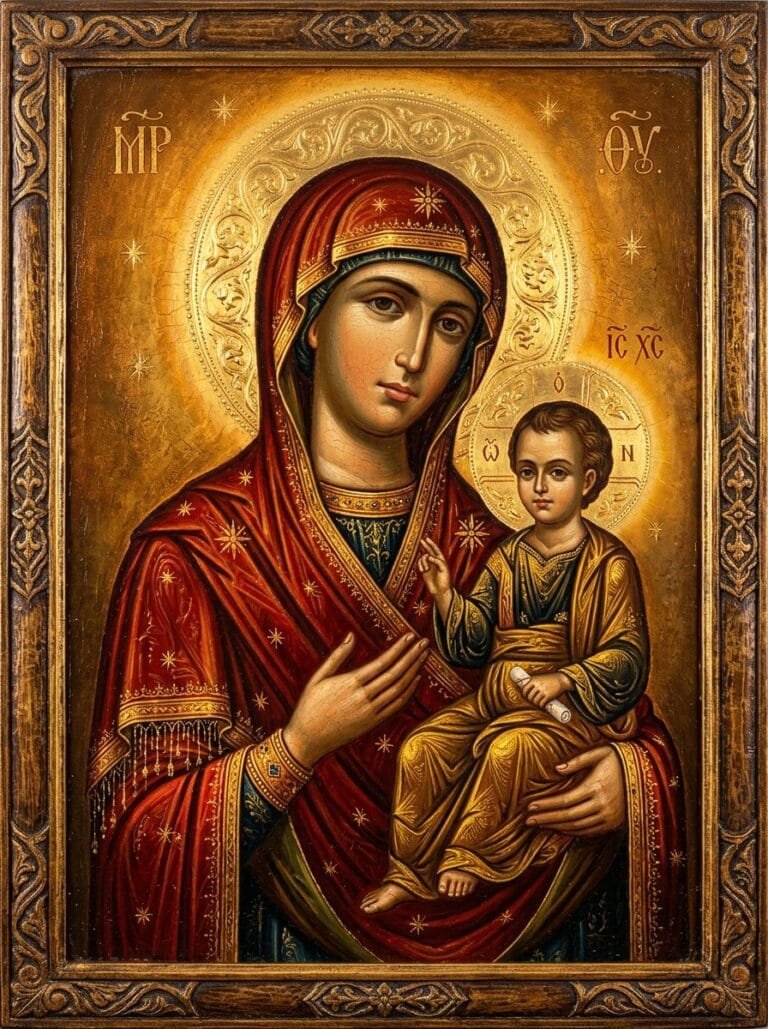
The Rosary and the Rule of the Theotokos represent two of the most famous and profound contemplative prayer devotions in the Christian world, dedicated to meditating on the earthly lives of our Lord Jesus Christ and His Most Pure Mother. Both traditions share a deep monastic heritage, built upon the rhythmic repetition of Gospel words and focused contemplation. This complete guide is designed to help you discover the deep historical and theological kinship between the Eastern Orthodox Athonite practice of the Rule of the Theotokos and the Western Catholic tradition of the Rosary.
This complete canonical guide has been created to provide you with deep spiritual insights and certified texts. Here, you will discover the biblical foundations of prayer on beads, the history of 150 prayers as a substitute for David’s Psalter, the detailed structure of the Orthodox Rule of the Theotokos, the order of the Catholic Rosary, hesychastic contemplative practices on the prayer rope, real-life testimonies of miracles, and a free downloadable collection of prayers for print.
1. Monastic Origins: How the 150 Psalms of David Transformed into the Prayer Rope
The historical roots of both the Eastern Rule of the Theotokos and the Western Rosary go back to the early Middle Ages and the daily liturgical life of great Christian monasteries. Monks chanted the complete Psalter of David (150 Psalms) daily. Laypeople and illiterate novices, who could not read or had no access to hand-copied manuscripts, desired to join in this constant praise of God.
Monastic elders provided a simple and brilliant spiritual alternative: to recite the Lord’s Prayer (Our Father) or the Angelic Salutation (Hail Mary) 150 times instead of the Psalms, using a rope with knots (komboskini / rosary) for counting. This practice of 150 repetitive prayers developed into two parallel but remarkably similar traditions in the East and the West.
2. The Orthodox Rule of the Theotokos: Athonite Tradition and St. Seraphim’s Legacy
In the Eastern Orthodox Church, particularly on Holy Mount Athos, a practice known as the **Rule of the Theotokos** (Богородичне правило) has been preserved since ancient times. It consists of reciting the prayer ‘O Virgin Theotokos, Rejoice’ 150 times daily. This rule was strongly promoted as a spiritual testament by the great Russian saint **Venerable Seraphim of Sarov**, who taught that anyone who daily recites this rule abides under the special, invincible Protection of the Queen of Heaven.
The rule is divided into 15 decades (groups of 10 prayers). Each decade is followed by ‘Our Father’, a prayer of mercy, and meditation on a specific event (mystery) in the lives of Christ and His Mother (such as the Nativity of the Theotokos, the Presentation, the Annunciation, the Nativity of Christ, the Presentation of Christ, the Baptism, the Transfiguration, the Crucifixion, the Resurrection, the Ascension, Pentecost, and the Dormition).
3. The Catholic Rosary: Christocentric Meditation on the Gospel
In the Western (Catholic) tradition, this practice is called the **Rosary** (from Latin *rosarium* — ‘crown of roses,’ representing each prayer as a spiritual rose offered to the Mother of God). According to tradition, the Blessed Virgin appeared to Saint Dominic in 1214, giving him the rosary as a powerful weapon against heresy and sin.
While Protestants sometimes criticize the Rosary as ‘idolatrous’ or ‘meaningless repetition,’ a detailed analysis of the text shows that the Rosary is **65% directly focused on Jesus Christ** and meditating on His Gospel life, and only 35% on requesting Mary’s intercession. Pope John Paul II in his apostolic letter *Rosarium Virginis Mariae* emphasized that the Rosary is strictly **Christocentric**: through Mary’s eyes, we contemplate Christ’s face, meditating on His birth (Joyful Mysteries), ministry (Luminous Mysteries), death (Sorrowful Mysteries), and Resurrection (Glorious Mysteries).
4. Canonical Texts of the Prayers
The Orthodox Prayer: ‘O Virgin Theotokos, Rejoice’
“O Virgin Theotokos, rejoice, Mary full of grace, the Lord is with thee. Blessed art thou among women, and blessed is the fruit of thy womb, for thou hast borne the Savior of our souls. Amen.”
The Catholic Prayer: ‘Hail Mary’ (Ave Maria)
“Hail Mary, full of grace, the Lord is with thee. Blessed art thou among women, and blessed is the fruit of thy womb, Jesus. Holy Mary, Mother of God, pray for us sinners, now and at the hour of our death. Amen.”
The ‘Glory Be’ (Doxology)
“Glory be to the Father, and to the Son, and to the Holy Spirit, as it was in the beginning, is now, and ever shall be, world without end. Amen.”
5. Hesychastic Practice and the Contemplative Power of Repetitive Prayer
Our website is dedicated to Hesychasm—the Orthodox teachings on inner silence and the Jesus Prayer. The quiet, rhythmic passing of knots and repetition of Gospel words in the Rule of the Theotokos or the Rosary is an outstanding example of contemplative prayer. The rhythm of prayer helps quiet chaotic thoughts (passions), focuses the mind inside the heart, and introduces the soul into a state of deep stillness (hesychia). Athonite hesychasts frequently alternate the Rule of the Theotokos with the unceasing Jesus Prayer on the prayer rope (komboskini): **“Lord Jesus Christ, Son of God, have mercy on me, a sinner”**.
6. The Spiritual Laws of Prayer: Thanksgiving and Love
Prayer on the beads bears fruit only when our lives are built upon the commandments of love and gratitude. The Apostle Paul teaches us: “In everything give thanks; for this is the will of God in Christ Jesus for you” (1 Thessalonians 5:18). Offer thanks to the Savior for His redemptive sacrifice on Calvary. Remember His greatest commandment: “Love the Lord your God with all your heart… Love your neighbor as yourself” (Matthew 22:37-39). We cannot request God’s mercy if we do not forgive others. Forgive everyone, and your prayer will be heard.
7. Communal Prayer in the Comments
Communal prayer holds special power before God, as the Savior taught: “For where two or three are gathered together in My name, there am I in the midst of them” (Matthew 18:20). If you need prayer support, we invite you to utilize our community’s strength:
- Leave your prayer requests in the comments below. State the names of those who need prayer. Other readers will read your request and reply with a brief ‘Amen,’ establishing an invisible chain of communal prayer before God.
8. Real-Life Testimonies
Testimony of Mary, Ivano-Frankivsk (Parish Archives):
“For years, I suffered from chronic insomnia and constant anxiety about my children. My spiritual father advised me to quietly pray at least one decade of the Rule of the Theotokos on a prayer rope before sleep, meditating on Jesus’ childhood. Within a week, the anxiety was completely gone, peaceful sleep returned, and my children received protection in their own challenges. Rhythmic prayer on the beads is a true medicine for an exhausted soul.”
9. Download the Complete Prayer Booklet for Free
You can download beautifully formatted digital files of the complete prayers to print or read offline:
10. Frequently Asked Questions (FAQ)
1. Is it mandatory to recite all 150 prayers of the Rule of the Theotokos daily?
No, praying all 150 prayers daily is a major spiritual undertaking. Beginners and laypeople are advised to start with one or five decades (50 prayers) daily, focusing attention on sincerity and meditating on Christ’s life rather than the quantity.
2. What is the difference between the Orthodox prayer rope and the Catholic rosary?
The Orthodox rule is typically prayed on a woven wool prayer rope (komboskini), while the Catholic Rosary is prayed on beads joined by a metal chain with a crucifix. The primary difference lies in the texts (Orthodox pray ‘O Virgin Theotokos, Rejoice’ and Catholics pray ‘Hail Mary’ with an added request for intercession).
3. Does repeating the same prayer multiple times violate the prohibition against empty repetitions?
No, Christ warned against pagan empty repetitions, where people thought they would be heard for their many words. Repetition in Christian practice has a different purpose—holding the mind from distraction and sinking the heart into constant remembrance of God, which is the core of hesychasm.
References (Canonical Links and Literature)
1. Orthodox Rule of the Theotokos — Canonical rules and St. Seraphim of Sarov’s spiritual legacy. Available online: parafia.org.ua.
2. CREDO Social-Religious Periodical — History and theological meaning of the Rosary. Available online: credo.pro.
3. The Holy Bible — Gospel of Luke (Angelic Salutation, 1:28), 1 Thessalonians (5:18), Epistle to the Colossians (1:19-20).