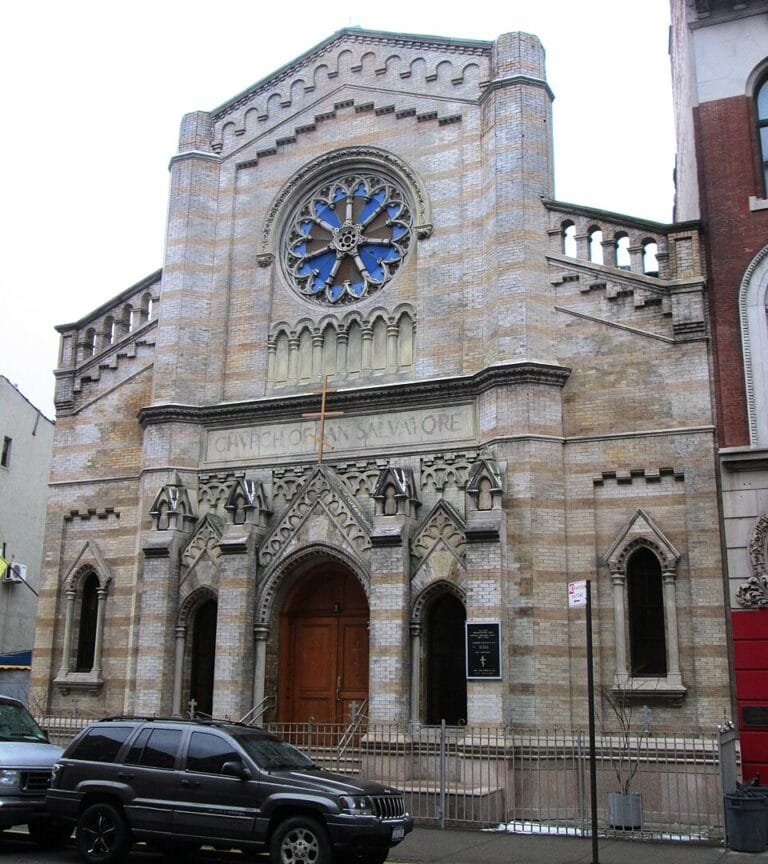
Holy Trinity Ukrainian Orthodox Cathedral in New York City is an architecturally celebrated sanctuary and a revered spiritual beacon anchored at the vibrant crossroads of Lower Manhattan. Situated at 359 Broome Street, at the dynamic convergence of Little Italy, Chinatown, and the historic Lower East Side, the cathedral has served for over six decades as an enduring fortress of Ukrainian Orthodox worship, pastoral care, and national identity in one of the most culturally storied neighborhoods of New York City.
Architectural Heritage: The 1901–1902 Masterpiece of Hoppin & Koen
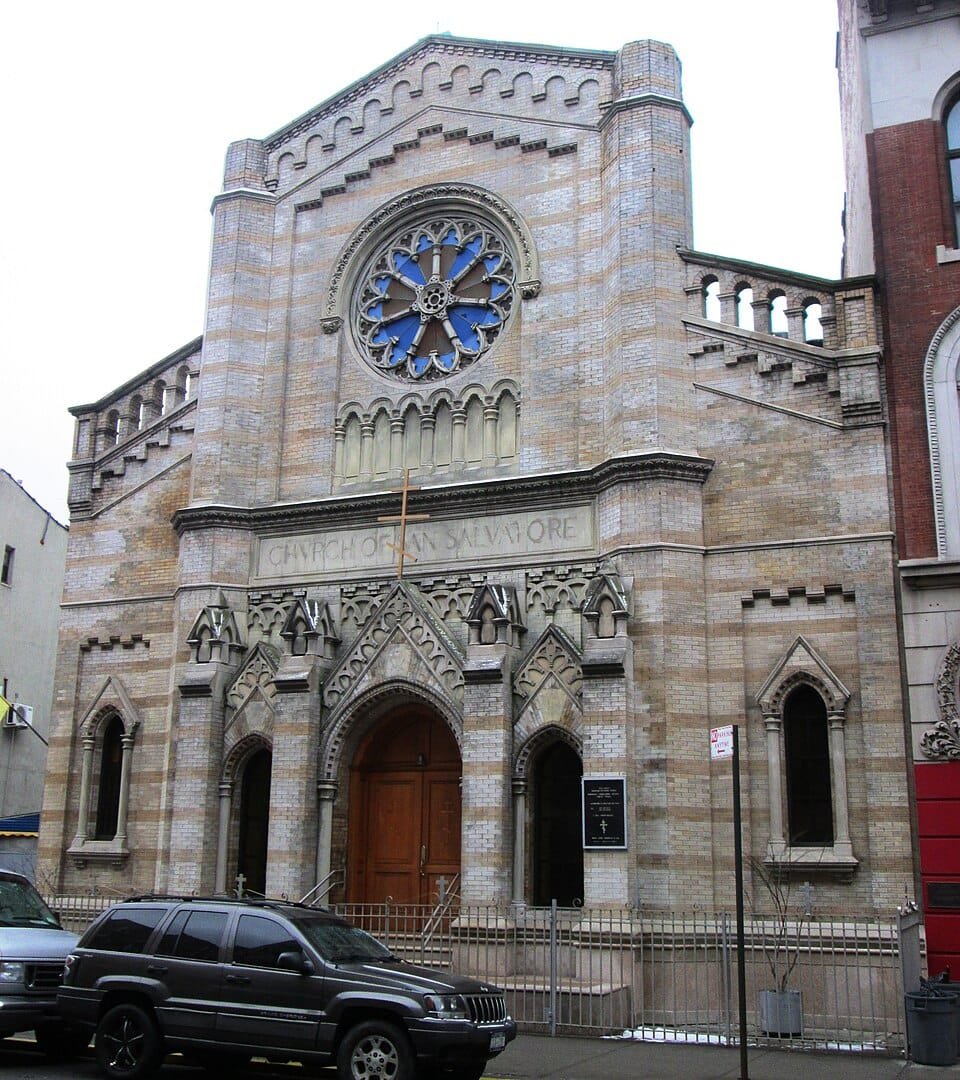
The edifice at 359 Broome Street is an extraordinary architectural treasure constructed between 1901 and 1902. The building was designed by the prominent New York architectural firm Hoppin & Koen, founded by Francis Laurens Vinton Hoppin and Terence A. Koen. Both architects had honed their craft at the legendary firm of McKim, Mead & White, one of the foremost American architectural practices of the Gilded Age. Hoppin & Koen earned immense acclaim across New York for monumental civic and residential projects, including the landmark New York City Police Headquarters at 240 Centre Street (erected 1905–1909), located just steps away from Broome Street.
For the Broome Street sanctuary, Hoppin & Koen developed a sophisticated synthesis of Romanesque Revival and English Perpendicular Gothic idioms. The façade is composed of warm buff-toned Roman brick accented by exquisitely carved Indiana limestone trim. The composition is defined by a bold, soaring central stepped gable reminiscent of northern European Flemish Gothic civic architecture. Dominating the upper elevation is a magnificent round Romanesque rose window featuring molded brick voussoirs and delicate limestone plate tracery that illuminates the interior nave with ethereal morning light.
Below the rose window, the façade transitions into a rhythmic arcade of pointed lancet stained-glass openings and decorative terracotta roundels. The ground floor presents a welcoming projecting portal with deep stone archivolts and an arched tympanum, crowned prominently by a traditional three-bar Ukrainian Orthodox cross in gleaming gilt metal. Flanking the entrance are authentic period wrought-iron lanterns that cast a warm, historic glow along Broome Street, inviting both metropolitan seekers and generations of Ukrainian faithful into sacred silence.
From Immigrant Mission to Ukrainian Orthodox Cathedral
The building originally opened in 1902 as the Episcopal Church of San Salvatore, erected by the New York Protestant Episcopal City Mission Society to minister to the massive influx of Italian immigrants who settled in Lower Manhattan at the turn of the twentieth century. For sixty years, the sanctuary operated as a center of religious services, English language instruction, and social assistance for downtown immigrant families.
By the late 1950s, shifting demographic patterns in Lower Manhattan led the mission to consolidate its operations. Concurrently, the post-World War II third wave of Ukrainian emigration—comprising thousands of displaced persons (DPs), political refugees, scholars, veterans, and clergy who had escaped Soviet totalitarian occupation—was vigorously seeking dedicated places of worship across New York City. In 1961, the Ukrainian Orthodox community acquired the Broome Street property, consecrated it under the patronage of the Most Holy Trinity, and elevated the sanctuary into an episcopal cathedral.
The acquisition of 359 Broome Street marked a watershed moment for Ukrainian religious autonomy in America. Holy Trinity served as the prominent seat of the hierarchs of the Ukrainian Autocephalous Orthodox Church in the USA and diaspora prior to the historical canonical consolidation under the Ecumenical Patriarchate of Constantinople in 1995. Throughout decades of Cold War exile, Holy Trinity Cathedral stood as an impassioned voice for the persecuted Church in Ukraine, holding uninterrupted liturgical memorial services for the millions of victims of the 1932–1933 Holodomor famine-genocide and political repressions.
Eastern Orthodox Transformation and Sacred Interior
Following its acquisition in 1961, the interior of the cathedral underwent a profound theological and liturgical reorientation to conform to ancient Eastern Orthodox canons. The Western longitudinal nave was gracefully adapted to accommodate the sacred Byzantine spatial hierarchy, separating the heavenly sanctuary (altar) from the nave through a majestic multi-tiered carved iconostasis.
The iconostasis at Holy Trinity Cathedral features canonical iconographic panels executed in the traditional Byzantine-Kyivan style. Flanking the gilded Royal Doors (Tsarshi Vrata)—adorned with icons of the Four Evangelists and the Annunciation—are the primary icons of the Lord Jesus Christ and the Holy Theotokos holding the Christ Child. The tier above presents the twelve Great Feasts of the liturgical year (Dodekaorton), while the uppermost register culminates in the Holy Trinity, the Patronal icon of the cathedral, and the Golgotha Cross.
Suspended from the high nave ceiling is a traditional multi-tiered brass panikadylo (chandelier), whose candle-shaped lights reflect against gold leaf accents and traditional Ukrainian hand-embroidered textiles (rushnyky) that drape reverently across analogia, veneration icons, and liturgical banners. A dedicated memorial wall within the cathedral honors departed pioneers of the Ukrainian community, hierarchs, and martyrs for Ukrainian freedom.
Liturgical Life, Choral Art, and Community Ministry
Under the devoted leadership of its Dean and Rector, Very Rev. Volodymyr Shtelen, Holy Trinity Cathedral maintains a robust cycle of liturgical services. Divine Liturgies are celebrated predominantly in Ukrainian, with selected litanies and scripture readings offered in English to embrace the multi-generational diversity of the downtown congregation.
Liturgical singing holds a central position in the life of Holy Trinity Cathedral. The cathedral choir preserves the glorious choral polyphony of classical Ukrainian sacred composers, including Artem Vedel, Dmytro Bortniansky, Maksym Berezovsky, Mykola Leontovych, and Kyrylo Stetsenko. The acoustic resonance of the high vaulted ceiling provides an inspiring setting for a cappella hymnody, elevating prayer and drawing listeners into the beauty of ancient Byzantine hymnology.
Beyond worship services, the cathedral functions as a vital educational and cultural nucleus. The parish sponsors Sunday school instruction in Orthodox catechism and Ukrainian language, seasonal workshops in traditional Pysanka egg writing and carol singing (koliadky), parish fellowship banquets, and pastoral counseling for individuals navigating the complexities of metropolitan life.
Humanitarian Mission and Wartime Relief for Ukraine
Following Russia’s unprovoked full-scale military invasion of Ukraine in February 2022, Holy Trinity Ukrainian Orthodox Cathedral mobilized as an active downtown coordinating hub for emergency relief and spiritual solace. Partnering with the Consistory of the Ukrainian Orthodox Church of the USA, the Ukrainian Congress Committee of America (UCCA), and local volunteer networks, the cathedral launched continuous humanitarian campaigns.
Key humanitarian initiatives undertaken by the cathedral community include:
- Emergency Medical and Trauma Shipments: Procurement and air-freight transport of battlefield first-aid kits (IFAKs), CAT tourniquets, hemostatic dressings, burn bandages, and specialized surgical sutures directly to frontline field hospitals in eastern and southern Ukraine.
- Civilian and Refugee Support: Collection and delivery of thermal blankets, winter outerwear, children’s clothing, power stations, and solar rechargeable lanterns to civilians suffering in blacked-out Ukrainian cities.
- Spiritual and Material Care for Displaced Families: Pastoral welcoming, emergency food drives, administrative guidance, and community integration for newly arrived Ukrainian refugees and displaced mothers with children seeking sanctuary in New York City.
- Continuous Intercessory Prayer: Regular Moliebens (supplication services) and Panakhyda memorial services for fallen defenders, civilian victims, and the restoration of a just and enduring peace in Ukraine.
Architectural and Historical Summary
| Sanctuary Name | Holy Trinity Ukrainian Orthodox Cathedral (Собор Пресвятої Трійці) |
| Street Address | 359 Broome Street, New York, NY 10013 |
| City & Borough | New York City (Lower Manhattan / Little Italy / Lower East Side) |
| Year Built | 1901–1902 |
| Year Consecrated (Ukrainian) | 1961 |
| Architectural Style | Romanesque Revival with English Perpendicular Gothic Elements |
| Original Architects | Hoppin & Koen (Francis L. V. Hoppin & Terence A. Koen) |
| Original Inception | Church of San Salvatore (Protestant Episcopal City Mission) |
| Key Exterior Features | Stepped brick gable, Romanesque rose window with plate tracery, buff Roman brick, limestone moldings, arched portal with gilt Ukrainian cross |
| Interior Elements | Multi-tiered Byzantine carved iconostasis, Deisis, festive tier, ornate brass panikadylo, traditional embroidered rushnyky |
Canonical Status and Parish Leadership
| Jurisdiction | Ukrainian Orthodox Church of the USA (UOC of the USA) |
| Ecclesiastical Mother Church | Ecumenical Patriarchate of Constantinople |
| Eparchy | Eastern Eparchy of the UOC of the USA |
| Dean & Rector | Very Rev. Volodymyr Shtelen |
| Liturgical Languages | Ukrainian, English |
| Feast Day (Patronal) | Descent of the Holy Spirit on the Apostles (Pentecost / Trinity Sunday) |
Parish Directory and Visiting Information
| Address | 359 Broome St, New York, NY 10013, USA |
| Telephone | +1 (212) 226-5830 |
| holytrinitycathedralnyc@gmail.com | |
| Sunday Divine Liturgy | 10:00 AM (Confessions at 9:30 AM) |
| Holy Day Services | Evening Vigil at 6:00 PM; Divine Liturgy at 9:30 AM |
| Subway Transit Access | Grand St (B, D trains); Bowery (J, Z trains); Spring St (6 train) |
| Google Maps Navigation | View Location on Google Maps |