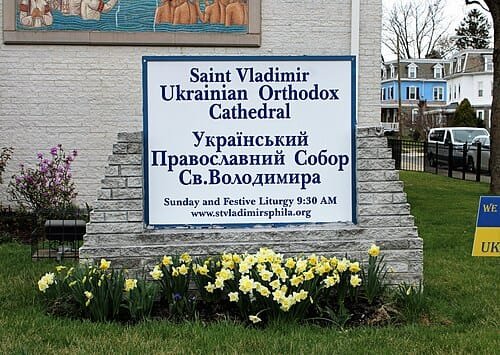
St. Vladimir Ukrainian Orthodox Cathedral in Philadelphia, Pennsylvania, stands as a premier bastion of Ukrainian religious life, cultural persistence, and civic achievement in the United States. Currently celebrating its historic Centennial Jubilee (1925/1926–2026), the cathedral has served for a century as the venerable Episcopal See of pioneering Ukrainian primates, nurturing generations of Ukrainian Americans while remaining an unwavering stronghold of spiritual comfort, community cohesion, and ardent humanitarian support for Ukraine.
Century of Faith: The Origins of Philadelphia’s Ukrainian Orthodox Community
The foundations of St. Vladimir Cathedral were forged in the crucible of early 20th-century American industrial expansion. Pennsylvania was the primary destination for waves of Ukrainian immigrants from Galicia, Bukovyna, Transcarpathia, and Central Ukraine, who sought economic opportunity in Philadelphia’s booming textile mills, locomotive factories, naval shipyards, and transport terminals. Longing for a liturgical home in which they could worship according to the sacred traditions and language of their forebears, a dedicated group of faithful met in 1925 to establish a permanent religious community.
Initially organized under the heavenly patronage of Saint Andrew the First-Called Apostle, the congregation quickly crystallized its ecclesiastical status. On April 26, 1928, the parish was legally chartered under the laws of the Commonwealth of Pennsylvania under the name St. Vladimir Ukrainian Orthodox Church. The adoption of Holy Equal-to-the-Apostles Prince Volodymyr the Great as patron saint carried deep theological and national resonance, asserting the ancient baptismal roots of Kyivan Rus and resisting assimilation.
The burgeoning congregation soon took on national responsibilities when it was designated as the official Episcopal Throne (Cathedral See) of His Beatitude Metropolitan-Archbishop John (Theodorovich). Metropolitan John had arrived in the United States in 1924, having been consecrated in Kyiv by Metropolitan Vasyl Lypkivsky, to lead the infant Ukrainian Orthodox Church in the New World. Philadelphia thus became the administrative capital of the early American Metropolia.
In 1930, demonstrating remarkable sacrifice during the Great Depression, the parish purchased a sprawling building complex at the corner of Germantown Avenue and Berks Street in North Philadelphia. This historic edifice was quickly transformed into an epicenter of diaspora life:
- The “Dnipro” Printing Press: An essential diaspora publishing house that produced thousands of Ukrainian prayer books, trebniki, musical scores for liturgical choirs, educational textbooks, and the diocesan newspaper.
- Parish Credit Union: A mutual-aid financial institution that enabled hundreds of newly arrived immigrant families to purchase homes, establish small businesses, and withstand economic downturns.
- Diocesan Theological Seminary Program: An early educational initiative established under Metropolitan John’s personal guidance to instruct and prepare American-born and emigre candidates for holy orders.
For over three decades, the spiritual life of the cathedral was anchored by the venerable Right Reverend Protopresbyter John Sawchuk, who served as Cathedral Dean for thirty-three years. Father Sawchuk, alongside Fr. Stephen Bilak and dedicated lay brotherhoods, cemented St. Vladimir’s reputation as a model community of Orthodox piety, educational excellence, and civic engagement.
Mid-Century Modernist Architecture and Great Consecration
By the early 1960s, demographic shifts altered the geography of Philadelphia’s Ukrainian population. Families were relocating from dense industrial wards toward the leafy, residential neighborhoods of North and Northeast Philadelphia, particularly East Oak Lane. To meet the pastoral needs of this growing constituency, the parish decided to construct a brand-new cathedral complex.
In 1965, Metropolitan John consecrated the newly acquired corner lot at North 5th and Independence Streets. Construction officially began on November 1, 1965, executed by the DeLoro Construction Firm under the meticulous on-site supervision of parish engineer Joseph Podgursk. The visionary architectural design was entrusted to architect Nick Chimes, who conceived an innovative synthesis of ancient Byzantine spatial geometry and expressive mid-century American structural modernism.
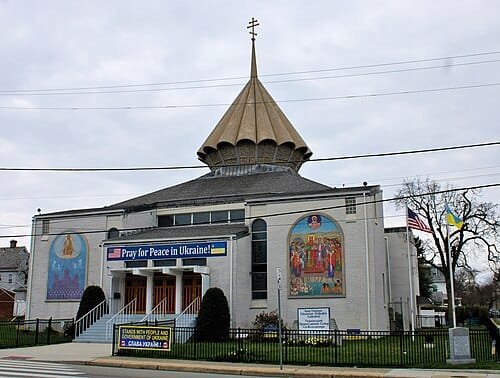
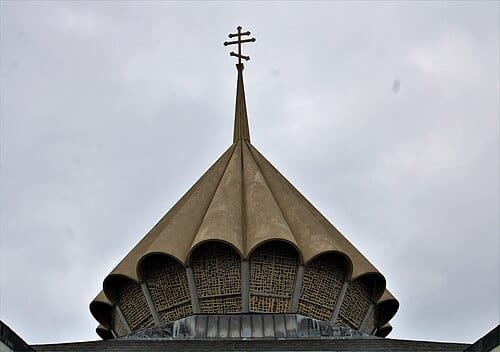
The cathedral was completed in July 1966 and consecrated in a magnificent service on September 11, 1966, by Metropolitan John Theodorovich, assisted by Bishop Alexander (Novitsky) and a large synod of regional clergy. The architectural exterior is dominated by an extraordinary folded-plate thin-shell concrete dome (umbrella dome) that rises dramatically above decorative masonry openwork, culminating in a slender gilded spire and a towering authentic Ukrainian three-bar cross. The expansive white-brick façade features sweeping archways framing monumental polychrome mosaics:
- The Baptism of Kyivan Rus: A monumental mosaic portraying Holy Equal-to-the-Apostles Prince Volodymyr baptizing the people of Kyiv in the waters of the Dnipro River in 988 AD.
- The Holy Protection (Pokrova): An artistic mosaic depicting the Theotokos extending her celestial omophorion of protection over the faithful, a devotion especially revered by Ukrainian Cossacks and armed defenders.
Following the falling asleep in the Lord of Metropolitan John on May 3, 1971, St. Vladimir Cathedral was chosen as the setting for one of the most pivotal events in modern diaspora history. On May 7, 1972, Archbishop Mstyslav (Skrypnyk) was enthroned on the cathedral seat as Metropolitan of the Ukrainian Orthodox Church of the USA. During the exact same solemn Divine Liturgy, Metropolitan Mstyslav and Bishop Mark (Hundiak) consecrated Archimandrite Constantine (Theodore Buggan) to the holy episcopacy. Metropolitan Constantine would later succeed Patriarch Mstyslav as the beloved Primate of the Church, steering it into canonical communion with the Ecumenical Patriarchate in 1995.
Patriotic Sacrifice: Anthony Bilyi and the Veterans Memorial
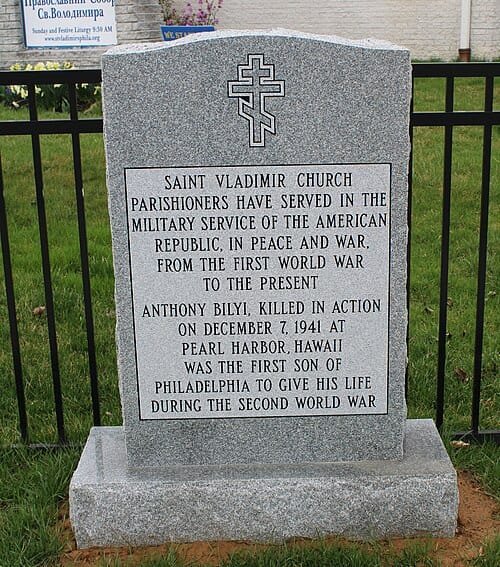
On the cathedral’s landscaped grounds stands a solemn polished granite memorial obelisk crowned by a carved Ukrainian cross. This monument bears witness to the profound patriotism and sacrificial service of Ukrainian Americans to the United States. The inscription commemorates all parishioners who served in the Armed Forces of the American Republic in peace and war, from World War I to the contemporary era.
Inscribed prominently in bronze lettering is the tribute to Anthony Bilyi, a young parishioner of St. Vladimir who gave his life aboard the battleship USS Arizona during the surprise attack on Pearl Harbor, Hawaii, on December 7, 1941. Anthony Bilyi earned the solemn historical distinction of being the very first son of the City of Philadelphia to sacrifice his life in the Second World War. Each year on Memorial Day and Veterans Day, the parish celebrates solemn panakhyda memorial services at the monument, uniting American civic memory with Orthodox prayer for fallen heroes.
Parish Ministries, Culture, and the Revised Julian Calendar
Today, under the energetic pastoral stewardship of Mitered Protopriest Taras Naumenko, St. Vladimir Cathedral is recognized as one of the most vibrant bilingual communities in the Ukrainian Orthodox Church of the USA. Recognizing the pastoral realities of a diverse multi-generational parish, Divine Liturgies are celebrated harmoniously in both Ukrainian and English on alternating schedules, allowing third- and fourth-generation Ukrainian Americans, recent immigrants, and Orthodox converts to worship in full unity.
In a historic pastoral step affirming liturgical harmony with the Mother Church of Constantinople and the Orthodox Church of Ukraine (OCU), the cathedral parish officially transitioned to the Revised Julian Calendar on November 14, 2024. This change celebrates the fixed feasts of the ecclesiastical year—such as Christmas, Epiphany, and the Annunciation—alongside the contemporary civil calendar while preserving the traditional Paschalion for Holy Week and Easter.
The cathedral is also home to flourishing parish organizations:
- Ukrainian Orthodox League (UOL): Both the Senior Chapter (chartered in 1955) and the Junior Chapter (chartered in 1960) remain exceptionally active, sponsoring youth retreats, religious education, leadership conventions, and benevolent community projects.
- Cathedral Choir: Renowned for its magnificent execution of classical Ukrainian polyphonic sacred music (compositions by Vedel, Bortniansky, Berezovsky, Stetsenko, and Koshetz).
- Parish School of Ukrainian Studies: Educating the youth in Ukrainian language, sacred history, catechism, literature, and folk traditions.
- Culinary Heritage & Varenyky Workshops: The parish kitchen operates regular volunteer workshops where generations gather to prepare thousands of handmade varenyky (pyrohy) and holubtsi, funding parish improvements and charitable outreach.
Wartime Solidarity: A Regional Humanitarian Anchor for Ukraine
From the first hours of Russia’s full-scale aggression against Ukraine in February 2022, St. Vladimir Cathedral mobilized its entire parish infrastructure into a high-capacity regional relief coordinator for the Delaware Valley. Banners proclaiming “Pray for Peace in Ukraine!” and “Stands with People and Government of Ukraine — Слава Україні!” were prominently mounted across the cathedral gates and facade.
The parish initiated the celebrated campaign “Save 100 Ukrainian Soldiers”, raising tens of thousands of dollars to procure individualized first-aid tactical trauma kits (IFAKs), tourniquets, hemostatic gauze, and protective medical gear for frontline defenders. In addition, the cathedral conducted massive winter drives, collecting and dispatching maritime shipping containers filled with high-grade thermal blankets, emergency sleeping bags, generators, and specialized field medicine.
On the domestic front, Father Taras Naumenko and the parish committee have provided an open door to hundreds of displaced Ukrainian refugees who settled in the Philadelphia metropolitan area. The cathedral assists newly arrived families with emergency financial aid, food supplies, housing navigation, English tutoring, and compassionate pastoral counseling to help them heal from the trauma of war.
Cathedral Chronology (1925–2026)
| Year | Historic Milestone |
|---|---|
| 1925 | First organizational assembly of Ukrainian Orthodox believers in Philadelphia dedicated to St. Andrew the First-Called. |
| 1928 | April 26: Official incorporation and state charter granted as St. Vladimir Ukrainian Orthodox Church. |
| 1930 | Purchase of Germantown Ave & Berks St property complex; establishment of the “Dnipro” printing department and seminary classes. |
| 1941 | Parishioner Anthony Bilyi is killed at Pearl Harbor, becoming Philadelphia’s first casualty of World War II. |
| 1955 | Establishment of the St. Vladimir Senior Chapter of the Ukrainian Orthodox League (UOL). |
| 1960 | Establishment of the St. Vladimir Junior Chapter of the UOL. |
| 1965 | Metropolitan John blesses the ground at 6740 North 5th Street; construction begins by DeLoro Construction. |
| 1966 | July: Construction completed. September 11: Solemn consecration of the new cathedral by Metropolitan John Theodorovich. |
| 1971 | May 3: Repose of Metropolitan John Theodorovich after 47 years of archpastoral ministry. |
| 1972 | May 7: Enthronement of Archbishop Mstyslav (Skrypnyk) as Metropolitan of the UOC of USA; consecration of Bishop Constantine (Buggan). |
| 2024 | November 14: Parish formally adopts the Revised Julian Calendar. |
| 2025–2026 | Celebration of the Centennial Jubilee of St. Vladimir Cathedral (100 Years of Faith). |
Parish Information & Contacts
| Official Name | St. Vladimir Ukrainian Orthodox Cathedral |
| Ecclesiastical Jurisdiction | Ukrainian Orthodox Church of the USA (Ecumenical Patriarchate of Constantinople) |
| Eparchy & Hierarchy | Eastern Eparchy; Under the Archpastoral care of His Eminence Metropolitan Antony |
| Physical Address | 6740 North 5th Street, Philadelphia, PA 19126, United States |
| Cathedral Dean | Mitered Protopriest Taras Naumenko |
| Dean Email | o.tapac@yahoo.com |
| Parish Office Phone | +1 (215) 927-2287 |
| Parish Email | StVladPhila@gmail.com |
| Official Website | stvladimirsphila.org |
| Liturgical Schedule | Sunday Divine Liturgy at 9:30 AM (Bilingual Ukrainian & English); Confessions at 8:30–9:15 AM |
| Ecclesiastical Calendar | Revised Julian Calendar (adopted Nov 2024) |
| Liturgical Languages | Ukrainian and English (Bilingual parish) |
| Geographic Coordinates | 40.0540° N, 75.1270° W |
| Interactive Navigation | Open in Google Maps |