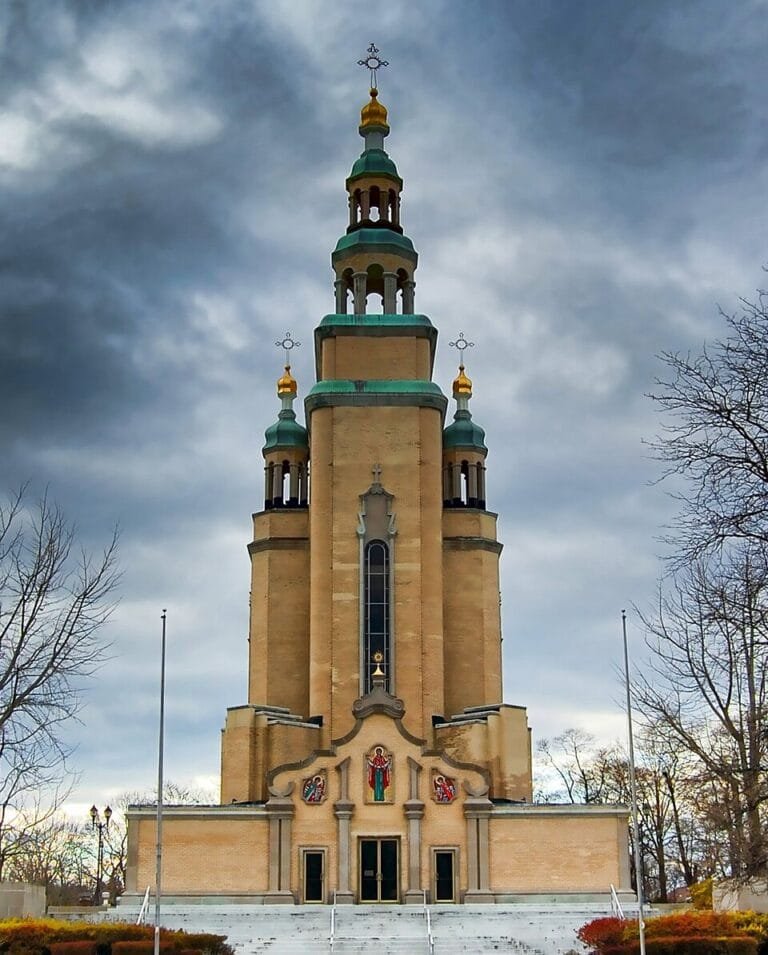
St. Andrew the First-Called Apostle Ukrainian Orthodox Memorial Church in South Bound Brook, New Jersey, is universally venerated by millions of Ukrainians across the globe as the “Ukrainian Jerusalem” and the paramount spiritual, administrative, and cultural sanctuary of the Ukrainian Orthodox Church of the USA (Ecumenical Patriarchate of Constantinople). Erected on the picturesque bluffs overlooking the Raritan River valley, this monumental cathedral stands as an immortal national monument-sanctuary, dedicated in perpetual remembrance to the millions of innocent men, women, and children martyred during the Soviet-engineered Holodomor-Genocide of 1932–1933 in Ukraine, as well as all selfless warriors, clergy, and patriots who gave their lives in defense of Ukrainian freedom and sovereignty.
Historical Foundations: The Sanctuary of a Nation in Exile
The establishment of the Metropolia Center and St. Andrew Memorial Church represents one of the most remarkable chapters in the history of the global Ukrainian diaspora. In the aftermath of World War II, Europe was inundated with hundreds of thousands of Ukrainian refugees, political dissidents, intellectuals, and veterans of the Army of the Ukrainian People’s Republic (UNR). Having escaped forced repatriation to the Soviet gulags, these displaced persons (DPs) were resettled across North America, bringing with them an unyielding dedication to preserve their distinct cultural, national, and religious identities in the free world.
By the dawn of the 1950s, the leadership of the Ukrainian Orthodox Church of the USA—headed by Metropolitan John (Theodorovich) and the profoundly energetic Archbishop Mstyslav (Skrypnyk, the future first Patriarch of Kyiv and All Ukraine)—recognized that the diaspora required a central spiritual headquarters. At that time, parishes were scattered across industrial centers in New York, Pennsylvania, Ohio, and Illinois, yet there existed no unified territorial center where national assemblies, theological training, historical preservation, and pan-diaspora commemorations could take place.
In 1951, Archbishop Mstyslav spearheaded the strategic acquisition of a sprawling 58-acre estate in Somerset and South Bound Brook, New Jersey. This picturesque location, bisected by the historic Delaware and Raritan Canal, provided ideal accessibility, situated halfway between the massive metropolitan areas of New York and Philadelphia. Almost immediately, the site was envisioned not merely as an administrative compound, but as a living monument to Ukrainian statehood, historical truth, and martyred victims of Russian imperialist and Soviet totalitarian oppression.
The cornerstone of the Memorial Church was solemnly laid and consecrated in the autumn of 1955. The construction became an extraordinary all-diaspora campaign of sacrificial giving. Thousands of Ukrainian working-class immigrants—laborers in foundries, tailors, domestic workers, miners, and engineers—donated hard-earned dollars weekly through parish committees, the Ukrainian Orthodox League (UOL), and United Ukrainian Orthodox Sisterhoods. On October 10, 1965, before an emotional crowd exceeding twenty thousand pilgrims from the United States, Canada, Europe, and Latin America, the Memorial Church was officially consecrated.
Architectural Synthesis: Masterpiece of Ukrainian Cossack Baroque
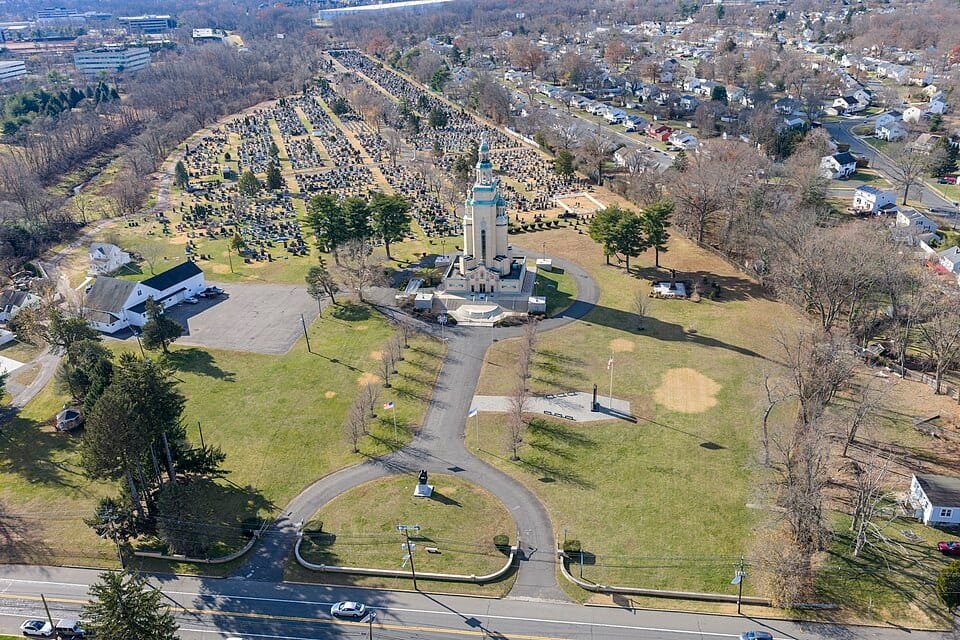
St. Andrew Memorial Church is revered by architectural historians as one of the finest embodiments of the Ukrainian Cossack Baroque (Mazepa Baroque) revival outside of Ukraine. While many diaspora sanctuaries were constrained to modest neo-Gothic or brick basilica designs, the South Bound Brook cathedral was conceived from its inception as an unapologetic, sovereign architectural statement of Ukrainian national genius.
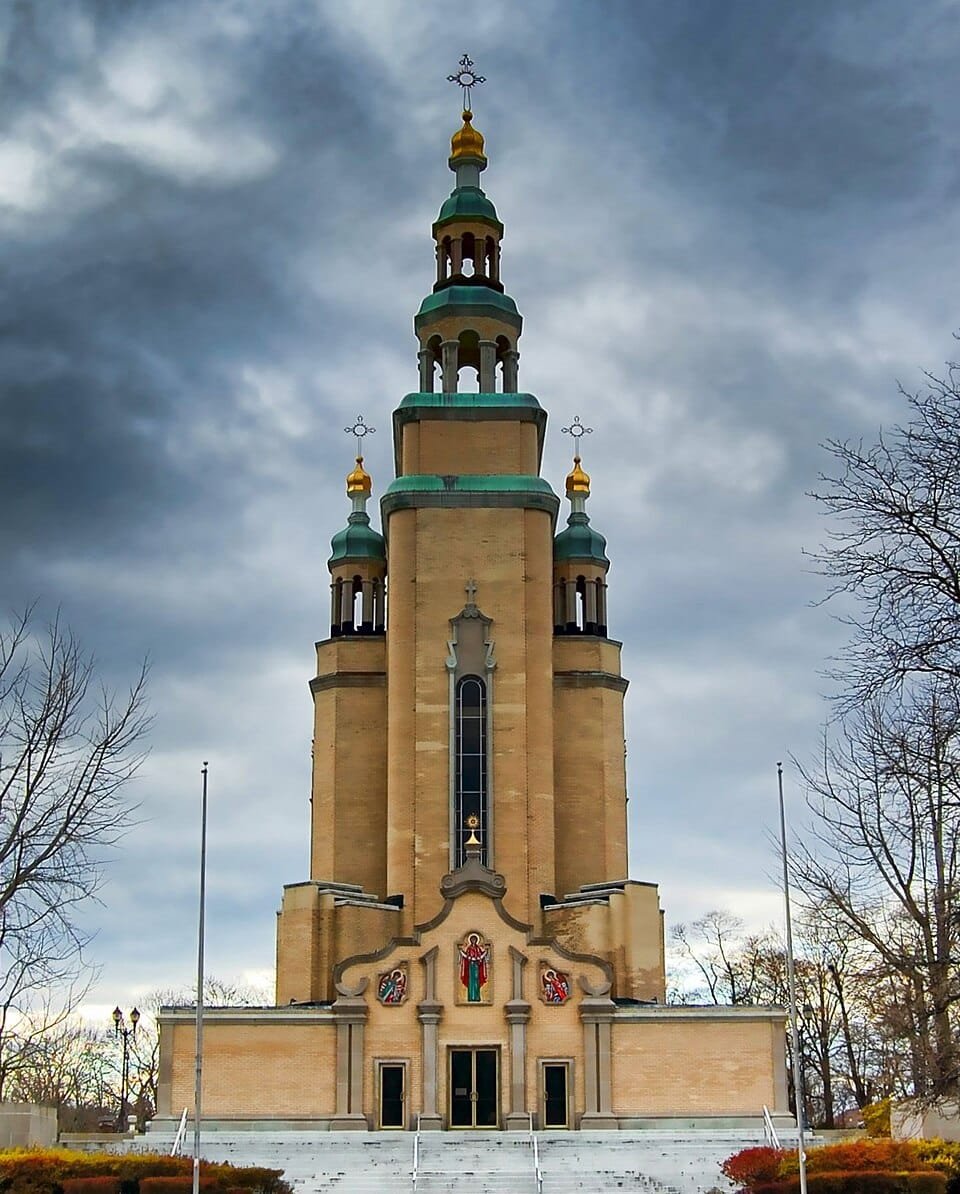
The primary architectural design was crafted by the emigre architect Yurij Denysenko (Jurij Denysenko), working in close conceptual dialogue with Archbishop Mstyslav and the distinguished architect Yurij Kodak-Vasylchenko (son of the renowned Ukrainian classical author Stepan Vasylchenko). Denysenko looked to the magnificent 17th- and 18th-century masonry and timber churches of Left-Bank Ukraine and the Hetmanate—specifically the tiered belfries of Chernihiv, Novhorod-Siverskyi, and Sedniv. The structure features a vertical, stepped-tier compositional hierarchy that gracefully draws the human eye toward the heavens.
The central tower-spire is composed of octagonal receding stages, pierced by classical open balustrades and arcaded belfry galleries. It culminates in an authentic pear-shaped baroque dome (banya), gilded with gold leaf and crowned by an ornate openwork Ukrainian tri-bar cross. Flanking the main nave are two subordinate octagonal turrets, also capped with baroque domes, creating an expressive three-domed silhouette that symbolizes the Holy Trinity and reflects traditional Ukrainian wooden church architecture.
Sacred Interior and Iconography: The Legacy of Petro Cholodny and Boris Makarenko
Stepping inside the cathedral nave, the visitor enters an ethereal realm of sacred light, profound theological symbolism, and liturgical grandeur. Unlike standard Western ecclesiastical interiors, St. Andrew’s interior was created as a harmonious synthesis of Kyivan Rus iconographic traditions and Ukrainian baroque decorative woodworking.
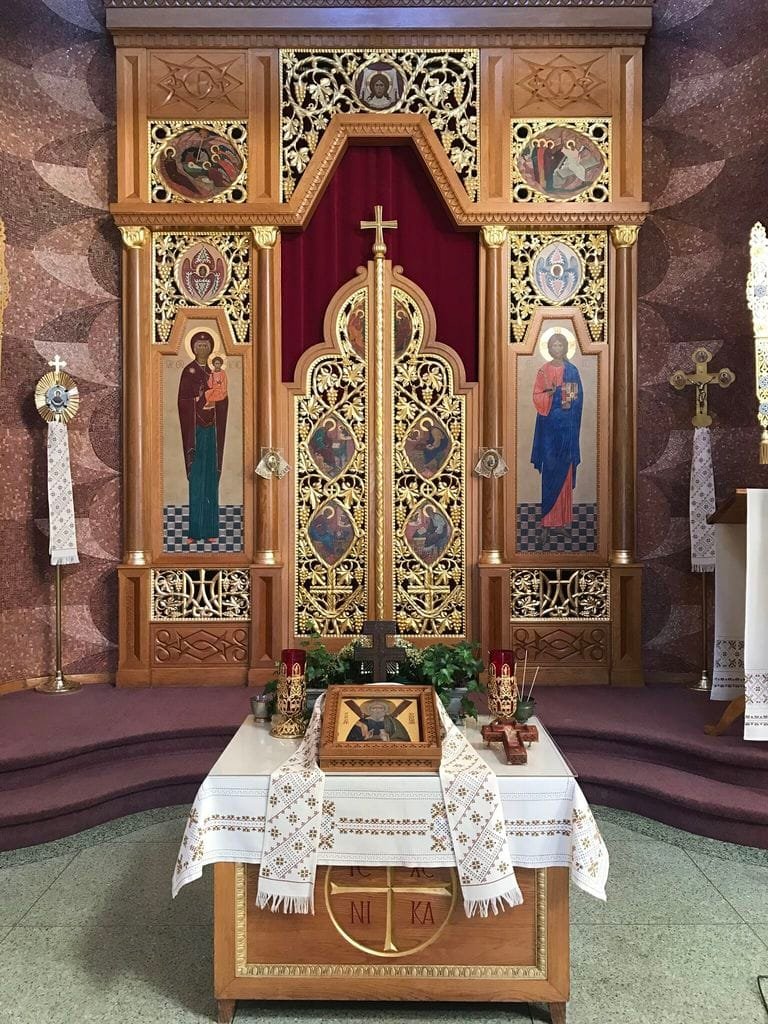
The crowning artistic treasure of the interior is the monumental iconostasis, created by the legendary Ukrainian artist-iconographer Petro Cholodny, Jr. (1902–1990). Son of the eminent Ukrainian modernist artist Petro Cholodny the Elder, Cholodny Jr. brought to South Bound Brook a deep knowledge of Byzantine tempera techniques, medieval Ukrainian fresco art, and modern Ukrainian sacred stylization.
The iconostasis is constructed of premium natural linden wood, adorned with delicate openwork carving depicting symbolic Ukrainian grapevine motifs, acanthus leaves, and wheat sheaves. The icons themselves display Cholodny’s signature style: elongated, dignified figures with expressive, contemplative visages, painted against delicate gold leaf backgrounds with rich mineral pigments. On the Sovereign Tier (the lowest rank), the icon of the Mother of God holding the Christ Child radiates maternal compassion, while the Christ Pantocrator blesses the congregation with serene divine majesty. The Royal Doors (Tsisarski Vrata) feature an intricate openwork carved lattice enclosing six circular medallions portraying the four Evangelists (Matthew, Mark, Luke, John) and the Annunciation.
In 1980, and further expanded during the major renovation of 1996, the expansive dome and vaulted sanctuary walls were embellished with monumental frescoes and sacred ornamental compositions painted by the distinguished Ukrainian master Boris Makarenko. Makarenko’s ceiling murals portray the Heavenly Liturgy, surrounded by cohorts of Old Testament prophets, Holy Apostles, and early Kyivan saints—including Equal-to-the-Apostles Prince Volodymyr the Great, Princess Olha, Anthony and Theodosius of the Kyiv Caves, and the holy martyrs Borys and Hlib.
The Holy Resurrection Crypt and the National Pantheon (St. Andrew Cemetery)
Directly beneath the sanctuary floor of the cathedral lies the sacred Crypt-Mausoleum of the Holy Resurrection. Conceived by Archbishop Mstyslav as a resting place for the spiritual primates of the Ukrainian Church, the crypt contains the sarcophagi of the most influential figures of modern Ukrainian ecclesiastical history. Here lies buried Metropolitan John (Theodorovich), who guided the diaspora flock for five decades from 1924 to 1971. Beside him rests Patriarch Mstyslav (Skrypnyk, 1898–1993)—a nephew of Symon Petliura, a cavalry officer of the Army of the UNR, a deputy to the Polish Sejm defending Ukrainian rights, and ultimately the first Patriarch of Kyiv and All Ukraine consecrated upon the revival of Ukrainian church independence.
Surrounding the cathedral is the expansive St. Andrew Ukrainian Orthodox Cemetery, widely revered as the “Arlington of Ukraine” and the national pantheon of the Ukrainian emigration. More than ten thousand Ukrainian patriots, intellectuals, cultural titans, and soldiers are buried here, including:
- General Petro Hryhorenko (Pyotr Grigorenko): Major General in the Soviet Army, founding member of the Moscow and Ukrainian Helsinki Human Rights Groups, and champion of Crimean Tatar rights, who was stripped of his Soviet citizenship while visiting the USA.
- Mykola Plaviuk: The last President of the Ukrainian People’s Republic (UNR) in Exile, who in a historic ceremony in Kyiv in August 1992 formally transferred the state regalia and authority of the UNR to the newly elected first President of independent Ukraine, Leonid Kravchuk.
- Ministers and Diplomats of the UNR: Key statesmen of the Ukrainian National Republic government who preserved state continuity during seven decades of Soviet occupation.
- Soldiers of the First and Second Liberation Struggles: Veterans of the Army of the UNR, the Galician Army (UHA), the Organization of Ukrainian Nationalists (OUN), and the Ukrainian Insurgent Army (UPA).
- Eminent Writers and Scholars: Literary scholars, historians, professors, and cultural leaders such as Dmytro Dontsov, Oleksa Powstenko, and numerous academicians.
At the center of the cemetery stands the ten-meter-tall Great Memorial Cross, designed by Petro Cholodny, Jr. In 1970, in a solemn ceremony of high national symbolism, the original stone gravestone plate from the tomb of Supreme Otaman Symon Petliura was transferred from Montparnasse Cemetery in Paris and embedded at the base of this cross. Nearby stands the world’s first bronze monument to Metropolitan-Martyr Vasyl Lypkivsky, the first Primate of the Ukrainian Autocephalous Orthodox Church who was executed by Soviet firing squad in Kyiv in 1937, sculpted by the Ukrainian Canadian master John Jaciw.
Metropolia Institutions: Education, Heritage, and Living Tradition
St. Andrew Memorial Church is not an isolated parish, but the nucleus of an extensive complex of religious and academic institutions serving the Ukrainian American community:
- St. Sophia Ukrainian Orthodox Theological Seminary: Founded to educate and form future pastors, theologians, and deacons for parishes across the Americas and the worldwide diaspora.
- Ukrainian History and Education Center (UHEC): A world-class museum and archival institution preserving irreplaceable historical artifacts, church vestments, folk textiles, historic periodicals, rare manuscripts, and personal archives of diaspora leaders.
- Metropolia Consistory Library and Archives: One of the richest repositories of 20th-century Ukrainian historical documentation outside Ukraine, visited by international researchers and scholars.
- Ukrainian Cultural Center: The host of the annual St. Thomas Sunday (Providna Nedilya) Pilgrimage, an event that draws thousands of pilgrims from across North America each spring for panakhyda memorial services, choral concerts, and cultural gatherings.
- All Saints Youth Camps and Educational Seminars: Regular summer camps, conferences of the Ukrainian Orthodox League (UOL), and youth leadership rallies fostering religious and cultural literacy.
Humanitarian Frontline: Relief to Ukraine During Russian Aggression
Since the launch of Russia’s full-scale military invasion of Ukraine in February 2022, St. Andrew Memorial Church and the Consistory of the UOC of the USA have transformed South Bound Brook into an international humanitarian command post. Under the hands-on leadership of Metropolitan Antony and Archbishop Daniel, the church has marshaled millions of dollars in direct logistical, medical, and emergency relief.
The Metropolia Center has procured and shipped dozens of fully equipped specialized emergency medical ambulances to frontline medical battalions across Kharkiv, Donetsk, Zaporizhzhia, and Kherson oblasts. Container shipments carrying surgical kits, wound vacuum machines, modern burn treatments, trauma bandages, and field hospital beds have been delivered directly to military hospitals and civilian clinics. In addition, the church has funded winter survival programs, purchasing hundreds of diesel generators, thermal clothing packages, and setting up heating and food distribution centers for displaced civilians and orphans in Ukraine.
Locally in New Jersey, the Memorial Church parish family provides comprehensive pastoral, legal, and material sponsorship for newly arrived Ukrainian war refugees. Families are assisted with housing, English language training, job placement, and enrollment of children in schools, while wounded Ukrainian military service members receiving prosthetic care at American medical centers are given spiritual solace and community support.
Chronological Milestones of St. Andrew Memorial Church
| Year | Historic Milestone |
|---|---|
| 1951 | Archbishop Mstyslav (Skrypnyk) and the UOC of USA Consistory acquire 58 acres of land in South Bound Brook / Somerset, NJ, to establish a national spiritual center. |
| 1955 | Solemn groundbreaking and blessing of the cornerstone for St. Andrew Memorial Church, dedicated to the victims of the 1932–1933 Holodomor. |
| 1965 | Grand consecration of St. Andrew Memorial Church on October 10 before an assembly of over 20,000 faithful, hierarchs, and international guests. |
| 1970 | The original tombstone plate of Supreme Otaman Symon Petliura is brought from Paris and consecrated at the base of the Great Memorial Cross. |
| 1971 | Metropolitan John (Theodorovich) reposes in the Lord and is entombed in the Holy Resurrection Crypt-Mausoleum beneath the church. |
| 1983 | Dedication of the world’s first monument to Metropolitan-Martyr Vasyl Lypkivsky, sculpted by John Jaciw. |
| 1990 | Metropolitan Mstyslav is elected in Kyiv as the first Patriarch of Kyiv and All Ukraine, uniting diaspora and homeland traditions. |
| 1993 | Patriarch Mstyslav reposes in the Lord and is solemnly laid to rest alongside Metropolitan John in the crypt beneath St. Andrew Memorial Church. |
| 1995 | The UOC of the USA formally enters into canonical communion under the Omophorion of the Ecumenical Patriarchate of Constantinople. |
| 2022–Present | Establishment of massive global humanitarian logistics hub providing dozens of ambulances, medical aid, and refugee support during Russia’s invasion of Ukraine. |
Parish Information & Contacts
| Full Official Name | St. Andrew the First-Called Apostle Ukrainian Orthodox Memorial Church |
| Ecclesiastical Jurisdiction | Ukrainian Orthodox Church of the USA (Ecumenical Patriarchate of Constantinople) |
| Status & Eparchy | Metropolia Center of the UOC of the USA / Eastern Eparchy |
| Physical Address | 280 Main Street, South Bound Brook, NJ 08880, United States |
| Pastor / Rector | Very Rev. Vasyl Pasakas |
| Assisting Clergy | Protodeacon Andrii Akulenko |
| Hierarchy | His Eminence Metropolitan Antony (Primate); His Eminence Archbishop Daniel (Consistory President) |
| Phone | +1 (908) 393-9408 / +1 (732) 356-0090 |
| consistory@uocofusa.org | |
| Official Website | uocofusa.org/memorial_church |
| Divine Liturgy Schedule | Sundays at 10:00 AM; Feast Days at 10:00 AM; Saturday Vespers at 6:00 PM |
| Liturgical Languages | Ukrainian and English |
| Geographic Coordinates | 40.5487° N, 74.5262° W |
| Interactive Navigation | Open in Google Maps |