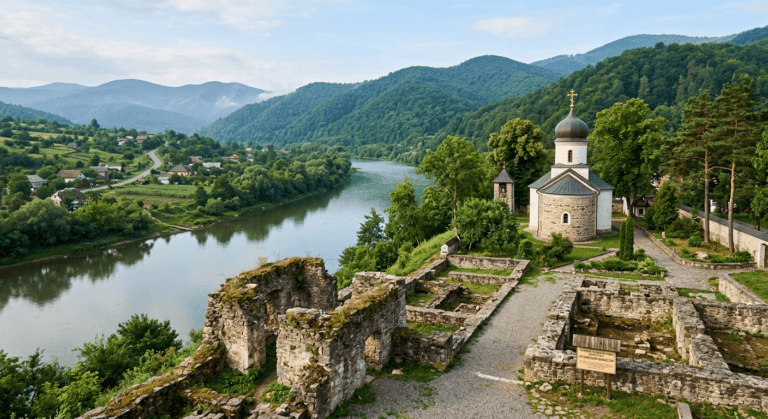
The Hrushiv Archangel Michael Men’s Monastery is the oldest Orthodox house of Transcarpathia, standing in the village of Hrushove in the Tiachiv district, on the right bank of the Tysa. The first written records of it, in which the monks complained to the Hungarian king about an attack by the Mongol-Tatars, date to 1242. Later the monastery became famous for its own printing house — one that served all of Maramorosh and the Carpathians. Destroyed in the 17th century, it was revived in the 21st century. [1]
Briefly about the monastery
- Full name: Hrushiv Archangel Michael Men’s Monastery. [1]
- Address: the village of Hrushove, Tiachiv district, Transcarpathian Oblast. [1][2]
- First record: 1242 (an appeal to King Bela IV). [1]
- Destruction: 17th century (its beginning — Calvinists, its end — Catholics). [1]
- Revival: the beginning of the 21st century, decision of the Holy Synod. [1]
- Abbot: Archimandrite Petro (Krailo). [1]
The oldest house of the region
The exact date of the founding of the Hrushiv monastery is unknown. The first written records of it appear in 1242, when the monastic buildings were plundered by the Mongol-Tatars. The monks complained in a written appeal to the Hungarian king Bela IV that the attackers killed monks, burned documents and took valuables. Possibly the founding of the house took place much earlier. [1]
This oldest house possessed over six thousand hectares of land, which included three villages — Hrushove, Teresva and Kryve. [1]
The printing house of the Hrushiv monastery
The Hrushiv monastery became famous for its printing house. Later, book printing in the Hrushiv house became an event of enormous significance for all of Maramorosh and the whole Carpathians: priceless manuscripts, which often existed in a single copy, could now be saved and multiplied. [1]
In the struggle against Rome and aggressive Catholicism, the presence among the Orthodox of their own printing house under the patronage of the great Hrushiv shrine was a great victory. It was precisely the existence here of an Orthodox typography that aroused particular hatred of this shrine — it hindered the spread of their influence in the Carpathians. [1]
The destruction of the 17th century
In the 17th century the shrine was ruined twice — at the very beginning of the century by Protestant Calvinists, and at its very end by Catholics, who came to power in Maramorosh. If after the first destruction the monastery recovered, then the repeated ruin literally wiped the ancient house from the face of the earth. [1]
Tradition says that the haters of Orthodoxy not only destroyed the monastery itself but also killed the monks. The place of the ancient house is strewn with bones: once, during earthworks, they dug out a filled-in stone chamber where they found a whole skeleton of a monk in a sitting position. [1]
Memory and excavations
In 1991, with the blessing of Archbishop of Mukachevo and Uzhhorod Yevfymii, in memory of the 500th anniversary of book printing, a cross was erected, near which on 7 July a solemn Divine Liturgy was served. [1]
In September 1997 excavations began on the territory of the monastery, initiated by scholars of Uzhhorod National University and scientists from Romania. A part of the foundation of the church and nine monks’ burials were uncovered. [1]
Revival in the 21st century
At the end of the 20th and the beginning of the 21st century, after many signs, the pious people of Transcarpathia restored their ancient spiritual centre. Through the rector of the Annunciation church of the village of Hrushove, Archpriest Mykhailo (Dupin), and his parishioners, a small church was built. [1]
The thought of reviving the Hrushiv house arose in Archimandrite Stratonik (Lehach) during a conversation with the ruling bishop. Thanks to his intercession at the Synod, the monastery was approved as a men’s house, and Archimandrite Stratonik (Lehach) was appointed its abbot. Despite his 70 years of age, he took upon himself the responsible labour of reviving the ancient house. Hierodeacon Venedikt (Khromei) and monk Pimen (Matsola) were enrolled in the number of the brethren. [1]
Over 11 years two residential buildings and a church with a bell tower and bells were built in the monastery. In its present form the building arose in 2004. Two sketes also operate at the house. [1][2]
Present state
Today the abbot of the monastery is Archimandrite Petro (Krailo); three clergymen and five novices live in the house. [1]
The Hrushiv house is not only a spiritual but also an important historical and archaeological site, testifying to ancient Christianity in Transcarpathia. [1]
Practical information
- Address: the village of Hrushove, Tiachiv district, Transcarpathian Oblast, right bank of the Tysa. [1][2]
- Chief shrine: the site of the ancient house with the ruins of the church foundation and monks’ burials. [1]
- Present church: a church with a bell tower, built in 2004. [2]
- How to get there: the village of Hrushove on the road along the Tysa, in the Tiachiv district. [1][2]
Frequently asked questions
When is the monastery first mentioned?
In 1242, when the monks complained to the Hungarian king Bela IV about an attack by the Mongol-Tatars. [1]
What made the monastery famous?
Its own printing house — the oldest centre of book printing in the Carpathian region. [1]
When and how was the house destroyed?
In the 17th century twice: first by Calvinists, then by Catholics; after the second destruction the ancient monastery vanished from the face of the earth. [1]
When was the monastery revived?
In the 21st century: approved as a men’s monastery by a Synod decision and rebuilt thanks to Archimandrite Stratonik (Lehach). [1]
What was found during the excavations?
A part of the foundation of the ancient church and nine monks’ burials. [1]
Conclusion
The Hrushiv Archangel Michael Men’s Monastery is a memory of the ancient Christianity of Transcarpathia. From the first record of 1242 and its own printing house, through the 17th-century destruction and the 1997 excavations, to the revival in the 21st century — the house returns to the region its ancient spiritual heritage. [1][2]