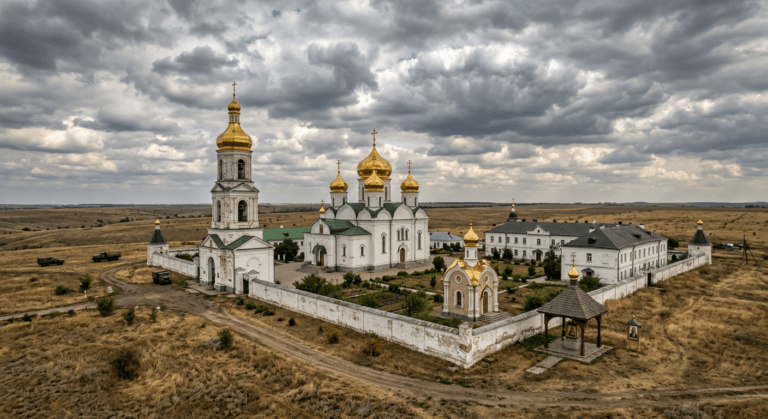
The Holy Dormition Mykolo-Vasylivskyi Monastery is a unique monastic complex in the village of Mykilske, in the Volnovakha district (now near Vuhledar) of Donetsk Oblast. It consists of two communities: the men’s St Nicholas (St Basil) and the women’s St Nicholas monasteries, built in 1998–2000. The complex owes its existence to the legendary schiarchimandrite Zosyma (Sokur), and its main shrine is the wonder-working icon of the Mother of God “Quick to Hear”. [1][4]
Briefly about the monastery
- Full name: Holy Dormition Mykolo-Vasylivskyi Monastery (men’s and women’s). [1][3]
- Address: Mykilske village, Volnovakha district, Donetsk Oblast. [1]
- Year founded: 1998–2000. [1]
- Components: the St Basil men’s monastery and the St Nicholas women’s monastery. [1][4]
- Founder: schiarchimandrite Zosyma (in the world Ivan Oleksiiovych Sokur). [1]
- Main shrine: the wonder-working icon of the Mother of God “Quick to Hear”. [2][5]
Background: two churches of the old village
Before 1959 the village of Mykilske, where the monastery is located, consisted of two villages — Mykilske and Vasylivka — each with its own churches. [1]
- In Mykilske — a two-headed church in honour of St Nicholas the Wonderworker, built in 1911. [1]
- In Vasylivka — a church with nine cupolas in honour of Basil the Great, built in 1912. [1]
The Church of St Nicholas has not survived to our day: after the October Revolution of 1917 it was almost completely destroyed and for a long time served as a grain storehouse. The Basil church, however, survived the hard times of revolution and civil war, and services in it were resumed in the 1940s. [1]
The arrival of schiarchimandrite Zosyma
Schiarchimandrite Zosyma (in the world Ivan Oleksiiovych Sokur) appeared in Mykilske in 1986. He was sent here into exile; the authorities hoped fewer people would travel to him. But everything turned out the opposite. [1]
Before him lay a terrible picture of decline: right at the entrance — a toilet and a rubbish dump, the churchyard overgrown with weeds, the church half-ruined. Beside the church stood a burnt wooden shed — the priest’s house, whose windows had sunk into the ground, and inside there were mice and rats. [1]
Yet already by autumn 1987 the churchyard was put in order: cleanliness everywhere, a baptistery and refectory were built over the summer, and a new iconostasis appeared in the church. [1]
The holy spring and the House of Mercy
Beside the St Basil church a well was dug, consecrated in honour of the Venerables Zosima and Savvatii of Solovki. At it schiarchimandrite Zosyma celebrated water-blessing services, after which the bitter and salty water, impossible to drink, became sweet and pleasant to the taste. Pilgrims take this water as a holy thing. [1]
In those days Zosyma gathered around him ailing old people and built for them a House of Mercy. Before the founding of the monastery the almshouse was in an old building to the left behind the altar; when the monastery was built, a new two-storey building was raised for it — with a church of Venerable Sampsion the Hospitable on the ground floor, refectories for the almshouse and pilgrims, and offices for the sisters of mercy. [1]
The building of the two monasteries
Construction began in 1998, when the already ailing Father Zosyma decided to build in the village two monasteries — a men’s and a women’s. In a short time several residential buildings were erected, a refectory church in honour of All the Saints of the Russian Land and an almshouse for a hundred people. [1]
The place for construction was chosen not by chance: here there was a holy spring, around which monks who lived here after being expelled from the Crimean monasteries held services. [4]
In 2001 the sisters’ community was granted the status of the St Nicholas Women’s Monastery, and in 2002 the St Basil Men’s Monastery was registered. [1]
In 2003 a gate church with a bell tower in honour of the Iberian Icon of the Mother of God was built, as well as chapels of St Nicholas the Wonderworker and St Basil the Great. The communities became a place of pilgrimage for thousands of adherents of the Orthodox faith. [1]
Shrines and relics
The chief spiritual pearl of the complex is the wonder-working icon of the Mother of God “Quick to Hear”. Believers came to the Mykilske monastery to venerate this icon and to pray at the tomb of Father Zosyma. [2][5]
In the St Basil church more than 200 particles of holy relics of the saints of God from throughout the Orthodox world were gathered. There were also many icons with relics: of Venerable Seraphim of Sarov, the great martyr and healer Panteleimon, the great martyr Barbara, St Ioasaph of Belgorod, the Optina Elders, and others. [1]
Zosyma himself most venerated the icons of the Mother of God “Quick to Hear”, of the holy great martyr and healer Panteleimon and of the holy righteous John of Kronstadt. [1]
According to some sources, in 2001 the monastic complex was consecrated by Patriarch Kirill. [4]
War and destruction
With the start of the full-scale invasion in 2022, the Holy Dormition Mykolo-Vasylivskyi Monastery found itself on the front line. The village of Mykilske lies near Vuhledar, which became an epicentre of fierce fighting. [2][3]
In 2023 Ukrainian sources reported that the monastery was being destroyed by the Russian occupation: Russian forces were turning the temple buildings into ruins, and the communities themselves were suffering from incessant shelling. The shrine’s territory holds 4 churches and over 200 particles of holy relics. [3]
This is one of the hardest chapters in the history of the complex: a shrine created for peace and prayer has become a victim of war, and its inhabitants and the village residents have found themselves under threat. [2][3]
Practical information
- Address: Mykilske village, Volnovakha district, Donetsk Oblast. [1]
- Components: the St Basil men’s and the St Nicholas women’s monasteries; about 4 churches on the territory. [1][3]
- Main shrine: the wonder-working icon of the Mother of God “Quick to Hear” and the tomb of Father Zosyma. [2]
- Access: because of hostilities and occupation the village is in practice inaccessible to Ukrainian pilgrims. [2][3]
Frequently asked questions
Why is the monastery called Mykolo-Vasylivskyi?
Because the complex unites two monasteries — the women’s one in honour of St Nicholas (St Nicholas) and the men’s one in honour of Basil the Great (St Basil). [1][4]
Who is the founder of the communities?
Schiarchimandrite Zosyma (in the world Ivan Oleksiiovych Sokur), who came to the village in 1986. [1]
What is the main shrine?
The wonder-working icon of the Mother of God “Quick to Hear”, as well as more than 200 particles of holy relics. [1][2]
When were the monasteries founded?
In 1998–2000; in 2001 the women’s community was granted monastery status, and in 2002 the men’s one was registered. [1]
What happened to the monastery during the war?
In 2022–2023 the complex suffered destruction from shelling and found itself in an occupation zone. [2][3]
Conclusion
The Holy Dormition Mykolo-Vasylivskyi Monastery is evidence of how, from a neglected church to which an elder was exiled in 1986, the largest monastic complex of eastern Ukraine grew in a decade and a half. More than 200 particles of relics, the wonder-working “Quick to Hear” and the House of Mercy turned Mykilske into a spiritual magnet for pilgrims. But the war of 2022 cut short this peaceful life: the monastery has become one of the symbols of the price Ukraine pays for freedom. [1][2][3]
Sources
- St Basil Men’s Monastery — Wikipedia
- The Holy Dormition Mykolo-Vasylivskyi Monastery suffers from shelling — dtv.dn.ua
- The Holy Dormition Mykolo-Vasylivskyi Monastery is being destroyed by Russian occupation — Donetsk Regional State Administration
- Holy Dormition Mykolo-Vasylivskyi Monastery — zruchno.travel
- Icon of the Mother of God “Quick to Hear” — Wikipedia