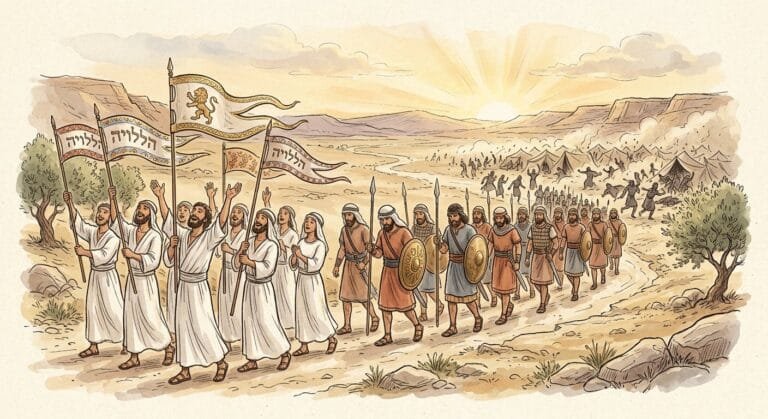
There are Bible stories that read like military manuals, and there are stories that read like a miracle. The story of King Jehoshaphat in 2 Chronicles 20 belongs to the second kind. Three armies marched on little Judah at once. The king had no military chance whatsoever. And he did what no commander in history had done: he put singers in front of his armed soldiers, dressed in holy attire, with one single order — to sing: “Give thanks to the Lord, for His mercy endures forever!” Judah never drew the sword. And then, for three days, it gathered the plunder.
In this article we will retell the story as it is written, analyse Jehoshaphat’s prayer line by line, discover what the phrase “His mercy endures forever” meant for ancient Israel, — and consider what the twentieth chapter of 2 Chronicles has to say to us today, when each of us sometimes faces our own “three armies”.
1. The Story as It Happened: Three Armies, a Fast, and a Choir Instead of a Vanguard
A coalition moved against Judah: the sons of Moab, the sons of Ammon, and the Meunites (mentioned in the text together with the inhabitants of Mount Seir). This was not a raid — it was a full-scale invasion with a single purpose, stated by the enemies themselves: they had come “to drive them out of Your possession” (2 Chr. 20:11) — to erase God’s people from the promised land entirely.
Hearing this, King Jehoshaphat did not convene a war council, did not send for allies, and did not begin emergency mobilization. The first thing he did was this: he “was alarmed, and set himself to seek the Lord, and proclaimed a fast throughout all Judah” (2 Chr. 20:3). And “Judah gathered to seek help from the Lord; from all the cities of Judah they came to seek the Lord” (20:4). The whole nation, instead of panic, made a collective turn toward God.
Then Jehoshaphat stood in the assembly of the house of the Lord, before the new court, and prayed the prayer we will analyse below. And while the prayer was still being spoken, the Spirit of the Lord came upon the assembly — through Jahaziel, a Levite of the sons of Asaph, who delivered God’s answer: “Do not be afraid and do not be dismayed at this great multitude, for the battle is not yours but God’s… You will not need to fight in this battle. Stand firm, hold your position, and see the salvation of the Lord on your behalf” (2 Chr. 20:15-17).
In the morning the army went out to the wilderness of Tekoa. And here the most incredible thing in the whole story happens. The king stopped the columns and said: “Hear me, O Judah and inhabitants of Jerusalem! Believe in the Lord your God, and you will be established; believe His prophets, and you will succeed” (20:20). Then “he took counsel with the people and appointed those who were to sing to the Lord and praise Him in holy attire, as they went before the army, saying: Give thanks to the Lord, for His mercy endures forever!” (20:21). First — a choir in white. Behind it — an army marching into a battle that, it seemed, would never be fought.
“And when they began to sing and praise, the Lord set ambushes against the sons of Ammon, Moab, and Mount Seir who had come against Judah… and they were defeated. For the sons of Ammon and Moab rose against the inhabitants of Mount Seir, devoting them to destruction; and when they had made an end of the inhabitants of Seir, they all helped to destroy one another” (20:22-23). When Judah came to the watchtower of the wilderness, they saw only fallen bodies — not one had escaped. No sword was ever drawn. There was so much plunder that Jehoshaphat and his people gathered it for three days (20:25). And on the fourth day they assembled in the valley that from then on was called the Valley of Beracah — “Blessing” — because there they blessed the Lord (20:26). And “the fear of God came upon all the kingdoms of the lands when they heard that the Lord had fought against the enemies of Israel. And the kingdom of Jehoshaphat had rest” (20:29-30).
2. Who Was Jehoshaphat: a Reformer King in a Difficult Age
Jehoshaphat, son of Asa, reigned over Judah approximately in 870–849 BC and belongs to the few kings of whom the Bible speaks almost without reproach: “The Lord was with Jehoshaphat, because he walked in the earlier ways of David his father” (2 Chr. 17:3). He removed the high places and the Asherim, and sent officials, Levites and priests throughout all the cities of Judah to teach the people the Law of God (2 Chr. 17:7-9) — in effect, a nationwide programme of biblical education, centuries before it became common. Under his reign Judah grew strong, neighbours paid tribute, and his army numbered hundreds of thousands of organized warriors (2 Chr. 17:12-19).
Yet Jehoshaphat was not flawless: he allied himself by marriage with the wicked king Ahab of Israel (his son married Ahab’s daughter Athaliah — a union that later almost destroyed the house of David), joined Ahab in the disastrous campaign at Ramoth-Gilead, and twice received rebukes from prophets for alliances with God’s enemies (2 Chr. 18-19). The story of 2 Chronicles 20 is not a portrait of a perfect hero. It is a portrait of a person who knew where to turn when his own mistakes, allies and armies had driven him into a dead end. And that is precisely what makes the story so close to every one of us.
3. Jehoshaphat’s Prayer: a Structure Worth Borrowing
The king’s prayer (2 Chr. 20:6-12) is one of the most beautiful prayers of Scripture, and it is built on a brilliantly simple scheme:
- 1. Confession of God’s greatness: “O Lord, God of our fathers, are You not God in heaven? You rule over all the kingdoms of the nations; in Your hand are power and might, and none is able to withstand You.” First — not requests, but a look at who God is.
- 2. Memory of past deeds: “Did You not, our God, drive out the inhabitants of this land before Your people Israel, and give it forever to the descendants of Abraham, Your friend?” Jehoshaphat reminds not God — but himself: God has already proven His faithfulness, and that memory sustains faith.
- 3. An honest description of the situation: “And now behold, the sons of Ammon and Moab and Mount Seir… see, they reward us by coming to drive us out of Your possession.” No downplaying of the threat — on the contrary, it is named precisely, without illusions.
- 4. Admission of helplessness: “For we are powerless against this great multitude that is coming against us. Nor do we know what to do.” This is the summit of the prayer. Not “help us, because we are strong and will try hard”, but complete honesty: no strength, no plan.
- 5. A gaze directed upward: “But our eyes are upon You!” One phrase that completes everything: when our own eyes see nothing but defeat, the eyes of faith look to God.
Note: the answer came before the prayer had finished — the Spirit of the Lord came “in the midst of the assembly” (20:14). God does not wait for perfect wording; He answers the heart that seeks Him.
4. Singers in Front of the Army: the Most Illogical Strategy in History
In military logic, scouts and the strongest warriors go first, because the front line is the most dangerous place. Jehoshaphat put there singers in holy attire — Levites whose “weapon” is words of praise. Why?
- It was a banner of faith. To march behind a choir singing thanksgiving before the victory meant for the whole army a daily confirmation: we believe God’s word more than our own eyes. Praise before victory is faith made visible by footsteps.
- It was an ordering of the heart. God had said: “the battle is not yours but God’s”. If God fights the battle, the people’s main task is not to keep up with God but not to hinder Him with fear. Praise keeps the army’s heart in the right state.
- It was a sermon to the enemy. An army going into battle with songs of thanksgiving testifies to the enemy camp: our God is alive, and He has already decided this battle. For the enemy, that is more demoralizing than any war cry.
And Scripture makes a precise, almost scientific note: “And when they began to sing and praise, the Lord set ambushes…” (20:22). Not when they finished, not when they had won — but when they began. The mechanism of God’s answer is launched at the moment of the first step of faith, not at the moment of the success report.
5. “Give Thanks to the Lord, for His Mercy Endures Forever”: a Formula Older than Jehoshaphat Himself
The song of Jehoshaphat’s choir was not random. “Give thanks to the Lord, for His mercy endures forever” (Hebrew: הוֹדוּ לַיהוָה כִּי לְעוֹלָם חַסְדּוֹ) is the first verse of Psalm 136 (135), the great thanksgiving hymn in which each of the twenty-six verses ends with this refrain. The same refrain sounds in Psalms 106, 107 and 118, and in Chronicles itself it functions as Israel’s national anthem: it was sung when David brought up the ark (1 Chr. 16:34), at the dedication of Solomon’s temple (“and the glory of the Lord filled the house”, 2 Chr. 5:13) and at the rededication of the temple under Hezekiah (2 Chr. 7:3).
The word “mercy” (hesed) here means not an emotion but covenant faithfulness: the God who has bound Himself to His people by promise cannot betray His love. When Jehoshaphat placed this song in front of the army, he effectively mobilized the whole history of salvation: Creation, the Exodus, the conquest of the Land — all of it lives in the refrain “for His mercy endures forever”. The army marched into battle not with an empty slogan but with a complete theology set to music. In Jewish tradition Psalm 136 is part of the morning liturgy, and in Christian worship the same phrase became the heart of countless thanksgiving prayers.
6. The Valley of Beracah: Three Days of Plunder and One Lesson
The finale of the story is written almost with humour: the enemies destroyed one another, and Judah was left only to gather. There was so much plunder — goods, clothing, precious objects — that they gathered it for three days, “for it was too much to carry away” (20:25). On the fourth day the people gathered for a thanksgiving assembly in the valley, and from that day the valley bears the name Beracah — “Blessing”. The place that was supposed to become Judah’s graveyard became its monument of gratitude.
Here lies one of the deep lessons of the whole story: God did not merely “solve the problem”. He turned the place of threat into a place of blessing — changing even the name of the location. What looked like an ending became an address where later generations would remember God’s faithfulness. And the fear that fell upon the neighbouring kingdoms afterwards (“for the Lord had fought against the enemies of Israel”) became years of rest for Judah (20:29-30).
7. What This Story Means for Us Today
2 Chronicles 20 is not a promise that every trouble will pass without effort; the Bible honestly tells of Jehoshaphat’s other days as well. But this chapter leaves us several principles that always work:
- The first movement in a crisis is toward God, not away from Him. Jehoshaphat was afraid — Scripture does not hide it. But he turned fear into seeking God and into a fast, that is, into action. Fear that prays becomes faith; fear that falls silent becomes panic.
- A prayer that begins with God’s greatness ends in peace. The structure of Jehoshaphat’s prayer — confession, memory, honesty, upward gaze — heals our habit of starting with a list of problems.
- Honesty about one’s helplessness is not defeat but a doorway. “We do not know what to do, but our eyes are upon You” is the strongest position a person or a community can take. It opens space for God’s power.
- Praise before victory is what faith actually is. Thanksgiving “in advance” does not mean ignoring reality; it means believing in the One who is greater than reality. In practical terms: thanking God in the midst of a trial is the most concrete spiritual action one can take.
- “The battle is not yours” — about unburdening. There are battles where action is required of us, and there are battles where we are told “stand firm and see”. Wisdom lies in discerning them in prayer, instead of carrying everything alone.
- Community changes the course of history. The fast was proclaimed throughout all Judah; everyone gathered — from the king to the little children (20:13). There would have been no answer of Jahaziel without that “all together”. The common prayer of a family, a parish, a nation is not a beautiful custom but a mechanism.
8. 2 Chronicles 20 in the Mirror of Other Scripture
- Exodus 14:13-14 — “Stand firm, and see the salvation of the Lord… The Lord will fight for you, and you have only to be still”: the same formula at the Red Sea, centuries before Jehoshaphat.
- Psalm 136 (135) — the hymn from which the choir’s song is taken: “Give thanks to the Lord, for His mercy endures forever.”
- Psalm 46 (45):1-3 — “God is our refuge and strength… therefore we will not fear though the earth gives way”: a prayer that sounds like the soundtrack of 2 Chronicles 20.
- Isaiah 37 — a parallel story: Hezekiah, Jerusalem, the Assyrian army of Sennacherib — and one prayer after which an angel strikes down the enemy camp.
- Romans 8:31 — “If God is for us, who can be against us?”: the New Testament echo of Jahaziel’s answer.
- Ephesians 6:10-13 — “Be strong in the Lord… stand firm”: Paul describes the same “stand and see” posture, but on the spiritual plane.
9. Frequently Asked Questions (FAQ)
Who was King Jehoshaphat, and when did this happen?
Jehoshaphat was king of Judah (c. 870–849 BC), son of King Asa, one of the most pious rulers of the southern kingdom: he conducted a nationwide teaching of the Law of God and reformed the courts. The battle described in 2 Chronicles 20 took place around the middle of his reign, when Moabites, Ammonites and Meunites marched against Judah at once.
Why did the singers go in front of the armed army?
It was a deliberate act of faith after God’s answer: “the battle is not yours but God’s”. The choir in holy attire, singing “Give thanks to the Lord, for His mercy endures forever”, became a visible banner of trust: the army marched not to fight for victory but to give thanks for a victory God had already promised. Scripture notes that the Lord “set ambushes” precisely when they began to sing.
What does “His mercy endures forever” mean?
This is the first verse of Psalm 136 (135) and one of the most important refrains of the Bible. The Hebrew word hesed means God’s faithful, covenantal love — a love that holds not to our merits but to His promise. In Chronicles this phrase sounded at the bringing up of the ark, at the dedication of Solomon’s temple and at its rededication under Hezekiah — effectively as the national anthem of God’s faithfulness.
How did the enemies destroy one another?
Scripture says the Lord “set ambushes” against the armies that came against Judah (2 Chr. 20:22) — then the coalition collapsed from within: the Ammonites and Moabites struck the inhabitants of Mount Seir and destroyed them, and afterwards “helped one another to destruction”, that is, killed each other. Judah, arriving on the fourth day, had only to gather the plunder — for three days in a row.
What is the Valley of Beracah?
Beracah means “blessing”. This is how the valley was named where, on the fourth day after the enemies’ defeat, Jehoshaphat and all the people gathered to bless the Lord (2 Chr. 20:26). The place that was supposed to become the field of Judah’s defeat became a monument of thanksgiving — and the name survived, as Scripture notes, “to this day”.
Does this story mean believers need do nothing in difficulties?
No. Jehoshaphat did everything in his power: he proclaimed the fast, gathered the people, prayed, organized the army and even arranged it in order — and then entrusted the outcome to God. The principle of the chapter is not inactivity but the right sequence: first prayer and trust, then action without panic. Other chapters of the same book show that when Jehoshaphat acted without prayer, he erred.
10. Sources
1. 2 Chronicles, chapter 20 — the biblical text in multiple translations: biblegateway.com (2 Chronicles 20).
2. Jehoshaphat: life, reforms and wars of the king of Judah — Wikipedia article: en.wikipedia.org (Jehoshaphat).
3. 2 Chronicles 20: structure, text and commentary — Wikipedia article: en.wikipedia.org (2 Chronicles 20).
4. Psalm 136 (135), “Give thanks to the Lord, for His mercy endures forever” — Wikipedia article: en.wikipedia.org (Psalm 136).