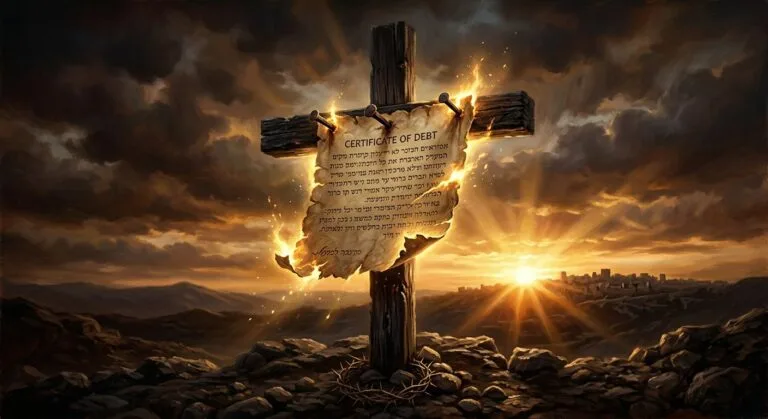
Some verses in the New Testament you read and pass by; others stop your heart. One of the latter is Colossians 2:14: “having canceled the record of debt that stood against us with its legal demands. This he set aside, nailing it to the cross.” In a single sentence the Apostle Paul compressed the whole Gospel story: a debt we could never pay, a document that condemned us, and a cross on which God did not hang the debtor — He nailed the debt itself. In this article we will calmly and deeply unpack what these words meant to their first readers, how the Church Fathers understood them, and — most importantly — what this verse means for each of us today.
Three words make this image unforgettable: the record of debt, against us, and nailed to the cross. Let us examine each of them.
1. Context: a Letter to a Community Threatened by “Salvation by Accounting”
To understand the verse, we must understand its audience. Colossae was a small town in Asia Minor, and its Christian community, founded through Paul’s disciples, was under pressure from a strange mixture of teachings scholars call the “Colossian heresy”: strict Jewish rules about food and holy days were being added to the Gospel, along with ascetic practices of “harsh treatment of the body”, angel worship and mystical “visions” (Col. 2:16-18, 20-23). In essence, the community was being told that Christ’s grace alone was not enough — that salvation had to be “topped up” by observing rules: fasts, calendars, prohibitions.
This is exactly what Paul’s letter opposes. His central thesis: in Christ you already have everything, and nothing needs to be added — “in him the whole fullness of deity dwells bodily, and you have been filled in him” (Col. 2:9-10). Verse 2:14 is the climax of this argument: God has already settled the question of our debt once and for all, so returning to “regulations” that supposedly save us means searching for a debt record that has already been destroyed.
2. What Is the “Record of Debt”? A Word We Would Miss Without History
The Greek word Paul uses here is χειρόγραφον (cheirographon), literally “something written by hand”. In the ancient world it was a very concrete document: a handwritten IOU, which the debtor himself wrote and handed to the creditor to acknowledge the debt. It is not a law imposed from above — it is your own signature under your own debt. As long as the document lay with the creditor, it was a constant reminder: “you owe”.
What exactly does Paul call this record? Patristic and theological tradition reads the image on two complementary levels:
- 1. The record of our sins — our debt before God. Every sin is, figuratively, one more line in an IOU we write against ourselves: “I owe”. Saint John Chrysostom explains it precisely this way: “It is an obligation of debt — that is, sin… This handwritten bond God did not merely erase but destroyed.” The record that “stood against us” with its “legal demands” is the itemized list of our offences, standing between us and God as proof of our insolvency.
- 2. The law itself, with its regulations, registering the debt. The word “legal demands” (Greek δόγμασιν, dogmasin) is also used by Paul in Ephesians: “abolishing the law of commandments expressed in ordinances” (Eph. 2:15). God’s law in itself is holy and good (Rom. 7:12), but for sinful humanity it functioned as a mirror and a register: it revealed the debt, named it, and thereby “stood against us”, because no one could keep it fully (Rom. 3:20; Gal. 3:10-13). The record is the law turned into a payment demand.
Both readings converge on one point: humanity stood before God as an insolvent debtor holding a document of condemnation. And nothing could be done about that document by human effort — it could neither be “worked off” nor “negotiated away”. One could only wait for what the Creditor would do with it.
3. “Nailing It to the Cross”: the Most Unexpected Way to Cancel a Debt
Now comes the point — what God did with the record. In the ancient world, cancelling a debt was straightforward: the creditor tore up or crossed out the bond, and the debt vanished. Paul could simply have said: “God tore up the record.” But he says something incomparably greater: God set it aside and nailed it to the cross.
Notice the shocking reversal. The cross was an instrument of execution to which the criminal was nailed. The record condemned us, and by every logic we should have been the ones on the cross. But the Gospel says: Christ was on the cross, and next to Him — our document of condemnation, nailed there. What was executed was not the debtor but the debt. The cross became not the place of our punishment but the place where our sentence was put to death. That is why the very next verse moves to the language of triumph: “He disarmed the rulers and authorities and put them to open shame, triumphing over them in him” (Col. 2:15) — the shame of the cross turned into a victory parade, because the power that held us in debt slavery lost its document.
One more subtlety: the record was removed from “the midst” — it had stood between us and God, blocking the relationship. By nailing it to the cross, God removed the obstacle: between us and Him there no longer stands a single sheet of paper listing our debts. The way is open.
4. How the Church Fathers Understood This Verse
Saint John Chrysostom (4th century), in his homilies on Colossians, reads the image directly: the record is our debt of sin, and God cancelled it not merely by forgiving but by destroying the document itself: “If a man has a debtor, he does not simply release the debt — he takes the bond, tears it and destroys it, so that no trace of it remains. So God: He did not merely forgive, but destroyed the handwritten bond by nailing it to the cross.” Chrysostom stresses that this happened not because we paid, but because the Creditor proved merciful — and that is precisely why what is expected of us is not “payment” but gratitude and love.
Blessed Theophylact of Ohrid (11th century) develops the same thought: the handwritten bond is the obligation we imposed on ourselves through sin; “nailing to the cross” means destroying it by Christ’s death, since Christ, being innocent, took upon Himself the consequences of another’s debt. Saint Cyril of Alexandria and the Western interpreters — from Blessed Augustine to Thomas Aquinas — add the second level: the record is also the law with its regulations condemning non-fulfilment, and Christ, having fulfilled the law in Himself, stripped it of its power to accuse. Both lines of interpretation agree on the essential: the cross is the place where a debt no one could pay was finally written off.
5. What It Meant for the Colossians — and Means for Us
Immediately after our verse Paul draws the practical conclusion: “Therefore let no one pass judgment on you in questions of food and drink, or with regard to a festival or a new moon or a Sabbath. These are a shadow of the things to come, but the substance belongs to Christ” (Col. 2:16-17). The logic is simple: if the record with its legal demands has been cancelled, nobody has the right to demand that you live as if it were still in force. It is not diets, calendars or “strict rules” that make us God’s people — we become such through faith in the One who nailed our debt to the cross (Eph. 2:8-9).
It is important to hear this freedom correctly and not fall into the opposite extreme. A cancelled debt is not a licence to run up new ones. The same Paul who wrote Colossians 2:14 asks in Romans 6: “Are we to continue in sin that grace may abound? By no means!” The cancellation of the record does not abolish love — it gives birth to it: now we live not from the fear of a debtor but from the gratitude of the forgiven. Christ explains this in the parable of the servant whose enormous debt was forgiven — precisely so that he would forgive his fellow servant’s small debt (Mt. 18:23-33). The forgiven record becomes not an excuse for carelessness but the source of a new heart.
6. Colossians 2:14 in the Mirror of Other Scripture
- Ephesians 2:15 — “abolishing the law of commandments expressed in ordinances, that he might create in himself one new man”: the same word “ordinances”, the same goal — peace instead of accusation.
- Romans 8:1-2 — “There is therefore now no condemnation for those who are in Christ Jesus”: if the record is nailed up, there is no trial left — the accusation has lost its document.
- Isaiah 43:25 — “I, I am he who blots out your transgressions for my own sake, and I will not remember your sins”: an Old Testament promise fulfilled by the cross.
- Psalm 103:12 — “as far as the east is from the west, so far does he remove our transgressions from us”.
- Matthew 6:12 — “forgive us our debts”: in the Lord’s Prayer the word “debts” (Greek ὀφειλήματα) is the same language of owing; every time we pray it, we confess that we live in a world where God cancels debts — and ask for grace to do the same.
- John 19:30 — “It is finished!”: Christ’s last word on the cross (Greek τετέλεσται) is the very term written on commercial documents to mean “paid in full”. On the cross where our record was nailed, the stamp of full payment was sounded.
7. What This Verse Means for Us Today
Colossians 2:14 is not only theology for seminaries; it is a verse for daily use, and here is what it changes in practice:
- Freedom from suffocating guilt. Many people live in a never-ending inner courtroom: “I failed again; God certainly won’t forgive me this time.” The verse answers: the document listing your failures has been nailed to the cross. Guilt may return as a temptation, but as a verdict it is cancelled.
- Freedom from religion-as-accounting. Faith is not a ledger where God tallies our pluses and minuses. If salvation is not the repayment of a debt but the gift of a cancelled one, then prayer, fasting and good works are not payments — they are love’s response.
- Courage for confession. In the sacrament of Confession the Church does exactly what Paul describes: we bring our record with its list of sins, and God does not demand payment — He forgives and destroys the entry. One can confess boldly, because the price has already been settled by the cross.
- Strength to forgive others. Whoever truly believes his own debt has been cancelled finds strength to cancel the debts of others — in family, at work, in the history of nations. This is the hardest and most realistic application of the verse.
- Hope in suffering. The cross, the most terrible symbol of defeat, turned out to be the place of the greatest victory. If God could nail our “document of condemnation” to a cross and turn it into triumph, He can also turn into good whatever today looks like an ending.
Perhaps the most exact summary of the verse is this: Colossians 2:14 is the Gospel compressed into one sentence. We had a debt we could not pay and a document proving it; God had every right to demand payment. Instead, He took the document, nailed it to the cross of His Son and said: “paid in full.” From that moment nobody — neither the enemy, nor the law, nor our own memory — can present that bill again.
8. Frequently Asked Questions (FAQ)
What does the word “record of debt” (cheirographon) mean in Colossians 2:14?
It is the Greek word χειρόγραφον — a handwritten IOU that a debtor gave to his creditor. Figuratively, it is the list of our sins as debts before God, and also the law with its regulations that registered this debt and condemned us for failing to keep it.
Does this verse mean that God abolished the Law of Moses?
Not in the sense of destroying the law’s moral content — Christ said He came not to abolish but to fulfil (Mt. 5:17). What is abolished is the law’s condemning power — its role as a payment demand against an insolvent debtor. Having fulfilled the law in Himself, Christ removed its accusation against us, while the demands of love for God and neighbour remain forever.
Why was the record “nailed” to the cross?
The cross was an instrument of execution to which the condemned person was nailed. The Gospel makes a shocking reversal: on the cross appeared not the debtor but his debt document — the sentence was executed, not us. A document nailed to the cross can never return to circulation: the cross became the place where our condemnation was put to death and triumph began (Col. 2:15).
Does a cancelled debt mean we can live however we want?
No. The same apostle warns: “Are we to continue in sin that grace may abound? By no means!” (Rom. 6:1-2). A cancelled debt is not a licence for new debts but a source of gratitude: in Christ’s parable (Mt. 18:23-33), the forgiven debtor was expected to learn to forgive. Freedom from the record produces not carelessness but love.
How is Colossians 2:14 connected with the Lord’s Prayer?
In the petition “forgive us our debts”, the word “debts” is Greek ὀφειλήματα — the very language of owing. Each time we pray the “Our Father”, we confess that we live in a world where God cancels debts through the cross — and we ask for grace to cancel our neighbours’ debts as He cancelled ours.
9. Sources
1. Epistle to the Colossians: authorship, context and the Colossian heresy — Wikipedia article: en.wikipedia.org (Epistle to the Colossians).
2. Saint John Chrysostom. Homilies on the Epistle to the Colossians (Homily 5 on Col. 2) — Full text: newadvent.org (Chrysostom on Colossians).
3. Commentaries of the Church Fathers and classic interpreters on Colossians 2:14 — BibleHub: biblehub.com (Colossians 2:14).
4. Послання до Колосян — Ukrainian-language version of this article with additional sources: pray.ee (Колосян 2:14).