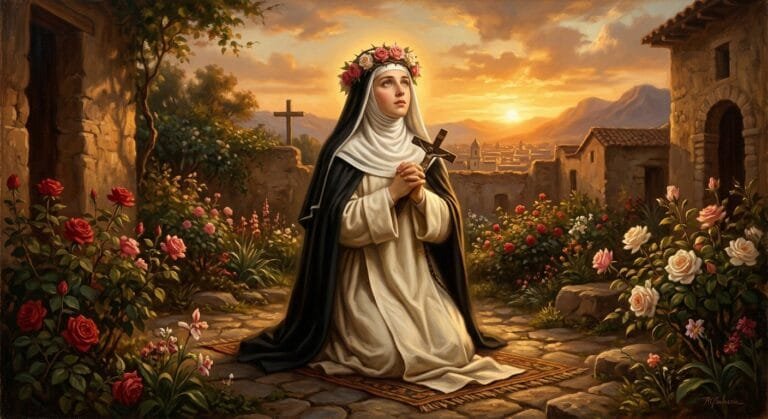
The daily query of what holiday is today or orthodox church calendar inspires millions of Christian households to align their days with sacred traditions, biblical meditations, and spiritual vigilance. Today, August 23, the Christian Church commemorates Saint Irenaeus, Bishop of Lyons (Eastern tradition) and Saint Rose of Lima, Virgin and Patroness of the Americas (Western tradition). This day is historically set apart for prayers of wisdom, family guidance, name days, and weather signs.
Understanding the liturgical cycle allows us to realize that every single day is sanctified by the memory of a specific saint or biblical milestone. For generations, Christian families have started their mornings with prayer, as it serves as the ultimate source of spiritual stability and peace of mind. By reciting the Lord’s Prayer (Our Father) and the Angelic Salutation (Hail Mary) at the start of our day, we entrust our intellect and our daily labor into God’s caring hands, protecting our souls from anger and despair. This synergy between quiet contemplation and active labor is the heart of Orthodox and Catholic spirituality, as beautifully documented by the holy fathers of the desert in the Philokalia.
To cultivate spiritual watchfulness (nepsis) and preserve peace of mind during trials, we warmly encourage you to read the cornerstone of Eastern Christian ascetical literature: the Philokalia (Dobrotolyubiye) in Ukrainian translation by S. Matiyash, where the desert fathers expound on the purification of the mind.
Who Was Saint Irenaeus of Lyons and Saint Rose of Lima?
Saint Irenaeus of Lyons was born around 130 AD in Smyrna (modern Izmir, Turkey). He was a disciple of Saint Polycarp, who in turn was a direct disciple of Saint John the Evangelist. Thus, Irenaeus served as a living link between the early Church and the apostolic age. He subsequently became Bishop of Lugdunum in Gaul (now Lyon, France). Saint Irenaeus authored the monumental work “Against Heresies” (Adversus Haereses), where he brilliantly defended orthodox Christian doctrine against the false teachings of Gnosticism, establishing him as the father of dogmatics. Saint Irenaeus of Lyons played a foundational role in defining the theological boundaries of the early Church. In his monumental five-volume work, “Against Heresies,” he not only dismantled the complex, dualistic system of the Gnostics but also established the criteria of apostolic succession—proving that the true doctrine of Christ is preserved openly in the Church, handed down from the Apostles through the chain of bishops, rather than through secret gnosis. He was the first major theologian to formally outline the fourfold Gospel canon (Matthew, Mark, Luke, and John), arguing that just as there are four zones of the world and four principal winds, there must be four pillars of the Church supporting the faith of the world. The theological legacy of Saint Irenaeus profoundly shaped the vocabulary of Christian doctrine. He was the first to adapt Greek philosophical terms to accurately describe the mystery of the Incarnation, establishing a solid dogmatic baseline for the future Ecumenical Councils. His writings teach us that faith is not an abstract, intellectual theory (as the Gnostics claimed), but a living, personal covenant of love with Christ, expressed through daily humble acts, obedience, and unceasing prayer of the heart, reflecting the patristic instructions detailed in the Philokalia.
The Revised Julian Calendar was designed in 1923 by the brilliant Serbian astronomer and geophysicist Milutin Milanković during a pan-Orthodox synod in Constantinople. This calendar is scientifically recognized as the most accurate calendar in human history: it accumulates an error of one day only once every 43,500 years, whereas the Gregorian calendar (used by the Roman Catholic Church) errs by one day every 3,280 years. The OCU and UGCC transition to this new style corrected the astronomical discrepancy of the old Julian calendar, which currently stands at 13 days and continues to widen over time, restoring celebrations to their true astronomical and historical periods.
The Western Christian tradition on this day honors Saint Rose of Lima (1586–1617) — the first canonized saint of the Americas and the patroness of Latin America and the Philippines. Born into a poor Spanish family in Peru, she chose the path of severe penance and solitude, entering the Third Order of Saint Dominic. Rose spent her nights in fervent prayer and her days working in her garden and sewing clothes to support her family. In 1615, her powerful prayers before the Blessed Sacrament miraculously saved Lima from pirate plundering. On Palm Sunday 1617, her mystical marriage with Christ occurred when the Savior told her in a vision: “Rose of My Heart, I want you as My bride.” She was canonized by Pope Clement X in 1671. The ascetical life of Saint Rose of Lima was marked by profound bodily mortifications and heroic humility. Desiring to preserve her virginity for Christ and overcome the temptations of vanity, she cut off her beautiful long hair, rubbed pepper on her face to mar her natural beauty, and wore a concealed silver crown with sharp metal spikes on her head, mimicking Christ’s Crown of Thorns. She slept on a bed made of broken glass, stones, and bricks, dedicating her nights to the Jesus Prayer on her chotki, interceding for the salvation of indigenous peoples and the poor. Her life is a powerful testament to the watchfulness of the mind (nepsis) and continuous inner sobriety under pressure, reflecting the ascetical standards expounded in the Philokalia.
The historical significance of Saint Rose of Lima is deeply revered. When she passed away at the age of thirty-one, her fame for holiness was so widespread that her funeral had to be delayed for days due to the immense crowds of citizens, bishops, and noblemen coming to touch her coffin. Clement X proclaimed her patroness of Peru, the Americas, and the Philippines, making her the first saint of the New World. Her life of silent, hands-on charity and profound prayer stands as an eternal beacon of how a soul can become a vessel of divine love, transforming her environment through the quiet and resoluto power of faith and contemplation.
The historical significance of Saint Rose of Lima is deeply revered. When she passed away at the age of thirty-one, her fame for holiness was so widespread that her funeral had to be delayed for days due to the immense crowds of citizens, bishops, and noblemen coming to touch her coffin. Clement X proclaimed her patroness of Peru, the Americas, and the Philippines, making her the first saint of the New World. Her life of silent, hands-on charity and profound prayer stands as an eternal beacon of how a soul can become a vessel of divine love, transforming her environment through the quiet and resoluto power of faith and contemplation.
Saint Irenaeus, Bishop of Lyons (Eastern tradition) and Saint Martyr Lupp of Thessalonica. The Holy Martyr Lupp of Thessalonica lived at the end of the 3rd century and was the devoted servant of Saint Demetrius of Thessalonica. Following the martyrdom of his master, Lupp took Demetrius’s blood-stained robe and signet ring, which he used with deep faith to perform numerous miracles and physical healings of the sick in Thessalonica. For his bold confession of Christ, he was arrested by Roman soldiers and beheaded, receiving the crown of martyrdom. His life is an inspiring testament of unwavering loyalty and courage in trials.
Whose Name Day Is Today, August 23?
Today, name days are celebrated by: Irenaeus, Victor, Paul, Roman, Lawrence, Rose, John, Nicholas. Congratulate your loved ones on their saint’s day, wishing them spiritual fortitude, peace of mind, and divine protection.
Celebrating our name days on the feast day of our patron saint is a beautiful and highly beneficial tradition in Christian life. The patron saint serves as our continuous heavenly guardian and intercessor before the Throne of God, protecting our souls from doubts, pride, and temptations. Congratulating our friends and family named Andrew, Victor, or Rose is a wonderful act of Christian love and charity.
Powerful Daily Prayers for August 23
Latin Originals of Daily Prayers (Pater Noster and Ave Maria) help us experience a deeper spiritual connection with the centuries-old liturgical heritage of the universal Church:
The Lord’s Prayer in Latin (Pater Noster):
“Pater noster, qui es in caelis, sanctificetur nomen tuum. Adveniat regnum tuum. Fiat voluntas tua, sicut in caelo et in terra. Panem nostrum quotidianum da nobis hodie. Et dimitte nobis debita nostra, sicut et nos dimittimus debitoribus nostris. Et ne nos inducas in tentationem, sed libera nos a malo. Amen.”
Angelic Salutation in Latin (Ave Maria):
“Ave, Maria, gratia plena, Dominus tecum. Benedicta tu in mulieribus, et benedictus fructus ventris tui, Iesus. Sancta Maria, Mater Dei, ora pro nobis peccatoribus, nunc et in hora mortis nostrae. Amen.”
3. Prayer to Saint Irenaeus of Lyons for Faith and Wisdom
“O Holy Father Irenaeus, great Defender of the Church and guardian of the apostolic tradition! You who manfully fought against false teachings to preserve the pure light of the Gospel. Ask our Lord to grant us the spirit of wisdom, discernment, and steadfastness in the True Faith, protecting our minds from doubt and our hearts from pride. Amen.”
Communal Prayer in the Comments: Unified in Faith
The combined prayer of believers has extraordinary power by Christ’s promise: “For where two or three are gathered in My name, there am I in the midst of them” (Matthew 18:20). We invite you to join our communal prayer circle:
- Leave the names of your loved ones in the comments section below, asking for Saint Rose’s protection. For example: “Saint Rose of Lima, protect my children Eugene and Rose from all visible and invisible harm today, and grant them a pure heart.”
- Other Christians visiting pray.ee will see your request and reply with a sincere ‘Amen’, magnifying the prayer before the Throne of Grace.
Free Downloads of Prayer Booklets for August 23
For your convenience, we have prepared high-quality prayer booklets containing these prayers in large, readable fonts. You can download them free of charge for printing or offline reading on your mobile device:
Frequently Asked Questions (FAQ)
Who was Saint Irenaeus of Lyons?
He was a prominent 2nd-century bishop of Lyons (France), disciple of Polycarp, and foremost theologian who defended apostolic doctrine against Gnosticism.
Why is Saint Rose of Lima highly celebrated?
She was the first canonized saint of the Americas (Peru), known for her extreme ascetical life, her mystical marriage with Christ, and saving Lima from pirates.
Whose name days are celebrated today, August 23?
Today, name days are celebrated by Irenaeus, Victor, Paul, Roman, Lawrence, Rose, John, and Nicholas.
Sources and Canonical References
1. Orthodox Church of Ukraine Portal — Life of the Holy Hieromartyr Irenaeus of Lyons. Available at: pomisna.info.
2. Saint Archangel Michael Parish Portal — Liturgical calendars and histories of early Church Fathers. Available at: parafia.org.ua.
3. Saint Rose of Lima and Dominican Spirituality — Historical essays in CREDO Journal. Available at: credo.pro.