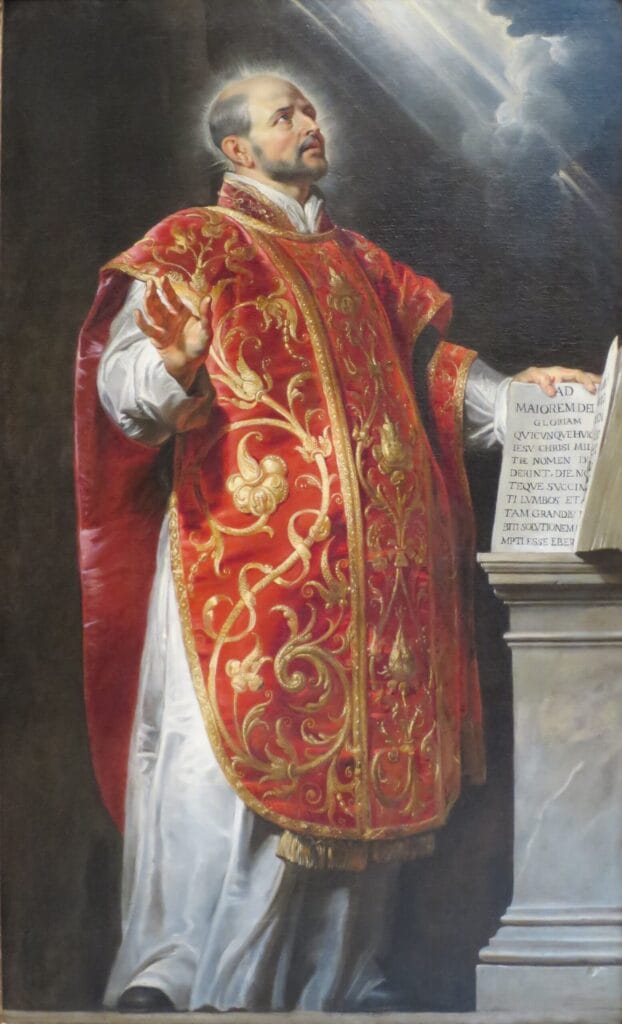
Ignatius of Loyola – “Spiritual Exercises” (Exercitia spiritualia)
SPIRITUAL EXERCISES
FOR A BETTER UNDERSTANDING OF SPIRITUAL EXERCISES THAT HELP BOTH THE PERFORMER AND THE PERCEIVER
1
First note . Under the name of Spiritual Exercises is understood every method of examination of conscience, reflection, contemplation, prayer of speech and thought, and other spiritual actions, as will be said later. For as bodily exercise is: walking, walking, running, so is every method by which the soul prepares and disposes itself for its liberation from all disordered passions, and if they are destroyed, for seeking and obtaining the will of God concerning the order of its life and for the salvation of its soul .
2
Second Note . He who teaches another method and order for reflections or contemplations, must faithfully convey the content of this contemplation or contemplation and put forward its main points, accompanying them with brief and necessary explanations. Because the contemplator, having received the basis [of knowledge of their content], begins to reason and draw conclusions for himself, and thus finds something, something that better explains [416] the meaning of the event or makes it more interesting, either through his own thinking, or under the influence of the grace of God that illuminates his mind. This will bring him more spiritual pleasure and benefit than if the teacher of the Exercises were to explain a lot and expand the meaning of the story. For it is not abundant knowledge that nourishes the soul and satisfies it, but the inner feeling of the thing and the pleasure in its content.
3
Third Note : Since in all the following Spiritual Exercises we use the mind when we reason, and the will when we love, it should be noted that in the actions of the will, and when we speak verbally or mentally with the Lord our God, or with his saints, more reverence is required on our part than in the action.
4
Fourth Note . The following Exercises are divided into four Weeks, according to the four parts into which the Exercises are divided. The first of these parts is resolved by the contemplation of the reflection on sins; the second is the life of our Lord Jesus Christ up to and including the day of Palm Sunday; the third is the sufferings of Christ our Savior; the fourth is the Resurrection and Ascension, with the addition of three images of the performance of the prayer.
yours. However, it should not be assumed that each Week must necessarily consist of seven or eight days. It may happen that some in the Exercises of the first Week will be slower in obtaining what they seek, that is, the breaking of heart, repentance and weeping for their sins; some will also be more diligent than others; others will suffer greater anxiety or attacks from various spirits – as a result of which it is necessary sometimes to shorten the Week, sometimes to increase it. The same should be done with regard to the following weeks, collecting their results according to the proposed content. [417]
However, all exercises should be completed within approximately thirty days. 5
Fifth Note : It is very beneficial for the manager to approach them with magnanimity and generosity towards his Creator and Lord, sacrificing all his will and freedom to Him, so that His Divine Majesty may have according to His holier will both them and all that he has.
6
Sixth Note : When the director notices that the practitioner does not feel any spiritual movements, whether of joy or sorrow, and is not influenced by the various spirits, he should carefully question the practitioner about the Exercises; whether he does them at the appointed time and in what manner, and whether he observes them diligently.
all the “additions” he must demand an account of each of these things. As for spiritual comforts and sorrows, this will be said in the “Rules for Discerning Spirits” and in the “Appendices” (at the end of the first Week).
7
Seventh Note . When the leader notices that the skilled one is giving in to [the feeling of] abandonment and temptations, let him beware of severity and harshness in his treatment of him, but rather let him be kind and friendly towards him; let him encourage him and strengthen him for further work, revealing to him the tricks and cunning of the enemy of the human race and encouraging him to prepare for the near consolation.
8
Eighth Note : According to the need that he notices in the adept, the leader can tell him about abandonment and about satanic tricks or about pleasures , he can explain to him the “Rules for Discerning Spirits” specific to the first or second Week.
9
Ninth note . It should be noted that if a person who is not refined in spiritual matters is capable of giving in during the first week to gross and obvious temptations, for example, he encounters obstacles in the fear of work, in false shame or in worldly honor, etc., to go further with his hand in the service of the Lord, the spirits of the second week, because insofar as the rules of the first week will be useful to him, the rules of the second week will be harmful to him, because their content is too subtle and sublime, and [therefore] cannot be known by him.
10
Tenth Note : When the director notices that the adept is oppressed or tempted by an evil spirit under the guise of good, this is the proper moment to explain to the adept the rules of the second week, for usually the enemy of the human race tempts under the guise of good when they enter the Exercises of the second week corresponding to
a life of illumination (vita illuminativa), and not a life of purification (vita purgativa), which is characteristic of the first Week of Exercises.
– 2 –
11
Eleventh Note . It is very useful for the manager during the first week not to know at all what he is to do in the second; and he should thus labor to obtain the fruits of the first week, if he had no hope of finding anything in the second.
12
Twelfth Note . Each of the five daily exercises or contemplations should last one hour . The director should persuade the exerciser to remove from himself the idea that he has devoted a whole hour to the Exercise; he should rather increase the duration of the Exercise than reduce it, for the tempter usually tries to make us shorten the time allotted to contemplation, reflection, or prayer.
13
Thirteenth Note . It should be noted that while it is pleasant and easy to spend an hour in contemplation during pleasure, it is so difficult when one is abandoned. Therefore, in order to counteract abandonment and overcome temptation, one must rightly set aside a little more time than is necessary, in order thus to be able not only to withstand the onslaught of the enemy, but even to overcome him.
14
Fourteenth Note . When the director notices that someone who is training is enjoying the pleasures of the arena and is very enthusiastic, he should warn him not to bind himself hastily and rashly with any promise or vow. And the more lively the character of the trainee, the more often the director should renew his warnings. For it is quite lawful to direct someone to the monastic life with vows of poverty.
wisdom and obedience; and every good deed done by promise is joined with greater grace than that done without promise. However, it is necessary to carefully consider the conditions [of life] and the qualities of the person, as well as the help or hindrances he will encounter in performing what he would like to promise.
15
Fifteenth Note . The director should not incline the exerciser to poverty, or to any other vow, or vocation, or way of life, as he prefers one to another. For it is permissible and praiseworthy, outside the time of the Spiritual Exercises, to instruct with advantage anyone whom we consider capable, to inspire him to choose temperance, chastity, monasticism, and every other virtue of evangelical perfection; but during the Spiritual Exercises it is incomparably better and more profound for him who seeks the will of God, if the Creator and Lord himself should reveal himself to that soul, immersing it in His love and glory, and showing it the way by which it may best serve Him. Let the leader not lean to one side or the other, but, remaining in an even balance, like the arrow of the scales, will allow the Creator to communicate and act directly with the creation and the creation with the Creator and its Lord.
– 3 –
16
Sixteenth Note . For this purpose—that is, that the Creator and Lord Himself may better influence His creation—it is necessary that the soul, if it is disorderly attached to something and feels an attraction for some thing, strive with all its might to achieve the opposite of its disorderly attachment. If, for example, it feels the desire to acquire some rank or place not for the glory of God and the salvation of souls, but for its own benefits and worldly interests, it should subdue this desire in itself with a contrary desire, striving for this in prayers and other spiritual feats, asking for this rank, place, or anything else until His Divine Majesty deigns to order its intentions and change its desires so much that the only reason for desiring and using this or that thing will be only the service, honor, and glory [dedicated] to the Divine Majesty. [421]
17
Seventeenth Note . It is very useful that the leader, although he does not seek to know the sins and thoughts of the practitioner, still be accurately aware of the thoughts and mental movements that the practitioner inspires with various spirits, so that according to the great or
less successful is the one who practices being able to teach him Spiritual Exercises that meet the needs of a soul that is indignant at thoughts.
18 a
Eighteenth Note . It is necessary to correlate the Spiritual Exercises with the capabilities of the persons who wish to carry them out, that is, with their age, education, and not to give to someone who is ignorant by nature or weak, things that are inaccessible to him, which he is unable to use. But it is also necessary to agree with the readiness, desire and goodwill of the comer; It is necessary to give him what will best serve his spiritual development.
18 b
To someone who only wants to receive instruction in his duties and to attain spiritual understanding, a “partial examination of conscience” (examen particulare) can be offered, followed by a “general examination of conscience” (examen generale). At the same time, he should be taught to devote half an hour in the morning to the first form of prayer, meditating on the commandments and mortal sins.
also advise him to begin weekly confession, and, if possible, to receive communion after two weeks, and if he has the inclination, then every week. To simple and uninitiated people, for whom the above-mentioned form of prayer is most suitable, it is necessary to explain separately each commandment of God, the capital sins, the commandments of the church, [the observance of] the five senses, and the works of mercy. [422]
18th century
Similarly, if the leader notices that he is dealing with a person who is naturally not very gifted and does not give hope of achieving great success, it is better to give him the two easiest exercises until he confesses his sins, and then teach him some methods of examining his conscience and give advice more often.
to preserve what has been received; but one should not touch upon the choice of vocation and subsequent Offices outside the first Week; especially if one can profitably engage in other exercises and there is not enough time for everything [the rest].
– 4 –
19
Nineteenth Note . A person engaged in public affairs, or who has some important occupation, gifted with knowledge or talent, can be given the Spiritual Exercises, so that he devotes an hour and a half a day to them. First of all, it should be explained to him for what man was created; during half an hour, the partial and then the general examination of conscience and the image of the worthy performance of confession and communion of the Holy Mysteries can be explained to him. Let him meditate hourly, for three days, on the first, second and third sin; then for three days, also hourly, let him meditate on his own sins, and on the next three days – on the punishment for sins. During all these meditations, ten “Additions” should be given to him. After that, the mysteries of the life of Jesus Christ should be presented to him, using the method and order set forth below in the Spiritual Exercises themselves.
20 a
Twentieth Note . A person who is free from work and wants to achieve as much success as possible should give the Spiritual Exercises in full, in the order in which they are here composed. Generally speaking, the one who exercises will receive the more spiritual benefit the more he withdraws from all friends and acquaintances and from all earthly cares, for example, moving from the house where he lives to another house or room, so as to be alone and have the opportunity to attend the liturgy and evening service daily.
20 b
This solitude, among other advantages, will bring him a triple good. First, a person, by distancing himself from friends and acquaintances and from current, unorganized occupations, in order to serve God and glorify Him in this way, acquires merit in the eyes of the majesty of God. Second,
living alone and not having a scattered attention, absorbed in a multitude of things, but directing all his diligence to the service of the Creator and the perfection of the soul, he can more easily use his natural gifts, freely directing his forces to achieve the desired goal. Thirdly, the more the soul is secluded and separated, the more it becomes capable of approaching and uniting with the Creator; and the more it truly approaches Him, the more it becomes capable of receiving gifts and grace from His Supreme and Divine goodness.
– 5 –
21
SPIRITUAL EXERCISES
SO THAT [ MAN ] MAY BE ABLE TO OVERCOME HIMSELF AND ORDER HIS LIFE BY THE POWER OF A DECISION , FREE FROM ANY UNGENERAL PACKAGING
22
In order that both the leader and the one being trained may benefit from the exercises, it should be noted above all that every pious Christian should try to interpret in a positive sense the judgment expressed by his neighbor rather than condemn him; if he cannot justify him, he should ask his neighbor to explain how he understands his opinion; if he is mistaken, he should lovingly correct him; and if this also proves insufficient, he should use all appropriate means to influence his neighbor and lead him to the knowledge of the truth and salvation.
23
BEGINNING AND BASIS
Man was created to praise the Lord his God, to honor and serve Him, and thereby to save his soul. Yet the rest that is on earth was created for man’s sake, to help him achieve the goal for which he was created. From this it follows that man should use all created things to the extent that they help him in achieving his goal, and should renounce them to the extent that they hinder him in this.
It is therefore necessary to become as dispassionate towards all creatures as our free will permits and does not prohibit; so that we do not desire health rather than sickness; wealth rather than poverty; honor rather than humiliation; a long life rather than a short one; and in like manner in all other things, desiring and choosing in unity that which leads us better to the end for which we were created.
24
PARTIAL AND DAILY BAG TESTING
covers three points in time and occurs twice a day
The first time is in the morning, when a person gets out of bed; then one should immediately resolve to diligently avoid a certain sin or imperfection from which one wishes to get rid of. [425]
25
The second hour after dinner. At this time a person should ask the Lord our God for what he desires, that is, to know the light of grace and remember how many times he has fallen into sins of weakness, which he wants to get rid of, and pray to correct himself. Then let him make a new test, demanding from his soul an account of the defect which he is trying to correct. And so, reviewing [the whole day] hour by hour, or action by action, starting from the moment he got out of bed, until the time of the real test. Then let him put on the first line (see the diagram attached) as many points as
– 6 –
how many times he has fallen into the said crime or weakness; and let him again resolve to reform himself before the next examination of conscience.
26
The third time is after supper. Then the second test takes place: an hour-by-hour report is also required, from the time of the first test to the present. After this, as many points are placed on the second line of the chart as there were falls into this weakness or sin; this can be done imperceptibly, even in the presence of many people.
27
There follow four Additions , useful for the speedy deliverance from a given sin or weakness. First Addition : If you fall into this sin or weakness, put your hand to your chest, regretting your fall; [426]
28
Second addition : Since the first line of the diagram indicates the first test of conscience, and the second the next, then, when going to sleep, you need to see if there is any noticeable success, expressed by the length of the second line relative to the first, that is, the second test compared to the first.
29
Third addition : [It is necessary] to compare the second day with the first, that is, the two trials of the present day with the two trials of the previous day, and see if there is success in self-correction.
30
Fourth Addition : Compare one Week with another and see if this Week’s correction is greater than the previous one.
31
In the attached diagram, the first capital G means Sunday, the second small G means Monday, the third means Tuesday, etc.
32
FULL TESTING OF THE BAG to cleanse it and make confession better
I begin with the premise that a person has thoughts of three kinds: the first are their own, occurring solely from their free will, the second and third are inspired from outside by good and evil spirits.
– 7 –
33
ABOUT THOUGHTS
If a sinful thought comes from without, then there are two ways to obtain grace. For example, a thought of committing a mortal sin comes [427] and the person immediately cuts it off. And in this way the thought is defeated.
34
Secondly, when the same evil thought comes and the person resists it, but it returns again and again, and the person resists it again until he is overcome. This is the second way, [worthy of] even greater grace.
35
A venial sin occurs when the thought of committing a grave sin occurs, a person listens to it, dwells on it for a while, or finds some pleasure in it, or simply allows inaction in the fight against it.
A capital crime can be committed twice.
36
The first way : A person accepts an evil thought in order to then act in accordance with its impulse, or proceeds to the action itself if the opportunity presents itself.
37
The second way : to commit a mortal sin: The actual execution of a sinful intention; this is an even greater sin than the previous one, for three reasons: first, because the sinfulness of the act lasts longer; second, because the will participates more strongly in the sin; third, because in this case [the sinner] and his accomplice do themselves greater harm.
38
ABOUT WORDS
One should not swear by either the Creator or the creature, and only to confirm the truth, for real need, and with reverence. It is necessary to consider that when an oath confirms not some truth, but one that has an important bearing on the soul, or on health, or on temporal goods. As for reverence, it requires that when pronouncing the name of the Creator and Lord, attention be paid to the religious reverence proper to it.
And now I’m starting to work.
– 8 –
39 a
It must be said that although, on the one hand, perjury is a great sin, and especially when one swears by the Creator and not by the creation, on the other hand, when one swears by the creation and not by the Creator, it is more difficult to observe the necessary conditions of an oath, that is, truth, true need, and goodness.
39 b
First , if we swear by creation, then the very name of creation does not arouse in us the same attention or caution in attesting to the truth that is associated with an oath in the name of the Creator .
39th century
Secondly , it is more difficult for a person to give reverent honor to the Creator when the oath is taken in the name of creation, and not in the name of God and the Lord. For the proclamation of the name of the Lord God will cause more reverence and respect than the proclamation of the name of a creature. According to this
Therefore, it is possible to swear by an animal more perfect than by an imperfect one; for the perfect, by contemplation and enlightenment of the mind, are more accustomed to notice and revere God, present in all creatures by His Essence and Omnipotence, and thereby they are more capable and better prepared to swear by the honor due to God than the imperfect. [429]
39 g
Thirdly , the constant oath by creation exposes the imperfect to the danger of idolatry more than the perfect.
40
One should not speak an empty word, that is, one that neither the speaker nor anyone else brings anything and has no purpose to bring anything. If a person speaks about objects that serve or, in his opinion, should serve his soul or the soul of his neighbor, the body or temporal goods, then this is not idle talk, even if he speaks about things that do not
according to his condition. For example, if a monk spoke about war or trade. But there is grace in this, if the speech is directed to a good purpose, and sin – if it is directed to an evil purpose or to vain talk.
41
One must avoid all slander and gossip in speech; for example, if someone proclaims someone else’s mortal sin, unknown to him, he sins mortally; if he is forgiving, he sins forgivingly; if he reveals someone else’s shortcoming, he reveals his own shortcoming.
If the intention is good, then it is permissible to speak about the sin or weakness of another in two cases:
First , if the crime is well known, as, for example, the crime of a public lady; or a sin proven by a court of law; or a social error which poisons the souls of those to whom it concerns.
– 9 –
Secondly , if the sin is secret, but is communicated to another for the purpose of dissuading or dissuading the sinner; however, there must be confidence or reason to hope that this help will be useful. [430]
42
ABOUT THE CASE
Take for self-examination the Ten Commandments of God, the rules of the Church and the decrees of the superiors. Every act that violates any of these three [obligations] is a greater or lesser sin – judging by the type of act. By decrees of the superiors I understand, for example, “bulls of the cross” and other letters of indulgence (Indulta), for example “for the sake of peace”, which are [granted] to those who begin the rites of repentance and Holy Communion. And it is no small sin if someone speaks or gives another a reason to speak against such pious orders and advice of our superiors.
43
METHOD OF COMPLETELY TESTING THE SUM ,
consisting of five points
First point : To thank the Lord God for the blessings received. Second point : To ask for grace to recognize one’s sins and to be cleansed from them.
Third point : Demand an account from your soul, first in thoughts, then in words, and finally in actions, reviewing in order the past time, or individual actions, from the moment of awakening to the real examination of conscience, as indicated in the partial examination of conscience.
Fourth point : It is sad to ask the Lord God for forgiveness of our sins.
Fifth point : Resolve to correct with the help of God’s grace. Conclude with the Lord’s Prayer . [ 431 ]
44 a
FULL CONFESSION AND PROVISION OF THE HOLY MYSTERIES
Making a full confession during the Spiritual Exercises, not out of necessity, but of one’s own free will, in addition to many other advantages, brings three benefits:
First , although one who confesses every year is not obliged to make a full confession, he will nevertheless have great grace if he does so, because he will do so with great sorrow for all the sins and vices of his entire life .
– 10 –
44 b
Secondly , since during the Spiritual Exercises a person becomes better acquainted with his sins and understands their heinousness more deeply than at other times when he is not so much occupied with spiritual matters, such a confession, made with great knowledge and with great contrition, will bring greater benefit and merit than the previous ones from those who were in the past.
44 in
Thirdly , as a result of this better confession , the person will be better prepared to receive the Holy Mysteries worthily, and this sacrament not only strengthens the person from falling into sin, but also supports the growth of grace in him. Such a full confession is best made immediately after the exercises of the first week. [432]
FIRST WEEK
45
FIRST EXERCISE
is a meditation with the help of the three faculties of the soul on the first , second, and third sin . In addition to the preparatory prayer and two introductions , this meditation contains three main points and one conversation
46
The preparatory prayer is a matter of grace from the Lord God, so that all my thoughts, actions, and deeds may be directed solely and exclusively to the service and glory of His Divine Majesty.
47
First introduction : A kind of creation of a place. If the reasoning or contemplation concerns something visible, such as, for example, events from the life of Jesus Christ, then the introduction will give a clear and distinct idea of the place where what I want to contemplate is located.
For example, a temple or a mountain where Jesus Christ or the Mother of God is located, according to the topic of reflection.
In reasoning about an invisible object, as in this case about sins, the representation of the place will be as follows: imagine your soul in mortal flesh, as in a prison, and yourself with soul and body, as if an exile in this valley, among fierce beasts. [433]
48
Second Introduction : Demanding from the Lord God what I want and desire from true contemplation. This request must correspond to the content of the contemplation; contemplating the Resurrection, one must ask for joy with the risen Christ; when contemplating the sufferings of the Lord, one must ask that I weep and suffer with the suffering Jesus. Here, in contemplating sins, I must ask that shame and disgrace befall me, seeing how great the number of those condemned for one mortal sin alone was, and how often I deserved eternal condemnation for the multitude of my sins.
– 11 –
49
Before each contemplation or meditation, one should always perform a preparatory prayer, which does not change, and the two aforementioned introductions, which change according to the content of the meditation.
50
First point : To recall in memory the first sin, that is, the sin of the angels; then to apply the mind, reflecting on this sin; finally, to apply the will to all this, to think and understand all this, to shame and reproach myself more, comparing the multitude of my sins with the one single sin of the angels; and if for one sin they were cast into hell, how many times have I deserved it for such a multitude of sins. I said: to add memory to the sin of the angels, this means to remember how they, being created in the grace of God, did not want to use their free will to worship and obey their Creator and Lord, but fell into pride, from the state of grace passed into impiety and were cast down from heaven to hell … And so on, to analyze this more thoroughly with the mind. [434]
51
Second point : To do the same, that is, to exercise the three faculties of the soul, [contemplating] the sin of Adam and Eve, remembering how long they repented for this sin, and how great the damage that befell the human race, and how many people went to hell. I said: to bring to mind the second sin, that is, the sin of our first parents; [to remember] how Adam was created in the valley of Damascus and settled in the earthly paradise, how Eve was created from his rib, how they were forbidden to eat from the fruit of the tree of knowledge, and how, having tasted it, they thus sinned, how they were then clothed in skins, and expelled from paradise, and were expelled from paradise. spent their whole life in many labors and constant repentance. Then to consider all this in thought and use the will, as was indicated above.
52
Third point : Do the same with regard to the third sin, that is, the sin of a certain man who, for one mortal sin, went to hell; and a multitude of other men perished for a smaller number of sins than mine. I say: one must do the same with regard to the third, private, sin; that is, remember the gravity and evil of the sin committed against one’s Creator and Lord; judge with reason that, by sinning in this way and acting contrary to infinite good, man was justly condemned to eternal punishment; and finish this with the assistance of the will, as was said above.
53
Conversation . Having presented Christ our Lord, crucified on the cross, one must enter into a heartfelt conversation with him: ask him how, being the Creator, [435] reduced himself to become man, and for my sins descended from eternal life to temporal death [and to such a death]. In the same way, addressing myself, I must ask myself:
What have I done for Christ? What am I doing for Him now? What more must I do for Him? And so, seeing Him [suffering] and crucified, I must consider all that will unfold before me.
– 12 –
54
The conversation should be conducted in one’s own understanding, as a friend speaks to a friend, or as a servant to his master, sometimes asking for some favor, sometimes accusing oneself of something bad, sometimes reporting one’s affairs [thoughts, doubts, intentions, the state of one’s soul], and in everything asking for advice. At the end, one should recite the Our Father .
55
SECOND EXERCISE
consists of reflecting on one’s sins ; it contains , after a preparatory prayer and two introductions , five points and one conversation
Prayer . The preparatory prayer is the same.
First introduction : Presentation of the place, as in the first Exercise.
Second Introduction : A request for what I desire; here I will ask for great and deep sorrow and for tears of sorrow for my sins.
56
First point : To review one’s sins, that is, to remember all the sins of one’s life, reviewing them year by year or by separate periods of time. This is facilitated by three things: first of all, to imagine the place and house where one lived; then the relationships one had with others; and finally the occupations and duties one had. [436]
57
Second point : Weigh sins, looking into the abomination and malice that every mortal sin contains, even if it was not forbidden.
58
Third point : To dwell on oneself, reflecting on one’s own nothingness, belittling oneself with the help of examples; first, what am I compared to all men; second, what are men compared to all the angels and saints in heaven; third, what is all creation compared to God, and finally, what will I be alone compared to Him? Fourth, to look closely at all the corruption and filthiness of one’s flesh; fifth, to imagine oneself, especially the soul, as a wound and ulcer from which so many sins, wrongdoings, and such vile poison have flowed.
59
Fourth point : To consider who God is [against whom I have sinned]; for this I must reflect on His perfections, contrasting them with my opposite qualities: His wisdom with my ignorance. His omnipotence with my weakness, His justice with my injustice, His goodness with my malice.
– 13 –
60
Fifth point : A rush of astonishment that [came from the depths of my soul]. With deep feeling I will go through all creation in my thoughts, asking them: how could they tolerate me during my life, and still support it; and the angels, being as it were the swords of God’s justice, how could they long
to bear with me, to protect me, and to pray for me; and how the saints could claim me; and the sky, the sun, the moon, the stars , the elements, the plants, the fruits, the birds, the fish, and the animals all served me instead of rebelling against me; and how the earth did not open up to swallow me up, forming a new hell in which I should suffer eternally.
61
To conclude [the Exercise] with a conversation, extolling the mercy of God; reflecting and expressing blessings to the Lord God for having preserved my life up to this moment, and daring to correct myself in the future with the help of His grace. Our Father .
62
THIRD EXERCISE
is a repetition of the first and second Exercises with the addition of three conversations
After the preparatory prayer and the two introductions, I must repeat the first and second exercises, stopping and lingering on those points in which I felt the greatest comfort or abandonment, or in general a strong spiritual movement. After which I will briefly conduct three conversations:
63
The first conversation is with our Lady, the Theotokos, that She may ask for three [gifts] of grace from Her Son and Lord: first, that I may receive an inner knowledge of my sins and aversion to them; second, that I may feel the disorder of my
actions, so that, struck by it, I may correct myself and put myself in order: thirdly, so that I may know the world and, turning away from it, depart from all worldly and vain things. At the end, read Bo goroditse Divo .
The second conversation is with the Son of God, that He may send me these three gifts from the [Heavenly] Father. Conclude with the prayer Soul of Christ . [438]
The third conversation [is carried out] with a prayer to the eternal Father, that He Himself may grant me these gifts. Then recite the Our Father .
64
FOURTH EXERCISE
there is a repetition of the third
I say repetition, so that the thought, without straying from the subject, consistently recalls all that was considered in the previous Exercises. Finish by carrying out the same three conversations.
– 14 –
65
FIFTH EXERCISE
is a reflection on hell and contains , after a preparatory prayer and two introductions , five points and one conversation
The usual preparatory prayer .
First introduction : Representation of the place. Here you should imagine the length, width, and depth of hell.
Second Introduction : A request for what I desire; in this case I must ask for an inner understanding of the punishments suffered by the lost, so that at least the fear of punishment may keep me from sinning, if because of my crimes I have forgotten the love of the Lord God.
66
First point : Imagine in your mind huge tongues of flame, and the souls [of the condemned] as if imprisoned in red-hot bodies.
67
Second point : To hear reproaches, weeping and cries, a recounting of the curse of Jesus Christ and His saints. [439]
68
Third point : Smell the smoke, sulfur, decomposition, and rot. 69
Fourth point : To feel bitter tears, sorrow, and remorse within. 70
Fifth point : Imagine that we ourselves feel this fire, how it touches souls and burns them.
71
Conversation with Christ our Lord: to remember the souls who are in hell; some because they did not believe in His coming; others because, having believed, they did not act according to His commandments. I divide all these souls into three groups: the first is those who died before the coming of Christ; the second is those who died during His life; the third is those who died after His stay on earth. Here we should thank the Lord for not allowing me to end my life in one of these three groups. We should also thank Him for having treated me with such kindness and mercy up to this day. I will end the conversation by reciting the Our Father.
– 15 –
72
Note : The first Exercise is performed at midnight; the second in the morning, immediately after rising from bed; the third before or after the Divine Liturgy, but generally before noon; the fourth during Vespers; the fifth an hour before dinner. This order [of time] must be observed more or less exactly throughout the four weeks, since the age, mental disposition, health, and strength of the practitioner can withstand no more than five exercises. [440]
73
ADD ,
to better do the Spiritual Exercises and more fully find what you seek
First supplement : When you go to bed, before you fall asleep, meditate for a time [sufficient to recite] the prayer to the Virgin Mary , at what hour you should get up and for what purpose; and then make a mental review of the Exercise you are to perform.
74
Second addition : When you wake up, you should not give place to extraneous thoughts, but immediately turn your attention to the topic of the first reflection, [produced] at midnight, arousing in yourself shame for the multitude of your sins and giving yourself such examples: how great shame would be embraced by a certain knight who stands before the king and all the king and all the king from whom he previously received so many favors and benefits?
The same is true when performing the second Exercise: one should imagine oneself in chains, as if a great sinner who must appear before the eternal Judge. An example of this can be prisoners who have deserved the death penalty and appear in chains before the temporal judge; and with these or similar thoughts, according to the content of the reflection, one should clothe oneself.
75
Third supplement : Before beginning your meditation or prayerful contemplation, stop two or three steps from the place designated for this Exercise, and after standing for a few minutes, as is necessary for reciting the Our Father , raise your mind to Heaven and think of [441] the Lord who is there and watches your every step, and bow in humility.
76
Fourth addition : Begin meditation either on your knees, or lying on the ground, or facing the sky, or sitting, or standing, constantly striving for what you want to find.
Here you should pay attention to two things: first, if you find that it is more comfortable for you to kneel, then you do not need to change the position, the same way if [it is more convenient to perform the Exercise] lying down or in another position. Second, if in any
– 16 –
If you find what you are looking for in a point of the Exercise, stay there until you are completely satisfied, without worrying at all about moving on [to another point].
77
Fifth Addition : Within a quarter of an hour after the Exercise, sitting or walking around the room, analyze the perfect contemplation or reflection; if it was bad, then seek the cause of the failure and, having found it, grieve [in spirit] to correct it in the future; if it was successful, then thank God and do the same another time.
78
Sixth addition : Do not desire to think about cheerful and joyful things, for example, about the glorious Resurrection of Christ, etc., because if you want to feel sorrow, sadness and tears about sins, then every joyful thought will prevent this, then have before your eyes, then have before your eyes. Rather remember death and condemnation.
79
Seventh addition : For the same purpose, eliminate daylight by closing the windows and doors if you are in your room , excluding the time when it is necessary to say prayers, read, or eat or write.
80
Eighth addition : Do not laugh or say anything that would cause laughter. 81
Ninth addition : Keep your gaze down, except when you are welcoming someone or saying goodbye to someone you have to talk to.
82
Tenth Appendix : Penance. It is divided into external and internal; the internal consists in sorrow for sins with a firm resolution not to repeat them or any other sins; external repentance, which is the fruit of the internal, consists in the punishment [epitimia] for sins committed and is offered in three ways.
83
The first image [of penance] concerns food; it should be noted that the renunciation of excesses is not penance, but only moderation. Penance occurs when we deprive ourselves of what our very nature requires, and the more we do this, the greater and better the penance will be, so that the body does not suffer harm and great weakness does not occur.
– 17 –
84
Another way of penance concerns sleep and the bed. It includes not only the renunciation of unnecessary comforts, but also of something that is necessary for a night’s rest; and the more we deprive ourselves, the better, lest we do harm to the body and fall into weakness. Therefore, one should not deprive oneself of a proper amount of sleep, except in the case of someone who has a bad habit of sleeping for a long time. Such a person should be gradually accustomed to a moderate amount [of sleep].
85
The third form of penance concerns the body, so that it may feel the pain caused by wearing a hair shirt, ropes, or iron chains, by self-flagellation, by wounding, or by other mortification of the flesh.
86
In general, the most suitable and safest images of penance seem to us to be those that cause pain in the flesh, not in the bones, and cause only suffering, not disease. Therefore, it is better to use thin ropes that cause only external pain than something else that can cause internal disease, which can be very serious.
87
Note one . It should be noted that external repentance exists mainly for a threefold purpose:
1) to correct past sins;
2) for victory over oneself, so that all the sensual aspects of our nature may be subject to reason; 3) to ask for and obtain the grace or gift one desires, for example, sorrow for sins or abundant tears over them, or over the sufferings of Jesus Christ, or in order to receive enlightenment in some doubt in which one is in.
88
Note Two . It should be noted that the first and second supplements refer exclusively to the Exercises performed at midnight and early in the morning; the fourth [supplement] is never to be used in church, in front of others, but only in oneself, in solitude. [444]
89
Note three . If the practitioner cannot find what he seeks, for example, tears, spiritual comforts, then it is recommended to make some change in the way of life (sleep, food), or in something else related to repentance, for example, to practice repentance for two or three days, and during the following days: one should use repentance more, the other less. It often turns out that we evade repentance because of sensual love for ourselves and the mistaken idea that our nature cannot endure it without considerable harm to health; sometimes, on the contrary, we do too much in the belief that the body will withstand everything. Therefore
– 18 –
The Lord God, who knows our nature infinitely better than we do, often makes it clear to everyone during such changes what is needed for it.
90
Note Four : A partial examination of conscience should be made to eliminate absent-mindedness and negligence in the exercises, and also in the use of supplements; the same [should be] done during the second, third, and fourth Weeks. [445]
SECOND WEEK
91
THE CALL OF THE KING OF EARTH ,
which helps in contemplating the life of the King of Heaven
The usual preparatory prayer .
First introduction : Imagining the place. Here it is necessary to visualize the synagogues, cities, and villages through which Jesus Christ passed while preaching.
Second Introduction . Ask the Lord for the grace by which I seek. Here I ask for His grace, that I may not be deaf to His calls, but quick and diligent in fulfilling His most holy will.
92
First point : Imagine some earthly king, chosen by God himself, whom all Christian princes and peoples must respect and obey.
93
Second point : Imagine yourself as someone who listens to this king addressing all his subjects, saying: My will [is] to subdue the infidels of the whole earth; and whoever wishes to go with me must be content with the same food, the same drink, and the same clothing as I. Like me, he must work and watch at night, and in everything else be in labor with me, so that he may then be a partaker with me in victory. [446]
94
Third point : Think about what loyal subjects should answer such a generous and kind king? And, conversely, he who rejects the appeal of such a king will deserve universal contempt and in the eyes of all people will appear to be a cowardly warrior.
95
The second part of this Exercise consists in applying the above example of the earthly king to our Lord Jesus Christ, according to the following three points.
First point : If the address of an earthly king to his subjects is worthy of attention and execution, how much more worthy of attention should we see our Lord Jesus?
– 19 –
Christ, the eternal King, who calls upon the whole world and every person, saying: My will is to conquer the whole world and all My enemies, and thus enter into the glory of My Father; and therefore he who wants to follow Me must work with Me, to participate in [My] works, to become My co-participant in glory.
96
Second point : Consider that all who have common sense and intelligence will fully offer themselves [for participation] in the work.
97
Third point : Those who are more devoted to [Christ] the King and want to excel in all service to Him, the eternal King and Lord of the universe, will not only give themselves completely to [all] work, but, opposing their sensuality and carnal love of themselves and the world, have made a sacrifice:
98
O eternal Lord of all things, behold, I make my offering with Your gracious help, before the face of Your infinite goodness, testifying in the presence of Your most glorious Mother and the assembly of all the saints of the heavenly curiae. I want and desire, and this is my deliberate decision, that it may glorify You still more and serve You more fully, to be like You in bearing all insults, all insults and all poverty, in spirit and in reality, if only it pleases Your Holy Majesty to choose me and remove me.
99
This Exercise should be done twice, in the morning, upon waking, and an hour before lunch or dinner.
100
In the second and subsequent Weeks, it is very useful to read [excerpts] from “The Imitation of Christ,” or from the Gospel, or from “The Lives of the Saints.”
101
First day
FIRST VIEW
The Incarnation ; contains, after a preparatory prayer, three introductions , three points , and one discourse
The usual preparatory prayer .
– 20 –
102
First Introduction : Recall the meaning of what we are to contemplate; in this case, imagine how the three Divine Persons looked upon the world, crowded with men, and how, seeing that all were going to hell, they decided in their eternity that the second Person should become human for the salvation of the human race. And so, when the fullness of time had come, the Archangel Gabriel was sent to the Virgin Mary. [448]
103
Second Introduction : Presentation of the Place. Here it is necessary to imagine the entire vast advancement of the world, inhabited by so many and diverse peoples. Then the gaze must turn to a certain part of the world – to the small house and light of our Lady – in the city of Nazareth in the land of Galilee.
104
Third introduction : Ask for what you desire; here you need to ask for a deep knowledge of the Lord, who became human for your sake, in order to love Him more and follow Him more perfectly.
105
Note that the preparatory prayer and three introductions should be performed during this and the next Week, changing only the form of the introductions according to the content.
106
First point : Consider separately the different people. First, those who live on the whole surface of the earth, who differ so much from one another both in their clothing and appearance—some white, some black; some in peace, some in wars; some crying, some laughing; some healthy, some sick; some being born, some dying, etc.
107
Secondly , one should imagine and think about how the three Divine Hypostases look from the throne of their Majesty upon the earthly space and upon all the nations, who are in deep blindness, and see how people die and go to hell. [ 449]
108
In the third , one should see the Blessed Virgin and the angel who greets her. And resort to meditation in order to benefit from this spectacle.
Second point : Listen to the words. Listen to what people say among themselves—how they swear and blaspheme, and so on. Also listen to what the Persons of the Most Holy Trinity say: “Let us accomplish the redemption of the human race”; finally [hear] what the angel and the Most Holy Virgin say.
After that, resort to reflection to benefit from the words [spoken by them].
– 21 –
Third point : Observe actions. Reflect on what the people of the earth do; how they fight, kill, go to hell, and so on. And on what the Persons of God do: They accomplish the all-holy Incarnation and so on. And on what the angel and the Most Holy Virgin do: how the angel fulfills the duty of the sent one, and the Most Holy Virgin in humility thanks the Majesty of God.
Then resort to reflection to derive benefit from each such action, 109
Conversation . Finally, you should consider what you should say to the three Persons of the Most Holy Trinity, or to the incarnate Eternal Word, or to His Mother, our Lady; and ask according to the feelings you acquire within yourself, that you may follow the incarnate Lord and imitate Him. Read the Our Father .
110
SECOND LOOK
Christmas of our Lord
Ordinary preparatory prayer . [450]
111
First Introduction : History. A pious reflection on how, in the ninth month of her pregnancy, the Blessed Virgin left Nazareth and, accompanied by Saint Joseph and the maids and a bullock, made her way on a donkey. How they went to Bethlehem to participate in the payment of the tribute imposed by Caesar on the whole country.
112
Second Introduction : Presentation of the Place. Here one should examine the road from Nazareth to Beth Lehem, imagining its length, its width, whether it was flat or went through mountains and valleys. Similarly, one should examine the place or [more precisely] the cave of the Nativity, whether it was large or small, low or high, and how it was arranged?
113
The third introduction is the same as in the previous contemplation.
114
First point : To see in my mind [those present]—the Holy Virgin, Joseph, the maidservant, and the Infant Jesus after His birth, imagining myself an unworthy and poor servant; to contemplate them, to look at them, and with respect and, quite possibly, reverence, to serve them in their needs, as if I were really there, being, as it were, the last beggar and unworthy slave. And then to resort to reflection in order to derive benefit [from all this].
115
The second point : Listen attentively to everything they say, and then engage in internal reflection to benefit [from all this]. [451]
– 22 –
116
Third point : To carefully observe what they do, that is, how they make the journey, endure hardships, labor, how in extreme poverty the Lord is born, so that later, after great labors, having experienced hunger and thirst, heat and cold, insults and insults, they die on the cross, and all this is a cross, and all this. Then resort to internal reflection in order to receive spiritual benefit.
117
End with a conversation, as in the previous contemplation, and add the Our Father . 118
third contemplation
will be a repetition of the first and second Exercises
After the preparatory prayer and the three introductions, it is necessary to repeat the first and second Offices, paying attention to the individual most important parts during which there was some enlightenment, consolation, or abandonment. End with a conversation and recite the Our Father .
119
In this and all subsequent repetitions, the same order should be maintained as in the repetitions of the first Week, changing the content while maintaining the form.
120
FOURTH VIEW
will be a repetition of the first and second in the same way as in the previous repetition [452]
121
FIFTH VIEW
will be an addition of the five senses to the first and second
contemplation
After the preparatory prayer and the three introductions, it is useful to direct one’s five senses to the objects of the first and second contemplations in this way:
122
First point : To mentally look into individuals, considering and contemplating in particular the situations in which they find themselves, and to try to benefit from this contemplation.
– 23 –
123
Second point : Listen to what these individuals say or could say, and, turning your thoughts inward, draw some [spiritual] fruit from it.
124
The third point : To eat and smell [with the inner sense of smell and taste] the infinite goodness and delight of the divinity of the soul, its virtues and everything else, according to the person we are contemplating. Inwardly consider all this and derive [from it spiritual] benefit.
125
Fourth point : Touching thoughts, for example, hugging and kissing the places where these individuals were, always trying to gain some spiritual fruit from this.
126
Conversation . End with a conversation, as in the first or second contemplation, and recite the Our Father . [453] 127
[ NOTES ]
First : It should be noted for this entire Week and for the following ones that we should read only about those mysteries that we should directly meditate on this day and at the present time, so that the meditation on one mystery does not interfere with the meditation on another .
128
Secondly : The first meditation on the Incarnation takes place at midnight; the second in the early morning; the third during the liturgy; the fourth during vespers; the fifth before supper. Each of these five exercises should last for one hour. In the future, they should maintain the same order.
129
Thirdly : It should be noted that if one practices in old age, or is weak, sluggish, and if strong, but somewhat weakened after the first Week, it is better that in the second Week, at least from time to time, he does not rise at midnight, but performs the first meditation at dawn; one of the repetitions of these three [Exercises] is closer to vespers; finally, the addition of the senses is before dinner.
130
In the fourth : In the second Week, of the ten additions discussed in the first Mistake, the second, sixth, seventh, and partially tenth must be changed.
– 24 –
The second is this: immediately upon awakening, to reflect on the contemplation that one must perform, arousing in oneself the desire to know the eternal Word [of God] made flesh, in order to better serve and follow Him. [454]
Sixth – this: to recall the mysteries of the life of Jesus Christ, starting from His incarnation, to the point or mystery that one should now reflect on.
Seventhly , the skilled can use light or darkness, clear or bad weather, depending on what suits him best.
The tenth is this: the skilled one must handle the mysteries he contemplates; for some require repentance, others do not. Thus, with great care, all ten additions must be performed.
131
Fifth : In all Exercises, except those performed at midnight and at dawn, you must do something corresponding to the second addition, namely, before beginning the Exercise, review everything you have to do, where you will go and before whom you will appear; and briefly analyze the entire Exercise that you will do; then, having performed the third addition , begin
Exercise.
132
Second day
For the first contemplation, one should take the Meeting (see below , in the mysteries of the life of Jesus Christ ); for the second , the flight into Egypt , as it were into exile ; and for these two contemplations , make two repetitions of them and add the five senses to them in the same way as [ indicated ] for the previous day .
133
Note : Sometimes, even if the practitioner is strong and feels well (dispositus), it is useful for him to make changes, reducing the number of Exercises, from this second day to the fourth inclusive, so that he can better find what he wants. And this can only be done
One contemplation in the early morning, another during the liturgy; at [455] vespers, a repetition of them, and before supper, an addition of feelings.
134
Third day
The first contemplation of how the Infant Jesus in Nazareth was obedient to his parents ; the second is how they found him in the Temple of Jerusalem.
Again, do two repetitions and add the five senses.
– 25 –
135
INTRODUCTION
to thinking about different ways of life
[We have just] considered the example of Christ [in two different ways of life], in the first, which is the fulfillment of the commandments when He obeyed His parents; in the second, which is the achievement of evangelical perfection when He left His betrothed Father and His own Mother to devote Himself solely to the service of His eternal Father.
Now let us begin to reflect on His life and earnestly ask and pray to know in what state or in what way of life the Majesty of God desires us to serve Him.
In the following Exercise, in preparation for such [self-examination], we will see both the intentions of Jesus Christ and the goals of the enemy of the human race, and we will learn how we will achieve perfection on the path of life that God, our Lord, will offer us.
136
Fourth day
Meditations on the Two Banners , one of Jesus Christ , our greatest Leader and Lord ; the other of Lucifer , the mortal enemy of the human race . Ordinary preparatory prayer . [456]
137
First introduction : History. Here our Lord Jesus Christ calls and wants to gather everyone under the banner, and Lucifer — under his banner.
138
Second Introduction : Presentation of the place. Here we must see a vast meadow on the outskirts of Jerusalem, where the greatest Leader of all the righteous is. Our Lord Jesus Christ; and another field on the outskirts of Babylon, where Lucifer rules over the enemies [of Christ].
139
Third Introduction : To ask for what is desired here, [first], knowledge of the wiles of the leader of evil and help to protect oneself from them; [second], knowledge of the true life, which is presented to us by the greatest and true Leader, and the grace to follow him.
[ PART ONE ]
140
First point : Imagine on this vast Babylonian field the leader of all enemies, of a terrible, disgusting appearance, as if sitting on a throne made of flame and smoke.
– 26 –
141
Second point : To trace how he summons countless demons, how he divides them, some for one city, others for another, and so on throughout the world, without passing over a single country, a single place, a single person.
142
The third point : To listen to the command which he gives them; as he commands to cast nets [457] and fetters upon men: first they must tempt them with the appearance of riches, for this is the most frequent case, that they may more easily arrive at empty worldly honor [honor], and thus fall into great pride. Therefore, in the first degree there must be riches, in the second degree honor, in the third degree pride; and by these three degrees Satan leads to all other vices.
[ PART TWO ]
143
Similar to this , but from the other side – to see the greatest, true Leader – our Lord Jesus Christ.
144
First point : To see how beautiful and kind Christ, our Lord, stands on a vast flat field in the vicinity of Jerusalem.
145
Second point : To see how the Lord of the universe chooses many people, apostles, disciples, and so on, and sends them throughout the world to sow His holy teachings among people of all ages and all classes.
146
Third point : To listen to the commands which the Lord gives to all his friends and servants who are referred to this matter; as he instructs them to try to help all men, first of all by urging them to complete poverty of spirit, and if it were the will of the Divine Majesty, then to actual poverty; then to the desire of infamy and disgrace; because from these two things comes humility.
And here too there will be three stages: the first is poverty versus wealth; the second is disgrace or shame versus worldly honor; the third is humility versus pride. Through these three stages people arrive at all the other virtues. [458]
147
A conversation with the Most Holy Mother, that She may obtain for me from her Son and Lord the grace to be accepted under his banner; first in the highest poverty of spirit. And if it pleases His Divine Majesty to choose and accept me, then in real poverty; and also in enduring insults and contempt, in order to better imitate Him in this; so that I may be able
– 27 –
to endure them without anyone’s sin and without anything displeasing to the Divine Majesty. Then read the Virgin Mary .
In the second conversation , ask the Son of God to intercede for me with God the Father. After that, recite the [prayer] Soul of Christ .
Finally , ask the same Father [Heavenly] to grant me this. Read the Our Father .
148
[ Note ]
This meditation takes place first at midnight, then early in the morning; it is repeated twice—during the liturgy and at Vespers, invariably concluding with the three conversations mentioned above. The next Exercise—“The Three Men”—takes place an hour before the evening meal.
149
On the same fourth day
There is a discussion about the Three Men to choose the best one .
The usual preparatory prayer .
150
First Introduction : Narrative. Here will be told of three men; each of whom, although he acquired 10,000 ducats, did so in an impure way, not as it should be done for the love of God. They all desire to be saved and to gain peace in God, by casting off the burden and hindrance which bind them to the thing [wealth] they have acquired, and to come to God.
151
Second Introduction : Presentation of the Place. To see oneself in the presence of the Lord God and all His saints, to desire and know what one most desires of His Divine goodness.
152
Third Introduction : Ask for what you desire. Here you need to ask for grace to choose what will most serve the glory of the Divine Majesty and the salvation of your soul.
153
The first man would like to free himself from attachment to the acquired thing in order to find God in the world and secure his salvation, but until his death he makes no effort to do so.
– 28 –
154
The second man wants to be free from the same attachment, but only in such a way that what he has acquired remains with him, that is, he wants God to grant what the man himself wants; therefore, he does not dare to leave this acquired thing to go to God, although this would be best for him.
155
The third man desires to be free from attachment, but his desire is so great that he has become quite indifferent to what he has acquired, but wants to desire it or not, according to what the Lord God will put [in his heart], and this he will consider best and most suitable for the service and glory of God. In anticipation [460] of this, he wants to renounce everything in his heart, trying not to desire this or any other thing, but [to revolve around it] only insofar as the service of the Lord God prompts him to do so: that is, so that the sole desire for the better service of the Lord God inclines him to abstinence.
156
To conclude with the same three conversations that were [mentioned] after the previous reflection on Two Flags.
157
It should be noted that if we feel disgust or a feeling opposite to the desire for real poverty, and if we are not indifferent to poverty or wealth, then the eradication of such disordered attachment can be greatly helped by asking the devil for it.
food (even against natural desire), a request that the Lord God choose us for true poverty, and even to desire it and ask and beg Him for it, but only if it is for His service and for the glory of His goodness.
158
Fifth day
Contemplation of how the Lord went out from Nazareth to the Jordan and how the Forerunner baptized Him . 159
This contemplation should be made the first time at midnight, the second time in the morning; in addition, two repetitions should be made: during the liturgy and during vespers; and before supper, the addition of the five senses should be made. Each of these five Exercises should be preceded by the usual preparatory prayer and three introductions, as set forth above in the contemplation of the Incarnation and the Nativity; and should be concluded with three discourses, as in [461] the meditation on the Three Men, or according to the note at the end of the same meditation.
160
A partial examination of conscience, after lunch and after dinner, should be made regarding prostrations and negligence in exercises and supplements; and so do today and the following days.
– 29 –
161
Sixth day
Contemplation of Christ in the desert beyond the Jordan . ( The form should be kept the same as on the fifth day .)
Seventh day
How Saint Andrew and the other apostles followed Christ .
Eighth day
On the Sermon on the Mount , [ in which Christ taught ] about the eight commandments of beatitude . Ninth day
How the Lord appeared to His disciples , walking on the waves of the sea .
Tenth day
As the Lord taught in the temple .
Eleventh day
About the resurrection of Lazarus .
Twelfth day
On the Entry of the Lord into Jerusalem on Palm Sunday . [462]
[ NOTES ]
162
First Note . The contemplation of this second Week, according to the time that each one wishes to devote to it, or to progress, can be either expanded or shortened. He who wishes to expand can also take [the mysteries]: the visitation of the Blessed Virgin Elizabeth, the adoration of the shepherds, the circumcision of the Lord, the adoration of the Magi, and others… He who wishes to shorten it can omit some of the above, because, in including them, we ask that they may be contemplated more perfectly later.
163
Second note : The choice of a vocation should begin with the contemplation of how the Lord went out from Nazareth to the Jordan, that is, from the fifth day: how to make a choice of a vocation will be explained below.
– 30 –
164
Third Note : When beginning the choice of a vocation, in order to better receive and better adapt the heart to the true teaching of Christ, it is very useful to consider the following three degrees of humility, dwelling on them from time to time throughout the day and carrying out [three] conversations, as will be indicated below.
165
[ THREE DEGREES OF HUMILITY ]
The first degree of humility necessary for eternal salvation is that I should so humble myself as I can, and so humble myself that I should be obedient in all things to our Lord God. So that even if [463] I were offered the lordship of all creation [in the world], or if I were threatened with the taking of my life, I would never think of breaking any commandment of God or man, and thereby committing a mortal sin.
166
The second degree of humility is more perfect than the first and consists in the following: I have humbled myself so much that I no longer desire wealth more than poverty, honor more than contempt, a long life more than a short one – so that all this may equally serve the glory of God and the salvation of my soul. And, moreover, it will not even occur to me to commit any sin, even the smallest, forgivable, for the sake of the opportunity to gain the whole world or save my life.
167
The third degree of humility—the most perfect—contains the first and second, and in that, where the praise and glory of the Divine Majesty will be equal, for the greater imitation of Christ our Lord and the likeness [to Him] in my actions, I desire and choose poverty with Christ the poor, rather than anything, than anything, and I would rather be counted useless and foolish for the sake of Christ, Who was accepted as such by me, than be considered wise and intelligent in this world.
168
Note : It is very useful for anyone who wants to acquire this third kind of humility to practice the three conversations shown above in the meditations on the Three Men , asking that our Lord may be pleased to choose him for this third and higher humility, so that he may better follow and serve Him more fully, whether equal to or greater than this.
His Divine Majesty. [464]
169 a
INTRODUCTION TO CHOOSING A VOCATION
In every good choice on my part, the eye of my intention must be pure, looking only to the end for which I was created, that is, to the glorification of the Lord our God, and the salvation of my soul. Therefore, if I choose anything, I must choose only that it may contribute to the attainment of the end for which I was created; not subjugating or increasing-
– 31 –
subordinating the ends to the means, but [subordinating] the means to the ends. Thus, for example, many choose marriage first, and then serve God in the married state, when the service of God itself is the end. Some wish first to have benefits, and then to serve God with them.
169 b
Such [persons] do not go directly to God, but wish that God should go to [them] and respond to their disorderly preferences; and thus they make the end a means, and the means an end, putting in second place what should have been put in first. For, first, we must awaken in ourselves the desire to serve God, which is the end, and then, secondly, strive to acquire ecclesiastical benefices or marriage, if that suits us better; for this is a means to the end.
Therefore, my decision to choose or reject one or another means should be influenced only by the service of the Lord our God, His glorification, and the eternal salvation of my soul.
170
FOR LIGHTING
[ about ] what may be the subject of election , for which a reasoning is proposed , containing four points and one note
First point : It is necessary that the subject of our election be either indifferent [to us], or good in itself and be in agreement with holy Mother [our] hierarchical Church; and not be bad or unpleasant to the Church.
171
Second point : Some [things] are subject to choice that cannot be revoked; such are the priesthood, marriage, etc.; others are subject to modified choice, such as accepting a benefice or refusing it, enjoying temporal goods or rejecting them.
172
Third point : In an unchangeable choice, once [forever] made, there is nothing more to choose, since [the subject] becomes inseparable from us – priesthood, marriage, etc. It is only necessary to note that if someone did not make a proper choice, that is, [made a choice] without proper reflection and with disordered inclinations, let him regret this error, repent and lead a good life in this state he has chosen, although [such] choice was not a calling from God, was not a calling from God, an inclination. And therefore many are mistaken, considering such [bad] choice to be a calling from God; whereas every calling from God is always pure, clear and without an admixture of fleshly or any other disordered affection.
173
Fourth point : If someone has made a choice in things subject to change in a wise and superior manner, not following the flesh and the world, he has no reason to choose again, but let him try, as far as possible, to become perfect in this choice.
– 32 –
174
Note : But if the choice that is subject to change was not made sincerely and without disordered desire, then a new choice must be made properly if we want to bear excellent and very pleasing fruits to the Lord our God.
175
ABOUT THREE HOURS ,
when you can make a healthy and good choice
The first time is when the Lord God so touches the will and so directs it that the believing soul, without doubting and unable to doubt, goes where God indicates to it, as the Apostle Paul and the Apostle Matthew did when they followed Christ.
176
The second time is when the soul receives much light and knowledge through the experience of comfort and abandonment and through the spiritual experience of recognizing various spirits.
177
The third time , a quiet time, when a person, considering first of all that for which he was born, that is, the glorification of the Lord our God and the salvation of his soul, and, desiring to achieve this goal, chooses as a means some way of life or a given vocation, permitted by the Church, so that it may help him in the work of serving the Lord God. I said: a time of quiet time, when the soul is not disturbed by various spirits and uses its natural powers freely and calmly.
178
If the choice did not take place in either the first or second time, then for the third time two ways to make a choice are offered.
FIRST METHOD
for making healthy and good choices , containing six points
First point : Put before your eyes what you want to choose, for example a position or a place of income that can be accepted or not accepted, or something else that is subject to a changed choice .
179
Second Point : It is necessary to keep in mind the end for which I was created, namely, the glorification of the Lord our God, and the salvation of my soul; and at the same time I must acquire dispassion, free myself from every disordered affection, so that I shall not be inclined or attached more to the acceptance of a supposed thing than to its abandonment, or to its abandonment more than to its acceptance; but I shall find myself as if standing motionless in equilibrium, to follow that which is most excellent for the glory and praise of the Lord our God, and for the salvation of my soul.
– 33 –
180
Third point : Ask the Lord God to be pleased to move my will and to put into my heart what I should do with this intended matter for the greater glory and praise of the Lord, and that I may well and faithfully understand with my mind and carry out the election according to His holy will and good pleasure.
181
Fourth Point : To consider carefully with my mind how much benefit and help I would derive from this, solely to the glory of the Lord our God, and to the salvation of my soul, if I were to choose the intended office or benefice; and, on the other hand, to consider the inconveniences and dangers that might arise from it. In the same way, to examine with the same attention the other side, that is, how much benefit and convenience there would be from denying the thing in question, and how much inconvenience and danger from not accepting it.
182
Fifth point : After you have thus considered and examined the intended thing from all sides, note in which direction the mind inclines more; and so, according to the light of reason, and not according to the impulse of the senses, it is necessary to make a choice of this matter.
183
Sixth point : Having made this choice or made a decision, the one who has made the decision must devote himself entirely to prayer before the Lord God and present to Him the choice made, so that the Majesty of God may be pleased to accept and confirm it, [in the event] if it [the choice] leads to better service to Him and His greatest glorification.
184
SECOND METHOD
for making healthy and good choices contains four rules and one note
First rule : The love that guides us and prompts us to choose this thing must come from above, from the love of God; so that the one who chooses first of all feels for himself that the greater or lesser love that he feels for what he chooses is a love that comes only from the Creator and the Lord.
185
Second rule : Imagine a person whom you have never seen or known, and, wishing him complete perfection, consider what you would advise him to do and choose for the greater glory of the Lord our God and for the greater perfection of his soul; taking [this advice] to yourself, do as you would advise another.
186
The third rule : Imagine yourself at the moment of death, and make the image and degree of election that you would like to have then the norm of your present election, and accordingly make your decision. [469]
– 34 –
187
Fourth Rule : Carefully consider and evaluate the state you will find yourself in on the Day of Judgment. Think about what you would like your current election to be like then, what rule you would then like to see fulfilled and carried out now, so that on the Day of Judgment you may taste happiness and complete joy.
188
[ Note .]
Having used the aforementioned rules given to me for salvation and eternal peace, I will make my choice and give it to the Lord God, as stated in the Sixth Point of the First Method of Election.
189 a
FOR CORRECTION
and changes in their lives and situations
It should be noted that for people who are in ecclesiastical positions or married (whether they are in abundance of earthly goods or not), when they do not have the ability or strong will to make choices in things that are subject to change, it would be very useful to propose, instead of choosing, some rules that would help their personal correction and [changes]
Namely: man must submit his created being, his life, and his state to the glorification and praise of the Lord our God and the salvation of his soul.
189 b
And then consider (in the Spiritual Exercises and in the methods of election) [the whole life]: what kind of house he should have, how many servants he should have, how he should dispose of them and how to govern them, how to teach by word and example; similarly [consider] his financial situation, what part he can allocate to his house and servants, how much [470] to the poor and to other good works, and in all this seek and desire nothing else than the greater honor and glory of the Lord our God.
And let everyone understand that he will succeed in spiritual things to the extent that he is freed from the love of himself, from his will and from his own benefits. [471]
THIRD WEEK
[First day]
190
FIRST VIEW
It happens at midnight : as Christ , our Lord ,
went from Bethany to Jerusalem for the Last Supper .
– 35 –
[ This contemplation ] contains a preparatory prayer , three introductions , six points, and one discourse.
The usual preparatory prayer .
191
First Introduction : Recall the content – how Christ our Lord sent two of His disciples from Bethany to Jerusalem to prepare the Supper; how He then Himself came to it with the other disciples; and how, after tasting the Paschal Lamb and after the Supper, He washed the feet of His disciples and gave them His most holy Body and His most precious Blood; how He spoke to them after Judas had gone to betray his Lord.
192
Second Introduction : Presentation of the Place. Here consider the road from Bethany to Jerusalem: is it wide or narrow, is it level, etc.; also imagine the upper room for the Supper, whether it is large or not, and what its appearance is. [472]
193
Third introduction : Ask for what you desire. Here you should [ask] for sadness, contrition, and shame, because it is for your sins that the Lord goes to suffer.
194
First point : To see the participants of the Supper, and, turning [your thoughts] to yourself, try to derive some benefit from it.
Second point : Listen to what they say and similarly try to derive some benefit from it.
Third point : Look at what they do and get any benefit from it. 195
Fourth point : To reflect on what our Lord experiences in His humanity, or wants to experience, that part of the sufferings which I am contemplating; and then to begin with great diligence to induce oneself to afflictions, sorrows, and tears, and to work in the same way in the following points.
196
Fifth point : To draw attention to the fact that the Divinity hides itself [during the Passion], namely, having the power to destroy His enemies, He does not do so and allows [His] Holy Humanity to suffer so terribly.
197
Sixth point : To understand that the Lord suffers all this for my sins and so on and that I [myself] must do and suffer for His sake.
– 36 –
198
To conclude with a conversation with Jesus Christ, our Lord, and the prayer Our Father . [473] 199
It must be borne in mind, as has been partly said above, that in conversations one should reflect and ask according to the subject [of reflection], according to whether one is in temptation or comfort; whether one wants to have this or that virtue; whether one wants to incline oneself in this or that direction; whether one wants to find sorrow or joy, according to the object of contemplation; asking only for what one most earnestly desires to attain. Thus, one can have either just one conversation with Jesus Christ, or, if it is precisely reflection
If diligence prompts you to do so, perform three of them: one with the Mother of God, another with [Her Divine] Son, and a third with [God] the Father, in the form indicated in the second Week, in the reflection on the Two Banners , and in the note placed at the end of the reflection .
200
SECOND LOOK
at dawn — [ events that occurred ] after the Last Supper up to and including the Garden of Gethsemane
The usual preparatory prayer .
201
First Introduction : Contents – how our Lord Jesus Christ descended with his eleven disciples from Mount Zion, where he had celebrated the Supper [and went] to the valley of Jehoshaphat, how he left eight of them in the valley and three in one part of the garden; and he was immersed in prayer, and his sweat was like drops of blood falling to the ground; and after he had prayed three times to the Father and awakened three of his disciples from sleep; and how the enemies fell prostrate at his voice; and how Judas kissed him, and how Saint Peter cut off the ear of Malchus, which the Lord had directed to the place; how, finally, he was taken, like a robber, and how they led him back through the valley, and from there down the mountain and up to the house of Annas [the high priest].
202
Second Introduction : The idea of the place – here consider the road from Mount Zion in the valley of Jehoshaphat, also to the garden [of Gethsemane], whether it is wide or long, whether it has this or that appearance.
203
Third Introduction : Ask for what you desire, [that] which is to be asked for during [reflections] on the Passion, that is, for sorrow with Christ, full of sorrow, for sorrow with Christ that exhausts, for tears, for inner suffering [at the thought] of the sufferings that Christ experiences.
– 37 –
204
In this second contemplation, after the preparatory prayer and the three introductions indicated, the same sequence of points and discussions is maintained as in the first contemplation of the Supper. During the liturgy and Vespers, two repetitions of the first and second contemplations are made, and before the Supper, an addition of feelings to these two contemplations is made, always starting with the preparatory prayer and the three introductions, according to the content, preserving the form and the indications given in the second Week.
205
As far as the age, temperament, and health of the practitioner permit, he should perform five Exercises or less each day.
206 a
In this third Week, the second and sixth additions must be changed. The second [will be] as follows: immediately upon awakening, asking myself where I am going and why, I will briefly recall the contemplation [of this mystery] that I want to perform, and [475] I will try, while getting up and dressing, to stir up in myself compassion and sorrow for such great sorrow, and sorrow for such great sorrow, and sorrow for such great sorrow.
206 b
The sixth addition will be changed as follows: do not arouse [in oneself] pleasant thoughts, even good and holy ones, such as, for example, about the Resurrection and about heaven, but, on the contrary, tune oneself to sadness, sorrow and grief, often recalling the labors and sorrows of Christ our Lord, which He endured from birth to the Mystery.
207
The partial examination of conscience, which concerns the Spiritual Exercises and these additions, should take place as it did in the previous Week.
208 a
Second day
At midnight there will be a contemplation of what happened after the Garden of Gethsemane and up to and including the house of Annas; at dawn – from the house of Annas to the house of Caiaphas inclusive ; after which – two ordinary repetitions and the addition of feelings in the manner indicated above.
2086
Third day
At midnight – from the house of Caiaphas to Pilate inclusive ; at dawn – from Pilate to Herod’s two houses inclusive : after which the usual repetitions and addition of feelings in the manner already indicated above
– 38 –
208
Fourth day
At midnight , from Herod to Pilate , contemplating also half of the mysteries that took place in Pilate’s house ; then, at [476] the Exercise , which is performed at dawn , they contemplate the other mysteries that took place there ; after which , a repetition and addition of the senses , as mentioned above.
208 g
Fifth day
At midnight – from Pilate’s house to the crucifixion on the cross ; at dawn – from his elevation on the cross to the death of the Lord Jesus ; after which two usual repetitions and the addition of the chuvs tv
208 d
Sixth day
At midnight – from the taking down from the cross to the laying in the coffin ; at dawn – from the burial to the return to the house in which our Lady hid after the burial of her Son.
208 is
Seventh day
Contemplation of all the Passions [ of Christ ] during the Midnight and Dawn Exercises
Instead of two repetitions and additions of feelings, throughout the day, think, as often as possible, about how the most holy body of Christ our Lord was separated from the soul, where and how it was buried; imagine also the loneliness, great sorrow and exhaustion of our Lady; and, on the other hand, the loneliness of the disciples.
209 a
[Note.]
It should be noted that if someone wants to extend the time of reflection on the Lord’s Passion, he should take a smaller part of the mysteries for each contemplation , for example, for the first contemplation – only the Last Supper; for the second – the washing of the feet; for the third – the communion of the apostles; for the fourth – the conversation of Christ with the disciples; and so [do] in the other contemplations and mysteries.
Then, having finished contemplating the Passion of the Lord, devote the entire day to the first part of the Passion, and the next day to the other part; and on the third day [take] all the sufferings.
209 b
On the contrary, if someone wishes to shorten the time of contemplation of the Lord’s Passion, let him take the Supper at midnight, the Garden [of Gethsemane] at dawn; during the liturgy, the house of Annas; near Vespers, the house of Caiaphas; before the Supper, the house of Pilate; so that, without doing
– 39 –
repetition and application of the senses, to do five different Exercises daily, and to connect each of them with a separate mystery of Christ our Lord. Having thus completed [the contemplation of] all the Passions [of Christ], one can contemplate the whole on the following day.
them in one Exercise or several, depending on which will prove more [capable] of bearing [spiritual] fruit.
RULES ,
[ which allow ] in the future to obtain order [ moderation ] in food
210
First rule : You can abstain less from bread, because it is a food that usually does not cause much greed or temptation, unlike other types of food.
211
Second rule : As for drinking, perhaps more moderation should be observed here than in the use of bread – therefore, one must strictly distinguish between what is useful and use it, and what is harmful and refuse it.
212
Third rule : As for other dishes, one must maintain a greater and more complete moderation, because here [the more immediate cause] of intemperance and strong temptation by the senses, this moderation in food, in order to avoid intemperance, can be cultivated in oneself in two ways: first, by accustoming oneself to eating more food in smaller quantities.
213
Fourth Rule : He who will limit himself more in necessary food, being careful not to weaken the body, will the sooner arrive at the norm which he must observe in eating and drinking. And this for two reasons: first, because in this way he helps himself and adjusts himself, he often experiences more inner illumination, comfort and divine inspirations, which will indicate the appropriate average measure; secondly, if a person sees that with such moderation he will have neither bodily strength nor ability for Spiritual Exercises, he will easily estimate the measure which he needs for the support of the flesh.
214
Fifth rule : While eating, look [with intelligent eyes] at Christ our Lord, eating with his apostles; at how he drinks, how he looks, how he speaks; and try to be like him so that your mind is more occupied with the contemplation of our Lord and less with
by the support of the body; by this you will achieve a better way and order in which you should work with your hands. [479]
– 40 –
215
Sixth rule : Sometimes, when you eat, you can engage in other reflections – either on the lives of the saints, or on pious contemplation, or on some spiritual work that you have to do, because then your attention, immersed in them, will be less receptive to the pleasure and sensation of bodily food.
216
Seventh rule : First of all, one must be careful not to let the mind be completely occupied with food and not to be hasty in eating out of greed, but one must control oneself both in the manner of eating and in its quantity.
217
Eighth rule : To eliminate [any] disorder [in eating], it is very useful if, after lunch or dinner, or at any other time when you do not feel like eating, you set yourself an appropriate measure for the next lunch or dinner and stick to it every day,
not changing [it] either through passion or through temptation; but, on the contrary, it is better to overcome every disordered desire and the temptation of the enemy, if it tempts to eat more, to eat less than the prescribed. [480]
FOURTH WEEK
218
FIRST VIEW
[ of ] how Christ our Lord appeared to the Most Holy Virgin
The usual preparatory prayer .
219
First Introduction : The story of how, after the death of Christ on the cross, His Body remained separated from His Soul, but was invariably united with the Divinity, and how His blessed Soul, still united with the Divinity, descended into hell; led the souls of the righteous from there and returned to the tomb; and how [Christ], having risen, appeared with the body and soul of His blessed Mother.
220
Second introduction : Presentation of the place – introduce the holy coffin, the location of Our Lady’s house, its individual rooms, the one in which she lives, the prayer room, and so on.
221
Third Introduction : Ask for what you desire; here you should ask for grace to greatly rejoice and be glad in such [great] glory and joy of Christ our Lord. [481]
– 41 –
222
The first , second, and third points will be ordinary, as was the case with [the contemplation of] the Lord’s Supper.
223
Fourth point : To consider (considerare) how the Divinity, which was hidden during the Passion, now so wonderfully exists and reveals itself in the holiest Resurrection, through His truer and holier actions.
224
Fifth point : Notice how Christ our Lord takes the part of the Comforter; and compare with this how we should [do] to comfort one another.
225
End with one or more conversations, according to the content of the contemplation, and the prayer Our Father .
226
First Note : In the following contemplations, it is necessary to go through all the mysteries [of the glory] of the Resurrection up to and including the Ascension, using the method indicated below, maintaining throughout the Week [dedicated to] the Resurrection the same form and the same method as in the Week [dedicated to] the Passion of the Lord. First Contemplation – Resurrection
nya — should be a model [in that] concerning the introductions, which must correspond to the content of the contemplation: and for the four points, which remain the same; and [for] the additions, which are mentioned below; also in everything else, in repetitions, in the addition of the senses, in the shortening or prolongation [of the contemplation] of the mysteries, one can be guided
by the method given for the Week dedicated to the Passion. [482]
227
Second Note . Usually, in this fourth Week, it is more useful than in the three previous ones, to do only four Exercises, not five. The first – in the morning, immediately after waking up; the second – during the liturgy or before lunch, instead of the first repetition; the third – during Vespers, instead of the second repetition; the fourth – before dinner, so
esha added feelings to the three exercises of the day, stopping and noticing the important parts that we were more moved by and [thanks to] which gave us spiritual comfort.
228
Third Note : Although all the contemplations specify a certain number of points—three, five, and so on—the contemplator may reduce or increase them according to what he thinks best for himself. In such a case, it will be very useful for him to determine the desired number of points before beginning the Exercises.
– 42 –
229 a
This fourth Week, the following (out of ten) additions should be changed: the second, sixth, seventh, and tenth.
Second : Immediately upon awakening, consider the contemplation that is to be performed, desiring to rejoice and be filled with the joy of our [resurrected] Lord Jesus Christ.
229 b
Sixth : Remember and think about things that lead to spiritual comfort, joy, and spiritual merriment, such as heaven.
229 in
Seventh . To meditate on the joyful light of day and all the beauties which each season brings us, namely , the coolness of summer; the bright sun and the warmth of fire in winter; and all this in such measure as will help the soul to rejoice in our Creator and Redeemer.
229 g
Tenth : Instead of [acts of] repentance, observe only moderation and moderation in everything, unless [on these days] there is a church fast and moderation, which must always be observed, unless there are serious obstacles to this.
230
CONSIDERATION FOR THE PURPOSE OF LOVE
First, you need to pay attention to two circumstances.
231
First , love should be invested more in actions than in words.
Secondly, love consists in the mutual communication of the parties; that is, the one who loves gives to the beloved and shares with him what he has, or a part of what he has, or what he can [do for him], and reciprocally the beloved to the lover; so that if one has knowledge, he gives it to the other who does not have it; and if one [has] honors or wealth, he shares them with the other.
Prayer : ordinary prayer.
232
First Introduction : Presentation of the place; here I see myself coming to God, our Lord, the angels and the Saints, interceding for me.
– 43 –
233
Second Introduction : Ask for what you desire; here ask for an interior knowledge of the multitude of goods received from God, so that, knowing them, you may be able to love [Him] in all of them and serve His Divine Majesty. [484]
234
First point : To remember the benefits received—creation, redemption, and the gifts given to me individually, considering with deep love all that the Lord our God has done for me, and how much He has given me of what He has; and, moreover, how the same Lord desires to give me Himself, as much as He can, according to His Divine will. And then
to think, [deepening] within myself, discerning [answering] with reason and justice what I must offer and give on my part to His Divine Majesty; namely: everything that is mine, and myself along with it, and, as one who wishes to offer with great feeling, [say]:
– Take, Lord, and accept all my freedom, my memory, my mind, and all my will – all that I have and what I possess; You have given me all this – to You, Lord, I return it; all is Yours, dispose of it according to Your will; grant me Your love and grace, these will be enough for me.
235
Second point : Consider how God lives in creation – in the elements, giving them existence, in plants, giving them germination, in animals, giving them feelings, in people, giving them understanding; and in myself, giving me existence, life, feelings, and understanding; and, above all, transforming me into His temple, for I was created in the Image and Likeness of God Most High.
And again reflect within yourself, according to what was said in the first point, or in some other way that seems most suitable to you.
236
Third point : Notice how God acts and works for you in all things created on the face of the earth, being as it were a laborer in the heavens, the elements, the plants, the grains of the earth, and so on, giving them existence, [and] [485] preserving [them], giving them. Then turn your mind to yourself.
237
Fourth point : Consider [the following]—as all good things and gifts come down from above, so my limited power comes from the highest and infinite power from above; and in the same way righteousness, goodness, piety, mercy, and so on, just as rays come from the sun, streams from a fountain, and so on. Finally, turn your thoughts inward, as was said above.
End with the Conversation and the Our Father .
– 44 –
238
THREE WAYS OF PRAYING
The first form of prayer concerns the ten commandments, the seven deadly sins, the three powers of the soul, and the five senses of the body; this form of prayer is not a kind or kind of prayer, but rather a form, a method, and a kind of exercise for preparing the soul so that it may grow and so that its prayer may be pleasing to God.
239
First, one must do what is equivalent to what is stated in the second addition of the second week, namely: before beginning the prayer, one must find peace in one’s thoughts, doing this sitting or walking, as seems best to you, reflecting on where I am going and what I am after; and this addition must be observed at the beginning of any method of performing the prayer.
[ ABOUT THE COMMANDMENTS ]
240
Then, as it were, a preparatory prayer takes place : for example, one should ask the Lord God for the grace [486] of knowing where I have sinned in the Ten Commandments, and for the grace of help, and in order to correct myself for the future, one should also ask for a perfect understanding of these commandments, so as to better keep them for the sake of glorifying and praising God.
241
For the first method of prayer, one should consider and reflect on how I have kept and in what way I have broken the first commandment. I will adopt [the following] as a rule: I will reflect on this for a time sufficient to recite three Our Fathers and three Our Lady of the Virgin Mary ; and if during this time I find any sin of mine, I will ask for forgiveness and absolution for this offense and recite an Our Father . And in this way I will go through each of the ten commandments.
242
It should be noted that if someone in reflection comes to a commandment against which he does not usually sin, it is not necessary for him to dwell on it for the entire time indicated: but, in accordance with the greater or lesser violation of this or that commandment, it is necessary to dwell on it accordingly, in order to make a test; the same is done with regard to mortal sins.
243
Having thus stopped at all ten commandments, repenting of one’s sins and asking the Lord God for grace and help for correction, end with a Conversation with the Lord God according to the content of [Exercise].
– 45 –
[ ABOUT DEADLY SINS ]
244
As for the seven deadly sins, after the [mentioned] addition, a preparatory prayer is made in the manner already indicated, with the change that here it is about sins to be avoided, while there it was about commandments to be kept. Like the previous one, the order and rules already indicated, as well as the conversation , are maintained here .
245
To better understand one’s guilt in mortal sins, one must also consider their opposite virtues, and to more accurately avoid these sins, one must make a decision and strive to acquire these seven opposite virtues and, through the holy Exercises, strengthen oneself in them.
246
[ ON THE THREE FORCES OF THE SOUL ]
When [contemplating] the three powers of the soul, one must observe the same order and rules as when [contemplating] the commandments, performing the appropriate addition , preparatory prayer, and Conversation .
247
[ ABOUT THE FIVE SENSES OF THE BODY ]
As for the five senses of the body, the same order is maintained, only the content changes.
248
Whoever wishes to imitate our Lord Christ in the use of his senses, let him commend himself in a preparatory prayer to His Divine Majesty; and after considering each sense, let him recite the Virgin Mary or the Our Father ; if anyone wishes to imitate the Most Holy Virgin in the use of his senses, let him commend himself to Her in a preparatory prayer , that She may obtain this grace from Her Son; and after considering each sense, let him recite the Virgin Mary . [488]
249
THE SECOND WAY OF PRAYING
consists in contemplating the meaning of each word of the prayer
250
The same addition as in the first method of prayer is retained in the second.
– 46 –
251
The preparatory prayer must be related to the person to whom the supplication is addressed.
252
The second way of praying is [the following]: Kneeling or sitting, in different ways, because each person finds it more convenient for himself, and also because it suits each person more in terms of reverent mood, closing his eyes or directing them to one place and not turning them to the sides, pronounce the word Father ; and linger on it for as long as is necessary to acquire its proper meanings, images, sensations and reason.
deer; and do the same for each word of the Our Father or any other prayer chosen to be performed in this way.
253
First rule : In the indicated manner, for a whole hour, one should go through the entire Lord’s Prayer ; after finishing it, let him recite in the usual manner – Theotokos, Virgin ; I believe ; Soul of Christ ; Rejoice , Queen .
254
Second Rule : If someone happens to find in one or two words of the Lord’s Prayer rich material for reflection, enjoyment, and comfort, let him not attempt to go further, even if the [ proper] time is already ending; when it is over, let him recite the rest of the Lord’s Prayer in the usual way.
255
Third Rule : If someone lingers for a whole hour on one or two words of the Lord’s Prayer and wants to return to the same prayer the next day, let him read the words in the usual way, [already analyzed], and begin to reason (contemplate) from the word immediately following in the way given in the second rule.
256
It should be noted that, having finished the Lord’s Prayer on one or more days, one should consider the Virgin Mary and other prayers in the same way , so as to remain in the Exercise for some time, performing one of them.
257
Another note : After finishing the prayer, you should turn to the Person to whom it was directed, and in a few words ask for the graces and virtues that you feel the greatest need for.
– 47 –
258
THIRD IMAGE OF PRAYER
Rhythmic recitation of prayer
The addition is the same as for the first and second ways of performing the prayer. The preparatory prayer is as in the second way [of performing the prayer].
The third way of praying is [as follows]: in proportion to the breath, to pray mentally, pronouncing at this time the words of the Lord’s Prayer or another prayer that you are reading, so as to pronounce one word, [having an independent meaning], between successive breaths; and during this time [490] to pay special attention to the meaning of this word, or to the Person to whom it is addressed, or to your own nothingness, or to the difference between the greatness of that Person and my nothingness; and in this way to say other words Our Father , and then other prayers, for example: Theotokos, Virgin ; Soul of Christ ; I believe and rejoice , Queen . These should be read in the usual way.
259
First rule : If on another day or at another hour [of the same day] someone wants to pray to them in this way, then let him recite the Theotokos in a measured manner, and the rest of you pray in the usual way, and do so gradually with the other prayers.
260
Second rule : If someone wants to increase their stay in the rhythmic form of prayer, they can [consecutively] recite all of the above-mentioned prayers or part of them, following the method of rhythmic inhalations, as mentioned above.
261
MYSTERIES OF THE LIFE OF OUR LORD JESUS CHRIST
Note : In all the following mysteries, the words following the colon are taken from the Gospel. For each mystery, in most cases, three points are given to facilitate reflection or contemplation.
262
ON THE ANNUNCIATION OF OUR LADY
narrated by the holy evangelist Luke , chap . 1, pp . 26-38
First point The angel Gabriel, greeting our Lady, announces the conception of Christ our Lord. The angel, entering into her, said: Rejoice, highly favored one… And behold, you will conceive in your womb and bear a Son. [491]
Second point : The angel confirms what was said to our Lady, announcing to her the conception of Saint John the Baptist: Behold, Elizabeth, your relative… and she has conceived a son in her old age…
– 48 –
Third point : Our Lady answered the angel: Behold, I am the servant of the Lord; may it be to me according to your word.
263
ABOUT THE VISIT OF OUR LADY SAINT ELIZABETH
narrated by the holy evangelist Luke , chap . 1, pp . 39-56
First point : When our Lady visited Elizabeth, then Saint John the Baptist, being in his mother’s womb, felt the presence of our Lady: When Elizabeth heard Mary’s greeting, the babe leaped in her womb, and Elizabeth was filled with the Holy Spirit, and cried out in the Holy Spirit, and among women, blessed is the fruit of your womb.
Second point : Our Lady responds with a song of thanksgiving: My soul magnifies the Lord.
Third point : Mary stayed with her about three months and returned to her own home. 264
ABOUT THE CHRISTMAS OF CHRIST , OUR LORD ,
narrated by the holy evangelist Luke , chap . 2, pp . 1-14
First point : Our Lady and her fiancé Joseph go from Nazareth to Bethlehem: Joseph also went from Galilee… to Bethlehem… to register with Mary, his betrothed wife, who was with child.
Second point : She gave birth to her firstborn Son, and wrapped Him in swaddling clothes, and laid Him in a manger.
Third point : Suddenly a multitude of the heavenly host appeared… shouting: Glory to God in the highest. [492]
265
ABOUT THE SHEPHERDS
narrated by the holy evangelist Luke . chap . 2, p . 8-20
First point : The Nativity of Christ. Our Lord is announced by an angel to the shepherds: I bring you good news of great joy, for today a Savior has been born to you.
Second point : The shepherds went to Bethlehem. And they came with haste and found Mary and Joseph, and the babe lying in the manger.
Third point : The shepherds returned, glorifying and praising God.
– 49 –
266
ABOUT CIRCUMCISION BY THE LORD
narrated by the holy evangelist Luke , chap . 2, p . 21
First point : Circumcision of the Infant Jesus.
Second point : He was given the name Jesus, which was given by the angel before He was conceived in the womb.
Third point : The Infant is returned to His Mother, who suffered, seeing the blood flowing from the [wounds] of Her Son.
267
ABOUT THE THREE KINGS – THE MAGI
narrated by the holy evangelist Matthew , chap . 2, pp . 1-12
First point : The three wise men, following a star, came to worship Jesus, saying: We saw His star in the east and have come to worship Him.
Second point : They worshiped Him and brought Him gifts. And falling down, they worshiped Him and … offered Him gifts: gold, frankincense, and myrrh.
Third point : Having been warned in a dream not to return to Herod, they departed for their own country by another route. [493]
268
THE PURIFICATION OF OUR LADY AND THE MEETING OF THE CHILD JESUS is narrated by the holy evangelist Luke , chap . 2, pp . 22-39.
First point : [Mary and Joseph] bring the Infant Jesus to the temple to present Him to the Lord as the firstborn, and bring for Him two turtledoves or two young pigeons.
Second point : Simeon, having come to the temple, took… and said: Now you are letting your servant go, Lord, according to your word, in peace.
Third point : Anna, coming up, praised the Lord and spoke of Him, who was waiting for the deliverance of Israel.
269
ABOUT THE FLIGHT TO EGYPT
narrated by the holy evangelist Matthew , chap . 2, cm. 13-15
The first point Herod wanted to kill the Infant Jesus and therefore ordered the infants to be killed; but before they were killed, an angel called Joseph to flee to Egypt: Arise, take the Infant Jesus and His Mother, and flee to Egypt.
– 50 –
Second point Joseph goes to Egypt: He got up… during the night and went to Egypt. Third point And he was there until the death of Herod .
270
ABOUT HOW CHRIST OUR LORD RETURNED FROM EGYPT is narrated by the holy evangelist Matthew , chap . 2, cm. 19-23
First point : The angel tells Joseph to return to the land of Israel: Arise, take the young child and his mother, and go to the land of Israel. [494]
Second point : He arose… and came into the land of Israel. Third point : Since Archelaus, the son of Herod, was king of Judea, he went to Nazareth.
271
THE LIFE OF CHRIST OUR LORD , FROM THE YEARS OF TWELVE TO THIRTY, is narrated by the holy evangelist Luke , chap . 2, pp . 51-52
First point : He was obedient to his parents: he prospered in wisdom, age, and love.
Second point : Apparently, he was engaged in the carpenter’s trade, as indicated in the holy evangelist Mark (chap. 6, v. 3): Is He not a carpenter?
272
ABOUT THE ENTRY OF THE TWELVE-YEAR-OLD CHRIST INTO THE TEMPLE
narrated by the holy evangelist Luke , chap . 2, pp . 41-45
First point : Christ our Lord, when He was twelve years old, came from Nazareth to Jerusalem.
Second point : Christ our Lord remained in Jerusalem, and His parents did not know about it.
Third point : After three days they found Him in the Temple, sitting among the teachers and talking with them; and when His parents asked Him where He had been, He answered them, “Did you not know that I must be in My Father’s house?”
273
ON THE BAPTISM OF CHRIST
narrated by the holy evangelist Matthew , chap . 3, cm. 13-17
First Point Christ our Lord, having taken leave of His blessed mother, came from Nazareth to the river Jordan, where St. John the Baptist was. [495]
– 51 –
Second point : Saint John performed the baptism of Christ our Lord; [but] at first he refused to do so, considering himself unworthy to baptize Him; but Christ said to him: Leave the feathers, for thus it is fitting for us to fulfill all righteousness.
Third point : The Holy Spirit descended upon Him, and a voice from heaven came from the Father, saying, This is My beloved Son, in whom I am well pleased.
274
ON THE TEMPTATION OF CHRIST [ IN THE DESERT ]
narrated by the holy evangelist Luke , chapter 4, verses 1-13 and the holy evangelist Matthew , chapter 4, verses 1-11
First point : After baptism, Christ went into the desert, where he fasted for forty days and forty nights.
Second point : He was tempted three times by the enemy: And the tempter came to Him and said, If You are the Son of God, command that these stones become loaves of bread… Throw Yourself down… All these things I will give You, if You will fall down and worship me.
Third point Angels came and ministered to Him.
275 a
ON THE CALLING OF THE APOSTLES
First point : It is evident that St. Peter and St. Andrew were called three times; first to some knowledge [of Christ], as appears from the testimony of St. John, chap. 1, [vv. 38-41]; then to some [hesitant] following of Christ, with the intention of returning to what they had left, as St. Luke says, chap. 5; thirdly, to following Christ our Lord forever (Matthew, chap. 4, vv. 18-20; and Mark, chap. 1, vv. 16-18).
Second point : [He] called Philip, as is said in St. John (ch. 1), and Matthew, as you see in himself (ch. 9). [496]
Third point : He called other apostles, whose special calling the gospel does not mention.
275 b
And three other circumstances must still be considered: first, how ignorant and lowly the apostles were; second, the dignity [of the ministry] to which they were so graciously called; third, the gifts and graces by which they were exalted above all the fathers of the New and Old Testaments.
276
THE FIRST MIRACLE PERFORMED AT THE WEDDING IN CANA OF GALILE is narrated by the holy evangelist John , ch . 2, v . 1-11.
First point : Christ, our Lord, was invited with his disciples to a wedding.
– 52 –
Second point : The Mother draws the Son’s attention to the lack of wine, saying: They have no wine; and orders the servants: Whatever He tells you, do it.
Third point : [Christ] turned water into wine and manifested His glory; and His disciples believed in Him.
277
[ ABOUT ] HOW CHRIST , OUR LORD , DRIVED OUT THE VENDORS FROM THE TEMPLE is narrated by the holy evangelist John , chap . 2, pp . 13-23
First point : Having made a whip of cords, [Christ] drove out of the temple all those who were selling in it. Second point : He overturned the tables and scattered the coins of the rich money changers who were in the temple.
Third point : To the poor man who sold doves, he said gently: Take these things hence, and make not my Father’s house a house of merchandise. [497]
278
ON CHRIST’S SERMON ON THE MOUNT
narrated by the holy evangelist Matthew , chap . 5, pp . 1-12
First Point : Addressing His beloved disciples separately, He tells them of the eight commandments of the Beatitudes: Blessed are the poor in spirit, the meek, the merciful, the mourners, the zealous and the zealous for the truth, the pure in heart, the peacemakers, the persecuted for the truth’s sake.
Second point : He encouraged them to use their talents well: Let your light so shine before men, that they may see your good works, and glorify your Father which is in heaven.
Third point : He declares himself not to be a violator of the law, but its executor, explaining the commandments about food, not to kill, not to commit adultery, not to swear, and about love for one’s neighbor: I say to you, love your enemies, do good to those who hate you.
279
[ ABOUT ] HOW CHRIST CALMED A SEA STORM ,
narrated by the holy evangelist Matthew , chap . 8, pp . 23-27
First point : When Christ our Lord was resting on the sea, a great storm arose.
Second point : The disciples, being afraid, woke Him up; and He rebuked them for their little faith, and said to them, Why are you so fearful, O you of little faith?
Third point : He commanded the winds and the sea to cease, and they ceased, and there was a calm on the sea, and the men marveled at this, asking, “Who then is this, that even the winds and the sea obey Him?” [498]
– 53 –
280
[ ABOUT ] HOW CHRIST WALKED ON THE SEA ,
narrated by the holy evangelist Matthew , chap . 15, pp . 22-23
First point : Christ, having dismissed the people, went up the mountain, and commanded His disciples to get into the boat, and, being left alone, began to pray.
Second point : The boat was tossed by the waves, and Christ came to it walking on the water; and did the disciples think it was a ghost?
Third point : Christ said to them: It is I, do not be afraid; [Then] Saint Peter, by His command, went to Him, walking on the waters, and, doubting, began to sink; but Christ our Lord saved him and rebuked him for his little faith, then entered the boat, and the wind ceased.
281
[ ABOUT ] HOW THE APOSTLES WERE SENT TO PREACH , is narrated by the holy evangelist Matthew , ch . 10, v . 1-16
First point : Christ calls His beloved disciples and gives them the power to cast out demons from human bodies and heal all kinds of diseases.
Second point : He instructs them in caution and patience: Behold, I send you out as sheep in the midst of wolves; be therefore wise as serpents and harmless as doves.
Third point : He teaches them how to travel: Take no gold or silver with you; freely you have received, freely give. He shows them the content of the sermons: As you go, preach, saying, ‘The kingdom of heaven is at hand.’
282
ABOUT THE ADDRESS OF MAGDALENE
narrated by the holy evangelist Matthew , chap . 7, pp . 36-50
First point : Magdalene, carrying an alabaster jar of myrrh, enters the house of the Pharisee, where Christ is reclining at table. [499]
Second point : Standing behind the Lord, at His feet, she began to wet His feet with tears and wipe them with the hair of her head, and kissed His feet and anointed them with oil.
Third point : When the Pharisee condemns Magdalene, Christ defends her, saying: Her sins, which are many, are forgiven, because she loved much… And he said to her: Your faith has saved you; go in peace.
– 54 –
283
[ ABOUT ] HOW CHRIST , OUR LORD , FEEDED THE FIVE THOUSAND PEOPLE , is narrated by the holy evangelist Matthew , chap . 14, pp . 13-21
First point : When it was already late, the disciples asked Christ to send away the people who were with Him.
Second point : Christ our Lord, commanded the apostles to bring the loaves they had, and commanded the people to lie down on the grass, and having taken [the loaves], He blessed them and broke them and gave them to the disciples, and the disciples to the people.
Third point : And they all ate and were filled; and they took up of the fragments that remained, twelve baskets full.
284
ON THE TRANSFIGURATION OF CHRIST
narrated by the holy evangelist Matthew , chapter 17, verses 1-9
First point : Christ our Lord, taking with him his beloved disciples Peter, James, and John, was transfigured [before them], and his face shone like the sun, and his garments became white as snow.
Second point : He spoke with Moses and Elijah.
Third point : While Saint Peter was speaking about the good of putting up three tents here, a voice came from heaven, saying: This is my beloved Son… Listen to him. The disciples, hearing this voice, were terrified and fell on their faces; but Christ our Lord touched them and said: Arise and do not be afraid… Tell no one until the Son of Man has been revealed.
will rise from the dead. [500]
285
ABOUT THE RESURRECTION OF LAZARUS
narrated by the holy evangelist John , chapter 11, verses 1 – 45
First point : Martha and Mary inform Christ, our Lord, of the illness of Lazarus; Having learned of it, Christ delays for two days, so that the miracle may be even more evident.
Second point : Before resurrecting him, Christ requires both of them to have faith: I am the resurrection and the life; he who believes in me, even if he dies, will live.
Third point : Jesus wept and, having prayed [to the Father], resurrected Lazarus, commanding: Lazarus, go away.
– 55 –
286
ABOUT THE EVENING IN BETHANY
narrated by the holy evangelist Matthew , chapter 26, pages 6-13
First point : The Lord is at evening in the house of Simon the leper, together with Lazarus.
Second point : Mary pours myrrh on the head of Christ.
Third point : Judas is indignant, saying: Why is this waste [of the world]? But the Lord again intercedes for Magdalene, saying: Why trouble the woman? She has done a good thing for me.
287
ABOUT PALM SUNDAY
narrated by the holy evangelist Matthew , chapter 21, pages 1-17
First point : The Lord sends the disciples to bring the donkey and the colt, saying: Untie them and bring them to Me; and if anyone says anything to you, you shall say, The Lord needs them, and immediately he will send them. [501]
Second point : The Lord sat on a donkey covered with the clothes of the apostles.
Third point : The people went out to meet him, spreading their garments and branches on the road and shouting: Hosanna to the Son of David! Blessed is he who comes in the name of the Lord! Hosanna in the highest.
288
ON PREACHING IN THE TEMPLE
narrated by the holy evangelist Luke , chap . 19, pp . 47-48
First point : [Christ] taught daily in the temple.
Second point : Having finished preaching, He returned to Bethany, because there was no one in Jerusalem to receive Him.
289
ABOUT THE SECRET EVENING
narrated by the holy evangelist Matthew , chap . 26, st . 20-30; holy evangelist John , chap . 13, cm. 1-30
First point : Christ eats the Passover lamb with His twelve apostles and foretells His death to them: Truly I say to you, one of you will betray Me.
Second point : Starting with Saint Peter, He washed the feet of His disciples, even Judas. But Peter, seeing the greatness of the Lord and his own nothingness, did not want to agree, saying: Lord,
– 56 –
Ode! Do you wash my feet? But the apostle Peter did not know that by this the Lord was giving an example of humility; and therefore Jesus said: For I have given you an example, that you also should do as I have done to you.
Third point : The Lord instituted the most holy sacrifice of the Eucharist, as a sign of his great love, saying: Take, go. After evening Judas went out to sell Christ, the Lord for whom. [502]
290
ABOUT THE MYSTERIES THAT HAVE BEEN CARRIED OUT FROM EVERYTHING UP TO AND INCLUDING THE GARDEN ,
narrated by the holy evangelist Matthew , chapter 26, verses 30-46; the holy evangelist Mark , chapter 14, verses 27-42
First point : The Lord, having celebrated the supper and sung a hymn, went out to the Mount of Olives with his disciples, filled with fear. And he left eight of them in Gethsemane, saying: Sit here while I go and pray yonder.
Second point : Taking with him Saint Peter, Saint James, and Saint John, he prayed three times, saying: My Father! if it is possible, let this cup pass from me; nevertheless, not as I will, but as you will. And being in an agony, he prayed earnestly.
Third point : And he was so afraid that he said: My soul is deeply troubled. — And he sweated blood so abundantly that the holy evangelist Luke says: and his sweat was like drops of blood falling down to the ground, which leads us to suppose that his clothes were covered with blood.
291
THE MYSTERIES THAT WERE ACCOMPLISHED FROM THE GARDEN TO THE HOUSE OF ANNA, INCLUDING , are narrated by the holy evangelist Matthew , chap . 26, pp . 47-58, 69-70; the holy evangelist Mark , chap . 14, cm. 43-54 and 66-68; the holy evangelist Luke , chap . 22, cm. 47-57
First point : The Lord allows Judas to kiss Him; and to be taken as a robber, by those to whom He said: Are you come out as against a robber with swords and clubs to take Me? I was daily with you in the temple teaching, and you took Me not. — And when He said to them: Whom seek ye? — His enemies fell down on their faces. [503]
Second point : The Apostle Peter wounded one of the servants of the high priest, but the gentle Lord said to him: Return your sword to its place, and healed the servant’s wound.
Third point : Christ, abandoned by the disciples, is led to Annas, where Saint Peter, who followed Him from afar, denied Him for the first time; and the servant struck Christ on the cheek, saying: Is that how you answer the high priest?
– 57 –
292
ABOUT THE MYSTERIES THAT TOOK PLACE FROM THE HOUSE OF ANNA TO THE HOUSE OF CAIAPHAS, INCLUDING ,
narrated by the holy evangelist Matthew , chap . 26, pp . 57-75
First point : The bound Christ is led from the house of Annas to the house of Caiaphas; Saint Peter denies Him twice; But when the Lord looked upon him, he went out and wept bitterly.
Second point : The Lord remained bound all that night.
Third point : Those who held Him bound mocked Him, struck Him, covered His face, slapped Him, and asked, “Prophesy to us, Christ, who struck You?” And they did similar blasphemies against Him.
293
ABOUT THE MYSTERIES THAT TOOK PLACE FROM THE HOUSE OF CAIAPHAS TO THE HOUSE OF PILATE, INCLUDING ,
narrated by the holy evangelist Matthew , chap . 27, st . 1-2, 11-26; the holy evangelist Luke , chap . 23, cm. 1-5 , 13-25; the holy evangelist Mark , chap . 15 cm. 1-15
First Point The whole multitude of the Jews led Him to Pilate, before whom they accused Him, saying: We found this man perverting our nation, and forbidding to give tribute to Caesar. [504]
Second Point : After this Pilate asked Him again and then again, and then said: I find no fault in this Man.
Third point : And they preferred Barabbas the robber to Him: they all cried out, saying, not Him, but Barabbas.
294
ABOUT THE MYSTERIES THAT WERE CARRIED OUT FROM THE HOUSE OF PILATE TO THE HOUSE OF HEROD , the holy evangelist Luke tells , chap . 23, pp . 6-11
First point : Pilate sent Jesus the Galilean to Herod, the ruler of Galilee.
Second point : Herod questioned Him many times with curiosity, but He answered him not a word, although the scribes and Pharisees did not cease to accuse Him.
Third point : Herod with his soldiers, having humiliated Him, dressed Him in a white robe.
– 58 –
295
ABOUT THE MYSTERIES THAT WERE CARRIED OUT FROM THE HOUSE OF HEROD TO THE HOUSE OF PILATE ,
narrated by the holy evangelist Matthew , chapter 27, verses 26-30; the holy evangelist Luke , chapter 23, verses 11-26, 32; the holy evangelist Mark , chapter 15, verses 15-20; the holy evangelist John , chapter 19, verses 1 – 6
First point : Herod sent Him back to Pilate, and so Herod and Pilate became friends and, above all, were at enmity with each other.
Second point : Pilate took Jesus and handed him over to be scourged, and the soldiers wove a crown of thorns and put it on his head, and they put a purple robe on him, and they came up to him and said, “Hail, King of the Jews!” and they struck him on the cheeks.
The third point : Pilate brought Him out to the public; then Jesus came out wearing the crown of thorns and the purple robe, and Pilate said to them, “Behold, the Man!” And when the chief priests saw Him, they cried out, saying, “Crucify Him, crucify Him !”
296
ABOUT THE MYSTERIES THAT WERE ACCOMPLISHED FROM THE HOUSE OF PILATE TO THE CRUCIFIXION , the holy evangelist John tells , chap . 19, pp . 13-22
First point : Pilate, sitting as a judge, handed Jesus over to them to be crucified, after the Jews had rejected him as their king, saying, “We have no king but Caesar.”
Second point : Christ carried the cross on his shoulders, and since he could not carry it, they forced Simon of Cyrene to carry it after Jesus.
Third point : They crucified Him between two thieves, and placed an inscription on the cross: This is Jesus of Nazareth, King of the Jews.
297
ABOUT THE MYSTERIES THAT WERE ACCOMPLISHED ON THE CROSS ,
narrated by the holy evangelist John , chapter 19, pages 23-37
First point : Christ on the cross uttered seven words – prayed for those who crucified Him, forgave the thief, entrusted Saint John to His Mother and Her Mother to Saint John, loudly uttered the words: I thirst – and they gave Him gall and vinegar; said that He had been abandoned by the Father; said: It is finished! – and again: Father, into Your hands I commend My spirit.
Second point : The sun was darkened, the rocks split, the tombs opened, and the veil of the temple was torn in two from top to bottom.
Third point : They blaspheme Him, saying: Ah! you who destroy the temple… come down from the cross; they part His garments; from His side, pierced by the spear, blood and water flowed out. [506]
– 59 –
298
ABOUT THE MYSTERIES THAT WERE ACCOMPLISHED FROM THE CROSS TO THE CONCEALMENT INCLUSIVELY , the holy evangelist John tells , chap . 19, pp . 38-42
First point : Christ was taken down from the cross by Joseph [of Arimathea] and Nicodemus, in the presence of His sorrowful Mother.
Second point : The body was placed in a coffin, anointed with spices, and buried. Third point : A guard was posted.
299
ON THE SUNDAY OF CHRIST OUR LORD AND ON HIS FIRST APPEARANCE
Christ appeared to the Blessed Virgin Mary: although the Scripture does not say this, it can be considered as said when it tells of His appearances to many others; the Holy Scripture assumes that we have understanding, thus asking: Have you not yet had it? (Matthew, ch. 15, v. 16.)
300
ABOUT THE SECOND JAVA
narrated by the holy evangelist Mark , chap . 16, cm. 1-11
First point : Early in the morning, Mary Magdalene, Mary Yakovleva, and Solomiya go to the tomb and say among themselves, “Who will roll away the stone from the door of the tomb for us?”
Second point : They see the stone rolled away and the angel who says [to them] – You are looking for Jesus of Nazareth, who was crucified; he has risen. He is not here.
Third point : Christ appeared to Mary Magdalene, who remained at the tomb after the others had left. [507]
301
About the third phenomenon
narrated by the holy evangelist Matthew , chap . 28, pp . 8-10
First point : These Marys come out of the tomb with fear and great joy, wanting to announce the Resurrection of the Lord to the disciples.
Second point : Christ our Lord appeared to them on the road, saying: Rejoice. And they, having drunk, fell at his feet and worshiped him.
Third point : Jesus said to them, “Do not be afraid; go, tell my brothers to go to Galilee, and there they will see me.”
– 60 –
302
ABOUT THE FOURTH JAVA
narrated by the holy evangelist Luke , chap . 26, pp . 9-12, 33-34
First point : Saint Peter, having heard from his wives about the Resurrection of Christ, hurried to the tomb.
Second point : Entering the tomb, I saw only the linen cloths with which the Body of Christ our Lord had been wrapped, and nothing more.
Third point : While Saint Peter was pondering over what had happened, Christ appeared to him; Therefore the apostles testified: The Lord is risen and appeared to Simon.
303
ABOUT THE FIFTH PHENOMENON
narrated by the holy evangelist Luke , chap . 24, pp . 13-33, 35
First point : Appeared to the disciples on the road to Emmaus and talked about Christ. [508]
Second point : He rebukes them, proving from the Scriptures that Christ had to die and rise again: O foolish ones and slow of heart to believe all that the prophets have spoken! Ought not Christ to have suffered these things and to enter into his glory?
Third point : At their request He stopped here [at Emmaus], and then, having given them communion, He became invisible. And they, returning, told the apostles how they had recognized Him in communion.
304
About the sixth phenomenon
narrated by the holy evangelist John , chap . 20, cm. 19-23
First point : The disciples, except for Saint Thomas, were together – out of fear for the Jewish people.
Second point : Christ appeared to them, although the doors were locked, and standing among them, he said: Peace be with you.
Third point : He gives them the Holy Spirit, saying to them: Receive the Holy Spirit… whose sins you forgive, they are forgiven them.
305
ABOUT THE SEVENTH PHENOMENON
narrated by the holy evangelist John , chap . 20, pp . 24-29
First point : Saint Thomas, who did not believe because he had not been present at the previous apparition, said: If I do not see… I will not believe…
– 61 –
Second point : Eight days later Jesus appears again to them [the apostles], the doors being locked, and says to Saint Thomas: Reach your finger here and see… and do not be unbelieving, but believing.
Third point : Saint Thomas finds faith and exclaims: My Lord and my God! — Christ answers him: Blessed are those who have not seen and yet have believed. [509]
306
ABOUT THE EIGHTH APPEARANCE
narrated by the holy evangelist John , chapter 21, verses 1-17
First point : Jesus is to seven of his disciples who had been fishing all night and had caught nothing; but, having cast the net at his command, they were unable to pull it in because of the multitude of fish.
Second point : Thanks to this miracle, Saint John learned about Christ and said to Saint Peter: It is the Lord. Peter threw himself into the sea and came to Christ.
Third point : Christ gave them to eat a piece of broiled fish and honeycomb. To Peter, after asking him three times about love, He entrusted his sheep and said to him: Feed my sheep.
307
ABOUT THE NINTH PHENOMENON
narrated by the holy evangelist Matthew , chap . 27, cm. 16-20
First point : At the Lord’s command, the disciples go to Mount Tabor.
Second point : Christ is him and says: All authority in heaven and on earth has been given to me.
Third point : He sends them into the world to preach, saying: Go and teach all nations, baptizing them in the name of the Father and of the Son and of the Holy Spirit.
308
ABOUT TEN JAVAS
narrated in the First Epistle to the Corinthians , chap . 15, pp . 6-7
Then more than five hundred brothers appeared at the same time. [510]
309
ON THE ELEVENTH PHENOMENON
narrated in the First Epistle to the Corinthians , chap . 15, v . 7
Then he appeared to Jacob.
– 62 –
310
ABOUT THE TWELFTH JAVA
Joseph of Arimathea appeared, as one can piously think about and read in the Lives of the Saints.
311
ABOUT THE THIRTEENTH JAVA
narrated in the First Epistle to the Corinthians , chap . 15, v . 8
After the ascension, he appeared to the apostle Paul: “Last of all, he appeared to me also, as to some non-human being. He also appeared in his soul to the holy Fathers in hell, and after he brought them out of there and after the union of his soul with his body, he was repeatedly a disciple and spoke with them.”
312
ON THE ASCENSION OF OUR LORD CHRIST
narrated in the Acts of the Apostles , chapter 1 , verses 1–12
First point : After Christ had been with the apostles for forty days, performing many proofs and signs, and speaking to them about the kingdom of God, He commanded them to wait in Jerusalem for the promised Holy Spirit.
Second point : He took them up to the Mount of Olives, and in their presence he was taken up, and a cloud hid him from their sight.
Third point : While they were looking up into heaven, the angels said to them, “Men of Galilee, why do you stand looking up into heaven? This Jesus, who has been taken up from you into heaven, will come in the same way you saw him go into heaven. ” [511]
RULES
to feel and recognize the various movements that are stirred in the soul ; the good ones to accept , and the bad ones to reject . These rules are most suitable for the first Week.
314
First Rule : To those who are going from one mortal sin to another, the enemy usually presents imaginary charms, forces them to imagine sensual pleasures and luxuries, in order to hold such people more firmly and deepen them in vices and sins. In these same persons, the good spirit acts in the opposite way: arousing in them reproaches of conscience, throws them into confusion and regret and makes them feel the denial of reason.
315
Second Rule : In those who are thoroughly cleansed of sins and in the service of our God go from good to better, the good and evil spirits act opposite to the first rule:
– 63 –
The evil spirit has the nature of gnawing, of stirring up sorrow, and of placing obstacles, forcing the soul to rest in false reasonings, so that it does not advance. The good spirit has the nature of instilling courage, strength, consolation, tears, inspiration, and peace, making everything easier and removing obstacles, so that [the soul] may succeed more and more in good.
316
Third Rule : On Spiritual Comfort. I call comfort the state of the soul when some [ 512] internal movement awakens in it, from which it begins to flare up in love for its Creator and Lord; and as a result it cannot love any creature on earth for its own sake, but only for the Creator of all. This also happens in the case when the tears flowing from the soul impel it – through repentance for its sins, or the sufferings of our Lord Jesus Christ, or something else that directly concerns His service and glory – to love the Lord.
Finally, I call comfort any increase in faith, hope, and love, and any inner joy that calls and attracts the soul to heavenly things and to the salvation of the soul, making it restful and reconciled in the Lord and its Creator.
317
Fourth Rule : On Spiritual Abandonment. I call abandonment everything that is opposite to comfort, which is explained in the third rule; namely, the darkening of the soul, its agitation, its attraction to things low and earthly, anxiety about various temptations and misfortunes that lead to despondency, abandonment without hope, without love; when the soul sees itself completely lazy, indifferent, sad and as if separated from its Creator and Lord. For just as comfort is opposite to abandonment, so the thoughts that arise from comfort are opposite to the thoughts that are born of abandonment.
318
Fifth rule : During abandonment, one should never make changes, but firmly and unwaveringly stand by the intention that was on the day preceding this abandonment, or during the previous consolation. For just as in consolation a good spirit leads us and directs us with its advice, so in abandonment an evil spirit, whose advice cannot show the way to any good decision.
319
Sixth Rule : Although we should not change our decisions during abandonment, it is still very useful [513] to change our minds in the face of such abandonment; for example, by praying more diligently, meditating, feeling our conscience more keenly, and resorting more diligently to penance.
320
Seventh Rule : While in solitude, let him think that the Lord, as a test of his counsel, has betrayed him to his natural or natural powers, so that he may resist the various instigations and temptations of the enemy; for he can resist with the help of God, which is incomparable.
when it does not leave him, although he does not clearly feel it, because the Lord has taken from him great zeal, great love, and strong grace, leaving, however, grace sufficient for eternal salvation.
– 64 –
321
Eighth Rule : He who is in abandonment should strive to maintain patience, as it resists future afflictions, and think that he will soon be comforted if he fights abandonment with all his might, as stated in the Sixth Rule.
322
Rule Nine : There are three main reasons why we fall into abandonment.
The first [is punishment], because we are cold, lazy, and negligent in our Spiritual Administrations, and thus, through our fault, spiritual comfort is removed from us.
The second [is a test], for God wants us to test our strength: what we stand for and how far we will advance in His service and praise, without the help of abundant comforts and great grace.
The third [- instruction], that we may receive an accurate and true knowledge and information and an inner sense of what is not in our power to find or retain: great piety, intense love, tears, or any spiritual comfort, but that all this is the gift and mercy of the Lord our God; and that we may not build ourselves a dwelling in another , and not be puffed up with reason, falling into pride or vanity, attributing to ourselves piety or other consequences of spiritual comfort.
323
Tenth rule : Let him who is in comfort reflect on how he will act in the abandonment that will then follow, and let him stock up on new strength for this time.
324
Eleventh Rule : Let him who is in comfort try to humble himself and humble himself as much as he can, thinking of his own insignificance [weakness] in the time of abandonment, being deprived of [the feeling of] grace or comfort. Conversely, let him who is in abandonment not forget that he can do much with the help of grace, because it is sufficient to resist all his enemies, if he turns for help to his Lord and Creator.
325
Twelfth rule : Our enemy is like a woman, for he shows weakness when we resist him, and strength when we give him the opportunity to act. Acting is a woman’s quality: when she quarrels with a man, she loses heart and flees if he resists her resolutely; and conversely, if the man begins to lose heart and flees, the woman’s anger, revenge, and malice become wild and boundless.
In the same way, it is characteristic of our enemy to weaken, to lose heart, and to retreat with his temptations, when the one who performs a spiritual work resolutely resists his temptations, doing the opposite of his teachings. And vice versa, if the skilled
– 65 –
begins to fear and lose heart in the tempting struggle, then there is no more cruel beast on earth than the enemy of the human race, who with great cunning tries to carry out his accursed intention. [515]
326
Thirteenth Rule : Furthermore, he acts like a seducer, hiding himself and not wanting to be discovered. Indeed, a seducer who, with malicious words, attracts some daughter of a respectable father or the wife of a good man, wishes his words and persuasions to remain secret. Conversely, he shows great displeasure when the daughter reveals his seductive speeches and changing intentions to her father or husband, because he easily understands that he will no longer be able to complete the work he has begun.
In the same way, when the enemy of the human race instills his tricks and teachings into a righteous soul, he desires and seeks that she accept and keep them secret. But when she reveals them to an enlightened confessor or other spiritual person who knows his tricks and malice, he does not like it very much, because he understands that he will not be able to complete the evil deed he has begun, because his tricks have become obvious.
327
Fourteenth Rule : Furthermore, he behaves like a certain leader in war who wishes to conquer or plunder [a city]. For just as a leader and commander of an army, when beginning a siege, seeks to learn the forces and plan of the place he is besieging, and attacks from its weaker side, so the enemy of the human race goes around the soul, searches out its virtues on all sides, theological, fundamental, moral [theological virtues: faith, hope, love; fundamental: prudence, justice, temperance, courage. – Note . transl .], and from which side he finds us more weakened and deprived of weapons for our salvation, from that side he attacks and tries to gain victory. [516]
328
RULES
on the same subject , for a more perfect discernment of spirits ; they are more suitable for the second Week
329
First : It is the nature of God and His angels, in their influences [on the soul], to bestow true joy and spiritual gladness, removing all sorrow and grief caused by the enemy. On the contrary, it is the nature of the enemy to wage war against this joy and spiritual comfort, using false reasoning, subtleties, and constant deceptions.
330
Second : The Lord our God alone can give the soul comfort without a previous cause, for only the Creator has the right to enter into the soul, to go out of it, and to act in it, drawing it completely into the love of His Divine Majesty. I say: without a cause, without any previous sensation or knowledge of any thing by which this comfort could arise through the [own] action of our reason or will. [517]
– 66 –
331
Third : The cause of comfort can be both a good angel and an evil one, but for opposite purposes: a good one for the success of the soul, so that it grows and goes from good to better; an evil angel – for the opposite, so that it then attracts it to its false intention and cunning.
332
Fourth : It is the nature of an evil angel who transforms himself into an angel of light to initially go in the direction in which the faithful soul is moving; in order to eventually persuade it to move in its own [i.e., opposite] direction; thus, he inspires good and holy thoughts that correspond to this righteous soul, but then gradually tries to achieve his goal by involving the soul in his hidden deceptions and false designs.
333
Fifth : We must strictly observe the sequential course of thoughts; and if the beginning, the only one, and the end of them are all good, that is, directed only to one good, this is a sign of a good angel. But if in the series of thoughts inspired by the angel, something evil is seen, or distracting, or less good than that which the soul previously intended to accomplish, or if something weakens the soul, or makes it restless and oppressed, depriving it of peace, silence, and tranquility. the protection of these thoughts from the evil spirit, the enemy of our success and eternal salvation.
334
Sixth : When we discover the enemy of the human race and recognize him by his “serpent’s tail” and by the evil purpose to which he leads us, then it is useful for the one who has been seduced by him to immediately restore the sequence [518] of good thoughts inspired by him, and to begin with them, and their beginning; to withdraw from the sweetness and spiritual joy in which [the soul] was and led it to his false design. Therefore, let this experience, received and assimilated, help us in the future to avoid the usual tricks [of the enemy].
335
Seventh : In those who go from good to better, the good angel touches the soul quietly, lightly and gently, like a drop of water penetrating a sponge; while the evil angel touches it roughly, with noise and anxiety, like a drop of water falling on a stone. In those who go from bad to worse, the aforementioned spirits touch the soul in the opposite way. The reason for this is the attachment of the soul to these angels, either negative or agreeable; when
If it is negative, then [these] spirits enter with noise and commotion, so that their entrance is noticeable; but if it is favorable, then they enter quietly, as if into one’s own house and through an open door.
336
Eighth : When comfort comes without a [previous] cause, then, although there is no deception in it, for it comes from the Lord our God Himself, as is said [in the second rule]; nevertheless, the spiritual man, gifted by God with this comfort, must very carefully and diligently discern and distinguish between the time of the comfort itself and the time that follows.
– 67 –
them, when the soul still retains warmth and is saturated with the grace and fruits of past comfort.
Indeed, in this subsequent time, the soul, from its own habitual reasonings and from the conclusions that flow from its ideas and judgments under the influence of good or evil spirits, often makes various decisions and advices that were not given to it directly by God our Lord; and therefore, before fully agreeing with them and carrying them out, they must be very carefully analyzed. [519]
337
RULES ,
which must be observed when distributing alms
338
First : If I give gifts to my parents, or friends, or loved ones, I should be guided by four considerations, which were partly mentioned when the choice was discussed. First of all, the love that prompts and compels me to give alms must come from above, from love for God our Lord. Therefore, from the very beginning I should realize that my greater or lesser love for them is for God’s sake and that the reason why I love them more than others is rooted in God.
339
Second : I want to imagine a person whom I have not seen and whom I do not know, and, assuming that I wish him perfection in the performance of his duties and in his condition, I will apply to myself the method in which, according to my desire, he [this person] with his hand
was in finding the middle ground in the distribution of alms for the greater glory of God our Lord, and the greater perfection of the soul; and in doing so, I will certainly maintain the rule and measure which I would wish for another and which I consider more suitable for the glory of God and the perfection of the soul. [520]
340
Third : I want to imagine that I am at the point of death – the method and measure that I would then have liked to adopt in the duty of [my] service to others, I will apply now and, guided by them, I will do the same in my distributions.
341
Fourth : Reflecting on how I will see myself on the Day of Judgment, I will deeply consider what I would then like to have accomplished in my given ministry or in the use of its benefits, and the rule that I would then like to see accomplished, I will apply now.
342
Fifth : When someone feels an inclination and attraction towards persons whom he wishes to help, let him restrain himself somewhat and think well about these four previous rules, testing and feeling his desire by them; and let him not give alms until he has removed and cast off his disordered affection according to these rules.
– 68 –
343
Sixth : There is no fault in accepting [material] goods from the Lord God and in distributing them when one is called by the Lord God to such service. Yet in determining the quantity and measure of what we use for ourselves from those goods that are intended to be distributed to others, there is a possibility of abuse and fault. Therefore, by means of the above rules, one can correct one’s life and one’s state [of service].
344 a
Seventh : According to the considerations already expressed, as well as many others, it is always better and safer in what concerns oneself and the contents of one’s house, [521]
It is possible to limit oneself more and to deprive oneself and to approach closer to the highest Shepherd, our Image and Rule, that is, to Christ our Lord. In accordance with this teaching, at the Third Council of Carthage (at which Saint Augustine was present) it was decreed and determined [the following]: the episcopal property should be cheap and poor.
344 b
The same must be observed in all conditions of life and in all circumstances, according to the situation, observing the measure. As for family life, here we have the example of Saint Joachim and Saint Anne, who divided their income into three parts: the first they gave to the poor, the second for the needs of the temple, and the third they kept for themselves to support themselves and their family.
345
For feeling and recognition
the concerns of conscience and the teachings of our enemy will be helped by the following observations 346
First : Usually, what is called scrupulum is that which arises from our own judgment and will, namely, when I consider a sin to be something that is not a sin, for example, when someone accidentally steps on two straws that have been folded in the shape of a cross, and according to his own judgment considers himself to be. This is his own erroneous judgment, and not a true anxiety of conscience.
347
Second : After I have stepped on such a cross, or after I have thought or said or done something else, the thought comes to me from outside that I have sinned, and on the other hand, it seems that I have not sinned, and yet there is a feeling of uneasiness: that is, at the same time, real distrust and temptation, inspired by the enemy.
– 69 –
348
Third : The first kind of distrust, mentioned in the first remark, is to be greatly despised, as it is a real error; but the second [kind of distrust], from the second remark, for a time greatly helps the soul that gives itself to the Spiritual Exercises; for it greatly purifies and washes it, separating it from every appearance of sin; for the word
According to Saint Gregory [Dialogues]: It is characteristic of good souls to see guilt even where there is no guilt.
349
Fourth : The enemy looks carefully to see whether the soul is coarse or fine, and if it is fine, he tries to make it even finer and to take it to the extreme, so that he can more easily offend and ruin it. For example, if he sees that the soul does not admit not only mortal sin, but also venial or the shadow of voluntary sin, then the enemy, seeing that he cannot force the soul to fall into anything that has even the appearance of sin, tries to force it to see sin where there is none; for example, in some word or the slightest thought.
If the soul is coarse, the enemy tries to make it even coarser. For example, if it has hitherto neglected venial sins, he tries to make it neglect mortal sins as well, and if it once cared at least a little about sins, now it cares even less or does not care at all.
350
Fifth : The soul that desires to prosper on the spiritual path must always act in the opposite way to what the enemy [523] does; namely, if he tries to make the soul coarser, it must strive to make itself finer; if he tries to bring it to the utmost fineness, the soul must establish itself in the middle, in order to feel at peace.
351
Sixth : Sometimes a good soul, [keeping] faithful to the Church or the teachings of its superiors, wants to say or do something for the glory of the Lord God. However, from without comes the thought or temptation not to say or do this on the pretext that it may fall into a trap or some other defect, etc. Then it should direct its mind to its Lord and Creator, and if it sees that this is the duty of its service, or that it at least does not contradict it, then it should act contrary to such temptation, answering the tempter with the words of St. Bernard: It was not for your sake that I began, and it is not for your sake that I will finish.
352
For correct judgment,
which we must have , [ being ] in the Church Militant , the following rules will serve
– 70 –
353
First : Having renounced any judgment of one’s own, one must have a ready and quick soul for obedience in all things to the true bride of Christ our Lord, that is, to our Holy Mother, the hierarchical Church.
354
Second : To praise confession before a priest and the communion of the Holy Mysteries, which are celebrated once a month, or even better every month or every day, observing the necessary and appropriate conditions. [524]
355
Third : To praise frequent attendance at the Divine Liturgy, as well as the singing of hymns, psalms, and prolonged prayers in or outside the church; also the time set aside for all divine service and prayer and all the canonical hours.
356
Fourth : To praise monasticism, chastity, and temperance greatly; also marriage, but less than the previous ones.
357
Fifth : To praise the monastic vows—obedience, non-covetousness, chastity, and other voluntary vows of perfection.
And it should be noted that since vows refer to everything that brings [us] closer to evangelical perfection, one cannot make a vow of something that takes us away from it: for example, [a vow] to become a merchant or to get married, and so on.
358
Sixth : To praise the relics of the saints – to venerate them and pray to the saints [to whom they belong]; to approve of stations, pilgrimages, indulgences, anniversaries, processions of the cross, and the lighting of candles in the church.
359
Seventh : To praise the ecclesiastical decrees concerning fasts and temperance, such as the forty-day fast, the fasts of the “four seasons,” on the eve of feasts, on Fridays and Saturdays; as well as repentance [epithymia], not only internal but also external.
360
Eighth . To praise the desire to build and decorate temples, as well as the veneration of icons for the sake of those whom they represent. [525]
– 71 –
361
Ninth : Finally, to praise all the commandments of the Church, quickly directing the mind to acquire judgment in their defense and by no means to fight against them.
362
Tenth : We should be ready to approve and praise both the orders and commands of our superiors and their conduct. For although the conduct of some of them is not praiseworthy, yet attacks on them in public sermons or speeches before the common people still lead to more grumbling and temptation than to benefit; thus the people are stirred up against their superiors, whether secular or spiritual. As much as the evil words addressed to the people about absent superiors are worthy of condemnation, so much the more it may be useful to report their actions to those who can apply the means of correction.
363
Eleventh : To praise positive and scholastic theology. For it is proper to the teachers of positive theology, such as St. Jerome, St. Augustine, St. Gregory, and others, to awaken in the hearts a feeling of love for God our Lord, and a desire to serve Him in all things. But it is proper to the scholastics, such as St. Thomas, St. Bonaventure, Peter Lombard, and others, to define and declare things necessary for eternal salvation, in accordance with our time, and for the better refutation and detection of all errors and all deceptions. The scholastic teachers, belonging to later times, not only make fruitful use of the true understanding of Holy Scripture and the teachings of the holy teachers of positive theology, but also, being enlightened and instructed by the grace of God, they themselves draw [526] help from the Councils and canons.
364
Twelfth : We must be afraid of making comparisons between us who are still living and the saints who have already passed away, because this can lead to great errors, for example, when they say that this one knows more than Saint Augustine, that another is higher or more holy than Saint Francis; or that he surpasses Paul in goodness and holiness, and so on.
365
Thirteenth : To follow the truth in all things, it is necessary to always believe that what I see as white is black, if the hierarchical Church so defines; believing that the one Spirit of Christ, our Lord. The Bridegroom, and of the Church, His Bride, Who will instruct us and
will guide us to the salvation of our souls. For it is by the same Holy Spirit, our Lord, to whom the Ten Commandments were given, that our mother Church is guided and directed.
366
Fourteenth : Although it is true that no one can be saved without being conditioned, and without faith and grace, yet one must be very careful in words and debates, concerning all this.
– 72 –
367
Fifteenth : We should not speak much about predestination, as if by habit; but if in some way, by the way, we speak about it, we should speak in such a way that the people do not fall into any error, as happens when they say: If it is already determined that I should be saved or perish, by my good or bad works, then this cannot be changed; and hence, growing cold, they neglect the works that lead their souls to salvation and perfection. [527]
368
Sixteenth : For the same reason, care must be taken not to speak much about faith, excitedly and without discernment and explanation, giving the people an excuse for negligence and laziness in performing good works, either before acquiring faith confirmed by love, or afterwards.
369
Seventeenth : We should not speak too much and insist too much on the operation of grace, lest we create a pernicious belief in the destruction of free will. Faith and grace may be spoken of as much as possible, with God’s help, for the greater glorification of His Divine Majesty, but not in this way and by such means, especially in our dangerous times, when works and free will are harmed or counted for nothing.
370
Eighteenth : The most highly esteemed is the diligent service of the Lord our God, out of pure love; but we must greatly praise the feeling of fear before His Divine Majesty; for not only is the fear of children a pious and holy thing,
but even slavish fear, when a person does not achieve something better and more useful, can greatly help to get rid of mortal sin, and after [a person] departs from it, [he] can easily reach filial fear, which is completely favorable and pleasing to the Lord our God, being inseparably connected.
– 73 –
PRAYER
Soul of Christ, sanctify me.
Body of Christ, save me.
Blood of Christ, give me drink. [528]
Water from Christ’s rib, wash me,
Passion of Christ, strengthen me.
O good Jesus, hear me:
Hide me in Your wounds.
Don’t let me be separated from You.
Protect me from the evil one.
At the hour of my death, call me,
And they told me to come to You,
To glorify You with Your saints
Forever and ever. Amen.
Anima Christi, sanctify me. Corpus Christi, save me. Sanguis Christi, inebria me. Aqua lateralis Christi, lava me. Passio Christi, conforta me. O good Jesu, exaudi me. Intra tua vulnera absconde me. Ne permittas me separari a te. Ab hoste maligno defende me. In hora mortis meae voca me, Et jube me venire ad te, Ut cum Sanctis tuis laudem te In saecula saeculorum. Amen (the author of this beloved prayer of St. Ignatius of Loyola is considered to be Blessed Bernardine de Feltre, a Franciscan who died in Pavia in 1494).
( Translated by S. Likhareva )
The text is reproduced from the edition of Ignatius of Loyola . Spiritual Exercises // The Jesuit Order : Truth and Fiction . M. AST . 2007
© text – Lihar’ova S. 2007
© online version – Trofimov S. 2008
© OCR – Trofimov S. 2008
© Scan – Marchenko I. 2008
© design – Voitekhovich A. 2001
© AST . 2007
http://www.vostlit.info/Texts/Dokumenty/Spain/XVI/Iesuiten/Loiola/Duch_upraznenija/text1.htm http://www.vostlit.info/Texts/Dokumenty/Spain/XVI/Iesuiten/Loiola/Duch_upraznenija/text2
– 74 –