Hesychasm, the Jesus Prayer, and the Power of Icons: How to Find God in Absolute Silence (The Experience of Hermit Fr. Lazarus)
Today’s world is oversaturated with information noise, gadgets, and constant anxiety. In search of inner peace, thousands of people daily search Google for: “how to find peace of mind”, “what is Hesychasm”, “how to pray the Jesus prayer properly”, and “what is the purpose of life”.
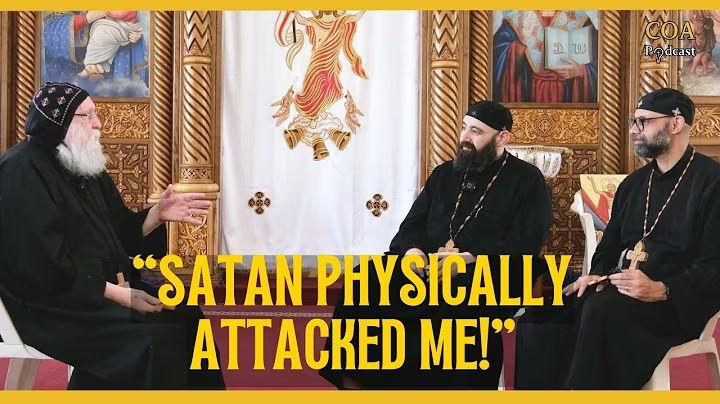
Astonishing answers to these questions can be found in the life story of Father Lazarus El Antony—an Orthodox hermit monk who has lived in the cave of St. Anthony the Great in Egypt for over 28 years. A former Australian university lecturer, convinced atheist, and Marxist, he experienced a supernatural encounter with the Mother of God in front of an icon after his mother’s painful death, which completely turned his life around.
In this article, we will delve into the deep practical experience of Father Lazarus regarding prayer, silence, spiritual warfare, and the power of icons to help you draw closer to God even in the midst of a hectic world.
1. What is Hesychasm and Prayer Without Words?
Many beginning Christians search for “how to learn to pray” or “what is the most powerful prayer”. They often start with long rules and a multitude of words.
Father Lazarus emphasizes that words are only the initial stage, similar to a baby learning to say “mama” or “dada” [00:18:14]. Psalms are excellent for structuring our thoughts, but for a deep union with God, the number of words must be reduced.
“Words are not really… going to get you very far… For serious spiritual prayer, we need to reduce the number of words. Bring it right down to something manageable so that you can allow your spiritual feelings to emerge.”
— Father Lazarus [00:18:22], [00:21:01]
This is the essence of Hesychasm (from the Greek hesychia—stillness, rest, quiet, solitude)—an ancient Orthodox ascetic practice of unceasing inner prayer that leads to the contemplation of the Divine Light.
2. The Jesus Prayer: A Practical Guide from a Hermit
If you are searching for “how to practice the Jesus prayer properly”, Father Lazarus’s experience serves as an ideal practical guide. Apostle Paul wrote: “I would rather pray five words with my understanding than hundreds of words without understanding.”
The Five Words of the Jesus Prayer (in Greek):
“Κύριε Ἰησοῦ Χριστέ, ἐλέησόν με” (Kirie Iisou Christe, eleison me) — “Lord Jesus Christ, have mercy on me” [00:19:06].
How to Pray the Jesus Prayer Using the Hermit’s Method:
- The Vocal Voice: For the first 20–30 minutes, the prayer is spoken aloud or in a whisper [00:20:09]. This helps focus a wandering mind.
- Transitioning into Whisper: Gradually, the voice calms down and transitions into a barely audible whisper [00:20:21].
- Inner (Noetic / Heart) Prayer: All external sounds stop completely. The prayer descends into the heart and repeats there silently for an hour or more [00:20:30]. The mind becomes vacant of worldly images but filled with the presence of God.
Father Lazarus highly recommends the book “The Way of a Pilgrim” as the best guide for anyone who wants to learn unceasing prayer on their own [00:20:36].
3. Loneliness vs. Solitude: What is the Difference?
One of the most common psychological and spiritual search queries is: “how to overcome loneliness” or “why do I feel lonely among people”. Father Lazarus provides a brilliant distinction between these two states:
- Loneliness: This is a state of deficit. You lack someone or something; you feel empty and unfulfilled, constantly seeking external distractions (TV, internet, shopping, social circles) to hide from yourself [00:38:50].
- Solitude (Communion with God): This is a state of absolute abundance and plenitude. You lack nothing because the space around you and your heart are completely filled with the presence of God [00:39:10].
“I have never been lonely since I became a monk… Solitude is a richness, a fullness, a complete state of being with God.”
— Father Lazarus [00:39:27], [00:41:04]
4. Spiritual Warfare in Silence: How to Discern God’s Voice and the Devil’s Snares?
When a person remains alone with themselves, fear often arises. People avoid silence because it brings out all the inner noise, fears, and suppressed sins [00:30:56].
Why Does Silence Attract the Devil?
Silence is the space where God speaks, but it is also the space where the enemy attempts to break in [00:31:02]. Father Lazarus quotes a famous metaphor:
“You allow the birds to fly over your head, but you don’t allow them to build a nest on your head” [00:31:34]. In the same way, we cannot completely avoid bad thoughts or temptations from crossing our minds, but we must not allow them to nest in our hearts.
The Secret to Defeating Temptation:
The devil has a massive inferiority complex—he craves your attention and recognition [00:33:34]. If we begin to argue with him or analyze his suggestions, we lose.
The secret is simple: ignore him. Turn away from the temptation completely and direct your gaze to Christ. Deprived of your attention, the devil loses all power [00:33:52].
How to Hear God?
God rarely speaks in loud words or direct “yes/no” answers [00:35:14]. Prayer is not a dialogue of rapid questions and answers. It is a state of readiness to listen. Father Lazarus suggests practicing the biblical prayer of young Samuel before sleep:
“Speak, Lord, for Your servant hears” [00:23:47]. Lie in stillness and just listen, allowing the Holy Spirit to touch your heart.
5. The Power of Icons: A Window to Heaven
Many people ask: “why do we need icons”, “can we pray without icons”, or “how do icons help in prayer”.
Quoting St. John of Damascus, the hermit explains that icons are windows to heaven [00:51:59]. We do not worship the wood or paint; we look through the icon to the prototype in heaven.
How to Find Your Icon:
- Find an icon whose image personally resonates with your heart (it could be an icon of Christ, the Virgin Mary, or your patron saint) [00:52:16].
- Keep a larger icon in your house and a smaller one in your pocket or wallet [00:52:33].
- In moments of stress, fear, or anxiety, simply take it out, look at the image, and sincerely say: “Lord, help me” [00:52:48]. This simple visual and tactile contact opens a real channel of communication with Heaven.
Father Lazarus’s favorite icon is the Sinai Christ Pantocrator [00:53:47]. One half of His face expresses mercy and love, while the other half shows the solemnity of the Judge. This reminds us that God desires to be a merciful Father to us, but we must also listen to His word.
Conclusion: How to Apply a Hermit’s Experience to Everyday Life?
You do not have to leave your job or family to go live in a cave for 28 years to experience God’s presence. The spiritual presence of Christ is available to everyone [00:51:31].
To find peace of mind amidst daily chaos, start small:
- Dedicate at least 30 minutes of silence a day (without your phone or social media) [00:23:16].
- Repeat the Jesus Prayer while walking, commuting, or doing household chores [00:21:09].
- Use an icon as a visual bridge to God whenever you feel overwhelmed by anxiety [00:52:40].
Remember the words of Father Lazarus: if you let go of trying to control everything on your own and trust the Creator, God will step in and sustain you in any storm of life.
Source of the interview: YouTube channel Coptic Orthodox Answers (video featuring Fr. Lazarus El Antony)