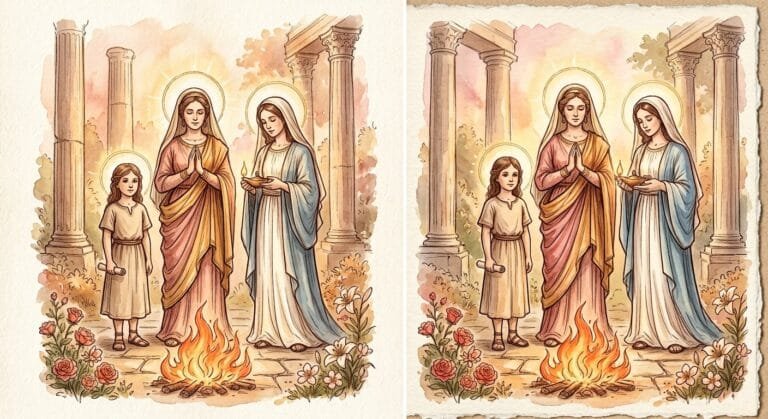
Every day millions of believers ask an important question: what holiday is today in the Church calendar, what are the folk signs and customs, what is strictly forbidden on this day, whose name day is celebrated, and how to call down God’s blessing on the family through a strong prayer. September 3 is a special day in the Orthodox calendar (new calendar / Revised Julian): the Church commemorates the martyrs Basilissa and Anthusa of Nicomedia and the virgin Domnina — three courageous women who did not renounce Christ in the time of the great persecutions. By the old calendar this day honored the Apostle Thaddaeus of the Seventy. In the Catholic Church September 3 is the feast of the great Saint Gregory the Great, Pope of Rome. This guide explores the lives of the Nicomedian martyrs, the folk traditions of the day, and offers the canonical prayers.
1. The Orthodox Feast — Martyrs Basilissa, Anthusa and the Virgin Domnina
Saint Martyr Basilissa of Nicomedia lived at the end of the 3rd century, during the fiercest persecutions of the emperors Diocletian and Maximian. Still very young — according to tradition, a girl of nine — she was seized for confessing Christ. They tried to break her with flattery, threatened her with torture, cast her into the fire — but, as the Church tradition recounts, the flame did not touch the child, and her tormentors marveled at her calm. This miracle converted many witnesses to Christ, among them Anthusa, the ruler’s wife, who openly confessed the faith and also received a martyr’s death. The little confessor died in peace without betraying Christ and became one of the most touching images of childlike faithfulness to God in the whole Church calendar.
Saint Martyr Anthusa was a former priestess who, seeing the steadfastness of the Christians, herself believed in Christ, received baptism and was tortured for it. Saint Virgin Domnina, according to tradition, was a pagan priestess at the imperial court in Nicomedia; hearing of the feats of the Christian martyrs, she believed, secretly received baptism and from then on devoted herself to works of mercy: she gathered the bodies of those martyred for the faith, buried them with honor and helped those who hid from the persecutions. When this became known, Domnina was seized, tortured and executed together with the other confessors. The Church honors the three women together: the young Basilissa, the converted Anthusa and the merciful Domnina — three different roads to Christ that met on one day of eternity.
2. The Catholic Feast — Saint Gregory the Great, Pope of Rome
In the Roman Catholic Church, September 3 honors Saint Gregory the Great (c. 540–604), Pope of Rome and Doctor of the Church, one of the four great Latin Fathers. Coming from a noble family, Gregory left worldly life, became a monk, and later Bishop of Rome in times of epidemics, wars and famine; he organized the church chant still called Gregorian, wrote numerous pastoral and theological works, and sent missionaries to the peoples of Europe. The Orthodox East honors the same saint under the name Gregory the Dialogist (commemorated in March), author of the famous “Dialogues” on the lives of the Italian fathers. Thus September 3 becomes a day uniting both branches of Christianity around one saint.
3. What Is Forbidden on September 3 — Folk Signs and Customs
In the folk calendar September 3 was considered a “women’s day” — in honor of the holy martyrs women prayed for the protection of home, family and children, asking wisdom in household matters and patience in trials. The main customs of the day: to pray for all the women of the family, especially for the youngest girls; to do a work of mercy after the example of Saint Domnina, who cared for the helpless; and not to listen to strangers’ advice in important matters, but to take counsel only with the closest people. Folk signs for September 3: clear and calm weather — a warm autumn; strong wind — a windy and rainy autumn; much fruit on the rowan trees — a rainy autumn and a harsh winter; cranes flying south — an early winter; thunder on this day — a warm autumn.
What is forbidden on September 3: by belief, one should not invite guests or visit strangers — the day is better spent among the closest people; one must not pick up other people’s things from the ground, especially at crossroads, so as not to bring another’s trouble into the home; one should not follow strangers’ advice in important questions; quarreling, swearing and offending women and children are forbidden; one must not refuse help to those who ask, for the saints of this day themselves were merciful to the persecuted. Instead, the day is best given to prayer for the family, works of mercy and quiet household affairs.
4. The Spiritual Laws of Life: the Law of Thanksgiving and the Commandment of Love
The prayer life of a Christian obeys unshakable spiritual laws. The first is the law of thanksgiving and spiritual abundance. The Apostle Paul teaches: “In everything give thanks, for this is the will of God in Christ Jesus for you” (1 Thess. 5:18). The lives of the Nicomedian martyrs show the deepest dimension of this law: Basilissa gave thanks to God even in the fire, and Domnina served those whom the world had rejected. When we sincerely thank God for the years lived, for our family and even for the trials that purified our faith, we release the power of His grace, which protects our families from dangers, illness and material want. The second is the fulfilment of the Commandments of Love for God and neighbour (Mt. 22:37-39): Domnina, risking her life, buried the martyrs’ bodies and helped the persecuted — and the Church sets her up as an example of how love of neighbour becomes a confession of faith. Let us care this day for those whom no one defends — and the holy martyrs will become our intercessors before God.
5. Hesychast Watchfulness (Nepsis) and Prayer on the Rope
In Orthodox hesychasm and the Athonite tradition, spiritual watchfulness (nepsis) is the foundation of the soul’s salvation. The feat of the martyrs is the highest form of watchfulness: amid threats and fire their minds remained with Christ and their hearts in peace, for he who keeps his mind in God fears no flame. When our mind is attacked by anxious thoughts about children, family and the future, the hesychasts advise immediately cutting them off with the short, rhythmic prayer on the rope (komboskini). A short prayer for the day:
Lord Jesus Christ, Son of God, by the prayers of Your holy martyrs Basilissa, Anthusa and Domnina, protect the women and children of my family, keep our home in peace, and have mercy on me, a sinner.
6. The Power of Communal Prayer
Communal prayer has the promise of extraordinary power from the Lord Himself: “For where two or three are gathered together in My name, there am I in the midst of them” (Mt. 18:20). Dear brothers and sisters! We invite you to join the prayer circle on Pray.ee. If you wish to pray for your children, mothers and grandmothers, if your loved ones are going through illness, hardship or danger, or if you yourself need intercession, write the names (for health and God’s protection) and your needs in the comments below. Our great Christian family will remember them daily in prayers before the Throne of God, asking the intercession of the holy Nicomedian martyrs, peace for the family and a good year.
7. A Living Testimony: Prayer for a Daughter
Parish chronicles and home testimonies preserve many stories of the martyrs’ intercession for women and children. Oksana from the Chernihiv region tells one of them. Her ten-year-old daughter Solomiia fell suddenly ill: a high fever lasted for days, the doctors could not make a diagnosis, and her mother hardly slept. In church Oksana heard that on September 3 the young martyr Basilissa is commemorated — and she began to read the troparion to the martyrs and the prayer for her daughter every day, adding a work within her power: she brought clothes for the children’s ward of the hospital, because, as she says, “Domnina taught that faith without works is dead.” On the fourth day the fever fell, and a week later the doctors said the child was healthy and could return to school. “I do not know whether it was a miracle in the medical sense,” says Oksana. “But I know that in those days I learned to pray truly: not to demand, but to trust. Now every year on September 3 Solomiia and I light a candle for the three martyrs and for all the children who are ill in our hospital.”
8. The Strongest Canonical Prayers of the Day
Troparion of the Martyrs, Tone 4:
Your ewe-lambs, O Jesus — Basilissa, Anthusa and Domnina — call to You with a great voice: You, my Bridegroom, I love, and seeking You I suffer; I am crucified and buried with You in Your baptism, and I suffer for You that I may reign with You; I die for You that I may live with You. But accept them as a sacrifice without blemish, who in love have offered themselves to You. By their prayers, O Merciful One, save our souls.
Prayer to the Holy Martyrs for Women, Children and Home (home prayer of the day)
Saint martyrs Basilissa, Anthusa and virgin Domnina! In youth and maturity you did not renounce Christ, neither before flattery nor before fire, and became intercessors for all who call upon you. Hear our prayer: protect the women of my family from every evil, keep our children in health and purity, grant wisdom and patience to mothers, and peace and abundance to our home. Teach us, like Domnina, not to fear doing good even when it is hard, and, like Basilissa, to keep our hearts with God in every fire of trials, so that by your prayers we too may glorify the Father, and the Son, and the Holy Spirit, now and ever and unto ages of ages. Amen.
9. Frequently Asked Questions (FAQ)
Who were Basilissa, Anthusa and Domnina of Nicomedia?
They were holy martyrs of the late 3rd century who suffered in Nicomedia during the persecutions of Diocletian: the young girl Basilissa who endured torture and fire without renouncing Christ, Anthusa converted by her feat, and the virgin Domnina who secretly received baptism, buried the martyrs’ bodies and helped the persecuted, for which she too died. The Church commemorates them on September 3 by the new calendar.
Whose name day is September 3?
Anthusa, Basilissa and Domnina celebrate their name days; by the old calendar this day also honored the Apostle Thaddaeus of the Seventy, so Thaddaeus celebrate as well. The holy martyrs are asked to intercede for women, children and the family.
Why do Catholics honor Gregory the Great on September 3?
Saint Gregory the Great (c. 540–604), Pope of Rome and Doctor of the Church, died on March 12, but in the West his memory is kept on September 3 — the day of his episcopal consecration. The Orthodox East honors the same saint as Gregory the Dialogist (in March); he was the author of the “Dialogues”, the organizer of church chant, and one of the four great Latin Fathers of the Church.
10. Sources
1. Pope Gregory I: life and legacy — Wikipedia article: en.wikipedia.org (Pope Gregory I).
2. Domnina of Nicomedia and the Nicomedian martyrs — Wikipedia article: en.wikipedia.org (Domnina of Nicomedia).
3. Gregorian chant: history and tradition — Wikipedia article: en.wikipedia.org (Gregorian chant).
4. 3 вересня: мучениці Василина, Анфіса та Домна Нікомідійські — Ukrainian-language version of this article: pray.ee (3 вересня).